68B Orthopedic Specialist
Bone breaks happen in combat. Joints give out on long rucks. Orthopedic injuries are the single most common reason soldiers end up in a clinic, and the 68B Orthopedic Specialist is the person who handles them. You apply casts, assist in orthopedic procedures, and get patients moving again so the Army can keep its soldiers operational.
Qualifying requires specific ASVAB line scores — our ASVAB study guide covers what to target and how to prepare.
Job Role and Responsibilities
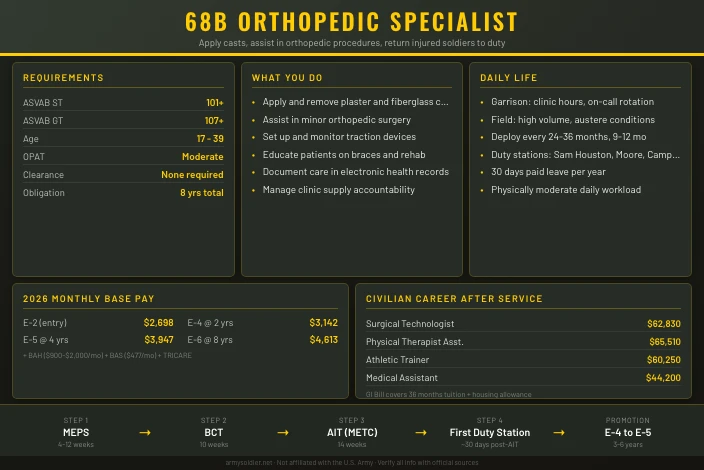
The 68B Orthopedic Specialist assists with the management and operations of orthopedic clinics under the supervision of an orthopedic physician, orthopedic physician assistant, or podiatrist. You apply and remove plaster and fiberglass casts and splints, perform traction procedures, assist in minor surgery, and educate patients on orthopedic appliances and proper rehabilitation. This MOS directly supports the Army’s readiness by getting injured soldiers back to duty.
A typical garrison day starts with clinic preparation: checking supply levels, verifying cast room readiness, and reviewing the patient schedule. You see walk-in appointments alongside scheduled surgical cases. Between patients, you clean equipment, restock materials, and document care.
When a patient comes in with a fracture, you take X-rays, prep the patient, and apply the appropriate immobilization device under a provider’s direction. You remove stitches and staples, change wound dressings, teach patients how to use crutches or braces, and document every encounter in the electronic health record.
Specific Roles
The 68B is the primary enlisted identifier for orthopedic care. Within the CMF 68 medical career field, additional qualifiers can expand your scope:
| Qualification Type | Identifier | Focus |
|---|---|---|
| MOS | 68B | Orthopedic Specialist (primary) |
| Additional Skill Identifier (ASI) | Various | Surgical assist, sports medicine, or clinical specialty support |
| Special Qualification Identifier (SQI) | Per Army policy | Recognized clinical certifications or specialty credentials |
Mission Contribution
Orthopedic injuries account for a significant share of medical evacuations from combat theaters. When soldiers can’t move, units lose capability. The 68B’s role is directly connected to the Army’s ability to keep personnel in the fight. Your work at a combat support hospital or forward operating base reduces the time between injury and return to duty.
Technology and Equipment
Your work involves casting materials (fiberglass and plaster), traction devices, splinting systems, orthopedic surgical instruments, and digital X-ray equipment. You’ll also use electronic health record systems to document patient care. In deployed environments, you adapt to field-expedient orthopedic setups with less equipment and more problem-solving.
Salary and Benefits
Financial Benefits
Pay is based on grade and years of service. New enlistees enter as E-1 and typically reach E-2 by the end of Basic Combat Training.
| Rank | Grade | Monthly Base Pay (2026) |
|---|---|---|
| Private (PV2) | E-2 | $2,698 |
| Specialist (SPC) | E-4, <2 yrs | $3,142 |
| Specialist (SPC) | E-4, 4 yrs | $3,659 |
| Sergeant (SGT) | E-5, 4 yrs | $3,947 |
| Staff Sergeant (SSG) | E-6, 8 yrs | $4,613 |
Base pay is only part of your compensation. BAH (Basic Allowance for Housing) adds $900 to $2,000+ per month depending on your duty station and dependency status. A single E-4 at Fort Sam Houston gets roughly $1,359 per month. BAS (Basic Allowance for Subsistence) adds $476.95 per month for food. Neither is taxed.
Additional Benefits
You get TRICARE Prime health coverage with zero enrollment fees, no deductibles, and no copays for active-duty soldiers. Families are covered under the same plan with a $1,000 annual catastrophic cap for out-of-network care.
Education benefits stack well:
- Tuition Assistance (TA): Up to $4,500 per year for college courses while on active duty
- Post-9/11 GI Bill: Up to 36 months of full in-state tuition plus a housing allowance and $1,000 annual book stipend
- Yellow Ribbon Program: Can cover tuition at private schools beyond the GI Bill cap
Retirement under the Blended Retirement System (BRS) gives you a pension at 20 years worth 40% of your high-36 average base pay. The government also matches up to 5% of your Thrift Savings Plan contributions starting in your third year.
Work-Life Balance
You earn 30 days of paid leave per year. In garrison, orthopedic clinic hours follow standard duty hours with on-call rotation for urgent cases. Unlike combat arms, most 68B assignments don’t involve continuous overnight schedules. That said, field exercises and deployments extend hours significantly and disrupt any routine.
Qualifications and Eligibility
Basic Qualifications
You must be a U.S. citizen between 17 and 39 years old. High school diploma holders need an AFQT score of at least 31. GED holders need a 50. The 68B requires both a Skilled Technical and a General Technical score:
| Requirement | Minimum |
|---|---|
| Age | 17-39 (up to 42 with waiver) |
| Citizenship | U.S. citizen or permanent resident |
| Education | High school diploma or GED |
| AFQT | 31 (HS diploma) / 50 (GED) |
| Skilled Technical (ST) | 101 |
| General Technical (GT) | 107 |
| Vision | Correctable to 20/20 |
| OPAT Category | Moderate |
| Security Clearance | None required |
The ST score combines General Science (GS), Verbal Expression (VE), Mechanical Comprehension (MC), and Math Knowledge (MK). The GT score combines Verbal Expression (VE) and Arithmetic Reasoning (AR). Both need to hit or exceed the minimums listed above. These are the same thresholds as the 68W Combat Medic, making 68B one of the more academically demanding medical enlisted roles.
The OPAT Moderate category requires you to pass a baseline physical movement test at MEPS. Moderate means you can handle routine patient lifting and equipment movement, but this is not a combat arms physical standard.
Application Process
Selection Criteria and Competitiveness
The 68B is moderately competitive. The Army consistently needs orthopedic clinic personnel because musculoskeletal injuries are the leading cause of medical non-availability. A prior background in sports medicine, athletic training, or clinical work makes your application stronger, though none of that is required. The real filter is the ASVAB: you need both a 101 ST and a 107 GT, so candidates who score well on reading, math, and science have the clearest path in.
Upon Accession into Service
You enter service as an E-1 (Private) and are typically promoted to E-2 after BCT. Most soldiers finish AIT as E-2 or E-3 depending on time in service. The standard service obligation is 8 years total, typically structured as active duty plus time in the Individual Ready Reserve.
See our ASVAB study guide for strategies to hit these line scores, or take the PiCAT from home if you are a first-time tester.
Work Environment
Setting and Schedule
Most 68B assignments are in orthopedic clinics at Army medical facilities. In garrison, that means you’re in a clinical environment with standard duty hours, plus on-call rotation. You work indoors, close to providers and patients, with a consistent patient schedule.
The field is a different story. On deployment or during major exercises, orthopedic specialists set up in combat support hospitals or aid stations. The patient volume spikes, the resources shrink, and you adapt. You might be applying casts in a building that was a school two months ago.
Leadership and Communication
You report to a medical officer or physician assistant who runs the orthopedic clinic, with day-to-day supervision from your senior medical NCO. At the E-5 level and above, you start supervising junior specialists and training new arrivals.
Performance feedback runs on the NCOER (NCO Evaluation Report) cycle for E-5 and above. Below E-5, counseling sessions from your NCO provide feedback on technical performance, fitness, and military duties. Direct, specific feedback is the norm in clinical settings because patient care outcomes depend on it.
Team Dynamics and Autonomy
You work in a small clinic team: a physician or PA, possibly a nurse or another medic, and you. The provider makes clinical decisions. You execute the technical procedures. With experience, you handle more of the routine patient encounters independently and train the newer specialists.
As a junior 68B, expect structured supervision. As a senior specialist, you’ll manage clinic flow, troubleshoot supply issues, and be the one training others. That shift from technician to team lead is part of how career progression works in this MOS.
Job Satisfaction and Retention
Soldiers in busy orthopedic clinics with high surgical case volume and diverse patient populations tend to stay longer and report more satisfaction. The technical depth of the work, direct patient impact, and direct preparation for civilian careers are common reasons 68Bs cite for re-enlisting.
The challenges are real: routine clinic work can be repetitive, deployments increase caseload dramatically, and the pace varies wildly between garrison assignments and deployed environments. Specialists who get exposure to both surgical assisting and outpatient clinic work tend to build the most portable skills.
Training and Skill Development
Initial Training
Training is split into two phases. BCT comes first, then AIT at Fort Sam Houston.
| Training Phase | Location | Duration | Focus |
|---|---|---|---|
| BCT | Fort Jackson, SC; Fort Moore, GA; Fort Leonard Wood, MO | 10 weeks | Marksmanship, tactics, fitness, military discipline |
| AIT (68B) | METC, Fort Sam Houston, TX | 14 weeks | Orthopedic procedures, casting, traction, patient education, surgical assist |
BCT is the same for every enlisted soldier regardless of MOS. Physical conditioning, weapons qualification, land navigation, and military customs are covered.
AIT for 68B runs 14 weeks at the Medical Education and Training Campus (METC) at Joint Base San Antonio – Fort Sam Houston. You’ll study:
- Anatomy and physiology focused on the musculoskeletal system
- Cast and splint application (plaster and fiberglass)
- Traction device setup and patient monitoring
- Surgical sterile technique and minor procedure assistance
- Orthopedic appliance fitting and patient education
- Electronic health records documentation
- Clinic management and supply accountability
The last weeks of AIT shift to clinical practicums where you practice on simulated and, in some cases, real patient scenarios under supervision.
Advanced Training
After AIT, the Army supports additional clinical and professional development. Certified Orthopedic Technologist (OTC) certification through the National Board for Certification of Orthopaedic Technologists is a recognized pathway that aligns directly with your AIT training.
Strong performers can apply for assignment to specialty surgical units, trauma centers at large Army medical centers like Brooke Army Medical Center (BAMC), or sports medicine clinics at installation fitness facilities. Some 68Bs pursue Emergency Medical Technician (EMT) certification through Army-sponsored programs to broaden their scope. Officers and warrant officer programs are not a standard pathway from 68B, but reclassification to 68W or 68C is possible with the right scores and a waiver.
Everything starts with qualifying ASVAB scores — our study guide covers what to study first.
Career Progression and Advancement
Career Path
Promotion to E-4 (Specialist) is largely automatic within 2 to 3 years. E-5 (Sergeant) requires a promotion board, hitting physical fitness standards, and completing military education requirements. That’s when the job transitions from individual performer to small team leader.
| Rank | Grade | Typical Years | Typical Role |
|---|---|---|---|
| Private (PV2) | E-2 | 0-1 | AIT graduate, entry-level clinic support |
| Specialist (SPC) | E-4 | 2-3 | Independent patient procedures, cast room lead |
| Sergeant (SGT) | E-5 | 4-6 | Clinic section lead, trains junior specialists |
| Staff Sergeant (SSG) | E-6 | 6-9 | Senior clinic NCO, quality oversight |
| Sergeant First Class (SFC) | E-7 | 9-14 | Orthopedic services supervisor, facility leadership |
| Master Sergeant (MSG) | E-8 | 14-20 | Senior enlisted advisor for medical facility operations |
E-6 and above are competitive. Strong NCOERs, military schooling (Basic Leader Course, Advanced Leader Course, Senior Leader Course), and a record of leading junior personnel drive selection.
Role Flexibility and Transfers
Lateral transfers within the CMF 68 field are possible, typically to 68D (Operating Room Specialist) or 68W (Combat Medic). These require open slots, leadership approval, and an additional service obligation. Transferring to a completely different career field is harder and typically requires a full retraining course.
Soldiers interested in officer or warrant officer paths can apply separately. Medical warrant officer programs (65D Physician Assistant) exist for enlisted soldiers with strong academic records and experience, though 68B is not a direct feeder.
Performance Evaluation
NCOs are rated annually on the NCOER. Your rater assesses technical competence, leadership, military education, and physical fitness. Senior raters provide relative ranking among peers. One outstanding NCOER will not get you promoted. A pattern of strong reports, completed military schooling, and recognized contributions will.
What actually moves 68B careers: mastery of orthopedic techniques (especially casting and surgical assist), patient and provider feedback, training effectiveness with junior soldiers, and consistent fitness results.
Physical Demands and Medical Evaluations
Physical Requirements
Orthopedic work is physically moderate compared to combat arms. You’ll lift patients and move equipment regularly, stand for extended clinic hours, and handle awkward loads when applying or removing casts. Fine motor control matters when setting fractures or adjusting traction.
The Army Fitness Test (AFT) applies to all 68B soldiers. Five events are scored 0 to 100 each, with a 300-point minimum (60 per event) to pass. Standards are age- and sex-normed. The 68B does not carry the combat specialty standard of 350.
| AFT Event | Description | Min Score (All Soldiers) |
|---|---|---|
| MDL | 3-Rep Max Deadlift | 60 pts |
| HRP | Hand-Release Push-Up | 60 pts |
| SDC | Sprint-Drag-Carry | 60 pts |
| PLK | Plank | 60 pts |
| 2MR | Two-Mile Run | 60 pts |
Total maximum is 500 points. The AFT replaced the ACFT on June 1, 2025 per Army Directive 2025-06. Anyone referencing the APFT or ACFT is citing an outdated standard.
Medical Evaluations
After enlistment, you get annual Periodic Health Assessments covering weight, blood pressure, vision, hearing, and dental. Occupational health requirements include bloodborne pathogen training and infection control certification, which are mandatory for anyone working in a clinical setting.
Pre-deployment health assessments are required before any overseas movement. Any condition that prevents safe deployment gets resolved or results in a medical hold determination before you ship.
Deployment and Duty Stations
Deployment Details
Active-duty 68Bs deploy as part of medical companies, combat support hospitals (CSHs), and brigade support medical companies (BSMCs). Typical rotation is one deployment per 24 to 36 months, lasting 9 to 12 months. Units supporting high-intensity conflict zones may deploy more frequently.
Orthopedic injuries spike in combat environments, so 68Bs in deployed settings often carry heavier patient loads than their garrison caseload suggests. Blast injuries, vehicle accidents, and overuse injuries from sustained operations all generate orthopedic patients.
Common deployment regions:
- Middle East (Iraq, Kuwait, Syria support operations)
- Europe (Germany, Poland)
- Pacific (South Korea, Japan)
- Rotational assignments and humanitarian operations
Location Flexibility
The Army assigns duty stations based on operational needs. You can submit a preference list, but assignments are ultimately mission-driven. Expect to move every 2 to 4 years.
Common duty stations for 68B:
- Brooke Army Medical Center, Fort Sam Houston, TX
- Fort Moore, GA
- Fort Campbell, KY
- Fort Liberty, NC
- Landstuhl Regional Medical Center, Germany
- Brian Allgood Army Community Hospital, South Korea
Larger medical centers like BAMC and Landstuhl tend to offer higher case volume and more surgical exposure.
Risk, Safety, and Legal Considerations
Job Hazards
Orthopedic clinic work in any setting carries occupational risk.
Clinical and garrison hazards:
- Needlestick injuries and bloodborne pathogen exposure during procedures
- Casting dust from plaster and fiberglass (respiratory protection required)
- Chemical exposure from cast materials and disinfectants
- Musculoskeletal strain from repetitive patient positioning
Deployed and field hazards:
- High casualty volume with limited personnel
- Austere environments with restricted supplies
- Physical danger in forward-positioned medical facilities
Safety Protocols
Standard infection control protocols apply everywhere: gloves, eye protection, proper sharps disposal, and documented bloodborne pathogen training. Casting materials require respiratory protection when mixing plaster. Field medical facilities follow theater-level infection control standards adapted for available resources.
Medical evacuation procedures protect personnel when situations exceed unit capability. Soldiers in deployed settings receive rules of engagement and force protection briefings before leaving the wire.
Security and Legal Requirements
The 68B does not require a security clearance for standard assignments. Soldiers assigned to specialized units or intelligence-adjacent medical support roles may require a Secret clearance, which takes 2 to 6 months to process.
All soldiers are subject to the Uniform Code of Military Justice (UCMJ). Medical personnel carry additional legal obligations: accurate documentation, proper patient consent, mandatory reporting of suspected abuse, and strict adherence to clinical standards of care.
Impact on Family and Personal Life
Family Considerations
Deployments of 9 to 12 months at a stretch and regular PCS moves create real disruption for families. Each duty station move means new schools for kids, potential employment gaps for spouses, and rebuilding a social network from scratch.
Support systems at most installations:
- Family Readiness Groups (FRGs) – unit-level peer support
- Army Community Service (ACS) – financial counseling, employment assistance, family programs
- Military OneSource – free counseling and life coaching services
- Exceptional Family Member Program (EFMP) – specialized support for families with medical or educational needs
- Child Development Centers (CDCs) – subsidized childcare on post
The Army’s family support infrastructure is real, but it varies by installation size. Larger posts like Fort Sam Houston and Fort Campbell have more programs and more staff than smaller garrisons.
Relocation and Flexibility
You will move. Most 68B soldiers receive a new duty station every 2 to 4 years. The Army covers your moving costs through the Permanent Change of Station (PCS) allowance, but relocation still costs time, energy, and family stability.
Medical facilities at large installations generally offer longer tours (3 to 4 years), which provide more stability for families with school-age children. If family stability is a priority, express that clearly during the assignment preference process.
Reserve and National Guard
The Army Reserve actively maintains 68B positions, and slots are available at medical companies and combat support hospitals across the country. The National Guard carries fewer orthopedic positions – Guard medical units don’t always have the surgical capability or clinic volume to justify a full-time 68B billet – but positions exist where medical detachments support surgical teams. If Guard service is your interest, check vacancy lists carefully before signing a contract.
Reserve 68Bs work in the same clinical roles as their active-duty counterparts, just on a different schedule. Drill weekends keep your casting and splinting skills current, and Annual Training often includes clinical rotations that replicate garrison orthopedic clinic work. The part-time structure works well for soldiers who already work in healthcare and want military service alongside a civilian career.
Drill schedule and CEU requirements
The standard schedule – one weekend per month, two weeks per year for Annual Training – applies to 68Bs in both components. Orthopedic specialists carry continuing education requirements that don’t pause between drills. Casting and splinting technique updates, new immobilization protocols, and documentation requirements from professional organizations mean you’ll spend time outside drill weekends staying current. This is the same reality civilian orthopedic technologists face, so it shouldn’t be a surprise.
Pay comparison
An E-4 at four years of service earns $3,659 per month on active duty. The Reserve or Guard equivalent is approximately $488 per drill weekend at the same rank and time in service. Annual drill pay including the two-week Annual Training runs roughly $5,000 to $7,000 per year for most soldiers – a meaningful supplement to civilian income, not a replacement for it.
Benefits differences
Healthcare is the most tangible difference. Active-duty soldiers pay nothing out of pocket for TRICARE coverage. Reserve and Guard soldiers who want year-round coverage use Tricare Reserve Select, which costs $57.88 per month for the member only, or $286.66 per month for the full family. That’s worth evaluating against your employer’s health plan options.
Education benefits shift too. The MGIB-SR (Chapter 1606) pays $493 per month while you’re enrolled full-time, available to any drilling Guard or Reserve soldier who contributes to the program. National Guard members benefit from state tuition waivers that many states offer – check your specific state, because coverage varies widely and some states cover full tuition at in-state public schools.
Active-duty retirement requires 20 years of continuous service with an immediate pension. Reserve and Guard retirement is points-based, accumulates over your career, and pays out starting at age 60. Mobilizations after January 28, 2008 can reduce that age by three months for every 90 days of active service – minimum age 50.
Mobilization frequency
Orthopedic specialists in Reserve and Guard units deploy at moderate rates. Combat support hospitals and surgical teams activate for overseas missions, large-scale exercises, and domestic emergencies. You should plan for at least one mobilization per enlistment contract. The timeline and duration vary by unit and mission type, but it’s realistic to expect 6 to 12 months of activation at some point during a Reserve or Guard career.
Civilian career integration and USERRA
The 68B civilian career path runs through orthopedic technician, cast technician, and surgical first assistant roles – jobs that exist in every orthopedic practice, surgery center, and hospital in the country. Reserve and Guard service complements that path directly. The skills transfer, the credentials overlap, and civilian orthopedic employers generally view military medical experience as a positive.
USERRA protects your civilian job during any military activation. You can’t be fired or demoted because of your service, and you return to your position with accumulated seniority. If your civilian employer questions a mobilization notice, USERRA is federal law with real enforcement mechanisms.
| Feature | Active Duty | Army Reserve | Army National Guard |
|---|---|---|---|
| Duty Status | Full-time | Part-time (1 wknd/mo + 2 wks/yr) | Part-time (1 wknd/mo + 2 wks/yr) |
| Monthly Pay (E-4, 4 yrs) | $3,659/mo | ~$488/drill weekend | ~$488/drill weekend |
| Healthcare | TRICARE (no premium) | Tricare Reserve Select ($57.88/mo) | Tricare Reserve Select ($57.88/mo) |
| Education | Post-9/11 GI Bill, TA | MGIB-SR ($493/mo), TA | MGIB-SR ($493/mo), TA, state tuition waivers |
| Deployment | Per unit rotation | When mobilized | When mobilized |
| Retirement | 20-year pension | Points-based, age 60 | Points-based, age 60 |
Post-Service Opportunities
Transition to Civilian Life
Your 14 weeks of AIT plus your service time give you hands-on clinical experience that civilian orthopedic tech programs take 1 to 2 years to replicate. When you leave the Army, you can move directly into casting technician roles, sports medicine support positions, or orthopedic surgery assistant roles at civilian hospitals and clinics.
The Transition Assistance Program (TAP) provides resume writing, interview prep, benefit counseling, and employer connection services during your last 12 months of active duty. Use it. The VA also offers vocational rehabilitation if a service-connected condition affects your civilian career options.
The Post-9/11 GI Bill pays full in-state tuition at public universities (or up to $29,920.95 annually at private schools for the 2025-2026 academic year), plus a monthly housing allowance and $1,000 book stipend. Many 68Bs use that to bridge into physical therapy assistant, nursing, or physician assistant programs.
Civilian Career Prospects
| Civilian Occupation | Median Annual Salary (2024) | 10-Year Job Outlook |
|---|---|---|
| Orthopedic/Cast Technician | ~$44,000-$55,000 | Growing demand |
| Surgical Technologist | $62,830 | +5% |
| Medical Assistant | $44,200 | +12% |
| Physical Therapist Assistant | $65,510 | +16% |
| Athletic Trainer | $60,250 | +11% |
Your Army experience also opens non-clinical doors. Medical supply chain, healthcare administration, and veteran hiring programs at the Department of Veterans Affairs actively recruit soldiers with clinical backgrounds.
Post-Service Policies
An honorable discharge gives you lifetime access to VA healthcare, disability compensation if applicable, and education benefits. Veterans with service-connected orthopedic conditions qualify for VA medical care and may receive disability ratings from the VA.
You can separate at the end of your initial enlistment. Talk to your career counselor at least 12 months before your end of service date. If you have a specific civilian school or program in mind, confirm GI Bill eligibility and timeline before you out-process.
Is This a Good Job for You?
Ideal Candidate Profile
The 68B suits someone who likes clinical work but doesn’t want to be the one making treatment decisions. You’re in the room, handling the procedures, and you see direct results. If hands-on technical work in a medical setting sounds more appealing than administrative or logistics roles, this MOS fits.
Traits that point to a good fit:
- Comfortable around injury, blood, and post-surgical wounds
- Detail-oriented and disciplined enough to follow clinical protocols consistently
- Physically active and able to sustain a moderate physical workload
- Interested in orthopedics, sports medicine, or surgical assisting as a long-term direction
- Patient-facing communication skills (you’ll explain procedures and rehab instructions regularly)
Prior experience in EMT, athletic training, physical therapy aide roles, or even sports team management gives you a head start in AIT.
Potential Challenges
This job has real downsides worth knowing before you sign.
- Clinic work can become repetitive in garrison, especially at smaller facilities with low patient volume
- Deployments mean sudden spikes in caseload under austere conditions, which is stressful even for experienced specialists
- You need both a high ST and GT score, which screens out a larger portion of candidates than single-score MOSs
- The physical demands are moderate but daily, so chronic joint or back problems are a real barrier
- Advancing past E-5 requires becoming a good leader, not just a good technician, and that transition isn’t easy for everyone
Who This Job Fits
If you want a medical career but don’t have the academic record or finances to start a nursing or PA program right away, 68B gets you paid clinical experience and education funding simultaneously. The GI Bill plus OTC certification plus Army orthopedic experience is a competitive package for civilian hiring in physical therapy, surgical technology, or sports medicine.
If you want predictable hours, a single location for years at a time, or to avoid physical patient care, this isn’t the right fit. The same goes for anyone uncomfortable with the reality of deployment medicine: higher case volume, more severe injuries, and significantly fewer resources than a civilian hospital.
More Information
Talk to an Army recruiter about the 68B. Ask specifically about current training slot availability, bonus programs, and duty station options. If possible, request a ride-along or job shadow at an Army orthopedic clinic before you commit.
Take the ASVAB practice test at goarmy.com to see where your ST and GT scores stand
Check Army COOL at cool.osd.mil for credential funding opportunities
Review your GI Bill options at va.gov before your enlistment conversation
Prepare for the ASVAB with our study guide to make sure your line scores qualify
This site is not affiliated with the U.S. Army or any government agency. Verify all information with official Army sources before making enlistment or career decisions.
Explore more Army medical careers such as the 68D Operating Room Specialist and 68W Combat Medic Specialist.