68C Practical Nursing Specialist
As a 68C, you’re the Army’s practical nurse. You take vitals, manage medications, dress wounds, and monitor patients in Army hospitals and clinics. It’s one of the few enlisted medical jobs where you work directly with patients every single day.
Qualifying requires specific ASVAB line scores — our ASVAB study guide covers what to target and how to prepare.
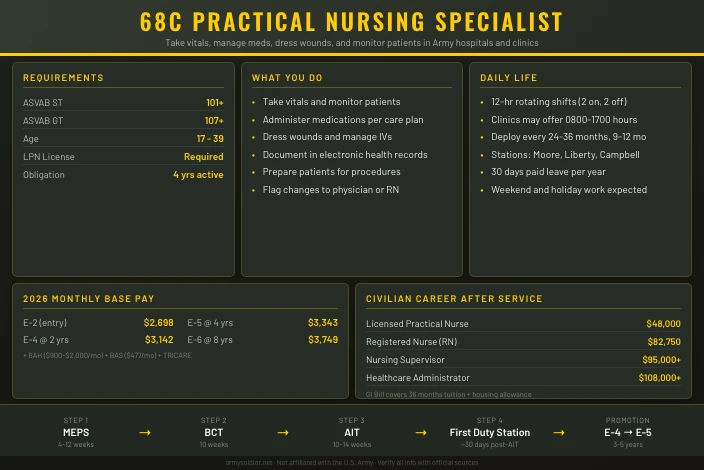
Job Role and Responsibilities
You provide direct patient care under the supervision of physicians and registered nurses. That means preparing patients for procedures, checking on them through a shift, documenting everything in electronic health records, and flagging anything that looks wrong to the provider above you.
In garrison, your day looks a lot like a civilian nursing job. You work in a hospital ward or clinic, staff rotations, and handle a steady stream of patients. In the field or on deployment, the pace picks up fast. Resources are limited, casualty volumes spike, and you need to keep delivering quality care.
Your scope covers wound care, vital sign monitoring, medication administration, patient education, and medical supply management. The 68C sits between patients and physicians, turning clinical observations into clear information and carrying out treatment plans.
Army Enlisted Medical Specialization System
| Qualification Level | Identifier | Purpose |
|---|---|---|
| Additional Skill Identifier (ASI) | Various codes available | Specialization in combat casualty care, surgical nursing, or healthcare management |
| Special Qualification Identifier (SQI) | Various codes available | Certifications like EMT-Basic, phlebotomy, or surgical technician |
| Professional Development Skill Identifier (PDSI) | Various codes available | Advanced clinical training in specialized nursing areas |
Additional qualifications build your expertise and improve your chances of promotion. Many 68Cs pursue ASI or SQI certifications in IV therapy, combat casualty care, or surgical nursing within their first few years.
You’ll work with electronic medical records systems like AESIP, medical monitors, infusion pumps, point-of-care testing devices, and standard hospital diagnostic equipment. Field assignments add portable oxygen systems, field litters, and field treatment protocols to the mix. Training for new equipment comes as it’s deployed.
Salary and Benefits
Financial Benefits
Military pay is based on rank and time in service. Most 68Cs start as E-2 after initial training.
| Rank | Pay Grade | Monthly Base Pay | Annual Base Pay |
|---|---|---|---|
| Private (PV2) | E-2 | $2,698 | $32,376 |
| Private First Class (PFC) | E-3 | $2,837 | $34,044 |
| Specialist (SPC) | E-4 | $3,142 | $37,704 |
| Sergeant (SGT) | E-5 | $3,343 | $40,116 |
| Staff Sergeant (SSG) | E-6 | $3,401 | $40,812 |
Source: DFAS 2026 pay tables. Figures reflect the 2026 pay raise.
Housing allowance (BAH) depends on your duty station and whether you have dependents, ranging from roughly $500 to $2,500 monthly. Basic Allowance for Subsistence (BAS) adds about $477 per month for food. Enlistment bonuses for the 68C range from $4,000 to $15,000 depending on Army recruiting demand. Medical personnel may also qualify for Special Duty Pay based on assignment.
Additional Benefits
You and your family get TRICARE health coverage at little or no cost, including doctor visits, hospital stays, prescriptions, dental, vision, and mental health. Tuition Assistance lets you take college courses while on active duty. After you leave, the Post-9/11 GI Bill covers up to 36 months of tuition at a public university (full in-state rate) plus a monthly housing allowance.
Retirement follows the Blended Retirement System (BRS):
- Serve 20 years and get a pension worth 40% of your base pay
- The government matches up to 5% of your Thrift Savings Plan (TSP) contributions
- The Survivor Benefit Plan (SBP) protects your family if something happens to you
Work-Life Balance
You earn 30 days of paid leave per year. Hospital 68Cs typically work 12-hour rotating shifts, two days on, two nights on, four off. Clinic assignments can offer more standard 0800-1700 schedules. Weekend and holiday work is expected. Deployments shift everything: 9 to 12 months of longer hours and less predictability.
Qualifications and Eligibility
Basic Qualifications
You need to be a U.S. citizen or permanent resident between 17 and 39. You must hold a valid state LPN license before entry, or be on track to obtain one through the Army. The 68C also requires a Top Secret security clearance.
Basic eligibility:
- Age 17-39 (parental consent required at 17)
- U.S. citizenship or permanent residency
- High school diploma, GED, or equivalent
- Valid LPN license (or path to obtain one)
- Pass MEPS medical exam and drug screening
- No disqualifying felony convictions
The LPN license requirement sets the 68C apart from most Army medical MOSs. You can get licensed before you enlist through a community college or vocational program, or the Army can put you in an LPN training program during your enlistment. Some soldiers complete the prerequisites and licensing at Army-sponsored facilities.
ASVAB Line Score Requirements
| Component | Minimum Score |
|---|---|
| Skilled Technical (ST) | 101 |
| General Technical (GT) | 107 |
The ST composite combines General Science, Verbal Expression, Mechanical Comprehension, and Math Knowledge. GT combines Verbal Expression and Arithmetic Reasoning. You need both minimums to qualify.
Application Process
Start at your local Army recruiting station. You’ll take the ASVAB at MEPS and, if your scores qualify, complete a full medical exam including vision, hearing, and drug screening. After meeting all qualifications, you sign a contract specifying the 68C MOS, training location, and service commitment (typically 4 years active duty).
The Army prioritizes candidates with existing LPN credentials and higher ASVAB scores. A clean background matters too. The whole process from ASVAB to contract signature typically takes 2 to 4 months, depending on medical clearance timelines.
Selection Criteria and Competitiveness
The 68C is moderately competitive. Already having an LPN license makes you a priority candidate. Prior medical experience (CNA, EMT-Basic) and a clean record strengthen your application. Candidates without a pre-existing LPN license may enter the 68C track with a conditional commitment to obtain licensure during initial training.
Upon Accession into Service
You enter as E-2 and commit to a 4-year active duty minimum, with options to extend in 2-year increments. Some soldiers with existing LPN licenses enter as E-3 or higher depending on credentials. If you already hold an LPN license, you may bypass full BCT and attend a shorter 2 to 4 week medical orientation course instead.
See our ASVAB study guide for strategies to hit these line scores, or take the PiCAT from home if you are a first-time tester.
Work Environment
Setting and Schedule
You work in three main settings:
- Garrison hospitals and clinics – climate-controlled, standard or rotating shifts, 24-hour operations requiring evening, night, and weekend coverage
- Field training – aid stations and forward medical setups, higher tempo, longer hours
- Deployment – field hospitals and coalition medical facilities, intense casualty volumes and limited resources
A typical garrison shift starts with reviewing patient status from the previous team, performing vital signs and basic assessments, assisting with procedures, documenting in medical records, and coordinating discharges. In a deployed setting, the same tasks happen faster, with more patients and fewer hands.
Leadership and Communication
Your chain of command flows through the unit’s medical officer (physician or PA), nurse supervisors, and your section leader. Documentation is taken seriously. Errors in nursing records or patient care get noticed quickly. Formal feedback comes through the annual NCOER; informal feedback is daily.
Team Dynamics and Autonomy
Nursing is team work. You work alongside physicians, registered nurses, other enlisted medical staff, and administrative personnel. Early on, your autonomy is limited to routine tasks like vital signs and basic wound care. As you gain experience and certifications, your independent scope grows. In field settings, experienced 68Cs often function with more autonomy because resources are stretched thin.
Job Satisfaction and Retention
Retention is moderate to strong. Soldiers who stay cite direct patient care, skill development, and the sense that their work keeps the force healthy. The hard parts are shift work, exposure to trauma in deployed settings, and the emotional weight of healthcare work. Many 68Cs extend their service or use Army-funded education to move into RN programs.
Training and Skill Development
Initial Training
Training has two main phases: Basic Combat Training and Advanced Individual Training.
| Training Phase | Location | Duration | Focus |
|---|---|---|---|
| BCT (if required) | Fort Jackson, Fort Leonard Wood, or Fort Moore | 10 weeks | Basic soldiering, marksmanship, fitness, discipline |
| Medical Orientation (if LPN-licensed) | Army-designated facility | 2-4 weeks | Army protocols, medical supply systems, unit integration |
| 68C AIT | Fort Sam Houston or MEDCOM-designated facility | 10-14 weeks | Patient care protocols, medical documentation, field medical procedures |
BCT is only required if you don’t hold an existing LPN license. AIT covers practical nursing in Army settings, including Army electronic health records, casualty handling, and field medical support. Expect roughly 50% classroom, 30% skills labs, and 20% practical exercises. You pass through written exams, skills check-offs, and field exercises.
Advanced Training
Several certifications open up after AIT:
- EMT-Basic (EMT-B): 2 to 3 weeks, expands emergency response capability. Many units require or strongly encourage this.
- IV Therapy and Phlebotomy: 1 to 2 weeks, expands clinical scope. Most soldiers pursue this within the first 2 years.
- Advanced Trauma Management: Multi-week course covering hemorrhage control and trauma assessment.
- Surgical Nursing Certification: 4 to 6 weeks, available to 68Cs with demonstrated competence, leads to SQI designation.
- NCLEX-RN Prep: The Army supports distance learning for soldiers pursuing registered nurse licensure after service.
Tuition Assistance covers civilian college courses while you’re in service. Many 68Cs use the GI Bill after separation to finish an RN degree in under two years.
Everything starts with qualifying ASVAB scores — our study guide covers what to study first.
Career Progression and Advancement
Career Path
Promotion to E-4 (Specialist) typically happens after 18 to 24 months with solid performance. E-5 (Sergeant) takes longer and requires passing a promotion board. At E-5, you shift from patient care to leading other nursing staff.
| Rank | Pay Grade | Typical Time in Grade | Role |
|---|---|---|---|
| Private First Class | E-3 | 1-2 years | Basic patient care under supervision |
| Specialist | E-4 | 2-3 years | Lead care teams, train junior staff |
| Sergeant | E-5 | 3-4 years | Section leader, clinical decisions, training oversight |
| Staff Sergeant | E-6 | 4-5+ years | Squad sergeant, unit training coordinator |
| Sergeant First Class | E-7 | 5+ years | Senior medical leadership |
| Master Sergeant | E-8 | 7+ years | Unit-level medical authority |
| Sergeant Major | E-9 | 8+ years | Battalion or higher-level medical advisor |
The Army’s E-4 to E-5 selection rate for medical MOSs runs around 60 to 70%, so well-performing 68Cs generally advance on expected timelines. Strong NCOERs are the biggest driver of promotion to E-6 and above.
Specialization Options
Within the medical field, 68Cs can pursue:
- Combat Medic (68W): Cross-training takes about 6 to 8 weeks and expands your field medicine scope.
- Operating Room Specialist (68D): Available after 2 or more years with demonstrated surgical interest.
- Healthcare Management: E-5 and above can move into administrative roles managing medical units and personnel.
- Warrant Officer: Options include 67F (Medical Logistics), 151B (Medical Evacuation), and 67B (Healthcare Administration) for experienced 68Cs with leadership records.
Lateral moves to other medical MOSs (68C to 68W, 68C to 68E) require command approval and an open training slot. Moving to a completely different career field requires retraining and a new service commitment.
Performance Evaluation
NCOs are rated annually through the NCOER on leadership, clinical competence, and military bearing. High ratings are the primary factor in promotion above E-5. Beyond formal evaluations, you can stand out by staying current on certifications, mentoring junior medics, maintaining physical standards, and volunteering for advanced training opportunities.
Physical Demands and Medical Evaluations
Physical Requirements
This is not a desk job. You stand for 10 to 12 hours per shift, lift and transfer patients, perform fine motor procedures, and maintain alertness through night rotations. Field assignments and deployments add carrying supplies over rough terrain and working in extreme heat or cold.
Daily physical demands:
- Standing and walking 8 to 12 hours per shift
- Lifting and transferring patients (often with mechanical lifts)
- Fine motor control for vital signs, medication administration, and wound care
- Exposure to bloodborne pathogens, infectious disease, and chemical/biological hazards
- Shift work fatigue, particularly night rotations
Every soldier takes the Army Fitness Test (AFT) annually. Minimum standards for ages 17 to 21:
| Event | Male Minimum | Female Minimum |
|---|---|---|
| 3-Rep Max Deadlift (MDL) | 140 lbs | 80 lbs |
| Hand-Release Push-Up (HRP) | 10 reps | 3 reps |
| Sprint-Drag-Carry (SDC) | 2:44 | 3:05 |
| Plank (PLK) | 1:30 | 1:30 |
| Two-Mile Run (2MR) | 16:51 | 20:36 |
Each event is scored 0 to 100. You need at least 60 per event and 300 total. Two consecutive AFT failures can trigger separation action.
Medical Evaluations
Annual physicals check vital signs, weight, vision, and hearing. Healthcare workers get additional occupational health screening for infectious disease exposure and bloodborne pathogen risk. Flu shots are annual; tetanus boosters every 10 years. Before deployment, a separate medical clearance determines fitness for the specific environment.
Deployment and Duty Stations
Deployment Details
Expect at least one major deployment during a 4-year enlistment. When operational tempo is high, 68Cs deploy every 18 to 24 months for 9 to 12 months. In deployed settings, you provide nursing care in field hospitals, forward support areas, and coalition medical facilities. The caseload and pace are significantly more intense than garrison nursing.
Common deployment regions:
- Middle East – Iraq, Afghanistan, Saudi Arabia
- Europe – Germany, Poland
- Pacific – South Korea
Location Flexibility
The Army assigns your first duty station based on its needs. You don’t choose, but you can submit preferences. Initial assignments typically go to major medical centers:
- Brooke Army Medical Center – Fort Sam Houston, TX
- Walter Reed National Military Medical Center – Bethesda, MD
- Madigan Army Medical Center – Joint Base Lewis-McChord, WA
- Blanchfield Army Community Hospital – Fort Campbell, KY
After your first assignment, you can request specific locations or geographic preferences. Popular duty stations (Hawaii, Europe, Korea) are competitive. High performers with clean records get preferential consideration. Plan on moving every 2 to 3 years. The Army covers PCS moving costs.
Risk, Safety, and Legal Considerations
Job Hazards
In garrison and field settings:
- Needlestick injuries and bloodborne pathogen exposure
- Communicable disease exposure from patient populations
- Back and musculoskeletal injury from patient lifting
- Shift work fatigue and impaired decision-making during night rotations
In deployed settings:
- Hostile fire in or near forward medical facilities
- Blast injuries and vehicle accidents
- Extreme heat, cold, or altitude
- Psychological stress from sustained casualty care
Safety Protocols
Universal precautions are mandatory: gloves, gowns, hand hygiene, proper sharps disposal. Needlestick protocols include immediate cleaning, baseline testing, prophylactic treatment, and follow-up. Personal protective equipment is provided. Bloodborne pathogen training is annual. Mental health resources are available and confidential.
Security and Legal Requirements
The 68C requires a Top Secret security clearance due to access to sensitive medical records. The clearance process covers criminal history, financial responsibility, drug use, and foreign contacts and typically takes 2 to 6 months. Felony convictions, significant financial irresponsibility, or deceptive conduct during the investigation can disqualify you.
All soldiers follow the Uniform Code of Military Justice (UCMJ). As a nursing specialist, you also carry specific healthcare obligations: treat patients according to standards of care, maintain confidentiality, and document accurately. Errors in nursing documentation or gross negligence are taken seriously under military law.
Impact on Family and Personal Life
Family Considerations
Rotating 12-hour shifts complicate family time and childcare. Night shifts disrupt sleep patterns and limit evenings at home. Deployments mean 9 to 12 months of separation. Spouses manage the household, children, and sometimes employment alone during that stretch. Returning from deployment takes readjustment on both sides.
Support resources at most installations:
- Family Readiness Groups (FRGs) – unit-based peer support for families
- Military OneSource – free counseling and family services (1-800-342-9647)
- Family Advocacy Program – counseling and prevention support
- Spouse Employment Programs – job transition help at each new duty station
- Survivor Benefit Plan (SBP) – insurance protecting your family’s finances
Relocation and Flexibility
You will move. Expect a new duty station every 2 to 3 years. Each move disrupts your spouse’s job, your kids’ school, and any community you’ve built. The Army covers moving costs, but the disruption is real. You can request preferred locations; the Army considers them based on availability. Reserve or National Guard components offer more geographic stability if staying close to home matters most.
Reserve and National Guard
The 68C Practical Nursing Specialist is available in both the Army Reserve and the Army National Guard, and demand in both components is strong. Medical units at every echelon need qualified nursing personnel, and LPN-trained soldiers are among the most useful enlisted medical assets a Reserve or Guard unit can have. If you’re already working as a civilian LPN or heading in that direction, this component path lines up directly with your civilian career.
Reserve and Guard nursing specialists work in the same clinical roles – patient care, medication administration, documentation, assisting with procedures – but do it on a part-time schedule. The skills stay sharp because civilian LPN work fills the gaps between drills. This is one of the strongest examples of a military MOS and civilian career reinforcing each other.
Drill schedule and licensure requirements
The standard drill schedule is one weekend per month plus two weeks for Annual Training. That baseline doesn’t change for 68Cs, but there’s an important requirement layered on top: you must maintain your state LPN or LVN license throughout your service. Licenses require continuing education hours and renewal on a state-defined cycle. Missing a renewal because of a mobilization doesn’t automatically excuse you from state licensing board requirements – the Army and your state board are separate systems.
Most Reserve and Guard units have medical NCOs who help soldiers track their CE requirements. Stay ahead of renewal deadlines and document everything.
Pay comparison
Active-duty E-4s at four years of service earn $3,659 per month in base pay, plus housing and food allowances. Reserve and Guard soldiers at the same rank earn roughly $488 per drill weekend. Annual drill pay – monthly weekends plus Annual Training – runs approximately $5,000 to $7,000 per year depending on rank and attendance. As a civilian LPN, your base salary likely exceeds enlisted active-duty pay anyway. Military service adds income, benefits, and retirement points on top of your civilian earnings.
Benefits differences
Active-duty TRICARE costs the service member nothing. Tricare Reserve Select is available to drilling Guard and Reserve soldiers for $57.88 per month (member only) or $286.66 per month (member and family). For soldiers without employer-sponsored health insurance, or with high-cost civilian plans, Tricare Reserve Select can represent real savings.
Education benefits: the MGIB-SR (Chapter 1606) pays $493 per month for full-time students, available to drilling soldiers who contribute to the program. National Guard members can access state tuition waivers – many states offer full coverage at in-state public universities, which can fund LPN-to-RN bridge programs or other advanced nursing education. Federal Tuition Assistance at $250 per credit hour up to $4,500 per year is also available to drilling soldiers.
Reserve and Guard retirement is points-based. Points accumulate over your career from drill weekends, Annual Training, and mobilizations. The pension becomes payable at age 60, with potential reduction for post-2008 mobilizations down to a minimum of 50. Active-duty retirement requires 20 years of continuous service and delivers an immediate pension.
Mobilization frequency
Medical units deploy at moderate to high rates. Nursing specialists are consistently in demand when units activate, whether for overseas combat support, medical assistance missions, or large-scale exercises. Plan for at least one mobilization of 6 to 12 months during a Reserve or Guard career. Units supporting combat support hospitals and Role 3 facilities see higher deployment rates than those in administrative medical roles.
Civilian career integration and USERRA
LPN is one of the most portable civilian healthcare licenses. Civilian nursing employers – hospitals, long-term care facilities, outpatient clinics – actively hire military-trained LPNs and value the discipline and crisis experience. Your military service and civilian nursing career reinforce each other without conflict.
USERRA protects your civilian nursing job during any military activation. Hospitals cannot terminate or demote you for serving, and you return to your position with the seniority you would have accrued. Given that many nursing employers understand military service well, this protection is rarely contested in healthcare settings.
| Feature | Active Duty | Army Reserve | Army National Guard |
|---|---|---|---|
| Duty Status | Full-time | Part-time (1 wknd/mo + 2 wks/yr) | Part-time (1 wknd/mo + 2 wks/yr) |
| Monthly Pay (E-4, 4 yrs) | $3,659/mo | ~$488/drill weekend | ~$488/drill weekend |
| Healthcare | TRICARE (no premium) | Tricare Reserve Select ($57.88/mo) | Tricare Reserve Select ($57.88/mo) |
| Education | Post-9/11 GI Bill, TA | MGIB-SR ($493/mo), TA | MGIB-SR ($493/mo), TA, state tuition waivers |
| Deployment | Per unit rotation | When mobilized | When mobilized |
| Retirement | 20-year pension | Points-based, age 60 | Points-based, age 60 |
Post-Service Opportunities
Transition to Civilian Life
Your 68C credentials transfer directly to civilian nursing. If you hold an LPN license from your Army training, you’re immediately eligible for civilian LPN positions. Many hospitals actively recruit and preference-hire former military LPNs.
The Transition Assistance Program (TAP) runs for 5 to 7 days during your last 180 days on active duty and covers resume writing, job search, interview prep, and benefits navigation. The Post-9/11 GI Bill covers up to 36 months of tuition at public universities (full in-state rate) plus a housing allowance and book stipend.
Civilian Career Prospects
| Civilian Job | Median Annual Salary | Job Outlook |
|---|---|---|
| Licensed Practical Nurse (LPN) | $48,000 | +6% |
| Registered Nurse (RN) | $82,750 | +9% |
| Nursing Supervisor | $95,000+ | +5% |
| Healthcare Administrator | $108,000+ | +8% |
Salary and outlook figures from the Bureau of Labor Statistics Occupational Outlook Handbook.
Many 68Cs leave with enough coursework to enter an RN bridge program and finish within two years. Others go straight into healthcare administration, healthcare IT, emergency medicine, or public health nursing.
Post-Service Policies
An honorable discharge preserves lifetime access to VA healthcare, disability compensation (if applicable), education benefits, and veterans’ preference on federal job applications. Early separation for hardship or medical reasons is possible with command approval and typically does not affect discharge status. Keep your record clean – a discharge other than honorable strips most VA benefits.
Is This a Good Job for You?
Ideal Candidate Profile
The best 68Cs care about patient outcomes, not just completing tasks. They notice when something is off and say so before it becomes a problem.
Traits that predict success:
- Pays close attention to detail – medication administration and documentation leave no room for carelessness
- Stays calm when a patient deteriorates suddenly
- Works well on rotating teams where responsibilities shift constantly
- Can handle 12-hour shifts on your feet without cutting corners at hour 11
- Comfortable following established protocols while still thinking critically
Potential Challenges
This MOS is a poor fit if you:
- Need a set 9-to-5 schedule with no nights or weekends
- Can’t handle blood, bodily fluids, or witnessing patient suffering consistently
- Need significant autonomy and struggle under hierarchical supervision
- Have family caregiving obligations that can’t flex around rotations and deployments
- Can’t commit to relocating every 2 to 3 years
Nursing wears people down emotionally. Deployed settings add trauma exposure and resource constraints that don’t exist in civilian hospitals. If you have untreated anxiety or past trauma, think honestly about whether this environment helps or hurts.
Career and Lifestyle Fit
If your goal is a civilian nursing career, the 68C is one of the fastest and cheapest paths to get there. You graduate with real patient care experience, an LPN license, and GI Bill funding for an RN degree. Employers value the discipline and crisis experience you bring.
The trade-off is real. You’ll move every few years, deploy for months at a time, and earn less than civilian RNs at the same experience level. This job works well if military service is the goal, and the nursing career follows from that. If the order is reversed and you just want the training, weigh whether 4-plus years of active duty is worth the shortcut.
More Information
Talk to an Army recruiter about the 68C. Ask about current bonuses, LPN licensing requirements in your state, training schedules, and whether your ASVAB scores qualify.
Take the MOS Finder quiz at goarmy.com
Schedule your ASVAB at your nearest MEPS to see where your scores land
Ask your recruiter to connect you with an active 68C so you hear what the job is really like
Prepare for the ASVAB with our study guide to make sure your line scores qualify
This site is not affiliated with the U.S. Army or any government agency. Verify all information with official Army sources before making enlistment or career decisions.
Explore more Army medical careers such as 68W Combat Medic and 68E Dental Specialist.