68E Dental Specialist
Army soldiers can’t deploy with an abscessed tooth. Dental readiness is a real part of combat readiness, and the 68E is the person keeping soldiers in the fight. You run cleanings, take X-rays, assist during extractions, and keep a clinic full of patients moving through their appointments. If you want steady healthcare work, regular hours, and skills that translate directly to civilian dentistry, this MOS is worth a serious look.
Qualifying requires specific ASVAB line scores — our ASVAB study guide covers what to target and how to prepare.
Job Role and Responsibilities
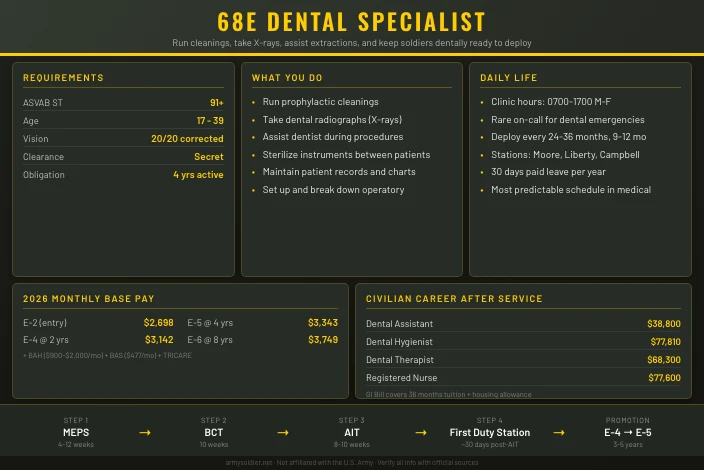
You work chair-side with a dentist, handling everything they don’t do themselves. That means cleanings, X-rays, instrument sterilization, patient records, and direct assistance during extractions and surgical procedures. Soldiers with untreated dental problems can’t deploy, so your work feeds directly into unit readiness.
A typical day looks like this: you set up the operatory, pull patient charts, run prophylactic cleanings, take radiographs, assist the dentist during procedures, sterilize instruments, and set up for the next patient. The schedule is structured and predictable. You’ll rarely be improvising under pressure the way a combat medic does.
As you gain experience, your scope grows. Early on, you assist on every procedure and do the routine work independently. After earning the Expanded Duties Dental Assistant credential (ASI-D1), you can place temporary restorations, adjust dentures, and administer local anesthesia under dentist protocol.
Army Enlisted Dental Specialization System:
| Qualification Level | Identifier | Purpose |
|---|---|---|
| Additional Skill Identifier (ASI) | D1 (Expanded Duties Dental Assistant) | Authorizes advanced clinical duties beyond basic assistant |
| Special Qualification Identifier (SQI) | D2 (Dental Hygiene), D3 (Oral Surgery) | Certifications in specialized dental areas |
Most dental specialists pursue ASI-D1 within their first 2 to 3 years. It’s the single biggest move you can make for your promotion competitiveness and your day-to-day clinical scope.
Technology and Equipment
You’ll use digital radiography systems, intraoral cameras, electric handpieces (high-speed and low-speed drills), ultrasonic scalers, and computerized dental records. Larger facilities have cone-beam CT imaging. Sterilization requires autoclave operation, proper instrument handling, and strict infection control. The Army trains you on new equipment when it comes in.
Salary and Benefits
Military pay is based on rank and years of service. Most dental specialists enter as E-1 and get promoted to E-2 after BCT.
| Rank | Pay Grade | Monthly Base Pay | Annual Base Pay |
|---|---|---|---|
| Private (PV2) | E-2 | $2,698 | $32,376 |
| Private First Class (PFC) | E-3 | $2,837 | $34,044 |
| Specialist (SPC) | E-4 | $3,142 | $37,704 |
| Sergeant (SGT) | E-5 | $3,343 | $40,116 |
| Staff Sergeant (SSG) | E-6 | $3,401 | $40,812 |
Source: DFAS 2026 pay tables. Figures reflect the 2026 pay raise.
Beyond base pay, you get housing and food allowances. BAH (Basic Allowance for Housing) depends on your duty station and dependent status, ranging from roughly $400 to $2,500 per month. BAS adds about $477 monthly for food. Enlistment bonuses for the 68E range from $3,000 to $12,000 depending on current Army needs. Soldiers with ASI-D1 or other advanced certifications may qualify for additional special pay or retention bonuses.
Benefits at a glance:
- TRICARE covers medical, dental, vision, and mental health for you and your family
- Thrift Savings Plan (TSP) works like a 401k, with the government matching up to 5% of your contributions
- BRS pension pays 40% of base pay if you serve 20 years
- 30 days paid leave per year; up to 60 days can carry forward
- Tuition Assistance lets you take college classes while on active duty
- Post-9/11 GI Bill covers up to 36 months of tuition after you leave
Qualifications and Eligibility
Basic Qualifications
You need to be between 17 and 39 years old, a U.S. citizen or permanent resident, and have a high school diploma or GED. Diploma holders need at least a 31 on the AFQT. GED holders need a 50.
The 68E requires one specific ASVAB line score:
| Component | Minimum Score |
|---|---|
| Skilled Technical (ST) | 91 |
The ST composite combines General Science, Verbal Expression, Mechanical Comprehension, and Math Knowledge. It’s achievable with focused study. If you miss it, the first retest is available after 30 days; subsequent retests require a 6-month wait.
Physical standards are standard for Army enlistment: vision correctable to 20/20, hearing adequate for normal communication, and no disqualifying medical conditions. Minor vision or hearing issues may get a waiver. A history of serious mental health conditions, drug use, or certain criminal convictions can require a moral waiver or disqualify you.
| Requirement | Details |
|---|---|
| Age | 17-39 years old; up to 42 with waiver |
| Citizenship | U.S. citizen or permanent resident |
| Education | High school diploma or GED |
| AFQT (ASVAB) | Minimum 31 (diploma) or 50 (GED) |
| Skilled Technical (ST) | Minimum 91 |
| Vision | Correctable to 20/20 |
| Security Clearance | Secret |
| Background | No disqualifying criminal history or drug use |
Application Process
Start at your local Army recruiting station. If you haven’t taken the ASVAB, you’ll take it at MEPS (Military Entrance Processing Station). Hit that ST 91 and pass the medical exam, and your recruiter will find you an open 68E slot.
From first visit to swearing in takes roughly 4 to 12 weeks. A straightforward background check moves fast. A detailed investigation takes longer. Once you’re cleared and sworn in, you get a report date for Basic Combat Training.
Selection Criteria and Competitiveness
The 68E is moderately competitive. The Army needs dental specialists steadily, but you still need that ST 91. Prior dental or healthcare experience (dental assisting, radiology tech) helps. So does maturity and manual dexterity. No civilian certifications are required before enlistment, though they make you a stronger candidate.
Upon Accession into Service
You enter as E-1 and get promoted to E-2 after BCT. Most soldiers finish AIT at E-2 or E-3, depending on time in service and performance. The standard obligation is 4 years of active duty. Training bonuses or special programs may extend that.
See our ASVAB study guide for strategies to hit these line scores, or take the PiCAT from home if you are a first-time tester.
Work Environment
Setting and Schedule
Dental specialists work in garrison dental clinics, field dental operatories, or deployed facilities. The environment is almost always indoors, climate-controlled, and structured. That’s a significant difference from most Army medical MOSs.
Standard clinic hours run roughly 0700 to 1700, Monday through Friday. Some bases extend to evenings or Saturdays. On-call rotations happen for dental emergencies, though they’re far less frequent than emergency medical calls.
Physical demands are lighter than most military jobs: you stand for 6 to 8 hours, use fine motor control in confined spaces, and occasionally lift supply boxes up to 50 pounds. Bloodborne pathogen exposure requires strict infection control every day.
Leadership and Communication
You report to a dental officer (usually a Captain or First Lieutenant) and senior dental NCOs who run clinic operations. On the floor, you work directly under the supervising dentist. Feedback is real-time. Dentists watch your work daily and correct technique on the spot. Annual evaluations cover the bigger picture.
Most dental clinics hold regular team meetings to discuss patient flow, protocols, and professional development. The teams are small, which means you know everyone you work with.
Team Dynamics and Autonomy
You and the dentist function as a two-person team on most procedures. During routine cleanings, you work largely on your own once you’ve proven competence. During extractions or surgical work, you move at the dentist’s pace and anticipate their next move.
Autonomy grows with credentials. ASI-D1 holders do more independent work and handle expanded procedures without direct supervision on every step. That expanded scope is both more interesting clinically and more competitive at promotion boards.
Job Satisfaction and Retention
Retention for the 68E is solid. The predictable schedule, low physical danger, and direct patient care make it one of the more sustainable medical MOSs over a full enlistment. Dental specialists who go for 20 years cite the clear skill progression, the quality of their teams, and the satisfaction of keeping soldiers healthy. The biggest complaints come from those who wanted more operational tempo or faster advancement.
Training and Skill Development
Initial Training
Training has two phases: Basic Combat Training (BCT) and Advanced Individual Training (AIT).
| Training Phase | Location | Duration | Focus |
|---|---|---|---|
| BCT | Fort Jackson, Fort Moore, or Fort Leonard Wood | 10 weeks | Soldier basics: marksmanship, tactics, fitness, discipline |
| AIT (Dental) | Fort Sam Houston (BAMC) or other MEDCOM facility | 8-10 weeks | Dental assisting, radiography, infection control, patient procedures, charting |
BCT is the same for every MOS. You’ll qualify on a rifle, learn land navigation, and build the physical baseline the Army expects of all soldiers.
AIT is where the dental training happens. At Brooke Army Medical Center in San Antonio, you study dental anatomy, operative dentistry, periodontics, prosthodontics, and oral surgery principles. The curriculum covers instrument handling, radiographic technique, sterilization protocols, patient management, and procedure assistance. You start on plastic models and work up to supervised clinical experience with real patients. The breakdown is roughly 40% classroom, 40% lab, 20% clinical.
You earn the 68E MOS at the end of AIT and report to your first duty station within about a month.
Advanced Training
After AIT, most dental specialists pursue the Expanded Duties Dental Assistant course (ASI-D1), a 3 to 4 week program that authorizes you to place temporary restorations, adjust dentures, and administer local anesthesia under dentist protocol. It’s the clearest path to more interesting work and better promotion potential.
Beyond ASI-D1, some soldiers pursue Dental Hygiene (SQI-D2) or Oral Surgery (SQI-D3) certifications after 2 or more years. Radiology certification is often available within the first year. The Army supports civilian dental auxiliary certifications through Tuition Assistance. Many soldiers use the GI Bill to pursue dental hygiene or related degrees during or after service.
Everything starts with qualifying ASVAB scores — our study guide covers what to study first.
Career Progression and Advancement
Career Path
Promotion to E-4 (Specialist) comes after about 2 to 3 years with solid performance. E-5 (Sergeant) requires time-in-grade, good evaluations, and passing a promotion board. At E-5, you start supervising other dental personnel and managing parts of clinic operations.
| Rank | Pay Grade | Typical Years | Typical Role |
|---|---|---|---|
| Private First Class | E-3 | 1-2 | Entry-level assistant, supervised procedures |
| Specialist | E-4 | 2-3 | Senior assistant, leads routine procedures |
| Sergeant | E-5 | 4-6 | Clinic supervisor, training NCO |
| Staff Sergeant | E-6 | 6-9 | Senior dental NCO, operations management |
| Sergeant First Class | E-7 | 9+ | Senior leadership, dental operations oversight |
E-6 comes around 6 to 9 years. At that rank, you manage personnel, clinic scheduling, and equipment maintenance. E-7 and above are highly competitive, requiring demonstrated leadership and a strong record across multiple assignments.
Role Flexibility and Transfers
You can request a move to a different MOS with leadership approval and an open slot. Common lateral moves for dental specialists include medical laboratory specialist (68K) or healthcare management (92Y). Any MOS transfer means completing that job’s training and a new service obligation. Strong evaluations make your options better.
Performance Evaluation
NCOs are rated annually through the NCOER (NCO Evaluation Report). Your rater and senior rater score you on leadership, training, and technical competence. Strong NCOERs drive promotion to E-6 and above.
What actually gets you noticed: clinic productivity, clean infection control records, mentoring junior soldiers, and consistent physical fitness standards. Dental specialists who pursue advanced certifications and take on clinic improvement projects get the “exceeds standards” ratings that matter at promotion boards.
Physical Demands and Medical Evaluations
Physical Requirements
This is a physically light job by Army standards. You stand for 6 to 8 hours per shift, use precise hand and arm movements throughout the day, and occasionally lift supply boxes up to 50 pounds. Repetitive motions are routine. Bloodborne pathogen exposure is a daily reality of the work.
You still have to pass the Army Fitness Test (AFT) every year. Here are the minimum standards for ages 17 to 21:
| Event | Male Minimum | Female Minimum |
|---|---|---|
| 3-Rep Max Deadlift (MDL) | 140 lbs | 80 lbs |
| Hand-Release Push-Up (HRP) | 10 reps | 10 reps |
| Sprint-Drag-Carry (SDC) | 2:40 | 3:40 |
| Plank (PLK) | 2:00 | 2:00 |
| Two-Mile Run (2MR) | 15:54 | 18:54 |
Each event is scored 0 to 100. You need at least 60 per event and 300 total. Dental specialists are held to the same standards as every other soldier.
Medical Evaluations
After enlistment, you get an annual health assessment: weight, blood pressure, vision, hearing, and a conversation with a provider. As a healthcare worker with regular bloodborne pathogen exposure, you may also go through occupational health surveillance. Any deployment requires a separate pre-deployment health assessment.
Deployment and Duty Stations
Deployment Details
Dental specialists deploy less often than combat medical roles. Active-duty soldiers in this MOS typically deploy once every 3 to 5 years for 6 to 12 months. In the field, you treat dental emergencies with limited equipment while routine care waits until you’re back in garrison.
Common deployment contexts:
- Forward operating bases – dental support for troops in the Middle East and Central Asia
- Field hospitals and combat support hospitals – assisting dental officers during surgical procedures
- European and Pacific rotations – coalition support and readiness missions
- Domestic humanitarian response – disaster relief and community health operations
Location Flexibility
The Army assigns your duty station based on what it needs. You submit a preference list, but there are no guarantees. Expect a new assignment every 2 to 3 years.
Common duty stations for dental specialists:
- Fort Liberty, NC (large MEDCOM dental clinic, high patient volume)
- Fort Moore, GA (training and operational dental support)
- Fort Campbell, KY (air assault division dental support)
- Germany or Japan (overseas assignments supporting forward-deployed units)
The Army covers all moving costs with each PCS. High performers with clean records get better consideration when preferences are reviewed.
Risk, Safety, and Legal Considerations
Job Hazards
Dental work carries lower risk than most military healthcare roles. There’s no combat exposure, minimal physical danger, and no dealing with mass casualty events in a muddy field. The hazards here are clinical.
Primary occupational hazards:
- Bloodborne pathogen exposure – needle sticks and contact with blood or saliva during procedures
- Infectious disease – high-volume clinic work means regular exposure to communicable illness
- Sharp instrument injuries – needles, scalers, and burs cut and puncture
- Chemical exposure – disinfectants, anesthetic agents, and dental materials used daily
- Ergonomic strain – repetitive hand and arm motions over long shifts build up over time
Safety Protocols
Universal precautions are mandatory: gloves, eye protection, proper sharps handling. PPE is provided and required. Needlestick protocols include immediate cleaning, baseline testing, and prophylactic treatment when indicated. Sterilization standards are audited regularly. Ergonomic training helps reduce cumulative injury. Hand hygiene is not optional.
Security and Legal Requirements
The 68E requires a Secret security clearance because of access to sensitive patient information and operational details. The clearance process runs 2 to 6 months and covers criminal history, drug use, financial responsibility, and foreign contacts.
All soldiers follow the Uniform Code of Military Justice (UCMJ). As a dental specialist, you’re also bound by professional responsibilities: treat patients within your scope, maintain patient confidentiality, and follow treatment protocols. Before any deployment, you receive rules of engagement training and legal briefings.
Impact on Family and Personal Life
Family Considerations
The 68E is one of the more family-friendly medical MOSs. Clinic hours are standard business hours Monday through Friday, which means more predictable family time than shift-work or combat medical roles. Low deployment frequency means less time separated from spouses and children.
The main family challenge is relocation. After AIT, you go where the Army sends you, often far from home. Subsequent assignments happen every 2 to 3 years. Families adapt to new schools, new communities, and new social networks each time.
Family support resources at most installations:
- Family Readiness Groups (FRGs) – unit-level peer support through deployments and transitions
- Military OneSource – free counseling, financial advising, and family services available 24/7
- Exceptional Family Member Program (EFMP) – support for families with special medical or educational needs
- Army Community Service (ACS) – on-post help for financial counseling, relocation, employment, and family advocacy
- Spouse Employment Assistance Program (SEAP) – job search support and employer connections at each new station
- School Liaison Officers (SLOs) – help families with school enrollment and transitions for kids
Relocation and Flexibility
You submit duty station preferences, but the Army’s operational needs decide. Soldiers with strong records and specialized certifications get better options in later career assignments. The Army tries to keep dental clinic tours at 2 to 3 years when possible. Each PCS is fully paid by the Army.
Reserve and National Guard
Dental detachments exist in both the Army Reserve and the Army National Guard, and 68E positions are available in both components. Guard and Reserve dental units focus primarily on soldier dental readiness – making sure personnel can deploy with no untreated dental problems. Those missions run during drill weekends, Annual Training, and periodic dental readiness missions at armories and training sites.
If you’re already a civilian dental assistant or planning to become one, the Reserve or Guard path is a natural fit. The skills you develop in the Army chair-side environment reinforce what you’re doing in civilian practice, and the schedule is manageable alongside a full-time job.
Drill schedule and certification maintenance
The standard one weekend per month plus two-week Annual Training schedule applies to 68Es. On top of that, dental specialists carry ongoing radiology certification requirements and infection control training updates. State dental radiology certifications have their own renewal cycles, and the Army’s infection control standards must also stay current. Some of that maintenance happens during drill, but you should expect to track it independently.
Dental clinics are small-team environments. Most Reserve and Guard dental detachments operate with a dentist, one or two assistants, and support personnel. You’ll know everyone you work with, and the clinical relationship is close.
Pay comparison
Active-duty E-4s with four years of service earn $3,659 per month in base pay, plus housing and food allowances. As a Reserve or Guard soldier at the same rank, a drill weekend generates approximately $488. Full-year drill pay – monthly weekends plus Annual Training – runs roughly $5,000 to $7,000. As a civilian dental assistant earning around $38,800 annually, military pay is meaningful supplemental income and not a replacement for it.
Benefits differences
Active-duty soldiers pay nothing out of pocket for TRICARE. Tricare Reserve Select is available to drilling Guard and Reserve soldiers at $57.88 per month for the member alone or $286.66 per month for member and family. If your civilian dental employer doesn’t provide health benefits – which is common in smaller practices – Tricare Reserve Select is worth considering seriously.
Education benefits through the Reserve and Guard include MGIB-SR (Chapter 1606) at $493 per month for full-time students and Federal Tuition Assistance at $250 per credit hour up to $4,500 per year. National Guard members can tap state tuition waivers, which vary by state but often cover full tuition at in-state public universities. For 68Es looking to move into dental hygiene or dental therapy programs, those waivers represent a significant funding source.
Reserve and Guard retirement differs from active duty. Active-duty soldiers earn a pension after 20 continuous years with an immediate annuity. Reserve and Guard retirement accumulates through a points system – drill weekends, Annual Training, and mobilizations all earn points – with the pension payable at age 60. Post-2008 mobilizations can reduce that age to a minimum of 50.
Mobilization frequency
Dental specialists deploy at moderate rates. Dental readiness is part of pre-deployment screening, so dental units do support deployment preparation missions. Full activations for overseas support happen less frequently than for surgical or trauma-focused medical units, but they do occur. Plan for at least one mobilization of 6 to 12 months over a Reserve or Guard career, with additional short activations for readiness missions.
Civilian career integration and USERRA
Dental assistant is one of the most stable civilian healthcare jobs in the country. Every dental practice – private, group, hospital-based – hires for this role. Some states accept military dental training toward dental assistant certification requirements, which can speed up your civilian credentialing. Check with your state dental board directly, since acceptance policies vary.
USERRA protects your civilian job during any military activation. Dental offices cannot terminate or demote you for serving, and you return to your position with the seniority that would have accumulated. In smaller practices where employers may not be familiar with military obligations, knowing your USERRA rights and keeping your employer informed early goes a long way.
| Feature | Active Duty | Army Reserve | Army National Guard |
|---|---|---|---|
| Duty Status | Full-time | Part-time (1 wknd/mo + 2 wks/yr) | Part-time (1 wknd/mo + 2 wks/yr) |
| Monthly Pay (E-4, 4 yrs) | $3,659/mo | ~$488/drill weekend | ~$488/drill weekend |
| Healthcare | TRICARE (no premium) | Tricare Reserve Select ($57.88/mo) | Tricare Reserve Select ($57.88/mo) |
| Education | Post-9/11 GI Bill, TA | MGIB-SR ($493/mo), TA | MGIB-SR ($493/mo), TA, state tuition waivers |
| Deployment | Per unit rotation | When mobilized | When mobilized |
| Retirement | 20-year pension | Points-based, age 60 | Points-based, age 60 |
Post-Service Opportunities
Transition to Civilian Life
Your dental training translates directly to civilian dental assisting and hygiene careers. You leave with hands-on procedure experience that most civilian dental assistants don’t accumulate for years. Many 68Es pursue Registered Dental Hygienist (RDH) credentials after service, crediting their military background toward program requirements. Others move into dental therapy or expanded clinical roles.
The Transition Assistance Program (TAP) is mandatory before separation. It covers resume writing, interview prep, job search skills, and benefits counseling. The Post-9/11 GI Bill covers up to 36 months of tuition at a public university (full in-state rate) plus a monthly housing allowance and book stipend. Healthcare employers actively recruit veterans with clinical backgrounds.
Civilian Career Prospects
Here’s where dental specialists typically land:
| Civilian Job | Median Annual Salary | 10-Year Outlook | Notes |
|---|---|---|---|
| Dental Assistant | $38,800 | +7% | Direct match with 68E skills |
| Dental Hygienist | $77,810 | +6% | Requires RDH license; many 68Es pursue this |
| Registered Nurse | $77,600 | +6% | Some 68Es transition to nursing |
| Dental Therapist | $68,300 | +10% | Emerging role; 68E experience valuable |
| Dental Lab Technician | $65,400 | +5% | Some 68Es move into lab work |
Sterilization training, patient management skills, and clinical procedures experience also carry into surgical tech, EMS, and healthcare administration roles.
Post-Service Policies
An honorable discharge gives you lifetime VA healthcare access, disability compensation if applicable, survivor benefits, and full education benefits. You can separate after your 4-year obligation if you don’t re-enlist. Talk to your career counselor well before your end date so you have a plan in place.
A discharge other than honorable strips most VA benefits. Keep your record clean.
Is This a Good Job for You?
Ideal Candidate Profile
Dental work rewards precision. Small technique errors have direct consequences for patients, so the best candidates are calm, methodical, and genuinely interested in healthcare.
Traits that predict success:
- Steady hands and good fine motor control – you’ll be working in tight spaces with small instruments
- Detail-oriented and procedure-driven – dental protocols exist for good reason, and following them matters
- Comfortable with direct patient care without the intensity of trauma medicine
- Thrives in small, close-knit teams – most dental clinics run with a dentist and one or two assistants
- Hands-on background helps – mechanics, craftsmanship, or lab work translates well to dental assisting
- Values a structured schedule and work-life separation
Potential Challenges
This MOS is a poor fit if you:
- Are uncomfortable with blood, decay, or gum disease – you see it every day
- Dislike confined spaces or close physical contact with patients
- Need autonomy outside a defined scope of practice – dentist-directed protocols govern your work
- Require geographic stability – moves every 2 to 3 years are standard
- Want frequent deployments or high operational tempo
- Expect higher short-term earnings – entry-level civilian dental group practices often pay more than enlisted pay
Career and Lifestyle Alignment
If you want to work in dentistry after the Army, this is one of the fastest ways to get real clinical hours. The GI Bill pays for dental hygiene or therapy school after you leave, and employers value the discipline and hands-on experience that comes with a military background.
The trade-off is real. You move every few years. Your first duty station probably won’t be near home. And pay at the E-2 to E-4 level is modest. But if you want to serve first and build a dental career second, the 68E sets you up well on both ends.
More Information
Talk to an Army recruiter about the 68E. Ask about current bonuses, available training slots, and whether your ASVAB scores qualify. If you can, ask to speak with a 68E soldier – there’s no better way to find out what the job is actually like day-to-day.
Take the MOS Finder quiz at goarmy.com
Schedule an ASVAB at your nearest MEPS to see where your scores land
Ask your recruiter about current enlistment bonuses for the 68E
Prepare for the ASVAB with our study guide to make sure your line scores qualify
This site is not affiliated with the U.S. Army or any government agency. Verify all information with official Army sources before making enlistment or career decisions.
Explore more Army medical careers such as the 68W Combat Medic Specialist and 68C Practical Nursing Specialist.