68G Patient Administration Specialist
Army hospitals run on two things: clinical skill and paperwork. The 68G Patient Administration Specialist handles the second half of that equation. Every patient who walks through the door at a military treatment facility needs their records tracked, their eligibility verified, their appointments scheduled, and their medical board documentation filed correctly. That work falls to the 68G.
This is a desk-forward MOS, but its stakes are real. A missing form can delay a soldier’s medical board. A data entry error can affect a veteran’s benefits. 68Gs work in a structured administrative environment with direct impact on patient care outcomes, and the skills they build translate cleanly into one of the fastest-growing sectors of the civilian economy.
Qualifying requires specific ASVAB line scores — our ASVAB study guide covers what to target and how to prepare.
Job Role and Responsibilities
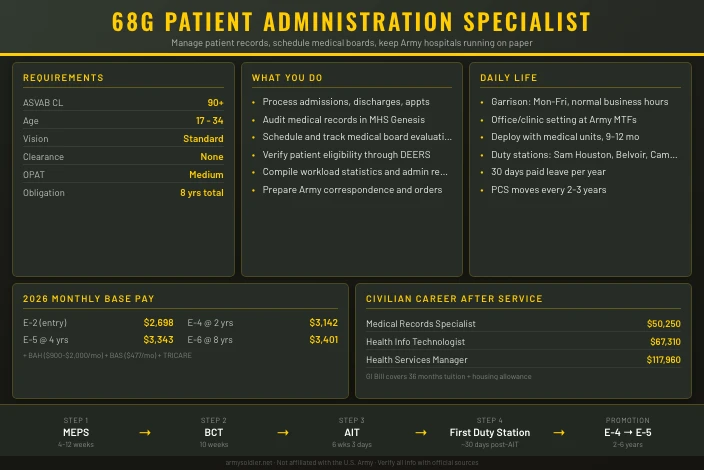
The 68G Patient Administration Specialist supervises and performs administrative duties in the patient administration division of Army hospitals and medical treatment facilities. They manage patient records, compile statistical health data, process admissions and discharges, coordinate medical board actions, and verify patient eligibility. This role is essential to the administrative operation of every Army medical facility.
Daily Tasks
The day-to-day work centers on records, data, and coordination. A typical shift involves:
- Processing patient admissions, outpatient appointments, and discharges
- Maintaining and auditing medical records for accuracy and completeness
- Scheduling soldiers for medical board evaluations and tracking case status
- Compiling patient workload statistics and preparing administrative reports
- Verifying eligibility through the Defense Enrollment Eligibility Reporting System (DEERS)
- Preparing correspondence, forms, and official orders in Army format
- Coordinating with clinical staff to ensure documentation requirements are met
At senior skill levels (SL3 and above), 68Gs supervise junior personnel, advise on accreditation standards, and manage complex eligibility cases.
Specific Roles
The 68G uses the Army MOS system with progression through five skill levels. Additional Skill Identifiers (ASIs) can be awarded for specialized duties such as medical board coordinator functions.
| Code | Type | Description |
|---|---|---|
| 68G | Primary MOS | Patient Administration Specialist |
| 68G1O | SL1 | Entry-level patient admin duties |
| 68G2O | SL2 | Intermediate; handles more complex records |
| 68G3O | SL3 | Senior specialist; supervisory duties begin |
| 68G4O | SL4 | Staff sergeant-level team leadership |
| 68G5O | SL5 | Senior NCO; advises on policy and accreditation |
Mission Contribution
Military medicine depends on accurate administrative infrastructure. When a soldier gets hurt downrange, their injury report, treatment history, and evacuation documentation have to follow them through every echelon of care. 68Gs maintain the systems that make that continuity possible. They also support medical readiness reporting, which commanders rely on to know whether their units are fit to deploy.
Technology and Equipment
68Gs work daily with the Military Health System Genesis (MHS Genesis), the Department of Defense’s electronic health record platform. They also use DEERS for eligibility verification, and various Army administrative software packages for records management, reporting, and correspondence. Strong typing skills and comfort with database-driven systems matter here.
Salary and Benefits
Base pay for Army enlisted soldiers follows the DFAS pay scale. A new 68G enters as a Private (E-1) or Private (E-2) and can reach Specialist (E-4) within two years. The table below shows 2026 monthly base pay at ranks typical for this MOS.
| Rank | Grade | Time in Service | Monthly Base Pay |
|---|---|---|---|
| Private (PV2) | E-2 | Entry | $2,698 |
| Private First Class (PFC) | E-3 | ~1 year | $2,837 |
| Specialist (SPC) | E-4 | ~2 years | $3,142 |
| Sergeant (SGT) | E-5 | ~4-6 years | $3,343 |
| Staff Sergeant (SSG) | E-6 | ~8-10 years | $3,401 |
Base pay is only part of the compensation picture. On top of it, soldiers receive:
- Basic Allowance for Subsistence (BAS): $476.95/month (enlisted flat rate, 2026)
- Basic Allowance for Housing (BAH): Varies by duty location and dependency status. At Fort Sam Houston, a single E-4 receives $1,359/month; with dependents, $1,728/month.
- No enlistment bonus is currently available for 68G.
Additional Benefits
Healthcare is covered at no cost through TRICARE Prime while on active duty. The plan covers medical, dental, vision, mental health, prescriptions, and hospitalization with no enrollment fee, deductible, or copay for active-duty soldiers. Family members enrolled under the sponsor’s plan pay nothing for in-network care, with a $1,000 annual catastrophic cap.
Education benefits include Army Tuition Assistance (TA) while serving, covering up to $4,500 per year toward college courses (capped at $250 per semester hour). After service, the Post-9/11 GI Bill covers full in-state tuition at public schools, a monthly housing allowance, and up to $1,000 per year in book stipends for up to 36 months of enrollment. The private school cap for the 2025-2026 academic year is $29,920.95.
Retirement under the Blended Retirement System (BRS) combines a pension (2% per year of service, calculated on the high-36 average base pay) with a government-matched Thrift Savings Plan (TSP). The Army automatically contributes 1% of base pay to TSP after 60 days of service and matches up to 4% more once the soldier has two years of service.
Work-Life Balance
Soldiers earn 30 days of paid leave per year, accruing at 2.5 days per month, with a maximum carryover of 60 days. The 68G role is primarily garrison-based with structured duty hours, typically Monday through Friday during normal business hours. This is one of the more predictable schedules in the Army, though field exercises, unit deployments, and 24-hour on-call rotations still apply.
Qualifications and Eligibility
Requirements Table
| Requirement | Detail |
|---|---|
| ASVAB Line Score | CL: 90 (Clerical composite: VE + AR + MK) |
| Minimum AFQT | 31 (high school diploma); 50 (GED) |
| Age | 17-34 (Active Duty); waivers possible to 39 |
| Citizenship | U.S. citizen or permanent resident alien |
| Security Clearance | None required |
| Physical Profile | Medium physical demand rating |
| Criminal History | No felony convictions; no disqualifying drug, weapons, violence, or sexual misconduct offenses |
| Service Obligation | Active Duty: 4 years (8 years total military obligation) |
The CL composite combines Verbal Expression (VE), Arithmetic Reasoning (AR), and Mathematics Knowledge (MK). Soldiers who score well on the verbal and reading portions of the ASVAB will typically hit the CL:90 threshold without difficulty. No color vision or specific vision standards beyond the general Army requirement apply to this MOS.
Application Process
- Contact an Army recruiter and confirm 68G is available in your preferred component (Active Duty, Reserve, or National Guard)
- Take the ASVAB at a Military Entrance Processing Station (MEPS) and achieve CL:90 or higher
- Complete the physical exam at MEPS; confirm medical eligibility for this MOS
- Request 68G as your MOS during job selection; sign your enlistment contract with the MOS guaranteed
- Ship to Basic Combat Training (BCT) after a waiting period that varies by seat availability
The full process from initial recruiter contact to shipping typically takes 4-12 weeks, depending on seat availability in the training pipeline.
Selection Criteria
68G is not a highly competitive MOS in terms of selection pressure. The main gate is the CL:90 score. There are no prerequisite civilian certifications required, though prior experience with medical records software, office administration, or healthcare customer service will help you hit the ground running at your first duty station.
Service Entry
Soldiers enter at E-1 or E-2. Prior college credit or civilian job experience can qualify for E-2 or E-3 entry pay grade. The standard Active Duty service obligation is four years, with a total military obligation of eight years (the remainder served in the Individual Ready Reserve).
See our ASVAB study guide for strategies to hit these line scores, or take the PiCAT from home if you are a first-time tester.
Work Environment
Setting and Schedule
68Gs work almost entirely indoors at Army medical treatment facilities (MTFs): hospitals, clinics, and medical centers located on or near Army installations. The physical environment is an office and administrative setting, with standard computer workstations and records management systems. Duty hours are generally structured around normal business hours, though coverage requirements at 24-hour facilities create rotating shifts for some positions.
During field training exercises, 68Gs may deploy in support of medical units, setting up administrative functions in a field environment. This happens periodically but is not the day-to-day norm.
Leadership and Communication
Like all Army NCOs, senior 68Gs operate within a clear chain of command that runs from team leader through first sergeant. Performance counseling is mandatory at 30, 60, and 90 days for new soldiers, and annually thereafter through the NCOER (NCO Evaluation Report) system. Direct supervisors provide regular feedback on task proficiency, records accuracy, and adherence to administrative standards.
Team Dynamics and Autonomy
Patient administration sections typically operate as small teams of 3-10 soldiers, supervised by a senior NCO. Junior specialists handle discrete tasks with limited autonomy; accuracy and compliance with established procedures are the priority. At SL3 and above, soldiers take on supervisory responsibility and make independent decisions about records management workflow. The environment is collaborative but structured.
Job Satisfaction and Retention
68Gs report that the role offers a stable, predictable work environment by Army standards. The work can be repetitive, but soldiers who are detail-oriented and take satisfaction in process-driven work tend to find it rewarding. The administrative skill set transfers readily to civilian employment, which is a factor that tends to influence retention decisions as soldiers approach their first reenlistment window.
Training and Skill Development
Initial Training Pipeline
| Phase | Location | Length | Focus |
|---|---|---|---|
| Basic Combat Training | Various (Fort Jackson, Fort Leonard Wood, others) | 10 weeks | Army fundamentals, fitness, weapons |
| 68G AIT | Fort Sam Houston, TX (MEDCoE) | 6 weeks, 3 days | Medical records, patient admin systems, MHS Genesis, DEERS |
| First Duty Assignment | Varies by Army needs | Ongoing | On-the-job proficiency in a live MTF environment |
AIT at Fort Sam Houston is classroom-focused. Students learn to navigate MHS Genesis, process patient records, manage eligibility documentation, and apply Army administrative standards. The training is less physically demanding than combat MOS pipelines and more similar to a focused vocational program in health information management.
Advanced Training and Development
After initial assignment, 68Gs can pursue:
- Warrior Leader Course (WLC): Required for promotion to Sergeant (E-5). Teaches NCO leadership fundamentals.
- Advanced Leader Course (ALC): Required for promotion to Staff Sergeant (E-6).
- Senior Leader Course (SLC): Required for Sergeant First Class (E-7).
- Army COOL (Credentialing Opportunities On-Line): The Army funds several civilian certifications for 68Gs, including Registered Health Information Technician (RHIT) credentials sponsored by AHIMA. Check the Army COOL program for currently funded credentials.
- Tuition Assistance: Soldiers can pursue an associate’s or bachelor’s degree in health information management, business administration, or a related field while on active duty.
Everything starts with qualifying ASVAB scores — our study guide covers what to study first.
Career Progression and Advancement
Rank Progression
| Rank | Grade | Typical Timeline | Primary Responsibility |
|---|---|---|---|
| Private (PV1-PV2) | E-1/E-2 | Entry | Learning tasks, supervised work |
| Private First Class (PFC) | E-3 | ~12 months | Individual contributor |
| Specialist (SPC) | E-4 | ~18-24 months | Proficient specialist, peer mentor |
| Sergeant (SGT) | E-5 | ~4-6 years | Team leader, junior NCO |
| Staff Sergeant (SSG) | E-6 | ~7-10 years | Section leader, multiple-team supervisor |
| Sergeant First Class (SFC) | E-7 | ~12-16 years | Platoon sergeant, senior advisor |
| Master Sergeant (MSG) | E-8 | ~18-22 years | Senior NCO, brigade-level operations |
| Sergeant Major (SGM) | E-9 | ~22+ years | Senior enlisted advisor, policy-level role |
Promotion to E-4 and E-5 is primarily time-and-performance based in the early career. From E-5 onward, a centralized promotion board evaluates NCOERs, education, physical fitness scores, and time in grade. Competition increases significantly at E-7 and above.
Specialization and Transfers
Experienced 68Gs can branch into related administrative and management roles. The officer counterpart is the 70E Patient Administration Officer (AOC), which 68Gs can pursue through Officer Candidate School (OCS) if they meet the education and qualifications requirements. Within the enlisted career field, senior 68Gs may serve as medical readiness NCOs, healthcare accreditation coordinators, or patient affairs supervisors.
Lateral transfers to other clerical or administrative MOS codes (such as 42A Human Resources Specialist) are possible through a reclassification process with command approval.
Performance Evaluation
Enlisted soldiers are evaluated through the NCOER system once they reach Sergeant (E-5). Below that rank, the Army uses a developmental counseling process with mandatory periodic sessions. Evaluations weigh task proficiency, Army values adherence, fitness scores, and leadership potential. For 68Gs, records accuracy, audit outcomes, and system proficiency are the key performance indicators supervisors watch most closely.
Physical Demands and Medical Evaluations
Physical Requirements
The 68G carries a medium physical demand rating, which means the role involves some lifting, carrying, and standing but is not combat-intensive. Day-to-day duties are primarily sedentary to light in physical demand.
All soldiers must pass the Army Fitness Test (AFT), which replaced the ACFT on June 1, 2025. The AFT has five events scored 0-100 points each, for a maximum of 500 points. Scores are sex- and age-normed.
| AFT Event | Description | Minimum Score |
|---|---|---|
| MDL (3-Rep Max Deadlift) | Tests lower body and core strength | 60 |
| HRP (Hand Release Push-Up) | Tests upper body pushing strength | 60 |
| SDC (Sprint-Drag-Carry) | Tests speed, power, and agility | 60 |
| PLK (Plank) | Tests core endurance | 60 |
| 2MR (Two-Mile Run) | Tests aerobic endurance | 60 |
| Total (General Standard) | Minimum passing total | 300 |
The 68G MOS falls under the general 300-point standard. Combat specialty MOSs require 350 total, but 68G does not meet the threshold for that designation.
Medical Evaluations
Soldiers undergo a complete medical examination at MEPS before enlistment. After entry, annual physical fitness tests and periodic Soldier Readiness Processing (SRP) events assess continued medical fitness. There are no MOS-specific medical requirements beyond the standard Army physical profile for 68G, and no color vision or hearing acuity standards beyond the general Army threshold.
Deployment and Duty Stations
Deployment Details
68Gs deploy as part of medical units when those units receive orders. Deployments typically last 9-12 months and may send soldiers to combat zones, humanitarian missions, or NATO exercises. Patient administration functions are needed wherever Army medicine operates, so 68Gs can expect to deploy at least once during a standard Active Duty service agreement. Deployment frequency is lower than combat arms MOS codes but is not uncommon.
In a deployed environment, the work changes character. Forward medical treatment facilities (MTFs) range from Role 2 facilities – which provide advanced trauma care and initial stabilization – up to Role 3 combat support hospitals that handle surgical cases and hold patients for evacuation. A 68G assigned to a deployed Role 2 or Role 3 unit processes the same core documentation functions as a garrison MTF, but with compressed timelines, austere equipment, and a higher pace of urgent admissions. Casualty documentation has to be accurate under pressure because those records drive medical evacuation priorities, track down range treatment history, and form the legal basis for VA disability claims after service.
The mobilization process for medical support units follows a standard Army pre-deployment timeline. Soldiers typically receive orders 90-180 days before deployment. That window includes Soldier Readiness Processing (SRP), which confirms medical, dental, administrative, and legal readiness. 68Gs go through the same SRP as any other soldier and add unit-specific record-closing tasks: transferring local patient cases, archiving open medical board actions, and ensuring no pending administrative actions are left open for soldiers shipping out. Units then move through a Mobilization Station for final training and validation before deploying.
Overseas permanent-change-of-station assignments differ from combat deployments. Locations like Landstuhl Regional Medical Center in Germany or Camp Humphreys in South Korea are accompanied tours where families can follow. These assignments run 2-3 years and come with full MTF operations, on-post housing, and access to SOFA-status benefits on host nation economies. Competition for preferred overseas assignments is driven by Army needs and NCOER records, not seniority alone.
Duty Station Assignments
Most 68G duty stations are at installations with major Army hospitals or medical centers. Common locations include:
- Fort Sam Houston, TX – Home of BAMC (Brooke Army Medical Center), one of the largest military hospitals in the country
- Fort Belvoir, VA – Proximity to Walter Reed National Military Medical Center
- Fort Campbell, KY – Blanchfield Army Community Hospital
- Fort Stewart, GA – Winn Army Community Hospital
- Overseas: Landstuhl Regional Medical Center (Germany), Tripler Army Medical Center (Hawaii), Camp Humphreys (South Korea)
Soldiers submit a dream sheet of preferred locations, but assignment is ultimately based on Army needs and available billets. Married soldiers with dependents receive priority consideration for certain locations.
Risk, Safety, and Legal Considerations
Job Hazards
The primary risks for 68Gs are occupational health hazards common to any healthcare administrative environment: prolonged computer use, repetitive motion, and the psychological stress of working in a clinical setting that handles serious illness and injury. During deployment, 68Gs face the same general risks as other soldiers assigned to forward-deployed medical units.
Safety Protocols
Army medical facilities follow Joint Commission accreditation standards and DoD occupational health regulations. 68Gs receive training on information security protocols for handling protected health information (PHI) under HIPAA-equivalent military standards. Standard ergonomic controls, equipment inspections, and occupational health programs apply at all Army MTFs.
Security and Legal Requirements
No security clearance is required for 68G, but the absence of a clearance requirement does not mean the job carries low legal exposure. 68Gs handle protected health information (PHI) for soldiers, retirees, and dependents every day. The legal framework governing that data includes multiple overlapping requirements:
- Privacy Act of 1974: Federal law that restricts how the government collects, maintains, uses, and discloses personal records. All Army administrative personnel receive annual Privacy Act training. Unauthorized disclosure of records covered under the Privacy Act is a federal offense.
- AR 40-66 (Medical Record Administration and Healthcare Documentation): The Army regulation that sets mandatory standards for creating, maintaining, storing, transferring, and disposing of medical records in the military health system. 68Gs are responsible for compliance with AR 40-66 on every record they touch.
- HIPAA-equivalent DoD protections: The Department of Defense operates under the Health Insurance Portability and Accountability Act framework through its own policies. Army MTF personnel are trained to handle PHI under standards that mirror civilian HIPAA requirements.
- MHS Genesis system access controls: Access to the electronic health record platform is role-based and audited. Logging into records outside your authorized scope, even out of curiosity, is a security violation.
The legal obligations of this MOS are real and carry consequences that follow soldiers beyond their service window. Civilian health information management is a credentialed field with its own professional ethics requirements, and a UCMJ record for PHI mishandling will surface in background checks for jobs at hospitals, insurance companies, and government health agencies.
Impact on Family and Personal Life
Family Considerations
The garrison-based, office-oriented nature of 68G makes it one of the more family-friendly MOS choices in the Army. Regular duty hours mean more predictable time at home compared to combat arms or field-heavy MOSs. Families have access to the full suite of Army Family Programs, including Military OneSource counseling, on-post child care, and Family Readiness Groups (FRGs) at each installation.
A typical 68G duty day at a garrison MTF runs roughly 0630 to 1700, Monday through Friday. That schedule includes physical training in the morning, administrative duties through the workday, and formation at end of day. On-call coverage for 24-hour facility operations rotates among the section, but it’s not a daily occurrence. Compared to a unit with frequent field exercises or unpredictable operational taskings, a 68G section at a major Army hospital is closer to a structured 9-to-5 than most Army jobs.
Deployments do affect family life for 9-12 months at a stretch, and PCS moves happen every 2-3 years on average. Both are realities of Army service regardless of MOS.
Families with children who have special medical or educational needs should look into the Exceptional Family Member Program (EFMP). Enrollment in EFMP is mandatory for soldiers whose family members require specialized services – including physical therapy, developmental services, specialized education, or ongoing specialty medical care. The EFMP coordinates with gaining installations during PCS moves to confirm that required services are available before orders are cut. This process does not always prevent a move to a location with limited services, but it gives families advance notice and access to support resources during the transition. EFMP enrollment happens through the medical treatment facility at the current duty station.
On-post housing is available at all major 68G duty stations, though wait times vary. At Fort Sam Houston, family housing is managed through Balfour Beatty Communities; at Fort Campbell, through Campbell Crossing. Basic Allowance for Housing covers off-post rent in local markets when on-post housing is unavailable or not preferred. Soldiers with dependents receive a higher BAH rate, and that figure adjusts to the local housing market at each duty station.
Relocation and Flexibility
PCS moves are Army-directed and happen every 2-3 years on average. The Army covers household goods shipment at government expense and provides a Dislocation Allowance (DLA) to offset move-in costs. Soldiers can express location preferences but assignment is driven by Army needs and available billets. The practical advantage for 68Gs is that Army medical facilities exist on virtually every major installation, giving this MOS a broader pool of potential duty stations than MOSs with a narrower qualifying footprint.
Reserve and National Guard
The 68G Patient Administration Specialist is widely available in both the Army Reserve and the Army National Guard. Every medical unit - from combat support hospitals to medical detachments - needs administrative personnel to keep patient records accurate and eligibility systems running. That demand exists in the reserve components just as much as it does on active duty.
Component Availability
Reserve and Guard 68Gs serve in medical brigades, medical battalions, and area support medical companies. These units are spread across the country, which makes it realistic to find a 68G position near where you live. The job is not a limited-allocation specialty, so openings exist across most states.
Part-time service follows the standard Army Reserve and National Guard drill schedule: one weekend per month plus two weeks of Annual Training per year. On drill weekends, 68Gs review administrative procedures, run records audits, train on updated medical records software, and practice the documentation workflows they’d use on a deployment. Annual Training often includes joint exercises with active-duty medical units or disaster response scenarios.
One additional requirement specific to this MOS: MHS Genesis and related medical records systems receive periodic updates, and 68G Reserve soldiers need to stay current on those changes. Your unit will schedule proficiency sessions, but self-study between drills keeps your skills sharp.
Part-Time Pay
A Reserve or Guard 68G at E-4 with four years of service earns approximately $488 for a standard four-drill weekend. That’s based on 2026 pay tables. It is not a full paycheck, but it is supplemental income that does not require leaving your civilian job.
Compare that to active duty, where an E-4 at four years earns $3,659 per month in base pay. The trade-off is clear: active duty pays more and provides far more training time and career advancement opportunities, while the reserve component lets you build civilian career experience alongside your military service.
Benefits Comparison
Healthcare is one of the most significant differences. Active-duty soldiers receive TRICARE at no cost, covering the soldier with no premium. Reserve and Guard soldiers can enroll in Tricare Reserve Select for $57.88 per month (member only) or $286.66 per month (member plus family). That is still a strong deal compared to most civilian employer plans, but it is not free.
Education benefits also differ. Active-duty soldiers have access to Post-9/11 GI Bill and Tuition Assistance ($250 per credit hour, $4,500 per year cap). Reserve and Guard soldiers get the Montgomery GI Bill Selected Reserve (MGIB-SR, Chapter 1606), which pays $493 per month for full-time students. National Guard members may also qualify for state tuition waivers - many states cover 100 percent of tuition at in-state public schools for Guard soldiers in good standing.
Retirement works on a points-based system in the reserve components. You earn points through drills, Annual Training, and any active-duty periods. A pension becomes available at age 60, though mobilization time after January 28, 2008, can reduce that minimum age - by three months for each 90 days of active-duty mobilization, down to a minimum of age 50.
Deployment and Mobilization
Reserve and Guard 68Gs deploy when their units are mobilized. Medical administrative positions support deployed hospitals and treatment facilities, so mobilization is real for this MOS. Historically, medical support units have seen moderate mobilization frequency - not as often as combat arms, but not rare either. Expect at least one mobilization over a 20-year reserve career, with the possibility of more depending on global demand.
When mobilized, USERRA (the Uniformed Services Employment and Reemployment Rights Act) protects your civilian job. Employers are required by federal law to hold your position and restore you to the same or equivalent role when you return. USERRA also protects your seniority, benefits, and pension credit during the period of military service.
Civilian Career Integration
The 68G skill set pairs exceptionally well with civilian healthcare careers. Medical records technician, health information technician, and medical office administrator roles are all direct applications of what you learn and practice in this MOS. Working as a 68G in the reserve component while building civilian experience in health information management is a practical combination. The Registered Health Information Technician (RHIT) credential from AHIMA is a recognized civilian certification that aligns with 68G duties, and Army COOL may fund the exam. Many reserve 68Gs pursue RHIT while continuing to drill, building credentials in both the civilian and military tracks simultaneously.
| Feature | Active Duty | Army Reserve | Army National Guard |
|---|---|---|---|
| Duty Status | Full-time | Part-time (1 wknd/mo + 2 wks/yr) | Part-time (1 wknd/mo + 2 wks/yr) |
| Monthly Pay (E-4, 4 yrs) | $3,659/mo | ~$488/drill weekend | ~$488/drill weekend |
| Healthcare | TRICARE (no premium) | Tricare Reserve Select ($57.88/mo) | Tricare Reserve Select ($57.88/mo) |
| Education | Post-9/11 GI Bill, TA | MGIB-SR ($493/mo), TA | MGIB-SR ($493/mo), TA, state tuition waivers |
| Deployment | Per unit rotation | When mobilized | When mobilized |
| Retirement | 20-year pension | Points-based, age 60 | Points-based, age 60 |
Post-Service Opportunities
The civilian health information management sector is growing fast. The administrative and records management skills from 68G translate directly to jobs that are in demand at hospitals, insurance companies, outpatient clinics, and government health agencies.
Civilian Career Prospects
| Civilian Job Title | Median Annual Salary | 10-Year Job Growth |
|---|---|---|
| Medical Records Specialist | $50,250 | +7% |
| Health Information Technologist / Medical Registrar | $67,310 | +15% |
| Medical and Health Services Manager | $117,960 | +23% |
The trajectory from 68G to Health Information Technologist to Medical and Health Services Manager is a realistic one. Many former 68Gs use the GI Bill to complete an associate’s or bachelor’s degree in Health Information Management (HIM) after separation, then sit for the Registered Health Information Technician (RHIT) or Registered Health Information Administrator (RHIA) exam through AHIMA.
Certifications matter in this field. The RHIT is the entry-level credential for graduates of CAHIIM-accredited HIM programs. Veterans with strong records from their service, plus an RHIT credential, compete well for mid-level roles right out of the gate.
The Transition Assistance Program (TAP) provides pre-separation employment workshops, resume support, and education counseling. Soldiers can begin TAP participation up to 24 months before separation.
Is This a Good Job for You? The Right (and Wrong) Fit
Ideal Candidate Profile
A strong 68G candidate:
- Is detail-oriented and catches errors before they become problems
- Can work comfortably with database systems and medical software
- Handles sensitive information with discretion
- Enjoys structured, process-driven work
- Wants a stable schedule and a lower operational tempo than combat MOSs
- Has a long-term interest in healthcare administration or health information management
Potential Challenges
This MOS is not a fit for everyone. If you want physical challenge, tactical work, or field time as your daily baseline, 68G will feel slow. The work is repetitive in stretches, and the bureaucratic demands of military recordkeeping can be frustrating if you prefer creative or problem-solving tasks. Deployments do occur, but the day-to-day administrative environment is intentionally stable and structured.
Who This Job Fits
68G is a strong match if you’re thinking beyond your service window. The civilian health information management field is growing, pays well at the senior level, and values exactly the credentialing and records experience that Army service builds. Soldiers who treat 68G as both a career and a credential-building opportunity tend to leave the Army with a clear employment path. Those who drift through it without taking advantage of COOL certifications and TA may find the transition harder.
More Information
Talk to an Army recruiter for current seat availability, bonus status, and component options (Active Duty, Reserve, National Guard) for MOS 68G. Requirements and opportunities change frequently, and a recruiter working current contracts will have the most accurate picture of what’s available today.
- Prepare for the ASVAB with our study guide to make sure your line scores qualify
This site is not affiliated with the U.S. Army or any government agency. Verify all information with official Army sources before making enlistment or career decisions.
Explore more Army medical careers such as 68D Operating Room Specialist and 68Q Pharmacy Specialist.