68H Optical Laboratory Specialist
Every soldier in the Army depends on clear vision to do their job. The 68H Optical Laboratory Specialist is the person who makes that possible. You fabricate prescription eyewear from scratch, repair optical equipment, and keep military lenses in service across hospitals, clinics, and deployed medical facilities. It’s a precision trade with medical stakes, and the Army trains you from the ground up at the only tri-service optical school in the military.
Qualifying requires specific ASVAB line scores — our ASVAB study guide covers what to target and how to prepare.
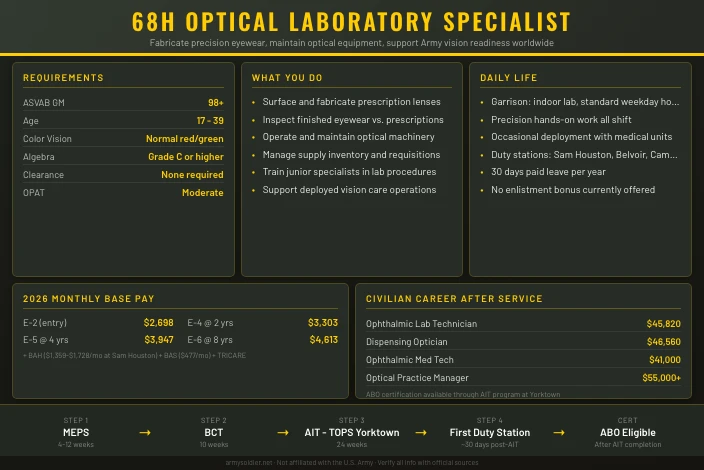
Job Role and Responsibilities
The 68H Optical Laboratory Specialist fabricates, assembles, and repairs prescription eyewear for Army personnel. Specialists surface lens blanks, verify prescriptions against finished lenses, maintain optical lab equipment, and support deployed vision care operations. This MOS is the backbone of military optometry, turning written prescriptions into finished eyewear used every day by soldiers in every branch of the service.
Day-to-day work happens in an optical laboratory. You start by reading prescriptions, selecting the correct lens blanks, and mounting them in a surfacing machine to grind them to the correct optical power. Once surfaced, lenses are inspected, cut to fit frames, and assembled into finished spectacles. Every pair gets a final quality check against the original prescription.
Beyond fabrication, you maintain the machinery that makes it all run. Surfacing equipment, lensometers, centration devices, and frame-heating tools all require regular calibration and cleaning. When equipment breaks, you troubleshoot it. At senior levels, you write the maintenance schedules and train junior specialists in proper technique.
What You Work On Daily
- Surface and fabricate prescription lenses from raw lens blanks
- Assemble completed eyewear and inspect against prescriptions
- Operate and maintain lensometers, surfacing units, and optical machinery
- Manage lab supply inventories and requisition materials
- Provide technical guidance to junior soldiers in fabrication procedures
- Support optometrists and ophthalmologists at garrison and deployed facilities
Specific Roles
Army Optical Laboratory Specialists serve under the MOS 68H designation within CMF 68. The skill-level progression uses the following codes:
| Code | Skill Level | Title |
|---|---|---|
| 68H10 | SL1 | Optical Laboratory Specialist (entry) |
| 68H20 | SL2 | Optical Laboratory Specialist (intermediate) |
| 68H30 | SL3 | Optical Laboratory Specialist (advanced) |
| 68H40 | SL4 | Optical Laboratory Specialist (senior/leadership) |
At SL1 and SL2, you do the hands-on fabrication work and learn to assist with quality checks. At SL3 and SL4, you shift into quality control inspections, supply management, training programs, and budget tracking. Senior NCOs plan and organize entire lab operations, coordinate with medical facilities, and determine staffing requirements.
Mission Contribution
Army optometry units keep the force combat-ready. Soldiers with poor uncorrected vision can’t qualify on weapons ranges, operate vehicles safely, or perform precision tasks in the field. The 68H fills a gap that civilian eye clinics can’t: deployable optical support. When a unit deploys, their optical equipment and supply chain go with them. Your skills mean soldiers don’t have to wait months for replacement eyewear when their current pair breaks in a combat zone.
Technology and Equipment
You’ll work with industrial surfacing equipment, lensometers (for measuring optical power), centration devices, UV curing lamps, frame heating equipment, and lens edgers. The Army also uses spectacle fabrication systems designed for deployed environments, where power and workspace are limited. Learning to operate these systems gives you skills that transfer directly to civilian optical labs and retail chains.
Salary and Benefits
Financial Benefits
Pay is set by rank and years of service, verified against 2026 DFAS military pay tables. Most 68H soldiers enter as E-1 or E-2 and reach E-4 Specialist by the end of their first enlistment.
| Rank | Pay Grade | Monthly Base Pay (2026) |
|---|---|---|
| Private (PV2) | E-2 | $2,698 |
| Private First Class (PFC) | E-3 | $2,837 (entry) |
| Specialist (SPC) | E-4 | $3,142 (entry) |
| Sergeant (SGT) | E-5 | $3,343 (entry) |
| Staff Sergeant (SSG) | E-6 | $3,401 (entry) |
Base pay is only part of total compensation. Basic Allowance for Subsistence (BAS) adds $476.95 per month for food. Basic Allowance for Housing (BAH) covers rent and varies by location and dependency status. At Fort Sam Houston, a single E-4 receives approximately $1,359 per month in BAH. A dependent E-4 receives about $1,728 per month at the same installation. The 68H MOS does not currently carry an enlistment bonus.
Additional Benefits
Active-duty soldiers receive TRICARE Prime health coverage at no cost. That covers doctor visits, prescriptions, dental, vision, mental health, and hospitalization for you and your family. There are no enrollment fees and no copays for in-network care.
Tuition Assistance pays up to $4,500 per year toward college courses while you’re on active duty. After separation, the Post-9/11 GI Bill covers up to 36 months of tuition at a public university (full in-state rate) plus a monthly housing allowance and up to $1,000 per year in book stipends.
Retirement falls under the Blended Retirement System (BRS). Serve 20 years and you receive 40% of your average high-36 months of basic pay as a monthly pension for life. The Army also automatically contributes 1% of your basic pay to a Thrift Savings Plan (TSP) after 60 days of service, then matches up to 4% of your own contributions starting in your third year.
Work-Life Balance
Soldiers earn 30 days of paid leave per year, accruing 2.5 days per month. Standard garrison duty runs weekdays with a predictable schedule since this is a lab-based, non-combat support role. Shifts can extend during high-volume periods or before a unit deploys, but the 68H does not face the same irregular hours as combat arms or operational medicine MOSs. Reserve and National Guard components serve part-time, making this MOS a practical path for civilians who want optical lab credentials without a full-time commitment.
Qualifications and Eligibility
Basic Qualifications
The 68H has a technical prerequisite that most Army MOSs don’t: you must have completed high school or college algebra with a final grade of “C” or better. That math background directly supports reading prescriptions and understanding optical formulas on the job.
| Requirement | Standard |
|---|---|
| ASVAB Line Score | GM: 98 (General Maintenance) |
| GM Formula | GS + AS + MK + EI |
| OPAT Category | Moderate |
| PULHES | 323222 |
| Color Vision | Normal red/green color perception required |
| Algebra | High school or college algebra, grade “C” or higher |
| Citizenship | Not required (legal resident alien eligible) |
| Felony | No felony convictions |
| Security Clearance | None required |
| Age | 17-39 (active duty) |
The GM composite combines General Science (GS), Auto and Shop Information (AS), Mathematics Knowledge (MK), and Electronics Information (EI). Study materials for these subtests are widely available. A strong math foundation makes the biggest difference since optical prescription math uses decimals and powers.
Alternative Qualification Path (ACASP)
The Army offers an accelerated civilian acquired skills program (ACASP) for civilians who already work in optometry. If you hold a state-recognized opticianry license, have completed a one-year opticianry program, and can provide official transcripts plus your license copy, you may qualify for accelerated placement into 68H training. Talk to your recruiter about whether your credentials meet the threshold.
Application Process
The entire process from MEPS to first duty station typically runs five to seven months. Your service obligation as an active-duty 68H includes a 20-month service remaining requirement upon completing AIT.
Selection Criteria
This MOS is not highly competitive in the way combat arms or intelligence roles are. The main gates are the GM score and the algebra requirement. Recruits who have worked in retail optical shops, done hands-on lab work, or have a background in precision manufacturing have an edge, but none of that is required.
See our ASVAB study guide for strategies to hit these line scores, or take the PiCAT from home if you are a first-time tester.
Work Environment
The 68H works in a controlled indoor lab environment almost exclusively. Optical fabrication requires clean, temperature-stable conditions, so you won’t be operating heavy equipment outside or in extreme environments. That said, this is the Army, and deployments happen.
Setting and Schedule
In garrison, you work standard weekday hours in an Army optometry clinic or medical center optical lab. The workspace is well-lit, ventilated, and organized around precision tasks. You stand for long periods while operating machinery and need manual dexterity and a steady hand. Noise levels are moderate from the grinding and surfacing equipment.
Deployed settings are different. Military optical teams have been deployed to field medical facilities in support of operations worldwide. Your lab becomes whatever space is available, and you improvise with portable equipment. The work is the same, but the comfort level drops significantly.
Leadership and Communication
You work within the Army’s standard NCO chain of command. Performance counseling happens quarterly at minimum, with formal NCOERs (Non-Commissioned Officer Evaluation Reports) at E-5 and above. At lower skill levels, you receive close supervision from the lab chief. As you advance, you take on quality control duties and supervise junior specialists. Communication with optometrists and clinic administrators is routine, since you’re fulfilling their prescription orders.
Team Dynamics and Autonomy
Small optical labs often run with just one to four specialists. That means you own your workload and are accountable for every lens that leaves the lab. There’s no hiding substandard work in a small team. At SL1 and SL2, you follow established procedures with direct oversight. By SL3, you’re making independent decisions about supply levels, equipment priorities, and how to train new arrivals.
Job Satisfaction
The fabrication work is satisfying in a measurable way. You start with a raw lens blank and finish with a piece of precision eyewear that a soldier relies on every day. Retention in this MOS reflects that tangibility. It’s also a low-stress specialty by Army standards, with no combat exposure for most assignments and a predictable daily rhythm in garrison.
Training and Skill Development
Initial Training
The training pipeline for 68H is longer than most medical MOSs because of the specialized nature of optical fabrication.
| Phase | Location | Length | Focus |
|---|---|---|---|
| Basic Combat Training (BCT) | Fort Jackson, SC or Fort Leonard Wood, MO | 10 weeks | Soldiering fundamentals, physical fitness, weapons qualification |
| Advanced Individual Training (AIT) | Tri-Service Optical School, Yorktown, VA | 24 weeks | Optics theory, lens surfacing, fabrication, inspection, equipment maintenance |
BCT covers the basics every Army soldier needs: physical fitness, weapons qualification, land navigation, first aid, and Army values. You don’t need any optical background going in.
AIT at Yorktown is where the specialty begins. The Tri-Service Optical School (TOPS) serves Army, Navy, and Air Force students in the same program. The course covers optical theory, mathematics of prescriptions, lens surfacing operations, frame selection and adjustment, quality control procedures, and optical equipment maintenance. Students who complete the program are eligible to sit for the American Board of Opticianry (ABO) certification exam, a nationally recognized civilian credential that opens doors in retail and clinical optometry after service.
Advanced Training
After AIT, skill development continues through formal and informal channels. The Army funds professional development through:
- Tuition Assistance: Take opticianry, business, or healthcare administration courses while serving
- Noncommissioned Officer Education System (NCOES): Required leadership courses tied to promotions at SGT, SSG, and SFC
- Army e-Learning: Online technical and professional courses accessible through the Army Learning Management System
- On-the-job cross-training: Many optical facilities support optometry clinics, giving 68H soldiers exposure to clinical workflows and patient interactions
Senior 68H NCOs often develop skills in logistics, budget management, and personnel planning that transfer directly to optical practice management in civilian life.
Everything starts with qualifying ASVAB scores — our study guide covers what to study first.
Career Progression and Advancement
Career Path
Most 68H soldiers start as E-1 or E-2 and reach E-4 Specialist by the end of their first enlistment. Promotion to E-5 Sergeant requires completing the Warrior Leader Course (WLC) and meeting time-in-grade requirements. The path from there follows the standard Army NCO progression.
| Rank | Pay Grade | Typical Time in Grade | Responsibilities |
|---|---|---|---|
| Private (PV1/PV2) | E-1/E-2 | 0-6 months | Training, orientation |
| Private First Class (PFC) | E-3 | 6-12 months | Entry-level lab work |
| Specialist (SPC) | E-4 | 1-4 years | Full fabrication duties |
| Sergeant (SGT) | E-5 | 4-6 years | Team leader, quality control |
| Staff Sergeant (SSG) | E-6 | 6-10 years | Lab section chief, training NCO |
| Sergeant First Class (SFC) | E-7 | 10-15 years | Platoon sergeant, senior advisor |
| Master Sergeant (MSG) | E-8 | 15-20 years | Senior optical NCO, staff positions |
| Sergeant Major (SGM) | E-9 | 20+ years | Command sergeant major or staff SGM |
Specialization
The 68H does not have formal ASI (Additional Skill Identifier) tracks the way some combat MOSs do, but soldiers can pursue additional qualifications through civilian certification bodies. The National Contact Lens Examiners (NCLE) certification and state optician licensing add credentials that matter for both military leadership roles and civilian employment. Some senior NCOs cross-train in medical logistics (68J territory) through experience managing lab supply chains.
Warrant Officer tracks within CMF 68 exist in medical service administration. An experienced 68H with leadership time and additional education may qualify for Warrant Officer (WO1) programs in the medical field. Talk to a warrant officer recruiter for current eligibility criteria.
Role Flexibility and Transfers
Soldiers who want to broaden their skills can apply for a lateral transfer or reclassification to related MOSs such as 68A (Biomedical Equipment Specialist) or 68K (Medical Laboratory Specialist), depending on ASVAB qualifications and Army needs. The process requires commander approval, a qualifying ASVAB score for the target MOS, and an available slot. Most reclassifications happen at reenlistment.
Performance Evaluation
NCOs (E-5 and above) are evaluated annually through the Non-Commissioned Officer Evaluation Report (NCOER). Key performance areas include competence (job proficiency), leadership, training, responsibility, and physical fitness. Younger soldiers below E-5 receive developmental counseling from their chain of command. Strong NCOERs and consistent physical fitness scores are the fastest route to promotion.
Physical Demands and Medical Evaluations
Physical Requirements
The 68H carries a Moderate OPAT category, which means you need to demonstrate moderate lifting and carrying capacity at MEPS before accessing this MOS. Specifically, the physical demands rating requires occasional lifting of 50 pounds and frequent lifting of 25 pounds during the course of the workday. You stand for extended periods while operating surfacing equipment, which places repetitive stress on lower back and feet.
The job is not physically punishing by Army standards. You’re not rucking with heavy loads or operating in extreme conditions day to day. But the Army is still the Army: you train, run, and maintain physical fitness year-round regardless of your MOS.
Army Fitness Test (AFT) Standards
The Army Fitness Test (AFT) replaced the ACFT on June 1, 2025. All active-duty soldiers, including medical MOSs, must pass the AFT. The 68H falls under the general standard (not the combat specialty standard), meaning scores are sex- and age-normed.
| Event | Abbreviation | Min Score (All) |
|---|---|---|
| 3 Rep Max Deadlift | MDL | 60 |
| Hand Release Push-Up | HRP | 60 |
| Sprint-Drag-Carry | SDC | 60 |
| Plank | PLK | 60 |
| Two-Mile Run | 2MR | 60 |
| Total Minimum | 300 |
Each event is scored 0-100 points. The maximum total is 500. Soldiers must score at least 60 on every individual event to pass, regardless of their total score. AFT standards are age-normed and sex-normed, so the raw performance targets differ by demographic but the point thresholds remain the same.
Medical Evaluations
The PULHES 323222 standard applies to 68H. That breaks down as: Physical capacity (3), Upper extremities (2), Lower extremities (3), Hearing and ear (2), Eyes (2), Psychiatric (2). The “2” in the eyes category means correctable vision is acceptable, but you must have normal red/green color perception. Color-blind applicants are disqualified since color-coded prescription forms and tinted lenses are a routine part of the job.
Annual physical exams and periodic PULHES re-evaluations track whether soldiers remain medically qualified. Any change that affects color vision or manual dexterity could impact MOS qualification.
Deployment and Duty Stations
Deployment Details
The 68H is a medical support MOS without a direct combat role. Deployment likelihood is real but lower than combat arms. Optical laboratory sections can deploy as part of larger medical units, brigade support battalions, or theater-level medical commands. Deployments typically run six to twelve months. Theater optometry support has been part of every major Army deployment since the Gulf War, so this is not a desk-only MOS.
Reserve and National Guard 68H soldiers face mobilization risk similar to other medical support MOSs, which has historically been moderate. Expect one deployment cycle over a typical 20-year career if you serve in the reserves, though operational demand can change that.
Location Flexibility
Active-duty 68H soldiers serve wherever the Army has optometry clinics and medical centers. Common duty stations include:
- Fort Sam Houston, TX (Army Medical Center of Excellence, major optometry hub)
- Fort Belvoir, VA (Walter Reed satellite operations)
- Fort Campbell, KY
- Fort Bragg (Fort Liberty), NC
- Joint Base Lewis-McChord, WA
- Landstuhl Regional Medical Center, Germany (overseas assignment)
Duty station assignments depend on Army needs and your preference list. You submit a dream sheet with preferred locations, but the Army assigns you where the vacancy exists. Medical specialty MOSs often have concentrated assignments at major medical centers.
Risk, Safety, and Legal Considerations
Job Hazards
Optical laboratory work involves chemical exposure, mechanical equipment, and repetitive motion risks. Lens surfacing compounds and polishing agents require proper ventilation and skin protection. Machinery that spins at high speed can cause injuries without proper training and personal protective equipment (PPE). Long-term, repetitive motion strain is a real occupational risk in high-volume labs.
Safety Protocols
Army optical labs follow standard industrial safety procedures. The Army’s occupational health program tracks chemical exposures and documents them in your medical record. Key protocols include:
- Mandatory PPE: chemical-resistant gloves, eye protection, ventilation compliance
- Equipment lockout/tagout before servicing any rotating machinery
- Biannual safety inspections of all surfacing and edging equipment
- Chemical exposure documentation in the soldier’s permanent medical record
Junior soldiers complete safety training during AIT before touching production equipment.
Security and Legal Requirements
The 68H requires no security clearance. You are not handling classified equipment or working in restricted access areas beyond standard medical facility security protocols. Your legal obligations include standard military service contract terms, the Uniform Code of Military Justice (UCMJ), and any applicable medical privacy laws (HIPAA applies in military medical settings). Deployment to a conflict zone is governed by existing military orders and international law of armed conflict, not by this MOS specifically.
Impact on Family and Personal Life
Family Considerations
The 68H is one of the more family-friendly medical MOSs. Garrison work follows a predictable weekday schedule with limited after-hours demands. Army families have access to a wide range of support services on post:
- Family Readiness Groups (FRGs): Unit-level support networks for spouses and family members
- Army Community Service (ACS): Financial counseling, employment assistance, and relocation support
- Child Development Centers (CDCs): On-post childcare at subsidized rates
- School Liaison Officers: Help military children transition between schools during PCS moves
During deployment, families qualify for additional programs including childcare subsidies and mental health services through TRICARE. The Military Family Life Counseling (MFLC) program provides free confidential counseling on and off post.
Relocation and Flexibility
Permanent Change of Station (PCS) moves typically occur every two to three years. The Army pays moving costs through the household goods program, and BAH adjusts to the new duty station rate. Frequent moves are a reality. Military spouses often face career disruption with each move, but resources like Military OneSource provide employment assistance and education support for family members at each new installation.
Reserve and National Guard
The 68H Optical Laboratory Specialist is a limited-allocation specialty in both the Army Reserve and the Army National Guard. Optical lab positions are genuinely scarce in the reserve components - there are only so many optical facilities operating at part-time capacity, and the number of available 68H slots reflects that. This is not a widely distributed MOS like a combat medic or a human resources specialist.
Component Availability
Both the Army Reserve and the Army National Guard maintain a small number of 68H positions, primarily in medical brigades and hospital units with active optometry clinics. If you are interested in serving part-time in this MOS, your first task is confirming that a position actually exists within a reasonable commute of where you live. Your recruiter can search the current vacancy list. In some states, there may be no open 68H slot for Reserve or Guard at all. This is a real limitation, not a minor administrative detail.
The drill schedule follows the Army standard: one weekend per month plus two weeks of Annual Training per year. Because optical fabrication requires hands-on equipment proficiency, 68H Reserve soldiers have a higher-than-average skill sustainment burden. Lens grinding, surfacing, and quality inspection are physical tasks that degrade without regular practice. Units typically schedule equipment time and fabrication exercises on drill weekends, but a Reserve 68H who works full-time in a civilian optical lab or retail optometry role will naturally maintain sharper skills than someone who only practices on drill weekends.
Part-Time Pay
A Reserve or Guard 68H at E-4 with four years of service earns approximately $488 for a standard four-drill weekend, based on 2026 pay tables. Active-duty E-4 base pay at four years is $3,659 per month. The part-time pay rate is supplemental income, not a salary replacement.
The financial picture changes meaningfully when you factor in civilian career income. A Reserve 68H who works as a licensed optician in a civilian role during the week and drills one weekend per month earns two income streams. That combination - civilian optician wages plus drill pay - is a legitimate financial strategy for people who want military benefits without a full-time service commitment.
Benefits Comparison
Active-duty 68H soldiers receive TRICARE at no cost to the service member. Reserve and Guard soldiers on part-time status can purchase Tricare Reserve Select for $57.88 per month (member only) or $286.66 per month (member plus family). This is still competitive against most civilian employer insurance plans, though it is not free.
Education access differs. Active-duty soldiers use Tuition Assistance ($250 per credit hour, $4,500 per year cap) and the Post-9/11 GI Bill. Reserve and Guard soldiers get the MGIB-SR (Chapter 1606), paying $493 per month for full-time students. National Guard soldiers may also qualify for state tuition waivers - many states provide free tuition at in-state public schools for Guard members meeting service requirements.
Retirement in the reserve components is points-based. Drills, Annual Training, and mobilization periods all accrue points. The pension becomes payable at age 60, though active-duty mobilization time after January 28, 2008, can reduce that floor by three months per 90 days of service, down to a minimum age of 50.
Deployment and Mobilization
The 68H is a low-mobilization-frequency MOS in the reserve components. Optical laboratory missions are highly specialized and are not typically the first positions called up in a general mobilization. That said, theater optometry support has deployed with Army medical units in every major operation, so mobilization risk is not zero. Reserve and Guard 68Hs can expect lower deployment frequency than most medical support MOSs, with the caveat that operational demand can always shift.
USERRA protects your civilian employment during any mobilization. Federal law requires your employer to hold your job and restore your position, seniority, and benefits when you return.
Civilian Career Integration
The 68H skills pair naturally with civilian opticianry. The American Board of Opticianry (ABO) certification earned during AIT at Yorktown is a nationally recognized civilian credential. Reserve 68Hs who maintain that certification and work in civilian optical roles have an unusually clean connection between military service and civilian career. Many states require licensed opticians to hold the ABO or similar state certification to fit and sell eyewear - your military training satisfies or significantly shortens the path to that license.
The limited availability of Reserve and Guard 68H positions is a real planning factor. If you want part-time service in this MOS specifically, confirm vacancy before committing to any recruiting plan.
| Feature | Active Duty | Army Reserve | Army National Guard |
|---|---|---|---|
| Duty Status | Full-time | Part-time (1 wknd/mo + 2 wks/yr) | Part-time (1 wknd/mo + 2 wks/yr) |
| Monthly Pay (E-4, 4 yrs) | $3,659/mo | ~$488/drill weekend | ~$488/drill weekend |
| Healthcare | TRICARE (no premium) | Tricare Reserve Select ($57.88/mo) | Tricare Reserve Select ($57.88/mo) |
| Education | Post-9/11 GI Bill, TA | MGIB-SR ($493/mo), TA | MGIB-SR ($493/mo), TA, state tuition waivers |
| Deployment | Per unit rotation | When mobilized | When mobilized |
| Retirement | 20-year pension | Points-based, age 60 | Points-based, age 60 |
Post-Service Opportunities
Transition to Civilian Life
The optical fabrication skills you develop in this MOS translate directly to civilian opticianry careers. The American Board of Opticianry (ABO) certification you can earn during AIT at Yorktown is recognized nationwide. Many states require opticians to hold a license, and your military training history accelerates that licensing process.
Beyond opticianry, the organizational and administrative skills you build as a senior NCO prepare you for optical practice management, supply chain roles in medical device companies, and healthcare operations management.
Transition programs include:
- Transition Assistance Program (TAP): Mandatory 5-day course covering resume writing, job search, and VA benefits before separation
- SkillBridge: Lets you work with a civilian employer for up to 180 days before separation while still on active duty and receiving military pay
- VA Vocational Rehabilitation: Available if you have a service-connected disability; covers education and training costs
Civilian Career Prospects
| Civilian Job Title | Median Annual Salary | Job Outlook (2024-2034) |
|---|---|---|
| Ophthalmic Laboratory Technician | $45,820 | -1% (declining) |
| Dispensing Optician | $46,560 | +3% (average growth) |
| Ophthalmic Medical Technician | $41,000 (est.) | +6% (faster than average) |
| Optical Practice Manager | $55,000-$75,000 (est.) | Steady |
The flat-to-declining outlook for lab technicians reflects automation in commercial lens fabrication, but clinical and retail optician roles are holding steadier. The BLS Occupational Outlook Handbook tracks these wage and employment trends by occupation. Military-trained opticians with ABO credentials and management experience sit above entry-level civilian candidates.
Is This a Good Job for You?
Ideal Candidate Profile
The 68H is a good fit for people who work well with their hands, have patience for precision tasks, and want a healthcare-adjacent career without patient care. You don’t need prior experience in optics, but the following traits indicate a strong match:
- Comfortable doing the same detailed physical task repeatedly with precision
- Strong enough math ability to pass an algebra course and understand optical formulas
- Interested in a medical field but not interested in direct patient treatment
- Prefer a structured, indoor work environment over field or combat roles
- Want a civilian-recognized credential built into their military training
The algebra prerequisite filters out applicants who struggle with the quantitative side of lens work. If math is a barrier, address it before you enlist rather than after.
Potential Challenges
The repetitive nature of the job is the most common complaint. Fabricating lenses is precise and satisfying at first, but high-volume labs grind out dozens of pairs daily, and the work can feel mechanical after a few years. If you need constant variety or a fast-paced environment, this isn’t the best fit.
Deployment risk, while lower than combat MOSs, is not zero. An optical specialist embedded in a deploying medical unit goes with that unit. If you’re not prepared for a nine-to-twelve month deployment with limited communication, you should weigh that before signing.
The declining civilian job outlook for ophthalmic laboratory technicians means that transitioning as a pure lab tech is tighter than it was a decade ago. The soldiers who do well post-service are the ones who pursued additional credentials, moved into dispensing optician roles, or shifted into practice management. Plan your post-military career trajectory early.
Long-Term Fit
This MOS rewards soldiers who take ownership of their professional development. The ABO certification, state licensure process, and leadership progression in the Army NCO corps build a genuine career foundation. Soldiers who treat this as a technical stepping stone, not just a paycheck, leave with credentials that matter. Those who coast through the technical training and skip certification opportunities leave with experience but no proof of competence that civilian employers can verify.
More Information
Talking to a recruiter is the fastest way to confirm current availability, bonus status, and training seat dates for 68H. You can reach the Army’s recruiting line at 1-888-550-ARMY or visit goarmy.com to start an online conversation. Bring your algebra transcript and any optical industry work history to your first appointment. Both items move the process faster.
- Prepare for the ASVAB with our study guide to make sure your line scores qualify
This site is not affiliated with the U.S. Army or any government agency. Verify all information with official Army sources before making enlistment or career decisions.
Explore more Army medical careers such as 68K Medical Laboratory Specialist and 68E Dental Specialist.