68J Medical Logistics Specialist
Every Army medical unit runs on supplies. Without the right medications, equipment, and materials in the right place at the right time, medical care breaks down. The 68J Medical Logistics Specialist is the soldier who keeps that system working. You manage medical supply chains from garrison warehouses to forward deployed hospitals, and the stakes are real every day you do it.
Qualifying requires specific ASVAB line scores — our ASVAB study guide covers what to target and how to prepare.
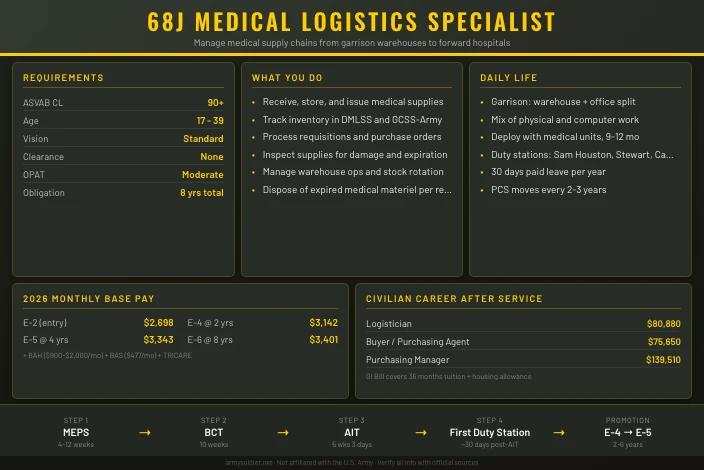
Job Role and Responsibilities
The 68J Medical Logistics Specialist receives, stores, accounts for, and issues medical supplies and equipment for Army medical units. You manage inventory databases, process purchase orders, perform quality control inspections, and ensure that medical facilities at every level have what they need to operate.
Day-to-day work involves a lot of system-based activity. You enter and track inventory using automated logistics software, process requisitions from medical units, receive shipments, and verify that delivered goods match orders. Physical warehouse work runs alongside the administrative side: loading and unloading pallets with forklifts and hand carts, inspecting supplies for damage or expiration, and rotating stock.
Quality control is a core part of the job. Medical supplies can’t just be counted – they need to be stored properly, temperature-monitored in some cases, and checked against strict expiration standards. Disposing of expired or contaminated medical materiel follows specific procedures. You document everything.
Specific Roles
The Army uses a skill-level progression within the 68J MOS:
| MOS Code | Skill Level | Role |
|---|---|---|
| 68J10 | SL1 (E1-E4) | Receipt, storage, inventory, shipping, and quality control of medical supplies |
| 68J20 | SL2 (E5) | Team leader; guides junior specialists on supply procedures |
| 68J30 | SL3 (E6) | Supervises small medical supply or stock control sections |
| 68J40 | SL4 (E7) | Supervises medium logistics division operations |
| 68J50 | SL5 (E8-E9) | Senior medical logistics NCO; advises commanders on supply readiness |
The Army also designates a 68J as eligible for specific additional skill identifiers (ASIs) as they gain experience. These can include property book management, medical maintenance oversight, and theater medical materiel management.
Mission Contribution
Medical readiness is directly tied to supply readiness. If a combat support hospital runs out of IV supplies, surgical equipment, or blood products, it cannot function. The 68J keeps that from happening. You support medical units in regional medical centers, combat support hospitals, and medical logistics companies across the Army.
Technology and Equipment
You work daily with the Medical Logistics Integrated Total Asset Visibility (MITAS) system, Defense Medical Logistics Standard Support (DMLSS) software, and the Global Combat Support System-Army (GCSS-Army). Physical equipment includes forklifts, pallet jacks, bar code scanners, and temperature monitoring devices. Larger medical depots use automated carousel storage systems.
Salary and Benefits
Financial Benefits
Military pay is based on rank and time in service. Most 68J soldiers graduate AIT and reach their first duty station as an E-2 or E-3.
| Rank | Pay Grade | Monthly Base Pay (2026) |
|---|---|---|
| Private (PV2) | E-2 | $2,698 |
| Private First Class | E-3 | $2,837 - $3,198 |
| Specialist | E-4 | $3,142 - $3,816 |
| Sergeant | E-5 | $3,343 - $4,422 |
| Staff Sergeant | E-6 | $3,401 - $5,044 |
| Sergeant First Class | E-7 | $3,932 - $5,537 |
Base pay reflects 2026 DFAS pay tables and the 3.8% across-the-board increase effective January 2026.
On top of base pay, you receive Basic Allowance for Housing (BAH) and Basic Allowance for Subsistence (BAS). BAH varies by duty station and dependency status. A single E-4 at Fort Sam Houston receives $1,359 monthly without dependents, or $1,728 with dependents. BAS adds $476.95 per month for food. Neither allowance is taxed.
The Army does not currently list a standard enlistment bonus for 68J. Bonus availability changes with recruiting conditions. Ask your recruiter about current incentives before signing.
Additional Benefits
TRICARE covers you and your family at no enrollment cost while on active duty. Doctor visits, hospital stays, prescriptions, dental, and vision are all included. There’s no deductible and no copay for in-network care.
Education benefits are a strong draw. Tuition Assistance covers up to $4,500 per year in college courses while you serve. After separation, the Post-9/11 GI Bill pays full in-state tuition at public universities (up to $29,920.95 per year at private schools) plus a monthly housing allowance and $1,000 annual book stipend for up to 36 months.
Retirement through the Blended Retirement System (BRS) combines a pension with a federal Thrift Savings Plan (TSP):
- Pension: 40% of your average base pay after 20 years of service
- TSP match: Government contributes up to 5% of basic pay (1% automatic plus up to 4% matching)
- Continuation pay: A lump-sum bonus available at 8 to 12 years of service in exchange for a 3-year extension
Work-Life Balance
You earn 30 days of paid leave per year. Garrison work follows a typical duty-day schedule. Field exercises and deployments extend those hours significantly, but the 68J spends far less time in austere field conditions than combat MOSs. Most duty time is spent in warehouse or administrative environments, which are more predictable.
Qualifications and Eligibility
Basic Qualifications
You must be a U.S. citizen or permanent resident, at least 17 years old (with parental consent) and no older than 39 at enlistment. High school graduates need a minimum AFQT of 31 on the ASVAB. GED holders need at least 50.
The 68J requires one ASVAB line score:
- Clerical (CL): 90 minimum
The CL composite combines Verbal Expression (VE), Arithmetic Reasoning (AR), and Mathematics Knowledge (MK). It measures the administrative and computational skills the job demands daily.
| Requirement | Details |
|---|---|
| Age | 17-39 years old |
| Citizenship | U.S. citizen or permanent resident |
| Education | High school diploma or GED |
| AFQT minimum | 31 (diploma) or 50 (GED) |
| ASVAB line score | CL: 90 minimum |
| Vision | Normal red/green color perception required |
| PULHES | 222332 (initial entry) |
| Physical demands | Medium (lift 50 lbs occasionally, 25 lbs frequently) |
| Security clearance | None required |
| Ineligible MOSs | Soldiers holding 68A, 68K, 68P, 68V, or 68WM6 cannot cross-train into 68J |
Application Process
Start with a visit to your local Army recruiting station. Your recruiter will confirm your qualifications and walk you through the enlistment options. If you haven’t taken the ASVAB, you’ll do so at MEPS (Military Entrance Processing Station) along with a full medical exam.
Selection Criteria and Competitiveness
The 68J is not among the most competitive Army MOSs. A CL of 90 is a moderate threshold, and there’s no special selection process beyond standard MEPS qualification. Prior experience in warehousing, supply chain, or inventory management won’t hurt, but nothing is required. If your CL score qualifies and you meet the physical and medical standards, you’re a viable candidate.
Upon Accession
You enter as an E-1 (Private, PV1) and promote to E-2 after graduating Basic Combat Training. The total service obligation for active-duty enlistment is typically 8 years: 2 to 4 years of active duty, with the remainder in the Reserve or Individual Ready Reserve (IRR).
See our ASVAB study guide for strategies to hit these line scores, or take the PiCAT from home if you are a first-time tester.
Work Environment
Setting and Schedule
Most 68J soldiers work in one of three environments:
- Medical supply warehouses and depots: The primary garrison setting. Climate-controlled where required. Standard duty hours with periodic on-call coverage.
- Medical logistics companies: Direct support to medical battalions. More field time than warehouse duty, especially during training exercises.
- Combat support hospitals (CSHs) and medical centers: Integrated with clinical teams. Faster pace, more direct contact with patient-care staff.
Shift work happens in high-demand settings. Some medical warehouses run 24-hour operations. During field exercises, you operate wherever the unit sets up, which can mean tents, vehicles, and extended hours.
Leadership and Communication
Your chain of command runs through the medical logistics section’s senior NCO and the medical unit’s officer in charge (OIC), typically a Warrant Officer (920A) or Medical Service Corps officer. Day-to-day communication involves supply requests from medical units, reports to your section chief, and coordination with civilian and military supply vendors.
Performance feedback comes through NCOERs (annual) and counseling sessions (quarterly at minimum). At the junior enlisted level, your squad leader evaluates your technical performance and professional development.
Team Dynamics and Autonomy
Logistics work is team-based by nature. You coordinate with receiving teams, storage teams, and issue teams. At the junior level, most decisions get checked with a supervisor. As you advance to E-5 and above, you take on independent accountability for sections of the supply account, which means real financial responsibility.
Inventory discrepancies are a big deal. A lost or misaccounted medical item can trigger formal investigations. Attention to detail and documentation discipline are what make the difference between a solid 68J and a liability.
Job Satisfaction and Retention
The 68J has moderate retention rates. Soldiers who enjoy logistics, systems work, and organizational problem-solving tend to stay. Those who enlist hoping for clinical patient-care exposure often feel the job doesn’t match expectations. Be clear about what the role is before committing to it.
Training and Skill Development
Initial Training
Training follows two phases before you reach your first duty station.
| Phase | Location | Duration | Focus |
|---|---|---|---|
| Basic Combat Training (BCT) | Fort Jackson, SC; Fort Moore, GA; Fort Leonard Wood, MO | 10 weeks | Soldier fundamentals: marksmanship, fitness, land navigation, tactical basics |
| Advanced Individual Training (AIT) – 68J | Fort Sam Houston, TX | 5 weeks, 3 days | Medical supply management, inventory systems, logistics software, warehouse procedures |
BCT is the same for every MOS. You learn rifle marksmanship, Army values, physical fitness standards, and basic soldier skills. There is no medical content in BCT.
AIT at Fort Sam Houston gives you a combination of classroom instruction and hands-on warehouse practice. You learn DMLSS and GCSS-Army software, supply accounting procedures, quality control protocols, and how to handle medical equipment. Towards the end of the course, practical exercises simulate actual medical unit supply scenarios.
At roughly 6 weeks total, this is one of the shorter AIT pipelines in CMF 68. You reach your first duty station faster than most medical MOS soldiers.
Advanced Training
After AIT, skill development continues on the job and through formal Army schooling. Options include:
- Unit Supply Specialist (92A) cross-training knowledge: Helpful for property book management roles at higher echelons
- Defense Medical Logistics Standard Support (DMLSS) operator courses: System-specific training available through the Army Medical Logistics School
- Property Book/Unit Supply Enhanced (PBUSE) training
- Hazardous Materials Handling certification: Required for handling certain pharmaceutical and chemical agent antidote stocks
- Army Logistics University (ALU) courses: Fort Gregg-Adams, VA. Available to NCOs pursuing logistics specializations
Senior NCOs typically pursue the Warrant Officer 920A (Property Accounting Technician) or 920B (Supply Systems Technician) tracks if they want to advance beyond the enlisted ceiling. The 68J experience is directly applicable.
Everything starts with qualifying ASVAB scores — our study guide covers what to study first.
Career Progression and Advancement
Career Path
Promotion to Specialist (E-4) typically happens automatically within 2 to 3 years if you meet time-in-grade and Army standards. Sergeant (E-5) requires a promotion board. At E-5, you move from performing supply tasks to leading a team of junior specialists.
| Rank | Pay Grade | Typical Years in Service | Role |
|---|---|---|---|
| Private (PV2) | E-2 | 0-1 | AIT graduate; entry-level supply tasks |
| Private First Class (PFC) | E-3 | 1-2 | Developing supply competency |
| Specialist (SPC) | E-4 | 2-3 | Proficient; handles independent supply functions |
| Sergeant (SGT) | E-5 | 4-6 | Team leader; supervises junior 68Js |
| Staff Sergeant (SSG) | E-6 | 6-9 | Section NCOIC; manages supply accounts |
| Sergeant First Class (SFC) | E-7 | 9-12 | Platoon sergeant; advises medical units on logistics readiness |
| Master Sergeant (MSG) | E-8 | 12-16 | Senior medical logistics advisor; battalion or brigade level |
| Sergeant Major (SGM) | E-9 | 16+ | Command sergeant major or senior medical logistics directorate NCO |
Role Flexibility and Transfers
Medical logistics experience transfers well within the Army logistics community. Common lateral paths include:
- 92A (Automated Logistical Specialist): Similar inventory and supply functions, broader materiel scope
- 92Y (Unit Supply Specialist): Property book and unit-level supply operations
- 68A (Biomedical Equipment Specialist): Medical equipment repair and maintenance (note: 68A holders cannot cross-train into 68J, but 68J can cross-train into other 68-series roles)
Any MOS change requires leadership approval, an open position, and usually a new service commitment for training.
Performance Evaluation
NCOs are evaluated annually through the NCOER system. Raters and senior raters score you on competence, character, leadership, and results. Strong NCOERs are the main driver of promotion to E-6 and beyond.
What separates good 68Js: zero inventory discrepancies, a clean property book, a well-run warehouse, and consistent mentorship of junior soldiers. Commanders and medical officers notice when supply readiness is high. They notice more when it isn’t.
Physical Demands and Medical Evaluations
Physical Requirements
The 68J carries a Medium physical demands rating. You lift up to 50 pounds occasionally and 25 pounds frequently. Operating forklifts, moving pallets, and working in warehouse environments are standard. Garrison work is not typically strenuous, but field exercises demand more – you set up and break down supply points, carry loads across rough terrain, and work long hours in varying weather.
Every soldier takes the Army Fitness Test (AFT) annually. The AFT replaced the ACFT on June 1, 2025, and has five events scored from 0 to 100 each. The 68J is not a combat specialty, so the general standard of 300 total (minimum 60 per event) applies.
| AFT Event | Description | Minimum Score |
|---|---|---|
| 3-Rep Max Deadlift (MDL) | Maximum weight lifted for 3 reps | 60 points (sex- and age-normed) |
| Hand-Release Push-Up (HRP) | Push-ups with arm extension at bottom | 60 points |
| Sprint-Drag-Carry (SDC) | Timed shuttle run with weighted tasks | 60 points |
| Plank (PLK) | Timed isometric hold | 60 points |
| Two-Mile Run (2MR) | Timed 2-mile run | 60 points |
Minimum passing total: 300 points. Each event is scored on sex- and age-normed tables.
The OPAT (Occupational Physical Assessment Test) is required at accession. The 68J’s medium physical demands category means you need to demonstrate a baseline lifting and work capacity at MEPS before your contract is signed.
Medical Evaluations
Normal red/green color perception is required for the 68J. The PULHES profile requirement of 222332 means no significant vision, hearing, psychiatric, or physical limitations. Annual medical readiness checks include weight, blood pressure, hearing, vision, and dental screenings. Pre-deployment medical clearances apply whenever your unit deploys.
Deployment and Duty Stations
Deployment Details
Medical logistics soldiers deploy with their units, but the role differs from combat MOS deployments. You’re typically based at a forward support area, medical logistics company, or CSH rather than at a patrol base or combat outpost. Deployment length runs 9 to 12 months for active duty, with typical rotations every 24 to 36 months.
Common deployment regions include the Middle East (Kuwait, Saudi Arabia, Iraq), Europe (Germany, Poland), and the Pacific (South Korea, Japan). Domestic deployments for disaster relief and humanitarian missions also occur.
Location Flexibility
The Army assigns duty stations based on manning requirements. You can submit a preference list, but it’s advisory, not binding. Common duty stations for 68J soldiers:
- Fort Sam Houston, TX – Home of the Army Medical Center of Excellence; large medical logistics presence
- Fort Stewart, GA
- Fort Liberty, NC
- Fort Campbell, KY
- Fort Wainwright, AK
- Overseas: Landstuhl Regional Medical Center (Germany), Yongsan (South Korea)
Expect to move every 2 to 4 years. The Army covers Permanent Change of Station (PCS) moves.
Risk, Safety, and Legal Considerations
Job Hazards
Compared to combat MOSs, the 68J operates in relatively low-risk environments. Still, there are real hazards:
- Forklift and warehouse accidents: The most common injury source for supply soldiers
- Hazardous materials exposure: Some medical supplies include controlled substances, biological agents, or chemical antidotes requiring special handling
- Deployed environment risks: Vehicle accidents, indirect fire, and physical security threats at forward medical areas
- Controlled substance accountability: Mishandling narcotics or controlled pharmaceutical items can result in criminal investigation under the UCMJ
Safety Protocols
Forklift operators require certification before operating equipment. Personal protective equipment (PPE) is mandatory for hazardous materials handling. Army Medical Department (AMEDD) protocols govern storage and disposal of temperature-sensitive, controlled, or biological materials. In deployed settings, force protection measures (body armor, battle drills) apply the same as any other soldier.
Security and Legal Requirements
No security clearance is required for the standard 68J. Certain assignments at higher command levels or involving controlled pharmaceutical stocks may require a Secret clearance as a collateral duty.
All soldiers operate under the Uniform Code of Military Justice (UCMJ). As a supply specialist, your legal exposure runs primarily through the Financial Liability Investigation of Property Loss (FLIPL) process. If supplies are lost, damaged, or misaccounted through negligence, you may be held financially liable. Sound documentation habits prevent this.
Impact on Family and Personal Life
Family Considerations
The 68J’s deployment frequency is similar to other active-duty MOSs: roughly one deployment cycle every 2 to 3 years. The nature of the role means you’re usually not embedded with high-tempo combat units, which reduces the chance of extended back-to-back deployments.
Garrison hours are more predictable than most combat arms MOS jobs. Field exercises still disrupt home life for weeks at a time, but the daily rhythm in garrison is closer to a standard work schedule.
Support resources at most installations include:
- Family Readiness Groups (FRGs) for peer connection and information sharing
- Military OneSource for free counseling, financial advice, and relocation help
- Army Community Service (ACS) for employment assistance, financial planning, and family support
- Exceptional Family Member Program (EFMP) for families with special medical or educational needs
Relocation and Flexibility
PCS moves happen every 2 to 4 years. The Army pays for household goods shipment and provides a move allowance, but each move disrupts spouses’ careers, children’s schooling, and community ties. Larger installations tend to offer more on-post housing and services, which helps with the transition.
Reserve and National Guard
The 68J Medical Logistics Specialist is well-represented in both the Army Reserve and the Army National Guard. Medical logistics companies exist in both components, and every medical unit that deploys needs a functioning supply chain. That requirement does not disappear in the reserve components - it just operates on a part-time schedule during peacetime.
Component Availability
Reserve and Guard 68Js serve in medical logistics companies, medical battalions, and area support medical companies. These units are distributed across the country, so finding a position near where you live is generally possible. Medical logistics is not a rare or limited-allocation specialty - units need it at every echelon, which means more openings than a highly specialized clinical MOS.
Drill weekends for 68J soldiers cover supply system procedures, inventory management updates, and medical materiel accountability training. The Army’s logistics software platforms - DMLSS, GCSS-Army, and MITAS - receive periodic updates, and staying current on those systems is part of the Reserve and Guard training requirement. Annual Training typically involves field exercises where logistics soldiers set up and run medical supply operations in a simulated operational environment.
One thing to plan for: medical supply management systems get upgraded on irregular schedules, and a Reserve 68J who works a civilian job unrelated to logistics may find the system-specific knowledge gaps widen between Annual Training cycles. Units address this through scheduled training, but personal investment in staying current matters.
Part-Time Pay
An E-4 with four years of service earns approximately $488 for a standard four-drill weekend, based on 2026 pay tables. Compare that to active duty, where the same E-4 earns $3,659 per month in base pay. Part-time pay supplements a civilian income rather than replacing it.
Reserve and Guard service works well financially when your civilian career already pays a living wage. The drill pay, combined with access to education benefits and healthcare, makes the part-time commitment a solid value proposition for someone who is not ready or willing to go full-time active duty.
Benefits Comparison
Active-duty soldiers receive TRICARE at no premium cost to the service member. Reserve and Guard soldiers on part-time status purchase Tricare Reserve Select: $57.88 per month for the member alone, or $286.66 per month for member plus family. That is a significantly better rate than most individual or family health insurance on the civilian market.
Education benefits for Reserve and Guard soldiers come through the Montgomery GI Bill Selected Reserve (MGIB-SR, Chapter 1606), which pays $493 per month for full-time students. National Guard members may also qualify for state tuition waivers - many states provide free or reduced tuition at in-state public universities for Guard soldiers meeting good-standing requirements. Active-duty soldiers use Tuition Assistance ($250 per credit hour, $4,500 per year cap) alongside the Post-9/11 GI Bill.
Reserve retirement is points-based. Drill attendance, Annual Training, and any mobilization periods all generate retirement points. A pension becomes payable at age 60. Mobilization after January 28, 2008, reduces that minimum age by three months for every 90 days of active service, down to a minimum of 50.
Deployment and Mobilization
Medical logistics units have a moderate mobilization history. They deploy to support combat support hospitals and theater medical operations, which means 68Js in the reserve components can expect real deployment risk during sustained military operations. Historical mobilization patterns for Army medical logistics units are similar to other medical support MOSs - not front-line frequency, but not rare. One mobilization over a 20-year reserve career is a reasonable baseline expectation, with the caveat that operational demand determines the actual number.
USERRA protects civilian employment during mobilization. Federal law requires employers to restore your position, seniority, and benefits when you return from active-duty service.
Civilian Career Integration
The 68J skill set translates directly into civilian supply chain and logistics careers. Medical supply chain manager, healthcare logistics coordinator, and materials management roles all draw on exactly what 68J soldiers do in uniform. Serving part-time while building civilian logistics or healthcare supply chain experience is a practical dual-track approach. Certifications from the Association for Supply Chain Management (CPIM, CSCP) align with 68J duties and are recognized by civilian healthcare systems, distribution companies, and government contractors. The combination of military credibility and professional civilian certification is a strong post-service positioning strategy.
| Feature | Active Duty | Army Reserve | Army National Guard |
|---|---|---|---|
| Duty Status | Full-time | Part-time (1 wknd/mo + 2 wks/yr) | Part-time (1 wknd/mo + 2 wks/yr) |
| Monthly Pay (E-4, 4 yrs) | $3,659/mo | ~$488/drill weekend | ~$488/drill weekend |
| Healthcare | TRICARE (no premium) | Tricare Reserve Select ($57.88/mo) | Tricare Reserve Select ($57.88/mo) |
| Education | Post-9/11 GI Bill, TA | MGIB-SR ($493/mo), TA | MGIB-SR ($493/mo), TA, state tuition waivers |
| Deployment | Per unit rotation | When mobilized | When mobilized |
| Retirement | 20-year pension | Points-based, age 60 | Points-based, age 60 |
Post-Service Opportunities
Transition to Civilian Life
Medical logistics experience is highly transferable. You leave the Army knowing how to run supply operations, manage automated inventory systems, handle controlled substances, and comply with regulatory standards. Those skills align directly with careers in healthcare supply chain management, government contracting, and commercial distribution.
The Transition Assistance Program (TAP) starts in your last 12 months on active duty and provides resume help, interview coaching, and employer connections. The Post-9/11 GI Bill covers tuition and a housing allowance for up to 36 months of school after you separate.
Several professional certifications align directly with 68J experience:
- Certified in Production and Inventory Management (CPIM) from the Association for Supply Chain Management (ASCM) – previously APICS
- Certified Supply Chain Professional (CSCP)
- Defense Acquisition Workforce Improvement Act (DAWIA) certifications for federal contracting roles
- Certified Materials and Resource Professional (CMRP)
Civilian Career Prospects
| Civilian Job | Median Annual Salary (2024) | 10-Year Outlook |
|---|---|---|
| Logistician | $80,880 | +17% |
| Purchasing Manager | $139,510 | +4% |
| Buyer / Purchasing Agent | $75,650 | +4% |
| Medical/Clinical Supply Chain Manager | $85,000-$110,000 (varies) | Strong |
| Inventory Control Specialist | $55,000-$75,000 (varies) | Stable |
Federal government positions are a natural fit. The Defense Logistics Agency (DLA), Department of Veterans Affairs (VA), and Army Materiel Command all hire veterans with 68J backgrounds for GS-6 through GS-12 positions. Your security-clearance eligibility and military system familiarity give you an edge over civilian candidates.
Post-Service Policies
An honorable discharge gives you access to VA healthcare, disability compensation if applicable, and lifetime education benefits. You can separate after your active-duty obligation expires. Talk to your career counselor 12 to 18 months before your end date to understand your options – especially if you’re considering switching to the Army Reserve or National Guard to maintain benefits and retirement credit.
Is This a Good Job for You?
Ideal Candidate Profile
The best 68J soldiers are organized, detail-oriented, and comfortable with accountability. You’re managing a supply account that has real financial and operational consequences. Sloppy record-keeping leads to investigations, shortages, and failed missions.
Strong fits for this MOS:
- People who liked business classes, accounting, or logistics coursework in high school
- Former warehouse, retail, or inventory management workers
- Anyone who naturally builds systems to track things and hates losing items
- Soldiers who want healthcare-adjacent work without the clinical patient-care demands of a medic role
- People interested in federal government or defense contractor careers after service
Potential Challenges
The 68J can disappoint soldiers who enlist expecting clinical exposure. You work around medical supplies, not with patients. The job is largely administrative and warehouse-based in garrison. That’s not a criticism – it’s just the reality. If you want to treat injuries, start IVs, or work directly with patients, this is the wrong MOS.
Other challenges:
- Accountability pressure: You are financially accountable for the supplies in your section. Errors cost money and can cost rank.
- Deployment environment: Even in a support role, deployed settings carry physical risk. You still need to be a soldier first.
- Repetitive tasks: Receiving, storing, and issuing the same categories of supplies can feel monotonous. If you need variety, plan for it through school, certifications, or a future career change.
Long-Term Fit
This MOS makes the most sense for someone with a long-term interest in logistics, supply chain management, or federal contracting. The civilian job market for supply chain professionals is strong, and your Army training maps directly onto in-demand skills.
If you want a medical career in nursing or clinical practice, use this MOS as a bridge – not a destination. The GI Bill and Tuition Assistance can fund a nursing degree or supply chain management degree after your service obligation ends.
The 68J is a solid choice for someone who wants an organized, mission-critical job, a path into healthcare or government logistics after service, and a military experience that doesn’t require combat-arms physical intensity.
More Information
Talk to an Army recruiter about the 68J. Confirm current AIT seat availability, enlistment options, and whether any bonuses apply to your contract. If you want to hear what the day-to-day is actually like, ask your recruiter to connect you with a currently serving 68J.
Visit goarmy.com to review the official 68J job description
Review credentialing and certification options through Army COOL
Use the DFAS pay tables to verify current base pay rates
Prepare for the ASVAB with our study guide to make sure your line scores qualify
This site is not affiliated with the U.S. Army or any government agency. Verify all information with official Army sources before making enlistment or career decisions.
Explore more Army medical careers such as the 68Q Pharmacy Specialist and 68D Operating Room Specialist.