68K Medical Laboratory Specialist
Army lab specialists run the blood tests, cultures, and diagnostic panels that tell doctors what’s actually wrong with a patient. Without accurate lab results, a physician is guessing. The 68K is the soldier behind those results.
Qualifying requires specific ASVAB line scores — our ASVAB study guide covers what to target and how to prepare.
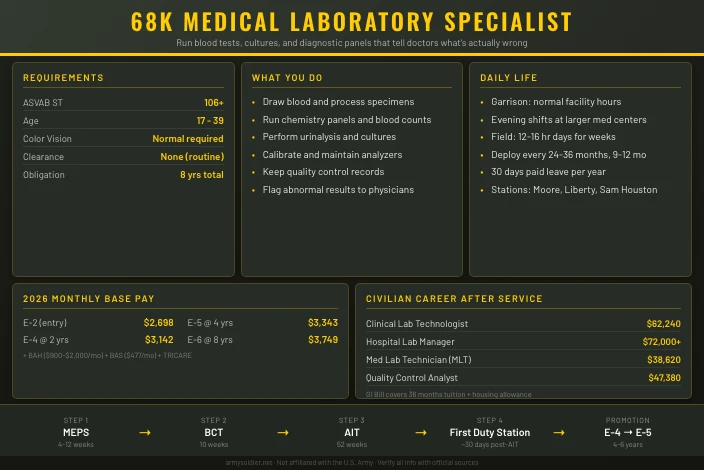
Job Role and Responsibilities
You process patient samples, run diagnostic tests, and report results to the physicians treating your unit. That means blood draws, urinalysis, cultures, chemistry panels, and immunology work. You also maintain the equipment and keep the quality control records that make every result defensible.
In garrison, most of your day looks like a hospital lab job. You collect and label samples, run them through automated analyzers, and flag anything that looks off. Standard tests include complete blood counts, chemistry panels, urinalysis, and blood cultures. You keep the centrifuges calibrated, the analyzers running, and the paperwork current.
Deployed, the job shrinks down to what portable gear can do. You run blood typing, basic chemistry, and screening tests for whatever infectious diseases are common to the region. The equipment is compact, the space is tight, and the turnaround time matters more than ever. Medics and physicians are waiting on your numbers before they make calls.
What sets this MOS apart from most lab work: you’re doing it inside a military system, sometimes in a tent, sometimes at a hospital in Germany, sometimes on a forward surgical team in a conflict zone. The science is the same. The conditions aren’t.
Salary and Benefits
Financial Benefits
Military pay is based on rank and time in service. Most lab specialists finish AIT at E-3 or E-4 depending on time in service.
| Rank | Pay Grade | Years of Service: 2 | Years of Service: 4 | Years of Service: 6 | Years of Service: 8 |
|---|---|---|---|---|---|
| Private (PV2) | E-2 | $2,698 | $2,698 | $2,698 | - |
| Specialist (SPC) | E-4 | $3,303 | $3,659 | $3,816 | $3,816 |
| Sergeant (SGT) | E-5 | $3,599 | $3,947 | $4,109 | $4,299 |
| Staff Sergeant (SSG) | E-6 | $3,743 | $4,069 | $4,236 | $4,613 |
Source: DFAS 2026 pay tables. Figures reflect the 2026 pay raise.
Beyond base pay, you get housing and food allowances. BAH (Basic Allowance for Housing) depends on your duty station and whether you have dependents. A single E-4 gets roughly $900 to $2,000+ per month depending on location. BAS adds about $477 monthly for food. Lab specialists may qualify for retention bonuses when the Army needs them in high-demand periods.
Additional Benefits
You and your family get TRICARE coverage at little or no cost – doctor visits, hospitalization, prescriptions, dental, and vision. The Army also covers mental health services. Tuition Assistance lets you take college classes while you’re on active duty. After you leave, the Post-9/11 GI Bill pays up to 36 months of tuition at a public university (full in-state rate) plus a monthly housing allowance.
Retirement works through the Blended Retirement System (BRS):
- Serve 20 years and you get a pension worth 40% of your base pay
- The government matches up to 5% of your Thrift Savings Plan (TSP) contributions
- Survivor Benefit Plan (SBP) protects your family if something happens to you
Work-Life Balance
You earn 30 days of paid leave per year (2.5 days per month). In garrison, lab work runs during normal facility hours with possible evening shifts at larger medical centers. That’s more predictable than most MOSs. Field exercises and deployments change the equation – high-tempo environments mean 12 to 16 hour shifts for weeks at a time.
The general rotation for active-duty units is 1 year deployed, 2 years home. That ratio shifts depending on how busy the Army is.
Qualifications and Eligibility
Basic Qualifications
You need to be a U.S. citizen between 17 and 39. High school grads need at least a 31 on the AFQT. GED holders need a 50. The 68K has one key ASVAB line score requirement:
- Skilled Technical (ST): 106 minimum
The ST score combines General Science, Verbal Expression, Mechanical Comprehension, and Math Knowledge. A 106 is competitive – this is a technical MOS, and the score reflects that.
Medical standards are standard for medical MOSs. You need normal color vision (some red-green color blindness may get a waiver), no severe hearing loss, and vision correctable to 20/20. A history of serious mental health issues, drug use, or certain criminal convictions may require a waiver or disqualify you.
| Requirement | Details |
|---|---|
| Age | 17-39 years old; up to 42 with waiver |
| Citizenship | U.S. citizen or permanent resident |
| Education | High school diploma or GED |
| AFQT (ASVAB) | Minimum 31 (diploma) or 50 (GED) |
| Skilled Technical (ST) | Minimum 106 (line score requirement for 68K) |
| Vision | Correctable to 20/20; no severe color blindness |
| Medical Standards | Able to work in medical facility environments; pass physical exam |
| Background | No disqualifying criminal history or drug use |
Application Process
Start at your local Army recruiting station. The recruiter will explain the 68K, check your qualifications, and help you decide between Active Duty, Reserve, or National Guard.
Next is MEPS (Military Entrance Processing Station). You take the ASVAB if you haven’t already, get a full medical exam, and go through a background check. This usually takes one full day. If your scores and medical results qualify you for 68K, your recruiter books a training slot.
The whole process from walking into the recruiter’s office to swearing in takes 4 to 12 weeks. Background investigations or medical clearances can stretch that. Once cleared, you get a report date for Basic Combat Training.
Selection Criteria and Competitiveness
The 68K is moderately competitive. That ST score of 106 filters out applicants who can’t handle the technical curriculum. Prior experience in phlebotomy, clinical lab work, or science helps. No civilian certifications are required, but having them makes you a stronger candidate.
Upon Accession into Service
You enter as E-1 and get promoted during and after training. Most lab specialists finish AIT at E-3 or E-4 depending on how long training takes relative to time in service. The standard obligation is 8 years total: typically 2 years active duty plus 6 years in the Reserve or Individual Ready Reserve. Training bonuses or special programs may extend that.
See our ASVAB study guide for strategies to hit these line scores, or take the PiCAT from home if you are a first-time tester.
Work Environment
Setting and Schedule
Lab specialists work in several different environments depending on assignment:
- Garrison hospital lab – climate-controlled, full diagnostic capability with modern analyzers; standard business hours with possible shift rotation
- Small clinic lab – broader responsibilities, smaller team; one specialist often covers all procedures
- Field hospital tent – mobile lab during exercises; portable equipment, limited resources
- Forward surgical team (deployed) – portable testing, rapid turnaround, schedules follow operational tempo
- Overseas medical centers – Landstuhl in Germany and facilities in South Korea run closer to garrison conditions
High-tempo deployments mean 12 to 16 hour shifts. Garrison assignments are far more predictable.
Leadership and Communication
Your chain of command runs through the facility’s chief of clinical laboratory (usually a Captain or First Lieutenant) and a senior lab NCO (E-5 or higher). Within the lab, you work under direct supervision of the lab supervisor or senior technician.
Feedback comes through annual evaluations and regular conversations with your supervisor. Most lab sections meet regularly to discuss new procedures, equipment changes, and quality issues.
Team Dynamics and Autonomy
You work as part of a team, but once you’re trained and qualified on specific equipment, you often work independently. You’re analyzing samples and generating results without someone checking every step. That requires real professional responsibility – you make judgment calls about sample quality, equipment behavior, and whether a result looks valid or needs a rerun.
The job rewards people who catch errors before they reach a physician. Specialists who question questionable results and push back when something looks wrong are the ones who earn trust.
Job Satisfaction and Retention
About 50 to 60% of lab specialists re-enlist after their first term, which is higher than combat-focused MOSs. The work is less physically brutal, and garrison assignments give you a more stable rhythm.
Specialists who stay tend to talk about the precision of the work, the respect they earn from medical officers, and the clarity of a result that’s either right or wrong. The most common frustrations are the repetitive nature of sample processing, the zero-error standard, and standing at a bench for long shifts.
Training and Skill Development
Initial Training
Training has two phases: Basic Combat Training (BCT) and Advanced Individual Training (AIT).
| Training Phase | Location | Duration | Focus |
|---|---|---|---|
| BCT | Fort Jackson, SC; Fort Moore, GA; Fort Leonard Wood, MO | 10 weeks | Soldier basics: marksmanship, tactics, fitness, discipline |
| AIT | Fort Sam Houston, TX (Brooke Army Medical Center) | 52 weeks (26 weeks classroom, 26 weeks clinical practicum) | Lab procedures, specimen handling, testing techniques, quality control |
BCT is the same for every MOS – rifle marksmanship, land navigation, squad tactics, and physical conditioning. It teaches you to be a soldier.
AIT at Brooke Army Medical Center in San Antonio is where you become a lab specialist. The 52-week program splits into two halves. The first 26 weeks cover classroom instruction: phlebotomy, urinalysis, blood banking, microscopy, clinical chemistry, microbiology, and immunohematology. The second 26 weeks are a clinical practicum – you process real patient samples, operate lab equipment, run quality control checks, and troubleshoot problems under supervision.
The curriculum is academically demanding. You need strong study habits to get through it.
Advanced Training
After AIT, several paths open up. Many lab specialists pursue the American Society for Clinical Pathology (ASCP) Medical Laboratory Technician (MLT) credential. Military lab experience counts toward the exam requirements, so you’re not starting from zero.
Some specialists focus on a specific area – microbiology, blood banking, chemistry, or immunology. Others move toward supervisory roles at E-5 and above, which shift the focus from bench work to managing other lab personnel and overseeing quality. The Army supports this through Tuition Assistance and the GI Bill, so pursuing a lab science or medical technology degree during or after service is common.
Everything starts with qualifying ASVAB scores — our study guide covers what to study first.
Career Progression and Advancement
Career Path
Promotion to E-4 (Specialist) comes after about 2 to 3 years and is mostly automatic if you meet the requirements. E-5 (Sergeant) takes longer and requires passing a promotion board. At E-5, you shift from running tests to leading other lab specialists.
| Rank | Pay Grade | Typical Years | Typical Role |
|---|---|---|---|
| Private First Class | E-3 | 0-1 | AIT graduate, entry level |
| Specialist | E-4 | 2-3 | Senior lab specialist, advanced procedures |
| Sergeant | E-5 | 4-6 | Lab supervisor, small unit leader |
| Staff Sergeant | E-6 | 6-9 | Senior lab leadership, quality oversight |
| Sergeant First Class | E-7 | 9-12 | Lab operations manager, NCO trainer |
| Master Sergeant | E-8 | 12+ | Senior medical leadership, facility-level oversight |
E-6 usually comes around 6 to 9 years. You manage other lab personnel and help shape medical policy for your facility. E-7 and above are highly competitive and require proven leadership, military education, and a clean record.
Role Flexibility and Transfers
You can request a transfer to another MOS, but you need leadership approval and an open slot. Common lateral moves include surgical specialist (68D), practical nursing specialist (68C), or medical supply specialist (92Y). Staying within the medical field is easier than crossing into a completely different career track.
Any MOS change means completing that job’s training and taking on a new service obligation. Lab specialists with strong evaluations generally have more options.
Performance Evaluation
NCOs get rated through the NCOER (NCO Evaluation Report) once a year. Your rater and senior rater score you on leadership, training, and technical skills. Strong NCOERs are the biggest factor in getting promoted to E-6 and above.
What actually sets you apart: testing accuracy, quality control discipline, mentoring junior specialists, and initiative in improving lab operations. Specialists who make the lab run better get noticed.
Physical Demands and Medical Evaluations
Physical Requirements
This MOS is lighter on the body than combat roles, but it’s not sedentary. You stand at benches for long shifts, carry samples and equipment, and need solid fine motor control. Needle-stick risk and bloodborne pathogen exposure are the primary occupational hazards, not heavy lifting.
The Army Fitness Test (AFT) applies to every soldier. Here are the minimum standards for ages 17 to 21:
| Event | Male Minimum | Female Minimum |
|---|---|---|
| 3-Rep Max Deadlift (MDL) | 140 lbs | 80 lbs |
| Hand-Release Push-Up (HRP) | 10 reps | 10 reps |
| Sprint-Drag-Carry (SDC) | 2:40 | 3:40 |
| Plank (PLK) | 2:00 | 2:00 |
| Two-Mile Run (2MR) | 15:54 | 18:54 |
Each event is scored 0 to 100. You need at least 60 per event and a 300 total. Lab specialists follow the same standards as every other soldier, though the job itself doesn’t carry combat-level physical demands.
Medical Evaluations
After enlistment, you get an annual health check: weight, blood pressure, vision, hearing, and a provider conversation. Lab specialists working with biohazard materials get baseline bloodwork at entry and periodic screening to catch any exposure-related issues early. Before deployment, you go through a separate medical clearance.
Deployment and Duty Stations
Deployment Details
Lab specialists deploy regularly, though less often than combat-focused MOSs. Active-duty specialists typically deploy once every 24 to 36 months for 6 to 12 months per rotation.
Deployment frequency depends on your assignment:
- Forward surgical team or hospital ship – regular deployment rotations, higher operational tempo
- Large garrison medical center – lower deployment probability, mission-essential at home station
- Field-focused medical unit – deploys more often, austere lab conditions are common
- Domestic emergency response – occasional deployment for natural disasters or humanitarian missions
Common deployment regions are the Middle East, Europe, and South Korea.
Location Flexibility
The Army assigns your duty station based on what it needs. You can submit a preference, but there are no guarantees. Expect to move every 2 to 4 years.
Common duty stations:
- Fort Moore, GA
- Fort Liberty, NC
- Fort Campbell, KY
- Overseas: Landstuhl, Germany; South Korea
Larger medical facilities can keep you in place for 3 to 4 years. Smaller clinic assignments rotate more frequently.
Risk, Safety, and Legal Considerations
Job Hazards
The primary risks in this MOS come from the materials you handle, not from enemy fire. Most are controllable with the right technique and protective equipment.
Primary hazards:
- Needle-stick and sharps injuries – the most common occupational risk; contaminated needles or broken glass can expose you to patient blood
- Bloodborne pathogen exposure – HIV, hepatitis B, and hepatitis C are the main concerns from accidental contact with samples
- Infectious microorganism contact – microbiology cultures carry live pathogens that require biosafety precautions
- Chemical exposure – laboratory reagents and solvents present skin and inhalation hazards
In deployed environments:
- Austere conditions – limited sanitation and communicable disease exposure
- Indirect conflict hazards – lab specialists at forward positions operate in protected medical facilities, but they’re not outside the risk zone entirely
Safety Protocols
The Army’s standard precautions apply to every sample:
- Gloves, eye protection, and lab coats for all specimen handling
- Needles and contaminated instruments go into sharps containers immediately
- Spill containment at every workstation
- Mandatory annual bloodborne pathogen training
- Immediate reporting and post-exposure prophylaxis for any needle-stick incident
Baseline bloodwork at entry and periodic follow-up testing during service track any exposure-related health changes.
Security and Legal Requirements
Routine 68K assignments don’t require a security clearance. Lab specialists at specialized facilities or deployed to sensitive locations may need a Secret clearance. The process takes 2 to 6 months.
All soldiers follow the Uniform Code of Military Justice (UCMJ). Lab specialists have specific legal duties around patient privacy – test results are protected health information, and you must handle them under HIPAA and military medical privacy rules.
Impact on Family and Personal Life
Family Considerations
Spouses and kids adjust to irregular training schedules and 6 to 12 month deployments. Lab specialists deploy less frequently than combat MOSs, but separations still happen.
Support resources at most installations:
- Family Readiness Groups (FRGs) – unit-level peer support and information during deployments
- Military OneSource – free counseling, financial coaching, and family services
- Spousal Employment Assistance (SECO) – career help for spouses at a new duty station
- School Liaison Program – helps kids transition between school systems during PCS moves
- Army Community Service (ACS) – financial readiness, parenting support, and emergency assistance
Relocation and Flexibility
You will move. After AIT, you go where the Army sends you, and that changes every 2 to 4 years. The Army pays for the move, but each PCS disrupts your spouse’s job, your kids’ school, and your community.
You can request preferred locations, but the Army’s needs come first. Larger installations tend to offer 3 to 4 year tours. Deployments separate families for 6 to 12 months. The target is 2 years home for every 1 year deployed, though operational demand can compress that.
Reserve and National Guard
The 68K Medical Laboratory Specialist is available in both the Army Reserve and the Army National Guard. Medical units with laboratory capability exist in both components, and lab diagnostic support deploys with medical battalions and combat support hospitals whenever those units are activated. Reserve and Guard lab specialists fill real positions, not just training slots.
Component Availability
Reserve and Guard 68Ks typically serve in medical battalions, combat support hospitals, and general support medical companies that maintain clinical laboratory sections. These units are distributed nationally, though not every state has a 68K-specific position open at any given time. Confirm vacancy with your recruiter before committing to a reserve component plan around this MOS.
The drill schedule for 68K soldiers carries more sustainment responsibility than many other MOSs. Clinical laboratory work is a proficiency-sensitive skill. Running diagnostic panels, interpreting results, and operating complex analyzers all require regular hands-on practice to stay sharp. On drill weekends, 68K soldiers typically work through proficiency testing exercises, review updated quality control protocols, and maintain familiarity with lab equipment. Reserve and Guard 68Ks who work in civilian laboratory settings during the week - as MLTs, phlebotomists, or clinical assistants - carry a significant skill maintenance advantage over those who don’t.
A specific ongoing requirement: the American Society for Clinical Pathology (ASCP) Medical Laboratory Technician (MLT) certification, which many 68Ks pursue, requires continuing education for renewal. The Army encourages this, but the responsibility for tracking and completing continuing education units (CEUs) often falls on the individual soldier. Staying credentialed matters both for military performance and civilian career value.
Part-Time Pay
A Reserve or Guard 68K at E-4 with four years of service earns approximately $488 for a standard four-drill weekend, based on 2026 pay tables. That same E-4 on active duty earns $3,659 per month in base pay. Part-time service is a supplement to civilian income, not a replacement.
For someone working as a civilian lab technician or phlebotomist, Reserve service adds drill pay, healthcare options, and retirement points on top of civilian wages. The financial math works well if you are already employed in a lab-adjacent civilian role.
Benefits Comparison
Active-duty 68K soldiers receive TRICARE at no cost. Reserve and Guard soldiers on part-time status can purchase Tricare Reserve Select: $57.88 per month for member-only coverage, or $286.66 per month for member plus family. That rate is below most comparable civilian individual or family plans.
Education access for Reserve and Guard soldiers runs through the MGIB-SR (Chapter 1606), which pays $493 per month for full-time enrollment. National Guard members may qualify for state tuition waivers - many states cover tuition at in-state public schools for Guard soldiers in good standing. Active-duty soldiers use Tuition Assistance ($250 per credit hour, $4,500 per year cap) and the Post-9/11 GI Bill. These are distinct programs, and Reserve soldiers should not expect the same Post-9/11 GI Bill access unless they accumulate qualifying active-duty time through mobilizations.
Reserve and Guard retirement is points-based. Drill weekends, Annual Training, and mobilization periods generate points toward a pension that becomes payable at age 60. Sustained mobilization time after January 28, 2008, can reduce that minimum age - three months off the threshold for every 90 days of active service, with a minimum floor of age 50.
Deployment and Mobilization
68K soldiers in the reserve components face moderate mobilization risk. Combat support hospitals and field medical units that include laboratory sections have deployed to support major operations, and Reserve and Guard lab specialists go with those units when they are activated. Lab support is a mission-essential function in deployed medical environments - blood typing, basic chemistry, and pathogen screening are required wherever Army medicine operates in a combat or contingency theater.
One deployment over a 20-year reserve career is a reasonable baseline expectation, though the actual number depends on global demand during your service window. USERRA protects your civilian job during any activation, requiring your employer to restore your position and benefits when you return.
Civilian Career Integration
The 68K skill set aligns directly with civilian laboratory careers. Medical laboratory technician (MLT) and clinical laboratory technologist positions are the most obvious transition targets. Military lab experience counts toward ASCP certification requirements, which shortens the path to a nationally recognized credential. Employers at hospitals, diagnostic labs, blood banks, and public health agencies actively recognize military lab training.
Reserve service while working in a civilian lab role creates a strong career combination. Each drill weekend reinforces clinical skills, the MGIB-SR or state tuition waiver can fund additional education, and the retirement points accumulate quietly in the background. For 68Ks planning a long civilian laboratory career, part-time Reserve or Guard service is a practical way to stay connected to the military while building civilian credentials simultaneously.
| Feature | Active Duty | Army Reserve | Army National Guard |
|---|---|---|---|
| Duty Status | Full-time | Part-time (1 wknd/mo + 2 wks/yr) | Part-time (1 wknd/mo + 2 wks/yr) |
| Monthly Pay (E-4, 4 yrs) | $3,659/mo | ~$488/drill weekend | ~$488/drill weekend |
| Healthcare | TRICARE (no premium) | Tricare Reserve Select ($57.88/mo) | Tricare Reserve Select ($57.88/mo) |
| Education | Post-9/11 GI Bill, TA | MGIB-SR ($493/mo), TA | MGIB-SR ($493/mo), TA, state tuition waivers |
| Deployment | Per unit rotation | When mobilized | When mobilized |
| Retirement | 20-year pension | Points-based, age 60 | Points-based, age 60 |
Post-Service Opportunities
Transition to Civilian Life
Your training transfers directly to civilian lab work. You leave with practical experience that most civilian lab techs take years to build. Military lab experience counts toward the ASCP certification exam, so many specialists get credentialed quickly after separating.
The Transition Assistance Program (TAP) gives you resume help, interview coaching, and benefits counseling during your last 12 months on active duty. The Post-9/11 GI Bill covers up to 36 months of tuition (full in-state rate at public schools or a capped amount at private ones) plus a housing allowance and book stipend. Employers in healthcare, pharmaceuticals, and diagnostic labs actively recruit veterans with lab backgrounds.
Civilian Career Prospects
Here’s where lab specialists typically land after service:
| Civilian Occupation | Median Annual Salary (2024) | 10-Year Outlook |
|---|---|---|
| Medical Laboratory Technician (MLT) | $38,620 | +5% |
| Clinical Laboratory Technologist | $62,240 | +5% |
| Phlebotomist | $35,870 | +7% |
| Quality Control Analyst | $47,380 | +4% |
| Hospital Laboratory Manager | $72,000+ | +6% |
Beyond direct lab work, your precision, quality control discipline, and technical troubleshooting skills translate to pharmaceutical manufacturing, diagnostic equipment companies, and federal health agencies. The CDC and Department of Defense labs recruit veterans for laboratory positions.
Post-Service Policies
An honorable discharge gives you lifetime access to VA healthcare, disability compensation (if applicable), survivor benefits, and education benefits. You can separate after your 8-year obligation if you choose not to re-enlist. Talk to your career counselor well before your end date.
A discharge other than honorable strips most VA benefits. Keep your record clean.
Is This a Good Job for You?
Ideal Candidate Profile
The best lab specialists are precise, disciplined, and genuinely curious about how diagnostic science works. They don’t find repetition boring – they find errors, and that matters more.
Traits that predict success:
- Detail-oriented and able to maintain focus during long bench shifts
- Strong study habits – lab AIT is academically demanding
- Self-directed enough to work independently once trained
- Comfortable with biological materials, needles, and infectious samples
- Background in science, chemistry, or healthcare
This job fits people who want to support patient care from behind the scenes. The results you produce shape every treatment decision.
Potential Challenges
This MOS is a poor fit if you:
- Need variety or constant change – the same tests run every single day
- Are uncomfortable around blood, infectious samples, or needle-stick risk
- Struggle with standing at a bench for hours while maintaining precision
- Want to be in the field with a rifle and a team
- Chafe under strict standard operating procedures – lab work has no room for improvisation
Career and Lifestyle Alignment
If you want to work in lab science, medical technology, or public health after the Army, this is a smart path in. Your military experience shortens the road to ASCP certification, and employers take military lab training seriously. The GI Bill covers further schooling if you want to move up to clinical laboratory technologist or beyond.
The trade-off is real. You’ll relocate every few years. Early-career pay is modest. The work is repetitive by design. But if precise, consequential work in a structured environment sounds like a good fit, this MOS delivers exactly that.
More Information
Talk to an Army recruiter about the 68K. Ask about current bonuses, open training slots, and whether your ASVAB scores qualify. If you can, ask to speak with an active 68K soldier about what a typical day actually looks like.
Take the MOS Finder quiz at goarmy.com
Schedule an ASVAB at your nearest MEPS to see where your scores land
Talk to military families in your area for an honest picture of Army life
Prepare for the ASVAB with our study guide to make sure your line scores qualify
This site is not affiliated with the U.S. Army or any government agency. Verify all information with official Army sources before making enlistment or career decisions.
Explore more Army medical careers such as the 68W Combat Medic Specialist and 68D Operating Room Specialist.