68L Occupational Therapy Specialist
Most people don’t expect to graduate Army AIT with over eight months of hands-on occupational therapy training and a shot at a $20,000 enlistment bonus. The 68L Occupational Therapy Specialist does exactly that. You work under licensed military occupational therapists to assess patients, build treatment plans, and guide injured soldiers back to full function. This MOS sits in a rare spot where clinical depth, military service, and a direct path to civilian OT careers all line up.
Qualifying requires specific ASVAB line scores — our ASVAB study guide covers what to target and how to prepare.
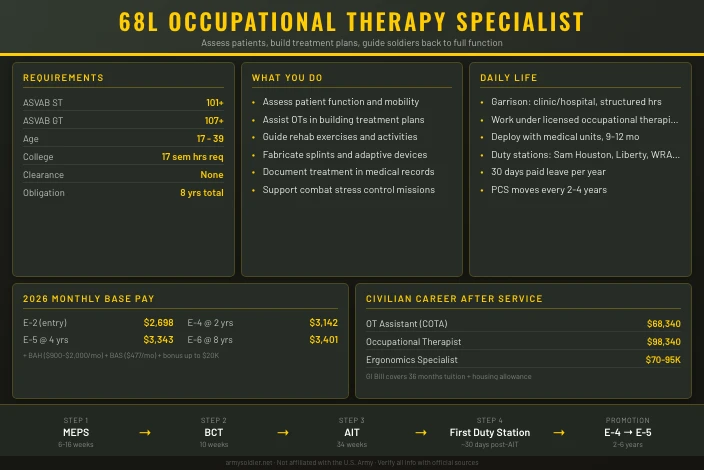
Job Role and Responsibilities
As a 68L Occupational Therapy Specialist, you assist licensed occupational therapists in evaluating patients, designing individualized treatment programs, and teaching soldiers how to perform daily life tasks after illness or injury. You conduct patient assessments, execute therapeutic interventions, document patient progress, and support recovery goals across Army medical facilities ranging from garrison clinics to deployed treatment centers.
Day-to-day work focuses on patient treatment, assessment support, and documentation. You interview patients to evaluate functional limitations, run therapeutic exercises, monitor progress, and adjust treatment plans with the supervising therapist. You file detailed progress reports and maintain accurate medical records for every patient in your caseload.
The scope of conditions you’ll treat is wide. Patients come in with orthopedic injuries, traumatic brain injuries (TBI), combat stress, and chronic pain conditions. You help them regain hand function after a fracture, rebuild strength and coordination after a TBI, or work through sensory processing issues after blast exposure.
Army Enlisted Specialization System for 68L:
| Identifier | Type | Purpose |
|---|---|---|
| MOS 68L | Primary MOS | Occupational Therapy Specialist |
| ASI (Additional Skill Identifier) | Specialization add-on | Advanced skills in specific OT techniques or patient populations |
| SQI (Special Qualification Identifier) | Qualification add-on | Special capabilities, e.g., assignment to combat operational stress control units |
Career progression in 68L follows the Army skill-level system. At SL1 (E-1 to E-4), you administer routine occupational therapy treatment and assist with patient assessments. At SL2 (E-5), you supervise day-to-day patient care activities and take on small-unit leadership duties. By SL3 (E-6 to E-7), you manage occupational therapy clinic sections, supervise other specialists, and oversee mobile treatment facilities. Senior NCOs at SL4 (E-8) can serve as Prevention Platoon Sergeant in a Combat and Operational Stress Control (COSC) Detachment.
Occupational therapy directly supports Army readiness. A soldier who can’t use their hands after a wrist injury is non-deployable. An OT specialist who gets that soldier through a focused rehabilitation program gets them back to duty faster, reduces medical evacuations, and keeps units at full strength. During combat operations, you treat battlefield casualties dealing with both physical and psychological impacts of injury.
Technology and Equipment
You’ll work with electronic health record systems across Army medical facilities. Clinical tools include standardized assessment instruments for measuring grip strength, range of motion, and functional task performance. Therapy equipment ranges from hand therapy tools and splinting materials to adaptive devices and sensory integration equipment. As Army healthcare technology updates, training on new systems comes with the role.
Salary and Benefits
Financial Benefits
Pay is based on rank and years of service. Most soldiers enter as Private (E-1) and promote to Private (E-2) after Basic Combat Training.
| Rank | Pay Grade | Monthly Base Pay (2026) |
|---|---|---|
| Private (PV2) | E-2 | $2,698 |
| Private First Class (PFC) | E-3 | $2,837 - $3,198 |
| Specialist (SPC) | E-4 | $3,142 - $3,816 |
| Sergeant (SGT) | E-5 | $3,343 - $4,422 |
| Staff Sergeant (SSG) | E-6 | $3,401 - $5,044 |
Base pay is only part of total compensation. Housing and food allowances add significantly. BAH (Basic Allowance for Housing) varies by duty station and dependent status. At Fort Sam Houston in San Antonio, a single E-4 receives approximately $1,359/month in BAH; with dependents, that rises to roughly $1,728/month. BAS (Basic Allowance for Subsistence) adds a flat $476.95/month for food regardless of duty location.
The GoArmy.com 68L career page lists a signing bonus of up to $20,000 for qualifying recruits. Bonus amounts depend on enlistment options, prior education, and current Army needs. Verify current bonus availability with a recruiter.
Additional Benefits
Active-duty soldiers and their families receive TRICARE Prime at no cost. That covers medical, dental, vision, prescriptions, mental health, and hospitalization. No enrollment fee, no deductibles, no copays for in-network care.
Tuition Assistance lets you take college courses while on active duty, covering up to $4,500 per year in tuition costs. After service, the Post-9/11 GI Bill pays full in-state tuition at public universities (up to $29,920.95 per year at private schools for the 2025-2026 academic year), a monthly housing stipend, and up to $1,000 annually for books. That’s 36 months of coverage – enough for a full degree.
Retirement under the Blended Retirement System (BRS):
- Pension: 40% of average base pay after 20 years of service
- TSP matching: Government contributes up to 5% of basic pay (1% automatic + up to 4% match)
- Continuation pay: Available between 8-12 years of service; typically 2.5x monthly basic pay for a 3-year commitment
Work-Life Balance
You earn 30 days of paid leave per year, accruing 2.5 days per month. Garrison OT clinics generally follow standard business hours. Field exercises and deployments disrupt that schedule, but occupational therapy specialists rarely work the kind of irregular hours that combat-focused roles do. Expect a deployment rotation roughly every 24 to 36 months depending on your unit’s readiness requirements.
Qualifications and Eligibility
Basic Qualifications
You must be a U.S. citizen between 17 and 39 years old. High school graduates need a minimum AFQT score of 31; GED holders need 50. The 68L has two ASVAB line score requirements:
- Skilled Technical (ST): Minimum 101
- General Technical (GT): Minimum 107
The ST composite includes General Science, Verbal Expression, Math Knowledge, and Mechanical Comprehension. The GT composite combines Verbal Expression and Arithmetic Reasoning. Both scores are on the higher end for enlisted medical MOSs, reflecting the clinical and academic demands of the role.
| Requirement | Details |
|---|---|
| Age | 17-39; up to 42 with waiver |
| Citizenship | U.S. citizen |
| Education | High school diploma or GED; 17 semester hours of college credit required |
| AFQT | 31 minimum (diploma); 50 minimum (GED) |
| ASVAB ST | 101 minimum |
| ASVAB GT | 107 minimum |
| OPAT Category | Moderate (Gold) |
| Vision | Normal color vision required |
| Security Clearance | Not required (E-8 and above may require interim clearance) |
| Other | No aversion to blood; bilateral finger dexterity required |
OPAT is the Occupational Physical Assessment Test. For Moderate (Gold) category, minimum scores are: Standing Long Jump 120 cm, Seated Power Throw 350 cm, Strength Deadlift 120 lbs, and Interval Aerobic Run 36 shuttles.
Application Process
Start at your local Army recruiting station. The recruiter verifies your ASVAB scores (or schedules testing at MEPS) and checks that your college credit meets the 17-semester-hour requirement. If you’re short on hours, you can complete them before shipping to BCT.
MEPS (Military Entrance Processing Station) is a full-day evaluation: physical exam, ASVAB (if not already taken), background review, and job selection. If your scores qualify and your medical exam clears, you sign your contract with the 68L MOS code listed. From your first recruiter visit to swearing in, expect 6 to 16 weeks. Medical waivers or incomplete college credits can stretch that timeline.
Selection Criteria and Competitiveness
The 68L is more selective than many enlisted medical MOS jobs. The combination of the ST 101 / GT 107 score requirement and the college credit prerequisite screens out a significant portion of applicants. Candidates with healthcare volunteer experience, CNA certification, or prior college coursework in healthcare or science have an edge in both qualifying and demonstrating fit.
Upon Accession into Service
You enter as Private (E-1) and promote to Private (E-2) after BCT. Most soldiers leave AIT as an E-3 or E-4 depending on time in service and prior college credit. The standard service obligation is 8 years total, typically split between active duty and the Reserve Component or Individual Ready Reserve.
See our ASVAB study guide for strategies to hit these line scores, or take the PiCAT from home if you are a first-time tester.
Work Environment
Setting and Schedule
The 68L works in structured clinical settings. Most garrison assignments are at military hospitals or outpatient rehabilitation clinics. Common locations include:
- Fort Sam Houston, TX (Brooke Army Medical Center)
- Fort Liberty, NC (Womack Army Medical Center)
- Fort Moore, GA (Martin Army Community Hospital)
- Walter Reed National Military Medical Center, MD
In garrison, the schedule follows standard clinical hours with occasional after-hours coverage. Deployed, you may support a Combat Support Hospital, a field medical facility, or a COSC detachment. In those settings, patient volume dictates hours more than any clock.
Senior NCOs in COSC detachments work with units returning from high-stress operations, conducting stress management programs and functional assessments in the field. That work happens wherever the unit is, not in a clinic.
Leadership and Communication
You work under a registered military occupational therapist – an Army officer with the AOC 65A designation. The treatment team typically includes physical therapists, physicians, and other allied health specialists. Your chain of command runs through the senior OT NCO, the clinic officer in charge, and the medical unit commander.
Performance feedback comes through annual NCO Evaluation Reports (NCOERs) for E-5 and above. Junior specialists receive counseling from their squad leaders and clinic supervisors. Most OT clinics run regular case reviews where specialists present patient progress and get direct clinical supervision.
Team Dynamics and Autonomy
In the clinic, you work within a structured team under direct therapist supervision. You don’t make independent clinical decisions, but you do run treatment sessions, make real-time adjustments during exercises, and observe patient responses closely enough to inform the treatment plan.
With experience, you take on more. An E-5 or E-6 will often run entire treatment sessions independently, with the supervising OT reviewing progress notes and adjusting the plan. Senior specialists at COSC detachments have broader independent authority in managing stress control programs for units.
Job Satisfaction and Retention
Specialists who stay point to visible patient outcomes, the clinical depth of the training, and the fact that the GI Bill positions them well for civilian OT programs. The harder factors are the college credit prerequisite before you can start the job and the long AIT that keeps you out of your first duty station for over eight months. Retention is solid among specialists who enter with clear goals for the post-service transition.
Training and Skill Development
Initial Training
Training consists of two phases before you reach your first duty station.
| Training Phase | Location | Duration | Focus |
|---|---|---|---|
| Basic Combat Training (BCT) | Fort Jackson, SC; Fort Moore, GA; Fort Leonard Wood, MO | 10 weeks | Soldier fundamentals: marksmanship, tactics, land navigation, physical fitness, Army discipline |
| AIT Phase 1 | Fort Sam Houston, TX | 18 weeks | Occupational therapy theory, anatomy and physiology, clinical assessment techniques, therapeutic interventions, documentation systems |
| AIT Phase 2 | Fort Sam Houston, TX | 16 weeks | Clinical practicum, hands-on patient treatment under supervision, case management, deployed OT operations |
BCT is the same for every enlisted soldier. Ten weeks of marksmanship, physical conditioning, land navigation, squad tactics, and Army customs.
AIT for 68L is among the longest in CMF 68 at 34 weeks total. Phase 1 builds the academic foundation: anatomy, physiology, therapeutic techniques, and the assessment tools you’ll use with every patient. Phase 2 is a supervised clinical practicum where you apply that knowledge with real patients under direct therapist oversight.
Advanced Training
After AIT, several development paths open up. Specialists can pursue certifications in hand therapy techniques, assistive technology, or sensory integration. COSC training prepares specialists for combat operational stress control assignments.
The Army funds continuing education through Tuition Assistance and the GI Bill. Some specialists use on-duty time to complete additional college prerequisites needed for a civilian Occupational Therapy Assistant program or a full OT master’s degree. The Army education center at most installations helps you build a degree plan that aligns with your post-service goals.
Strong performers are competitive for Warrant Officer programs in medical administration, or can pursue a commission through the Officer Candidate School pathway with a bachelor’s degree and prior service experience.
Everything starts with qualifying ASVAB scores — our study guide covers what to study first.
Career Progression and Advancement
Career Path
Most soldiers enter as E-1 and reach E-4 within 2 to 3 years with standard performance. Promotion to E-5 requires a promotion board and demonstrated NCO competence.
| Rank | Pay Grade | Typical Years in Service | Typical Role |
|---|---|---|---|
| Private (PV2) | E-2 | 0-1 | AIT graduate, initial orientation at first unit |
| Specialist (SPC) | E-4 | 2-3 | Staff OT specialist; develops clinical and technical skills |
| Sergeant (SGT) | E-5 | 4-6 | Clinic section leader; supervises junior specialists and daily patient care |
| Staff Sergeant (SSG) | E-6 | 6-9 | Senior OT NCO; manages clinic operations, mobile treatment facilities |
| Sergeant First Class (SFC) | E-7 | 9-14 | OT operations NCO; COSC detachment leadership; advanced clinical oversight |
| Master Sergeant (MSG) | E-8 | 14+ | Senior medical NCO; program management, training development, policy; requires interim security clearance per AR 600-8-19 |
At E-6 and E-7, specialists move into COSC detachments and manage occupational therapy programs for entire units. That’s where the MOS gets strategic – you’re not just treating individual patients, you’re running unit-level prevention programs.
Role Flexibility and Transfers
Lateral transfers to other medical MOSs are possible but require leadership approval and an available slot. Common cross-training paths include 68W (Combat Medic), 68C (Practical Nursing Specialist), and medical administrative roles. Any transfer requires completing the new MOS training and accepting a new service obligation.
College credit accumulated before and during service counts toward civilian OT degree programs, giving you more educational flexibility than most enlisted specialties.
Performance Evaluation
NCOs (E-5 and above) are evaluated annually through the NCOER. Raters score you on leadership, clinical competence, Army values adherence, and performance against assigned tasks. The highest rating tier – “exceeds standards” – puts you in the competitive zone for early promotion.
What separates strong performers: patient outcomes documentation, clinical supervision skills, initiative in process improvement, and consistent mentoring of junior specialists. Staying current on OT techniques and building civilian certifications alongside military duties signals long-term commitment and earns strong ratings.
Physical Demands and Medical Evaluations
Physical Requirements
The 68L is rated in the Moderate (Gold) OPAT category. The daily physical demands are real but not extreme: you’re on your feet for most of the workday, you handle patients with limited mobility, and you physically assist some patients through exercises or transfers. Manual dexterity in both hands is required – it’s explicitly listed in the MOS medical requirements.
Every soldier takes the Army Fitness Test (AFT) annually. The AFT has five events scored 0-100 each. Minimum passing score is 60 per event, with a 300 total minimum for standard Army roles. All scoring is sex- and age-normed.
| AFT Event | Event Name | Minimum Score |
|---|---|---|
| MDL | 3 Repetition Maximum Deadlift | 60 points |
| HRP | Hand Release Push-Up | 60 points |
| SDC | Sprint-Drag-Carry | 60 points |
| PLK | Plank | 60 points |
| 2MR | Two-Mile Run | 60 points |
Maximum score: 500 points (100 per event). Minimum passing total: 300 points (60 per event).
Medical Evaluations
Annual health assessments cover weight, blood pressure, vision, and hearing. Soldiers working in clinical OT settings may also undergo occupational health reviews. Pre-deployment medical clearances confirm fitness for the specific environment – forward-deployed OT specialists in austere conditions face different physical demands than garrison clinic work.
Normal color vision is a medical requirement for the 68L. Some color vision deficiencies may be waiverable; a military physician makes that determination. A history of conditions affecting bilateral hand function or dexterity requires review.
Deployment and Duty Stations
Deployment Details
Occupational therapy specialists deploy regularly but less often than combat-focused roles. Active-duty 68L soldiers typically deploy once every 24 to 36 months for 9 to 12 months. Specialists assigned to COSC detachments or high-readiness units deploy more frequently than those in fixed-facility garrison clinics.
Common deployment environments:
- Middle East: Combat support hospitals and forward operating bases with high musculoskeletal and TBI patient loads
- Europe: NATO commitment hospitals in Germany and Poland
- South Korea: Persistent deterrence mission medical facilities
- Domestic: Disaster relief and humanitarian assistance operations at stateside and OCONUS locations
Location Flexibility
The Army assigns duty stations based on mission requirements. You can submit a preference list, but availability drives the assignment. Expect to move every 2 to 4 years.
Common duty stations for 68L specialists:
- Fort Sam Houston, TX (Brooke Army Medical Center)
- Fort Moore, GA (Martin Army Community Hospital)
- Fort Liberty, NC (Womack Army Medical Center)
- Fort Campbell, KY (Blanchfield Army Community Hospital)
- Walter Reed National Military Medical Center, MD
- Landstuhl Regional Medical Center, Germany
- Brian Allgood Army Community Hospital, South Korea
Risk, Safety, and Legal Considerations
Job Hazards
The 68L works in a clinical environment with a moderate risk profile. Physical contact with patients – assisting with exercises, guiding movement, managing agitated individuals – carries a small risk of musculoskeletal strain. Specialists working with neurological patients or those recovering from psychiatric injury may encounter unpredictable behavior.
Deployed OT specialists face indirect fire, vehicle accidents, and austere living conditions alongside any other forward-deployed personnel. COSC specialists operating near the front lines work in conditions that carry operational risk.
Safety Protocols
Clinical environments have structured safety measures:
- Patient handling training and body mechanics instruction before direct patient care
- Clinical supervision from licensed OT officers for all patient treatment
- Behavioral protocols for managing agitated or confused patients
- Infection control and personal protective equipment standards
- Deployment-specific safety briefings and force protection procedures for forward medical facilities
Security and Legal Requirements
The 68L does not require a security clearance for standard assignments. Specialists promoted to E-8 and above may require an interim clearance per AR 600-8-19. Assignments supporting special operations medical programs could require a Secret clearance; the process typically takes 2 to 6 months.
All soldiers follow the Uniform Code of Military Justice (UCMJ). Medical specialists carry additional obligations under HIPAA. Patient records are legally protected, and unauthorized disclosure is a disciplinary offense. Service obligation for most 68L contracts is 8 years total (active duty plus Reserve Component time).
Impact on Family and Personal Life
Family Considerations
Army life means moves, deployments, and adjustments. For a 68L, the initial training pipeline alone runs nearly 11 months before you arrive at your first permanent duty station. That gap affects relationships, housing decisions, and family plans. Partners and spouses need to prepare for that reality before you ship.
Once at a duty station, the garrison lifestyle for medical specialists is more predictable than for combat arms soldiers. Clinic hours are generally regular. Deployments are real but less frequent than frontline roles.
Support resources at Army installations:
- Family Readiness Groups (FRGs): Unit-level peer support and communication during deployments
- Military OneSource: Free counseling, financial services, and family support available 24/7
- Army Community Service (ACS): Spousal employment assistance, relocation support, financial counseling
- TRICARE: Full healthcare coverage for family members at no enrollment cost
- School Liaison Officers: Help military children through school transitions during moves
- Chaplain services: Confidential pastoral counseling at no charge
Relocation and Flexibility
Moving is part of Army service. After AIT, the Army assigns you to a duty station based on needs, and you’ll likely move again every 2 to 4 years. The Army covers moving costs through the Permanent Change of Station (PCS) process, but each move disrupts established routines. Spouses often face career interruptions, and children switch schools repeatedly.
Larger installations tend to offer 3-year assignment tours, giving families more stability than short tours. Deployments are 9 to 12 months on average and occur roughly every 2 to 3 years for active-duty 68L specialists.
Reserve and National Guard
The 68L Occupational Therapy Specialist is a limited position in both the Army Reserve and the Army National Guard. Occupational therapy is a highly specialized rehabilitation role, and the number of OT positions in reserve component medical units is small. This is not a broadly distributed MOS - it requires active optometry and rehabilitation capability in the unit, which narrows the pool considerably.
Component Availability
Reserve and Guard 68L positions exist primarily in medical brigades and hospital units with rehabilitation program capability. The number of available slots is genuinely limited, and in many states there may be no open 68L position at all. If part-time service as a 68L is your goal, your first step is verifying that a position exists within a geographic area that works for you. Ask your recruiter to run a current vacancy search before you invest time in the application process.
The drill schedule is the same Army standard: one weekend per month plus two weeks of Annual Training per year. For 68L soldiers, drill weekends typically include clinical skill sustainment - reviewing therapy techniques, working through patient care scenarios, and maintaining familiarity with occupational therapy assessment tools. The hands-on nature of OT work means skills can degrade between drill cycles for soldiers who are not working in a related civilian role. Units try to schedule practical training, but the sustainment challenge is real for this specialty.
The 34-week AIT requirement means there is a long pipeline investment before you reach any duty position, active or reserve. That investment applies the same way regardless of component.
Part-Time Pay
A Reserve or Guard 68L at E-4 with four years of service earns approximately $488 for a standard four-drill weekend, based on 2026 pay tables. Active-duty E-4 base pay at four years is $3,659 per month. The gap is significant. Part-time service in a limited-slot MOS makes the most financial sense when combined with a civilian career that is already generating income.
For a 68L who transitions out of active duty and into a civilian occupational therapy aide or COTA role, Reserve service adds drill pay, Tricare Reserve Select healthcare access, and retirement points - a meaningful supplement to civilian income without requiring full-time military service.
Benefits Comparison
Active-duty soldiers receive TRICARE at no cost to the service member. Reserve and Guard soldiers on part-time status purchase Tricare Reserve Select: $57.88 per month for member-only coverage, or $286.66 per month for member plus family. Both rates are competitive against civilian health insurance alternatives, though they are not free.
Education access for Reserve soldiers runs through the MGIB-SR (Chapter 1606), which pays $493 per month for full-time enrollment. National Guard members may qualify for state tuition waivers - many states cover tuition at in-state public schools for Guard soldiers meeting service requirements. This benefit can be especially valuable for a 68L working toward a COTA associate degree or OT master’s program after service.
Retirement in the reserve components is points-based. Drill attendance, Annual Training, and mobilization periods all generate points toward a pension that becomes payable at age 60. Mobilization after January 28, 2008, can reduce that threshold - three months off the minimum age for every 90 days of active-duty service, down to a floor of age 50.
Deployment and Mobilization
The 68L in the reserve components has a low mobilization frequency compared to most medical support MOSs. Occupational therapy rehabilitation is a specialized clinical role with a limited number of deployment positions. Not every medical unit that deploys includes an OT section. That said, mobilization is not impossible - combat support hospitals and higher-echelon medical units do include OT capability, and when those units activate, their 68L soldiers go with them.
USERRA protects your civilian employment during any mobilization, requiring your employer to restore your position, seniority, and benefits when you return from active-duty service.
Civilian Career Integration
The connection between 68L training and civilian occupational therapy careers is strong. Your AIT practicum mirrors what Certified Occupational Therapy Assistant (COTA) programs teach, and civilian OTA employers recognize Army training. Reserve service while pursuing a COTA associate degree or additional clinical hours creates a parallel career-building track. The MGIB-SR or state tuition waiver funds part of that education, and each drill weekend keeps your clinical exposure current.
The limited number of Reserve and Guard 68L positions is the primary planning challenge. If part-time service in this specialty is part of your plan, confirm position availability before committing. If no local vacancy exists, your recruiter may need to identify the nearest unit with an open slot and assess whether that commute is realistic.
| Feature | Active Duty | Army Reserve | Army National Guard |
|---|---|---|---|
| Duty Status | Full-time | Part-time (1 wknd/mo + 2 wks/yr) | Part-time (1 wknd/mo + 2 wks/yr) |
| Monthly Pay (E-4, 4 yrs) | $3,659/mo | ~$488/drill weekend | ~$488/drill weekend |
| Healthcare | TRICARE (no premium) | Tricare Reserve Select ($57.88/mo) | Tricare Reserve Select ($57.88/mo) |
| Education | Post-9/11 GI Bill, TA | MGIB-SR ($493/mo), TA | MGIB-SR ($493/mo), TA, state tuition waivers |
| Deployment | Per unit rotation | When mobilized | When mobilized |
| Retirement | 20-year pension | Points-based, age 60 | Points-based, age 60 |
Post-Service Opportunities
Transition to Civilian Life
The 68L is one of the strongest medical MOS jobs for civilian career alignment. Your AIT puts you through a supervised clinical practicum that directly mirrors what Certified Occupational Therapy Assistant (COTA) programs teach. Many civilian OTA programs and employers recognize that training.
The Transition Assistance Program (TAP) provides resume support, interview preparation, and VA benefits counseling during your last 12 months on active duty. That’s the time to apply for NBCOT certification and start researching which civilian OTA programs will accept your military training toward their requirements.
After separation, the Post-9/11 GI Bill covers up to 36 months of tuition at public universities (full in-state rate) plus a monthly housing allowance and $1,000 per year for books. That’s enough to complete an OTA associate degree or work toward a master’s in occupational therapy.
The VA’s Rehabilitation and Prosthetic Services is one of the largest employers of occupational therapists in the country, employing over 2,000 OT professionals. Veterans with 68L experience are well-positioned for those roles.
Civilian Career Prospects
| Civilian Occupation | Median Annual Salary (2024) | 10-Year Job Outlook | Notes |
|---|---|---|---|
| Occupational Therapy Assistant (OTA/COTA) | $68,340 | +18% | Closest alignment; Army training provides strong foundation |
| Occupational Therapist (OTR) | $98,340 | +14% | Requires master’s degree; GI Bill can fund the path |
| Rehabilitation Specialist | $57,000-$75,000 | +12% | Broader rehab settings; hospitals, VA facilities, outpatient clinics |
| Activity Therapist | $48,000-$62,000 | +8% | Community mental health and long-term care settings |
| Ergonomics Specialist | $70,000-$95,000 | +9% | Workplace injury prevention; strong market in manufacturing and tech |
The OT job market is one of the stronger in healthcare. Both occupational therapists and OTAs project faster-than-average growth through 2034, driven by an aging population and expanded recognition of OT in pediatric, behavioral health, and community care settings.
Is This a Good Job for You?
Ideal Candidate Profile
The 68L rewards a specific kind of person: patient, attentive, and genuinely motivated by helping people rebuild physical function.
Traits that predict success in this MOS:
- Interest in rehabilitation science, anatomy, or physical function
- Comfort with hands-on patient contact over extended periods
- Detail-oriented documentation habits
- Calm and methodical approach to patients who progress slowly
- Clear goals for civilian OT licensure after service
People who enter 68L with a concrete post-service plan – COTA certification, an OTA program, or a full OTR master’s degree – tend to extract the most value from the training. The AIT is too long and specific to treat as a general stepping stone.
Potential Challenges
This MOS may not be a good fit if you:
- Can’t meet the 17-semester-hour college credit requirement before shipping
- Find clinical documentation tedious or difficult to sustain accurately
- Are drawn to high-tempo, physically demanding roles rather than structured clinical work
- Don’t have a genuine interest in patient rehabilitation and physical function
- Are uncomfortable with the slow pace of long-term recovery work
The college prerequisite is the most common barrier. Some recruits need six to twelve months of community college before they’re eligible. That delay is worth knowing upfront. Waivers are not typically available for the academic requirement.
The long AIT also means nearly a year in training before reaching a duty station and your first paycheck at full assignment. Financial planning before enlistment matters here.
Career and Lifestyle Alignment
If your goal is a career in occupational therapy, physical rehabilitation, or healthcare administration, the 68L is one of the most targeted enlisted MOS paths available. You build real clinical experience, fund advanced education through the GI Bill, and enter the civilian OT market with credentials that put you ahead of entry-level candidates.
The trade-offs are the academic entry barrier, the eight-month training commitment, and the standard Army obligations of moving, deploying, and adapting to military culture. For people who are clear on the post-service goal and willing to meet the entry requirements, this MOS is a genuinely strong investment.
More Information
Talk to an Army recruiter about the 68L. Ask specifically about current enlistment bonus availability, whether your current college credits satisfy the prerequisite requirement, and what duty stations have open 68L slots. The specifics change frequently, and only a recruiter can give you current numbers.
- Review the official GoArmy.com 68L career page for baseline requirements
- Check Army COOL for civilian credentials aligned to this MOS
- Visit NBCOT.org to understand certification requirements before service ends
- Prepare for the ASVAB with our study guide to make sure your line scores qualify
This site is not affiliated with the U.S. Army or any government agency. Verify all information with official Army sources before making enlistment or career decisions.
Explore more Army medical careers such as the 68X Mental Health Specialist and 68W Combat Medic Specialist.