68M Nutrition Care Specialist
A deployed soldier’s performance degrades fast when nutrition suffers. The 68M Nutrition Care Specialist is the person fixing that problem. You assess patients, develop therapeutic diet plans, educate soldiers on performance nutrition, and run food service operations under the supervision of a registered dietitian. This is one of the few Army healthcare roles where clinical skill and food science collide in the same job.
The training pipeline is short at just seven weeks of AIT, and the skills transfer directly into registered dietitian programs, food service management, and clinical nutrition careers. If healthcare interests you but you don’t want to work in a combat medic role, this MOS deserves a close look.
Qualifying requires specific ASVAB line scores — our ASVAB study guide covers what to target and how to prepare.
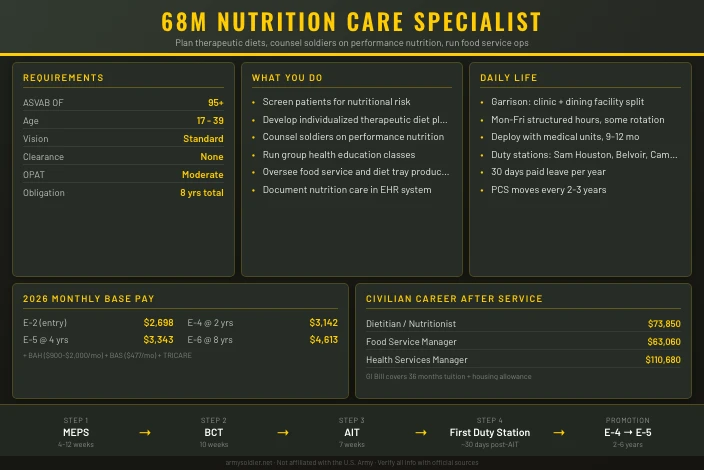
Job Role and Responsibilities
68M Nutrition Care Specialists provide medical nutrition therapy to patients in military treatment facilities, plan and implement therapeutic diets, conduct nutrition screenings, deliver health education to soldiers and their families, and support food service operations in field and fixed-facility settings.
Your daily work splits between clinical and food service environments. On the clinical side, you screen patients for nutrition risk using standardized tools, calculate caloric and macronutrient needs, develop individualized diet plans for conditions like diabetes and heart disease, and document care in the electronic health record. On the food service side, you oversee meal production, verify diet trays meet prescription requirements, and manage special feeding programs.
Patient education is a major part of this job. You run group classes and one-on-one counseling sessions covering topics like weight management, sports nutrition, and chronic disease prevention. Army performance nutrition programs are a growing focus, with 68Ms working directly with units to optimize training diets for high-load exercise periods.
Army Enlisted Classification System for 68M:
| Identifier Type | Code | Purpose |
|---|---|---|
| MOS (Primary) | 68M | Nutrition Care Specialist |
| Skill Level 10 | 68M10 | Entry-level clinical dietetics and food service functions |
| Skill Level 30 | 68M30 | NCO supervisory duties; manages nutrition clinics and staff |
| Skill Level 40 | 68M40 | Senior NCO; oversees multiple clinic operations |
| Additional Skill Identifier (ASI) | Various | Specialized competencies added to the primary MOS |
The 68M extends the reach of the AOC 65C (Army Dietitian officer). In facilities without a staff dietitian present, experienced 68M NCOs manage clinical nutrition operations and serve as the primary point of contact for patient dietary care. Field deployments add mobile feeding responsibilities, including operating kitchen equipment and running nutrition support in austere environments.
Technology is part of daily work. You use the MHS GENESIS electronic health record, diet management software, metabolic carts for indirect calorimetry, and standard kitchen production equipment. Larger medical centers have body composition analyzers and clinical nutrition support technology for tube feeding and parenteral nutrition programs.
Salary and Benefits
Financial Benefits
Pay is based on rank and years of service. Most 68Ms enter at E-1 and reach E-2 after completing basic training. The table below shows base pay at key career points using current 2026 DFAS rates.
| Rank | Grade | Time in Service | Monthly Base Pay |
|---|---|---|---|
| Private (PV2) | E-2 | Entry after BCT | $2,698 |
| Private First Class (PFC) | E-3 | ~1 year | $2,837 |
| Specialist (SPC) | E-4 | ~2 years | $3,142 |
| Sergeant (SGT) | E-5 | ~4-6 years | $3,343 |
| Staff Sergeant (SSG) | E-6 | ~8 years | $4,613 |
Base pay is only part of your total compensation. Basic Allowance for Housing (BAH) adds significant monthly income based on your duty location and dependent status. At Fort Sam Houston, a single E-4 receives $1,359/month in BAH; with dependents, that rises to $1,728/month. Basic Allowance for Subsistence (BAS) adds $476.95 per month for food. Combined, allowances can add $1,800 to $2,500 monthly on top of base pay, and neither BAH nor BAS is taxable income.
No confirmed enlistment bonus currently applies to 68M. Reenlistment incentives and special pays can become available when the Army identifies critical shortages in this specialty. Check with a recruiter for current incentive offers, as these change frequently.
Additional Benefits
TRICARE Prime covers medical, dental, vision, mental health, and prescription drugs for you and your family with no enrollment fee and no out-of-pocket costs at military treatment facilities. Family members are covered under the same plan.
The Blended Retirement System (BRS) combines a pension and a Thrift Savings Plan (TSP). The government automatically contributes 1% of your base pay to TSP after 60 days, and matches up to 4% more once you hit two years. Contribute 5% yourself to get the full match. At 20 years, your pension pays 40% of your average high-36 months of base pay.
Tuition Assistance covers up to $4,500 per year and $250 per semester hour for college courses while on active duty. After separation, the Post-9/11 GI Bill pays full in-state tuition at public universities plus a monthly housing allowance for up to 36 months. Private school coverage caps at $29,920.95 per academic year (AY 2025-2026 rate).
Work-Life Balance
Soldiers earn 30 days of paid leave per year, accruing 2.5 days per month. Up to 60 days can carry over between fiscal years. Most 68Ms in garrison work standard duty hours Monday through Friday, with on-call rotation for diet coverage in inpatient settings. Duty cycles vary significantly between large Army medical centers and smaller clinics.
Qualifications and Eligibility
Basic Qualifications
You need to be 17 to 39 years old, a U.S. citizen or permanent resident, and hold a high school diploma or GED. Diploma holders need at least 31 on the AFQT. GED holders need at least 50.
The 68M requires one ASVAB line score:
| Composite | Minimum Score | Formula |
|---|---|---|
| Operators and Food (OF) | 95 | VE + NO + AS + MC |
The OF composite draws from Verbal Expression, Numerical Operations, Auto and Shop Information, and Mechanical Comprehension. This differs from most CMF 68 medical MOS jobs, which use the Skilled Technical (ST) composite. The OF composite emphasizes verbal ability and practical reasoning, reflecting the education and food service dimensions of this role.
The full qualifications at a glance:
| Requirement | Details |
|---|---|
| Age | 17-39; waiver possible up to 42 |
| Citizenship | U.S. citizen or permanent resident |
| Education | High school diploma (AFQT 31+) or GED (AFQT 50+) |
| ASVAB Composite | OF: 95 minimum |
| Security Clearance | None required |
| OPAT Category | Moderate |
| Physical Demands | Moderately heavy; occasional lifts up to 80 lbs, frequent lifts to 40 lbs |
| Medical | Standard Army medical accession standards |
Application Process
The path to 68M starts at the Military Entrance Processing Station (MEPS), where you take the ASVAB, complete a physical, and select your MOS. If you score OF 95 or higher and pass the OPAT at the Moderate category, you’re eligible to contract for 68M. The entire MEPS process typically takes one to two days, with follow-up paperwork and background checks adding a few weeks.
You’ll ship to Basic Combat Training (BCT) first. Once BCT is complete, you move directly to AIT at Fort Sam Houston. The total time from enlistment contract to first duty station typically runs four to six months including BCT and AIT.
Service Obligation
The standard service obligation for an enlisted MOS is four years of active duty plus four years in the Individual Ready Reserve (IRR), for a total of eight years of military service. Some soldiers opt for three-year contracts, though availability varies by Army needs.
See our ASVAB study guide for strategies to hit these line scores, or take the PiCAT from home if you are a first-time tester.
Work Environment
Setting and Schedule
Most 68Ms work in fixed medical treatment facilities: Army hospitals, outpatient clinics, and nutrition care clinics on installation. A typical day runs through standard duty hours with a clinic schedule driven by patient appointments and meal service windows. Inpatient settings require coverage around meal times, so shift rotations exist in larger facilities.
Typical weekly schedule contrasts by setting:
- Garrison (fixed facility): Monday through Friday, 0630-1700 formation and clinic hours; patient appointments fill the morning block, meal tray verification and documentation run through afternoon; on-call rotation for inpatient diet coverage on evenings and weekends
- Field exercise or deployment: Operations tied to kitchen service windows (typically 0400, 1100, 1700); nutrition support briefs to unit leadership interspersed; physical work running and managing field kitchen equipment in all weather conditions
Field environments add a different dimension. During training exercises and deployments, 68Ms run food service operations and provide nutrition support in mobile settings. This means working with field kitchen equipment, managing caloric targets under logistical constraints, and advising unit commanders on nutrition readiness. It’s a different pace from garrison clinical work.
Team Dynamics and Leadership
The 68M works directly under an officer dietitian (AOC 65C) in facilities that have one. At smaller posts or deployed locations, experienced 68M NCOs manage clinic operations independently. At the E-5 and above level, you take on supervisory responsibility for junior specialists, train incoming soldiers, and manage clinic quality assurance programs.
Performance evaluations follow the standard NCO Evaluation Report (NCOER) system, with ratings covering professionalism, competence, and leadership. Feedback from supervisors typically happens quarterly in counseling sessions, with formal evaluations annually.
Job Satisfaction
Retention in this MOS tends toward average for Army healthcare specialties. Soldiers who stay often cite the mix of clinical skill development, regular hours in garrison, and strong civilian transition value. Those who leave commonly do so to pursue registered dietitian (RDN) programs, which require a graduate degree and supervised practice hours.
Training and Skill Development
Initial Training Pipeline
| Phase | Location | Length | Focus |
|---|---|---|---|
| Basic Combat Training (BCT) | Various installations | 10 weeks | Soldiering fundamentals, fitness, weapons |
| Advanced Individual Training (AIT) | Fort Sam Houston, TX (METC) | 7 weeks | Clinical nutrition, therapeutic diets, food service operations |
| First Duty Station | Installation-dependent | Ongoing | Applied clinical practice under dietitian supervision |
BCT teaches you to be a soldier before you become a healthcare specialist. You’ll qualify on the M4, pass the Army Fitness Test, and learn land navigation, first aid, and military customs. Ten weeks moves fast.
AIT at the Medical Education and Training Campus (METC) covers the technical core of the job. The seven-week course addresses basic nutrition science, therapeutic and regular diet planning, performance nutrition for warfighters, clinical nutrition functions, and Army field feeding concepts. Classes average around 20 soldiers per cohort, which means individual attention from instructors.
Advanced Training and Development
After AIT, skill development continues at your duty station working alongside experienced NCOs and dietitians. Formal advanced education opportunities include:
- Army Medical Department courses at METC for clinical nutrition management and supervisory skills
- Functional courses aligned with promotion requirements at each NCO career level
- Army Continuing Medical Education programs and professional development training
- Civilian credential preparation through tuition assistance and voluntary civilian exam programs
The Army COOL (Credentialing Opportunities On-Line) program maps civilian credentials to 68M skills and identifies exams the Army may fund. The Certified Dietary Manager (CDM) credential from ANFP aligns closely with 68M food service duties. COOL funding covers exam fees for approved credentials.
Long-term, soldiers interested in becoming registered dietitians use the Army’s graduate education programs or the GI Bill to pursue the required master’s degree and dietetic internship. Some transition to the 65C officer track through Officer Candidate School.
Everything starts with qualifying ASVAB scores — our study guide covers what to study first.
Career Progression and Advancement
Rank and Career Timeline
| Rank | Grade | Typical Time | Key Milestone |
|---|---|---|---|
| Private (PV1/PV2) | E-1/E-2 | Entry | BCT and AIT completion |
| Private First Class (PFC) | E-3 | ~6-12 months TIS | First duty assignment |
| Specialist (SPC) | E-4 | ~18-24 months TIS | Independent clinic duties |
| Sergeant (SGT) | E-5 | ~3-5 years TIS | Primary Zone promotion; supervisory duties begin |
| Staff Sergeant (SSG) | E-6 | ~7-10 years TIS | Clinic NCO-in-charge |
| Sergeant First Class (SFC) | E-7 | ~13-17 years TIS | Platoon sergeant; senior clinical advisor |
| Master Sergeant (MSG) | E-8 | ~17-22 years TIS | Senior NCO positions; MEDCEN leadership |
Promotion to E-4 is largely time-based. E-5 and above are competitive, based on your NCOER ratings, Army education requirements, physical fitness, and points accumulated through training and awards. Medical specialties can be competitive at the E-6 and E-7 levels because the career field is relatively small.
Specialization and Lateral Moves
Experienced 68Ms can add competencies through Additional Skill Identifiers (ASIs) that expand their scope and improve promotion potential. Soldiers interested in broader healthcare leadership sometimes reclassify or pursue warrant officer programs within the medical field.
The Army’s Officer Candidate School is open to eligible enlisted soldiers, and some 68Ms pursue commissioning as 65C (Dietitian) officers after earning their registered dietitian credential. This path requires a master’s degree and passing the CDR national exam, which takes years of investment but represents a major career advancement.
Performance Evaluation
NCO performance is evaluated through the NCOER system. Your rater (direct supervisor) and senior rater (their supervisor) score your performance in Army Values, attributes, competencies, and responsibilities. The evaluation feeds directly into promotion board packets. Duty performance, professional military education completion, and Army Fitness Test scores all factor into your overall competitive standing.
Physical Demands and Medical Evaluations
Fitness Standards
The 68M carries a Moderate OPAT physical demand category. You need to pass the OPAT at that level before the Army will offer you this MOS at MEPS.
On the job, the physical demands are real but not extreme. Pushing food carts, lifting trays and supply cases up to 80 pounds occasionally, standing for extended periods in a kitchen or clinic, and managing food production lines are part of daily work. Deployments add environmental stressors and physical logistics demands.
All soldiers must pass the Army Fitness Test (AFT), which replaced the ACFT in June 2025. The AFT has five events:
| Event | Abbreviation | Description |
|---|---|---|
| 3-Rep Max Deadlift | MDL | Maximum load for 3 deadlift reps |
| Hand Release Push-Up | HRP | Max reps with arm extension |
| Sprint-Drag-Carry | SDC | 250m sprint, drag, lateral, carry, sprint |
| Plank | PLK | Maximum hold time |
| Two-Mile Run | 2MR | Timed 2-mile run |
The general standard is 300 total points (minimum 60 per event), sex- and age-normed. 68M is not a designated combat MOS, so the 350-point combat specialty standard does not apply. Scores are tested twice per year on active duty.
Medical Evaluations
Annual Soldier Readiness Processing (SRP) events check your medical status. Periodic dental readiness, immunization currency, and medical screening are required to maintain deployable status. No security clearance medical evaluation is required for this MOS.
Deployment and Duty Stations
Deployment Patterns
68Ms deploy with hospitals, clinics, and combat support units. The typical deployment cycle for Army medical units runs every 24 to 36 months, with deployments lasting 9 to 12 months. Locations include OCONUS installations, humanitarian missions, and combat support hospital postings in operational theaters.
Field exercises happen regularly even when not deployed. Units conduct annual training rotations at combat training centers, which test field feeding and medical support operations.
Duty Stations
Major 68M assignments cluster around Army medical centers and large installations:
- Fort Sam Houston, TX (Brooke Army Medical Center)
- Fort Bragg, NC (Womack Army Medical Center)
- Fort Campbell, KY (Blanchfield Army Community Hospital)
- Fort Hood, TX (Carl R. Darnall Army Medical Center)
- Walter Reed National Military Medical Center, MD
- Camp Humphreys, South Korea (OCONUS)
- Landstuhl Regional Medical Center, Germany (OCONUS)
Your initial assignment depends on Army needs and available positions. You can submit assignment preferences, but the Army makes final decisions based on manning requirements. OCONUS assignments are normal in this MOS.
Risk, Safety, and Legal Considerations
Job Hazards
The 68M faces lower physical risk than combat MOSs but is not risk-free. In deployed settings, medical personnel operate in austere environments and may be co-located with combat operations. Food safety failures can affect entire units, so errors carry real consequences. Ergonomic risks from repeated lifting and prolonged standing are common in both clinic and kitchen settings.
Field kitchen environments add hazards beyond what civilian dietary aides typically encounter. You work near hot cooking surfaces, pressurized equipment, and bulk chemical sanitizers in conditions ranging from extreme heat to freezing cold. Extended operations in high-heat environments create meaningful heat injury risk, while cold-weather field exercises create hypothermia and frostbite risk during outdoor food service.
Common hazards and how the Army addresses them:
| Hazard | Environment | Mitigation |
|---|---|---|
| Heat injury (heat stroke, heat exhaustion) | Field kitchens, hot weather operations | Work-rest cycles per FM 7-22 heat categories; buddy checks; hydration standards |
| Cold injury (frostbite, hypothermia) | Winter field exercises, cold storage facilities | Cold weather gear standards; time limits on cold exposure; medical screening |
| Musculoskeletal injury | Repeated lifting, prolonged standing in kitchens and clinics | Proper lift technique training; mechanical assist equipment where available; weight limits enforced at 80 lbs occasional / 40 lbs frequent |
| Bloodborne pathogen exposure | Clinical patient care settings | Standard precautions; PPE protocol; annual bloodborne pathogen training |
| Chemical exposure | Sanitization chemicals in food service | Proper PPE; MSDS awareness; chemical storage SOPs |
| Deployed environment hazards | Theater operations, austere facilities | Level I force protection training; medical unit security protocols |
Safety Protocols
Army food service operations follow HACCP (Hazard Analysis and Critical Control Points) protocols, the same framework used by civilian commercial food service. HACCP identifies specific control points in food production where contamination risk is highest and requires documented temperature monitoring, sanitation verification, and corrective action logs. A HACCP failure isn’t an abstract compliance problem; it’s a potential mass casualty event. One foodborne illness outbreak in a deployed medical unit can take dozens of soldiers off mission. Your documentation and verification work is the main defense against that.
When an accident or injury occurs on duty, soldiers and supervisors use DA Form 285, the Army Accident Report, to document the incident. Submitting an accurate DA Form 285 is mandatory, not optional. The form feeds Army-wide safety data and triggers follow-up from unit safety officers. Failing to report an accident or submitting an inaccurate form is a UCMJ violation.
Security and Legal
No security clearance is required for 68M. Your legal obligations are standard enlistment terms: following the Uniform Code of Military Justice (UCMJ), meeting training requirements, and completing your service obligation.
HIPAA applies within the Army healthcare system, and the obligation is real. You’ll handle patient dietary records, clinical assessments, and diagnoses as part of daily work. Unauthorized disclosure of patient information, discussing patient cases outside appropriate clinical channels, or accessing records without a care-related need are all violations. The Army’s HIPAA training is mandatory at accession and annually after that. The clinical environment at a large Army medical center handles thousands of patient records; your access is tracked.
Impact on Family and Personal Life
Family Considerations
Garrison assignments bring predictable schedules for most 68Ms. Standard duty hours mean evenings and weekends are typically available for family time, though on-call rotation for inpatient diet coverage exists at larger facilities. Deployments are the primary disruption, and deployments happen in this career field.
Families with a member who has a special need or disability should know about the Exceptional Family Member Program (EFMP). EFMP enrollment is mandatory if a family member has a special medical or educational need. It coordinates assignments to locations with appropriate support services, which affects where you can be stationed. Enrollment doesn’t block assignments entirely, but it narrows the pool and can slow the process. Contact the EFMP office at your installation before a PCS move to confirm receiving installation capacity.
Spouses who work or want to work after relocation have access to the Army Spouse Employment Partnership (ASEP), a network of employers committed to hiring military spouses. Large Army medical centers, particularly Brooke Army Medical Center, Walter Reed, and Womack, have substantial on-post employment options in healthcare administration, childcare, and retail. Remote-work and portable-credential careers tend to transfer better across PCS cycles than employer-dependent positions.
Support resources available to 68M families:
- MWR (Morale, Welfare and Recreation): Recreation facilities, youth sports, gyms, pools, and family event programs at no or low cost
- Military OneSource: Free counseling sessions (up to 12 per issue per year), financial counseling, relocation assistance, and deployment support
- TRICARE Prime: Full medical, dental, vision, mental health, and prescription coverage for family members at no enrollment fee
- Child Development Centers (CDC): On-post childcare at rates below civilian market, with fee assistance programs for lower-income families; waitlists at major installations can be long
- Commissary access: Grocery shopping at cost plus a small surcharge, typically 20-30% below retail grocery prices
- Army Community Service (ACS): Relocation assistance, financial readiness classes, deployment readiness programs, and family advocacy services
Relocation
PCS moves happen every two to three years on average, though the timeline varies by assignment type. Soldiers at large medical centers like Brooke Army Medical Center or Walter Reed typically get three-year tours, which provides more stability than smaller clinics that cycle soldiers every two years. OCONUS assignments to Germany or South Korea run one to three years depending on whether dependents accompany you.
The Army provides a moving allowance based on weight entitlement and distance, plus temporary lodging allowance (TLA/TLE) for the transition period. The allowances rarely cover full moving costs for families with substantial household goods, so budgeting for the gap matters. For families with school-age children, relocation means mid-year school changes and rebuilding social connections at each new installation. The School Liaison Officer (SLO) at most installations helps with school enrollment and transfer credit issues.
Reserve and National Guard
The 68M Nutrition Care Specialist is available in both the Army Reserve and Army National Guard. Medical treatment facilities in both components staff nutrition care positions, though the total number of slots is smaller than high-demand MOS like 68W or 68G. Most Reserve and Guard 68M positions sit at medical units attached to combat support hospitals or area support medical companies.
Drill and Training Commitment
Reserve and Guard 68Ms follow the standard schedule of one weekend per month and two weeks of Annual Training per year. Nutrition care soldiers may need to complete food safety certification renewals and clinical nutrition assessment training during drill periods. Some units schedule additional training days around field exercises where 68Ms practice setting up and running dining facility nutrition programs in field conditions.
Part-Time Pay
An E-4 with four years of service earns about $488 per drill weekend in 2026, based on four drill periods per weekend. Over 12 drill weekends, that totals roughly $5,856 per year before Annual Training pay. Compare that to $3,659 per month for an active-duty E-4 at the same pay grade and time in service.
Benefits
Reserve and Guard members can enroll in Tricare Reserve Select at $57.88 per month for individual coverage or $286.66 per month for family coverage. Active-duty soldiers pay no premium for TRICARE. Education benefits include the Montgomery GI Bill-Selected Reserve (MGIB-SR) at $493 per month for full-time students and Federal Tuition Assistance up to $4,500 per year. National Guard members may qualify for state tuition waivers that vary by state, with many covering full tuition at public universities.
Retirement in the Reserve and Guard follows a points-based system. Your pension begins at age 60 rather than immediately after 20 years of service. Each 90-day mobilization after January 28, 2008 reduces the retirement age by three months, down to a minimum of age 50.
Deployment and Mobilization
68M soldiers in the Reserve and Guard face moderate mobilization rates. Nutrition care specialists deploy with medical units to support dining facility operations and patient nutrition programs at field hospitals. A typical mobilization runs 9 to 12 months including pre-deployment training. Frequency depends on unit assignment and operational tempo, but expect the possibility of one mobilization every several years.
Civilian Career Integration
The 68M pairs well with civilian careers in food service management, dietary technology, and clinical nutrition support. Reserve and Guard 68Ms often work as dietary aides, food service supervisors, or nutrition technicians in hospitals and long-term care facilities. The Certified Dietary Manager (CDM) credential is within reach for soldiers with 68M training and experience. USERRA (Uniformed Services Employment and Reemployment Rights Act) protects your civilian job during drill weekends, Annual Training, and mobilizations. Employers in healthcare and food service are generally familiar with military obligations, which helps smooth the balance between part-time service and full-time work.
| Feature | Active Duty | Army Reserve | Army National Guard |
|---|---|---|---|
| Duty Status | Full-time | Part-time (1 wknd/mo + 2 wks/yr) | Part-time (1 wknd/mo + 2 wks/yr) |
| Monthly Pay (E-4, 4 yrs) | $3,659/mo | ~$488/drill weekend | ~$488/drill weekend |
| Healthcare | TRICARE (no premium) | Tricare Reserve Select ($57.88/mo) | Tricare Reserve Select ($57.88/mo) |
| Education | Post-9/11 GI Bill, TA | MGIB-SR ($493/mo), TA | MGIB-SR ($493/mo), TA, state tuition waivers |
| Deployment | Per unit rotation | When mobilized | When mobilized |
| Retirement | 20-year pension | Points-based, age 60 | Points-based, age 60 |
Post-Service Opportunities
Military service as a 68M builds directly toward civilian healthcare and food service management careers. Seven weeks of AIT and years of applied experience give you documented skills in clinical nutrition assessment, patient education, and food service operations.
The most direct path is registered dietitian (RDN) licensure. The current requirement is a master’s degree from an ACEND-accredited program and completion of supervised practice hours. Army service doesn’t substitute for those requirements, but the GI Bill funds graduate school, and your clinical experience strengthens admission applications significantly.
Civilian career options for 68M veterans:
| Civilian Role | Median Annual Salary | Job Outlook (2024-2034) |
|---|---|---|
| Dietitian / Nutritionist (RDN) | $73,850 | +6% (faster than average) |
| Food Service Manager | $63,060 | +4% |
| Health Educator | $62,860 | +7% |
| Medical and Health Services Manager | $110,680 | +28% |
RDN licensure opens hospital clinical dietitian, outpatient counseling, and sports nutrition roles. Food service management skills from 68M apply directly to hospital food service director and institutional foodservice positions without additional licensure. Veterans with supervisory experience in the Army also qualify for health services management programs and VA dietitian positions, which offer veteran hiring preferences.
The Army’s Transition Assistance Program (TAP) helps with resume writing, interview preparation, and civilian job connections. VA vocational rehabilitation is available for veterans with service-connected conditions.
Is This a Good Job for You? The Right (and Wrong) Fit
Who This Role Suits
You’ll fit well in 68M if you’re interested in healthcare but want a niche that combines clinical work with food science. Strong communicators do well here because patient education and group classes are a daily part of the job. People who are organized, detail-oriented, and comfortable with both clinical documentation and kitchen management thrive.
This MOS also works well if you have a long-term goal of becoming a registered dietitian. The experience base you build and the GI Bill you earn are both relevant to that path. If your interest is more toward emergency medicine or trauma care, 68W is the better fit.
Potential Challenges
The OF composite requirement is unusual within CMF 68. If your ASVAB preparation focused on the ST composite for other medical MOS jobs and you didn’t hit 95 on OF, you may need to retest. The sections that drive OF scores (Verbal Expression, Numerical Operations) are different from the science-heavy subjects that drive ST.
Deployment reality is worth considering honestly. 68Ms work in medical units that do deploy to operational environments. If you want healthcare work with minimal deployment risk, Army Reserve or National Guard service might offer a different balance.
Career Fit Test
Ask yourself these questions before committing:
- Do you have genuine interest in nutrition, food science, or patient education?
- Are you comfortable with both clinical and kitchen environments?
- Can you work within a structured dietary prescription system while adapting to field conditions?
- Are you planning to use military service as a bridge to a healthcare credential program?
If most answers are yes, 68M is a strong fit. If you’re drawn more to emergency response, surgery, or pharmacy, look at those sibling MOS jobs instead.
More Information
Talk to an Army recruiter to confirm current ASVAB requirements, bonus availability, and open training seats for 68M. You can reach the Army recruiting line at 1-888-550-ARMY (2769) or visit goarmy.com to explore the MOS directly. Bring your questions about OPAT category requirements, current assignment locations, and any waivers you may need.
- Prepare for the ASVAB with our study guide to make sure your line scores qualify
This site is not affiliated with the U.S. Army or any government agency. Verify all information with official Army sources before making enlistment or career decisions.
Explore more Army medical careers such as 68Q Pharmacy Specialist and 68X Mental Health Specialist.