68N Cardiovascular Specialist
Most Army medical jobs look like nursing or emergency medicine. The 68N is different. You spend your days running echocardiograms, assisting with cardiac catheterizations, and managing a cath lab, work that cardiologists and hospital systems pay very well for in the civilian world. The training pipeline runs 56 weeks, one of the longest in the entire medical field. When you finish, you have hands-on cardiac experience that takes civilian technicians years to accumulate.
Qualifying requires specific ASVAB line scores — our ASVAB study guide covers what to target and how to prepare.
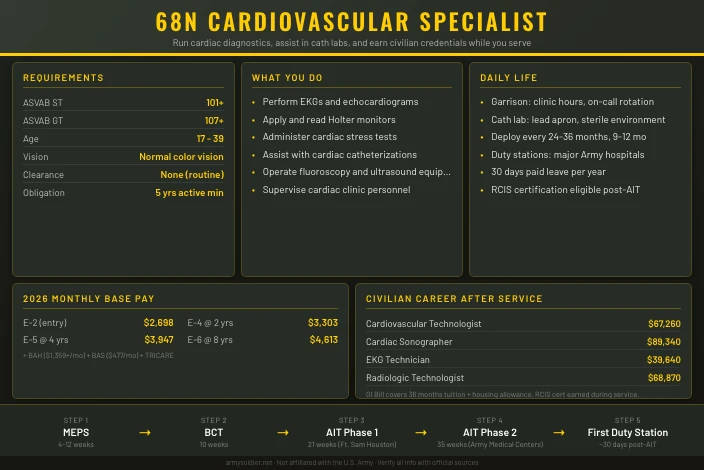
Job Role and Responsibilities
The 68N Cardiovascular Specialist operates cardiac diagnostic and interventional equipment at Army hospitals and medical treatment facilities. Specialists perform electrocardiograms, echocardiograms, cardiac stress tests, and Holter monitoring, and assist physicians during cardiac catheterization and balloon stent procedures. This MOS is the Army’s primary cardiac technician role, covering both noninvasive diagnostics and invasive interventional procedures.
Day-to-day work splits between two tracks. Noninvasive technicians run EKGs, administer cardiac ultrasounds, and conduct stress tests that help physicians diagnose arrhythmias, valve disease, and coronary artery disease. Invasive cardiac technicians work inside catheterization labs alongside physicians, preparing patients, monitoring vitals, and passing instruments during procedures like angioplasty and pacemaker implantation.
Your work directly shapes clinical decisions. A missed arrhythmia on a Holter monitor or a blurry echocardiogram image can lead a physician down the wrong diagnostic path. Precision and attention to detail matter at every step.
Primary Duties
- Perform 12-lead electrocardiograms (EKGs) and interpret waveforms for physician review
- Conduct echocardiography studies using ultrasound equipment to assess heart structure and function
- Apply and read Holter monitors for continuous cardiac rhythm tracking
- Administer exercise and pharmacologic cardiac stress tests
- Assist physicians with diagnostic and interventional catheterization procedures
- Prepare and maintain cardiac diagnostic equipment, supplies, and the cath lab environment
- Supervise lower-grade personnel and manage cardiology clinic operations at senior grades
Specific Roles
Army Cardiovascular Specialists hold the primary MOS code 68N. Soldiers may earn Additional Skill Identifiers (ASIs) through advanced training or assignment to specialized units. At higher grades, the role shifts from hands-on technician work toward clinic supervision, budget management, and personnel oversight.
| Identifier | Type | Description |
|---|---|---|
| 68N | Primary MOS | Cardiovascular Specialist |
| ASI (various) | Additional Skill Identifier | Advanced specializations acquired through training or assignment |
Mission Contribution
The Army’s aging soldier population, combined with the physical demands of service, creates steady demand for cardiac diagnostics. A cardiovascular specialist at a major installation like Brooke Army Medical Center or Walter Reed National Military Medical Center may process dozens of EKGs in a single shift and assist on several catheterizations each week. During deployments, cardiac screening helps commanders keep medically fit soldiers in the field.
Technology and Equipment
You work with specialized cardiac equipment that civilian technicians also use:
- Echocardiography machines for cardiac ultrasound imaging
- Electrocardiograph machines for 12-lead EKG recording
- Holter monitoring systems for 24-72 hour rhythm tracking
- Cardiac catheterization lab equipment including fluoroscopy systems, pressure monitoring, and angiography
- Stress test systems combining treadmills, pharmacologic agents, and real-time cardiac monitoring
Salary and Benefits
Financial Benefits
Base pay depends on your rank and time in service. Most soldiers enter the Army at E-1 and promote to E-2 after completing Basic Combat Training.
| Rank | Pay Grade | Monthly Base Pay (2026) |
|---|---|---|
| Private (PV2) | E-2 | $2,698 |
| Specialist | E-4 (2 yrs) | $3,303 |
| Sergeant | E-5 (4 yrs) | $3,947 |
| Staff Sergeant | E-6 (8 yrs) | $4,613 |
Base pay from DFAS 2026 military pay charts. On top of base pay, you receive two allowances. Basic Allowance for Housing (BAH) covers off-post housing and varies by duty station and whether you have dependents. A single E-4 at Fort Sam Houston, TX receives roughly $1,359 per month. Basic Allowance for Subsistence (BAS) adds a flat $476.95 per month for food regardless of location or rank.
Additional Benefits
Active-duty soldiers and their families receive TRICARE Prime health coverage with no enrollment fee, no deductible, and zero copays for in-network care. Coverage includes medical, dental, vision, mental health, and prescriptions.
The Army’s retirement plan is the Blended Retirement System (BRS):
- 20-year pension: 40% of your average basic pay for the highest 36 months of service
- TSP matching: The government contributes 1% automatically, then matches up to 4% if you contribute 5%
- Continuation Pay: A lump-sum bonus at 8 to 12 years for soldiers who extend their service obligation
Education benefits include Tuition Assistance (up to $4,500 per year while on active duty) and the Post-9/11 GI Bill after separation, which covers full in-state tuition at public schools plus a monthly housing allowance and up to $1,000 annually for books.
Work-Life Balance
You earn 30 days of paid leave per year, accruing at 2.5 days per month. Cardiovascular specialists stationed at garrison hospitals typically work weekday clinic hours with on-call rotations for cardiac emergencies. The schedule is more predictable than combat MOSs, though deployment periods and field exercises can disrupt the routine. Expect 12-hour shifts during deployments to forward medical facilities.
Qualifications and Eligibility
Basic Qualifications
You must be a U.S. citizen or permanent resident between the ages of 17 and 39. A high school diploma requires an AFQT score of at least 31; a GED requires 50.
The 68N requires two ASVAB line scores:
- Skilled Technical (ST): 101 minimum
- General Technical (GT): 107 minimum
The ST composite draws from General Science, Verbal Expression, Math Knowledge, and Mechanical Comprehension subtests. The GT composite combines Verbal Expression and Arithmetic Reasoning. Both scores reflect the academic demands of cardiac physiology and medical equipment operation.
| Requirement | Details |
|---|---|
| Age | 17-39 years old |
| Citizenship | U.S. citizen or permanent resident |
| Education | High school diploma (AFQT 31+) or GED (AFQT 50+) |
| Skilled Technical (ST) | Minimum 101 |
| General Technical (GT) | Minimum 107 |
| Color Vision | Normal color vision required |
| Physical Demands (OPAT) | Moderate (Gold) category; verify current standard with recruiter |
| Security Clearance | None required for standard assignments |
Application Process
Start at a local Army recruiting station. Your recruiter will verify your ASVAB scores, walk you through the 68N requirements, and help you choose between Active Duty, Reserve, or National Guard. If you haven’t taken the ASVAB yet, the recruiter schedules that first.
The full process from first recruiter visit to BCT start typically takes 4 to 12 weeks. Medical waivers or background checks extend that timeline. Soldiers with prior medical experience, science coursework, or healthcare certifications are competitive candidates.
Selection Criteria
The 68N requires higher ASVAB scores than most medical MOSs and has smaller class sizes because Phase 2 training is done at clinical sites, not a schoolhouse. The Army limits enrollment based on available hospital training slots. Prior experience as an EMT, phlebotomist, or cardiovascular technician can make your application stronger, though no civilian certification is required to enlist.
Upon Accession
You enter as E-1 (Private, PV1) and promote to E-2 after completing BCT. The standard service obligation is eight years total, typically split between active service and the Individual Ready Reserve (IRR). The 68N’s minimum commitment on active duty is generally five years given the length and cost of training.
See our ASVAB study guide for strategies to hit these line scores, or take the PiCAT from home if you are a first-time tester.
Work Environment
Setting and Schedule
Cardiovascular specialists work almost entirely indoors at Army hospitals and medical treatment facilities. You spend most of your time in three settings: the echo lab, the cardiac catheterization lab, and the cardiology clinic.
- Echo lab: Quiet, controlled environment performing ultrasound studies and EKGs
- Cath lab: Sterile surgical environment; you wear lead aprons to protect against fluoroscopic radiation during catheterizations
- Cardiology clinic: Patient intake, Holter monitor application, stress test administration
At garrison hospitals, most specialists work weekday business hours with rotating on-call coverage for cardiac emergencies. Deployed settings compress the schedule. Forward medical teams perform cardiac screening in field conditions, sometimes with portable equipment.
Leadership and Communication
Your chain of command runs through the cardiology department’s medical officer (typically a physician or nurse practitioner) and a senior NCO who manages clinic operations. At E-5 and above, you take on direct supervisory responsibilities for lower-grade technicians. Communication with physicians is constant; clear reporting of test findings is part of every shift.
Performance reviews come through the annual NCOER (NCO Evaluation Report) at E-5 and above. Below that, soldiers receive developmental counseling from their supervisors. Feedback on clinical accuracy, equipment maintenance, and patient care quality shapes your evaluation record.
Team Dynamics and Autonomy
Unlike combat MOSs, this role is structured around a stable clinical team. You work alongside other cardiac technicians, nurses, physicians, and support staff, and your work is reviewed and interpreted by a cardiologist before any diagnosis is made. At the same time, you operate equipment independently and are responsible for the technical quality of every study you produce.
At senior grades, you may manage a cath lab team, coordinate scheduling, and oversee equipment procurement. That combination of clinical precision and management responsibility suits people who want professional growth inside a structured medical environment.
Job Satisfaction and Retention
Cardiovascular specialists have a strong re-enlistment profile compared to physically demanding MOSs. The skills acquired are directly marketable in the civilian sector, and many soldiers use military service as a paid pathway into a career that would otherwise require an associate’s degree, hospital residency, and years of clinical hours. The work itself is technically engaging and carries clear patient impact.
Training and Skill Development
Initial Training
The 68N pipeline is one of the longest enlisted training programs in the Army, totaling approximately 66 weeks when BCT is included.
| Training Phase | Location | Duration | Focus |
|---|---|---|---|
| BCT | Fort Jackson, SC; Fort Moore, GA; or Fort Leonard Wood, MO | 10 weeks | Soldier fundamentals: marksmanship, tactics, physical fitness |
| AIT Phase 1 | Fort Sam Houston, TX (METC) | 21 weeks | Cardiac anatomy, physiology, EKG interpretation, echocardiography fundamentals |
| AIT Phase 2 | Army Medical Centers (varies) | 35 weeks | Clinical practicum: supervised hands-on training in cath labs and echo labs at Army hospitals |
Phase 1 takes place at the Medical Education and Training Campus at Fort Sam Houston. The curriculum is academically demanding, covering cardiac anatomy, pathophysiology, hemodynamics, pharmacology, and the technical operation of cardiac equipment. Class sizes run 10 to 15 students.
Phase 2 is a supervised clinical practicum at one of several Army Medical Centers. You rotate through echocardiography, EKG, Holter monitoring, stress testing, and cardiac catheterization procedures under the direct supervision of experienced technicians and cardiologists. This phase is designed to mirror a civilian hospital residency.
Advanced Training
Graduates of the 68N pipeline are eligible to sit for the RCIS (Registered Cardiovascular Invasive Specialist) examination through Cardiovascular Credentialing International (CCI). Many soldiers pursue this certification during service, which carries significant weight in the civilian job market. Some specialize in echocardiography and earn the RCS (Registered Cardiac Sonographer) credential.
At E-5 and above, options for professional development expand:
- NCO Education System courses (PLDC, ALC, SLC) for leadership development
- Advanced cardiac imaging courses offered through Army continuing medical education programs
- Cross-training in related imaging or interventional radiology work depending on assignment
- Competition for the Army’s Medical Enlisted Commissioning Program (MECP) for soldiers seeking a nursing degree and officer commission
Everything starts with qualifying ASVAB scores — our study guide covers what to study first.
Career Progression and Advancement
Career Path
The 68N career follows two phases. The first decade centers on building and applying technical skills. After E-5, the focus shifts toward leadership, clinic management, and mentoring junior technicians.
| Rank | Grade | Typical Years | Typical Role |
|---|---|---|---|
| Private (PV2) | E-2 | 0-1 | AIT student |
| Specialist | E-4 | 2-3 | Staff cardiac technician |
| Sergeant | E-5 | 4-6 | Lead technician, small-team supervisor |
| Staff Sergeant | E-6 | 6-9 | Clinic NCO, cath lab supervisor |
| Sergeant First Class | E-7 | 9-12 | Department NCOIC, training manager |
| Master Sergeant | E-8 | 12+ | Senior medical NCO, strategic advisor |
Promotion to E-4 is largely time-based in the first term. Promotion to E-5 requires passing a promotion board, meeting physical fitness standards, and completing required military education. E-6 and above are competitive; your NCOER record, clinical reputation, and leadership contributions determine who advances.
Role Flexibility and Transfers
Lateral moves within CMF 68 are possible with leadership approval and an available slot. Soldiers with 68N training often have strong qualifications to reclassify into 68D (Operating Room Specialist) or 68P (Radiology Specialist), given overlapping skills in imaging and clinical procedures. Moving outside CMF 68 requires meeting the target MOS’s ASVAB scores and physical standards.
Any MOS transfer comes with a training obligation and a new service commitment. Most 68N soldiers who want to change direction do so at reenlistment, when the Army’s needs and the soldier’s preferences can be matched through the assignment system.
Performance Evaluation
NCOs at E-5 and above are rated through the annual NCOER, which scores leadership, training management, and technical proficiency. The rater and senior rater both contribute to the overall evaluation. Strong NCOERs are the primary factor in competitive promotions to E-6 and E-7.
Below NCO rank, soldiers receive regular developmental counseling from their direct supervisor. Early records of clinical accuracy, equipment care, and professional behavior set the tone for a long-term career. Soldiers who pursue additional certifications like the RCIS while on active duty signal ambition that leadership notices.
Physical Demands and Medical Evaluations
Physical Requirements
The 68N is a clinical MOS. Daily physical demands are moderate compared to combat arms jobs. You stand for extended periods during catheterization procedures, move patients on stretchers, and wear lead protective aprons during fluoroscopic imaging, which add significant weight. Heavy lifting of cardiac equipment during moves or deployments is part of the job.
All soldiers take the Army Fitness Test (AFT) once per year. The AFT has five events scored 0 to 100 each, with a minimum of 60 per event required. Cardiovascular specialists fall under the general standard of 300 total points (sex- and age-normed).
| Event | Minimum Score (any age/sex) |
|---|---|
| 3-Rep Max Deadlift (MDL) | 60 points |
| Hand-Release Push-Up (HRP) | 60 points |
| Sprint-Drag-Carry (SDC) | 60 points |
| Plank (PLK) | 60 points |
| Two-Mile Run (2MR) | 60 points |
Standards are sex- and age-normed per Army AFT guidance. The AFT replaced the ACFT on June 1, 2025.
Medical Evaluations
You receive an annual health assessment covering weight, blood pressure, vision, and hearing. Pre-deployment medical clearances are more detailed. Working in a cardiac cath lab also exposes you to fluoroscopic radiation, so dosimetry badges and annual radiation exposure reviews are standard. Any meaningful radiation exposure is tracked and reported through occupational health.
Deployment and Duty Stations
Deployment Details
Most 68N specialists deploy with hospital units or medical detachments rather than combat units. Deployments support field medical treatment facilities, surgical companies, or combat support hospitals. Typical deployment duration is 9 to 12 months on a cycle of roughly one deployment every 24 to 36 months, depending on unit type.
Common deployment theaters have included:
- Middle East (Iraq, Kuwait, Bahrain) supporting medical units attached to combat forces
- Europe (Germany, Poland) with Army medical units on rotational assignments
- Pacific (South Korea, Japan) at fixed medical facilities
Cardiovascular specialists at major medical centers on CONUS installations may go longer between deployments than those assigned to deployable medical units.
Location Flexibility
The Army assigns duty stations based on its needs, not your preference. That said, most 68N positions are at large Army installations with hospital facilities. You can submit a preference list, and soldiers with high-demand skills like cardiac technology sometimes get more weight in the assignment process.
Common duty stations for 68N:
- Fort Sam Houston, TX (Brooke Army Medical Center)
- Fort Belvoir, VA (Ft. Belvoir Community Hospital)
- Fort Moore, GA
- Tripler Army Medical Center, HI
- Landstuhl Regional Medical Center, Germany
Risk, Safety, and Legal Considerations
Job Hazards
The 68N role carries occupational risks that are different from combat MOSs:
- Radiation exposure: Fluoroscopic imaging in the cath lab exposes you to low-level ionizing radiation daily. Lead aprons and proper positioning reduce but do not eliminate exposure.
- Bloodborne pathogen exposure: Cardiac catheterization involves blood and body fluids. Standard precautions are mandatory.
- Patient handling: Moving patients, including those post-procedure who cannot assist, risks back and shoulder strain.
- Deployment-related risks: Medical personnel in deployed environments share the general risks of the theater.
Safety Protocols
Lead shielding, dosimetry monitoring, and annual radiation safety training are standard for cath lab personnel. Universal precautions, gloves, eye protection, and sterile technique apply throughout. Army occupational health tracks cumulative radiation exposure and flags any soldier approaching threshold limits. Medical units in deployed environments follow theater force protection and evacuation protocols.
Security and Legal Requirements
Standard 68N assignments do not require a security clearance. If assigned to a classified unit or program, a Secret clearance may be needed, but this is uncommon in a clinical cardiac role. All soldiers operate under the Uniform Code of Military Justice (UCMJ). As a medical specialist, you have additional legal obligations: treat all patients without discrimination, maintain patient confidentiality, and document procedures accurately. Medical records are legal documents.
Impact on Family and Personal Life
Family Considerations
Cardiovascular specialists generally have a more predictable lifestyle than combat arms soldiers. Garrison-based hospital assignments mean more consistent schedules. Still, deployments, on-call rotations, and PCS moves affect families the same as any other MOS.
Support resources available at most installations:
- Family Readiness Groups (FRGs) for peer connection during deployments
- Military OneSource for free counseling, financial advice, and family services
- School Liaison Officers to help with children’s school transitions
- Exceptional Family Member Program (EFMP) for families with special medical or educational needs
Relocation and Flexibility
The Army moves you. You’ll receive a Permanent Change of Station (PCS) every two to four years. The Army pays for the move, but each relocation disrupts your family’s routines. Because 68N positions concentrate at major medical centers, duty station options are more limited geographically than for common MOSs. You’re more likely to end up at a large installation with a hospital than at a small post.
Soldiers can submit a preference list and, in some cases, negotiate preferred assignments through the healthcare assignment management system, but the Army’s staffing needs take priority.
Reserve and National Guard
The 68N is a specialized clinical MOS, and that specialization shapes your Reserve and Guard options. Positions exist in both components, but they concentrate at larger medical units attached to military hospitals or major reserve centers with medical detachments. You will not find a 68N slot at every armory. If you live near a major city or a installation with a medical brigade, your chances of finding an open billet are much better.
Drilling 68Ns perform the same cardiovascular diagnostic work as their active-duty counterparts, but the pace is different. Annual Training (AT) often involves supporting MEDRETE (Medical Readiness Training Exercises) or field exercises at military installations with hospital facilities. Between AT cycles, you need to maintain proficiency with EKG interpretation, stress testing, and Holter monitoring. The Army expects you to keep those skills current on your own, through clinical work at a civilian job or through certification maintenance programs.
Drill schedule and training requirements
The standard Reserve and Guard commitment is one weekend per month and two weeks per year for Annual Training. For 68N soldiers, annual certification maintenance is expected on top of that baseline. The Cardiovascular Credentialing International (CCI) offers the RCIS (Registered Cardiovascular Invasive Specialist) and RCES (Registered Cardiac Electrophysiology Specialist) credentials. Maintaining CCI certification requires continuing education hours, which most Reserve 68Ns satisfy through their civilian cardiovascular jobs.
Pay and benefits comparison
Active-duty 68Ns earn a full-time salary with no healthcare premiums. Reserve and Guard 68Ns earn drill pay for their weekend work, roughly $488 for a standard four-drill weekend at the E-4 level with four years of service. That is part-time compensation for part-time service.
Healthcare is a significant difference. Active-duty TRICARE costs the service member nothing in premiums. Reserve and Guard soldiers can buy into Tricare Reserve Select for $57.88 per month for member-only coverage, or $286.66 per month for member and family. Those are real out-of-pocket costs.
For education, Reserve and Guard 68Ns are eligible for the Montgomery GI Bill - Selected Reserve (MGIB-SR, Chapter 1606), which pays $493 per month for full-time students. Federal Tuition Assistance is also available at $250 per credit hour, capped at $4,500 per year. National Guard soldiers may also qualify for state tuition waivers, which in many states cover 100% of tuition at public universities.
Retirement in the Reserve and Guard is points-based rather than tied to 20 consecutive years of active service. You earn a pension at age 60, though that age can be reduced by three months for every 90 days of qualifying active-duty mobilization after January 28, 2008 - down to a minimum of age 50.
Mobilization and deployment
The 68N is a low-deployment-frequency MOS in the Reserve and Guard context. Cardiovascular diagnostic positions are not in high demand at combat deployments. When mobilizations occur, they typically support Sustainment Operations or large-scale exercises, not forward combat positions. That said, mobilization is always possible. Soldiers can be called up for humanitarian missions, domestic support operations, or large medical sustainment deployments.
Civilian career integration
The 68N part-time component is one of the cleanest Reserve pairings in the Army’s medical career field. Civilian cardiovascular technologists work in hospitals, cardiology clinics, and cardiac catheterization labs. Your Army skills directly support your civilian job performance, and vice versa. USERRA (the Uniformed Services Employment and Reemployment Rights Act) protects your civilian job during any military service period, including activations and Annual Training. Employers cannot terminate you or deny reemployment because of your Guard or Reserve duties.
| Feature | Active Duty | Army Reserve | Army National Guard |
|---|---|---|---|
| Duty Status | Full-time | Part-time (1 wknd/mo + 2 wks/yr) | Part-time (1 wknd/mo + 2 wks/yr) |
| Monthly Pay (E-4, 4 yrs) | $3,659/mo | ~$488/drill weekend | ~$488/drill weekend |
| Healthcare | TRICARE (no premium) | Tricare Reserve Select ($57.88/mo) | Tricare Reserve Select ($57.88/mo) |
| Education | Post-9/11 GI Bill, TA | MGIB-SR ($493/mo), TA | MGIB-SR ($493/mo), TA, state tuition waivers |
| Deployment | Per unit rotation | When mobilized | When mobilized |
| Retirement | 20-year pension | Points-based, age 60 | Points-based, age 60 |
Post-Service Opportunities
Transition to Civilian Life
The 68N is one of the Army’s best-credentialed medical MOSs for civilian transition. Your training parallels the didactic and clinical education required for a civilian cardiovascular technology degree, and many soldiers leave service already holding the RCIS certification.
The Transition Assistance Program (TAP) provides resume coaching, interview preparation, and VA benefits counseling during your last 12 months on active duty. The Post-9/11 GI Bill covers up to 36 months of tuition at the full in-state rate at public schools, or up to $29,920.95 per year at private institutions, plus a monthly housing allowance and book stipend.
Hospital systems, cardiovascular imaging centers, and outpatient cardiology practices actively recruit former Army cardiac technicians. The combination of clinical hours, certification eligibility, and professional discipline gives veterans a measurable advantage over new civilian graduates.
Civilian Career Prospects
| Civilian Job | Median Annual Salary (BLS, 2024) | Job Outlook (2024-2034) |
|---|---|---|
| Cardiovascular Technologist / Technician | $67,260 | +3% |
| Diagnostic Medical Sonographer (Cardiac) | $89,340 | +13% |
| EKG Technician | $39,640 | +9% |
| Radiologic Technologist | $68,870 | +5% |
| Registered Nurse (with GI Bill degree) | $86,070 | +6% |
BLS salary and outlook data from the Occupational Outlook Handbook. Cardiac sonographers who specialize in echocardiography earn at the higher end of the diagnostic medical sonographer range. Invasive cardiac technicians working in cath labs at major hospitals often earn above the median for the broader cardiovascular technologist category.
Post-Service Policies
An honorable discharge unlocks lifetime access to VA healthcare, education benefits, and disability compensation if applicable. Soldiers can separate at the end of their active service obligation without re-enlisting. Career counselors can walk you through your options in the final year of service, including bridge programs that let you maintain pay and benefits while completing a degree.
Is This a Good Job for You?
Ideal Candidate Profile
The 68N attracts people who want clinical healthcare work without spending four years in nursing school first, and who have the academic aptitude to handle advanced cardiac physiology coursework.
Traits that predict success:
- Strong in science and math, especially biology and anatomy
- Detail-oriented and methodical; cardiac imaging errors have direct clinical consequences
- Comfortable in a hospital or clinical environment, including around blood and medical procedures
- Patient with long training programs; 56 weeks of AIT requires sustained commitment
- Interested in long-term healthcare careers, not just a short military stint
This MOS is a strong fit for someone who wants a clear, well-paying civilian career path in cardiac technology and is willing to trade a longer training obligation for that credential.
Potential Challenges
This MOS is a poor fit if you:
- Want to be in the field or assigned to combat units
- Can’t handle clinical environments (blood, invasive procedures, critically ill patients)
- Are looking for the shortest training pipeline
- Need geographic flexibility in duty station assignments
The 56-week AIT is the hardest part for many candidates. Phase 1 covers material at a fast pace, and the small class sizes mean academic struggles are visible. There’s no room to coast through this program.
The minimum service commitment is longer than most enlisted MOSs, which matters if your goals change after you join. Think carefully about whether you want to be in this career for at least five years before signing the contract.
Who Thrives Here
People who wanted to work in cardiac care before they considered the Army, and who see military service as a practical path to that credential, do very well. The Army pays you to become a certified cardiac technician while you’re in your early twenties. That’s a hard offer to match in the civilian world, where the same training requires tuition, a hospital residency, and years of accumulating clinical hours.
More Information
Talk to an Army medical recruiter about the 68N. Ask specifically about current enlistment bonuses, Phase 2 training site assignments, and how quickly 68N training slots are filling. If possible, ask to speak with a working 68N soldier through your recruiter’s network.
You can also explore the goarmy.com job finder and verify ASVAB line score requirements with your recruiter against the current version of DA Pam 611-21.
- Prepare for the ASVAB with our study guide to make sure your line scores qualify
This site is not affiliated with the U.S. Army or any government agency. Verify all information with official Army sources before making enlistment or career decisions.
Explore more Army medical careers such as the 68D Operating Room Specialist and 68K Medical Laboratory Specialist.