68P Radiology Specialist
Army radiology specialists run the imaging equipment that tells doctors what’s wrong before surgery starts. You take X-rays, operate CT scanners, and produce the pictures that guide almost every major treatment decision in a military hospital. It’s a technical job done on your feet, in close contact with patients, often under time pressure.
Qualifying requires specific ASVAB line scores — our ASVAB study guide covers what to target and how to prepare.
Job Role and Responsibilities
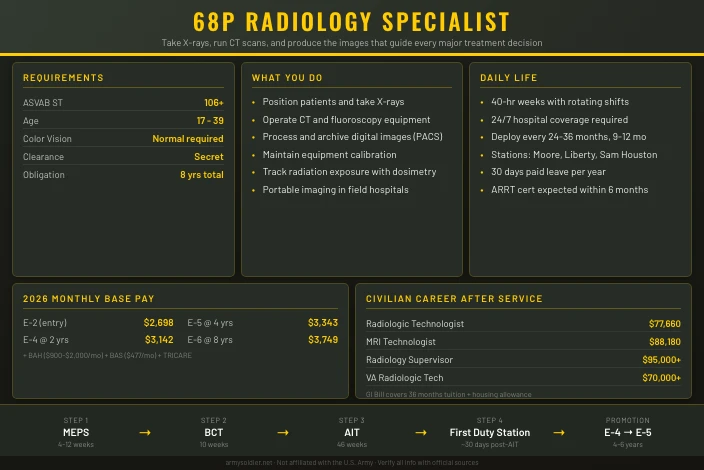
As a 68P, you position patients, operate radiographic and fluoroscopic equipment, process digital images, and hand results to physicians. You keep radiation exposure low, maintain equipment calibration, and document everything. This is a patient-facing role that demands technical precision and the ability to communicate clearly with people who are scared or in pain.
Daily Tasks
A typical shift runs 15 to 30 radiographic exams. You position patients for each one, explain the procedure so they stay still, run the equipment, process the images, and log exposures and findings in the military’s medical record system. Between patients, you sterilize the exam area and check your equipment.
Digital image archiving through PACS (Picture Archiving and Communication System) is a regular part of the job. In a busy garrison hospital, you work alongside physicians, nurses, and other 68P soldiers in real time. In a deployed setting, you may be the only imaging specialist available for an entire patient care team.
Specific Roles
The 68P career field has specialization paths beyond basic radiography:
| Specialization | Focus Area | Credential |
|---|---|---|
| Radiography | General X-ray imaging and fluoroscopy | ARRT Radiography (RT-R) |
| Computed Tomography (CT) | Advanced cross-sectional imaging | ARRT CT (CT-R) |
| Magnetic Resonance Imaging (MRI) | Non-radiation soft-tissue imaging | ARRT MRI (MR) |
These specializations are available through Army Continuing Education and Training (ACET) and are supported by Army COOL (Career Opportunities On-Line) credentials.
Mission Contribution
Doctors can’t treat what they can’t see. When a soldier comes in with a possible spinal injury or suspected pneumonia, your images are what the physician acts on. In deployed field hospitals with limited staff, a single 68P can be the difference between fast treatment and dangerous guesswork.
Your accuracy matters in garrison too. Routine screening and chronic disease management both depend on clean, well-positioned images that don’t need to be redone.
Technology and Equipment
You’ll work with digital radiography units, fluoroscopic systems, CT scanners, portable X-ray units, and in advanced settings, MRI equipment. PACS and electronic health record integration are standard. You wear a dosimetry badge every shift so your radiation exposure is tracked over time.
The field is moving toward lower-dose digital protocols and AI-assisted image analysis. Learning those tools now puts you ahead of most civilian technologists just starting out.
Salary and Benefits
Financial Benefits
Army enlisted soldiers receive base pay by rank and years of service. The 2026 base pay scale reflects a 3.8% increase from 2025. Additional pay may include enlistment bonuses (if applicable), BAH (Basic Allowance for Housing) when assigned off-post, and specialty pay in certain assignments.
| Rank | Pay Grade | Years of Service: 2 | Years of Service: 6 | Years of Service: 12 |
|---|---|---|---|---|
| Private (PV1) | E-1 | $2,407 | $2,407 | - |
| Private (PV2) | E-2 | $2,698 | $2,698 | - |
| Private First Class (PFC) | E-3 | $3,015 | $3,198 | - |
| Specialist (SPC) | E-4 | $3,303 | $3,816 | - |
| Sergeant (SGT) | E-5 | $3,599 | $4,109 | $4,422 |
| Staff Sergeant (SSG) | E-6 | $3,743 | $4,236 | $5,044 |
Source: DFAS 2026 pay tables. Figures reflect the 2026 pay raise.
Enlistment bonus eligibility for the 68P varies by Army recruiting needs and fiscal year. Contact your local Army recruiter for current bonus amounts and qualification criteria, as these change quarterly.
Additional Benefits
All Army service members get full healthcare coverage – medical, dental, and vision – at no cost on active duty. The Post-9/11 GI Bill provides up to $30,908 in annual tuition coverage at private institutions or full in-state tuition at public universities, plus a monthly housing allowance averaging $2,522 (2026-2027 rates) while enrolled full-time. TRICARE continues for 180 days after honorable discharge.
Army life insurance includes Servicemembers’ Group Life Insurance (SGLI) with up to $500,000 in coverage. The Blended Retirement System (BRS) pays a pension equal to 40% of base pay at 20 years of service. TSP contributions are matched up to 5% – worth starting early, especially if you separate before 20 years.
Work-Life Balance
Medical technologists in garrison typically work 40-hour weeks with rotating shifts to cover 24/7 hospital operations. Shift schedules vary by duty station and seniority. Annual leave builds at 2.5 days per month (30 days per year), approved by unit leadership.
Deployed locations limit leave access, though combat zone assignments often provide increased leave entitlements. Family readiness groups and childcare programs are available at most installations.
Qualifications and Eligibility
Basic Qualifications
You need to be a U.S. citizen or national between 17 and 39 at enlistment (parental consent required if under 18). A high school diploma or GED is required. Normal color vision is required – no red-green color blindness – tested at MEPS. You also need at least one year of high school algebra or the equivalent.
The 68P requires the ability to obtain a Secret security clearance. No active clearance is needed at entry, but you must pass a background check confirming you can get one. Waivers for moral character issues or financial instability are rarely granted.
ASVAB Requirements
The 68P requires a minimum 106 on the Skilled Technical (ST) line score. ST combines Word Knowledge, Paragraph Comprehension, Mathematics Knowledge, General Science, and Mechanical Comprehension.
| Qualification | Requirement | Notes |
|---|---|---|
| ASVAB ST Line Score | 106 minimum | Must be 106 or higher |
| Color Vision | Normal (no red-green blindness) | Tested at MEPS |
| High School Algebra | 1 year minimum | Or equivalent math |
| Age | 17-39 years old | 17-18 requires parental consent |
| Citizenship | U.S. citizen or national | Required |
| Security Clearance | Ability to obtain Secret | Background check required |
Application Process
Start at a local Army recruiting station. Your recruiter will check your qualifications and help you choose between Active Duty, Reserve, or National Guard. From there, you go to MEPS for the ASVAB, a full physical, and a background check.
Bring a valid photo ID, Social Security card, birth certificate, and any medical records you have. If you qualify for 68P, a contract is offered and a background investigation starts for your Secret clearance. The whole process from recruiter contact to Basic Training start date typically takes 30 to 90 days, depending on MEPS workload and investigation timelines.
Selection Criteria and Competitiveness
The 68P is moderately competitive within the Medical Career Management Field (CMF 68). Your ST score, color vision, and physical fitness are the primary selection factors. A background in science or healthcare helps. No civilian radiography certification is required, though EMT or medical assistant experience looks good in a recruiter interview.
Upon Accession into Service
You enter as E-1 (Private) with a standard eight-year military service obligation – four years active, four years inactive reserve. Graduation from AIT brings automatic advancement to E-2 (PV2) for satisfactory performers. Some 68P soldiers go on to Medical Service Corps officer programs or Special Forces medical roles. At the end of your commitment, you can separate honorably, or move to Army Reserves or National Guard.
See our ASVAB study guide for strategies to hit these line scores, or take the PiCAT from home if you are a first-time tester.
Work Environment
Setting and Schedule
The 68P works across several environments depending on assignment:
- Garrison hospital radiology department: Climate-controlled imaging suites with full digital equipment and PACS integration. This is where you’ll spend most of your career.
- Field hospital or forward surgical team: Portable radiographic units in tents or mobile structures. Setup and breakdown are part of the job.
- Deployed medical facility: Expeditionary imaging in contingency locations. Higher patient volumes, fewer resources, more individual responsibility.
- Outpatient or troop medical clinic: Smaller facilities handling routine sick-call imaging for garrison populations.
The role is almost entirely indoors except during patient transport or facility setup. Shift work is standard, with rotating 8-hour or 12-hour shifts covering 24/7 operations. Night shifts, weekend duty, and holiday coverage are routine.
Physical demands include standing 6 to 8 hours per shift, moving patients with minimal assistance, and wearing lead-lined protective equipment that adds weight and fatigue over time.
Leadership and Communication
Your direct supervisor is usually an NCO (E-5 to E-7) radiography supervisor or chief technologist. Physicians order exams; you run them independently and report findings to the radiologist. The chain of command is always in effect, but clinical decisions about image quality go through the radiologist.
Talking to patients is a real part of the job. You explain procedures, adjust positions, and keep anxious people calm in plain language. Performance feedback comes through monthly training meetings and annual NCOERs.
Team Dynamics and Autonomy
Large hospitals employ 8 to 15 radiographic technologists; smaller clinics may have just 2 to 3. You run equipment independently after certification but collaborate constantly with physicians, nurses, and other 68P soldiers.
Autonomy is high once you’re certified. But repeat exams or protocol changes require the radiologist. Field settings push you to solve problems fast with limited supervision. That’s where the job gets interesting.
Job Satisfaction and Retention
Early-service soldiers in their first four years show the highest attrition, mostly due to shift fatigue and the adjustment to military structure. Soldiers who earn ARRT certification and specialize in CT or MRI stay longer and advance faster.
Those who stick with the 68P describe the job satisfaction clearly: their images directly affect patient outcomes, they earn real respect from medical teams, and the path to a civilian career is well-defined. Promotion becomes selective after E-6; only top performers reach Master Sergeant (E-8) and beyond.
Training and Skill Development
Initial Training
All soldiers start with Basic Combat Training (BCT), a 10-week program at Fort Jackson (SC), Fort Leonard Wood (MO), or Fort Moore (GA). BCT covers military fundamentals: rifle marksmanship, chemical defense, and physical fitness.
After BCT, you go directly to Advanced Individual Training (AIT), which is 46 weeks total at the Medical Education and Training Campus (METC), Fort Sam Houston, San Antonio, TX.
| Phase | Duration | Location | Focus |
|---|---|---|---|
| Phase 1 | 24 weeks | Fort Sam Houston | Classroom and lab: anatomy, radiation physics, patient care, equipment operation |
| Phase 2 | 22 weeks | Clinical facility (varies) | Hands-on clinical training with real patients and supervising radiologists |
Phase 1 covers human anatomy and physiology, radiation biology and physics, medical terminology, radiographic positioning and technique, patient care, pathology recognition, medical ethics, and military medical information systems. You practice on radiographic phantoms and study clinical cases. Written exams and practical skills tests are required to advance.
Phase 2 puts you in a military hospital performing supervised exams on actual patients. A qualified instructor watches your positioning, technique, and image processing. Over hundreds of real exams, you build the speed and accuracy needed for independent practice. The phase ends with a final practical exam.
After AIT, you’re awarded the 68P MOS and report to your first duty station within about 30 days.
Advanced Training
The Army encourages ARRT certification, which you’re eligible to test for through your military training. The exam costs roughly $300, is usually taken within 6 months of AIT, and the Army reimburses the fee if you pass. ARRT is nearly required for advancement to E-6 and above.
CT and MRI specialty training is available through ACET:
- CT training: 12 weeks at METC, requires 2 to 3 years post-AIT experience
- MRI training: 8 weeks, same experience requirement and supervisor recommendation needed
The Army COOL system lists all credentials available, including ASI 68P7F (CT Specialization) and 68P7H (MRI Specialization). Specializing in one of these dramatically improves both your civilian job prospects and your promotion speed. NCOES courses open up for leadership advancement at E-5 and above.
Everything starts with qualifying ASVAB scores — our study guide covers what to study first.
Career Progression and Advancement
Career Path
You start at E-2 after AIT and reach E-3 (PFC) within the first year automatically. Promotion to E-4 (Specialist) typically comes between 18 months and 3 years with a solid record. Getting to E-5 (Sergeant) is competitive, usually around 4 to 6 years. E-6 (Staff Sergeant) is more selective and requires proven leadership plus ARRT certification.
| Rank | Typical Timeline | Leadership Responsibilities |
|---|---|---|
| E-2 (PV2) | At AIT completion | None (junior technologist) |
| E-3 (PFC) | 12 months post-AIT | None (senior technologist) |
| E-4 (SPC) | 2-3 years | Team lead for 2-3 technologists |
| E-5 (SGT) | 4-6 years | Shift supervisor, 5+ technologists |
| E-6 (SSG) | 8-12 years | Chief radiographer, section lead |
| E-7-E-9 | 12+ years | First Sergeant, Master Sergeant (very selective) |
The 68P community is small. Strong performers get noticed by senior medical leaders across installations. Advanced coursework funded by Tuition Assistance or the GI Bill improves your odds at higher ranks.
Role Flexibility and Transfers
You can transfer to related medical specialties like 68C (Practical Nursing), 68D (Operating Room Specialist), or 68W (Combat Medic), though reclassification requires additional training. Some 68P soldiers move into Medical Service Corps officer roles through the Direct Commission Officer program or OCS. Reserve and National Guard options are available for soldiers who want geographic stability after active duty.
Your ARRT certification transfers across all military branches and the civilian healthcare system. Dual-credentialed soldiers – say, a 68P with both EMT and ARRT – are competitive for aeromedical evacuation, field hospital leadership, or military medical training roles.
Performance Evaluation
NCOs at E-5 and above are rated through the NCOER (NCO Evaluation Report). E-4 and below go through the Enlisted Evaluation Report (EER). These annual reviews cover technical proficiency, leadership potential, physical fitness, and Army values. Senior rater summaries directly influence promotion recommendations.
Technical performance is tracked through radiology quality assurance: your repeat rate (retakes due to poor image quality) should stay below 5%. Patient safety incidents and licensing compliance are also on record. Strong NCOERs, low repeat rates, and ARRT certification are the factors that actually drive advancement here.
Success in This Career
Get ARRT certified as soon as you’re eligible. Then pick a specialty – CT or MRI – and pursue it. Build solid relationships with the radiologists in your department. Volunteer for additional duties and mentor junior technologists when the chance comes up.
The 68P community rewards people who combine technical skill with leadership. Chief Radiographer and Medical Unit Leader roles go to soldiers who do both well.
Physical Demands and Medical Evaluations
Physical Requirements
This job is moderately physically demanding. You stand 6 to 8 hours per shift, position patients on radiographic tables, and occasionally lift or help turn patients over 150 pounds. Lead aprons weigh 5 to 10 pounds and are worn throughout the shift, which adds strain to your neck, shoulders, and lower back over time.
Fine motor skills matter. You adjust patient positioning and equipment controls with precision, and hand-eye coordination is tested during phantom positioning exercises in AIT. Color vision (specifically the absence of red-green color blindness) is non-negotiable for radiation safety monitoring and reading image display colors. Mental stamina is high: physicians are waiting for results and patients need efficient, calm care.
Army Fitness Test (AFT) Standards
The current Army Fitness Test (AFT), effective 2025-2026, has five events. Minimum passing standards for soldiers aged 17-21:
| Event | Male Minimum | Female Minimum |
|---|---|---|
| 3-Rep Max Deadlift (MDL) | 140 lbs | 80 lbs |
| Hand-Release Push-Up (HRP) | 10 reps | 3 reps |
| Sprint-Drag-Carry (SDC) | 3:26 | 4:14 |
| Plank (PLK) | 1:00 | 1:00 |
| 2-Mile Run (2MR) | 19:35 | 22:12 |
Medical MOSs have no exemptions from AFT requirements. You need 60 points per event and a minimum total of 300. Most soldiers train 3 to 4 times per week during dedicated physical training time built into the work schedule.
Medical Evaluations
Annual health checks cover weight, blood pressure, vision, and hearing. Radiation dose monitoring runs through dosimetry badges you wear every shift – cumulative exposure is reviewed quarterly and tracked for your entire career. Any dose approaching regulatory limits triggers reassignment or additional shielding.
Vision and color vision are rechecked annually. Developing color blindness or significant uncorrectable vision loss can lead to reclassification. Mental health screenings are available after deployments or exposure to mass casualty scenarios.
Deployment and Duty Stations
Deployment Details
Deployment likelihood for 68P is high compared to many support specialties. Medical imaging personnel are in constant demand for forward surgical teams, field hospitals, and combat support hospitals during contingency operations. Recent patterns show 68P rotations every 18 to 36 months depending on Army strength and active conflicts. Deployments typically run 9 to 12 months.
Overseas permanent duty stations:
- Landstuhl Regional Medical Center – Germany. One of the largest U.S. military hospitals outside CONUS; high caseload, modern imaging equipment.
- Camp Humphreys – South Korea. Growing installation with expanding medical facilities.
- Kadena Air Base – Okinawa, Japan. Joint-service facility hosting Army medical personnel.
- Forward surgical teams – Middle East and Africa contingency locations.
Domestic duty stations:
- Walter Reed National Military Medical Center – Washington D.C. area. Flagship military hospital with advanced imaging specializations.
- Brooke Army Medical Center – San Antonio, Texas. Co-located with METC; strong training environment.
- Madigan Army Medical Center – Washington State. Level II trauma center serving Joint Base Lewis-McChord.
- Tripler Army Medical Center – Hawaii. Pacific regional medical hub.
Location Flexibility
Initial duty station assignment is based on Army needs. You can submit a preference list, but there are no guarantees. Soldiers with CT or MRI credentials have more options. Married soldiers with military spouses can request follow-on assignments together, though that’s not guaranteed. Most soldiers get one permanent change of station (PCS) every 3 to 4 years.
Risk, Safety, and Legal Considerations
Job Hazards
Radiation exposure is the main occupational hazard. Federal regulations limit annual occupational exposure to 5,000 millirems per year. Most 68P soldiers receive 200 to 1,000 millirems annually depending on facility workload and shielding – well within safe limits, but tracked carefully regardless.
Other hazards include:
- Musculoskeletal injury: Repetitive patient positioning and lead apron wear stress the lower back and neck over time.
- Bloodborne pathogen exposure: Needle sticks and body fluid contact can occur during invasive procedures or trauma response.
- Psychological stress: High-volume casualty scenarios during deployments affect some soldiers, particularly those with no prior exposure to severe trauma.
Safety Protocols
Military medical facilities follow strict radiation safety procedures throughout your career:
- Dosimetry monitoring: Badges worn at all times; cumulative dose reviewed quarterly and tracked for your entire service career.
- Shielding equipment: Lead aprons, thyroid shields, and lead-lined gloves required during all fluoroscopic procedures.
- Pregnancy protection: Pregnant soldiers are reassigned away from radiation sources immediately upon notification.
- Equipment calibration: Regular shielding audits and imaging system calibration maintain dose minimization.
- Bloodborne pathogen training: Annual recertification covering glove use, hand hygiene, and sharps disposal.
- Ergonomic training: Safe patient handling techniques taught in AIT and refreshed annually.
Security and Legal Requirements
The 68P requires the ability to obtain and maintain a Secret clearance. Background investigations cover financial history, criminal record, and drug use. Felony convictions, dishonorable discharge eligibility, or serious financial delinquency can result in clearance denial. Dishonest answers on the clearance application can lead to federal prosecution.
All soldiers operate under the Uniform Code of Military Justice (UCMJ). Patient privacy is protected under HIPAA; unauthorized access to or disclosure of medical records results in disciplinary action. Your military experience and ARRT certification directly support civilian licensing in all 50 states – no additional reciprocity steps needed.
Deployment to conflict zones carries Geneva Conventions protections. Military medical personnel are non-combatants. But medical personnel can be assigned to combat support roles where hostile fire is a risk, and SGLI and VA benefits cover combat exposure liability.
Impact on Family and Personal Life
Family Considerations
Single soldiers maintain barracks or off-post housing. Married soldiers receive BAH that typically covers rent or mortgage, ranging from $1,200 to $2,400 monthly depending on duty station, rank, and dependency status. Deployments run 9 to 12 months – that’s the hardest part for most military families.
The Army provides support resources at most installations:
- Family Readiness Groups (FRGs): Unit-level volunteer networks that connect families during deployments.
- Army Community Service (ACS): Financial counseling, spouse employment assistance, relocation support, and emergency aid.
- Military Family Life Counseling (MFLC): Free short-term counseling, no referral required.
- Child Development Centers (CDCs): On-post childcare at subsidized rates; availability varies by installation.
- TRICARE dependent coverage: Full medical, dental, and vision for spouses and children at no cost on active duty.
- Military OneSource: 24/7 resource for benefits, counseling referrals, and deployment prep.
Military spouses face real career disruption from PCS moves every 3 to 4 years. Joint spouse assignments are prioritized when both partners are military.
Relocation and Flexibility
PCS moves happen every 3 to 4 years on average. Some soldiers stay longer at high-priority locations like Walter Reed or Brooke. Overseas tours typically last 2 to 3 years with a return to CONUS afterward. Government covers moving costs for PCS moves.
Flexibility increases with rank and specialization. Senior NCOs request specific locations more effectively than junior soldiers. Reserve and National Guard components offer more geographic stability, though at reduced pay and benefits.
Reserve and National Guard
The 68P slot exists in both the Army Reserve and the Army National Guard, and it is one of the more accessible medical specialties in the part-time components. Medical units with imaging capability, including field hospitals and medical detachments, maintain radiology positions. You can find billets in both components, though availability depends on your geographic location and the size of the medical unit near you.
Drilling 68Ps are expected to maintain the same technical proficiency as their active-duty counterparts. That means keeping your American Registry of Radiologic Technologists (ARRT) certification current. ARRT requires 24 continuing education credits every two years to maintain primary certification, plus adherence to ARRT’s Standards of Ethics. Most Reserve and Guard 68Ps satisfy those CE requirements through their civilian radiology jobs, which run in parallel with military service.
Drill schedule and training requirements
The baseline commitment is one weekend per month and two weeks per year for Annual Training. AT often involves field exercises where you operate portable X-ray and other mobile imaging equipment, which differs from the fixed-equipment environment of a civilian hospital. You will also attend radiation safety refreshers and equipment proficiency training during drill weekends. Keeping hands-on skills sharp with portable and digital imaging systems is a recurring requirement, not a one-time box to check.
Pay and benefits comparison
Active-duty 68Ps receive a full-time base pay with no healthcare premiums. An E-4 with four years of service earns $3,659 per month. Reserve and Guard 68Ps earn drill pay, approximately $488 for a standard four-drill weekend at the same rank and experience level. The difference is real, but most Reserve and Guard soldiers maintain full civilian careers alongside their part-time service.
Healthcare costs diverge significantly between components. Active-duty TRICARE covers the service member at no premium. Reserve and Guard soldiers can purchase Tricare Reserve Select for $57.88 per month (member only) or $286.66 per month (member and family). These are manageable costs compared to most civilian insurance plans, but they are costs the active-duty soldier does not pay.
Education benefits include the MGIB-SR (Chapter 1606), which pays $493 per month for full-time students in the Reserve and Guard. Federal Tuition Assistance is also available at $250 per credit hour with a $4,500 annual cap. Guard soldiers may access state tuition waivers on top of those federal benefits, with many states covering full tuition at in-state public institutions.
Reserve and Guard retirement is points-based. You earn a pension at age 60, reduced by three months for every 90 days of qualifying active mobilization after January 28, 2008, down to a minimum of age 50.
Mobilization and deployment
The 68P faces moderate deployment frequency in the Reserve and Guard. Radiology capability is essential in deployed medical treatment facilities. When a field hospital or forward surgical team deploys, it typically includes imaging support. Reserve and Guard 68Ps attached to medical brigades or combat support hospitals are more likely to see mobilization orders than those attached to smaller detachments without organic imaging assets. Mobilizations can last 6 to 12 months.
Civilian career integration
Radiology is one of the strongest civilian-military pairing fields in the Army medical career structure. Civilian radiologic technologists work in hospitals, outpatient imaging centers, and urgent care facilities. Your ARRT certification carries equal weight whether earned through military training or a civilian program. The civilian imaging field has strong demand, with roughly 15,400 annual job openings projected through the early 2030s. USERRA protects your civilian job and seniority during any military activation, including Annual Training and mobilization periods.
| Feature | Active Duty | Army Reserve | Army National Guard |
|---|---|---|---|
| Duty Status | Full-time | Part-time (1 wknd/mo + 2 wks/yr) | Part-time (1 wknd/mo + 2 wks/yr) |
| Monthly Pay (E-4, 4 yrs) | $3,659/mo | ~$488/drill weekend | ~$488/drill weekend |
| Healthcare | TRICARE (no premium) | Tricare Reserve Select ($57.88/mo) | Tricare Reserve Select ($57.88/mo) |
| Education | Post-9/11 GI Bill, TA | MGIB-SR ($493/mo), TA | MGIB-SR ($493/mo), TA, state tuition waivers |
| Deployment | Per unit rotation | When mobilized | When mobilized |
| Retirement | 20-year pension | Points-based, age 60 | Points-based, age 60 |
Post-Service Opportunities
Transition to Civilian Life
ARRT certification earned through military training transfers directly to civilian employers nationwide. The Bureau of Labor Statistics projects 5% job growth for radiologic technologists from 2024 to 2034, with roughly 15,400 openings annually. Median annual salary was $77,660 in 2024, with MRI specialists earning around $88,180.
Federal employment is a natural first step. The VA, DoD civilian hospitals, and Indian Health Service hire radiologic technologists with Veterans Preference, which puts you ahead in the applicant pool. Major hospital networks like HCA and CommonSpirit actively recruit military-trained technologists.
| Civilian Role | Median Salary | Transition Pathway |
|---|---|---|
| Radiologic Technologist | $77,660 | ARRT cert direct transfer |
| MRI Technologist | $88,180 | ARRT MRI specialization |
| VA Radiologic Technologist | $70,000-$90,000 | Veterans Preference hiring |
| Radiology Supervisor | $95,000-$110,000 | Leadership experience + advanced degree |
Some 68P soldiers use the GI Bill for Radiography-to-Nurse bridging programs, radiology management degrees, or imaging informatics training. Your security clearance and leadership record also open doors in federal contracting and healthcare administration.
Programs and Transition Support
The Transition Assistance Program (TAP) provides mandatory career counseling, resume help, and interview coaching during your last 12 months on active duty. The GI Bill covers up to 36 months of education benefits (roughly $30,908 annually at private institutions for 2026-2027). VETS (Veterans’ Employment and Training Services) offers job placement and priority federal hiring.
VA Vocational Rehabilitation and Employment (VR&E) provides additional education and training funding for service-connected disabilities. Reserve and National Guard options let you maintain some military benefits while building a civilian career.
Discharge and Separation
Honorable discharge is awarded to soldiers who complete their service obligation with satisfactory conduct. Discharges under other than honorable conditions affect VA benefits and federal employment eligibility. Early separation before your contract ends is possible under hardship, medical, or early retirement programs, but requires commander approval. Start transition planning 12 to 18 months before your end date.
Is This a Good Job for You?
Ideal Candidate Profile
The best 68P soldiers are precise, patient-centered, and genuinely comfortable with science. You spend your career with anxious patients and impatient physicians, and both expect you to get it right.
This is a good fit if you:
- Do well in fast-paced medical environments where your work directly affects diagnosis and treatment
- Have strong hand-eye coordination and can communicate calmly with anxious patients
- Like anatomy and physics and enjoy the technical challenge of positioning for clean images
- Can handle rotating shifts, varied patient populations, and unpredictable deployment timelines
- Take radiation safety, patient privacy, and confidential medical records seriously
- Want civilian medical imaging work afterward and plan to use the GI Bill and ARRT certification to get there
This may not be a good fit if you:
- Need a fixed schedule and one city – night shifts, weekends, and moves every 3 to 4 years are standard
- Have chronic back problems or musculoskeletal vulnerabilities; lifting patients and lead apron wear add up
- Are worried about long-term radiation exposure as a health issue
- Find high-stakes accountability stressful – missed findings delay treatment, and that pressure is real
- Prefer working independently without military structure and UCMJ rules
Career and Lifestyle Alignment
You’ll learn X-ray skills faster in the Army than in most civilian programs. A motivated soldier can reach a leadership position within 8 to 12 years. The GI Bill and veteran hiring preferences give you a real head start if you want to move into civilian medical imaging after service.
This job works best for people who are OK with moving every few years and spending time away from home. If you want a stable 9-to-5 in one city right away, this isn’t it.
More Information
Talk to an Army recruiter about the 68P career field, current bonuses, and whether you qualify. Ask them to connect you with a 68P soldier so you can hear what the job is really like. You can also:
Search “68P Radiology Specialist” on goarmy.com and take the MOS Finder quiz
Check the Army COOL database for credentialing and certification details
Schedule an ASVAB at your nearest MEPS to see if your scores qualify
Talk to military families in your area to get a realistic picture of Army life, shift work, and deployments
Prepare for the ASVAB with our study guide to make sure your line scores qualify
This site is not affiliated with the U.S. Army or any government agency. Verify all information with official Army sources before making enlistment or career decisions.
Explore more Army medical careers such as 68W Combat Medic Specialist and 68D Operating Room Specialist.