68Q Pharmacy Specialist
Army pharmacy specialists manage pharmacy operations, prepare medications, and support pharmaceutical care for soldiers and their families. You work in hospital pharmacies, outpatient clinics, and deployed medical facilities. The 68Q handles everything from dispensing prescriptions to managing controlled substance inventories under pharmacist supervision.
This role fits people who want healthcare experience without direct patient combat duties. You gain skills that transfer directly to civilian pharmacy technician careers, with opportunities for national certification and advancement in military or civilian healthcare systems.
Qualifying requires specific ASVAB line scores — our ASVAB study guide covers what to target and how to prepare.
Job Role and Responsibilities
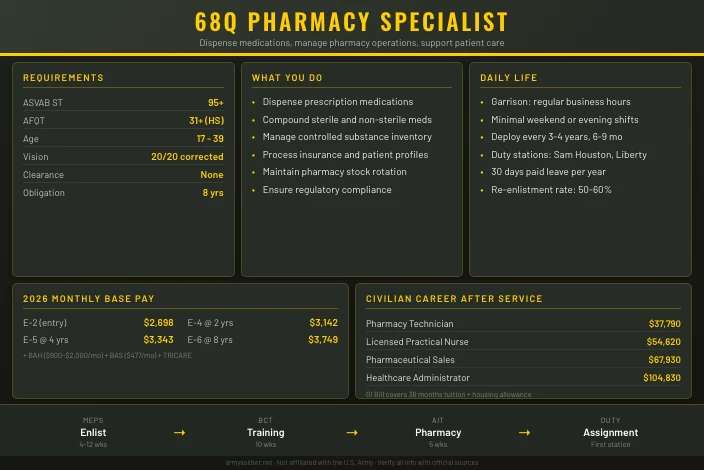
You manage pharmacy operations, prepare and dispense medications, maintain pharmaceutical records, and support licensed pharmacists in military treatment facilities. You handle controlled substances, compound medications, process insurance claims, and ensure compliance with all pharmacy regulations.
Your daily work splits between technical tasks and customer service. You receive prescription orders, verify patient information, prepare medications in pill or liquid form, label containers, and process payments. Most of your day involves working with pharmacy databases, counting medications, mixing compounds, and answering patient questions about dosage and side effects.
Specialized duties include sterile compounding for IV medications, chemotherapy preparation, and total parenteral nutrition (TPN) mixing. These require additional training and certification. You also manage inventory, order supplies, rotate stock to prevent expiration, and maintain temperature-controlled storage areas.
| Specialty Area | Description | Additional Training Required |
|---|---|---|
| Retail/Outpatient Pharmacy | Dispense medications to outpatients, process insurance, customer service | None (entry level) |
| Inpatient/Hospital Pharmacy | Prepare medications for hospitalized patients, IV compounding, unit dose packaging | On-the-job training |
| Sterile Compounding | IV admixture, chemotherapy, TPN preparation | Sterile processing certification |
| Pharmacy Administration | Inventory management, controlled substance tracking, regulatory compliance | Advanced pharmacy courses |
Pharmacy specialists work with automated dispensing machines, electronic health records (like MHS GENESIS), barcode scanning systems, and compounding equipment. You use IV hoods, laminar flow workbenches, pill counters, and prescription processing software daily. Larger facilities may have robotic dispensing systems.
Your work supports the Army Medical Department’s mission to maintain a healthy fighting force. Proper medication management prevents disease, treats injuries, and keeps soldiers medically ready. You also serve retirees and family members, making healthcare accessible to the entire Army community.
Salary and Benefits
Financial Benefits
Military pay is based on rank and time in service. Most pharmacy specialists start as E-2 after completing AIT.
| Rank | Pay Grade | Years of Service: 2 | Years of Service: 4 | Years of Service: 6 | Years of Service: 8 |
|---|---|---|---|---|---|
| Private (PV2) | E-2 | $2,698 | $2,698 | $2,698 | - |
| Specialist (SPC) | E-4 | $3,303 | $3,659 | $3,816 | $3,816 |
| Sergeant (SGT) | E-5 | $3,599 | $3,947 | $4,109 | $4,299 |
| Staff Sergeant (SSG) | E-6 | $3,743 | $4,069 | $4,236 | $4,613 |
Source: DFAS 2026 pay tables. Figures reflect the 2026 pay raise.
Base pay is only part of your compensation. You receive Basic Allowance for Housing (BAH) based on your duty station and dependency status. A single E-4 typically gets $900 to $2,000+ monthly depending on location. Basic Allowance for Subsistence (BAS) adds about $477 monthly for food.
Pharmacy specialists may qualify for special duty assignment pay or reenlistment bonuses when the Army has critical shortages. Current enlistment bonuses for 68Q range from $5,000 to $20,000 depending on contract length and Army needs.
Additional Benefits
You and your family receive TRICARE health coverage with minimal out-of-pocket costs. This includes medical, dental, vision, and mental health services. While serving, you can use Tuition Assistance to take college courses. After separation, the Post-9/11 GI Bill provides up to 36 months of tuition coverage at public universities (full in-state rate) plus a monthly housing allowance.
Retirement follows the Blended Retirement System:
- Serve 20 years and receive a pension worth 40% of your base pay
- The government matches up to 5% of your Thrift Savings Plan (TSP) contributions
- Survivor Benefit Plan (SBP) protects your family if you die during or after service
Work-Life Balance
You earn 30 days of paid leave annually (2.5 days per month). Pharmacy specialists in garrison typically work regular business hours with minimal weekend or holiday rotations. Some positions require evening or weekend coverage for 24-hour hospital pharmacies.
Deployments are less common for 68Q than combat MOSs, but still happen. When deployed, you work in field pharmacies or hospital ships with longer hours. Most pharmacy specialists experience one deployment every 3 to 4 years for 6 to 9 months.
Qualifications and Eligibility
Basic Qualifications
You must be a U.S. citizen or permanent resident between 17 and 39. High school graduates need at least a 31 on the AFQT. GED holders need a 50. The 68Q requires one specific ASVAB line score:
- Skilled Technical (ST): 95 minimum
The ST composite combines General Science, Verbal Expression, Mechanical Comprehension, and Math Knowledge. This score is moderate compared to other medical MOSs, making 68Q accessible to many recruits.
Medical standards require normal or corrected vision, no severe color blindness (you must distinguish medication colors and labels), and no disqualifying mental health history. You cannot have drug-related convictions or felony records.
| Requirement | Details |
|---|---|
| Age | 17-39 years old; up to 42 with waiver |
| Citizenship | U.S. citizen or permanent resident |
| Education | High school diploma or GED |
| AFQT (ASVAB) | Minimum 31 (diploma) or 50 (GED) |
| Skilled Technical (ST) | Minimum 95 |
| Vision | Correctable to 20/20; ability to distinguish colors |
| Medical Standards | Pass physical exam; no disqualifying conditions |
| Background | No drug-related or felony convictions |
Application Process
Start at your local Army recruiting station. The recruiter reviews your qualifications and schedules ASVAB testing if needed. Next comes MEPS (Military Entrance Processing Station) for a full medical exam, background check, and drug screening. This takes one full day.
If you qualify, your recruiter books a training slot for Basic Combat Training and AIT. The entire process from initial contact to shipping out takes 4 to 12 weeks. Background investigations or medical waivers can extend this timeline.
Selection Criteria and Competitiveness
The 68Q is moderately competitive. The Army needs pharmacy specialists at every major medical facility, but training slots are limited. Higher ASVAB scores, prior pharmacy experience (retail or hospital), or healthcare certifications strengthen your application.
Math and chemistry aptitude matter. Pharmacy involves constant calculations for dosages, dilutions, and conversions. If you struggled with these subjects in school, this MOS will be challenging.
Upon Accession into Service
You enter as E-1 (Private) and advance to E-2 after Basic Combat Training. Most soldiers reach E-3 or E-4 by the end of AIT depending on time in service and performance. The standard service obligation is 8 years total: typically 3 to 4 years active duty plus remaining time in the Reserve or Individual Ready Reserve.
See our ASVAB study guide for strategies to hit these line scores, or take the PiCAT from home if you are a first-time tester.
Work Environment
Setting and Schedule
Pharmacy specialists work in three primary settings:
- Garrison hospitals – Large medical centers with inpatient and outpatient pharmacies. Standard business hours with some evening and weekend rotations.
- Outpatient clinics – Retail-style pharmacies serving walk-in patients. Regular Monday through Friday schedules with occasional Saturdays.
- Deployed medical facilities – Field hospitals, hospital ships, or expeditionary medical support. Longer hours, 6 to 7 days per week, for 6 to 9 months.
Most 68Qs work 40-hour weeks in climate-controlled environments. You stand for much of the day, handle repetitive tasks like counting pills, and interact with dozens of patients daily. Eye strain from computer work and reading small labels is common.
Leadership and Communication
Your chain of command runs through the pharmacy officer (usually a Captain or Major who is a licensed pharmacist) and a senior NCO (E-6 or higher). Within the pharmacy, you work under civilian pharmacists and senior pharmacy technicians.
Performance feedback comes through annual evaluations and daily supervision. Civilian pharmacists review your work, correct errors, and provide training on new procedures. Most pharmacies hold regular staff meetings to discuss policy changes and safety updates.
Team Dynamics and Autonomy
Pharmacy work balances teamwork and independent responsibility. You collaborate with pharmacists, nurses, physicians, and other technicians. But you also work independently when counting medications, processing prescriptions, or managing inventory sections.
Accuracy is critical. A mistake in dosage or medication selection can harm patients. You double-check your work and follow strict protocols. There is little room for improvisation.
Job Satisfaction and Retention
About 50% to 60% of pharmacy specialists reenlist after their first term. That is higher than combat MOSs, reflecting the stable work environment and transferable civilian skills. Common reasons for leaving include pursuing civilian pharmacy careers, returning to school, or seeking less structured work.
Pharmacy specialists who stay appreciate the regular hours, healthcare benefits, and opportunities for advancement. The biggest complaints are repetitive tasks, high accuracy pressure, and dealing with difficult patients.
Training and Skill Development
Initial Training
Training has two phases: Basic Combat Training and Advanced Individual Training.
| Training Phase | Location | Duration | Focus |
|---|---|---|---|
| BCT | Fort Jackson, SC; Fort Moore, GA; or Fort Leonard Wood, MO | 10 weeks | Soldier skills: marksmanship, tactics, fitness, Army values |
| AIT | Fort Sam Houston, TX (Joint Base San Antonio) | 5 weeks | Pharmacy operations: calculations, dispensing, compounding, regulations |
Basic Combat Training teaches rifle marksmanship, land navigation, first aid, physical fitness, and military discipline. Every MOS completes this phase.
AIT at Fort Sam Houston focuses on pharmacy-specific skills. You study medical terminology, pharmacology, pharmacy mathematics, prescription processing, sterile and non-sterile compounding, inventory management, and pharmacy law. The curriculum includes classroom instruction and hands-on practice with dispensing equipment and compounding materials.
You learn to read prescriptions, calculate dosages, identify drug interactions, and compound medications under supervision. The program prepares you for national Pharmacy Technician Certification Board (PTCB) examination.
Advanced Training
After AIT, several advancement paths open up. Most pharmacy specialists pursue PTCB certification within their first year. The Army pays for exam fees and continuing education credits.
Specialized training includes:
- Sterile Compounding Certification – IV admixture, chemotherapy preparation, hazardous drug handling
- Pharmacy Automation Training – Robotic dispensing systems, barcode verification, automated inventory management
- Advanced Pharmacy Management – Controlled substance accountability, regulatory compliance, quality assurance
Experienced 68Qs can attend the Army’s Medical Department NCO Leadership Center courses for promotion to E-5 and above. Some pursue college degrees in healthcare administration or pre-pharmacy through Tuition Assistance.
The Army also offers opportunities to train as a Medical Laboratory Specialist (68K) or Medical Logistics Specialist (68J) through lateral reclassification.
Everything starts with qualifying ASVAB scores — our study guide covers what to study first.
Career Progression and Advancement
Career Path
Promotion to E-4 (Specialist) comes after 2 to 3 years and is mostly automatic with satisfactory performance. E-5 (Sergeant) requires passing a promotion board and takes 4 to 6 years.
| Rank | Pay Grade | Typical Years | Typical Role |
|---|---|---|---|
| Private (PV2) | E-2 | 0-1 | AIT graduate, entry-level technician |
| Specialist | E-4 | 2-3 | Senior technician, independent dispensing |
| Sergeant | E-5 | 4-6 | Pharmacy section supervisor, trainer |
| Staff Sergeant | E-6 | 6-9 | Pharmacy operations NCO, quality control |
| Sergeant First Class | E-7 | 9-12 | Senior pharmacy NCO, department management |
E-6 (Staff Sergeant) positions involve supervising other technicians, managing inventory systems, and ensuring regulatory compliance. E-7 and above are highly competitive and require proven leadership, military education, and strong evaluations.
Role Flexibility and Transfers
Lateral transfers to other medical MOSs are possible with leadership approval. Common moves include Medical Laboratory Specialist (68K), Medical Logistics Specialist (68J), or Medical Records Specialist (68G). Staying within the medical field is easier than crossing to non-medical MOSs.
Any MOS change requires completing that job’s training and accepting a new service obligation. Pharmacy specialists with strong records have more options.
Performance Evaluation
Annual evaluations (NCOERs for E-5 and above) assess your technical skills, leadership, and adherence to Army values. Your rater and senior rater score you on pharmacy operations, training management, and professional development.
Strong evaluations, PTCB certification, and advanced training lead to promotion. Pharmacy specialists who excel often become instructors at the Medical Education and Training Campus at Fort Sam Houston.
Physical Demands and Medical Evaluations
Physical Requirements
Pharmacy specialist is one of the less physically demanding Army jobs. You stand for 6 to 8 hours daily, lift medication boxes up to 40 pounds, and perform repetitive tasks like counting pills or typing labels. Fine motor skills and hand-eye coordination matter more than brute strength.
All soldiers take the Army Fitness Test (AFT) annually. Here are the minimum standards for ages 17 to 21:
| Event | Male Minimum | Female Minimum |
|---|---|---|
| 3-Rep Max Deadlift (MDL) | 140 lbs | 80 lbs |
| Hand-Release Push-Up (HRP) | 10 reps | 10 reps |
| Sprint-Drag-Carry (SDC) | 2:40 | 3:40 |
| Plank (PLK) | 2:00 | 2:00 |
| Two-Mile Run (2MR) | 15:54 | 18:54 |
Each event scores 0 to 100. You need at least 60 points per event and 300 total. Combat roles require 350. Pharmacy specialists must meet the same standards as all soldiers, though the job itself does not demand combat-level fitness.
Medical Evaluations
Annual health screenings include weight, blood pressure, vision, hearing, and immunization updates. Before deployment, you complete a separate medical clearance. Any condition that prevents deployment gets addressed first, or you remain stateside.
Deployment and Duty Stations
Deployment Details
Active-duty pharmacy specialists typically deploy once every 3 to 4 years for 6 to 9 months. Deployments are less frequent than combat MOSs but still expected.
Common deployment locations:
- Middle East – Iraq, Kuwait, Qatar
- Europe – Germany, Poland, Romania
- Pacific – South Korea, Japan
- Domestic – Disaster relief, humanitarian missions
Deployed pharmacies operate in field hospitals, hospital ships (USNS Comfort or Mercy), or expeditionary medical facilities. You work longer hours but maintain similar dispensing and compounding duties.
Location Flexibility
The Army assigns duty stations based on needs, not preferences. You can submit a preference list, but there are no guarantees. Expect to move every 2 to 4 years.
Common duty stations for 68Q:
- Fort Sam Houston, TX (Brooke Army Medical Center)
- Fort Liberty, NC (Womack Army Medical Center)
- Fort Campbell, KY (Blanchfield Army Community Hospital)
- Fort Carson, CO (Evans Army Community Hospital)
- Overseas: Landstuhl, Germany; Seoul, South Korea; Okinawa, Japan
Larger medical centers offer more advancement opportunities and specialized training. Remote or small clinics provide broader responsibility with less supervision.
Risk, Safety, and Legal Considerations
Job Hazards
Pharmacy work involves several occupational hazards:
In garrison and field settings:
- Exposure to hazardous drugs (chemotherapy, radiopharmaceuticals)
- Needlestick injuries and bloodborne pathogen exposure
- Contact with infectious diseases from patients
- Chemical exposure from compounding materials
- Repetitive strain injuries from counting, typing, lifting
Safety Protocols
Standard precautions apply everywhere: gloves, eye protection, proper handling of sharps and hazardous materials. Sterile compounding requires laminar flow hoods, protective gowns, and double gloving. Hazardous drug handling follows OSHA and NIOSH guidelines with specialized containment equipment.
Pharmacies maintain strict controlled substance accountability with dual-verification systems, secure storage, and regular audits. Any discrepancy triggers an investigation.
Security and Legal Requirements
Most 68Q assignments do not require a security clearance. Some positions in classified medical facilities or with controlled substances may need a Secret clearance. The process takes 2 to 6 months.
All soldiers follow the Uniform Code of Military Justice (UCMJ). Pharmacy specialists have additional legal obligations: maintain patient privacy under HIPAA, follow controlled substance regulations, and adhere to pharmacy practice laws. Violations can result in criminal charges, loss of certification, and administrative separation.
Before handling controlled substances, you complete training on the Controlled Substances Act and Army regulations. Annual refresher training is mandatory.
Impact on Family and Personal Life
Family Considerations
Spouses and children adjust to periodic deployments, frequent relocations, and the stress of military life. Deployments separate families for 6 to 9 months at a time.
Support resources at most installations:
- Family Readiness Groups (FRGs) – Unit-based peer support
- Military OneSource – Free counseling and family services
- Spousal employment assistance – Job placement help at each duty station
- Exceptional Family Member Program (EFMP) – Support for families with special needs
Relocation and Flexibility
You will relocate every 2 to 4 years. The Army pays for moves, but each PCS disrupts your spouse’s career, your children’s schooling, and your community connections.
You can request preferred locations, but the Army’s needs come first. Larger medical centers tend to have 3 to 4 year tours. Deployments add 6 to 9 months away from family. The target is 2 years home for every 1 year deployed, but operational demands vary.
Reserve and National Guard
The 68Q position exists in both the Army Reserve and the Army National Guard. Medical units in both components run pharmacy operations, and those units need trained pharmacy specialists to manage medication dispensing, controlled substance accountability, and patient counseling support. Billets are available in medical brigades, combat support hospitals, and medical detachments in both components.
If you complete active-duty service as a 68Q and transition to the Reserve or Guard, you are walking into a role with direct civilian-military skill alignment. Your day job as a civilian pharmacy technician and your weekend Army role as a 68Q reinforce each other in ways that few other MOS pairings can match.
Drill schedule and training requirements
Standard commitment is one weekend per month and two weeks per year for Annual Training. 68Qs have ongoing certification maintenance requirements beyond the standard drill schedule. Pharmacy Technician Certification Board (PTCB) certification requires 20 hours of continuing education every two years, with one CE hour covering pharmacy law. Controlled substance handling procedures also change, and you need to stay current. Reserve and Guard 68Qs typically meet these requirements through their civilian pharmacy jobs, but it is your responsibility to track your own certification status.
Annual Training for pharmacy units often involves field pharmacy operations, including setting up and running a deployable pharmacy within a field hospital or medical company. That hands-on logistics and accountability work is different from a civilian pharmacy counter but builds skills you will not get anywhere else.
Pay and benefits comparison
Active-duty 68Qs receive full-time base pay with no healthcare premiums. An E-4 at four years earns $3,659 per month. Reserve and Guard 68Qs earn drill pay, approximately $488 for a four-drill weekend at the same pay grade. That is the trade-off for part-time service, and most Reserve soldiers maintain full civilian employment alongside their Army commitment.
Healthcare is where the cost difference is most visible. Active-duty soldiers pay nothing for TRICARE. Reserve and Guard soldiers can buy into Tricare Reserve Select for $57.88 per month for member-only coverage, or $286.66 per month for member and family. That is significantly cheaper than most civilian employer plans, but it is not free.
The MGIB-SR (Chapter 1606) pays $493 per month for full-time students in the Reserve or Guard. Federal Tuition Assistance covers $250 per credit hour up to $4,500 per year. National Guard soldiers get an additional option in many states: state tuition waivers that can cover 100% of tuition at in-state public schools.
Retirement is points-based for Reserve and Guard soldiers. The pension vests at age 60, with a possible reduction of three months per 90 days of active mobilization after January 28, 2008, down to a minimum pension age of 50.
Mobilization and deployment
The 68Q sees moderate deployment frequency in the Reserve and Guard. Every deployed medical treatment facility needs pharmacy support. When medical brigades or combat support hospitals mobilize, their pharmacy sections go with them. Reserve and Guard 68Qs attached to those units can expect deployment orders when the unit is mobilized. Activations typically run 9 to 12 months, depending on the operation and unit mission.
Domestic missions also arise. During national emergencies and large-scale federal activations, Guard pharmacy specialists support civilian medical operations. Those mobilizations are shorter but real.
Civilian career integration
Pharmacy is a field where civilian and military skills translate directly and continuously. Civilian pharmacy technicians work in retail pharmacies, hospital pharmacies, long-term care facilities, and mail-order operations. The CPhT certification from PTCB is the civilian standard credential. Reserve 68Qs who maintain their CPhT while serving have stronger resumes and a clearer path to higher-paying hospital pharmacy roles. USERRA protects civilian pharmacy jobs during any military activation, including Annual Training, mobilization, and deployment.
| Feature | Active Duty | Army Reserve | Army National Guard |
|---|---|---|---|
| Duty Status | Full-time | Part-time (1 wknd/mo + 2 wks/yr) | Part-time (1 wknd/mo + 2 wks/yr) |
| Monthly Pay (E-4, 4 yrs) | $3,659/mo | ~$488/drill weekend | ~$488/drill weekend |
| Healthcare | TRICARE (no premium) | Tricare Reserve Select ($57.88/mo) | Tricare Reserve Select ($57.88/mo) |
| Education | Post-9/11 GI Bill, TA | MGIB-SR ($493/mo), TA | MGIB-SR ($493/mo), TA, state tuition waivers |
| Deployment | Per unit rotation | When mobilized | When mobilized |
| Retirement | 20-year pension | Points-based, age 60 | Points-based, age 60 |
Post-Service Opportunities
Transition to Civilian Life
Pharmacy specialist training transfers directly to civilian healthcare. You leave with hands-on pharmacy experience that most civilian pharmacy technicians do not get until years into their career. Many 68Qs earn PTCB certification before separation, so they qualify for civilian pharmacy roles on day one.
The Transition Assistance Program (TAP) provides resume help, interview coaching, and benefits counseling during your last 12 months. The Post-9/11 GI Bill covers up to 36 months of tuition (full in-state rate at public schools) plus a housing allowance and book stipend.
Civilian Career Prospects
Here is what pharmacy specialists typically move into:
| Civilian Job | Median Annual Salary (2024) | 10-Year Outlook |
|---|---|---|
| Pharmacy Technician | $37,790 | +6% |
| Licensed Practical Nurse | $54,620 | +5% |
| Medical Records Specialist | $47,180 | +7% |
| Pharmaceutical Sales Representative | $67,930 | +2% |
| Healthcare Administrator | $104,830 | +28% |
Your experience with electronic health records, inventory management, and regulatory compliance also opens doors in hospital administration, insurance companies, and pharmaceutical corporations.
Post-Service Policies
An honorable discharge provides lifetime VA healthcare access, disability compensation (if applicable), survivor benefits, and education benefits. You can separate after your 8-year obligation if you do not reenlist. Talk to your career counselor about options well before your end date.
A discharge other than honorable strips most VA benefits. Keep your record clean.
Is This a Good Job for You?
Ideal Candidate Profile
The best pharmacy specialists are detail-oriented, mathematically proficient, and comfortable with repetitive tasks.
Traits that predict success:
- Strong attention to detail and accuracy under pressure
- Comfortable working with numbers and measurements daily
- Good communication skills for patient interaction
- Self-directed learner who follows protocols precisely
- Background in chemistry, biology, or healthcare
This role fits people who want stable healthcare work without combat deployment. If you prefer predictable schedules and indoor environments, 68Q is a strong match.
Potential Challenges
This MOS is a poor fit if you:
- Need variety and excitement in daily tasks
- Struggle with math or detailed procedures
- Prefer outdoor or physically active work
- Want frequent combat or field experience
- Have difficulty standing for long periods
Pharmacy work is repetitive and high-stakes. A mistake can harm patients. If you need constant variety or struggle with precision, look at other medical MOSs like 68W (Combat Medic) or 68C (Practical Nursing).
Career and Lifestyle Alignment
If you want a healthcare career with regular hours and minimal physical demands, this is one of the best Army jobs. The training and certification prepare you for civilian pharmacy technician roles immediately. The GI Bill pays for advanced degrees in pharmacy, nursing, or healthcare administration.
The trade-off is modest pay compared to civilian healthcare workers and the military lifestyle of frequent moves and deployments. If you value stability over adventure, 68Q delivers.
More Information
Talk to an Army recruiter about the 68Q. Ask about current bonuses, training dates, and whether your ASVAB scores qualify. Request to speak with a current 68Q soldier to hear what the job is really like day-to-day.
Take the MOS Finder quiz at goarmy.com
Schedule an ASVAB at your nearest MEPS to see where your scores land
Research PTCB certification requirements at ptcb.org
Prepare for the ASVAB with our study guide to make sure your line scores qualify
This site is not affiliated with the U.S. Army or any government agency. Verify all information with official Army sources before making enlistment or career decisions.
Explore more Army medical careers such as 68C Practical Nursing Specialist and 68K Medical Laboratory Specialist.