68R Veterinary Food Inspection Specialist
Every meal a soldier eats on post, on a ship, or downrange has a 68R behind it. Army Veterinary Food Inspection Specialists inspect dining facilities, commissaries, and military rations to catch contaminated food before it reaches a soldier’s tray. It is one of the few Army jobs where your work directly touches the health of every person on the installation, every day.
The 68R MOS sits inside the Army Medical Department’s Veterinary Corps, which also oversees food safety contracts with every Defense Department food vendor worldwide. If you want a career with real public health impact, transferable civilian credentials, and a shorter AIT pipeline than most medical MOSs, this is worth a close look.
Qualifying requires specific ASVAB line scores — our ASVAB study guide covers what to target and how to prepare.
Job Role and Responsibilities
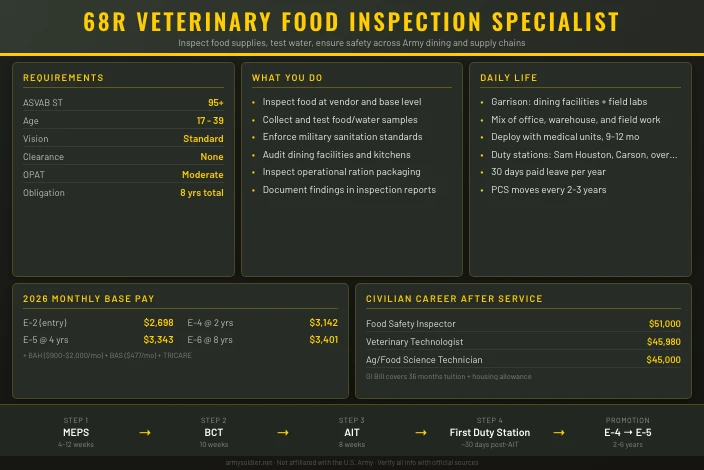
Veterinary Food Inspection Specialists inspect, test, and certify the safety of all food purchased and served across Department of Defense installations. They evaluate meats, poultry, seafood, dairy, eggs, fresh produce, and operational rations using statistical sampling methods to detect contamination, spoilage, improper storage, and labeling violations before the food reaches soldiers.
Daily work depends on where you are assigned. In garrison, a typical day includes morning inspections at the dining facility, reviewing temperature logs, checking pest control records, and pulling food samples for lab analysis. You document findings in inspection reports and work with facility managers to correct deficiencies on the spot.
What You Actually Do Each Day
- Inspect red meats, poultry, seafood, dairy products, eggs, fresh produce, and operational rations
- Verify temperature compliance throughout cold chain storage and food preparation areas
- Collect and submit food samples for microbiological laboratory analysis
- Audit vendor documentation, commercial invoices, and food contracts
- Evaluate cleaning and sanitization procedures in dining facilities and commissaries
- Identify and condemn contaminated or adulterated food items
Field and deployment environments expand the scope significantly. You apply food safety principles in environments ranging from hospital ships to field kitchens operating in chemical, biological, radiological, and nuclear (CBRN) conditions. The Army trains 68Rs on CBRN food protection specifically because deployed forces depend on operationally prepared rations that cannot be compromised.
ASIs and Skill Identifiers
| Code | Type | Description |
|---|---|---|
| MOS 68R | Primary MOS | Veterinary Food Inspection Specialist |
| SQI M | Special Qualification Identifier | Airborne qualified |
| SQI P | Special Qualification Identifier | Instructor |
The Veterinary Corps also has a warrant officer track. Army Warrant Officer 640A is the Food Safety Officer designation for commissioned officers overseeing the food safety mission at the operational and strategic level. A 68R with strong performance and college credits can pursue this path.
Mission Contribution
The 68R protects two things simultaneously: soldier health and government money. Food-borne illness in a garrison or deployed environment can degrade unit readiness faster than most threats. At the same time, 68Rs verify that the Defense Department gets what it paid for from commercial food vendors. Advanced-trained specialists participate in Navy ship-rider programs, extending food safety oversight to vessels that share Army procurement.
Technology and Equipment
You work with food thermometers, pH meters, water activity meters, and portable laboratory testing kits. Documentation is done in Army systems including GEMS (Government-owned and -contractor-operated enterprise systems). Some assignments involve gas chromatography and spectroscopy equipment in military veterinary laboratories for pesticide and adulterant testing.
Salary and Benefits
Financial Benefits
Military pay is based on rank and time in service. New soldiers enter at E-1 (Private) and typically reach E-2 shortly before or after AIT graduation. The table below shows 2026 base pay for common grades a 68R will hold across an early-to-mid career.
| Pay Grade | Rank | Less Than 2 Yrs | 4 Yrs | 6 Yrs |
|---|---|---|---|---|
| E-2 | Private (PV2) | $2,698 | $2,698 | $2,698 |
| E-4 | Specialist (SPC) | $3,142 | $3,659 | $3,816 |
| E-5 | Sergeant (SGT) | $3,343 | $3,947 | $4,109 |
| E-6 | Staff Sergeant (SSG) | $3,401 | $4,069 | $4,236 |
Base pay is not your total compensation. Basic Allowance for Housing (BAH) varies by duty station and dependency status. A single E-4 at Fort Sam Houston receives $1,359 monthly in BAH. Basic Allowance for Subsistence (BAS) adds $476.95 monthly as a flat food allowance for all enlisted soldiers. Neither allowance is taxable income.
There is no specific enlistment bonus currently listed for MOS 68R. Check with your recruiter for the latest incentive data, which changes quarterly.
Additional Benefits
TRICARE Prime covers all active-duty soldiers and their dependents at no enrollment fee. Medical, dental, vision, mental health, and prescription coverage are all included. No copays for in-network care.
Army Tuition Assistance pays up to $4,500 per year toward college courses while you serve. After service, the Post-9/11 GI Bill covers 36 months of full in-state tuition at public universities plus a monthly housing allowance based on the school’s ZIP code. Private school tuition is covered up to $29,920.95 per academic year under the current cap.
Work-Life Balance
All soldiers earn 30 days of paid leave annually. Garrison 68Rs generally work standard business hours, Monday through Friday, with some weekend coverage for commissary and dining facility inspections. Deployment cycles vary by unit, but food inspection specialists typically deploy with support units every two to three years for six to nine months.
Retention is relatively strong for this MOS. The combination of stable work, regular hours in garrison, and clear civilian career pathways makes 68R a job where many soldiers stay through multiple terms.
Qualifications and Eligibility
Basic Qualifications
You must be a U.S. citizen or permanent resident between 17 and 39 years old. High school graduates need an AFQT score of at least 31. GED holders must score 50 or higher. There are no waivers for the MOS-specific ASVAB line score.
The 68R has one line score requirement:
- Skilled Technical (ST): 95 minimum
The ST composite is calculated from General Science (GS) + Verbal Expression (VE) + Math Knowledge (MK) + Mechanical Comprehension (MC). A score of 95 is moderate within the CMF 68 field, comparable to several other medical MOS requirements.
| Requirement | Details |
|---|---|
| Age | 17-39; waivers possible up to 42 |
| Citizenship | U.S. citizen or permanent resident |
| Education | High school diploma or GED |
| AFQT | 31 minimum (diploma); 50 minimum (GED) |
| Skilled Technical (ST) | 95 minimum |
| Vision | Normal color vision required |
| Physical Profile (PULHES) | 222221 |
| Security Clearance | None required |
| Gender | Open to all |
Normal color vision is a firm requirement. You need to distinguish food characteristics by appearance, including meat discoloration, mold, and label text. If you have significant color blindness, this MOS is not available.
Application Process
Selection Criteria and Competitiveness
The 68R is moderately competitive. Training slots open based on Army needs at veterinary detachments and food inspection offices worldwide. Prior food service experience or any food handler certification strengthens your packet. An understanding of food safety principles from high school or community college coursework also helps.
The ST 95 requirement is lower than some medical MOSs (68W and 68C require both ST 101 and GT 107), so this MOS is more accessible to recruits who score well in science and math without the language-heavy GT composite pulling them down.
Upon Accession into Service
You enter as E-1 (Private, PV1). Most soldiers advance to E-2 before or shortly after completing AIT. The standard service obligation is 8 years total: typically 3 to 4 years active duty plus the remaining time in the Army Reserve or Individual Ready Reserve (IRR).
See our ASVAB study guide for strategies to hit these line scores, or take the PiCAT from home if you are a first-time tester.
Work Environment
Setting and Schedule
The 68R works across a wider range of settings than most medical MOS jobs. In garrison, you rotate among dining facilities, commissaries, sub-contractors, and procurement offices. Some assignments place you in Army veterinary laboratories where food sample analysis happens.
- Garrison (primary): Dining facilities, commissaries, storage warehouses, food vendor sites
- Deployed: Operational ration plants, field kitchens, forward operating bases, hospital ships
- Laboratory: Sample analysis, pesticide testing, microbiological work
Schedule in garrison follows standard business hours. Inspections often happen early in the morning before meal service begins. Deployed settings mean longer and less predictable hours depending on operational tempo.
Leadership and Communication
Your chain of command runs through an NCO (typically an E-6 or E-7 veterinary inspector) up to a 640A Food Safety Warrant Officer or a Veterinary Corps officer. At the junior enlisted level, you work under a senior 68R who mentors you through inspection procedures and report writing.
Performance feedback is written into the Army NCO Evaluation Report (NCOER) for sergeants and above. Junior soldiers receive informal feedback from supervisors and formal counseling from squad leaders. The Veterinary Corps is a small community, so your reputation for attention to detail follows you.
Team Dynamics and Autonomy
In the early career, expect to work closely with a senior inspector who reviews your findings before reports go out. As you gain experience, you’ll lead your own inspections and sign off on findings independently. Staff NCO positions involve supervising junior 68Rs and coordinating inspection schedules across multiple facilities.
The job requires precision. A missed temperature violation or a misidentified contaminant has real consequences. You cannot guess.
Job Satisfaction and Retention
The 68R community is small but tends to have strong retention. The job offers tangible daily results, regular hours in garrison, and a direct link between your work and soldier welfare. Common complaints include repetitive inspection routines in garrison and limited MOS visibility within the broader Army medical community.
Training and Skill Development
Initial Training
Every Army soldier completes Basic Combat Training first, then moves to MOS-specific Advanced Individual Training. The 68R pipeline is one of the shorter medical training sequences.
| Phase | Location | Duration | Focus |
|---|---|---|---|
| Basic Combat Training (BCT) | Fort Jackson, SC; Fort Moore, GA; or Fort Leonard Wood, MO | 10 weeks | Soldier skills, marksmanship, fitness, Army values |
| Advanced Individual Training (AIT) | Fort Sam Houston, TX | 8 weeks | Food inspection, sampling, sanitation, operational rations |
BCT is the same for every Army MOS. You will qualify on the M4 rifle, complete land navigation, learn first aid, and build baseline fitness. This is where you become a soldier.
AIT at Fort Sam Houston covers eight weeks of hands-on and classroom instruction. The curriculum includes:
- Inspection of red meats, poultry, seafood, eggs, dairy products, fresh produce, and MREs
- Temperature monitoring and cold chain verification
- Cleaning and sanitization assessments
- Food sample collection, labeling, and laboratory submission
- Hazardous food identification
- Vendor audit procedures
- CBRN food safety protocols
One notable aspect of the training: students taste various food items during the program. The logic is straightforward, as you cannot recognize spoilage unless you know what fresh products are supposed to taste and smell like.
Advanced Training
After AIT and assignment to your first duty station, professional development follows the Army Medical Department CMF 68 career progression model. Advanced training opportunities include:
- Primary Leadership Development Course (PLDC/WLC): Required for promotion to E-5
- Advanced Leaders Course (ALC): Required for E-6
- Senior Leaders Course (SLC): Required for E-7
- Airborne School (Fort Moore, GA): Available to qualified soldiers; SQI M designation
- Drill Sergeant School: Open to 68Rs with strong performance records
- 640A Warrant Officer application: For soldiers with 3+ years experience, college credits, and leadership potential
Civilian food safety certifications recognized by Army COOL include the Registered Environmental Health Specialist (REHS), Certified Food Safety Manager credentials, and ServSafe certifications. Soldiers can pursue these at personal expense or through Tuition Assistance coursework.
Everything starts with qualifying ASVAB scores — our study guide covers what to study first.
Career Progression and Advancement
Career Path
CMF 68 career progression is standardized across the medical MOS family. Promotion timelines are competitive and based on a combination of time in service, performance evaluations, and points accumulated through education, training, and awards.
| Rank | Pay Grade | Typical Time in Service | Key Position |
|---|---|---|---|
| Private (PV1/PV2) | E-1/E-2 | 0-1 years | Student (BCT/AIT) |
| Private First Class (PFC) | E-3 | 1-2 years | Junior food inspector |
| Specialist (SPC) | E-4 | 2-4 years | Food inspector |
| Sergeant (SGT) | E-5 | 4-6 years | Team leader, inspection NCO |
| Staff Sergeant (SSG) | E-6 | 6-10 years | Section NCOIC |
| Sergeant First Class (SFC) | E-7 | 10-15 years | Platoon sergeant, veterinary detachment NCOIC |
| Master Sergeant (MSG) | E-8 | 15-20 years | Senior advisor, command level |
| Sergeant Major (SGM) | E-9 | 20+ years | Senior enlisted advisor, Veterinary Corps level |
Promotion to E-5 is semi-centralized, meaning a promotion board reviews your record and commanders manage selections at the unit level. Promotions to E-6 and above are fully centralized through the Human Resources Command board process.
Role Flexibility and Transfers
Reclassification from 68R to another MOS is possible at the two- to three-year mark if Army needs align. Many 68Rs have transitioned to 68W (Combat Medic), 68K (Medical Laboratory Specialist), or 68T (Animal Care Specialist). Requests go through your chain of command and require Army Human Resources Command approval.
Reserve and National Guard units also have 68R slots. Active-duty soldiers who separate can often affiliate with a Reserve unit at the same grade and continue building toward retirement.
Performance Evaluation
Junior enlisted soldiers (E-1 through E-4) receive counseling through the Army performance counseling process. Sergeants and above are formally evaluated on the NCOER annually and after every key assignment. The 68R’s evaluation centers on inspection quality, report accuracy, mission accomplishment, and leadership development.
Success in this career means zero missed critical violations, clean inspection reports, and a track record of finding problems before they become incidents.
Physical Demands and Medical Evaluations
Physical Requirements
The 68R carries a moderately heavy physical demands rating (PULHES 222221). Daily work involves lifting and moving boxes of food product (up to 40-50 pounds), extended periods of standing and walking during inspections, and occasional work in cold storage environments. You are not carrying a rucksack or breaching doors, but this is not a desk job.
All Army soldiers take the Army Fitness Test (AFT), which replaced the ACFT on June 1, 2025. The AFT has five events scored 0-100 each for a 500-point maximum.
| AFT Event | Description | Minimum Score |
|---|---|---|
| 3 Repetition Maximum Deadlift (MDL) | Lower body strength | 60 |
| Hand Release Push-Up (HRP) | Upper body endurance | 60 |
| Sprint-Drag-Carry (SDC) | Functional fitness | 60 |
| Plank (PLK) | Core stability | 60 |
| Two-Mile Run (2MR) | Cardiorespiratory endurance | 60 |
The 68R MOS uses the general standard: 300 total points minimum (60 per event), sex- and age-normed. This is not a combat specialty MOS, so the stricter 350-point sex-neutral standard does not apply. Scores must be maintained annually.
Medical Evaluations
You receive a periodic health assessment (PHA) annually. The PULHES physical profile code 222221 sets your baseline medical standards. An updated physical is required before each deployment. Color vision is evaluated at MEPS and remains a firm standard throughout your service.
Deployment and Duty Stations
Deployment Details
Food inspection specialists deploy with the units they support. Deployment likelihood is moderate. Most active-duty 68Rs can expect one deployment every two to three years, typically ranging from six to nine months. Deployed assignments include forward operating bases, combat support hospitals, and Navy vessels through the ship-rider program.
The food safety mission does not disappear in a combat zone. If anything, it intensifies, since operational rations and locally procured food must meet strict standards to prevent mass foodborne illness in deployed forces.
Location Flexibility
The Army places 68Rs at installations with active Veterinary Service detachments. Common duty stations include:
- Fort Sam Houston, TX (home of the Army Veterinary Corps and MEDCoE)
- Fort Bragg (now Fort Liberty), NC
- Fort Campbell, KY
- Joint Base Lewis-McChord, WA
- Germany (USAREUR installations)
- Korea (Camp Humphreys, Area I installations)
- Japan (Camp Zama)
Overseas assignments are common. The Army Veterinary Corps has a global footprint because the food safety mission extends to every installation worldwide. You can request preferred duty stations, but assignments depend on the needs of the Army and slot availability.
Risk, Safety, and Legal Considerations
Job Hazards
The primary hazards are biological: contact with contaminated food, raw meats, and microbiological samples. You work with potentially hazardous materials daily. Deployed environments add risks from field kitchen accidents, extreme temperatures, and CBRN contamination scenarios.
Chemical exposure is possible during laboratory analysis work, particularly in installations with food testing labs.
Safety Protocols
Protective equipment in food inspection includes gloves, lab coats, and eye protection during sample collection. Food safety regulations require strict hand hygiene and cross-contamination prevention. Laboratory work follows standard biosafety protocols.
The Army Veterinary Corps trains 68Rs on CBRN food protection protocols, including how to test and certify food safety in contaminated environments.
Security and Legal Requirements
No security clearance is required for 68R. The job does not involve classified information systems or sensitive intelligence. Your legal obligations are the standard requirements of any Army enlistment: abide by the Uniform Code of Military Justice (UCMJ), fulfill your service contract, and follow Army regulations.
Soldiers who condemn food items have legal authority to do so under DoD food safety directives. This responsibility means your inspection findings carry weight in vendor contracting disputes and can result in significant financial consequences for non-compliant vendors.
Impact on Family and Personal Life
Family Considerations
The 68R is a better family MOS than most combat specialties. Garrison assignments generally mean regular hours, weekends mostly free, and predictable schedules except during exercises or inspections with hard deadlines. The deployment tempo is lower than combat MOSs but still real.
Military OneSource provides counseling, financial planning, and support services for families. Fort Sam Houston has on-post childcare, spouse employment programs, and housing support offices among the more complete family service offerings at any Army medical installation.
Relocation and Flexibility
Expect two to three permanent change of station (PCS) moves over a 10-year career. Overseas tours (Germany, Korea, Japan) are common in the Veterinary Corps. Each PCS includes a moving allowance and temporary lodging entitlement. Families can accompany soldiers on most assignments, including many overseas posts.
The Army provides 30 days of paid leave annually. Most 68Rs take leave between assignments and around the holidays. The Veterinary Corps’ smaller size means assignments are sometimes predictable from cycle to cycle, which helps with family planning.
Reserve and National Guard
The 68R exists in both the Army Reserve and the Army National Guard through veterinary detachments attached to medical commands and support brigades. Both components need food safety and veterinary specialists, and the 68R is one of the more consistently available medical MOS billets outside of large medical centers. Veterinary detachments tend to be small units, so you can find them at a wider geographic spread than some specialty medical MOSs.
If you are transitioning out of active duty and want to keep the MOS while building a civilian food safety career, the Reserve or Guard veterinary detachment is a strong fit. The skills reinforce each other directly, and the civilian food safety sector values both your experience and your federal service.
Drill schedule and training requirements
The baseline commitment is one weekend per month and two weeks per year for Annual Training. 68R soldiers in the Reserve and Guard have ongoing training requirements beyond the standard schedule. Food safety regulations and USDA inspection standards update regularly, and the Army expects you to stay current. Annual Training for veterinary detachments often includes food safety surveys, water quality assessments, and installation-level food inspection training.
Certification maintenance for civilian food safety credentials, like the Registered Sanitarian (RS) or Certified Professional - Food Safety (CP-FS), is your responsibility and aligns well with military training requirements. Some AT exercises are conducted at installations with dining facilities where real-world inspections occur, which provides direct skill reinforcement.
Pay and benefits comparison
Active-duty 68Rs receive full-time base pay with no out-of-pocket healthcare costs. An E-4 with four years of service earns $3,659 per month. Reserve and Guard 68Rs earn drill pay, approximately $488 for a four-drill weekend at the same grade. Most part-time soldiers maintain a full civilian career alongside their military service.
Healthcare in the Reserve and Guard costs more than active duty. Active-duty TRICARE has no premium for the service member. Reserve and Guard soldiers can buy Tricare Reserve Select for $57.88 per month (member only) or $286.66 per month (member and family). Compared to most civilian employer-sponsored plans, this is still a competitive rate.
Education benefits for Reserve and Guard soldiers include the MGIB-SR (Chapter 1606), which pays $493 per month for full-time students. Federal Tuition Assistance is available at $250 per credit hour with a $4,500 annual ceiling. National Guard soldiers in many states can also access state tuition waivers covering full tuition at public universities, stacking on top of federal education benefits.
Reserve and Guard retirement is points-based. The pension becomes available at age 60, with a potential reduction of three months per 90 days of qualifying active mobilization after January 28, 2008, to a minimum of age 50.
Mobilization and deployment
The 68R faces moderate to high mobilization frequency compared to other medical MOSs. Food safety is not optional in any operational environment. Every deployed unit requires food inspection and water safety support, and veterinary detachments are consistently in demand when large formations mobilize. Reserve and Guard 68Rs attached to veterinary detachments supporting combat support hospitals or expeditionary units should expect deployment when the parent unit is activated.
Deployments typically run 9 to 12 months. Domestic activations also occur, particularly during natural disasters and large federal food safety emergencies.
Civilian career integration
The civilian food safety career path and the 68R part-time role reinforce each other better than almost any other Reserve pairing in the medical career field. USDA Food Safety and Inspection Service (FSIS) hiring preferences favor veterans, and your military food inspection experience is directly relevant to FSIS work. State agriculture departments, local health departments, and FDA-regulated facilities employ food inspectors and quality assurance specialists in roles that map to 68R duties. USERRA protects your civilian food safety job during any military activation, including Annual Training and mobilization orders.
| Feature | Active Duty | Army Reserve | Army National Guard |
|---|---|---|---|
| Duty Status | Full-time | Part-time (1 wknd/mo + 2 wks/yr) | Part-time (1 wknd/mo + 2 wks/yr) |
| Monthly Pay (E-4, 4 yrs) | $3,659/mo | ~$488/drill weekend | ~$488/drill weekend |
| Healthcare | TRICARE (no premium) | Tricare Reserve Select ($57.88/mo) | Tricare Reserve Select ($57.88/mo) |
| Education | Post-9/11 GI Bill, TA | MGIB-SR ($493/mo), TA | MGIB-SR ($493/mo), TA, state tuition waivers |
| Deployment | Per unit rotation | When mobilized | When mobilized |
| Retirement | 20-year pension | Points-based, age 60 | Points-based, age 60 |
Post-Service Opportunities
Transition to Civilian Life
The 68R training maps directly to federal and state food safety careers. The USDA Food Safety and Inspection Service (FSIS) actively recruits veterans with food inspection experience. State agriculture departments, public health agencies, and the FDA employ food inspectors and quality assurance specialists in roles that align with 68R duties.
The Army’s Transition Assistance Program (TAP) helps soldiers translate military experience into civilian resumes, access VA benefits, and explore educational opportunities. Soldiers who pursue a degree using GI Bill benefits can move into food science, environmental health, or public health administration at higher salary levels.
| Civilian Job Title | Median Annual Wage | Projected Job Growth |
|---|---|---|
| Veterinary Technologist/Technician | $45,980 | 9% (faster than average) |
| Agricultural and Food Science Technician | ~$45,000 | 6% (as fast as average) |
| Food Safety Inspector (Federal/State) | ~$51,000 | Varies by agency |
| Quality Assurance Inspector | ~$42,000 | 4% |
Certifications that transfer directly from 68R experience include the Registered Environmental Health Specialist (REHS), Certified Food Protection Manager (CFPM), and HACCP (Hazard Analysis Critical Control Points) credentials. These certifications typically require an exam and documentation of experience, both of which 68R service satisfies in full.
Is This a Good Job for You? The Right (and Wrong) Fit
Ideal Candidate Profile
This MOS suits people who are detail-oriented and comfortable with repetitive inspection processes. You need to be able to write clear, accurate reports under time pressure. Curiosity about food science, microbiology, and public health helps. Candidates who worked in food service, healthcare, or agriculture before enlisting tend to adapt quickly.
The right person for 68R:
- Pays close attention to detail and does not skip steps
- Communicates findings clearly in writing
- Is comfortable working in cold storage, kitchens, and outdoor vendor sites
- Has an interest in food science, biology, or public health
- Wants a military career that builds directly applicable civilian skills
Potential Challenges
The work can become routine in garrison. Inspecting the same dining facility every week for two years is not for someone who needs constant novelty. The 68R community is small, which limits the number of leadership slots, schools, and high-visibility assignments compared to larger MOS communities.
This is also not a field medicine or combat-focused role. If direct patient care or combat-arms work is your goal, 68R is the wrong direction.
Career and Lifestyle Alignment
If you want a medical MOS with regular hours, a defined civilian career path, and a moderate physical demand, 68R fits well. It also suits people who want to serve but maintain something closer to a traditional work schedule than combat MOSs allow.
The overseas assignment opportunities are real and frequent. If travel and global exposure appeal to you, the Veterinary Corps’ worldwide footprint makes this one of the more geographically interesting medical jobs in the enlisted force.
More Information
Talk to an Army recruiter to confirm current training availability, bonus status, and assignment options for MOS 68R. Recruiter information is available at goarmy.com or by calling 1-888-550-ARMY. Bring your ASVAB scores or schedule a practice test during your first meeting.
- Prepare for the ASVAB with our study guide to make sure your line scores qualify
This site is not affiliated with the U.S. Army or any government agency. Verify all information with official Army sources before making enlistment or career decisions.
Explore more Army medical careers such as 68Q Pharmacy Specialist and 68X Mental Health Specialist.