68S Preventive Medicine Specialist
Most soldiers never think about the water they drink in the field or why a disease outbreak doesn’t sweep through a crowded forward operating base. That’s because a 68S Preventive Medicine Specialist already handled it. This MOS sits at the intersection of public health, environmental science, and military operations, and it leads directly to one of the most portable credential paths in the Army medical field.
Qualifying requires specific ASVAB line scores — our ASVAB study guide covers what to target and how to prepare.
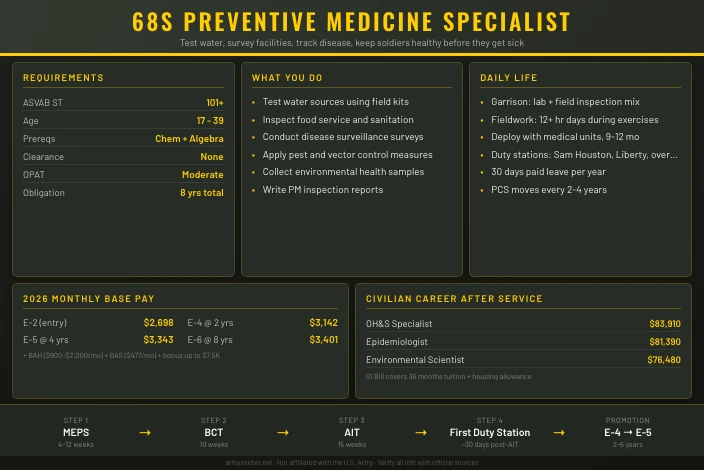
Job Role and Responsibilities
Preventive Medicine Specialists protect the force by identifying and eliminating threats before they become casualties. They conduct food and water safety inspections, run disease surveillance programs, investigate potential contamination sites, and collect environmental samples for laboratory analysis. In deployed environments, a 68S can directly affect a unit’s readiness by catching a waterborne disease threat before it sidelines hundreds of soldiers.
Day-to-day work depends heavily on where you’re assigned. In a garrison setting, you inspect food service facilities, review sanitation practices, test potable water systems, and track communicable disease reports across the installation. You submit written findings to medical leadership and recommend corrective actions. The work is methodical and documentation-heavy.
In the field, the pace shifts. You assess local water sources, evaluate waste disposal systems, survey the ground for vector breeding sites (mosquitoes, rodents, insects that carry disease), and provide commanders with public health risk assessments. When soldiers start getting sick, you investigate to find the source before it spreads.
Specialized Roles
The Army uses MOS Skill Codes (MOSC) to reflect levels of responsibility within the 68S career field:
| MOSC | Level | Typical Responsibilities |
|---|---|---|
| 68S1O | Entry/Journeyman | Conducts inspections, collects samples, assists with PM laboratory procedures |
| 68S3O | Supervisor | Supervises small PM services, organizes water, food sanitation, and epidemiological programs |
| 68S4O | Senior Supervisor | Supervises medium-size PM services or medical teams and detachments |
| 68S5O | Senior Leader | Supervises large PM units or serves on preventive medicine staff at higher headquarters |
Technology and Equipment
You’ll work with field water testing kits, environmental sampling equipment, entomological surveillance tools, and pesticide application systems. Electronic lab reporting platforms and Army disease surveillance databases are standard. Some assignments involve handheld GPS units for environmental mapping. Training on all equipment comes with your AIT and unit-level instruction.
Mission Contribution
Preventive medicine keeps the Army fighting. During World War I, disease killed more soldiers than enemy action. Today, 68S specialists are the reason that statistic no longer holds. By preventing illness before it spreads through a unit, you preserve combat power and reduce strain on already-stretched medical resources.
Salary and Benefits
Financial Benefits
Military pay is based on rank and time in service. Most soldiers enter as E-1 (Private) and promote to E-2 after completing Basic Combat Training.
| Rank | Pay Grade | Monthly Base Pay (2026) |
|---|---|---|
| Private (PV2) | E-2 | $2,698 |
| Private First Class (PFC) | E-3 | $2,837 |
| Specialist (SPC) | E-4 | $3,142 |
| Sergeant (SGT) | E-5 | $3,343 |
| Staff Sergeant (SSG) | E-6 | $3,401 |
Pay figures are 2026 rates per DFAS. The 68S currently qualifies for an enlistment bonus of up to $7,500 for eligible recruits, confirmed by goarmy.com.
Beyond base pay, you receive two key allowances. Basic Allowance for Housing (BAH) covers housing costs and varies by duty station, pay grade, and whether you have dependents. A single E-4 at Fort Sam Houston, TX receives $1,359 per month; rates across CONUS installations range from roughly $900 to $2,000 or more. Basic Allowance for Subsistence (BAS) adds $476.95 per month to cover food costs, regardless of rank.
Additional Benefits
Active-duty soldiers and their families receive TRICARE Prime health coverage at no enrollment cost – zero premiums, zero deductibles, zero copays for in-network care. Coverage includes medical, dental, vision, mental health, and prescriptions. That alone is worth thousands of dollars per year compared to civilian insurance.
The Army’s education benefits are substantial:
- Tuition Assistance (TA): Up to $4,500 per year for college courses while on active duty
- Post-9/11 GI Bill: Up to 36 months of tuition (full in-state rate at public schools), monthly housing allowance, and $1,000 per year for books after you separate
- GI Bill Transfer: After 6 years of service, you can transfer benefits to a spouse or dependent children
Retirement follows the Blended Retirement System (BRS). Serve 20 years and you earn a pension worth 40% of your base pay. The government also contributes up to 5% of your pay to your Thrift Savings Plan account – the military equivalent of a 401(k).
Work-Life Balance
You earn 30 days of paid leave per year (2.5 days per month). In a garrison preventive medicine office, work is generally structured around standard business hours. Field training exercises and deployments break that routine, sometimes for weeks at a time. When environmental health emergencies or disease outbreaks occur, the hours get long until the situation is contained. Most active-duty 68S specialists deploy once every 24 to 36 months on 9 to 12-month rotations.
Qualifications and Eligibility
Basic Qualifications
You need to be a U.S. citizen between ages 17 and 39. High school diploma holders need a minimum 31 on the AFQT portion of the ASVAB; GED holders need a 50. The key line score for 68S is the Skilled Technical (ST) composite, which combines General Science, Verbal Expression, Mathematics Knowledge, and Mechanical Comprehension.
Color vision is required. Normal color vision is a medical prerequisite because the work involves reading reagent test results and interpreting color-coded laboratory indicators. A color vision deficiency will disqualify you from this MOS.
One additional academic requirement sets this MOS apart from most CMF 68 jobs:
| Requirement | Details |
|---|---|
| Age | 17-39; up to 42 with waiver |
| Citizenship | U.S. citizen |
| Education | High school diploma or GED |
| AFQT | 31 minimum (diploma); 50 minimum (GED) |
| ASVAB Line Score | ST: 101 minimum |
| Academic Prerequisite | 1 year high school chemistry + 1 year algebra, grade C or better |
| Color Vision | Normal color vision required |
| OPAT Category | Moderate physical demand |
| Security Clearance | None required |
| Enlistment Bonus | Up to $7,500 |
| Service Obligation | 8 years total (active duty + IRR) |
Application Process
Start at your local Army recruiting station. Your recruiter checks your qualifications, pulls your ASVAB scores (or schedules the test if you haven’t taken it), and verifies your academic prerequisites. If everything lines up, they submit your paperwork to request a 68S training slot.
MEPS (Military Entrance Processing Station) is next. You get a full physical, a background check, and a final review of your qualifications. Color vision testing happens at MEPS. The whole process from recruiter visit to swearing in typically takes 4 to 12 weeks, depending on training slot availability and how quickly your medical and background checks clear.
Selection Criteria and Competitiveness
The ST 101 requirement filters out a significant share of applicants. This is the same minimum score required for 68W (Combat Medic) and 68X (Mental Health Specialist). The chemistry and algebra prerequisites add another filter. If your transcripts show both courses with a C or better, you’re ahead of many applicants.
Strong candidates often have some background in science, environmental work, or public health. That experience isn’t required, but it helps you hit the ground running in AIT.
Upon Accession into Service
You enter as E-1 (Private) and promote to E-2 after BCT. Most soldiers reach E-3 or E-4 within their first year depending on performance and time in service. The standard obligation is 8 years total: the active duty portion (typically 2 to 4 years) plus remaining time in the Individual Ready Reserve.
See our ASVAB study guide for strategies to hit these line scores, or take the PiCAT from home if you are a first-time tester.
Work Environment
Setting and Schedule
The 68S works across several distinct environments, and the daily rhythm changes with each one:
- Preventive medicine office (garrison): Standard hours, weekday schedule; inspection and report writing work
- Field training exercises: Irregular hours; setup and survey work in austere conditions for days or weeks at a time
- Deployed medical unit: Operational tempo drives everything; water and food safety surveys, disease investigation, and environmental assessments happen alongside active operations
- Higher headquarters PM staff: Planning and oversight work, more administrative, less field time
The work is largely independent during inspections and surveys, but you document everything and report findings through the chain of command.
Leadership and Communication
You report to a senior 68S NCO or a Preventive Medicine Officer (typically a Medical Corps officer). Daily communication involves written inspection reports, lab results, and public health risk assessments. At E-5 (Sergeant) and above, you lead teams conducting surveys and begin supervising junior specialists.
Performance feedback comes through the standard Army evaluation system. NCOs (E-5 and above) receive annual NCOER ratings covering leadership, technical skills, and Army values.
Team Dynamics and Autonomy
Entry-level 68S specialists work under supervision, but real autonomy appears quickly. Inspections often involve going to a facility, making observations, and writing findings without a supervisor present. Your documentation has to be accurate because commanders use it to make health decisions. At E-4 and above, you run surveys independently and brief results to medical leadership.
Job Satisfaction and Retention
Specialists who enjoy science, detective work, and variety in their daily tasks tend to stay long-term. The work is intellectually engaging and the credential path (REHS/RS) gives you a tangible post-service asset. Soldiers who prefer constant patient interaction may find the inspection and documentation focus less rewarding.
Training and Skill Development
Initial Training
Training follows two phases: Basic Combat Training and Advanced Individual Training.
| Phase | Location | Duration | Focus |
|---|---|---|---|
| BCT | Fort Jackson, SC; Fort Moore, GA; Fort Leonard Wood, MO | 10 weeks | Soldiering fundamentals: marksmanship, tactics, physical fitness, discipline |
| AIT | Fort Sam Houston, TX (Brooke Army Medical Center) | 15 weeks | Environmental health, food and water sanitation, disease surveillance, entomology, laboratory sampling, PM inspection techniques |
BCT is the same for every Army enlistee. You run, shoot, navigate, and learn to operate as a soldier before any specialty training begins.
AIT at Fort Sam Houston is where the job takes shape. The 15-week program covers environmental health science, field water purification, food safety inspection methods, pest and vector control, communicable disease reporting, and basic preventive medicine laboratory procedures. You practice water testing with field kits, conduct mock facility inspections, and learn how to write the reports that commanders actually read.
Advanced Training
After initial training, several specialized paths open up. The Army offers advanced courses in:
- Entomology: Surveillance and control of insects and other vectors that spread disease
- Environmental science: Industrial hygiene, hazardous waste, and occupational health surveys
- Epidemiology: Disease investigation and outbreak response procedures
- Water purification: Advanced field water treatment and quality testing
The Army Soldier Care Navigation (Army COOL) program funds civilian credential fees for qualifying soldiers. The Registered Environmental Health Specialist/Registered Sanitarian (REHS/RS) credential from the National Environmental Health Association is the primary civilian certification that aligns with 68S skills, and the Army actively supports soldiers in pursuing it.
Tuition Assistance allows you to take college courses in environmental science, public health, or biology while on active duty – building toward a degree that stacks directly on your service credentials.
Everything starts with qualifying ASVAB scores — our study guide covers what to study first.
Career Progression and Advancement
Career Path
Promotion through E-4 is largely automatic if you meet the requirements and stay out of trouble. The jump to E-5 (Sergeant) is the first genuinely competitive step. At that rank, the job shifts from executing surveys to supervising them.
| Rank | Pay Grade | Typical Time in Service | Typical Role |
|---|---|---|---|
| Private (PV2) | E-2 | 0-1 year | AIT graduate, entry-level PM surveys |
| Specialist (SPC) | E-4 | 1-3 years | Independent inspection and lab work |
| Sergeant (SGT) | E-5 | 3-6 years | NCO, team leader, small-unit PM supervisor |
| Staff Sergeant (SSG) | E-6 | 6-10 years | Senior NCO, PM section leadership |
| Sergeant First Class (SFC) | E-7 | 10-14 years | PM operations leadership, significant administrative responsibilities |
| Master Sergeant (MSG) | E-8 | 14+ years | Senior leader, program oversight, policy input |
E-7 and above requires competitive selection through the promotion board system, with strong evaluations, military education (Sergeant Major Academy for E-9), and a demonstrated leadership record.
Role Flexibility and Transfers
Lateral moves within the CMF 68 family are possible but require approval and an open slot in the receiving MOS. Soldiers with strong evaluations and verified qualifications sometimes move toward related fields like 68K (Medical Laboratory Specialist) or warrant officer paths in medical operations. Any MOS change means completing that job’s training.
Performance Evaluation
NCOs at E-5 and above receive annual NCOER ratings. Your rater assesses you on technical competence, leadership, physical readiness, and Army values. Scores range from “meets standards” to “exceeds standards.” A consistent “exceeds standards” rating across multiple raters is what accelerates promotion.
What distinguishes top 68S performers: meticulous documentation, solid science fundamentals, initiative during field exercises, and the ability to brief complex health risks to non-medical commanders in plain language.
Physical Demands and Medical Evaluations
Physical Requirements
The 68S carries an OPAT (Occupational Physical Assessment Test) rating of Moderate physical demand. That means you need to demonstrate the ability to handle loads and physical tasks at a moderate intensity level, not at the heavy or very heavy standard required by combat arms.
Day-to-day physical demands include carrying inspection kits and sampling equipment, moving through installation facilities and field sites on foot, and occasionally working in protective gear (respirators, gloves, chemical protective suits) during hazmat assessments.
Every soldier takes the Army Fitness Test (AFT) annually. The AFT has 5 events scored 0 to 100 each, with a minimum of 60 points per event required to pass. The general passing standard is 300 total (sex- and age-normed). Scores are not MOS-specific for 68S – the general standard applies.
| Event | Abbreviation | What It Tests |
|---|---|---|
| 3 Repetition Maximum Deadlift | MDL | Lower body strength and grip |
| Hand Release Push-Up | HRP | Upper body pushing strength |
| Sprint-Drag-Carry | SDC | Speed, power, and muscular endurance |
| Plank | PLK | Core stability |
| Two-Mile Run | 2MR | Aerobic endurance |
The AFT replaced the Army Combat Fitness Test (ACFT) on June 1, 2025. Maximum possible score is 500 points.
Medical Evaluations
Beyond the initial MEPS physical, soldiers undergo annual health assessments: vision, hearing, weight, blood pressure, and provider check-in. 68S specialists who work with pesticides, industrial chemicals, or hazardous materials receive occupational health monitoring specific to those exposures. Pre-deployment medical clearances are required before any overseas assignment.
Deployment and Duty Stations
Deployment Details
Active-duty 68S specialists deploy as part of preventive medicine detachments or medical support units. Deployments typically run 9 to 12 months, with active-duty soldiers deploying roughly once every 24 to 36 months. Specialists assigned to high-readiness units or forward-positioned forces may deploy more frequently.
Common deployment environments:
- Middle East: Supporting large-scale operations and forward-deployed brigades, where food and water safety are constant challenges
- Europe: NATO deployments in Germany and Poland with multinational force health protection requirements
- South Korea: Persistent deterrence mission with regular field exercises and high-readiness posture
- Domestic humanitarian support: Disaster response deployments where water safety and disease prevention are immediate public health priorities
Location Flexibility
Duty station assignments are driven by Army needs. You submit a preference list, but there are no guarantees. Preventive medicine detachments are assigned to major installations with significant troop populations.
Common 68S duty stations:
- Fort Sam Houston, TX
- Fort Moore, GA
- Fort Liberty, NC
- Fort Campbell, KY
- Fort Bliss, TX
- Overseas: Germany (Landstuhl), South Korea (Camp Humphreys)
Expect to move every 2 to 4 years. Larger installations tend to offer longer tours and more assignment stability.
Risk, Safety, and Legal Considerations
Job Hazards
Preventive medicine work involves real occupational hazards that most Army jobs don’t share:
- Chemical exposure: Pesticide application, water treatment chemicals, and environmental contaminants during field surveys
- Biological hazards: Handling specimens from disease outbreaks, working in areas with endemic diseases, and collecting samples from contaminated environments
- Deployed risks: Indirect fire, vehicle accidents, and extreme environmental conditions in forward areas
- Field conditions: Austere environments with limited support, high heat or cold, and physical demands during long-range surveys
Safety Protocols
The Army manages these risks through structured protective measures:
- Personal protective equipment (PPE) is required and issued for hazmat and pesticide operations
- Biological sample collection follows strict chain-of-custody and decontamination protocols
- Deployed PM teams operate under force protection guidelines set by the supported unit
- All chemical handling follows the Army’s Safety and Occupational Health (SOH) regulatory framework
Security and Legal Requirements
The 68S does not require a security clearance for routine assignments. Specialists supporting classified programs or special operations units may be screened for Secret clearance, but this is not standard for the MOS.
All soldiers operate under the Uniform Code of Military Justice (UCMJ). 68S specialists who work with medical and public health data have additional responsibilities around accurate reporting – falsifying inspection results or environmental data is a serious legal and safety violation.
Impact on Family and Personal Life
Family Considerations
Military life means adapting to frequent moves, extended field exercises, and 9 to 12-month deployments. The 68S deploys at a moderate rate compared to combat-focused MOSs, which helps with family stability between rotations. That said, long stretches in the field during stateside training cycles are common.
Support systems available at most installations:
- Family Readiness Groups (FRGs): Unit-level peer support and information sharing during deployments
- Military OneSource: Free counseling and family services, 24/7
- Army Community Service (ACS): Financial counseling, spousal employment assistance, relocation support
- TRICARE coverage for family members: Full health insurance with minimal out-of-pocket costs
- School Liaison Officers: Help military children manage school transitions during moves
Relocation and Flexibility
You will move. After AIT, the Army assigns your duty station based on its needs. After that first assignment, expect a permanent change of station (PCS) every 2 to 4 years. The Army covers moving costs through government transportation and DITY (Do It Yourself) moving allowances. Your spouse’s career and your kids’ schooling take the disruption every time.
Preferred location requests are submitted and sometimes honored, particularly for soldiers with strong records. Retention NCOs can sometimes negotiate assignment locations as part of a re-enlistment package.
Reserve and National Guard
The 68S exists in both the Army Reserve and the Army National Guard through preventive medicine detachments and medical brigades. Both components maintain preventive medicine units because environmental health and disease prevention are mission-critical functions in any operation. Billets are available across a wider geographic spread than highly specialized clinical MOSs, giving 68S soldiers more flexibility in finding a unit near home.
Part-time preventive medicine work pairs well with civilian public health careers. If you work as an environmental health technician, occupational health and safety officer, or public health specialist during the week, your weekend Army duties reinforce those skills directly. Many Reserve and Guard 68Ss find the two roles inform each other in ways that make them stronger at both.
Drill schedule and training requirements
The standard commitment is one weekend per month and two weeks per year for Annual Training. Preventive medicine soldiers have ongoing technical training requirements beyond that baseline. Environmental regulations change, water quality testing protocols are updated, and pest management certification standards evolve. Annual Training for preventive medicine detachments often involves conducting environmental health surveys, water sanitation assessments, and vector control operations at field exercises or installation sites.
The Registered Environmental Health Specialist/Registered Sanitarian (REHS/RS) credential from the National Environmental Health Association (NEHA) is the civilian standard. Maintaining it requires continuing education, and most Reserve 68Ss complete those CE hours through their civilian public health jobs, which run in parallel with their military service.
Pay and benefits comparison
Active-duty 68Ss earn full-time base pay with no healthcare premiums. An E-4 with four years of service earns $3,659 per month. Reserve and Guard 68Ss earn drill pay, approximately $488 for a standard four-drill weekend at the same rank. The pay reflects the part-time nature of the commitment; most Reserve and Guard soldiers maintain separate civilian employment.
Healthcare costs differ significantly. Active-duty TRICARE costs the service member nothing in premiums. Reserve and Guard soldiers can buy into Tricare Reserve Select for $57.88 per month (member only) or $286.66 per month (member and family). Those rates are competitive with most civilian plans but are real costs that active-duty soldiers do not pay.
Education benefits include the MGIB-SR (Chapter 1606), which pays $493 per month for full-time students. Federal Tuition Assistance covers $250 per credit hour with a $4,500 annual cap. National Guard soldiers in many states can also access state tuition waivers covering full tuition at public universities. Those can be stacked with federal TA in some states.
Reserve and Guard retirement is points-based, with a pension available at age 60. Each 90-day period of qualifying active mobilization after January 28, 2008 can reduce that age by three months, down to a minimum of age 50.
Mobilization and deployment
The 68S has moderate mobilization frequency in the Reserve and Guard. Preventive medicine is a required function at any deployed location. Environmental health assessments, water quality testing, and disease prevention work happen at every forward operating base and base camp. Reserve and Guard 68Ss attached to preventive medicine detachments supporting combat support hospitals or expeditionary forces should expect mobilization when the unit activates.
Deployments run 9 to 12 months on average. Domestic missions are also real for Guard 68Ss, who may be activated for emergency public health responses, natural disaster operations, or large-scale federal disaster declarations.
Civilian career integration
The 68S civilian-military pairing is strong. Environmental health technicians, public health inspectors, and occupational health and safety specialists all use skills that overlap directly with 68S duties. The REHS/RS certification is the civilian credential to pursue, and military preventive medicine experience counts toward the experience requirements for that certification. USERRA protects civilian jobs in public health or any other sector during military activations, including Annual Training, mobilization, and any period of federal service.
| Feature | Active Duty | Army Reserve | Army National Guard |
|---|---|---|---|
| Duty Status | Full-time | Part-time (1 wknd/mo + 2 wks/yr) | Part-time (1 wknd/mo + 2 wks/yr) |
| Monthly Pay (E-4, 4 yrs) | $3,659/mo | ~$488/drill weekend | ~$488/drill weekend |
| Healthcare | TRICARE (no premium) | Tricare Reserve Select ($57.88/mo) | Tricare Reserve Select ($57.88/mo) |
| Education | Post-9/11 GI Bill, TA | MGIB-SR ($493/mo), TA | MGIB-SR ($493/mo), TA, state tuition waivers |
| Deployment | Per unit rotation | When mobilized | When mobilized |
| Retirement | 20-year pension | Points-based, age 60 | Points-based, age 60 |
Post-Service Opportunities
Transition to Civilian Life
The 68S translates directly to environmental health and public health careers. Civilian employers in local health departments, federal agencies, and private industry recognize military environmental health experience as meaningful and hard to replicate in entry-level civilian roles.
The primary credential path is the Registered Environmental Health Specialist/Registered Sanitarian (REHS/RS), issued by the National Environmental Health Association. This credential requires a qualifying degree, passing a written exam, and meeting experience hours – most of which you accumulate during your service. The Army COOL program funds exam fees for eligible soldiers.
The Transition Assistance Program (TAP) starts 12 months before your separation date. It covers resume writing, federal job applications, interview preparation, and VA benefits enrollment. The Post-9/11 GI Bill covers full in-state tuition at public universities, up to $29,920.95 per year at private schools, a monthly housing allowance, and $1,000 per year for books – enough to fund an entire bachelor’s degree in environmental science or public health.
Civilian Career Prospects
| Civilian Occupation | Median Annual Salary | Job Outlook | Notes |
|---|---|---|---|
| Occupational Health and Safety Specialist | $83,910 | +12% | Direct skill alignment with 68S inspection and hazard assessment work |
| Epidemiologist | $81,390 | +27% | Strong growth; graduate degree often required for advancement |
| Environmental Health and Safety Manager | ~$100,000+ | Steady | Federal, state, and private sector positions |
| Environmental Scientist | $76,480 | +6% | Fieldwork and sampling directly applicable |
| Health Inspector (Government) | Varies by agency | Stable | Local, state, and federal public health roles |
Salary data for occupational health specialists and epidemiologists sourced from BLS. Federal agencies including the EPA, CDC, FDA, and USDA actively recruit veterans with environmental health backgrounds. Many 68S veterans also find strong opportunities in the VA system, leveraging their military service and public health credentials together.
Is This a Good Job for You?
Ideal Candidate Profile
The best preventive medicine specialists combine scientific curiosity with systematic thinking. You spend a lot of time making detailed observations, writing clear reports, and explaining technical findings to people who didn’t take chemistry. If that sounds engaging rather than tedious, you’ll do well.
Traits that predict success:
- Strong foundation in biology, chemistry, or environmental science
- Detail-oriented, comfortable with documentation and data
- Good communication skills – you’ll brief findings to commanders and medical officers
- Self-directed during independent inspections and surveys
- Drawn to solving problems before they become emergencies
If you’re considering a career in public health, environmental science, or occupational health, the 68S is a direct route to real-world experience and a portable credential.
Potential Challenges
This MOS is a poor fit if you want constant patient interaction – most of your time goes to inspections, surveys, and documentation rather than direct patient care. If you struggle with rigorous science coursework (the chemistry and algebra prerequisites exist for a reason) or find methodical documentation work draining, the day-to-day will be frustrating.
Deployed assignments can place you in austere and potentially hazardous environments. Pest control operations, water testing in contaminated areas, and disease outbreak investigations require comfort with occupational risk and strict adherence to safety protocols.
Career and Lifestyle Alignment
If your goal after service is a career in environmental health, public health, or occupational safety, the 68S builds the exact foundation you need. The REHS/RS credential, the BLS-documented salary range above $80,000, and the 27% projected growth in epidemiology make this a strong long-term play.
The trade-off is standard Army life: modest enlisted pay, regular moves, and deployment cycles. Someone with a science background who wants geographic stability from day one might find civilian environmental health programs a more direct path. But for anyone who also wants to serve, the 68S stacks meaningful credentials on top of the service commitment.
More Information
Talk to an Army recruiter about the 68S. Bring your high school transcripts showing chemistry and algebra credits. Ask about current bonus amounts, available training dates, and duty station options. A recruiter can run your ASVAB scores and tell you whether you qualify before you commit to anything.
- Visit goarmy.com for the official 68S job description
- Check the Army COOL program to see which civilian credentials align with this MOS
- Use the BAH rate lookup tool at militaryonesource.mil to check housing allowances at specific installations
- Prepare for the ASVAB with our study guide to make sure your line scores qualify
This site is not affiliated with the U.S. Army or any government agency. Verify all information with official Army sources before making enlistment or career decisions.
Explore more Army medical careers such as the 68K Medical Laboratory Specialist and 68P Radiology Specialist.