68T Animal Care Specialist
The Army owns thousands of animals: military working dogs that detect explosives and track suspects, horses used in ceremonial units, and research animals supporting military medicine. Someone has to keep them alive, healthy, and mission-ready. That job belongs to the 68T Animal Care Specialist.
This is one of the few Army medical MOS jobs where your patients cannot tell you where it hurts. You learn to read animal behavior, interpret laboratory results, assist with surgeries, and administer anesthesia. The 11-week AIT at Fort Sam Houston is 75 percent hands-on, and the skills you build translate directly into a civilian veterinary technician career that pays better than most non-medical Army MOS civilian equivalents.
Qualifying requires specific ASVAB line scores — our ASVAB study guide covers what to target and how to prepare.
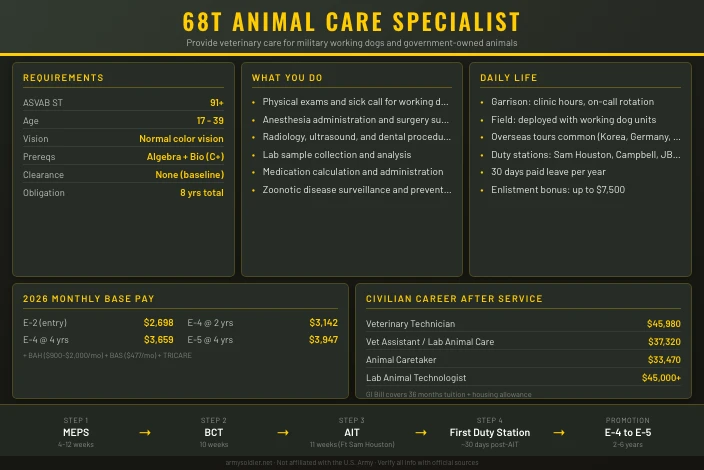
Job Role and Responsibilities
Army Animal Care Specialists provide full-scope veterinary care for government-owned animals, assist licensed veterinarians with medical procedures, and prevent the transmission of diseases from animals to humans. Daily duties include physical exams, surgery preparation, anesthesia monitoring, laboratory sample collection, radiology, dental care, and medical record maintenance.
The scope of the job is broader than most recruits expect. You are not simply feeding animals and cleaning kennels. You calculate medication doses, operate ultrasound and X-ray equipment, perform diagnostic laboratory work, and support emergency veterinary responses. The comparison to a civilian veterinary technician is accurate in terms of technical skills, but you do the job in military facilities ranging from post veterinary treatment clinics to field deployments.
What You Do Each Day
Day-to-day work depends heavily on where you are assigned. At a post veterinary clinic:
- Perform physical examinations on military working dogs and other government animals
- Collect blood, urine, and tissue samples for laboratory analysis and parasite identification
- Prepare animals for surgery and monitor anesthesia during procedures
- Conduct dental cleanings, X-rays, and ultrasounds
- Calculate and administer medications including sedatives and controlled substances
- Maintain detailed medical records and treatment histories
- Sterilize surgical instruments and maintain a clean clinical environment
In field environments, the work shifts toward preventive medicine. You support zoonotic disease surveillance (diseases transmissible between animals and humans), conduct food safety inspections alongside 68R specialists, and provide care for working animals deployed with combat and support units.
MOS Codes and Skill Identifiers
| Code | Type | Description |
|---|---|---|
| MOS 68T | Primary MOS | Animal Care Specialist |
| SQI M | Special Qualification Identifier | Airborne qualified |
| SQI P | Special Qualification Identifier | Instructor |
The Army Veterinary Corps also has a warrant officer pathway. Veterinary Service Technician (640A) is the warrant officer designation overseeing animal care programs at the operational level. A 68T with strong performance records, college credits, and several years of MOS experience can apply through the Army Warrant Officer Selection Board.
Mission Contribution
Government-owned animals serve in roles that directly affect military operations. Military working dogs detect improvised explosive devices and narcotics, perform patrol duties, and track suspects in law enforcement contexts. A working dog that is sick or injured cannot perform those missions. When a dog goes down, the tactical capability of the unit it supports goes with it.
Beyond working dogs, the 68T supports the broader preventive medicine mission. Zoonotic diseases, including rabies, leptospirosis, and anthrax, pose real risks on installations and in deployed environments. The 68T’s disease surveillance and animal health work is part of the Army’s force protection mission.
Technology and Equipment
The job is more technically demanding than the job title suggests. You operate:
- Digital radiography and analog X-ray machines
- Ultrasound equipment for diagnostic imaging
- Anesthesia delivery and monitoring systems
- Hematology and chemistry analyzers for in-house laboratory work
- Dental prophylaxis units and oral radiography equipment
- Pharmacy management systems for controlled substance tracking
Some assignments, particularly at research and development laboratories, involve more specialized equipment used in biomedical research supporting military medicine programs.
Salary and Benefits
Financial Benefits
Military pay is based on rank and time in service. Most 68Ts enter at E-1 (Private) and advance to E-2 before or shortly after completing AIT. The table below shows 2026 base pay at common grades across an early-to-mid career, verified against current DFAS pay rates.
| Pay Grade | Rank | Less Than 2 Yrs | 4 Yrs | 6 Yrs |
|---|---|---|---|---|
| E-2 | Private (PV2) | $2,698 | $2,698 | $2,698 |
| E-4 | Specialist (SPC) | $3,142 | $3,659 | $3,816 |
| E-5 | Sergeant (SGT) | $3,343 | $3,947 | $4,109 |
| E-6 | Staff Sergeant (SSG) | $3,401 | $4,069 | $4,236 |
Base pay is the starting point, not the full picture. Basic Allowance for Housing (BAH) adds several hundred to over two thousand dollars monthly depending on duty station and family status. At Fort Sam Houston, a single E-4 receives $1,359 monthly in BAH. Basic Allowance for Subsistence (BAS) adds $476.95 monthly as a flat food allowance. Both allowances are tax-free.
The Army currently lists an enlistment bonus of up to $7,500 for MOS 68T. Bonus amounts change based on Army needs, so confirm the current figure with your recruiter before signing.
Additional Benefits
TRICARE Prime covers all active-duty soldiers and their dependents. There is no enrollment fee, no deductible, and no copays for in-network care. Medical, dental, vision, mental health, and prescriptions are all included.
Army Tuition Assistance pays up to $4,500 per year toward college coursework while you serve. The Post-9/11 GI Bill, available after service, covers 36 months of full in-state tuition at public schools plus a monthly housing allowance based on the school’s ZIP code. Private school tuition is covered up to $29,920.95 per academic year under the current cap.
Retirement under the Blended Retirement System (BRS) provides a pension worth 40% of your high-36 average base pay at 20 years, combined with government-matched contributions to the Thrift Savings Plan (TSP) of up to 5% of base pay.
Work-Life Balance
All soldiers earn 30 days of paid leave annually, accruing at 2.5 days per month. Garrison assignments for 68Ts generally follow standard clinic hours. Weekend and holiday on-call rotations exist when working dogs or other government animals need emergency care, but the schedule is predictable by military standards.
Deployment cycles depend on unit assignment. 68Ts supporting working dog units can expect deployments aligned with those units’ cycles. Specialists assigned to fixed veterinary clinics or research facilities deploy less frequently.
Qualifications and Eligibility
Basic Qualifications
You must be a U.S. citizen or permanent resident between 17 and 39 years old. A high school diploma requires an AFQT score of at least 31. GED holders must score 50 or higher on the AFQT.
The 68T has one MOS-specific line score requirement:
- Skilled Technical (ST): 91 minimum
The ST composite formula is General Science (GS) + Verbal Expression (VE) + Mathematics Knowledge (MK) + Mechanical Comprehension (MC). An ST of 91 is accessible to candidates with solid science and math fundamentals, though it requires preparation if those subjects are not strong.
Beyond the ASVAB, the Army requires academic prerequisites that reflect the technical nature of the job:
- 1 year of algebra at the high school level, grade C or better, with official transcripts
- 1 year of biological sciences at the high school level, grade C or better, with official transcripts
These academic requirements are verified during the accession process. If you cannot provide transcripts, the MOS is not available to you regardless of your ASVAB score.
| Requirement | Details |
|---|---|
| Age | 17-39; waivers possible in some cases up to 42 |
| Citizenship | U.S. citizen or permanent resident |
| Education | High school diploma or GED |
| AFQT | 31 minimum (diploma); 50 minimum (GED) |
| Skilled Technical (ST) | 91 minimum |
| Vision | Normal color vision required |
| Academic Prerequisites | 1 yr algebra (C+); 1 yr bio sciences (C+) |
| Physical Profile (PULHES) | 222221 |
| OPAT Category | Moderately Heavy |
| Security Clearance | None required at baseline |
| Gender | Open to all |
Normal color vision is non-negotiable. Distinguishing tissue condition, medication labels, and diagnostic imaging requires accurate color perception. Significant color blindness disqualifies you from this MOS.
Application Process
Selection Criteria and Competitiveness
The 68T is moderately competitive. The academic transcript requirement eliminates a portion of otherwise qualified applicants. Prior experience with animals, whether from farm work, veterinary clinic employment, or pet ownership in a working capacity, is a genuine advantage and worth mentioning to your recruiter.
An ST of 91 is lower than the requirements for 68W (ST 101, GT 107) and 68K (ST 106), making this MOS accessible to candidates who score well in science without necessarily excelling in the verbal-heavy GT composite.
Upon Accession into Service
You enter as E-1 (Private, PV1). Most soldiers advance to E-2 before AIT graduation. The standard service obligation is 8 years total: typically 3 to 4 years of active duty followed by time in the Army Reserve or Individual Ready Reserve (IRR). An enlistment bonus carries an additional service commitment tied to the bonus contract terms.
See our ASVAB study guide for strategies to hit these line scores, or take the PiCAT from home if you are a first-time tester.
Work Environment
Setting and Schedule
The 68T works in controlled clinical environments more than most Army medical MOSs. Garrison assignments at installation veterinary clinics are the baseline. The work setting is:
- Veterinary Treatment Facility (VTF): Primary setting; examination rooms, surgical suite, lab, dental suite, and imaging areas
- Military Working Dog kennels: Routine health checks, preventive care, and sick call
- Research and Development (R&D) Laboratories: Biomedical research support at installations like Fort Detrick, MD or the Army Institute of Surgical Research
- Field environments: Deployed with working dog units or preventive medicine teams
Clinic hours in garrison follow a structured schedule. Emergency coverage exists for working dog health crises. Field assignments follow operational tempo and are less predictable.
Leadership and Communication
Your chain of command runs through a senior 68T NCO up to a Veterinary Corps officer or 640A Warrant Officer. The Veterinary Corps is one of the smallest branches in Army medicine, which means your performance is visible and your reputation travels quickly within the community.
Junior soldiers receive counseling from direct supervisors and formal feedback through the Army performance counseling process. NCOs are evaluated annually on the NCOER, with ratings tied to patient outcomes, record accuracy, and leadership development.
Team Dynamics and Autonomy
Early in your career, expect close supervision from a senior 68T who reviews your work before it stands on its own. You will assist on procedures before you lead them. This is appropriate given the consequences of errors in anesthesia or medication dosing.
As you reach E-4 and E-5, you perform procedures independently and train junior soldiers. At the NCO level, you manage clinic operations, coordinate with veterinarians on caseloads, and take ownership of specific program areas like controlled substance inventory or equipment maintenance.
Job Satisfaction and Retention
The 68T community is small and tends toward strong retention among soldiers who genuinely care about animal care. The combination of technically engaging work, tangible patient outcomes, and civilian career value makes it a MOS where re-enlistment rates are solid.
Common frustrations include limited MOS visibility within the broader Army (few people outside veterinary units know what a 68T does) and restricted promotion slots compared to larger MOS communities. Still, the Army COOL program actively supports certification attainment, and soldiers leave with credentials that matter in the civilian job market.
Training and Skill Development
Initial Training
Every Army enlistee completes Basic Combat Training first, then moves to MOS-specific Advanced Individual Training. The 68T pipeline is among the most technically demanding entry-level medical training sequences in CMF 68.
| Phase | Location | Duration | Focus |
|---|---|---|---|
| Basic Combat Training (BCT) | Fort Jackson, SC; Fort Moore, GA; or Fort Leonard Wood, MO | 10 weeks | Soldier skills, marksmanship, first aid, Army values |
| Advanced Individual Training (AIT) | Fort Sam Houston, TX (Dept of Veterinary Science, MEDCoE) | 11 weeks | Animal anatomy, diagnostics, anesthesia, surgery support, lab analysis |
BCT is identical for every Army MOS. You qualify on the M4 rifle, complete land navigation, and build the fitness baseline required to succeed in service. This is where the Army culture becomes real.
AIT at Fort Sam Houston is conducted at the Department of Veterinary Science within the Medical Center of Excellence. The 11-week course is 75 percent hands-on instruction, which is higher than most Army AIT programs. The curriculum covers:
- Animal anatomy and medical terminology
- Medication dose calculation and administration
- Blood collection, urinalysis, and laboratory sample analysis
- Parasite identification and fecal examination
- Anesthesia administration and intraoperative monitoring
- Surgery preparation and instrument sterilization
- Dental prophylaxis and oral radiography
- Radiology and ultrasonography
- Emergency response and triage for animals
- Zoonotic disease recognition and reporting
Students handle live animals throughout the course. This is not a program where you read about procedures and then take a written exam. You perform them.
Advanced Training
After AIT and your first duty station assignment, professional development follows the CMF 68 career progression path. Advanced training available to 68Ts includes:
- Warrior Leader Course (WLC): Required for promotion to E-5
- Advanced Leaders Course (ALC): Required for E-6
- Senior Leaders Course (SLC): Required for E-7
- Airborne School (Fort Moore, GA): Available to qualified soldiers; awards the SQI M identifier
- Drill Sergeant School: Available to high-performing NCOs
- 640A Warrant Officer application: Open to soldiers with 3+ years of MOS experience and college credits
The Army COOL (Credentialing Opportunities On-Line) program maps civilian certifications to 68T experience. Recognized credentials include the Certified Manager of Animal Resources (CMAR) and the Laboratory Animal Technologist (LATG). Soldiers can use Tuition Assistance to pursue the coursework required for these credentials while on active duty.
Everything starts with qualifying ASVAB scores — our study guide covers what to study first.
Career Progression and Advancement
Career Path
CMF 68 career progression is competitive and standardized. Promotion to E-5 and below follows semi-centralized processes. E-6 and above require selection by centralized Human Resources Command boards.
| Rank | Pay Grade | Typical Time in Service | Primary Role |
|---|---|---|---|
| Private (PV1/PV2) | E-1/E-2 | 0-1 years | AIT student |
| Private First Class (PFC) | E-3 | 1-2 years | Junior animal care technician |
| Specialist (SPC) | E-4 | 2-4 years | Animal care technician |
| Sergeant (SGT) | E-5 | 4-6 years | Section NCO, senior technician |
| Staff Sergeant (SSG) | E-6 | 6-10 years | Section NCOIC, clinic operations |
| Sergeant First Class (SFC) | E-7 | 10-15 years | Platoon sergeant, senior program advisor |
| Master Sergeant (MSG) | E-8 | 15-20 years | Senior advisor, command level |
| Sergeant Major (SGM) | E-9 | 20+ years | Senior enlisted advisor, Veterinary Corps |
Soldiers seeking specialization can pursue research and development laboratory assignments, working dog handler support roles, or the 640A warrant officer track. The warrant officer path requires a separate application, board selection, and Warrant Officer Candidate School (WOCS).
Role Flexibility and Transfers
Reclassification to another MOS is possible at the 2-3 year mark if Army needs align with your request. Common crossover paths include 68W (Combat Medic), 68R (Veterinary Food Inspection Specialist), and 68K (Medical Laboratory Specialist), all of which build on the laboratory and diagnostic skills developed in 68T.
Reserve and National Guard units have 68T slots. Active-duty soldiers who separate can often affiliate with a Reserve component unit at their current grade, maintaining benefits and continuing toward retirement.
Performance Evaluation
Junior enlisted soldiers receive feedback through the Army performance counseling process. NCOs are formally evaluated annually on the NCOER. For 68Ts, the evaluation criteria center on patient care quality, record accuracy, controlled substance accountability, equipment readiness, and leadership development of junior soldiers.
Success in this career is measured by animal health outcomes and zero deficiencies in controlled substance tracking. The Veterinary Corps is small enough that a reputation for precision and reliability compounds quickly over a career.
Physical Demands and Medical Evaluations
Physical Requirements
The 68T carries a moderately heavy physical demands rating (PULHES 222221). The job involves lifting and restraining animals, moving equipment, extended standing during surgical procedures, and carrying supplies. Restraining a large working dog or moving a crate of equipment requires real physical capability. This is not a light physical profile.
All Army soldiers take the Army Fitness Test (AFT), which replaced the ACFT on June 1, 2025. The AFT has five events scored 0-100 each, with a 500-point maximum.
| AFT Event | Description | Minimum Score |
|---|---|---|
| 3 Repetition Maximum Deadlift (MDL) | Lower body strength | 60 |
| Hand Release Push-Up (HRP) | Upper body endurance | 60 |
| Sprint-Drag-Carry (SDC) | Functional fitness | 60 |
| Plank (PLK) | Core stability | 60 |
| Two-Mile Run (2MR) | Cardiorespiratory endurance | 60 |
The 68T MOS uses the general standard: 300 total points minimum (60 per event), sex- and age-normed. The stricter 350-point sex-neutral standard applies only to designated combat MOSs. AFT scores must be maintained annually.
Medical Evaluations
You receive a Periodic Health Assessment (PHA) annually. The PULHES code 222221 sets your baseline medical standards throughout service. Color vision is evaluated at MEPS and is a hard requirement for this MOS. A deployment physical is required before each overseas assignment.
Some assignments at R&D laboratories include occupational health monitoring specific to the animal species and biological agents in use at that facility.
Deployment and Duty Stations
Deployment Details
Deployment likelihood for 68Ts depends heavily on unit assignment. Soldiers attached to military working dog units deploy on the same schedule as those units, which can be frequent and operationally intense. Soldiers assigned to fixed veterinary clinics or research facilities deploy less often.
When deployed, the 68T supports working dog health, conducts zoonotic disease surveillance in the operational area, and assists with food safety when collocated with veterinary food inspection teams. Deployments typically range from six to twelve months for active-duty assignments.
Location Flexibility
The Army places 68Ts at installations with Veterinary Service assets. Common duty stations include:
- Fort Sam Houston, TX (MEDCoE; home of Army Veterinary Science training)
- Fort Moore, GA
- Fort Campbell, KY
- Joint Base Lewis-McChord, WA
- Fort Detrick, MD (research and development laboratory assignments)
- USAREUR installations in Germany
- Camp Humphreys, South Korea
- Camp Zama, Japan
Overseas assignments are genuinely common in the Veterinary Corps. The Army maintains working dogs and veterinary support worldwide, so international duty stations are part of the 68T career path and not exceptional.
Risk, Safety, and Legal Considerations
Job Hazards
Working with animals carries risks that most Army jobs do not. Bites, scratches, and kicks from stressed or injured animals are the most common physical hazards. Handling zoonotic species and biological samples requires care to prevent disease transmission.
Laboratory and R&D assignments may involve exposure to biological agents, chemical compounds, and research animals carrying experimental conditions. Anesthesia work requires awareness of inhalant anesthetics and proper ventilation in surgical areas.
Safety Protocols
Personal protective equipment in veterinary settings includes gloves, protective eyewear, lab coats, and appropriate respiratory protection for specific tasks. Animal handling protocols are standardized to minimize injury risk during restraint and examination. Controlled substance handling follows strict Army regulations with two-person accountability for all Schedule I and II drugs.
Biological safety protocols apply in any assignment involving pathogen work or zoonotic disease surveillance. The Army trains 68Ts on bloodborne pathogen exposure response and post-exposure protocols.
Security and Legal Requirements
No security clearance is required at baseline for MOS 68T. Certain assignments, particularly at research facilities handling sensitive biological research or at classified installations, may require a clearance that is obtained after accession.
Your legal obligations are standard for any Army enlistment: comply with the Uniform Code of Military Justice (UCMJ), fulfill your service contract, and follow Army regulations. Controlled substance handling adds a specific legal dimension; discrepancies in controlled substance inventories trigger formal investigations under UCMJ.
Impact on Family and Personal Life
Family Considerations
The 68T offers a more stable family life than most combat-arms jobs. Garrison clinic assignments mean predictable hours, weekends largely free, and less separation than high-deployment infantry or aviation roles. The working dog unit assignments carry higher deployment tempo, so your specific duty station affects this significantly.
Military OneSource provides counseling, financial planning, and family support services at no cost to active-duty soldiers and their families. Fort Sam Houston, where most 68Ts complete AIT and where many remain for first duty assignments, offers substantial on-post family services including childcare, spouse employment programs, and housing support.
Relocation and Flexibility
Expect two to three permanent change of station (PCS) moves over a 10-year career. The Veterinary Corps’ global footprint means overseas assignments in Germany, Korea, and Japan are common and sometimes predictable on a rotation basis. Each PCS includes a moving allowance and temporary lodging entitlement. Families can accompany soldiers on most assignments, including overseas.
The Army provides 30 days of paid leave annually. The Veterinary Corps’ smaller size means assignment cycles can be more predictable than in larger branches, which helps with family planning around school years and childcare commitments.
Reserve and National Guard
The 68T exists in both the Army Reserve and the Army National Guard through veterinary units attached to medical commands. Veterinary units support military working dog programs, food safety operations, and zoonotic disease prevention across all operational environments. Both components maintain these units, and billets exist in both. Geographic availability is better than for highly specialized clinical MOSs because veterinary support is needed at a wider range of installations and exercises.
If you complete active-duty service as a 68T and want to continue in a part-time capacity while building a civilian veterinary career, the Reserve or Guard vet unit is a direct fit. Your Army duties and your civilian work share skills continuously, and that overlap is one of the better civilian-military pairings in the medical career field.
Drill schedule and training requirements
The standard commitment is one weekend per month and two weeks per year for Annual Training. 68T soldiers have ongoing training requirements specific to their role. Veterinary care procedures evolve, large animal handling protocols are updated, and military working dog care standards require periodic refresher training. Annual Training often involves supporting MWD programs at installations, conducting animal health assessments, or participating in veterinary support exercises for field medical units.
The Certified Veterinary Technician (CVT) credential is the civilian standard. State licensing requirements vary, but most states require passing the Veterinary Technician National Exam (VTNE). Maintaining CVT status requires continuing education, and most Reserve 68Ts satisfy those requirements through their civilian veterinary jobs. Some states grant credit toward VTNE eligibility for military veterinary training, which can shorten the civilian credentialing path.
Pay and benefits comparison
Active-duty 68Ts receive full-time base pay with no healthcare premiums. An E-4 with four years of service earns $3,659 per month. Reserve and Guard 68Ts earn drill pay, roughly $488 for a standard four-drill weekend at the same grade. Most part-time soldiers hold civilian employment alongside their military commitment.
Healthcare costs are a real difference between components. Active-duty TRICARE costs the service member nothing. Reserve and Guard soldiers can buy into Tricare Reserve Select for $57.88 per month for member-only coverage, or $286.66 per month for member and family. That is a lower cost than most civilian employer plans, but it is not zero.
Education benefits for Reserve and Guard soldiers include the MGIB-SR (Chapter 1606), which pays $493 per month for full-time students. Federal Tuition Assistance is available at $250 per credit hour with a $4,500 annual cap. National Guard soldiers in many states can also access state tuition waivers covering 100% of tuition at public universities. For 68Ts pursuing a veterinary technology degree, stacking state TA with federal TA can cover a large portion of program costs.
Reserve and Guard retirement is points-based. The pension is available at age 60, reduced by three months for every 90 days of qualifying active mobilization after January 28, 2008, down to a minimum of age 50.
Mobilization and deployment
The 68T has moderate mobilization frequency in the Reserve and Guard. Military working dog programs operate at deployed locations, and MWD veterinary support goes with them. Food safety and zoonotic disease prevention are also required in deployed environments. Reserve and Guard 68Ts attached to veterinary companies or detachments supporting combat support hospitals can expect mobilization when the parent unit activates.
Deployments average 9 to 12 months. Domestic Guard activations also occur. State governors can activate National Guard units for animal care operations during agricultural emergencies, disease outbreaks, or natural disaster responses, which gives Guard 68Ts a broader range of potential domestic missions.
Civilian career integration
The civilian veterinary technician field has strong and growing demand. The Bureau of Labor Statistics projects faster-than-average growth for veterinary technicians through the early 2030s, driven by increased pet ownership and expanded veterinary services. The 68T part-time role pairs directly with work in private veterinary practices, animal shelters, research facilities, and large animal operations. USERRA protects civilian veterinary jobs during any military activation, including Annual Training, mobilization, and any period of federal service. Employers in the veterinary field generally view military animal care experience as a strong positive.
| Feature | Active Duty | Army Reserve | Army National Guard |
|---|---|---|---|
| Duty Status | Full-time | Part-time (1 wknd/mo + 2 wks/yr) | Part-time (1 wknd/mo + 2 wks/yr) |
| Monthly Pay (E-4, 4 yrs) | $3,659/mo | ~$488/drill weekend | ~$488/drill weekend |
| Healthcare | TRICARE (no premium) | Tricare Reserve Select ($57.88/mo) | Tricare Reserve Select ($57.88/mo) |
| Education | Post-9/11 GI Bill, TA | MGIB-SR ($493/mo), TA | MGIB-SR ($493/mo), TA, state tuition waivers |
| Deployment | Per unit rotation | When mobilized | When mobilized |
| Retirement | 20-year pension | Points-based, age 60 | Points-based, age 60 |
Post-Service Opportunities
Transition to Civilian Life
The 68T training maps directly to the civilian veterinary technician field. State licensing requirements vary, but many states grant credit for military veterinary training toward the Veterinary Technician National Exam (VTNE), the primary credentialing exam for civilian vet techs. Passing the VTNE after service is the most common transition path.
The Army Transition Assistance Program (TAP) helps soldiers translate military experience into civilian resumes, access VA benefits, and connect with employers. The Army COOL program identifies specific certifications the 68T experience supports, reducing the coursework needed post-service.
Federal agencies including the USDA, NIH, and the Department of Defense’s biomedical research centers actively recruit veterans with veterinary technology backgrounds for both clinical and research roles.
| Civilian Job Title | Median Annual Wage | Projected Job Growth (2024-2034) |
|---|---|---|
| Veterinary Technologist/Technician | $45,980 | 9% (much faster than average) |
| Veterinary Assistant/Lab Animal Caretaker | $37,320 | 11% (much faster than average) |
| Animal Caretaker | $33,470 | 11% (much faster than average) |
| Laboratory Animal Technologist (Research) | $45,000-$60,000 | Varies by sector |
The veterinary sector is growing substantially faster than most fields, driven by increased pet ownership and expanding companion animal medicine. A credentialed vet tech with military experience and exposure to surgery, anesthesia, and diagnostics is a strong candidate at private practices, emergency clinics, research facilities, and zoological institutions.
Is This a Good Job for You? The Right (and Wrong) Fit
Ideal Candidate Profile
This MOS rewards people with genuine interest in animal biology and hands-on healthcare. You are working with living patients who depend entirely on your precision. The job requires patience, physical capability for animal handling, and the ability to stay calm when an animal is in distress.
The right person for 68T:
- Has a real interest in animal health, not just animals as pets
- Can perform precise, methodical work under pressure
- Handles physically demanding restraint and lifting without hesitation
- Reads and communicates clearly, since medical records must be accurate
- Wants clinical veterinary skills that transfer directly to a civilian career
Prior animal experience, such as work at a veterinary clinic, farm, shelter, or animal research facility, is a meaningful advantage both in selection and in AIT performance.
Potential Challenges
The Veterinary Corps is small. There are fewer promotion slots, high-visibility schools, and competitive leadership assignments than in larger MOS communities. Soldiers who want to be known across the Army and build a broad military resume may find the corps too narrow.
The job also requires comfort with euthanasia procedures. Working dog retirements, research animal protocols, and terminally ill patients are part of the work. This aspect of the job is something candidates should consider honestly before committing.
Working dog unit assignments carry real deployment exposure and longer hours during operational periods. If you expect a predictable schedule at all times, those assignments may not suit you.
Who Should Not Choose This MOS
People who enrolled primarily for a medical job without specific interest in animal care tend to find the work unsatisfying. The emotional weight of treating animals that cannot consent or communicate compounds over a career. If veterinary medicine is not genuinely interesting to you, the 68W (Combat Medic) or 68K (Medical Laboratory Specialist) pathways offer medical careers with different patient populations and broader visibility.
More Information
Talk to an Army recruiter to confirm current training slot availability, bonus status, and assignment options for MOS 68T. Bring your high school transcripts showing algebra and biology coursework from the first meeting. Recruiter information is available at goarmy.com or by calling 1-888-550-ARMY.
- Prepare for the ASVAB with our study guide to make sure your line scores qualify
This site is not affiliated with the U.S. Army or any government agency. Verify all information with official Army sources before making enlistment or career decisions.
Explore more Army medical careers such as 68R Veterinary Food Inspection Specialist and 68W Combat Medic.