68U Ear, Nose, and Throat (ENT) Specialist
The Army trains fewer than a dozen specialists for every otolaryngologist it employs. That ratio means 68Us carry serious clinical responsibility from their first assignment. You won’t spend your days filing charts. You’ll be the hands-on technician who makes an ENT clinic function – conducting hearing tests, assisting with procedures, and keeping a physician productive across dozens of patient visits per week.
This is not a well-known MOS. That works in your favor. Competition for slots is lower than in high-profile medical jobs, training is shorter than most CMF 68 specialties at 14 weeks, and the civilian skills you build translate directly into audiology and ENT clinic careers that are growing faster than the national average.
Qualifying requires specific ASVAB line scores — our ASVAB study guide covers what to target and how to prepare.
Job Role and Responsibilities
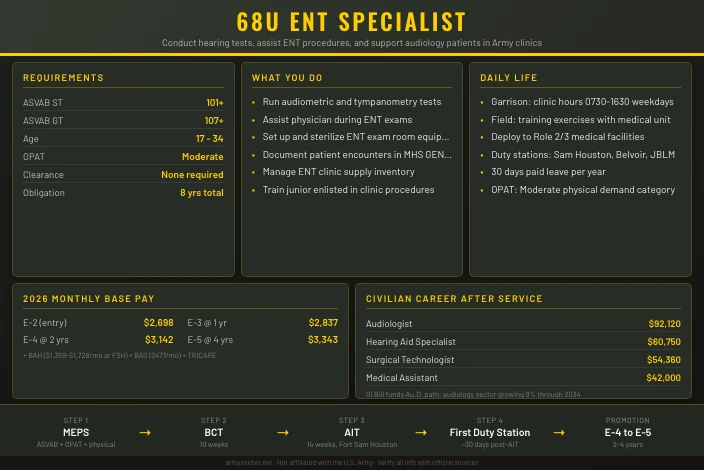
The 68U Ear, Nose, and Throat Specialist supervises or conducts routine diagnostic tests and assists physicians in the care and treatment of ENT and audiology patients. Soldiers in this role set up and maintain exam rooms, sterilize medical supplies, operate diagnostic equipment, and provide direct patient support under the supervision of an otolaryngologist (MOS 60T). The position bridges the gap between administrative medical support and hands-on clinical care in a specialized outpatient environment.
Daily Tasks
A typical garrison day runs clinical hours in the morning and administrative tasks in the afternoon. The work is structured around a physician’s patient schedule, so pace is steady rather than chaotic.
Core daily responsibilities include:
- Conducting pure-tone audiometric testing and tympanometry
- Setting up exam rooms with scopes, specula, and irrigation equipment
- Assisting the physician during minor ENT procedures such as cerumen removal and nasal endoscopy
- Documenting patient encounters in the Military Health System GENESIS (MHS GENESIS) electronic health record
- Sterilizing and inventorying reusable instruments per infection control protocols
- Educating patients on post-procedure care and hearing conservation
At senior grades, 68Us also supervise junior soldiers, manage clinic supply budgets, and coordinate patient referrals across the hospital or troop medical clinic system.
Specific Roles
Army ENT Specialists serve under the enlisted classification system. There is one primary MOS code with no formal sub-specializations at accession, but soldiers can earn Additional Skill Identifiers (ASIs) through advanced training.
| Classification | Code | Description |
|---|---|---|
| Primary MOS | 68U | Ear, Nose and Throat Specialist |
| ASI | Available post-assignment | Specialty qualifications earned in service |
Mission Contribution
The Army operates ENT clinics at major medical treatment facilities and some large troop medical centers. Soldiers in 68U keep those clinics running – a physician without a trained specialist supporting them cannot see the same patient volume. Hearing health is a direct readiness issue: auditory damage from weapons fire and explosives is one of the most common service-connected disabilities, and early detection depends on 68Us running accurate audiometric screenings.
Technology and Equipment
Daily equipment includes diagnostic audiometers, immittance audiometers (for tympanometry), video otoscopes, nasal endoscopes, and surgical instrument sterilization systems. Soldiers also work within MHS GENESIS, the Department of Defense’s primary electronic health record platform deployed across military treatment facilities.
Salary and Benefits
Military pay follows the 2026 DFAS pay tables, which reflect a 3.8% raise effective January 1, 2026. Base pay is the same across all Army MOSs at the same rank and time-in-service – what varies is your total compensation package once allowances are added.
Base Pay (2026)
| Rank | Time in Service | Monthly Base Pay |
|---|---|---|
| E-1 (PV1) | Entry | $2,407 |
| E-2 (PV2) | ~6 months | $2,698 |
| E-3 (PFC) | ~1 year | $2,837 |
| E-4 (SPC) | ~2 years | $3,142 |
| E-5 (SGT) | ~4-5 years | $3,343 |
| E-6 (SSG) | ~8-10 years | $4,613 |
Allowances
Base pay is only part of the picture. Two non-taxable allowances add significant value:
- BAH (Basic Allowance for Housing): Varies by duty location and dependency status. At Fort Sam Houston (a common 68U assignment), an E-4 without dependents receives $1,359/month; with dependents, $1,728/month. Rates at other installations vary – use the official DoD BAH calculator for your specific location.
- BAS (Basic Allowance for Subsistence): $476.95/month flat rate for all enlisted soldiers in 2026, regardless of rank.
Together, an E-4 68U at Fort Sam Houston takes home roughly $5,600-$5,900 per month in combined base pay and allowances – before special pays or bonuses.
Additional Benefits
Healthcare: TRICARE Prime covers active-duty soldiers and their families at no enrollment fee, no deductible, and no copays for in-network care. Coverage includes medical, dental, vision, mental health, and prescriptions.
Education: The Army’s Tuition Assistance program covers up to $4,500 per year for college courses taken while on active duty. After service, the Post-9/11 GI Bill pays full in-state tuition at public universities for up to 36 months, plus a monthly housing allowance and up to $1,000 per year for books.
Retirement: Under the Blended Retirement System (BRS), soldiers who serve 20+ years earn a pension equal to 40% of their high-36 average basic pay. The Army also contributes to a Thrift Savings Plan (TSP) – automatically depositing 1% of base pay after 60 days, then matching up to 4% additional contributions beginning in year three.
Work-Life Balance
Soldiers earn 30 days of paid leave per year, accruing 2.5 days per month. ENT clinic work in garrison generally follows a structured weekday schedule tied to clinic hours. Field exercises and deployments interrupt that schedule, but ENT is not a combat MOS, and daily operations are typically more predictable than line-unit assignments.
Qualifications and Eligibility
Requirements Table
| Requirement | Standard |
|---|---|
| ASVAB ST Line Score | 101 minimum |
| ASVAB GT Line Score | 107 minimum |
| AFQT (minimum enlistment) | 31 (HS diploma) / 50 (GED) |
| OPAT Category | Moderate |
| Security Clearance | None required |
| Citizenship | U.S. citizen or eligible non-citizen |
| Age | 17-34 (active duty) |
| Education | High school diploma or GED |
| Gender | Open to all |
The ST (Skilled Technical) composite is calculated from General Science + Verbal Expression + Mathematics Knowledge + Mechanical Comprehension. The GT (General Technical) composite is Verbal Expression + Arithmetic Reasoning. Both minimums must be met – a score above one does not waive the other.
Physical Requirements (OPAT)
The Occupational Physical Assessment Test (OPAT) for 68U is rated Moderate. This is one of the lower physical demand categories in the Army, reflecting the clinical nature of the work. OPAT is administered at MEPS before enlistment and evaluates strength, endurance, and mobility relevant to the MOS.
Application Process
- Contact an Army recruiter and confirm the MOS is available in your enlistment window
- Take the ASVAB at a Military Entrance Processing Station (MEPS) – you must achieve ST:101 and GT:107
- Complete the OPAT at MEPS (Moderate category)
- Pass the MEPS physical examination
- Select 68U on your enlistment contract, pending seat availability
- Ship to Basic Combat Training (BCT)
The process from first recruiter contact to shipping typically takes 2-6 months, depending on seat availability and your individual processing timeline.
Service Obligation
Soldiers who contract for 68U enter at the E-1 (PV1) grade. The standard active-duty enlistment for this MOS is 4 years, with a total military service obligation of 8 years (active + inactive reserve time). Soldiers who receive specialty training or bonuses may have additional service obligations tied to those agreements.
Competitiveness
68U is a moderately competitive MOS. The ASVAB requirements (ST:101, GT:107) are the same as 68W Combat Medic – so applicants need genuine technical aptitude. Clinical experience as a volunteer EMT, hospital aide, or audiometry screener makes your application stronger and your AIT performance better.
See our ASVAB study guide for strategies to hit these line scores, or take the PiCAT from home if you are a first-time tester.
Work Environment
Setting and Schedule
68Us work primarily in clinical settings: ENT clinics attached to Army community hospitals, Brooke Army Medical Center, Walter Reed National Military Medical Center, and regional health centers. The workspace is an examination room equipped with diagnostic instruments, a computer terminal, and a clean instrument preparation area.
Garrison hours typically mirror civilian clinic hours – around 0730 to 1630 on weekdays. On-call rotations exist at larger facilities but are less frequent for ENT than for emergency or surgical specialties. Soldiers in this MOS also participate in unit physical training in the early morning before clinic hours.
Leadership and Communication
The 68U works within the Army Medical Department (AMEDD) structure. At lower enlisted grades, you report to a senior NCO (Non-Commissioned Officer) and take clinical direction from the physician or physician assistant running the clinic. Performance evaluations occur annually through the Army’s Non-Commissioned Officer Evaluation Report (NCOER) system once you reach E-5 (SGT).
Team Dynamics and Autonomy
Clinical work is inherently collaborative. You’ll work closely with an otolaryngologist, may coordinate with audiology professionals (MOS 68RB or civilian audiologists), and interact with other medical support staff daily. At entry level, your autonomy is limited – you execute established procedures under direct supervision. As experience grows, senior 68Us run independent audiometric screening programs and manage clinic operations with minimal physician oversight.
Job Satisfaction
The clinical specialization of ENT work appeals to soldiers who want structured, skill-focused medical work without the unpredictability of combat medic duties. The MOS offers a predictable garrison schedule for much of a career and a clear connection between daily work and patient outcomes.
Factors that affect satisfaction in this role:
- Predictability: Clinic hours are consistent compared to line unit schedules
- Skill depth: The specialty is narrow but technically demanding – you become very good at a specific thing
- Patient connection: You see the same patient population repeatedly, which builds continuity of care
- Limited field time: Less time in the field than combat-support MOSs, which suits some soldiers and frustrates others
Training and Skill Development
Initial Training Pipeline
| Phase | Location | Length | Focus |
|---|---|---|---|
| Basic Combat Training (BCT) | Various Army installations | 10 weeks | Soldier skills, weapons, physical fitness |
| Advanced Individual Training (AIT) | Fort Sam Houston, TX | 14 weeks | ENT diagnostic procedures, audiometry, clinical support |
BCT is the same for all Army recruits regardless of MOS. It covers rifle qualification, land navigation, first aid, physical conditioning, and Army values. You graduate BCT as a fully trained soldier before reporting to AIT.
AIT for 68U runs 14 weeks at the U.S. Army Medical Center of Excellence (MEDCoE) at Joint Base San Antonio – Fort Sam Houston. MEDCoE trains more than 35,000 students annually and is the Army’s primary medical training school. The 68U program covers:
- Pure-tone audiometric testing procedures
- Tympanometry and immittance audiometry
- Otoscopic examination techniques
- ENT instrument setup, use, and sterilization
- Minor procedure assistance (irrigation, suture removal)
- Patient documentation in military electronic health record systems
- Basic pharmacology relevant to ENT care
- HIPAA compliance and patient privacy protocols
Advanced Training and Development
After initial assignment, 68Us can pursue several paths for skill development:
Formal courses:
- Army Medical Department NCO courses at various career levels
- Audiometric Technician certification training (may be funded through unit training budgets)
- Advanced Clinical Specialist courses through MEDCoE
Civilian certifications: The Army’s COOL (Credentialing Opportunities On-Line) program helps 68Us pursue civilian-recognized credentials while on active duty. The program covers exam fees for eligible certifications that align with the MOS.
Tuition Assistance allows soldiers to pursue college coursework concurrently with their duty assignments, which many 68Us use to accumulate credits toward an associate or bachelor’s degree in health science or audiology technology.
Everything starts with qualifying ASVAB scores — our study guide covers what to study first.
Career Progression and Advancement
Rank Progression
| Grade | Rank | Typical Time in Service | Role |
|---|---|---|---|
| E-1 | Private (PV1) | 0-6 months | AIT student |
| E-2 | Private (PV2) | 6-12 months | Junior specialist |
| E-3 | Private First Class (PFC) | 12-18 months | Clinic assistant |
| E-4 | Specialist (SPC) | 18-36 months | Qualified ENT tech |
| E-5 | Sergeant (SGT) | 4-6 years | Team leader / senior tech |
| E-6 | Staff Sergeant (SSG) | 7-12 years | Clinic NCO |
| E-7 | Sergeant First Class (SFC) | 12-18 years | Section or platoon sergeant |
| E-8 | Master Sergeant (MSG) | 18-24 years | Senior enlisted advisor |
Promotions to E-4 and E-5 are time-and-grade based early in a career. Above E-5, promotions require board selection and become increasingly competitive.
Specialization Options
No formal sub-specializations exist at accession, but experienced 68Us can develop deep expertise in audiology support through unit-level training, civilian certification programs, and assignment to major medical treatment facilities where caseload is higher and technology is more advanced.
Lateral transfers to related medical MOSs are possible but require a retraining assignment and Army approval. Some soldiers transition to 68X (Mental Health Specialist) or pursue warrant officer programs in healthcare administration.
Performance Evaluation
All Army NCOs (E-5 and above) are evaluated through the NCOER system. Key rating areas include Army values, competence, physical fitness, leadership, and responsibility. Strong NCOERs are required for competitive promotion boards. Soldiers also complete Army Physical Fitness scores semi-annually, which are reflected in personnel files and affect promotion potential.
How to Succeed
The 68Us who advance fastest treat every patient interaction as a skill development opportunity. Clinic work can become routine – the soldiers who stand out are the ones who pursue certifications on their own time, volunteer for additional duty assignments at larger medical facilities, and complete college coursework through Tuition Assistance. A solid NCOER narrative supported by documented patient care metrics and civilian credentials is the fastest path to E-6 and beyond.
Physical Demands and Medical Evaluations
Physical Requirements
68U carries a Moderate OPAT category, reflecting work that involves standing for extended periods, moving patients, handling medical equipment, and occasional light lifting. You won’t be carrying rucksacks on 12-mile marches as part of your daily job, but you will be on your feet for most of a clinic shift.
All soldiers, regardless of MOS, must pass the Army Fitness Test (AFT), which replaced the ACFT on June 1, 2025. The AFT has five events:
| Event | Abbreviation | Description |
|---|---|---|
| 3 Rep Max Deadlift | MDL | Maximum weight lifted for 3 repetitions |
| Hand Release Push-Up | HRP | Arm extension push-ups |
| Sprint-Drag-Carry | SDC | 250-meter shuttle with drag and carry elements |
| Plank | PLK | Timed hold |
| Two-Mile Run | 2MR | Timed 2-mile run |
Each event is scored 0-100. The minimum passing score is 60 points per event (300 total). The AFT is sex- and age-normed at the general standard. 68U is not a combat MOS and does not require the 350-point combat specialty standard.
Medical Evaluations
Soldiers undergo an initial physical at MEPS before enlisting. After that, periodic health assessments (PHAs) occur annually and include vision, hearing, dental, and general physical exams. ENT Specialists are not exempt from any standard medical requirements. Color vision deficiencies do not disqualify candidates for 68U since the work does not require color discrimination for safety-critical tasks.
Deployment and Duty Stations
Deployment
68U is a medical support MOS. ENT Specialists can deploy in support of combat operations, but they typically serve in Role 2 or Role 3 medical facilities rather than at forward line units. Deployment frequency depends on the Army’s operational tempo and your unit’s rotation schedule. Medical units deploy, but the mission inside a deployed hospital is clinical – not direct combat operations.
Deployment lengths for medical support units have historically ranged from 9 to 12 months. Between deployments, soldiers at medical treatment facilities generally work on a garrison schedule without the high deployment frequency seen in combat arms MOSs.
Duty Stations
Common duty stations for 68Us include installations with military hospitals or large medical treatment facilities:
- Fort Sam Houston, TX (Brooke Army Medical Center)
- Fort Belvoir, VA (Fort Belvoir Community Hospital)
- Tripler Army Medical Center, HI
- Madigan Army Medical Center, WA (Joint Base Lewis-McChord)
- Landstuhl Regional Medical Center, Germany (overseas assignment)
- Camp Humphreys, South Korea (Korea rotation)
Assignment preferences can be listed when you reenlist or request a Permanent Change of Station (PCS), though the Army’s needs take priority. Medical facilities at larger installations generally offer more clinical variety and advancement opportunity.
Risk, Safety, and Legal Considerations
Job Hazards
The primary hazards in ENT clinic work are exposure to bloodborne pathogens, sharps injuries, and chemical sterilants used for instrument processing. Hearing hazards exist at ranges and in field environments where all soldiers operate.
Safety Protocols
Standard military infection control protocols apply: personal protective equipment (PPE) for all patient contact procedures, OSHA bloodborne pathogen training, and strict instrument sterilization procedures. Soldiers receive annual training on sharps safety, PPE use, and chemical handling.
Security and Legal Requirements
68U does not require a security clearance. The primary legal obligation is the enlistment contract itself, including the service commitment and HIPAA compliance within military medical settings (governed by AR 40-66).
Soldiers in all medical MOSs are bound by the Geneva Conventions protections for medical personnel – and the obligations that come with them, including restrictions on bearing arms while performing medical duties in specific operational contexts.
Key legal and contractual obligations for 68U:
- Service commitment: Minimum 4-year active-duty contract (8-year total military obligation)
- HIPAA compliance: Patient privacy requirements apply throughout service and continue as a professional standard after separation
- Uniform Code of Military Justice (UCMJ): Governs conduct for all active-duty soldiers
- Geneva Conventions: Medical personnel status carries both protections and behavioral restrictions in operational environments
Impact on Family and Personal Life
Family Considerations
Assignment to a military hospital installation generally provides more family stability than many combat arms MOSs. Major medical centers are at large installations with mature family support infrastructure: schools, childcare, commissary, TRICARE access, and recreational programs. The Family Readiness Group (FRG) is available at unit level for family support.
Clinic work schedules are more predictable than many Army jobs, which allows for more consistent family routines during garrison periods. Deployments and field exercises still disrupt family life, but the frequency and duration are generally lower for medical support MOSs than for maneuver units.
Relocation
Military families move on average every 2-3 years. 68Us are assigned to installations with medical facilities, which limits duty station options compared to MOSs that serve at every installation. That also means most 68U assignments are at larger bases with better family amenities. Permanent Change of Station (PCS) moves are funded by the Army, including transportation of household goods and a relocation allowance.
Reserve and National Guard
Reserve and Guard positions for 68U are limited. The Army simply does not have many ENT technician slots in part-time components. You will find a handful of positions scattered across medical units in the Reserve, and a smaller number in the National Guard. Competition for those billets is real. If you want to serve part-time in this specific MOS after active duty, research available units in your state before you separate.
That said, if you can land a 68U slot in the Reserve or Guard, the arrangement can work well alongside a civilian ENT or audiology career. Your military training reinforces your civilian job, and your civilian experience makes you a more capable Soldier during drills and deployments.
Drill Schedule
Standard commitment is one weekend per month and two weeks per year for Annual Training. For a specialty like ENT, your unit may schedule additional training days tied to audiometry certification maintenance or hearing conservation program refreshers. These are not frequent, but plan for them.
Pay and Benefits
Part-time pay is a significant step down from active duty. An E-4 with four years of service earns roughly $488 for a standard drill weekend. An active-duty E-4 at the same grade earns $3,659 per month. Reserve and Guard service is not a living wage - it is supplemental income on top of your civilian career.
Healthcare works differently too. Active-duty service members pay no premium for TRICARE. Reserve and Guard members use Tricare Reserve Select, which costs $57.88 per month for the service member alone, or $286.66 per month for member plus family. If your civilian employer provides affordable health coverage, you may not need TRS. If not, $57.88 per month for solid medical, dental, and vision coverage is a strong value.
Education benefits:
- MGIB-SR (Chapter 1606): $493 per month for full-time students
- Federal Tuition Assistance: $250 per credit hour, capped at $4,500 per year
- National Guard members may also qualify for state tuition waivers, which in many states cover 100% of tuition at in-state public schools
Retirement:
Reserve and Guard retirement is points-based rather than time-based. You earn retirement points for each drill, Annual Training day, and any active-duty time. The pension does not start paying until age 60, though that age can be reduced if you are mobilized - by three months for every 90 days of active service after January 28, 2008, down to a minimum age of 50. Active-duty retirement is a 20-year pension that pays immediately at separation.
Deployment and Mobilization
Deployment frequency for 68U in the Reserve and Guard is low. ENT is a narrow specialty with limited operational demand. Most mobilizations that pull Reserve or Guard medical personnel focus on primary care, combat medicine, or surgical support. You may go years between mobilizations, if you are ever deployed at all. That said, no guarantee - your unit’s mission and the operational environment both factor in.
Civilian Career Integration
The biggest advantage of Reserve or Guard service as a 68U is how cleanly it pairs with civilian healthcare work. ENT technician and audiometric technician roles exist in hospitals, ENT clinics, occupational health programs, and hearing conservation offices. Demand is steady even if it is not explosive. The Hearing Instrument Specialist credential is a well-established civilian pathway for Soldiers with audiology training.
Federal law protects your civilian job under USERRA (Uniformed Services Employment and Reemployment Rights Act). Your employer must hold your position, or a comparable one, when you return from military duty. They cannot discriminate against you for your service obligations.
| Feature | Active Duty | Army Reserve | Army National Guard |
|---|---|---|---|
| Duty Status | Full-time | Part-time (1 wknd/mo + 2 wks/yr) | Part-time (1 wknd/mo + 2 wks/yr) |
| Monthly Pay (E-4, 4 yrs) | $3,659/mo | ~$488/drill weekend | ~$488/drill weekend |
| Healthcare | TRICARE (no premium) | Tricare Reserve Select ($57.88/mo) | Tricare Reserve Select ($57.88/mo) |
| Education | Post-9/11 GI Bill, TA | MGIB-SR ($493/mo), TA | MGIB-SR ($493/mo), TA, state tuition waivers |
| Deployment | Per unit rotation | When mobilized | When mobilized |
| Retirement | 20-year pension | Points-based, age 60 | Points-based, age 60 |
Post-Service Opportunities
Civilian Career Transition
The skills developed as a 68U translate directly into civilian healthcare employment. Audiometric testing, medical instrument handling, patient documentation, and clinical workflow management are all marketable in the civilian healthcare sector. Soldiers who pursued certifications during service – and those who used Tuition Assistance for degree credits – are best positioned at separation.
The Army’s Transition Assistance Program (TAP) begins preparation at 12 months before separation and provides resume assistance, federal employment application guidance, and connections to employer programs that prioritize veteran hiring.
Civilian Career Prospects
| Civilian Job Title | Median Annual Wage (BLS 2024) | Job Outlook (2024-2034) |
|---|---|---|
| Audiologist | $92,120 | +9% (much faster than average) |
| Hearing Aid Specialist | $60,750 | +8% |
| Medical Assistant | $42,000 | +14% (much faster than average) |
| ENT / Surgical Technologist | $54,360 | +5% |
| Health Information Technician | $47,180 | +9% |
Veterans Affairs (VA) hospitals and civilian healthcare systems actively recruit veterans for clinical support roles. The audiology field in particular has a shortage of trained technicians at the support level, which means 68U veterans with documented hours and an audiology-related certification can find work quickly after separation.
Is This a Good Job for You? The Right (and Wrong) Fit
Who Fits This Role
The ideal 68U candidate is detail-oriented, comfortable with clinical environments, and patient enough to work with people who may be frustrated by hearing or communication difficulties. Diagnostic accuracy matters in audiometry – a poorly conducted test leads to incorrect treatment decisions.
Traits that fit well:
- Strong attention to procedural detail
- Comfort with medical settings (blood, minor procedures)
- Good communication skills for patient interaction
- Interest in anatomy and sensory healthcare
- Preference for structured, skill-based work over physical field operations
- Long-term interest in an audiology, ENT, or healthcare career
Potential Challenges
This MOS does not suit everyone. Soldiers looking for high-tempo tactical assignments won’t find that here – the day is largely clinical and administrative. If you joined the Army for combat experience or frequent field operations, 68U will feel limiting.
The specialty is also more narrowly focused than 68W (Combat Medic), which opens more civilian career paths. A 68U’s skills are directly relevant to audiology and ENT – but if your interests shift during service, lateral retraining requires additional time and Army approval.
Deployment assignments for ENT Specialists can be limited in scope. You may spend a deployment at a hospital treating routine cases rather than in a high-demand trauma environment. Whether that’s a drawback or a benefit depends entirely on what you’re looking for.
The Bottom Line
If you score high enough for 68U (ST:101, GT:107), want a structured medical career with predictable hours, and have a genuine interest in audiology or ENT care, this MOS delivers real clinical skills in a reasonable 14-week training pipeline. The civilian job market for audiology support is growing, the GI Bill funds a direct path to professional licensure, and the day-to-day work is more satisfying than many people expect from a niche medical support role.
More Information
Talk to an Army recruiter to confirm current 68U seat availability, bonus eligibility, and duty station options for your enlistment window. MOS availability changes frequently based on Army manning needs, and a recruiter can run your ASVAB scores against current openings to confirm you qualify. You can also browse official career details at goarmy.com or contact your nearest MEPS to schedule testing.
- Prepare for the ASVAB with our study guide to make sure your line scores qualify
This site is not affiliated with the U.S. Army or any government agency. Verify all information with official Army sources before making enlistment or career decisions.
Explore more Army medical careers such as 68D Operating Room Specialist and 68K Medical Laboratory Specialist.