68V Respiratory Specialist
Every hospital has patients who can’t breathe on their own. The 68V is the Army soldier who keeps them alive – managing ventilators, clearing airways, and running the pulmonary tests that tell physicians how damaged a patient’s lungs really are. It’s one of the most technically demanding jobs in Army medicine, and it’s one of the few that hands you a nationally recognized clinical credential when training ends.
Qualifying requires specific ASVAB line scores — our ASVAB study guide covers what to target and how to prepare.
Job Role and Responsibilities
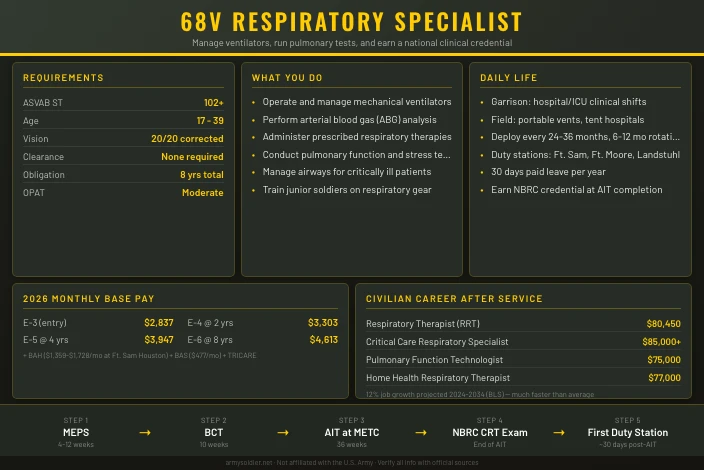
As a 68V Respiratory Specialist, you assess and treat patients with acute and chronic respiratory conditions, operate mechanical ventilators, perform pulmonary function tests, and conduct arterial blood gas analysis. You work directly under physician or nurse anesthetist supervision in military treatment facilities, managing everything from short-term oxygen therapy to long-term ventilator-dependent care.
The day-to-day work centers on patient assessment and therapy delivery. You receive physician orders, gather the equipment, assess the patient’s condition, and administer the prescribed respiratory treatment. That might mean a nebulizer treatment for a soldier with asthma, a ventilator adjustment for a trauma patient in the ICU, or a full pulmonary function workup to evaluate a chronic condition.
You also transport ventilator-dependent patients between units – which requires knowing your equipment cold, because disconnecting a ventilated patient without a plan gets someone killed.
Daily tasks include:
- Administering prescribed respiratory therapies (nebulizers, CPAP, BiPAP, mechanical ventilation)
- Performing arterial blood gas (ABG) sampling and analysis
- Operating and calibrating mechanical ventilators
- Conducting cardiopulmonary stress tests and pulmonary function studies
- Assessing patients for airway management and intubation support
- Transporting ventilator-dependent patients between care areas
- Training junior soldiers and medical staff on respiratory equipment
- Maintaining and troubleshooting all respiratory care equipment
Skill Levels and Specialization
As you advance in rank, the 68V has three defined skill levels:
| Skill Level | Grade Range | Focus |
|---|---|---|
| 68V20 (Entry) | E-1 to E-4 | Direct patient care, therapy delivery, equipment operation |
| 68V30 (Intermediate) | E-5 to E-6 | Patient care plus training junior personnel; liaison between pulmonary care physicians and command |
| 68V40 (Senior) | E-7 and above | Mobilization planning, training program development, senior advisory roles on specialty boards |
No ASI (Additional Skill Identifier) tracks are formally published for 68V, but senior specialists may cross-train in high-acuity critical care settings or pursue officer commissioning through the Army Medical Department’s Officer Candidate School pipeline.
Mission Contribution
Respiratory failure is one of the leading causes of death in trauma patients. Without a trained 68V, there’s no one to manage complex ventilator cases, perform pulmonary diagnostics, or stabilize patients with compromised airways. The 68V fills a gap that no other enlisted MOS covers, which is why this specialty exists within Army medicine.
Technology and Equipment
The equipment list is long and genuinely clinical. You’ll work with mechanical ventilators (including transport ventilators for field use), positive pressure devices (CPAP/BiPAP), spirometers for pulmonary function testing, pulse oximeters, capnographs, and arterial blood gas analyzers. You also use bronchoscopy support equipment and high-flow oxygen delivery systems. This is the same category of equipment you’d use in a civilian hospital ICU or pulmonary lab.
Salary and Benefits
Financial Benefits
Pay is based on rank and time in service. Most soldiers finish BCT and the 36-week AIT at E-3 or E-4. Here are the 2026 monthly base pay rates for the ranks most 68V soldiers hold during their first enlistment:
| Rank | Pay Grade | Monthly Base Pay |
|---|---|---|
| Private First Class | E-3 | $2,837 – $3,198 |
| Specialist | E-4 | $3,142 – $3,816 |
| Sergeant | E-5 | $3,343 – $4,422 |
| Staff Sergeant | E-6 | $3,401 – $5,044 |
Base pay is only part of the picture. Most soldiers receive housing and food allowances on top of it. BAH (Basic Allowance for Housing) is paid tax-free and varies by duty station and dependent status. At Fort Sam Houston, a single E-4 receives $1,359/month in BAH; an E-4 with dependents receives $1,728/month. BAS adds $476.95 per month for food. The combination often puts total compensation well above what the base pay line suggests.
No current enlistment bonus is confirmed for 68V as of early 2026. Check with a recruiter for updated incentive pay, since bonus lists change quarterly.
Additional Benefits
Active-duty soldiers and their families get TRICARE Prime at no cost – zero enrollment fee, zero deductibles, and zero copays at military treatment facilities. Coverage includes medical, dental, vision, mental health, prescriptions, and hospitalization.
The Army supports education while you serve. Tuition Assistance (TA) covers up to $4,500 per year in tuition costs. After separation, the Post-9/11 GI Bill pays full in-state tuition at public universities plus a monthly housing allowance and up to $1,000 per year in book stipends – for up to 36 months.
Retirement works through the Blended Retirement System (BRS):
- Serve 20 years and collect a pension worth 40% of your average basic pay
- The government matches up to 5% of your Thrift Savings Plan (TSP) contributions
- Continuation Pay at the 8-to-12 year mark offers a lump sum in exchange for additional service commitment
Work-Life Balance
Every soldier earns 30 days of paid leave per year (2.5 days per month). In garrison, respiratory specialists work within medical facility hours – typically weekdays with some shift rotation for evening and weekend coverage. The schedule is more predictable than most combat-arms MOSs.
Deployments and field exercises are exceptions to that routine. During high-tempo periods, respiratory specialists support forward medical teams and can work 12 to 16 hour shifts for extended periods. The standard active-duty cycle aims for roughly 2 years at home for every 1 year deployed.
Qualifications and Eligibility
Basic Qualifications
You must be a U.S. citizen between 17 and 39 years old, hold a high school diploma or GED, and meet Army physical standards. The AFQT minimum is 31 for diploma holders and 50 for GED holders. The 68V has a single ASVAB line score requirement:
- Skilled Technical (ST): 102 minimum
The ST composite draws on General Science, Verbal Expression, Mechanical Comprehension, and Mathematics Knowledge. A 102 is a meaningful threshold – it filters for the analytical ability you’ll need to interpret blood gas results, calibrate equipment, and follow complex clinical protocols.
Important: The 68V is described in Army recruiting materials as an advanced-level position. Some soldiers enter through direct enlistment; others reclassify into 68V from another MOS. If you’re enlisting fresh, confirm slot availability with your recruiter – training seats are limited.
| Requirement | Details |
|---|---|
| Age | 17-39; waivers possible up to 42 |
| Citizenship | U.S. citizen |
| Education | High school diploma (AFQT 31+) or GED (AFQT 50+) |
| ASVAB Line Score | ST: 102 minimum |
| Security Clearance | None required |
| Physical | OPAT Moderate category; standard Army medical exam |
| Vision | Correctable to 20/20 |
| Medical Standards | No conditions incompatible with clinical care environments |
Application Process
Start at a local Army recruiting station. Your recruiter will check your ASVAB score, explain the 68V training pipeline, and confirm whether slots are open for your target cycle. If you haven’t taken the ASVAB, they’ll schedule you for MEPS (Military Entrance Processing Station).
At MEPS, you take the ASVAB (if needed), complete a full medical exam, and go through a background review. The whole MEPS process typically runs one full day. If your ST score and medical results clear 68V, your recruiter books a training slot and you swear in.
From first recruiter visit to shipping date runs 4 to 12 weeks on average, though medical clearances and background reviews can extend that. You’ll ship to BCT on your scheduled date regardless.
Selection Criteria and Competitiveness
The ST 102 requirement puts the 68V above average for enlisted medical MOSs – most CMF 68 jobs require 91 to 106. Applicants with prior healthcare experience, Emergency Medical Technician (EMT) certification, or strong science coursework are competitive. No civilian credentials are required at entry, but the NBRC (National Board for Respiratory Care) exam at the end of AIT is far more manageable if you already understand respiratory physiology.
Upon Accession into Service
New soldiers enter at E-1 (Private, PV1). Promotions happen automatically through E-3 based on time in service. You’ll likely finish the 36-week AIT at E-3 or E-4 depending on your time-in-service calculation. The standard Army service obligation is 8 years total: typically an active-duty commitment (often 3 to 4 years for medical specialties) plus time in the Reserve Component or Individual Ready Reserve (IRR).
See our ASVAB study guide for strategies to hit these line scores, or take the PiCAT from home if you are a first-time tester.
Work Environment
Setting and Schedule
Respiratory specialists work primarily in clinical settings: hospital ICUs, emergency rooms, pulmonary care clinics, and surgical recovery units. In garrison, that means working inside a modern medical treatment facility with regular hours and shift rotations.
The environment is quieter and more controlled than infantry or armor, but it’s not low-stress. You’re managing critically ill patients – ventilator alarms, deteriorating blood gases, and emergent airway situations are part of the job. Decision speed matters.
Deployed, respiratory specialists typically support combat support hospitals or forward surgical teams. The setting gets austere fast: portable equipment, tent hospitals, and limited specialist backup. You may be the only respiratory specialist within your unit.
Leadership and Communication
Your chain of command runs through the facility’s respiratory care department head (typically a physician or Medical Corps officer) and a senior respiratory NCO. You work closely with ICU nurses, physicians, and physician assistants daily.
Performance feedback comes through the NCOER (NCO Evaluation Report) at E-5 and above. At E-4 and below, counseling sessions with your supervisor set performance expectations. The most respected 68V soldiers are the ones who catch problems before a physician has to ask twice.
Team Dynamics and Autonomy
Respiratory care combines tight teamwork with genuine individual responsibility. A physician writes the order, but you’re the one at the bedside assessing whether the therapy is working, adjusting flow rates, and flagging deterioration. Senior specialists operate with real autonomy – they make clinical judgment calls that affect patient outcomes.
At the junior level, you work under close supervision. As your skills develop and your supervisors trust your judgment, you run more of your own caseload. That progression is part of what makes the 68V engaging for clinically minded soldiers.
Job Satisfaction and Retention
Retention in the 68V is relatively strong among medical MOSs. The clinical complexity keeps work from feeling repetitive, and the career transition to civilian respiratory therapy is direct and well-compensated. Most specialists who re-enlist cite the work itself, the clinical challenge, and the career portability as the reasons they stayed.
Frustrations that push soldiers out: the healthcare facility hours don’t always match Army operational tempo, and respiratory specialists at smaller posts may feel isolated from the broader medical community.
Training and Skill Development
Initial Training
Training has two phases:
| Phase | Location | Duration | Focus |
|---|---|---|---|
| BCT (Basic Combat Training) | Fort Jackson, SC; Fort Moore, GA; Fort Leonard Wood, MO | 10 weeks | Soldiering fundamentals: marksmanship, tactics, physical fitness |
| AIT (Advanced Individual Training) | Medical Education and Training Campus (METC), Fort Sam Houston, TX | 36 weeks | Respiratory therapy theory, clinical rotations, equipment operation |
BCT is the same for every Army MOS. You’ll qualify on the M4, learn land navigation, and finish the AFT. Physical conditioning is the primary daily concern.
AIT at METC in San Antonio is where the real work begins. The 36-week program combines classroom instruction with hands-on clinical training. The academic portion covers respiratory physiology, mechanical ventilation principles, pulmonary function testing, arterial blood gas interpretation, pharmacology of respiratory drugs, and airway management techniques. The clinical phase puts you in actual patient care settings – military and civilian medical facilities affiliated with METC.
Total time from arrival at BCT to first duty station: approximately 11 to 12 months.
Advanced Training
After AIT, 68V soldiers can pursue the NBRC Registered Respiratory Therapist (RRT) credential, which is the advanced civilian certification. Many soldiers accomplish this within their first enlistment term.
At E-5 and above, focus shifts to managing other respiratory personnel and developing mobilization planning skills. The Army supports this through professional military education – sergeants attend the Basic Leader Course (BLC), staff sergeants attend the Advanced Leader Course (ALC). The Army’s Tuition Assistance program funds college courses during service, so many 68V soldiers pursue associate or bachelor’s degrees in respiratory care, health sciences, or healthcare management while on active duty.
Some specialists explore cross-training opportunities in emergency medicine, critical care, or flight medicine. 68W (Combat Medic) cross-training is possible with leadership approval and available slots. Board-certified respiratory therapists who also hold EMT certification are unusually marketable, both in and out of the Army.
Everything starts with qualifying ASVAB scores — our study guide covers what to study first.
Career Progression and Advancement
Career Path
Promotions to E-4 are mostly automatic within the first few years. E-5 and above require passing a promotion board and building a competitive file – strong NCOER ratings, military education, and physical fitness scores.
| Rank | Pay Grade | Typical Time | Responsibilities |
|---|---|---|---|
| Private First Class | E-3 | 0-1 years | AIT graduate, supervised patient care |
| Specialist | E-4 | 1-3 years | Independent therapy delivery, equipment operation |
| Sergeant | E-5 | 3-6 years | Team leader, training junior personnel, liaison duties |
| Staff Sergeant | E-6 | 6-10 years | Section leader, quality oversight, mobilization planning |
| Sergeant First Class | E-7 | 10-14 years | Operations management, training program development |
| Master Sergeant | E-8 | 14+ years | Senior clinical and medical leadership roles |
Strong performers at E-6 and E-7 may apply for the Warrant Officer program or pursue a commission through the Army’s Officer Candidate School (OCS). Medical officers with clinical backgrounds are in demand.
Role Flexibility and Transfers
MOS transfers are possible but require leadership approval and an open training slot. The most natural lateral moves are into 68C (Practical Nursing Specialist), 68W (Combat Medic), or clinical support roles. Staying within CMF 68 is easier than crossing into a different career management field.
Any lateral transfer triggers a new service obligation tied to completing the new MOS training.
Performance Evaluation
E-5 and above are rated through the NCOER system. Your rater evaluates leadership, training effectiveness, technical competence, and personal conduct. Senior raters provide an overall assessment that carries the most weight for promotion boards.
What sets successful 68V NCOs apart: clinical accuracy, the ability to train junior soldiers effectively, consistent AFT scores, and a history of handling high-pressure patient situations without errors.
Physical Demands and Medical Evaluations
Physical Requirements
The 68V is classified in the Moderate OPAT physical demand category. Daily physical demands include standing through long clinical shifts, moving patients and equipment, and carrying portable respiratory gear. Heavy lifting is not routine, but bending, pushing equipment carts, and repositioning patients are part of daily work.
The Army Fitness Test (AFT), which replaced the ACFT in June 2025, applies to every soldier regardless of MOS. It has five events scored 0 to 100 each, with a 300-point minimum for non-combat MOSs. Minimums for the 17-21 age group:
| Event | Male Minimum (60 pts) | Female Minimum (60 pts) |
|---|---|---|
| 3-Rep Max Deadlift (MDL) | 140 lbs | 80 lbs |
| Hand-Release Push-Up (HRP) | 10 reps | 10 reps |
| Sprint-Drag-Carry (SDC) | 2:40 | 3:40 |
| Plank (PLK) | 1:30 | 1:30 |
| Two-Mile Run (2MR) | 15:54 | 18:54 |
Each event requires a minimum 60-point score. The 300-point minimum applies to 68V. Combat-focused MOSs face a higher 350-point standard; 68V is not among the 21 designated combat specialties.
Medical Evaluations
After enlistment, soldiers get an annual preventive health assessment covering weight, blood pressure, vision, hearing, and a provider review. Respiratory specialists working in clinical environments with biohazard exposure receive periodic bloodborne pathogen screenings. Pre-deployment medical clearances happen before every rotation.
Soldiers with asthma, chronic pulmonary conditions, or severe respiratory disease typically do not qualify for this MOS at accession.
Deployment and Duty Stations
Deployment Details
Active-duty 68V soldiers deploy regularly, typically every 24 to 36 months for 6 to 12 months per rotation. The frequency depends on your unit type:
- Combat support hospitals (CSH): higher deployment frequency, full clinical environment in-theater
- Forward surgical teams (FST): more austere, faster operational tempo, portable equipment
- Garrison medical centers: lower deployment probability, mission-essential at home station
- Overseas installations: Landstuhl (Germany) and South Korea are common long-term assignments that don’t count as combat deployments
Respiratory specialists are not direct combat soldiers, but deployed medical facilities are not outside the risk zone. Support hospital locations can receive indirect fire, and aeromedical evacuation missions can carry real danger.
Location Flexibility
The Army assigns duty stations based on its operational needs, not your preferences. You submit a request, but approval depends on available slots. Expect to move every 2 to 4 years. Larger installations with major medical centers can offer longer tours.
Common duty stations for CMF 68 medical specialists:
- Fort Sam Houston, TX (Brooke Army Medical Center)
- Fort Moore, GA (Martin Army Community Hospital)
- Fort Liberty, NC (Womack Army Medical Center)
- Fort Campbell, KY (Blanchfield Army Community Hospital)
- Tripler Army Medical Center, HI
- Overseas: Landstuhl Regional Medical Center, Germany; Brian Allgood Army Community Hospital, South Korea
Risk, Safety, and Legal Considerations
Job Hazards
The primary occupational risks for 68V soldiers are clinical, not combat-related in garrison:
- Bloodborne pathogen exposure – arterial blood gas sampling and intubation support put you in direct contact with blood and respiratory secretions; HIV, hepatitis B, and hepatitis C are the main concerns
- Infectious airborne pathogen exposure – patients with tuberculosis, COVID-19, or other respiratory infections require N95 protection and negative-pressure room protocols
- Chemical and medication exposure – inhaled anesthetic agents and respiratory pharmacological agents carry long-term exposure risks without proper ventilation
- Physical strain – patient repositioning and equipment transport create musculoskeletal risk during extended shifts
In deployed environments, forward medical positions add indirect fire risk and the stress of austere conditions.
Safety Protocols
Standard precautions govern every patient interaction:
- N95 or surgical masks for airway procedures; full PPE for patients on airborne isolation
- Gloves and eye protection for all blood and secretion contact
- Sharps containers immediately at point of use
- Annual bloodborne pathogen training (mandatory)
- Immediate reporting and post-exposure prophylaxis after any exposure incident
Negative-pressure isolation rooms are standard for treating patients with suspected airborne infectious disease.
Security and Legal Requirements
The 68V does not require a security clearance. Patient data handled by respiratory specialists is protected under the Health Insurance Portability and Accountability Act (HIPAA) and military medical privacy rules. Unauthorized disclosure of patient test results or health information is a UCMJ violation, not just a civilian HR problem.
All soldiers operate under the Uniform Code of Military Justice (UCMJ). Service obligations, conduct standards, and deployment requirements are legally binding from the day you sign your enlistment contract.
Impact on Family and Personal Life
Family Considerations
Medical MOS deployments happen, and they’re typically 6 to 12 months. Respiratory specialists deploy less frequently than combat-arms soldiers, but the separations still affect families. Most garrison assignments at major medical centers offer a predictable schedule – weekday shifts with weekend rotation – which is better for family stability than many Army jobs.
Family support resources available at most installations:
- Army Community Service (ACS) – financial counseling, emergency assistance, parenting support
- Family Readiness Groups (FRGs) – unit-level peer support during deployments
- Military OneSource – free counseling, legal referrals, and family services (available 24/7)
- School Liaison Program – helps children transition between schools during PCS moves
- TRICARE – covers the whole family at no cost while you’re on active duty
Relocation and Flexibility
PCS (permanent change of station) moves happen roughly every 2 to 4 years. The Army pays for the move, but relocation still disrupts your family’s established life – schools, friendships, your spouse’s career. Larger medical installations like Fort Sam Houston or Tripler offer longer tours and more stability.
You can submit a preference for specific duty stations, but the Army fills its needs first. Soldiers with prior service at a location and strong evaluations have better odds of getting preferred assignments.
Reserve and National Guard
Reserve positions for 68V exist, though they are not common. The Army maintains respiratory therapy capability in some medical units, primarily at the brigade support and combat support hospital level. National Guard slots are fewer - respiratory therapy is not a high-density specialty in Guard medical battalions. If you want to serve part-time as a 68V, research which units in your area have open slots before counting on it.
If you land a position, the arrangement pairs well with a civilian respiratory therapy career. Your military training and credentials reinforce each other directly - every hour you spend in a military hospital setting adds clinical depth that helps on the civilian side.
Drill Schedule
The standard commitment is one weekend per month plus two weeks for Annual Training each year. Respiratory therapy is a hands-on clinical skill that degrades without practice. Expect your unit to schedule additional training beyond standard drill to maintain ventilator proficiency, airway management drills, and respiratory therapy credential maintenance. This is not optional - your MOS requires demonstrated competency.
Pay and Benefits
The pay gap between active duty and Reserve or Guard service is large. An E-4 with four years earns $3,659 per month on active duty. The same Soldier earns roughly $488 for a drill weekend in the Reserve or Guard. Part-time service supplements your civilian income - it does not replace it.
Healthcare is the other significant difference. Active-duty service members pay no premium for TRICARE. Reserve and Guard members use Tricare Reserve Select at $57.88 per month for the service member, or $286.66 per month for member plus family. If your civilian hospital job provides good health coverage, you may not need TRS. If your civilian benefits are thin, $57.88 per month for TRS is hard to beat.
Education benefits:
- MGIB-SR (Chapter 1606): $493 per month for full-time students
- Federal Tuition Assistance: $250 per credit hour, capped at $4,500 per year
- National Guard members may also qualify for state tuition waivers - many states cover 100% of tuition at public in-state schools
Retirement:
Reserve and Guard retirement is points-based. You accumulate retirement points for drills, Annual Training, and any active-duty time. The pension starts at age 60, though mobilization after January 28, 2008, reduces that minimum by three months per 90 days of active service, down to age 50. Active-duty retirement is a 20-year pension that pays immediately at separation.
Deployment and Mobilization
Deployment tempo for 68V in the Reserve and Guard is moderate. Respiratory therapy is a critical care specialty. When a hospital unit mobilizes to support a deployed medical facility, respiratory therapists go with it - ventilators do not run themselves. You are less likely to deploy than a 68W combat medic, but more likely than most administrative or support specialties. Expect a real possibility of mobilization if your unit is a hospital or medical battalion.
Civilian Career Integration
This MOS has one of the most direct civilian career pairings in Army medicine. Registered respiratory therapists are in demand across hospitals, ICUs, pulmonology clinics, home health agencies, and long-term acute care facilities. Your military training counts toward civilian credentialing - the Certified Respiratory Therapist (CRT) exam is accessible after AIT, and the Registered Respiratory Therapist (RRT) follows with clinical experience. Both are administered by the National Board for Respiratory Care (NBRC).
Your civilian employer cannot legally retaliate against you for Reserve or Guard service. USERRA requires them to hold your position, or an equivalent one, when you return from military duty, and prohibits discrimination based on military obligations.
| Feature | Active Duty | Army Reserve | Army National Guard |
|---|---|---|---|
| Duty Status | Full-time | Part-time (1 wknd/mo + 2 wks/yr) | Part-time (1 wknd/mo + 2 wks/yr) |
| Monthly Pay (E-4, 4 yrs) | $3,659/mo | ~$488/drill weekend | ~$488/drill weekend |
| Healthcare | TRICARE (no premium) | Tricare Reserve Select ($57.88/mo) | Tricare Reserve Select ($57.88/mo) |
| Education | Post-9/11 GI Bill, TA | MGIB-SR ($493/mo), TA | MGIB-SR ($493/mo), TA, state tuition waivers |
| Deployment | Per unit rotation | When mobilized | When mobilized |
| Retirement | 20-year pension | Points-based, age 60 | Points-based, age 60 |
Post-Service Opportunities
Transition to Civilian Life
The 68V has one of the cleanest direct transitions in Army medicine. Your training qualifies you to sit for the NBRC Certified Respiratory Therapist (CRT) exam immediately after AIT. Most soldiers with a few years of clinical experience can pass the Registered Respiratory Therapist (RRT) exam by the time they separate.
Civilian hospitals, long-term acute care facilities, rehabilitation centers, and home health agencies all hire registered respiratory therapists. The field has a shortage of qualified practitioners, which means competitive salaries and strong hiring rates for veterans.
The Transition Assistance Program (TAP) provides resume writing, interview prep, and benefits counseling during your last year on active duty. The Post-9/11 GI Bill covers full in-state tuition at public schools (or up to $29,920.95 at private schools for the 2025-2026 academic year) plus a monthly housing allowance and $1,000 per year in book stipends. Soldiers who want to advance beyond the associate’s degree level can pursue bachelor’s programs in respiratory care or health sciences.
Civilian Career Prospects
| Civilian Occupation | Median Annual Salary (BLS, 2024) | 10-Year Outlook (2024-2034) |
|---|---|---|
| Respiratory Therapist | $80,450 | +12% (much faster than average) |
| Respiratory Therapy Supervisor | $90,000 – $105,000+ | +10% |
| Pulmonary Function Technologist | $65,000 – $85,000 | +10% |
| Critical Care Respiratory Specialist | $85,000 – $100,000+ | +12% |
| Home Health Respiratory Therapist | $72,000 – $82,000 | +15% |
The 12% projected growth rate for respiratory therapists is roughly four times the national average for all occupations, driven by aging demographics and the long-term prevalence of COPD, asthma, and post-COVID respiratory complications. Veterans with RRT credentials and ICU experience are particularly competitive.
Post-Service Policies
An honorable discharge unlocks VA healthcare, disability compensation if applicable, education benefits, and veteran hiring preferences in federal employment. You can separate after fulfilling your service obligation. Talk to your career counselor at least 12 months before your end of active service (EAS) date – benefits filing, TAP classes, and job searches take more time than most soldiers expect.
Is This a Good Job for You?
Ideal Candidate Profile
The 68V is not for people who want to work outdoors, be in the field with a rifle, or avoid clinical environments. The job rewards people who are drawn to medicine, comfortable with sick patients, and willing to invest serious study time in a technically demanding curriculum.
Strong indicators you’d do well:
- You’re interested in physiology and how the body works under stress
- You perform well in structured academic settings
- You want civilian career portability when you separate
- You’re comfortable working around critically ill patients and invasive equipment
- You want a healthcare career but aren’t ready to commit to nursing school upfront
- A nationally recognized credential on your way out appeals to you
Potential Challenges
This job probably isn’t right if you:
- Want to be in the field doing combat-focused work
- Find hospital environments stifling or anxiety-inducing
- Prefer physical labor to clinical precision work
- Need variety – respiratory therapy involves the same core procedures daily
- Are bothered by high-pressure situations involving patient deterioration
- Want to move around frequently between different types of Army work
Who Thrives Here
The best 68V soldiers share a profile: clinically curious, academically disciplined, and patient-focused. They find ventilator management genuinely interesting, not just technically tolerable. They study for the NBRC exam because they want to pass, not just because they’re required to. And they recognize that the 36-week AIT is a compressed version of a two-year civilian program – which means the credential you earn at the end has real value.
If a career in respiratory therapy, pulmonary medicine, or critical care interests you, this MOS gets you there faster than most civilian paths, with the Army paying for your training along the way.
More Information
Talk to an Army recruiter to confirm whether 68V training slots are currently open and whether any bonus incentives apply. Ask specifically about your ASVAB scores and whether your ST composite meets the 102 requirement – you can also take a practice ASVAB before the official test to see where you stand.
Find a recruiter and explore current openings at goarmy.com
Review Army COOL credential funding options at cool.osd.mil
Check BLS data on respiratory therapy careers at bls.gov
Prepare for the ASVAB with our study guide to make sure your line scores qualify
This site is not affiliated with the U.S. Army or any government agency. Verify all information with official Army sources before making enlistment or career decisions.
Explore more Army medical careers such as the 68K Medical Laboratory Specialist and 68P Radiology Specialist.