68X Mental Health Specialist
Army mental health specialists are the first people soldiers talk to when things fall apart. You run behavioral health screenings, step in during psychological crises, support counseling sessions, and keep detailed mental health records across military medical settings. If you’re drawn to mental healthcare and want real clinical experience before you ever set foot in a graduate program, this MOS gets you there fast.
Qualifying requires specific ASVAB line scores — our ASVAB study guide covers what to target and how to prepare.
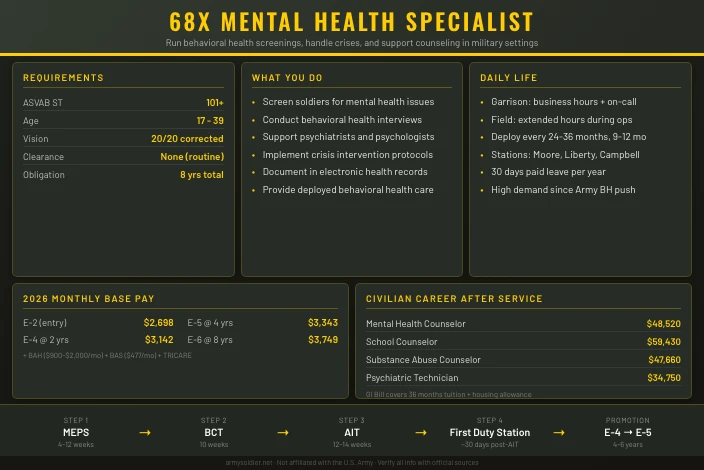
Job Role and Responsibilities
You work as part of a behavioral health team, backing up psychiatrists, psychologists, and social workers. Your day includes interviewing soldiers referred for mental health evaluation, documenting what you observe, helping manage patients in crisis, and making sure the care plan actually gets followed. In deployed settings, you may be the only behavioral health support available for miles.
In garrison, the work is structured. You greet patients, run standardized screening interviews, enter findings into electronic medical records, and flag anything urgent to the treatment team. Soldiers come in with depression, anxiety, combat stress, substance problems, and relationship breakdowns. You assess them, document clearly, and hand off to the licensed provider.
The field is a different pace. When a soldier breaks down after a firefight or goes silent after a casualty, you’re often first on the scene. You implement crisis protocols, provide immediate stabilization, and decide when someone needs to be evacuated. That kind of autonomy requires sound judgment and solid training.
Army Enlisted Medical Specialization System:
| Qualification Level | Identifier | Purpose |
|---|---|---|
| Additional Skill Identifier (ASI) | Various ASI codes available | Specialization in areas such as combat operational stress control, crisis intervention, or behavioral health administration |
| Special Qualification Identifier (SQI) | Various SQI codes available | Certifications such as Peer Support Specialist, Crisis Intervention Team (CIT) training, or Suicide Prevention training |
| Professional Development Skill Identifier (PDSI) | Various PDSI codes available | Advanced training in specialized behavioral health areas |
The 68X is the primary MOS code. Many soldiers add certifications in crisis intervention, peer support, or trauma-informed care over their first term.
Soldier mental health directly affects combat effectiveness, unit cohesion, and whether people stay in the Army. By providing accessible screening and early intervention, you keep soldiers deployable and help them process trauma before it becomes a career-ending problem. In garrison, you reduce the barrier to care. Deployed, you prevent unnecessary medical evacuations and get soldiers back to duty faster.
Technology and Equipment
You’ll use electronic medical records systems (AESIP and similar Army-wide platforms), standardized screening tools like the Primary Care PTSD Screen (PC-PTSD) and Patient Health Questionnaire (PHQ), and telehealth platforms. In the field, you use portable mental health assessment protocols. New systems and evidence-based practices get rolled out regularly, and training comes with them.
Salary and Benefits
Financial Benefits
Military pay is based on your rank and time in service. Most soldiers enter as E-1 and promote to E-2 after Basic Combat Training.
| Rank | Pay Grade | Years of Service: 2 | Years of Service: 4 | Years of Service: 6 | Years of Service: 8 |
|---|---|---|---|---|---|
| Private (PV2) | E-2 | $2,698 | $2,698 | $2,698 | - |
| Specialist (SPC) | E-4 | $3,303 | $3,659 | $3,816 | $3,816 |
| Sergeant (SGT) | E-5 | $3,599 | $3,947 | $4,109 | $4,299 |
| Staff Sergeant (SSG) | E-6 | $3,743 | $4,069 | $4,236 | $4,613 |
Source: DFAS 2026 pay tables. Figures reflect the 2026 pay raise.
On top of base pay, you get housing and food allowances. BAH (Basic Allowance for Housing) depends on your duty station and whether you have dependents. A single E-4 at Fort Liberty, NC gets roughly $1,400 per month; rates across CONUS installations range from about $900 to $2,000+ depending on location. BAS adds approximately $477 monthly for food. Mental health specialists may qualify for special duty pay or retention bonuses during high-demand periods.
Additional Benefits
You and your family get TRICARE health coverage at little or no cost – doctor visits, hospitalizations, prescriptions, dental, vision, and mental health services. Tuition Assistance lets you take college classes while on active duty. After you leave, the Post-9/11 GI Bill pays up to 36 months of tuition at a public university (full in-state rate) plus a monthly housing allowance. The GI Bill can transfer to a spouse or children in some cases.
Retirement works through the Blended Retirement System (BRS):
- Serve 20 years and you get a pension worth 40% of your base pay
- The government matches up to 5% of your Thrift Savings Plan (TSP) contributions
- Survivor Benefit Plan (SBP) protects your family if something happens to you
Work-Life Balance
You earn 30 days of paid leave per year (2.5 days per month). In garrison behavioral health clinics, the schedule is mostly standard business hours with an on-call rotation for after-hours crises. During field exercises and deployments, that regularity disappears. When combat operations spike or casualties hit hard, you work extended hours until things stabilize.
Active-duty units generally follow a 1-year deployed, 2-year home rotation. That ratio can shift based on force readiness.
Qualifications and Eligibility
Basic Qualifications
You need to be a U.S. citizen between 17 and 39. High school grads need at least a 31 on the AFQT. GED holders need a 50. The 68X requires one specific ASVAB line score:
- Skilled Technical (ST): 101 minimum
The ST score combines General Science, Verbal Expression, Mechanical Comprehension, and Math Knowledge. That’s a moderate threshold, consistent with other healthcare MOSs.
Medical standards are standard. You need vision correctable to 20/20, no severe hearing loss, and the ability to function in clinical environments. A history of serious mental health conditions requiring ongoing psychiatric medication or hospitalization may require a waiver or disqualify you – evaluated case by case with input from a military physician and psychiatrist.
| Requirement | Details |
|---|---|
| Age | 17-39 years old; up to 42 with waiver |
| Citizenship | U.S. citizen or permanent resident |
| Education | High school diploma or GED |
| AFQT (ASVAB) | Minimum 31 (diploma) or 50 (GED) |
| Skilled Technical (ST) | Minimum 101 (line score requirement for 68X) |
| Vision | Correctable to 20/20 |
| Medical Standards | Able to serve in medical environments; pass physical exam |
| Background | No disqualifying criminal history or drug use; mental health history reviewed on case-by-case basis |
Application Process
Start at your local Army recruiting station. The recruiter will walk you through the 68X, check your qualifications, and discuss Active Duty, Reserve, or National Guard options.
Next comes MEPS (Military Entrance Processing Station). You take the ASVAB if you haven’t already, get a full medical exam, and go through a background check. That usually takes one full day. If your scores and medical results qualify you for 68X, your recruiter books you a training slot.
The whole process from walking into the recruiter’s office to swearing in typically takes 4 to 12 weeks. Background investigations or medical clearances can stretch that. Once cleared, you get a report date for Basic Combat Training.
Selection Criteria and Competitiveness
The 68X is moderately competitive. Demand is steady because the Army has pushed hard on behavioral health access in recent years, but you still need that ST 101 score. Applicants with prior experience in counseling, crisis work, or peer support have an edge. The Army wants people who are empathetic, emotionally steady, and mature enough to handle sensitive information without slipping.
Upon Accession into Service
You enter as E-1 and promote to E-2 after Basic. After AIT, most soldiers are E-2 or E-3 depending on time in service and performance. The standard obligation is 8 years total: typically 2 years active duty plus 6 years in the Reserve or Individual Ready Reserve. Training bonuses or special programs may extend that.
See our ASVAB study guide for strategies to hit these line scores, or take the PiCAT from home if you are a first-time tester.
Work Environment
Setting and Schedule
Mental health specialists work across several settings:
- Behavioral health clinic (garrison): Standard business hours, on-call rotation possible for after-hours crises
- Military hospital or behavioral health unit: Clinic hours with shift coverage alongside psychiatrists, psychologists, and social workers
- Field hospital or command post: Deployed with the unit during exercises; hours track the operational tempo
- Forward operating base or combat support hospital: Deployed setting; responds to combat stress reactions; extended hours during active operations
- Divisional aid station: Embedded with maneuver units; supports unit leaders in identifying soldiers who need evaluation
Soldiers in crisis don’t keep regular hours. Deployments to high-stress areas mean irregular schedules, especially after significant casualties or sustained combat.
Leadership and Communication
You report to the unit’s medical officer (usually a Captain or psychiatrist) and senior behavioral health staff. In the clinic, you work under a behavioral health officer – psychiatrist, psychologist, or clinical social worker – who manages treatment protocols and final clinical decisions.
Performance feedback comes through annual evaluations and regular clinical supervision. Most behavioral health teams run weekly case conferences to discuss patient progress and treatment adjustments.
Team Dynamics and Autonomy
In garrison, you work inside a clinical team. You document observations, escalate crises to supervisors, and carry out care plans developed by licensed providers. The decisions stay with the treatment team.
Deployed, the picture changes. When a mental health officer isn’t available, you may be the first and only responder for a soldier in acute distress. You implement crisis protocols, provide immediate intervention, and determine when someone needs evacuation. That level of responsibility is real, and the training prepares you for it.
Job Satisfaction and Retention
The 68X has steady retention. Specialists assigned to strong behavioral health programs with good supervision re-enlist at solid rates. Some leave specifically to pursue graduate degrees in counseling, psychology, or social work – which the Army actively supports through education benefits.
Satisfied specialists point to the trust soldiers place in them, the respect from the treatment team, and the clinical skills they build fast. The harder part is the emotional weight – hearing traumatic stories day after day takes a toll if you don’t actively manage it.
Training and Skill Development
Initial Training
Training has two phases: Basic Combat Training (BCT) and Advanced Individual Training (AIT).
| Training Phase | Location | Duration | Focus |
|---|---|---|---|
| BCT | Fort Jackson, SC; Fort Moore, GA; Fort Leonard Wood, MO | 10 weeks | Soldier basics: marksmanship, tactics, fitness, discipline |
| AIT | Fort Sam Houston, TX (Brooke Army Medical Center) | 12-14 weeks | Mental health assessment, behavioral health protocols, crisis intervention, documentation, therapeutic communication |
BCT teaches you to be a soldier. Rifle marksmanship, land navigation, squad tactics, physical fitness. Every MOS does this.
AIT is where you become a mental health specialist. At Brooke Army Medical Center in San Antonio, you study behavioral health fundamentals, mental health assessment tools, crisis intervention protocols, and documentation standards. The curriculum covers recognizing symptoms of depression, anxiety, PTSD, substance abuse, and suicidal ideation. You practice de-escalation techniques, behavioral health interviewing with role-play scenarios, and the referral process for different conditions.
You earn your 68X MOS after AIT and report to your first duty station within about a month.
Advanced Training
After initial training, several paths open up. Certified Peer Specialist (CPS) certification is widely available and valued in behavioral health units. Crisis Intervention Team (CIT) certification and Mental Health First Aid are also common early adds.
Strong performers can pursue advanced courses in suicide prevention, substance abuse counseling, or trauma-informed care. Some specialists compete for social work officer programs or graduate-level education in psychology or counseling. Specialization tracks exist for E-5 and above positions, often moving toward supervision, program management, or specialized treatment roles.
The Army funds a lot of this through Tuition Assistance and the GI Bill. Many specialists use those benefits to earn bachelor’s or master’s degrees in psychology, counseling, or social work during or after service.
Everything starts with qualifying ASVAB scores — our study guide covers what to study first.
Career Progression and Advancement
Career Path
Promotion to E-4 (Specialist) typically comes after 2 to 3 years and is mostly automatic if you meet the requirements. E-5 (Sergeant) takes longer and requires passing a promotion board. At that rank, you shift from seeing patients to leading other specialists.
| Rank | Pay Grade | Typical Years | Typical Role |
|---|---|---|---|
| Private (PV2) | E-2 | 0-1 | AIT graduate, entry-level specialist |
| Specialist | E-4 | 2-3 | Senior behavioral health specialist, clinical skills development |
| Sergeant | E-5 | 4-6 | Behavioral health NCO, small unit leader, peer support coordination |
| Staff Sergeant | E-6 | 6-9 | Senior behavioral health leader, program management, training responsibilities |
| Sergeant First Class | E-7 | 9-12 | Behavioral health operations, clinical oversight, significant leadership role |
| Master Sergeant | E-8 | 12+ | Senior behavioral health leadership, policy development, training |
E-6 (Staff Sergeant) usually comes around 6 to 9 years. You manage other specialists, run behavioral health programs, and help shape unit policy. E-7 and above are highly competitive and require proven leadership, military education, and a strong record.
Role Flexibility and Transfers
You can request a transfer to another medical MOS, but you need leadership approval and an open slot. Some specialists lateral move into medical supply (92Y) or other healthcare support roles. Any MOS change means completing that job’s training and taking on a new service obligation. Specialists with strong evaluations generally have more options.
Performance Evaluation
NCOs (E-5 and above) get rated through the NCOER (NCO Evaluation Report) once a year. Your rater and senior rater score you on leadership, technical competence, and Army values. Ratings range from “below center” to “fully capable” to “exceeds standards.” Those rated “exceeds standards” are competitive for accelerated promotion.
What actually sets you apart: solid clinical skills, the trust of your treatment team, initiative in improving behavioral health services, and mentoring junior specialists. Staying physically fit and pursuing advanced training matters too.
Physical Demands and Medical Evaluations
Physical Requirements
The 68X is less physically demanding than combat medic roles, but you’re still an Army soldier. You stand for extended periods, walk throughout medical facilities, and may need to respond quickly to agitated patients during a crisis – which can sometimes involve managing someone in acute physical distress. All Army fitness standards apply.
Every soldier takes the Army Fitness Test (AFT) annually. Minimum standards for ages 17 to 21:
| Test Component | Male 17-21 | Female 17-21 | Scoring Method |
|---|---|---|---|
| 3 Repetition Maximum Deadlift (MDL) | Minimum 140 lbs | Minimum 80 lbs | Max weight lifted for 3 reps |
| Hand Release Push-Up (HRP) | Minimum 10 repetitions | Minimum 10 repetitions | Continuous reps with hand release |
| Sprint-Drag-Carry (SDC) | Minimum 2:40 | Minimum 3:40 | 50 meter sprint, 2x drag 90 lbs, 2x carry 40 lbs |
| Plank (PLK) | Minimum 2:00 minutes | Minimum 2:00 minutes | Static hold |
| Two-Mile Run (2MR) | Minimum 15:54 | Minimum 18:54 | Continuous running |
Each event is scored 0 to 100. You need at least 60 per event and a 300 total. Combat specialty roles require 350. Mental health specialists follow the same standards as every other soldier.
Medical Evaluations
After enlistment, you get an annual health assessment: weight, blood pressure, vision, hearing, and a check-in with a provider. Specialists working in behavioral health clinics may also have occupational health evaluations related to secondary trauma exposure. Before deployment, you go through a separate medical clearance to confirm fitness for the environment.
Deployment and Duty Stations
Deployment Details
Mental health specialists deploy regularly but less often than combat-focused personnel. Active-duty specialists typically deploy once every 24 to 36 months for 9 to 12 months. Specialists assigned to high-readiness units deploy more frequently; those in garrison behavioral health clinics may deploy less often.
Common deployment locations:
- Middle East: Supporting forward-deployed units in high-operations-tempo environments
- Europe: NATO commitments in Germany and Poland
- South Korea: Persistent deterrence mission along the Korean Peninsula
- Domestic (disaster relief): Occasional deployments for natural disasters or humanitarian operations
Specialists supporting combat units have a higher chance of deployment to active operations than those in garrison hospitals.
Location Flexibility
The Army assigns your duty station based on what it needs, not what you want. You can submit a preference list, but there are no guarantees. Expect to move every 2 to 4 years.
Common duty stations for mental health specialists:
- Fort Moore, GA
- Fort Liberty, NC
- Fort Campbell, KY
- Fort Jackson, SC
- Walter Reed National Military Medical Center, MD
- Overseas: Germany, South Korea
Risk, Safety, and Legal Considerations
Job Hazards
Mental health specialists face moderate occupational hazards. The work involves sustained exposure to trauma, crisis, and distress at a volume most civilian healthcare roles don’t match.
In garrison and field settings:
- Secondary trauma from hearing traumatic narratives repeatedly
- Patients in acute psychological distress can present with unpredictable behavior
- Physical risk during crisis de-escalation of agitated individuals
- Compassion fatigue from sustained emotional labor without adequate self-care
During deployment:
- Indirect fire and vehicle accidents in forward-deployed settings
- Extreme heat, austere living conditions, and limited access to mental health support for the specialist
- Psychological toll of supporting traumatized soldiers in dangerous environments
Safety Protocols
The Army reduces these hazards through structured supports:
- De-escalation and crisis management training: Required before working with patients
- Suicide prevention protocols: Treatment teams implement evidence-based prevention collaboratively
- Clinical supervision: Regular case conferences and supervisor oversight reduce isolation when managing difficult cases
- Violence prevention measures: Behavioral health units maintain security protocols for staff and patient safety
- Unit safety coordination: During operations, behavioral health teams stay in communication with command and operational medics
Security and Legal Requirements
Routine 68X assignments don’t require a security clearance. Specialists supporting special operations or classified programs may need a Secret or Top Secret clearance. The process takes 2 to 6 months.
All soldiers follow the Uniform Code of Military Justice (UCMJ). Mental health specialists carry specific legal responsibilities beyond standard conduct rules:
- HIPAA compliance: Mental health records are protected; unauthorized disclosure results in disciplinary action
- Privileged communication: You cannot disclose patient information without authorization or legal process
- Mandatory reporting exceptions: Confidentiality has legal limits – imminent danger to self or others, child or elder abuse, and certain other situations require disclosure by law
Training in these exceptions is part of initial and ongoing behavioral health education.
Impact on Family and Personal Life
Family Considerations
Spouses and kids adjust to irregular hours, frequent training, and 9 to 12 month deployments. That’s the hardest part for most military families. Mental health work adds another layer: you hear traumatic stories at work, and managing that at home takes self-awareness and honest communication.
Support resources at most installations:
- Family Readiness Groups (FRGs): Unit-level peer support during deployments
- Military OneSource: Free counseling and family services available 24/7
- Army Community Service (ACS): Financial counseling, spousal employment assistance, and relocation support
- TRICARE behavioral health coverage: Mental health services available to family members, including counseling for secondary trauma or deployment stress
- School Liaison Officers: Help military children switch schools during moves
- Chaplain services: Confidential pastoral counseling at no cost
Relocation and Flexibility
You will move. After AIT, you go where the Army sends you, and that’s often far from home. After that, expect a new duty station every 2 to 4 years. The Army covers the moving costs, but each move disrupts your spouse’s job, your kids’ school, and your community.
You can request preferred locations, but the Army’s needs come first. Larger installations tend to offer 3 to 4 year tours. Deployments separate families for 9 to 12 months, though mental health specialists typically deploy less often than combat-focused roles.
Reserve and National Guard
68X positions exist in both the Army Reserve and the National Guard, primarily in behavioral health units and combat stress control (CSC) companies. These are specialized units that deploy to provide mental health support during and after operations. If you want to serve part-time after active duty in this MOS, you have real options - more than many medical specialties.
Both components have been expanding behavioral health capacity over the past decade as demand for mental health support in the military has grown. Experienced 68Xs with active-duty backgrounds are valued in Reserve and Guard units because the training pipeline is long and the skills are hard to develop without real clinical exposure.
Drill Schedule
Standard commitment is one weekend per month and two weeks for Annual Training each year. For a 68X, expect additional training requirements on top of that:
- Annual suicide prevention certification (required for all 68X personnel)
- Behavioral health intervention skills refreshers
- Crisis counseling scenario training
- Unit-level readiness exercises for combat stress control missions
Mental health skills require regular practice to stay sharp. Your unit will schedule training beyond the minimum drill calendar. Plan for it.
Pay and Benefits
The pay difference between active duty and part-time service is significant. An E-4 with four years earns $3,659 per month on active duty. In the Reserve or Guard, the same Soldier earns roughly $488 for a standard drill weekend. Part-time military pay supplements a civilian career - it does not stand alone.
Healthcare works differently in the Reserve and Guard. Active-duty service members pay no premium for TRICARE. Reserve and Guard members use Tricare Reserve Select, which costs $57.88 per month for the service member only, or $286.66 per month for member plus family. For Soldiers working in behavioral health or social services, where civilian employer benefits vary widely, TRS can be a genuinely valuable option.
Education benefits:
- MGIB-SR (Chapter 1606): $493 per month for full-time students
- Federal Tuition Assistance: $250 per credit hour, capped at $4,500 per year
- National Guard members may also qualify for state tuition waivers - many states cover 100% of tuition at public in-state schools, which matters a lot if you are working toward a social work or counseling degree
Retirement:
Reserve and Guard retirement is points-based. You earn retirement points for every drill, Annual Training day, and any active-duty time. The pension starts at age 60, though qualifying mobilization after January 28, 2008, reduces that minimum by three months per 90 days of active service, down to age 50. Active-duty retirement is a 20-year pension that pays immediately at separation.
Deployment and Mobilization
Behavioral health demand in deployed environments has grown steadily. Combat stress control units and behavioral health sections deploy with brigades and division-level commands to provide direct mental health support. Demand is not just during combat operations - it extends to post-deployment reintegration, where 68X Soldiers support Soldiers returning from high-stress tours.
Deployment frequency for 68X in the Reserve and Guard is moderate to high relative to other medical specialties. If you are in a behavioral health unit or a combat stress control company, deployment is part of the mission. Expect a realistic chance of mobilization, particularly in the current environment where behavioral health is a recognized readiness priority.
Civilian Career Integration
This is one of the cleaner part-time military pairings for a behavioral health career. Civilian employers in behavioral health - hospitals, community mental health centers, VA facilities, substance abuse programs - value the training and experience 68X Soldiers bring. You will work alongside licensed clinicians in the civilian world. Your military experience gives you credibility and exposure to complex cases that many civilian-only workers do not see until much later in their careers.
Common civilian paths that work well alongside Reserve or Guard service:
- Behavioral health technician or psychiatric technician
- Mental health aide or crisis stabilization worker
- Substance abuse counselor or recovery coach
- Entry-level case manager (with a bachelor’s degree)
Federal law protects your civilian job through USERRA. Your employer must reinstate you to your position, or a comparable one, after military duty. They cannot penalize you, reduce your seniority, or deny a promotion because of your service obligations.
| Feature | Active Duty | Army Reserve | Army National Guard |
|---|---|---|---|
| Duty Status | Full-time | Part-time (1 wknd/mo + 2 wks/yr) | Part-time (1 wknd/mo + 2 wks/yr) |
| Monthly Pay (E-4, 4 yrs) | $3,659/mo | ~$488/drill weekend | ~$488/drill weekend |
| Healthcare | TRICARE (no premium) | Tricare Reserve Select ($57.88/mo) | Tricare Reserve Select ($57.88/mo) |
| Education | Post-9/11 GI Bill, TA | MGIB-SR ($493/mo), TA | MGIB-SR ($493/mo), TA, state tuition waivers |
| Deployment | Per unit rotation | When mobilized | When mobilized |
| Retirement | 20-year pension | Points-based, age 60 | Points-based, age 60 |
Post-Service Opportunities
Transition to Civilian Life
Your training transfers directly to civilian behavioral health careers. You leave with hands-on experience in crisis intervention, behavioral health assessment, and therapeutic communication that most entry-level civilian candidates simply don’t have. Many specialists go straight into counseling or social work programs, where schools credit military training toward clinical hours.
The Transition Assistance Program (TAP) gives you resume help, interview coaching, and benefits counseling during your last 12 months on active duty. The Post-9/11 GI Bill covers up to 36 months of tuition (full in-state rate at public schools, or a capped amount at private ones) plus a housing allowance and book stipend.
Civilian Career Prospects
Here’s where 68X specialists typically land:
| Civilian Occupation | Median Annual Salary (2024) | 10-Year Job Outlook | Notes |
|---|---|---|---|
| Mental Health Counselor | $48,520 | +12% | Direct alignment with 68X assessment and counseling skills |
| Substance Abuse Counselor | $47,660 | +10% | Many 68X specialists work with substance abuse in the military; strong transition |
| Psychiatric Technician | $34,750 | +10% | Entry-level to intermediate clinical role |
| School Counselor | $59,430 | +8% | Some specialists pursue school-based mental health roles |
| Case Manager | $43,240 | +7% | Social services coordination using assessment and care coordination skills |
Crisis management experience and communication skills also open doors in victim advocacy, employee assistance programs, and community health organizations. The VA, DHS, FEMA, and non-profit mental health agencies actively recruit veterans for these positions.
Post-Service Policies
An honorable discharge gives you lifetime access to VA healthcare, disability compensation (if applicable), survivor benefits, and education benefits. You can separate after your 8-year obligation if you don’t re-enlist. Talk to your career counselor about options well before your end date.
A discharge other than honorable strips most VA benefits. Keep your record clean.
Is This a Good Job for You?
Ideal Candidate Profile
The best mental health specialists are genuinely curious about human behavior and resilient enough to absorb difficult stories without collapsing under the weight of them.
Traits that predict success:
- Natural listener who stays calm when someone is in crisis
- Comfortable discussing suicide, trauma, and mental illness without flinching
- Strong enough boundaries to care about patients without bringing their pain home
- Detail-oriented enough to document accurately under pressure
- Background in peer support, counseling, crisis hotlines, or community service
This role rewards people who find meaning in helping others work through hard things. If you want to build real clinical skills before graduate school, there’s no faster path.
Potential Challenges
This MOS is a poor fit if you:
- Find emotionally difficult conversations draining rather than energizing
- Struggle with confidentiality or tend to process things by talking them out with others
- Lack healthy coping skills for absorbing secondary trauma over time
- Need complete autonomy in clinical decisions
- Are uncomfortable with suicidal ideation, trauma survivors, or psychiatric emergencies
Secondary trauma is real in this job. Specialists who don’t actively manage their own mental health can burn out fast. Behavioral health records are legally protected, and a breach can end your career.
Career and Lifestyle Alignment
If your goal is a career in counseling, psychology, or social work, the 68X is one of the most direct routes there. You build clinical hours, earn crisis intervention credentials, and fund graduate school with the GI Bill afterward. Employers in behavioral health actively want people with your background.
The trade-off is real. You move every few years. Deployments take you away from family for months at a time. Enlisted pay is modest compared to civilian healthcare. And the emotional weight of this work doesn’t disappear when you clock out.
This job works for people who want to do meaningful clinical work before they have the letters after their name. If the goal is simply a well-paying healthcare job with geographic stability, look at civilian counseling programs instead.
More Information
Talk to an Army recruiter about the 68X. Ask about current bonuses, training dates, and whether your ASVAB scores qualify. If possible, ask to speak with an active 68X soldier so you hear what the day-to-day actually looks like.
- Take the MOS Finder quiz at goarmy.com
- Schedule an ASVAB at your nearest MEPS to see where your scores land
- Talk to military families in your area for an honest picture of Army life
- Prepare for the ASVAB with our study guide to make sure your line scores qualify
This site is not affiliated with the U.S. Army or any government agency. Verify all information with official Army sources before making enlistment or career decisions.
Explore more Army medical careers such as the 68W Combat Medic Specialist and 68C Practical Nursing Specialist.