68Y Eye Specialist
Millions of soldiers need their vision corrected to do their jobs safely. The 68Y Eye Specialist is the enlisted soldier who makes that happen – running diagnostic tests, assisting with procedures, and managing optometry and ophthalmology clinics at Army medical facilities around the world. If you want hands-on clinical experience, a clear path to national certification, and a healthcare career that survives the transition to civilian life, this MOS has all three.
Qualifying requires specific ASVAB line scores — our ASVAB study guide covers what to target and how to prepare.
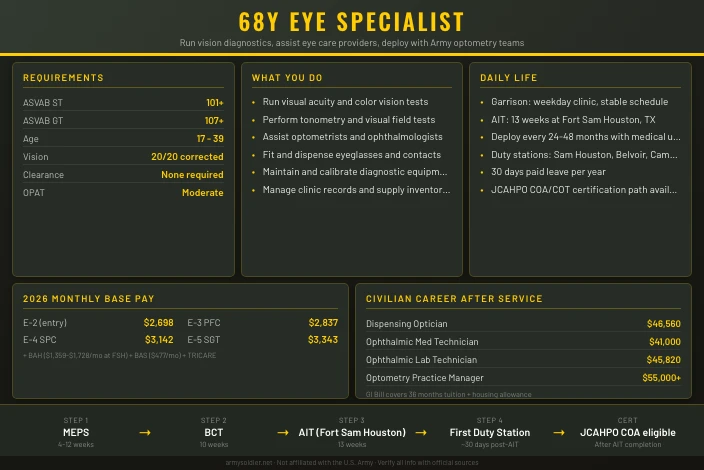
Job Role and Responsibilities
The 68Y Eye Specialist supervises or conducts routine diagnostic vision tests and assists in the care and treatment of optometry and ophthalmology patients. Specialists perform tonometry assessments, conduct visual field testing, measure refractive error, and assist Army optometrists and ophthalmologists with patient exams and clinical procedures. This is a patient-facing healthcare role with real clinical depth.
Your day starts with patient flow. You prep exam lanes, pull records, run pre-exam screenings, and ensure each patient is ready for the provider. Visual acuity testing, color vision screening, intraocular pressure measurement, and lensometry on current eyewear are all part of the standard workup before the optometrist or ophthalmologist walks in. You also fit contact lenses, adjust frames, educate patients on lens care, and document everything in the medical record.
At senior levels, the scope expands. You take on clinic management duties, order supplies, write maintenance schedules for diagnostic equipment, and train junior specialists. Senior 68Y NCOs serve as detachment NCOs for deployable eye teams, responsible for the entire operational readiness of forward eye care assets.
Daily Tasks
- Conduct visual acuity, color vision, and depth perception testing
- Perform tonometry (intraocular pressure measurement) and visual field assessments
- Assist optometrists and ophthalmologists during patient exams and procedures
- Fit and dispense eyeglasses and contact lenses
- Maintain and calibrate ophthalmic diagnostic equipment
- Manage patient scheduling, medical records, and supply inventories
- Train junior eye specialists and supervise clinic operations at senior grades
Specific Roles
Army Eye Specialists serve under the MOS 68Y designation within CMF 68. Skill-level progression follows the standard Army enlisted system:
| Code | Skill Level | Title |
|---|---|---|
| 68Y10 | SL1 | Eye Specialist (entry) |
| 68Y20 | SL2 | Eye Specialist (intermediate) |
| 68Y30 | SL3 | Eye Specialist (advanced) |
| 68Y40 | SL4 | Eye Specialist (senior/leadership) |
Additional Skill Identifiers (ASIs) allow soldiers to document specialized capabilities beyond the base MOS. Senior 68Y NCOs may also earn ASIs tied to clinical or leadership qualifications acquired through advanced training or certification programs.
Mission Contribution
Combat readiness depends on visual acuity. Soldiers who can’t see clearly can’t shoot accurately, can’t operate vehicles safely, and can’t perform precision tasks in the field. Army eye teams support the entire force, from garrison clinics at major medical centers to forward-deployed optometry assets that keep deployed soldiers in the fight with working eyewear and treated eye injuries. Your role is not administrative support. It’s operational medicine.
Technology and Equipment
You work with slit-lamp biomicroscopes, autorefractors, keratometers, lensometers, tonometers, visual field analyzers, and digital imaging systems. Larger facilities use optical coherence tomography (OCT) and corneal topography. Army clinics run computerized medical record systems (AHLTA and MHS Genesis) for documentation. Deployed settings require you to operate portable diagnostic equipment in field conditions, which demands practical troubleshooting skills beyond what a standard clinic environment tests.
Salary and Benefits
Financial Benefits
Pay is based on rank and years of service per 2026 DFAS pay tables. Most 68Y soldiers enter as E-1 or E-2 and reach E-4 Specialist by the end of their first enlistment.
| Rank | Pay Grade | Monthly Base Pay (2026) |
|---|---|---|
| Private (PV2) | E-2 | $2,698 |
| Private First Class (PFC) | E-3 | $2,837 (entry) |
| Specialist (SPC) | E-4 | $3,142 (entry) |
| Sergeant (SGT) | E-5 | $3,343 (entry) |
| Staff Sergeant (SSG) | E-6 | $3,401 (entry) |
Base pay is only one piece. Basic Allowance for Subsistence (BAS) adds $476.95 per month tax-free for food. Basic Allowance for Housing (BAH) varies by duty station and dependent status. At Fort Sam Houston, a single E-4 receives approximately $1,359 per month in BAH; an E-4 with dependents receives roughly $1,728. There is no confirmed enlistment bonus currently attached to 68Y. Verify current bonus availability with your recruiter, as incentive programs change frequently.
Additional Benefits
Active-duty soldiers receive TRICARE Prime at zero cost. There are no enrollment fees, no deductibles, and no copays for in-network care. Coverage extends to your family and includes medical, dental, vision, mental health, prescriptions, and hospitalization.
Tuition Assistance pays up to $4,500 per year toward college courses while you’re serving. After leaving the Army, the Post-9/11 GI Bill covers up to 36 months of tuition at a public university at the full in-state rate, plus a monthly housing allowance and up to $1,000 per year in book stipends.
The Blended Retirement System (BRS) provides a pension at 20 years equal to 40% of your average high-36 monthly pay, plus a Thrift Savings Plan with government matching up to 4% of your contributions starting in year three.
Work-Life Balance
Soldiers accrue 30 days of paid leave per year at 2.5 days per month. Garrison clinic schedules are weekday-centered with predictable hours. The 68Y is not a combat role, so daily life in a stateside assignment is more structured than most operational MOSs. Deployments and field exercises do happen, but the baseline garrison schedule is stable enough for family planning and education.
Qualifications and Eligibility
Basic Qualifications
The 68Y carries two ASVAB requirements: a Skilled Technical (ST) score of 101 and a General Technical (GT) score of 107. Both composites must be met. The ST composite (General Science + Verbal Expression + Math Knowledge + Mechanical Comprehension) tests the science and technical reasoning that clinical work demands. The GT composite (Verbal Expression + Arithmetic Reasoning) reflects the communication and analytical skills needed for patient interaction and documentation.
| Requirement | Standard |
|---|---|
| ASVAB Skilled Technical (ST) | 101 minimum |
| ASVAB General Technical (GT) | 107 minimum |
| OPAT Category | Moderate |
| Security Clearance | None required |
| Age | 17-39 (active duty) |
| Citizenship | U.S. citizen or permanent resident |
| Education | High school diploma (AFQT 31+) or GED (AFQT 50+) |
| Vision | Correctable to 20/20 |
Both the ST and GT scores are above the Army average, so this MOS rewards focused ASVAB preparation. Study materials for General Science, Mathematics Knowledge, and Arithmetic Reasoning make the biggest difference. The Moderate OPAT category requires demonstrating moderate physical capacity at MEPS before the job can be assigned.
Civilian Acquired Skills Program (ACASP)
Candidates who already work in clinical optometry can qualify for accelerated placement. Holding a Certified Ophthalmic Assistant (COA) credential or higher – awarded by the Joint Commission on Allied Health Personnel in Ophthalmology (JCAHPO) – may allow entry into 68Y with credit toward AIT. Talk to your recruiter about current ACASP thresholds, since these change periodically.
Application Process
The full process from MEPS to first duty station typically runs five to eight months. Service obligation upon completing AIT follows standard Army enlistment terms.
Selection Criteria
This MOS requires strong science and verbal scores but is not heavily competitive in the way intelligence or special operations roles are. Applicants who have volunteered in clinical settings, completed anatomy or biology coursework, or worked in any eye care environment have a practical edge. None of that is required, but it shortens your learning curve in AIT.
See our ASVAB study guide for strategies to hit these line scores, or take the PiCAT from home if you are a first-time tester.
Work Environment
Setting and Schedule
The 68Y works in clinic environments. You spend your day inside a medical facility, moving between exam lanes, diagnostic equipment stations, and supply areas. Lighting conditions shift constantly – you work in darkened rooms for slit-lamp exams, normal lighting for patient intake, and at computer screens for documentation. The work is not physically demanding in the traditional Army sense, but requires sustained attention to detail and the ability to work efficiently under patient flow pressure.
Garrison hours follow a standard clinic schedule on weekdays. Unlike operational or combat MOSs, you are not typically working overnight shifts or rotating through 24-hour duty cycles in garrison. Deployed or field-exercise settings are different, where clinic hours extend to meet patient demand.
Leadership and Communication
You operate within the standard Army NCO chain of command. Below E-5, you receive direct supervision from the clinic’s senior specialist or lab officer in charge. At E-5 and above, you lead junior soldiers, run quality control on patient documentation, and interface directly with optometrists and ophthalmologists about patient care and equipment needs. Performance counseling happens at minimum quarterly, with formal NCOERs (Non-Commissioned Officer Evaluation Reports) starting at E-5.
Team Dynamics and Autonomy
Eye clinics typically run lean. A small team handles a full patient load, which means individual accountability is high. At SL1 and SL2, you follow established clinical protocols with close supervision. By SL3, you make independent decisions about equipment maintenance schedules, supply ordering, and junior soldier training plans. The work rewards people who operate reliably without reminders.
Job Satisfaction
The direct patient interaction sets this MOS apart from many CMF 68 roles. You see patients, help them see better, and witness the practical outcome of your work. That feedback loop is motivating in a way that purely technical or administrative roles aren’t. Soldiers who stay in this MOS tend to cite the clinical variety and the transferable credentials as the main reasons for re-enlistment.
Training and Skill Development
Initial Training
The 68Y training pipeline runs from BCT straight into a focused clinical AIT program at MEDCoE.
| Phase | Location | Length | Focus |
|---|---|---|---|
| Basic Combat Training (BCT) | Various Army installations | 10 weeks | Soldiering fundamentals, physical fitness, weapons qualification |
| Advanced Individual Training (AIT) | Fort Sam Houston, TX (MEDCoE) | 13 weeks | Ophthalmic clinical skills, diagnostic testing, patient care, equipment operation |
BCT builds the physical fitness, weapons proficiency, and team skills every Army soldier needs regardless of MOS. No prior clinical experience is expected or required going in.
AIT at Fort Sam Houston covers ophthalmic anatomy and physiology, ocular disease recognition, diagnostic instrumentation (tonometry, lensometry, visual field testing, autorefraction), clinical documentation, patient management, contact lens fitting, and basic optics. The Medical Center of Excellence trains all Army medical MOS students at this installation, so you’ll be surrounded by other healthcare-track soldiers during your time there. Completing the course makes you eligible to pursue JCAHPO certification as a Certified Ophthalmic Assistant (COA) – a credential with direct civilian market value.
Advanced Training
After AIT, skill development runs on two tracks: formal Army schooling tied to promotions, and professional certification through external bodies.
Army-funded development includes:
- Noncommissioned Officer Education System (NCOES): Warrior Leader Course at E-5, Advanced Leader Course at E-6, Senior Leader Course at E-7. Each is required for promotion and focuses on leadership, not just technical skills.
- Tuition Assistance: Take anatomy, healthcare administration, or science courses while serving to build toward a degree.
- Army Learning Management System (ALMS): Online modules for clinical refreshers, compliance training, and leadership development.
External certification paths:
The Joint Commission on Allied Health Personnel in Ophthalmology (JCAHPO) awards three progressive credentials that 68Y soldiers can pursue: COA (Certified Ophthalmic Assistant), COT (Certified Ophthalmic Technician), and COMT (Certified Ophthalmic Medical Technologist). Each level requires clinical hours and a written exam. Many soldiers leave the Army with COT credentials, which translate directly to higher civilian salaries and expanded clinical scope.
Everything starts with qualifying ASVAB scores — our study guide covers what to study first.
Career Progression and Advancement
Career Path
Most 68Y soldiers enter as E-1 or E-2 and reach E-4 Specialist during their first enlistment. The standard Army promotion system drives the rest of the progression.
| Rank | Pay Grade | Typical Time in Grade | Responsibilities |
|---|---|---|---|
| Private (PV1/PV2) | E-1/E-2 | 0-6 months | Training, orientation |
| Private First Class (PFC) | E-3 | 6-12 months | Entry-level clinical work |
| Specialist (SPC) | E-4 | 1-4 years | Full clinical patient care duties |
| Sergeant (SGT) | E-5 | 4-6 years | Team leader, quality control |
| Staff Sergeant (SSG) | E-6 | 6-10 years | Clinic section chief, training NCO |
| Sergeant First Class (SFC) | E-7 | 10-15 years | Senior advisor, platoon sergeant |
| Master Sergeant (MSG) | E-8 | 15-20 years | Senior medical NCO, staff assignments |
| Sergeant Major (SGM) | E-9 | 20+ years | Command sergeant major or staff SGM |
Specialization
Beyond the base MOS, 68Y soldiers can pursue Additional Skill Identifiers (ASIs) tied to specialized clinical skills or leadership roles. The JCAHPO COT and COMT credentials are the most valued forms of specialization in the eye care field, though they sit outside the Army’s formal ASI system.
Soldiers with strong science records and additional college credits may qualify for officer commissioning programs, including the Army’s Medical Service Corps. Prior-enlisted optometry soldiers with enough clinical experience have also pursued the Warrant Officer track in health services maintenance (MOS 670A), though this requires meeting additional education thresholds. Consult a warrant officer recruiter for current criteria.
Role Flexibility and Transfers
A 68Y who wants to broaden their medical experience can apply for reclassification to related MOSs like 68H (Optical Laboratory Specialist) or other CMF 68 roles at reenlistment, subject to Army needs and ASVAB qualifications. The clinical documentation and patient management skills built in this MOS also position soldiers well for administrative medical MOSs if interests shift.
Performance Evaluation
NCOs at E-5 and above are evaluated annually through the Non-Commissioned Officer Evaluation Report (NCOER). Rated areas include clinical competence, leadership, responsibility and accountability, and physical fitness. Soldiers below E-5 receive developmental counseling from their chain of command. The fastest path to promotion combines strong NCOER ratings, physical fitness scores above the minimum, and professional certifications that demonstrate clinical commitment.
Physical Demands and Medical Evaluations
Physical Requirements
The 68Y carries a Moderate OPAT category, which means you must demonstrate moderate lifting and carrying capacity at MEPS. Occasional lifting up to 50 pounds and frequent carrying of 25 pounds reflects the physical demands of moving diagnostic equipment, patient supply boxes, and clinic materials.
The day-to-day physical demand is not high. You’re working in a clinic, not carrying a ruck. But the Army is still the Army: fitness testing, physical training, and unit readiness requirements apply to every soldier regardless of MOS. You will run, lift weights, and maintain fitness year-round.
Army Fitness Test (AFT) Standards
The Army Fitness Test (AFT) replaced the ACFT on June 1, 2025. All active-duty soldiers must pass it. The 68Y falls under the general standard – not the combat specialty standard – so scores are sex- and age-normed.
| Event | Abbreviation | Minimum Score |
|---|---|---|
| 3 Rep Max Deadlift | MDL | 60 |
| Hand Release Push-Up | HRP | 60 |
| Sprint-Drag-Carry | SDC | 60 |
| Plank | PLK | 60 |
| Two-Mile Run | 2MR | 60 |
| Total Minimum | 300 |
Each event is scored 0-100 points. Maximum total is 500. Every event requires at least 60 points to pass regardless of total score. The AFT applies to all soldiers including medical MOSs – there are no MOS-based exemptions.
Medical Evaluations
Standard Army periodic physical examinations apply throughout your service. The 68Y requires correctable vision to 20/20 and standard medical fitness. Any change to your vision or physical capacity that affects your ability to perform clinical duties may trigger an MOS Medical Review Board assessment.
Deployment and Duty Stations
Deployment Details
The 68Y is a medical support MOS without a direct combat role. Deployment likelihood is real, but typically lower than combat arms. Army eye teams have deployed as part of brigade or theater medical commands to support operations in the Middle East, Europe, and the Pacific. Deployments run six to twelve months in most cases. When a medical unit deploys, its specialty assets – including optometry – go with it.
Reserve and National Guard 68Y soldiers carry mobilization risk similar to other medical support MOSs. Historical deployment frequency for reserve component medical soldiers has been moderate, though operational demand dictates actual numbers.
Location Flexibility
Active-duty 68Y soldiers serve wherever the Army operates optometry clinics. Common duty stations include:
- Fort Sam Houston, TX (Army Medical Center of Excellence, primary training hub)
- Fort Belvoir, VA (Rader Clinic and Walter Reed-affiliated facilities)
- Fort Campbell, KY
- Fort Liberty (formerly Fort Bragg), NC
- Tripler Army Medical Center, Honolulu, HI
- Landstuhl Regional Medical Center, Germany (overseas assignment)
You submit a preference list (dream sheet) at assignment time, but the Army places you where vacancies exist. Medical specialty MOSs tend to cluster at major medical centers, so duty stations are more predictable than in combat arms.
Risk, Safety, and Legal Considerations
Job Hazards
Clinical eye care carries specific occupational risks. Laser equipment and bright light sources require eye protection protocols. Chemical exposures from diagnostic dyes and contact lens solutions require proper handling procedures. Needlestick risks are low for this MOS compared to surgical specialties, but patient contact means following infection control standards every day.
Safety Protocols
Army optometry clinics operate under OSHA and Army occupational health standards. Key safety practices include:
- PPE requirements for any chemical handling (gloves, splash protection)
- Laser safety protocols with documented training for equipment operators
- Strict infection control for shared diagnostic equipment (slit lamps, trial frames)
- Sharps disposal procedures for any injections or sample collection in ophthalmology settings
Safety training begins during AIT and continues through annual refresher requirements.
Security and Legal Requirements
The 68Y requires no security clearance. You are not handling classified information or operating in restricted access facilities beyond standard medical center protocols. Legal obligations include standard military service contract terms and the Uniform Code of Military Justice (UCMJ). Patient care is governed by HIPAA, which applies in military medical settings the same as in civilian facilities. Your Army enlistment contract sets your service obligation, and separation procedures follow standard Army regulations.
Impact on Family and Personal Life
Family Considerations
The 68Y is one of the more family-stable medical MOSs. Clinic-based work in garrison follows a predictable weekday schedule. Army families at stateside medical installations have full access to:
- Family Readiness Groups (FRGs): Unit-level support for spouses and dependents
- Army Community Service (ACS): Financial counseling, career assistance, and relocation support
- Child Development Centers (CDCs): On-post childcare at subsidized rates
- TRICARE for families: Complete health coverage with no out-of-pocket costs for in-network care
During deployment, families qualify for additional childcare subsidies, military family life counseling, and expanded TRICARE services. The Military OneSource program provides 24/7 counseling and resource referrals at no cost.
Relocation and Flexibility
Permanent Change of Station (PCS) moves typically happen every two to three years. Moving costs are covered through the Army’s household goods program, and BAH adjusts to the new duty station rate. Frequent relocation is a reality for every active-duty family. Military spouses face career disruption with each move, but Army Community Service offices provide employment assistance at every installation.
Reserve and National Guard
The 68Y Eye Specialist has limited availability in the Army Reserve and Army National Guard. Ophthalmic positions exist in both components, but the total number of slots is small. Most 68Y billets in the Reserve and Guard are concentrated at medical units with ophthalmology or optometry clinic capability, which limits geographic options. If you want to serve part-time as a 68Y, you may need to drill at a unit that is not close to home.
Drill and Training Commitment
Reserve and Guard 68Ys follow the standard one weekend per month and two weeks of Annual Training schedule. The clinical nature of this MOS means drill weekends often focus on equipment proficiency with ophthalmic instruments, visual acuity testing procedures, and patient screening protocols. Maintaining competency on specialized eye care equipment between drills takes some self-directed study, since you may not work with these devices in your civilian job.
Part-Time Pay
An E-4 with four years of service earns about $488 per drill weekend in 2026. Over 12 drill weekends per year, that comes to roughly $5,856 before Annual Training pay. An active-duty E-4 with the same time in service earns $3,659 per month in base pay. The part-time pay is a fraction of active-duty compensation, but the schedule allows you to hold a full-time civilian job.
Benefits
Tricare Reserve Select costs $57.88 per month for individual coverage or $286.66 per month for family plans. Active-duty TRICARE has no premium for the service member. Education benefits include the Montgomery GI Bill-Selected Reserve at $493 per month for full-time students and Federal Tuition Assistance up to $4,500 per year. Guard members may also qualify for state tuition waivers, which vary by state but often cover full tuition at public colleges.
Reserve and Guard retirement uses a points-based system with pension payments starting at age 60. Active-duty soldiers can retire after 20 years with an immediate pension. Mobilizations after January 28, 2008 reduce the Reserve retirement age by three months for each 90-day period of activation, with a minimum retirement age of 50.
Deployment and Mobilization
68Y soldiers in the Reserve and Guard see low mobilization rates. Ophthalmic specialists fill a niche role, and deployed medical facilities rarely staff dedicated ophthalmology positions. When 68Ys do mobilize, they typically support medical readiness screenings or work in garrison-level eye clinics during extended activations rather than deploying to forward locations. Expect mobilization to be infrequent compared to higher-demand medical MOS.
Civilian Career Integration
The 68Y translates directly to civilian work as an ophthalmic technician or ophthalmic assistant. You can pursue the Certified Ophthalmic Technician (COT) or Certified Ophthalmic Assistant (COA) credential through JCAHPO, and your Army training gives you a head start on both. Ophthalmology practices, eye clinics, and hospital eye centers hire ophthalmic technicians at steady rates. USERRA protects your civilian position during all military duties, including drill weekends, Annual Training, and any mobilization. Since 68Y positions in the Reserve and Guard are scarce, some soldiers transition to related medical MOS to stay in a part-time role closer to home.
| Feature | Active Duty | Army Reserve | Army National Guard |
|---|---|---|---|
| Duty Status | Full-time | Part-time (1 wknd/mo + 2 wks/yr) | Part-time (1 wknd/mo + 2 wks/yr) |
| Monthly Pay (E-4, 4 yrs) | $3,659/mo | ~$488/drill weekend | ~$488/drill weekend |
| Healthcare | TRICARE (no premium) | Tricare Reserve Select ($57.88/mo) | Tricare Reserve Select ($57.88/mo) |
| Education | Post-9/11 GI Bill, TA | MGIB-SR ($493/mo), TA | MGIB-SR ($493/mo), TA, state tuition waivers |
| Deployment | Per unit rotation | When mobilized | When mobilized |
| Retirement | 20-year pension | Points-based, age 60 | Points-based, age 60 |
Post-Service Opportunities
Transition to Civilian Life
The clinical skills you build in this MOS translate directly to civilian optometry practices, ophthalmology offices, and vision care centers. The JCAHPO certifications you pursue during service – COA, COT, or COMT – are nationally recognized and valued by civilian employers. Soldiers who reach the COT or COMT level leave the Army with credentials that civilian technicians often spend years earning.
Beyond direct clinical roles, senior NCO experience in clinic management, supply chain, and personnel training prepares 68Y soldiers for optometry practice management, healthcare operations, and medical device sales positions.
Transition programs available:
- Transition Assistance Program (TAP): Mandatory 5-day course covering resume writing, VA benefits, and job search before separation
- SkillBridge: Work with a civilian employer for up to 180 days before separation while still receiving military pay. Eye care companies and retail vision chains have participated.
- VA Vocational Rehabilitation: Covers education and training costs if you have a service-connected disability
Civilian Career Prospects
The Bureau of Labor Statistics Occupational Outlook Handbook tracks wages and employment trends for related civilian titles.
| Civilian Job Title | Median Annual Salary | Job Outlook (2024-2034) |
|---|---|---|
| Dispensing Optician | $46,560 | +3% (average growth) |
| Ophthalmic Medical Technician | $41,000 (est.) | +6% (faster than average) |
| Ophthalmic Laboratory Technician | $45,820 | -1% (slight decline) |
| Optometry Practice Manager | $55,000-$75,000 (est.) | Steady |
The ophthalmic technician path shows the strongest outlook, and it aligns directly with what 68Y soldiers do in service. Soldiers who pursue COT or COMT credentials during their enlistment qualify for the upper range of technician salaries and are competitive for supervisory clinical roles.
Is This a Good Job for You?
Ideal Candidate Profile
The 68Y is a strong fit for people who want patient interaction, are interested in medicine at the clinical level, and can work carefully with precision instruments. You don’t need prior optometry experience, but these traits signal a good match:
- Comfortable working one-on-one with patients in a clinical setting
- Detail-oriented enough to document patient data accurately every time
- Interested in science, anatomy, and how vision works mechanically
- Patient enough to run thorough diagnostic tests without cutting corners
- Want a healthcare credential, not just a job
The dual ASVAB requirement (ST 101 and GT 107) also filters for candidates who can handle the science and the communication demands of the role simultaneously.
Potential Challenges
The work can feel repetitive in high-volume clinics. Running tonometry and visual field tests on twenty patients a day follows the same protocol each time, and that sameness can wear on people who need variety. If you find precision routine satisfying, it won’t bother you. If you need constant novelty, it will.
Deployment risk is real. An eye team attached to a deploying medical unit goes with that unit. A nine-to-twelve month deployment is possible during your first enlistment. The civilian job you’re waiting to start and the family plans you’ve made both have to accommodate that reality.
The GT and ST score requirements mean some candidates will need targeted ASVAB study before qualifying. That’s not a knock on the MOS, but it does mean you shouldn’t walk in assuming your scores from high school standardized tests will carry you through without preparation.
Long-Term Fit
This MOS rewards soldiers who treat their clinical time as professional development, not just a posting. The soldiers who leave the Army with COT or COMT credentials, solid NCOER ratings, and clinic management experience walk into civilian optometry careers on day one. Those who don’t pursue certification during service leave with experience but nothing a civilian employer can easily verify. Start the JCAHPO process before AIT ends.
More Information
Talk to an Army recruiter to confirm current availability, training seat dates, and any bonus programs attached to 68Y. You can start the conversation at goarmy.com or call 1-888-550-ARMY. Bring any prior clinical work history or science coursework to your first appointment – both can accelerate your path through the process.
- Prepare for the ASVAB with our study guide to make sure your line scores qualify
This site is not affiliated with the U.S. Army or any government agency. Verify all information with official Army sources before making enlistment or career decisions.
Explore more Army medical careers such as 68H Optical Laboratory Specialist and 68E Dental Specialist.