31B Military Police
Every Army installation needs someone to keep order. The 31B Military Police MOS puts you in that role. You patrol post, respond to emergencies, investigate crimes, and control traffic. In the field, you run detainee operations, provide area security, and support combat units with route clearance and convoy protection. It’s one of the few Army jobs where you do real law enforcement every day.
Qualifying requires specific ASVAB line scores — our ASVAB study guide covers what to target and how to prepare.
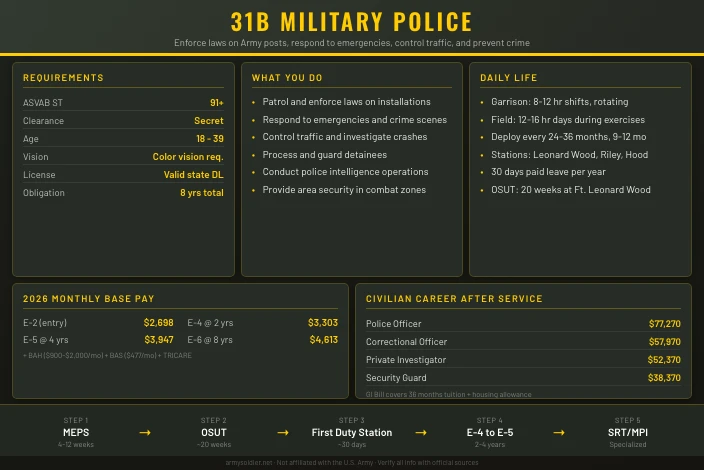
Job Role and Responsibilities
Military Police enforce laws and regulations on Army installations. You patrol post housing and work areas, respond to domestic disturbances and accidents, investigate crimes, process evidence, and guard detainees. Deployed, you shift to combat support: area security, route clearance, convoy escorts, and police intelligence operations.
Daily Tasks
Garrison duty looks a lot like civilian policing. You drive patrol routes, answer dispatch calls, write reports, and testify in military court proceedings. Traffic enforcement fills a big chunk of your shift. Fender benders, DUIs, and speeding on post are constant.
When something serious happens, you’re first on scene. Domestic violence calls, thefts, assaults, and drug-related incidents all land on your desk. You secure the scene, collect statements, photograph evidence, and hand complex cases off to CID (Criminal Investigation Division) agents.
Field operations are different. During exercises and deployments, MPs conduct checkpoint operations, escort convoys through hostile areas, search vehicles and personnel, and handle enemy prisoners of war. You also run police intelligence operations, gathering information from local populations and feeding it to the intelligence section.
Specialized Roles
The MP career field includes several related MOSs and skill identifiers:
| Code | Title | Description |
|---|---|---|
| 31B | Military Police | Primary law enforcement and combat support |
| 31D | Criminal Investigation Special Agent | CID felony investigations |
| 31E | Internment/Resettlement Specialist | Detention and corrections operations |
| 31K | Military Working Dog Handler | K9 patrol, detection, and security |
| ASI H3 | Physical Security Specialist | Antiterrorism and force protection |
| ASI Q9 | Traffic Management/Collision Investigator | Accident reconstruction and traffic analysis |
Technology and Equipment
You work with standard police gear plus military-specific systems. Patrol vehicles, body cameras, radar guns, breathalyzers, and handcuffs are daily tools. On the tactical side, you operate crew-served weapons, mine detectors, and tactical communications equipment. MPs also use biometric collection devices and forensic evidence kits for battlefield forensics.
Salary and Benefits
Financial Benefits
Your pay is based on rank and time in service. Most MPs finish OSUT as E-2 (PV2).
| Rank | Pay Grade | Time in Service | Monthly Base Pay |
|---|---|---|---|
| Private (PV2) | E-2 | Entry | $2,698 |
| Specialist (SPC) | E-4 | 2 years | $3,303 |
| Sergeant (SGT) | E-5 | 4 years | $3,947 |
| Staff Sergeant (SSG) | E-6 | 8 years | $4,613 |
These figures come from the 2026 military pay tables. Base pay is just the starting point. BAH (Basic Allowance for Housing) adds $900 to $2,000+ per month depending on your duty station and whether you have dependents. BAS (Basic Allowance for Subsistence) adds about $477 monthly for food.
Some MPs qualify for special duty pay or enlistment bonuses when the Army needs to fill slots. Bonus availability changes monthly, so ask your recruiter about current offers.
Additional Benefits
TRICARE covers you and your family at zero cost for doctor visits, hospital stays, prescriptions, dental, vision, and mental health care. While on active duty, Tuition Assistance pays up to $4,500 per year toward college courses. After you leave, the Post-9/11 GI Bill covers up to 36 months of tuition at a public university (full in-state rate) plus a monthly housing allowance and $1,000 annual book stipend.
Retirement runs through the Blended Retirement System (BRS):
- 40% pension after 20 years of service (based on your highest 36 months of base pay)
- Government matches up to 5% of your TSP contributions
- Continuation pay at the 8 to 12 year mark (typically 2.5x monthly base pay for a 3-year commitment)
Work-Life Balance
You earn 30 days of paid leave per year. MP shifts rotate, so you won’t always have weekends off. Garrison duty typically means 8 to 12 hour shifts with rotating days off. Field exercises and deployments break that routine. Expect 12 to 16 hour days during training rotations and deployments.
Qualifications and Eligibility
Basic Qualifications
The 31B requires a minimum Skilled Technical (ST) score of 91 on the ASVAB. The ST composite combines General Science, Verbal Expression, Math Knowledge, and Mechanical Comprehension. That’s a moderate bar. Most people with average test prep can reach it.
| Requirement | Details |
|---|---|
| Age | 18-39 (17 with split training option) |
| Citizenship | U.S. citizen required |
| Education | High school diploma or GED |
| AFQT (ASVAB) | Minimum 31 (diploma) or 50 (GED) |
| Skilled Technical (ST) | Minimum 91 |
| Security Clearance | Secret |
| Vision | Red/green color discrimination required |
| Driver’s License | Valid state license before training |
| Physical Profile | 222221 |
| OPAT | Significant (Gray) |
Application Process
Walk into an Army recruiting station and tell them you want to be an MP. The recruiter checks your basic qualifications and schedules you for MEPS (Military Entrance Processing Station). At MEPS, you take the ASVAB (if you haven’t already), go through a full medical exam, and start the security clearance paperwork.
The Secret clearance investigation looks at your criminal history, financial records, and personal references. Any felony convictions, serious drug history, or major financial problems can disqualify you. Waivers exist for some issues, but they slow the process down.
From first recruiter visit to ship date, expect 4 to 12 weeks. Security clearance processing can stretch that timeline.
Selection Criteria and Competitiveness
The 31B is moderately competitive. The Army stations MPs at every installation worldwide, so slots open regularly. An ST score above 100 and a clean background check put you in good shape. Prior law enforcement experience, security work, or criminal justice coursework can strengthen your file, though none of it is required.
Upon Accession into Service
You enter at E-1 (PV1) and can expect E-2 after about 6 months. E-3 comes around the 12-month mark for soldiers with good performance. The standard service obligation is 8 years total, typically 3 to 6 years active duty plus the remainder in the Reserve or Individual Ready Reserve.
See our ASVAB study guide for strategies to hit these line scores, or take the PiCAT from home if you are a first-time tester.
Work Environment
Setting and Schedule
MP work falls into two modes:
- Garrison – You work from a provost marshal office or MP station on post. Shifts rotate through days, evenings, and nights. Most installations run 8 to 12 hour shifts with 3 to 4 day workweeks. You patrol in a vehicle, respond to calls, and handle paperwork between incidents.
- Field/Deployment – Forward operating bases, checkpoints, and convoy routes. Hours stretch to 12 to 16 per day. Sleep depends on the threat level and operational tempo.
MPs assigned to combat units deploy with their brigade. Those in garrison MP companies spend more time on post but still rotate through field exercises and deployment cycles.
Leadership and Communication
Your chain of command flows through the provost marshal (usually a Lieutenant Colonel) down to your patrol supervisor (typically an E-6 or E-7). Day-to-day, your shift leader assigns sectors, reviews reports, and handles escalations.
Performance feedback comes through annual NCOERs for NCOs and counseling sessions for junior soldiers. Most MP units hold daily shift briefings where leadership covers active cases, wanted persons, and changes to the patrol plan.
Team Dynamics and Autonomy
On patrol, you work with a partner or alone depending on the installation. You make judgment calls constantly. When to pull someone over, when to de-escalate, when to use force. Your shift supervisor reviews your decisions after the fact, but in the moment, it’s your call.
In the field, you operate as part of a squad or team with more structured tactics. Checkpoint operations, convoy escorts, and detainee handling follow standard operating procedures. There’s less room for improvisation and more reliance on rehearsed battle drills.
Job Satisfaction and Retention
MPs who enjoy the work talk about the variety. No two shifts look the same. You handle traffic stops, domestic calls, crime scenes, and VIP security all in the same week. The biggest complaints are shift work fatigue, dealing with hostile soldiers who don’t want to cooperate, and the gap between what you’re trained to do and what garrison leadership lets you do.
Retention rates for MPs are average compared to other support MOSs. Re-enlistment bonuses, when available, help keep experienced soldiers in the field.
Training and Skill Development
Initial Training
The 31B uses One Station Unit Training (OSUT), which combines Basic Combat Training and Advanced Individual Training into a single course at one location. You stay with the same drill sergeants and classmates the entire time.
| Training Phase | Location | Duration | Focus |
|---|---|---|---|
| Phase I-III (BCT) | Fort Leonard Wood, MO | ~10 weeks | Soldier fundamentals: marksmanship, land navigation, squad tactics, fitness |
| Phase IV-V (AIT) | Fort Leonard Wood, MO | ~10 weeks | MP skills: law enforcement, defensive tactics, detainee operations, battlefield forensics |
| Total OSUT | Fort Leonard Wood, MO | ~20 weeks | Combined soldier and police training |
The BCT portion covers rifle qualification with the M16/M4, bayonet training, NBC defense, and individual tactical skills. Phase III ends with field exercises and the Army Values Ceremony.
AIT phases teach you the actual police work. You train at Stem Village, a realistic mock town built for law enforcement scenarios. The curriculum covers crew-served weapons, defensive tactics, traffic accident investigation, evidence collection, detainee operations, active shooter response, and advanced communications.
Advanced Training
After OSUT, specialized training paths include:
- Special Reaction Team (SRT) – the Army’s version of SWAT. Covers building clearing, hostage rescue, and high-risk warrant service.
- Military Police Investigator (MPI) – advanced crime scene processing, interview techniques, and case management. A stepping stone to CID.
- Traffic Management and Collision Investigator (ASI Q9) – accident reconstruction and traffic flow analysis.
- Physical Security Course (ASI H3) – antiterrorism planning and force protection for installations.
The Army pays for these courses. Strong performers with good NCOERs get priority for school slots. Many MPs also pursue civilian certifications like the Certified Protection Professional (CPP) credential through Army education programs.
Everything starts with qualifying ASVAB scores — our study guide covers what to study first.
Career Progression and Advancement
Career Path
Promotion to E-4 (Specialist) is mostly automatic around the 2-year mark if you meet the requirements. E-5 (Sergeant) requires a promotion board and typically comes between years 3 and 5. That’s when the job shifts from patrol work to supervising other MPs.
| Rank | Pay Grade | Typical Years | Typical Role |
|---|---|---|---|
| Private (PV2) | E-2 | 0-1 | Patrol officer, post security |
| Specialist (SPC) | E-4 | 2-3 | Senior patrol, desk sergeant |
| Sergeant (SGT) | E-5 | 3-5 | Shift leader, patrol supervisor |
| Staff Sergeant (SSG) | E-6 | 6-9 | Operations NCO, investigator |
| Sergeant First Class (SFC) | E-7 | 10-14 | Platoon sergeant, provost sergeant |
| Master Sergeant (MSG) | E-8 | 14+ | Senior MP leadership |
At E-6, you manage investigations or run an MP operations section. E-7 and above require the Senior Leaders Course, strong NCOERs, and demonstrated leadership across multiple assignments.
Role Flexibility and Transfers
MPs can transition to related MOSs within CMF 31. The most common moves:
- 31D (CID Special Agent) – requires E-5 or above, clean record, and a competitive application
- 31E (Internment/Resettlement Specialist) – detention and corrections focus
- 31K (Military Working Dog Handler) – K9 teams for patrol and detection work
Crossing into a different career management field is harder. You need leadership approval, an open training slot, and willingness to start over in a new AIT. MPs with investigative backgrounds sometimes move into intelligence (35 series) roles.
Performance Evaluation
NCOs receive annual NCOERs rated by their supervisor and senior rater. The evaluation covers leadership, training proficiency, and technical competence. Strong NCOERs are the single biggest factor in getting promoted past E-5.
What sets top MPs apart: solid arrest records, clean use-of-force reports, mentoring junior soldiers, completing professional military education on time, and pursuing advanced training like SRT or MPI. Volunteering for deployments and tough assignments also gets noticed.
Physical Demands and Medical Evaluations
Physical Requirements
MP work is physically demanding. You wear body armor on patrol (roughly 30 pounds), chase suspects on foot, physically restrain uncooperative individuals, and stand for hours at checkpoints. Field operations add rucksacking, vehicle recovery, and manual labor in extreme weather.
The OPAT (Occupational Physical Assessment Test) classifies 31B as Significant, meaning you need to pass the Gray-level standards before shipping to OSUT.
Every soldier takes the Army Fitness Test (AFT) at least once per year. Minimum standards for ages 17-21:
| Event | Male Minimum | Female Minimum |
|---|---|---|
| 3-Rep Max Deadlift (MDL) | 140 lbs | 80 lbs |
| Hand-Release Push-Up (HRP) | 10 reps | 10 reps |
| Sprint-Drag-Carry (SDC) | 2:40 | 3:40 |
| Plank (PLK) | 2:00 | 2:00 |
| Two-Mile Run (2MR) | 15:54 | 18:54 |
Each event scores 0 to 100 points. You need at least 60 per event and 300 total to pass. The AFT applies the same way to all soldiers regardless of MOS, with sex- and age-normed scoring.
Medical Evaluations
After OSUT, you get an annual Periodic Health Assessment (PHA): weight, blood pressure, hearing, vision, and a provider conversation. Before any deployment, a separate medical screening clears you for the operational environment. Conditions that don’t fit the deployment setting get treated first, or you stay behind.
MPs must maintain red/green color discrimination throughout their career. A physical profile of 222221 is the standard. Any permanent change to your profile can trigger a Medical Evaluation Board review.
Deployment and Duty Stations
Deployment Details
Active-duty MPs deploy on a similar cycle to other support units. The general rotation is 9 to 12 months deployed, then 24 to 36 months at home station. MP companies attached to Infantry or Armored brigade combat teams follow those units’ deployment schedules, which can be more frequent.
Deployed MPs perform a mix of law enforcement and combat support. Common missions include base security, route clearance patrols, convoy escort, checkpoint operations, and detainee handling. Some MPs work alongside host-nation police forces in advisory roles.
Location Flexibility
The Army assigns duty stations based on unit needs. You can submit a preference list, but no guarantees. MPs serve at nearly every Army installation because every post needs law enforcement. Expect a PCS (permanent change of station) move every 2 to 4 years.
Common CONUS duty stations:
- Fort Leonard Wood, MO (MP school and training units)
- Fort Riley, KS
- Fort Cavazos, TX (formerly Fort Hood)
- Fort Liberty, NC (formerly Fort Bragg)
- Fort Campbell, KY
- Fort Carson, CO
- Fort Drum, NY
Overseas: Germany, South Korea, Japan, Italy, and Belgium all have MP units.
Risk, Safety, and Legal Considerations
Job Hazards
MP work carries real risks in every environment.
Garrison:
- Physical confrontations during arrests
- Exposure to domestic violence and armed suspects
- Vehicle accidents during high-speed responses
- Bloodborne pathogen exposure at crime scenes
Deployed:
- IEDs and ambushes during route clearance and patrols
- Direct and indirect fire at checkpoints and bases
- Vehicle rollovers on unimproved roads
- Psychological stress from detainee operations and combat exposure
Safety Protocols
Standard personal protective equipment includes body armor, eye protection, and gloves. Garrison MPs carry sidearms, OC spray, batons, and tasers. Use-of-force training covers de-escalation first, then a graduated response ladder.
In combat, you wear full battle rattle: helmet, plates, and kit. Rules of engagement govern when and how you can use lethal force. Every soldier reviews ROE before deploying.
Security and Legal Requirements
The 31B requires a Secret security clearance, which involves a background investigation covering criminal history, financial records, drug use, and foreign contacts. The process takes 2 to 6 months. MPs who move into specialized roles like SRT or physical security may need higher clearances.
All soldiers follow the Uniform Code of Military Justice (UCMJ). As an MP, you also enforce it. You have authority to detain, search, and arrest military personnel and their dependents on post. That authority comes with strict rules. Improper searches, excessive force, and evidence mishandling can end your career and result in criminal charges against you.
Impact on Family and Personal Life
Family Considerations
Shift work is the biggest adjustment for MP families. You’ll miss dinners, weekends, and holidays on a regular basis. Deployments separate you for 9 to 12 months. The stress of the job comes home with you sometimes, especially after tough calls.
Support resources on most installations:
- Family Readiness Groups (FRGs) – peer support through your unit
- Military OneSource – free counseling, financial advice, and relocation help
- Spousal employment assistance – job placement support at each new duty station
- Military Family Life Counselors – confidential short-term counseling
Relocation and Flexibility
PCS moves happen every 2 to 4 years. The Army covers moving costs, but each relocation disrupts your spouse’s career and your kids’ school year. Overseas assignments in Germany, Korea, or Japan mean bigger adjustments.
You can request CONUS-to-CONUS moves or overseas tours, but the needs of the Army come first. Larger installations tend to offer longer tours (3 to 4 years). Single soldiers and those without dependents may get shorter rotations.
Reserve and National Guard
Component Availability
The 31B MOS is one of the most common jobs in both the Army Reserve and Army National Guard. MP companies and battalions exist in nearly every state, making it easy to find a unit close to home. Both components carry positions at every enlisted grade. The Guard and Reserve together field a large percentage of the Army’s total MP force, so part-time 31B soldiers make up a significant share of the military police community.
Drill Schedule and Training Commitment
Standard commitment is one weekend per month plus two weeks of Annual Training. 31B soldiers in the Reserve and Guard may need extra training days for weapons qualification, use-of-force certification, and law enforcement proficiency. Some units schedule additional range days and scenario-based training exercises. If your unit is approaching a deployment rotation, expect increased drill frequency during the pre-mobilization period.
Part-Time Pay
An E-4 with about three years of service earns roughly $422 per drill weekend in 2026. Over 12 weekends, that totals about $5,064. Annual Training adds approximately $1,583, bringing the annual total to roughly $6,647. Active-duty E-4 monthly base pay is $3,166. Many Reserve and Guard MPs earn their primary income from civilian law enforcement jobs while drilling on the side.
Benefits Differences
Reserve and Guard 31B soldiers receive Tricare Reserve Select instead of free active-duty TRICARE. TRS costs $57.88 per month for member-only or $286.66 for member plus family in 2026.
Education benefits include:
- Federal Tuition Assistance: $4,500 per year for drilling members
- MGIB-SR: roughly $416 per month while enrolled
- Post-9/11 GI Bill: requires 90 or more days of federal activation; many MP soldiers earn this through frequent mobilizations
- State tuition waivers (Guard only): vary by state, some cover full tuition at state schools, which is useful for criminal justice degrees
Retirement uses the points-based system. Pension draws at age 60, reducible by qualifying mobilizations down to age 50. TSP matching up to 5% applies under the Blended Retirement System.
Deployment and Mobilization
MP units are among the most frequently deployed in the Reserve and Guard. 31B soldiers mobilize for detention operations, base security, convoy security, and law enforcement support. Mobilizations typically last 9 to 12 months. Some MP units have deployed multiple times in the past two decades. This is a high-deployment MOS in the Reserve and Guard, so plan accordingly.
Civilian Career Integration
The 31B skill set transfers directly to civilian law enforcement. Police departments, sheriff’s offices, federal agencies (CBP, ICE, Secret Service, U.S. Marshals), and private security firms all value military police experience. Many Reserve and Guard 31B soldiers work as civilian police officers or correctional officers during the week. The combination of military and civilian law enforcement credentials strengthens your resume for promotions and federal positions. USERRA protects your civilian job during mobilization, and most law enforcement agencies are supportive of Reserve and Guard service.
| Feature | Active Duty | Army Reserve | Army National Guard |
|---|---|---|---|
| Commitment | Full-time | One weekend/month + 2 weeks/year | One weekend/month + 2 weeks/year |
| Monthly Pay (E-4, ~3 yrs) | $3,166/month | ~$422/drill weekend | ~$422/drill weekend |
| Healthcare | TRICARE, $0 premiums | TRS, $57.88/month (member) | TRS, $57.88/month (member) |
| Education | TA + Post-9/11 GI Bill | Federal TA, MGIB-SR; Post-9/11 after activation | Federal TA, MGIB-SR, state tuition waivers |
| Deployment | Regular rotation every 2-3 years | Mobilization every 2-4 years | Mobilization every 2-4 years + state missions |
| Retirement | BRS pension at 20 years | Points-based, age 60 | Points-based, age 60 |
Post-Service Opportunities
Transition to Civilian Life
MP experience translates directly to civilian law enforcement, corrections, and security careers. You leave the Army with patrol experience, investigation skills, report writing, defensive tactics training, and firearms proficiency. Most civilian police academies credit military law enforcement training, shortening your path to certification.
The Transition Assistance Program (TAP) provides resume help, interview coaching, and benefits counseling during your last 12 months on active duty. The Post-9/11 GI Bill covers up to 36 months of tuition, a monthly housing allowance, and a $1,000 annual book stipend.
The Partnership for Your Success (PaYS) program guarantees job interviews with military-friendly employers, including major police departments across the country.
Civilian Career Prospects
| Civilian Job | Median Annual Salary (2024) | 10-Year Outlook |
|---|---|---|
| Police Officer / Detective | $77,270 | +3% |
| Correctional Officer | $57,970 | -7% |
| Private Investigator | $52,370 | +6% |
| Security Guard | $38,370 | +0.3% |
Many former MPs go into federal law enforcement with agencies like the FBI, DEA, U.S. Marshals, Border Patrol, and Federal Protective Service. Veterans get preference points on federal job applications, and your Secret clearance transfers to many government positions.
A criminal justice degree (paid for by the GI Bill) combined with MP experience makes you a strong candidate for detective or supervisory roles in civilian departments.
Post-Service Policies
An honorable discharge gives you access to VA healthcare, disability compensation (if applicable), and education benefits for life. You can separate after your service obligation ends. Talk to your career counselor at least 12 months before your ETS date to plan the transition.
Is This a Good Job for You? The Right (and Wrong) Fit
Ideal Candidate Profile
Good MPs stay level-headed when people are yelling, lying, or swinging at them.
Traits that predict success:
- Comfortable with authority and willing to enforce rules even when it’s unpopular
- Quick decision-maker who can read a situation and act
- Strong written communication (you’ll write dozens of reports per week)
- Physically fit and able to work long shifts on your feet
- Interested in law enforcement as a long-term career
If you want hands-on police work without spending 4 years in a criminal justice program first, this MOS gets you there fast.
Potential Challenges
This MOS is a poor fit if you:
- Dislike confrontation or avoid conflict
- Struggle with rotating shift work and irregular schedules
- Have trouble separating work stress from home life
- Want a desk job with predictable hours
- Have a criminal record that would prevent a Secret clearance
Shift work grinds people down over time. You’ll work holidays, miss family events, and deal with people at their worst. Deployments add combat stress on top of that. MPs who burn out usually cite the combination of shift fatigue and emotionally draining calls.
Career and Lifestyle Alignment
The 31B is one of the fastest paths into law enforcement. You get paid to train, earn a security clearance, and build a resume that civilian departments actively recruit. After one enlistment, you’ll have more patrol experience than most rookie cops.
The trade-off: Army pay is lower than most civilian police salaries, you move every few years, and you deploy to places where the job becomes genuinely dangerous. If civilian policing pays better and you’re not interested in the military lifestyle, apply to your local department instead.
But if you want the experience, the GI Bill, and a career foundation that opens doors in federal law enforcement and private security, the 31B delivers.
More Information
Talk to an Army recruiter about the 31B. Ask about current bonus offers, available training dates, and whether your ASVAB scores qualify. If possible, ask to speak with an MP soldier for an honest picture of day-to-day garrison life.
Take the MOS Finder quiz at goarmy.com
Schedule an ASVAB at your nearest MEPS to see where your scores land
Visit Fort Leonard Wood’s MP training page for details on OSUT phases
Prepare for the ASVAB with our study guide to make sure your line scores qualify
This site is not affiliated with the U.S. Army or any government agency. Verify all information with official Army sources before making enlistment or career decisions.
Explore more Army military police careers such as 31D Criminal Investigation Special Agent and 31K Military Working Dog Handler.