31D Criminal Investigation Special Agent
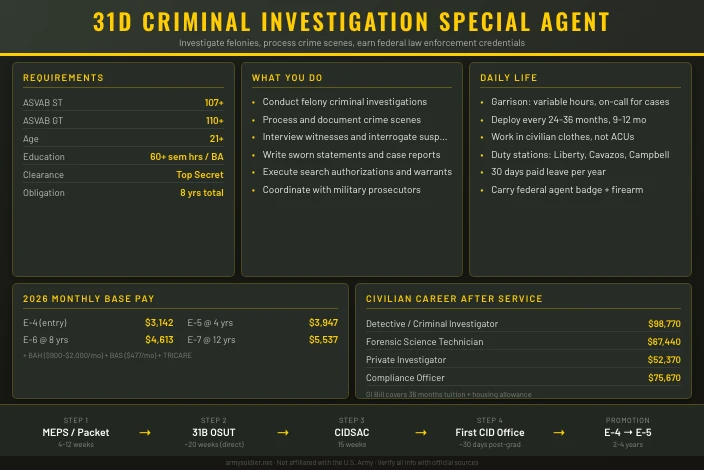
Most Army jobs put you on a base or in the field with a rifle. The 31D puts you in an interview room with a notepad, a badge, and federal law enforcement authority. CID special agents investigate felonies that happen on Army installations or involve Army personnel, from murder and sexual assault to fraud and cybercrime. You carry the same 1811 federal agent credential as FBI and DEA agents.
Qualifying requires specific ASVAB line scores — our ASVAB study guide covers what to target and how to prepare.
Job Role and Responsibilities
As a 31D CID Special Agent, you plan and conduct independent felony-level criminal investigations affecting Department of the Army personnel, property, and facilities. Your cases range from violent crimes and death investigations to economic fraud, computer crimes, and drug trafficking. You process crime scenes, interview witnesses and suspects, write sworn statements, and present findings to military prosecutors.
Daily Tasks
Your day depends on your caseload. Most mornings start with case reviews and coordination calls with prosecutors or local law enforcement. You might spend the afternoon interviewing a suspect at an installation office or processing a crime scene in soldier barracks.
Paperwork is a big chunk of the job. Every interview gets a sworn written statement. Every crime scene gets a detailed report with diagrams and evidence logs. Agents spend hours drafting case files that need to hold up in a military courtroom.
Field work breaks up the desk time. You drive to crime scenes, serve search authorizations, coordinate with civilian police agencies, and sometimes execute arrest warrants. Some weeks are quiet. Others have you working a death investigation at 2 AM on a Tuesday.
Specialized Roles
CID agents can specialize after the basic course. Assignments vary by office needs and your skills.
| Specialization | Focus |
|---|---|
| General Crimes | Homicide, assault, robbery, sex crimes |
| Economic Crimes | Fraud, theft, contract crimes, identity theft |
| Cyber Crimes | Digital forensics, computer intrusions, online crimes |
| Drug Suppression | Narcotics investigations, undercover operations |
| Protective Services | VIP security for senior Army leaders |
| Criminal Intelligence | Threat analysis and counterintelligence support |
CID also uses Additional Skill Identifiers (ASIs) to track agent specializations. Agents who complete advanced courses at the FBI Academy, Federal Law Enforcement Training Center (FLETC), or the Defense Cyber Investigations Training Academy earn ASIs that open higher-level assignments.
Mission Contribution
CID is the Army’s primary felony investigative organization. Without agents, commanders have no independent way to investigate serious crimes on their installations. Your work feeds directly into courts-martial, federal prosecutions, and command actions that maintain discipline across the force.
Technology and Equipment
You work with forensic evidence kits, digital forensic tools, and latent fingerprint equipment. Crime scene processing requires cameras, casting materials, and evidence collection supplies. Cyber agents use specialized software to image hard drives and recover deleted data. Protective service agents carry concealed firearms and use secure communications gear.
Every agent carries a government-issued firearm and badge. Your vehicle is typically an unmarked government sedan, not a patrol car.
Salary and Benefits
Financial Benefits
Military pay depends on rank and time in service. Most CID agents enter at E-4 or E-5 after reclassification. Direct accession agents start at E-4 after completing 31B OSUT.
| Rank | Pay Grade | Monthly Base Pay (2026) |
|---|---|---|
| Specialist | E-4 | $3,142 - $3,816 |
| Sergeant | E-5 | $3,343 - $4,395 |
| Staff Sergeant | E-6 | $3,401 - $5,044 |
| Sergeant First Class | E-7 | $3,932 - $5,537 |
| Master Sergeant | E-8 | $5,867 - $7,042 |
On top of base pay, you get BAH (Basic Allowance for Housing) that varies by duty station and dependent status. A single E-5 gets roughly $900 to $2,000+ per month depending on location. BAS adds about $477 monthly for food.
CID agents may qualify for special duty assignment pay. Re-enlistment bonuses depend on manning levels and change frequently.
Additional Benefits
TRICARE covers you and your family at zero cost for active duty. Doctor visits, hospital stays, prescriptions, dental, vision, and mental health are all included.
While serving, Tuition Assistance pays up to $4,500 per year toward college courses. After separation, the Post-9/11 GI Bill covers up to 36 months of tuition at public universities (full in-state rate) plus a monthly housing allowance and $1,000 annual book stipend. Private school tuition is capped at $29,920.95 per academic year.
Retirement runs through the Blended Retirement System (BRS):
- 40% pension after 20 years of service (based on your highest 36 months of pay)
- Government matches up to 5% of your TSP contributions
- Continuation pay bonus at 8 to 12 years of service
Work-Life Balance
You earn 30 days of paid leave per year. CID agents in garrison typically work regular hours, but active investigations can mean nights, weekends, and holiday call-outs. A homicide at midnight means you’re at the crime scene at midnight.
The schedule is less predictable than most Army jobs. Cases drive your hours, not a set duty roster.
Qualifications and Eligibility
Basic Qualifications
The 31D is not an entry-level MOS you pick at MEPS. It’s an accession MOS with two paths in: reclassification from another MOS or the CID Direct Accessions Pilot Program for civilians with a bachelor’s degree.
| Requirement | In-Service Reclassification | Direct Accession Program |
|---|---|---|
| Age | 21+ | 21+ |
| Citizenship | U.S. citizen | U.S. citizen |
| Education | 60+ semester hours | Bachelor’s degree (see fields below) |
| ASVAB ST | 107+ | 107+ |
| ASVAB GT | 110+ | 110+ |
| Rank | SPC through SGT(P) | Enters as E-4 |
| Time in Service | 2-10 years | N/A |
| Security Clearance | Top Secret (SSBI) | Top Secret (SSBI) |
| Vision | No color blindness | No color blindness |
| Driver’s License | Valid, clean record | Valid, clean record |
| Physical | Pass height/weight (AR 600-9) | Pass height/weight (AR 600-9) |
| Background | No felonies, favorable credit | No felonies, favorable credit |
Direct Accession accepted degree fields: Criminal Justice, Forensic Science, Computer Science, Computer Forensics, Digital Forensics, Legal Studies, Accounting, Finance, Psychology, or Biology. A minimum 3.0 GPA is required.
Application Process
In-service soldiers submit a reclassification packet through their chain of command. The packet goes to CID for screening. If selected, you attend the 15-week CID Special Agent Course (CIDSAC) at Fort Leonard Wood. The Single Scope Background Investigation (SSBI) for your Top Secret clearance can take 6 to 12 months, so start early.
Direct accession civilians work with a recruiter to enter the program. You enlist, complete 31B Military Police OSUT (about 20 weeks at Fort Leonard Wood), then attend CIDSAC. The total training pipeline from enlistment to your first CID assignment is roughly 9 to 10 months.
Selection Criteria and Competitiveness
This is one of the more competitive enlisted MOSs. CID screens every applicant for writing ability, analytical thinking, and clean personal history. Credit problems, DUI arrests, or domestic violence incidents are usually disqualifying with no waiver.
Prior law enforcement experience, college coursework in criminal justice or forensics, and strong NCOERs help your packet. Writing samples or interview performance matter because agents spend as much time writing reports as they do conducting interviews.
Upon Accession into Service
In-service agents keep their current rank and service obligation, plus add a 36-month commitment after completing CIDSAC. Direct accession soldiers enter at E-4 with an 8-year total obligation (typically 4 years active, 4 years IRR). Both paths produce a fully credentialed 1811-series federal special agent upon graduation.
See our ASVAB study guide for strategies to hit these line scores, or take the PiCAT from home if you are a first-time tester.
Work Environment
Setting and Schedule
CID offices look more like a detective bureau than a military unit. You work in a building with interview rooms, evidence storage, and desk space for writing reports. The uniform is often business casual or civilian clothes, not ACUs. Agents need to build rapport with witnesses and suspects, and showing up in full combat gear doesn’t help.
Hours vary. A slow week might be 40 hours at your desk. A hot case can mean 14-hour days for two weeks straight. Protective service details follow the schedule of the person you’re protecting, which can mean travel and irregular hours.
Leadership and Communication
Your chain of command runs through the CID office, not through the installation’s line units. A supervisory special agent (usually an E-7 or warrant officer) oversees your cases and signs off on investigative actions. The office chief manages the team and coordinates with installation commanders and Staff Judge Advocates.
Performance feedback comes through annual NCOERs and ongoing case reviews. Your supervisor reads every major case file you produce, so the quality of your work is constantly visible.
Team Dynamics and Autonomy
CID agents work more independently than most soldiers. You manage your own caseload, decide which leads to pursue, and schedule your own interviews. Complex cases pair you with another agent or a team, but the day-to-day is largely self-directed.
That autonomy comes with accountability. If your investigation falls apart because of sloppy evidence handling or a missed lead, it’s on you. Supervisors expect agents to manage their time and produce thorough work without being micromanaged.
Job Satisfaction and Retention
Agents who stay past their first term generally stay for a career. The work is intellectually demanding, the cases are real, and the federal credentials carry weight. The biggest retention challenge is the Army lifestyle around the job. Frequent moves, deployments, and military bureaucracy push some agents toward civilian federal law enforcement agencies that offer similar work with more stability.
Training and Skill Development
Initial Training
The training path depends on how you enter the MOS.
Direct Accession Pipeline:
| Phase | Location | Duration | Focus |
|---|---|---|---|
| 31B MP OSUT | Fort Leonard Wood, MO | ~20 weeks | Basic soldiering + military police fundamentals |
| CIDSAC | Fort Leonard Wood, MO | 15 weeks | Criminal investigation techniques, federal agent certification |
In-Service Reclassification:
| Phase | Location | Duration | Focus |
|---|---|---|---|
| CIDSAC | Fort Leonard Wood, MO | 15 weeks | Criminal investigation techniques, federal agent certification |
The CID Special Agent Course (CIDSAC) is accredited by the Federal Law Enforcement Training Accreditation Board. The curriculum covers criminal law, criminalistics, crime scene processing, interview and interrogation techniques, economic crime investigation, computer crimes, drug suppression operations, and family advocacy cases.
You graduate with MOS 31D and federal agent credentials under Title 28 CFR Part 60.3a(2). That’s the same legal authority that backs FBI and Secret Service agents.
Advanced Training
After your first assignment, advanced courses open up based on your specialization and performance.
- FBI Academy (Quantico, VA) for advanced investigative techniques
- Federal Law Enforcement Training Center (Glynco, GA) for specialized courses
- Defense Cyber Investigations Training Academy for digital forensics
- Defense Academy of Credibility Assessment for polygraph examiner training
- Advanced Leader Course (ALC) for NCO development
Strong agents rotate through multiple specializations over their career. Economic crimes training differs completely from homicide investigation, and CID values agents who can handle both.
Everything starts with qualifying ASVAB scores — our study guide covers what to study first.
Career Progression and Advancement
Career Path
Promotion timelines depend on your entry path. In-service agents enter at their current rank, often E-5. Direct accession agents start at E-4 and compete for E-5 relatively quickly given the MOS requirements.
| Rank | Pay Grade | Typical Timeline | Role |
|---|---|---|---|
| Specialist (SPC) | E-4 | Entry (direct accession) | Agent trainee, basic case assignments |
| Sergeant (SGT) | E-5 | 2-4 years as agent | Independent case agent, full caseload |
| Staff Sergeant (SSG) | E-6 | 6-9 years | Senior agent, complex case lead |
| Sergeant First Class (SFC) | E-7 | 10-14 years | Supervisory special agent |
| Master Sergeant (MSG) | E-8 | 16-20 years | Office chief, senior leadership |
The 31D Active Component talent development model caps at MSG. Agents who want to continue past E-8 can compete for Warrant Officer MOS 311A (CID Special Agent), which extends the career to CW5 and shifts into senior investigative leadership and program management.
Role Flexibility and Transfers
Transferring out of CID is straightforward since you hold the underlying 31B qualification from OSUT. Moving to another MOS outside CMF 31 follows the standard Army reclassification process.
Within CID, you can shift between specializations by requesting different assignments or attending the relevant advanced course. Moving from general crimes to cyber investigations, for instance, requires completing the cyber training pipeline.
Performance Evaluation
NCOERs rate agents on the same Army criteria as other NCOs, but case quality is the real differentiator. Closing complex cases, producing court-ready evidence, and maintaining investigative integrity get you promoted. Supervisors track conviction rates, case clearance, and peer feedback.
Earning advanced training slots, ASIs, and strong recommendations from prosecutors all strengthen your record. Agents aiming for Warrant Officer 311A need a competitive NCO packet and a proven track record of progressive case responsibility.
Physical Demands and Medical Evaluations
Physical Requirements
CID work is less physically demanding than combat arms, but you still need to meet Army standards. Foot chases, building searches, and protective service details can get physical fast. You carry a firearm every day and need to qualify on it regularly.
The bigger physical demand is endurance. Long hours on surveillance, driving to crime scenes across multiple installations, and the mental fatigue of managing heavy caseloads all add up.
Every soldier takes the Army Fitness Test (AFT) once a year. Minimum standards for ages 17-21:
| Event | Male Minimum | Female Minimum |
|---|---|---|
| 3-Rep Max Deadlift (MDL) | 140 lbs | 80 lbs |
| Hand-Release Push-Up (HRP) | 10 reps | 10 reps |
| Sprint-Drag-Carry (SDC) | 2:40 | 3:40 |
| Plank (PLK) | 2:00 | 2:00 |
| Two-Mile Run (2MR) | 15:54 | 18:54 |
Each event is scored 0-100. You need at least 60 per event and 300 total to pass. The AFT uses sex- and age-normed scoring for the general standard. CID agents are not in a combat MOS, so the 300-point general standard applies rather than the 350 combat specialty standard.
Medical Evaluations
Annual physicals check weight, blood pressure, vision, and hearing. CID agents must maintain height and weight standards under AR 600-9 throughout their career. Color vision requirements are strict because crime scene processing and evidence identification depend on distinguishing colors accurately.
Pre-deployment medical screenings apply the same way as any other MOS. Agents deploying to combat zones get additional readiness checks.
Deployment and Duty Stations
Deployment Details
CID agents deploy wherever the Army operates. Deployed agents investigate crimes committed by or against soldiers in theater. Deployment lengths typically run 9 to 12 months on a 24 to 36 month rotation cycle.
In a combat zone, your mission doesn’t change much. You still investigate felonies, but the environment adds complexity. Crime scenes might be in contested areas. Witnesses rotate out of theater. Evidence preservation is harder when mortar rounds are landing nearby.
Not all deployments are combat-focused. CID agents also support peacekeeping operations, training missions, and exercises in Europe, the Pacific, and Africa.
Location Flexibility
CID has offices at most major Army installations and several overseas locations. Common duty stations include:
- CONUS: Fort Liberty (NC), Fort Cavazos (TX), Fort Campbell (KY), Fort Carson (CO), Fort Riley (KS), Joint Base Lewis-McChord (WA), Fort Drum (NY)
- OCONUS: Germany, South Korea (Camp Humphreys), Hawaii (Schofield Barracks), Japan, Alaska
The Army assigns your location based on CID manning needs. You can submit preferences, but field office vacancies drive assignments. Agents typically PCS every 2 to 4 years. CID’s worldwide presence means you could end up almost anywhere the Army has soldiers.
Risk, Safety, and Legal Considerations
Job Hazards
CID agents face risks that differ from typical military jobs.
Investigation hazards:
- Confronting armed suspects during warrant execution or arrest
- Exposure to hazardous materials at crime scenes
- Threats or retaliation from subjects under investigation
- Psychological stress from working violent crime and death investigations
Deployment hazards:
- Indirect fire and IEDs in combat zones
- Operating in areas with limited security
- Extended operations in extreme climates
Safety Protocols
Agents train on firearms qualification, defensive tactics, and building entry procedures. Evidence handling follows strict chain-of-custody protocols that protect both the agent and the integrity of the investigation.
In high-risk warrant executions, CID coordinates with military police for tactical support. Protective service agents follow Secret Service-style security procedures. All agents carry government-issued firearms and maintain proficiency through regular range time.
Security and Legal Requirements
Every 31D agent holds a Top Secret clearance backed by a Single Scope Background Investigation (SSBI). This is one of the highest clearance levels in the military. The investigation reviews your financial history, personal conduct, foreign contacts, and criminal background going back years.
Agents operate under federal law enforcement authority (Title 28 CFR). You can execute search authorizations, apprehend suspects, and administer oaths. The UCMJ governs your military conduct, while federal law enforcement standards govern your investigative actions. Mishandling evidence or violating a suspect’s rights can destroy a case and end your career.
Impact on Family and Personal Life
Family Considerations
CID agents move every 2 to 4 years like other soldiers, but the work schedule adds a wrinkle. Active cases don’t pause for dinner or weekends. Your spouse needs to be comfortable with last-minute schedule changes, late-night callouts, and the emotional weight of working violent crime.
Support resources are the same as any Army family:
- Family Readiness Groups (FRGs) for peer support
- Military OneSource for free counseling and family services
- Spousal employment assistance at each new duty station
- Exceptional Family Member Program (EFMP) for families with special needs
Relocation and Flexibility
CID has offices worldwide, which means more diverse assignment options than some MOSs. But it also means you might end up at a small installation where the CID office has 3 agents and limited community resources.
Overseas tours (Germany, Korea, Japan) last 2 to 3 years. CONUS assignments typically run 3 to 4 years. Each PCS disrupts your family’s routine, but CID’s smaller office culture often means tighter peer support than a large combat unit provides.
Reserve and National Guard
Component Availability
The 31D MOS is primarily active duty. Some Army Reserve CID detachments carry 31D positions, but they are limited. The National Guard does not typically have 31D slots. If you want to serve as a CID agent in a part-time capacity, the Army Reserve is your only realistic option, and openings are competitive. Reserve CID agents augment active-duty investigations and can be called to support major cases.
Drill Schedule and Training Commitment
Standard commitment for Reserve 31D agents is one weekend per month plus two weeks of Annual Training. Maintaining investigative skills requires ongoing training in evidence handling, interview techniques, forensic procedures, and legal updates. Some Reserve CID detachments schedule extra training days for case review exercises, courtroom testimony preparation, and coordination with active-duty CID offices. Annual Training may involve working actual cases alongside active-duty agents.
Part-Time Pay
An E-4 with about three years of service earns roughly $422 per drill weekend in 2026. Over 12 weekends, that totals about $5,064. Annual Training adds approximately $1,583. Because most 31D agents hold higher grades (31D typically requires E-5 or above), actual pay is usually higher. An E-5 with 4 years earns roughly $484 per drill weekend. Active-duty E-5 monthly base pay is about $3,468.
Benefits Differences
Reserve 31D agents receive Tricare Reserve Select instead of free active-duty TRICARE. TRS costs $57.88 per month for member-only or $286.66 for member plus family in 2026.
Education benefits include:
- Federal Tuition Assistance: $4,500 per year for drilling members
- MGIB-SR: roughly $416 per month while enrolled
- Post-9/11 GI Bill: requires 90 or more days of federal activation
- State tuition waivers: not applicable since 31D is rare in the Guard
Retirement follows the points-based system. Pension draws at age 60, reducible by qualifying mobilizations.
Deployment and Mobilization
Reserve CID agents mobilize at a moderate rate. When mobilized, they deploy to support criminal investigations in theater, including fraud, assault, and death investigations. Mobilizations typically last 9 to 12 months. The frequency depends on operational need, but Reserve CID agents should expect at least one mobilization during a career.
Civilian Career Integration
The 31D skill set is one of the most transferable in the military police field. Reserve CID agents work as civilian criminal investigators, detectives, federal agents (FBI, ATF, DEA, Secret Service, Homeland Security Investigations), fraud investigators, and corporate security directors. The investigative credentials, security clearance, and federal law enforcement experience you build make you highly competitive for federal agencies. USERRA protects your civilian job during mobilization.
| Feature | Active Duty | Army Reserve | Army National Guard |
|---|---|---|---|
| Commitment | Full-time | One weekend/month + 2 weeks/year | Very limited positions |
| Monthly Pay (E-5, ~4 yrs) | ~$3,468/month | ~$484/drill weekend | Very limited positions |
| Healthcare | TRICARE, $0 premiums | TRS, $57.88/month (member) | Very limited positions |
| Education | TA + Post-9/11 GI Bill | Federal TA, MGIB-SR; Post-9/11 after activation | Very limited positions |
| Deployment | Regular rotation | Mobilization as needed | Very limited positions |
| Retirement | BRS pension at 20 years | Points-based, age 60 | Points-based, age 60 |
Post-Service Opportunities
Transition to Civilian Life
CID agents leave the Army with federal law enforcement experience that civilian agencies value highly. Your 1811-series credentials, interview skills, report writing, and case management experience translate directly to federal, state, and local investigative roles.
The Transition Assistance Program (TAP) provides resume help, interview coaching, and benefits counseling in your last 12 months. The Post-9/11 GI Bill covers up to 36 months of tuition plus housing and a book stipend if you want to finish a degree or earn a graduate credential.
Many former CID agents get hired by federal agencies without needing additional training because the CIDSAC curriculum already meets federal law enforcement standards.
Civilian Career Prospects
| Civilian Job | Median Annual Salary (BLS, 2024) | 10-Year Job Outlook |
|---|---|---|
| Detective / Criminal Investigator | $98,770 | +3% |
| Forensic Science Technician | $67,440 | +13% |
| Private Detective / Investigator | $52,370 | +6% |
| Compliance Officer | $75,670 | +4% |
| Insurance Fraud Investigator | $75,080 | +3% |
Federal agencies that actively recruit former CID agents include the FBI, DEA, ATF, Secret Service, NCIS, and the U.S. Marshals Service. State and local law enforcement agencies also hire former agents into detective and supervisory positions.
Post-Service Policies
Honorable discharge gives you lifetime access to VA healthcare, disability compensation (if applicable), and education benefits. The standard service obligation is 8 years total. If you don’t re-enlist, you move to IRR status for the remaining time.
Is This a Good Job for You? The Right (and Wrong) Fit
Ideal Candidate Profile
The best CID agents think like detectives and write like lawyers. You need sharp analytical skills, patience for detail work, and the ability to sit across from someone who committed a violent crime and get them to talk.
Traits that predict success:
- Strong writing skills (you’ll write more reports than most lawyers)
- Curiosity and persistence when leads go cold
- Comfortable working alone and managing your own time
- Ethical to the core (your credibility is your career)
- Degree or coursework in criminal justice, forensic science, or a related field
This MOS suits people who want a career in law enforcement but also want the structure, benefits, and travel opportunities the Army provides.
Potential Challenges
This MOS is a poor fit if you:
- Prefer physical, hands-on work over desk and interview time
- Struggle with writing or detailed documentation
- Want a predictable daily schedule with no surprises
- Have financial or legal issues that won’t survive a background investigation
Working violent crime takes a psychological toll. You will investigate sexual assaults, child abuse cases, and deaths. CID provides access to behavioral health support, but the weight of these cases accumulates over a career. Not everyone handles it well.
Career and Lifestyle Alignment
If you want a law enforcement career with federal credentials, CID gets you there faster than most paths. You earn your 1811 badge while the Army pays you, houses you, and covers your family’s healthcare. After one enlistment, you’re qualified for federal agency jobs that civilian applicants spend years trying to land.
The trade-off is the Army lifestyle. You move every few years, deploy to combat zones, and answer to a military chain of command. If the structure and service appeal to you, CID is one of the strongest career-building MOSs in the Army. If you just want to be a detective, a civilian department might get you there with fewer moves and no deployments.
More Information
Talk to an Army recruiter or visit the CID recruiting page for current openings and application details. Ask about the Direct Accessions Pilot Program if you’re a college graduate. If you’re already serving, check with your career counselor about reclassification packets and CIDSAC class dates.
- Prepare for the ASVAB with our study guide to make sure your line scores qualify
This site is not affiliated with the U.S. Army or any government agency. Verify all information with official Army sources before making enlistment or career decisions.
Explore more Army military police careers such as the 31B Military Police and 31K Military Working Dog Handler.