31E Internment/Resettlement Specialist
Military prisons don’t run themselves. Someone has to process inmates, maintain order inside the wire, and make sure every detainee gets treated according to the law. That someone is the 31E Internment/Resettlement Specialist. If you’ve ever considered corrections or law enforcement but want military training and benefits behind it, this MOS puts you inside a controlled facility from day one.
Qualifying requires specific ASVAB line scores — our ASVAB study guide covers what to target and how to prepare.
Job Role and Responsibilities
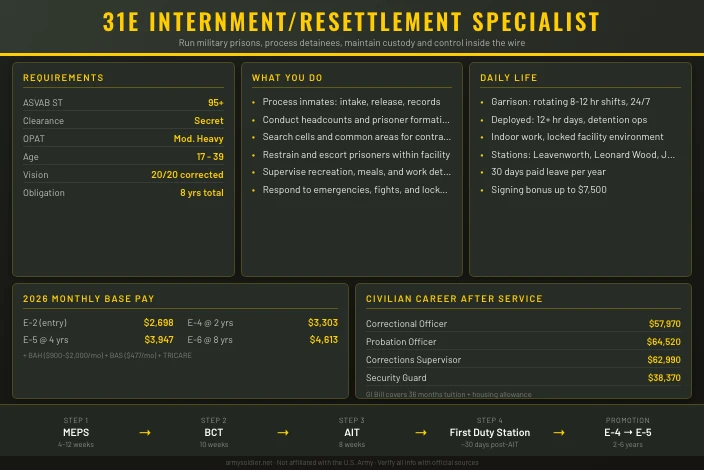
The 31E runs daily operations inside military confinement and detention facilities. You process prisoners, maintain custody and control, conduct searches, manage inmate records, counsel detainees, and enforce facility rules. In detention operations, you handle both U.S. military prisoners and foreign detainees under different legal frameworks.
Daily Tasks
Most days follow a structured routine. You conduct headcounts, escort prisoners to meals and work details, search cells and common areas for contraband, and log everything. Shift work is the norm. Mornings might start with prisoner formations and sick call coordination. Afternoons could involve supervising recreation, running intake paperwork for new arrivals, or updating behavioral records.
When something goes wrong, the pace changes fast. Fights, medical emergencies, attempted escapes, and facility lockdowns all fall on you. You’re trained in restraint techniques, riot control, and emergency response procedures specific to corrections environments.
Specialized Roles
The 31E career field has skill levels that determine your responsibilities at each rank:
| Designation | Skill Level | Typical Rank | Role |
|---|---|---|---|
| 31E10 | SL1 | PV2-SPC | Corrections/Detention Specialist |
| 31E20 | SL2 | SGT | Team Leader, supervises up to 20 soldiers |
| 31E30 | SL3 | SSG | Squad Leader, training and development |
| 31E40 | SL4 | SFC | Compound Supervisor, up to 47 soldiers |
Some 31E soldiers earn Additional Skill Identifiers (ASIs) through specialized training. The Drill Sergeant identifier is available at the E-6 and E-7 level through the Drill Sergeant Academy.
Mission Contribution
Military corrections is a legal requirement, not an option. The Army operates confinement facilities under the Uniform Code of Military Justice (UCMJ) and must comply with Department of Defense detention standards. Without trained corrections specialists, the Army can’t lawfully hold prisoners or conduct detention operations during wartime.
In deployed environments, the mission shifts to detainee operations. You may process enemy combatants, manage holding areas, and coordinate with military intelligence and legal teams. The Geneva Conventions apply, and you’re trained on the rules.
Technology and Equipment
Your daily tools include restraint devices (handcuffs, leg irons, belly chains), surveillance camera systems, electronic access control panels, radio communication equipment, and weapons (9mm pistol, shotgun). You also work with digital records systems for tracking inmate behavior, medical needs, and legal status.
Salary and Benefits
Financial Benefits
Pay is based on rank and time in service. Most 31E soldiers enter as E-1 or E-2 after training.
| Rank | Pay Grade | Typical Time in Service | Monthly Base Pay (2026) |
|---|---|---|---|
| Private (PV2) | E-2 | 0-1 years | $2,698 |
| Private First Class (PFC) | E-3 | 1-2 years | $2,837 |
| Specialist (SPC) | E-4 | 2-4 years | $3,142-$3,659 |
| Sergeant (SGT) | E-5 | 4-6 years | $3,947-$4,109 |
| Staff Sergeant (SSG) | E-6 | 6-10 years | $4,069-$4,759 |
Base pay is just the starting point. BAH (Basic Allowance for Housing) adds $900 to $2,000+ per month depending on your duty station and whether you have dependents. BAS (Basic Allowance for Subsistence) adds $476.95 per month for food. The 31E currently offers a signing bonus of up to $7,500 depending on your contract length and the Army’s needs at the time you enlist.
Additional Benefits
TRICARE covers you and your family at zero cost for active duty. That means doctor visits, hospital stays, dental, vision, prescriptions, and mental health services with no enrollment fee, no deductible, and no copay.
The Post-9/11 GI Bill pays up to 36 months of college tuition (full in-state rate at public schools, up to $29,920.95 per year at private schools) plus a monthly housing allowance and $1,000 annual book stipend. Tuition Assistance lets you take classes while still serving, up to $4,500 per year.
Retirement runs through the Blended Retirement System (BRS). Serve 20 years and collect a pension worth 40% of your highest 36 months of base pay. The government also matches up to 5% of your TSP contributions starting in your third year.
Work-Life Balance
You earn 30 days of paid leave per year. Corrections work runs on shifts, so you’ll rotate through days, evenings, and nights. Garrison schedules are predictable once you learn the rotation. Deployments disrupt that rhythm, but most 31E assignments are at fixed facilities with stable hours compared to combat arms MOSs.
Qualifications and Eligibility
Basic Qualifications
You need a minimum Skilled Technical (ST) score of 95 on the ASVAB. The ST composite adds your General Science, Verbal Expression, Math Knowledge, and Mechanical Comprehension subtest scores. A 95 is moderate for the military police field, higher than the 91 needed for 31B Military Police but lower than the 107 ST required for 31D Criminal Investigation.
| Requirement | Details |
|---|---|
| Age | 17-39 years old |
| Citizenship | U.S. citizen or permanent resident |
| Education | High school diploma or GED |
| AFQT (ASVAB) | Minimum 31 (diploma) or 50 (GED) |
| Skilled Technical (ST) | Minimum 95 |
| Security Clearance | Secret (must be obtainable) |
| OPAT Category | Moderately Heavy |
| Vision | Correctable to 20/20 |
| Background | No disqualifying criminal history |
The Secret security clearance is a hard requirement. That means a background investigation covering 7 years of personal history. Any serious criminal record, drug use, or significant financial problems can delay or block your clearance.
Application Process
Walk into a recruiting station and tell them you want 31E. Your recruiter will pull your ASVAB scores (or schedule the test), verify your eligibility, and check for open training slots. If your ST score hits 95 and your medical and background look clean, you move to MEPS.
At MEPS, you get a full physical exam, finalize paperwork, and swear in. The process from first recruiter visit to shipping out typically takes 4 to 12 weeks. Clearance investigations can extend that timeline.
Selection Criteria and Competitiveness
The 31E is less competitive than investigative or special operations MOSs, but the Secret clearance requirement filters out candidates who can’t pass a background check. Prior law enforcement, corrections, or security experience strengthens your application. No civilian certifications are required to enlist.
Upon Accession into Service
You enter at E-1 (Private) with a standard 8-year service obligation. That breaks down as your active duty contract (typically 3-6 years) plus time in the Individual Ready Reserve. Soldiers with college credits or certain qualifications may enter at E-2 or E-3. The signing bonus, if offered, depends on your contract length.
See our ASVAB study guide for strategies to hit these line scores, or take the PiCAT from home if you are a first-time tester.
Work Environment
Setting and Schedule
You work inside locked facilities. That means concrete walls, steel doors, surveillance cameras, and controlled movement corridors. Temperature and lighting are regulated. The work is indoors almost entirely, unlike most Army jobs.
Shifts rotate between 8 and 12 hours. Nights, weekends, and holidays are all part of the schedule. A typical corrections facility runs 24/7/365, so you’ll work when everyone else is off.
- Garrison – Military confinement facilities at U.S. installations. Structured shifts, regular routine.
- Deployed – Detention operations at overseas locations. Longer hours, higher tension, less predictability.
Leadership and Communication
Your chain of command runs from your shift supervisor (usually an E-5 or E-6) through the facility commander (typically an officer). Communication is constant because corrections environments require precise handoffs between shifts. You brief the incoming team on every incident, inmate status change, and pending issue.
Annual NCOERs (NCO Evaluation Reports) track your performance once you reach E-5. Before that, counseling sessions with your supervisor happen monthly or quarterly. Good corrections specialists get noticed because the facility depends on consistent, reliable people.
Team Dynamics and Autonomy
Corrections is team-dependent. You never work a cell block alone. Backup is always nearby because the nature of the job demands it. That said, you make individual judgment calls constantly. When an inmate escalates, you decide whether to talk them down, call for backup, or use force. Those split-second decisions get reviewed afterward.
Senior soldiers and NCOs get more autonomy in how they run their sections. At the team leader level, you’re responsible for training junior soldiers and managing daily operations on your shift.
Job Satisfaction and Retention
Retention varies. Some soldiers find corrections work fulfilling because it’s structured and the skills transfer directly to civilian law enforcement. Others find the shift work and confinement environment draining after a few years. Re-enlistment bonuses and promotion opportunities keep experienced NCOs in the field, but first-term retention is lower than the Army average for support MOSs.
The soldiers who stay tend to value stability and predictability. Corrections doesn’t have the unpredictable field schedule of combat arms. You know where you’re going to be tomorrow.
Training and Skill Development
Initial Training
Both BCT and AIT happen at Fort Leonard Wood, Missouri. That’s home to the U.S. Army Military Police School.
| Training Phase | Location | Duration | Focus |
|---|---|---|---|
| BCT | Fort Leonard Wood, MO | 10 weeks | Soldier basics: marksmanship, tactics, fitness, discipline |
| AIT | Fort Leonard Wood, MO (USAMPS) | 8 weeks | Corrections and detention operations |
BCT is the same for every soldier. Rifle qualification, land navigation, first aid, physical training, and basic soldier tasks.
AIT is where you learn corrections. The curriculum covers 19 major training areas: military corrections law, restraint techniques (handcuffs, leg restraints, belly chains), facility access control, cell and area searches, prisoner escort procedures, weapons qualification (9mm pistol and shotgun), unarmed self-defense, emergency response, and riot control. A 64-hour field training exercise caps the course.
You must pass the Army Fitness Test and meet weight standards to graduate. Your security clearance paperwork should already be submitted before you arrive so the investigation is underway.
Advanced Training
After AIT, career development follows the standard NCO education path:
- Basic Leader Course (BLC) – Required for promotion to E-5. Covers leadership fundamentals.
- Advanced Leader Course (ALC) – Required for E-6. Focuses on corrections supervision and facility management.
- Senior Leader Course (SLC) – Required for E-7. Develops senior NCO skills for running larger operations.
Some 31E soldiers attend the Drill Sergeant Academy and return to Fort Leonard Wood to train new recruits. That assignment is competitive and typically goes to strong E-6 and E-7 performers.
The Army also funds civilian certifications. The Certified Jail Officer (CJO) credential through the American Jail Association is directly relevant to your MOS and strengthens your resume for civilian corrections work.
Everything starts with qualifying ASVAB scores — our study guide covers what to study first.
Career Progression and Advancement
Career Path
Promotion timelines follow the standard enlisted schedule, but 31E is a smaller MOS, so competition for senior ranks is tighter.
| Rank | Pay Grade | Typical Years | Role |
|---|---|---|---|
| Private (PV2) | E-2 | 0-1 | Entry-level corrections specialist |
| Private First Class (PFC) | E-3 | 1-2 | Experienced guard, compound duties |
| Specialist (SPC) | E-4 | 2-3 | Senior specialist, mentors new soldiers |
| Sergeant (SGT) | E-5 | 4-6 | Team leader, supervises up to 20 soldiers |
| Staff Sergeant (SSG) | E-6 | 6-9 | Squad leader, training NCO |
| Sergeant First Class (SFC) | E-7 | 9-14 | Compound supervisor, up to 47 soldiers |
| Master Sergeant (MSG) | E-8 | 14-18 | Senior corrections leadership |
| Sergeant Major (SGM) | E-9 | 18+ | Command-level corrections manager |
E-4 is mostly automatic if you stay out of trouble and meet time-in-grade requirements. E-5 requires a promotion board, BLC completion, and enough points. The smaller size of the 31E field means fewer slots at E-6 and above, so performance and education matter more as you advance.
Role Flexibility and Transfers
Lateral moves within CMF 31 (Military Police) are the easiest path. Transitioning to 31B (Military Police) is common because the fields overlap. Moving to 31D (Criminal Investigation) requires meeting higher ASVAB thresholds and completing CID selection. Transfers outside the MP field are possible but require reclassification training and leadership approval.
Performance Evaluation
NCOs get rated annually through the NCOER system. Your rater and senior rater score you on leadership, technical competence, and contribution to the unit mission. Strong NCOERs are the biggest factor in promotion to E-6 and above.
What gets you ahead: running a clean facility, training your soldiers well, earning civilian credentials, and completing military education on schedule. Corrections is a field where reliability matters more than flash.
Physical Demands and Medical Evaluations
Physical Requirements
The 31E carries an OPAT rating of Moderately Heavy, which means you need to lift 80 pounds occasionally and 40 pounds frequently. Inside a facility, the physical demands include standing for long periods, restraining non-compliant inmates, running to respond to emergencies, and carrying equipment during cell extractions.
Every soldier takes the Army Fitness Test (AFT) at least once a year. The AFT has 5 events, each scored 0 to 100. You need 60 points per event and 300 total to pass.
| Event | Minimum Standard (Ages 17-21) |
|---|---|
| 3-Rep Max Deadlift (MDL) | 140 lbs (male) / 80 lbs (female) |
| Hand-Release Push-Up (HRP) | 10 reps (both) |
| Sprint-Drag-Carry (SDC) | 2:40 (male) / 3:40 (female) |
| Plank (PLK) | 2:00 (both) |
| Two-Mile Run (2MR) | 15:54 (male) / 18:54 (female) |
AFT standards are the same for all soldiers and apply across all MOSs. The general passing standard of 300 uses sex- and age-normed scoring. Corrections specialists don’t face MOS-specific fitness requirements beyond the OPAT.
Medical Evaluations
Annual physicals check weight, blood pressure, vision, and hearing. Pre-deployment screenings are more thorough. Any condition that limits your ability to work in a confined facility setting gets evaluated and resolved before you continue in the MOS.
Mental health screenings matter in this field. Working with prisoners day after day takes a psychological toll. The Army provides behavioral health resources, and smart soldiers use them.
Deployment and Duty Stations
Deployment Details
Most 31E soldiers spend the majority of their careers at fixed facilities in the U.S. Deployments happen when the Army needs detention operations overseas, which depends on global events. During the wars in Iraq and Afghanistan, 31E soldiers deployed regularly to run detainee operations. Current deployment frequency is lower, but the mission can ramp up quickly.
Deployed rotations typically last 9 to 12 months. You might run a detention facility, process captured enemy combatants, or support military intelligence operations. The legal framework shifts from UCMJ corrections to Geneva Convention detainee rules.
Location Flexibility
Duty station assignments depend on where the Army runs confinement facilities. The biggest hub is Fort Leavenworth, Kansas, home to the United States Disciplinary Barracks, the military’s only maximum-security prison.
Common duty stations:
- Fort Leavenworth, KS – U.S. Disciplinary Barracks
- Fort Leonard Wood, MO – Training base and regional facility
- Joint Base Lewis-McChord, WA
- Joint Base Myer-Henderson Hall, VA
Overseas:
- Guantanamo Bay, Cuba – Joint Detention Group
- Camp Humphreys, South Korea
- Germany (Garmisch, Sembach)
You can submit preferences, but the Army assigns you based on need. Moves happen every 2 to 4 years. The smaller number of corrections facilities means fewer options than most MOSs, but it also means you’ll likely know the people at your next assignment.
Risk, Safety, and Legal Considerations
Job Hazards
Working inside a corrections facility carries specific risks:
- Physical confrontation with inmates during cell extractions, restraint procedures, or unexpected altercations
- Exposure to bodily fluids during medical emergencies or assaults
- Psychological stress from managing volatile individuals in confined spaces over long shifts
- Contraband hazards including improvised weapons found during searches
Deployed detention operations add combat zone risks: indirect fire, IEDs during transport, and heightened tension from handling enemy combatants.
Safety Protocols
You work in pairs or teams. Solo operations in a cell block are against policy. Body armor, protective gloves, and communication equipment are standard. Facilities have layered security: cameras, electronic locks, sally ports, and armed response teams. Use-of-force policies follow strict escalation procedures, and every incident gets documented and reviewed.
Security and Legal Requirements
The Secret security clearance is mandatory. Processing takes 2 to 6 months and covers your financial history, criminal record, associates, and personal conduct over 7 years. Maintaining the clearance requires avoiding debt problems, legal trouble, and foreign contacts that could create a vulnerability.
All soldiers follow the UCMJ. As a corrections specialist, you also operate under Army Regulation 190-47 (military corrections) and DoD Directive 2310.01 (detainee operations). You’re legally required to treat prisoners humanely, report abuse, and follow established procedures. Violating these rules carries serious criminal consequences.
Impact on Family and Personal Life
Family Considerations
Shift work is the biggest challenge for families. You’ll work nights, weekends, and holidays regularly. That means missing dinners, events, and routines that most civilian families take for granted. The upside: your schedule is predictable once you learn the rotation, and you’re not in the field for weeks at a time like infantry soldiers.
Support resources available at most installations:
- Family Readiness Groups (FRGs) – Unit-based peer support
- Military OneSource – Free counseling and family services (24/7)
- Exceptional Family Member Program (EFMP) – Support for dependents with special needs
- Spouse employment assistance – Job help at each duty station
Relocation and Flexibility
Expect to move every 2 to 4 years. The Army pays for each PCS (permanent change of station), but every move disrupts your spouse’s job, your kids’ school, and your community. The limited number of corrections facilities means your options are narrower than soldiers in larger MOSs.
Deployments separate families for 9 to 12 months. Communication from detention facilities overseas can be more restricted than from regular forward operating bases due to the classified nature of some operations.
Reserve and National Guard
Component Availability
The 31E MOS is available in both the Army Reserve and Army National Guard, with a higher concentration in the Reserve. The Army relies heavily on Reserve I/R units for detention capacity, so a large percentage of 31E soldiers serve part-time. Guard I/R positions exist in some states but are less common. Both components carry positions at all enlisted grades.
Drill Schedule and Training Commitment
Standard commitment is one weekend per month plus two weeks of Annual Training. 31E soldiers train on detention facility operations, detainee processing, and custody procedures during drill weekends. Annual Training often involves simulated detention exercises or support to active-duty correctional facilities. Some units schedule additional training for use-of-force certification, riot control procedures, and non-lethal weapons qualification.
Part-Time Pay
An E-4 with about three years of service earns roughly $422 per drill weekend in 2026. Over 12 weekends, that totals about $5,064. Annual Training adds approximately $1,583, for an annual total near $6,647. Active-duty E-4 monthly base pay is $3,166 for comparison.
Benefits Differences
Reserve and Guard 31E soldiers receive Tricare Reserve Select instead of free active-duty TRICARE. TRS costs $57.88 per month for member-only or $286.66 for member plus family in 2026.
Education benefits include:
- Federal Tuition Assistance: $4,500 per year for drilling members
- MGIB-SR: roughly $416 per month while enrolled
- Post-9/11 GI Bill: requires 90 or more days of federal activation; frequent mobilizations help many 31E soldiers qualify
- State tuition waivers (Guard only): vary by state; Reserve members (the majority of I/R forces) do not receive state waivers
Retirement uses the points-based system. Pension draws at age 60, reducible by qualifying mobilizations down to age 50.
Deployment and Mobilization
Reserve and Guard I/R units mobilize at a moderate to high rate. 31E soldiers deploy for detention operations, holding facility management, and detainee processing in theater. Mobilizations typically last 9 to 12 months. Because the Army depends on Reserve forces for much of its detention capacity, I/R units are called up regularly when operations require holding facilities.
Civilian Career Integration
The 31E skill set transfers directly to civilian corrections and criminal justice careers. Corrections officer, detention center staff, probation officer, and parole officer positions all align with the training you receive. Many Reserve 31E soldiers work in state or federal correctional facilities during the week. The combination of military detention experience and civilian corrections credentials strengthens your resume for supervisory roles. USERRA protects your civilian job during mobilization.
| Feature | Active Duty | Army Reserve | Army National Guard |
|---|---|---|---|
| Commitment | Full-time | One weekend/month + 2 weeks/year | One weekend/month + 2 weeks/year |
| Monthly Pay (E-4, ~3 yrs) | $3,166/month | ~$422/drill weekend | ~$422/drill weekend |
| Healthcare | TRICARE, $0 premiums | TRS, $57.88/month (member) | TRS, $57.88/month (member) |
| Education | TA + Post-9/11 GI Bill | Federal TA, MGIB-SR; Post-9/11 after activation | Federal TA, MGIB-SR, state tuition waivers |
| Deployment | Regular rotation | Mobilization every 3-5 years | Mobilization every 3-5 years |
| Retirement | BRS pension at 20 years | Points-based, age 60 | Points-based, age 60 |
Post-Service Opportunities
Transition to Civilian Life
Your corrections training transfers directly to civilian law enforcement and corrections jobs. You leave with experience in inmate management, facility operations, use-of-force procedures, and records administration. Most state and federal corrections agencies recognize military service as qualifying experience.
The Army’s PAYS (Partnership for Youth Success) program guarantees job interviews with military-friendly employers in law enforcement and corrections. The Transition Assistance Program (TAP) provides resume workshops, interview prep, and benefits counseling during your last year on active duty.
The Post-9/11 GI Bill covers up to 36 months of tuition at a public university (full in-state rate) or up to $29,920.95 per year at private schools, plus a monthly housing allowance and $1,000 annual book stipend. Many former 31E soldiers use these benefits for criminal justice, homeland security, or public administration degrees.
Civilian Career Prospects
| Civilian Job | Median Annual Salary (BLS, 2024) | 10-Year Outlook |
|---|---|---|
| Correctional Officer / Jailer | $57,970 | -7% (declining, but 31,900 openings/year) |
| Probation Officer / Correctional Treatment Specialist | $64,520 | +3% |
| Security Guard | $38,370 | +2% |
| First-Line Supervisor of Correctional Officers | $62,990 | Stable |
Federal corrections jobs (Bureau of Prisons) pay more than state facilities and give preference to military veterans. The Federal Law Enforcement Training Center (FLETC) recognizes your military corrections background, which can shorten the onboarding process.
Post-Service Policies
An honorable discharge gives you lifetime access to VA healthcare, disability compensation if applicable, and education benefits. You can separate after completing your active-duty contract; any remaining obligation transfers to the Individual Ready Reserve. Talk to your career counselor at least 12 months before your end of service date to plan your transition.
Is This a Good Job for You?
Ideal Candidate Profile
Corrections work attracts a specific kind of person. You need patience, discipline, and the ability to stay calm when someone is screaming in your face. The best 31E soldiers are consistent and unflappable. They follow procedures exactly, communicate clearly, and don’t let emotions drive their decisions.
Traits that predict success:
- Comfortable with authority and enforcing rules
- Calm under pressure, even during physical confrontations
- Detail-oriented with paperwork and records
- Able to work nights, weekends, and holidays without complaint
- Interested in law enforcement or criminal justice as a career
Potential Challenges
This MOS may not suit you if:
- You need variety and outdoor work. This job is indoors, repetitive, and structured.
- You struggle with shift work or irregular sleep schedules.
- You have trouble separating work stress from personal life. Dealing with inmates for 8 to 12 hours takes a psychological toll.
- You want a combat-focused MOS. While 31E soldiers can deploy, most of your career happens inside a facility.
The confined environment gets to some people. Spending years inside a locked building, surrounded by prisoners, is not for everyone. And the smaller MOS size means fewer duty station options and potentially slower promotion at senior ranks.
Career and Lifestyle Alignment
If you want a direct pipeline into civilian law enforcement or federal corrections, the 31E is one of the most efficient paths. You get paid to earn the experience that civilian agencies require for hiring. The security clearance, corrections training, and military discipline on your resume put you ahead of most civilian applicants.
The trade-off is a narrower military experience. You won’t kick down doors or ride in convoys. Your stories will be about managing a compound, not clearing a building. For some people, that’s exactly what they want. For others, it’s a reason to look at 31B Military Police instead.
More Information
Talk to an Army recruiter about the 31E. Ask about current signing bonus amounts, training dates, and whether your ASVAB scores qualify. If you can, ask to speak with a corrections specialist so you hear what the job is really like on a daily basis.
Take the MOS finder quiz at goarmy.com
Schedule an ASVAB at your nearest MEPS to see where your scores land
Check the Army bonus list for current 31E incentives
Prepare for the ASVAB with our study guide to make sure your line scores qualify
This site is not affiliated with the U.S. Army or any government agency. Verify all information with official Army sources before making enlistment or career decisions.
Explore more Army military police careers such as the 31B Military Police and 31K Military Working Dog Handler.