31K Military Working Dog Handler
Most soldiers carry a rifle. You carry a rifle and a dog. As a 31K Military Working Dog Handler, you train and work alongside a canine partner every day, detecting explosives, searching buildings, and patrolling installations both stateside and overseas. The bond between handler and dog is the foundation of the job, and the stakes are high. A missed detection can cost lives. If you want a military career that is physically demanding, mentally engaging, and unlike anything else in the Army, 31K is it.
Qualifying requires specific ASVAB line scores — our ASVAB study guide covers what to target and how to prepare.
Job Role and Responsibilities
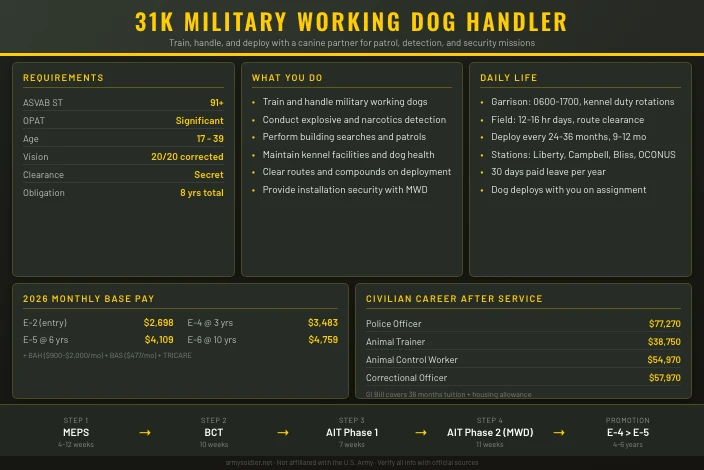
A 31K Military Working Dog Handler is responsible for the care, training, and tactical employment of military working dogs (MWDs) in patrol, detection, and law enforcement operations. You maintain your dog’s health and readiness, conduct explosive and narcotics detection sweeps, perform building searches, provide installation security, and deploy forward with combat units to clear routes and secure areas.
What You Do Daily
In garrison, your day starts at the kennels. You feed, water, groom, and inspect your dog before the first training session. Morning hours go to obedience reinforcement, detection drills, and controlled aggression exercises. You cycle between live detection problems using training aids and building search scenarios that keep your dog sharp. After training, you clean and maintain kennel facilities, update records, and check your dog for injuries or signs of illness.
Afternoons shift to patrols. MWD teams sweep parking lots, buildings, and entry control points on the installation. When a VIP visits or a large event takes place, you and your dog screen vehicles, packages, and areas for threats before anyone else enters. You also spend time on veterinary appointments, equipment maintenance, and physical training.
In the field or on deployment, the tempo changes. You clear routes ahead of convoys, search compounds before infantry enters, and provide perimeter security at forward operating bases. Twelve-to-sixteen-hour days are normal when operating outside the wire. Your dog works in the same heat, dust, and terrain you do.
Specialized Roles and Identifiers
MWD Handlers operate in several capacities depending on their unit and additional training.
| Identifier | Description |
|---|---|
| MOS 31K | Military Working Dog Handler (primary enlisted MOS) |
| MOS 31B | Military Police (feeder MOS; required before 31K for reclassification) |
| ASI K9 | Military Working Dog Handler (additional skill identifier awarded after MWD course completion) |
| PEDD-E | Patrol Explosive Detector Dog - Enhanced course graduate |
Handlers who complete the Patrol Explosive Detector Dog-Enhanced (PEDD-E) course at Fort Leonard Wood specialize in off-leash explosive detection operations. These teams deploy with infantry and special operations units where a leashed dog cannot operate effectively.
Mission Contribution
A single MWD team can search an area faster and more reliably than a squad of soldiers using handheld detectors. Your dog’s nose detects trace amounts of explosives that electronic equipment misses. During deployments, MWD teams reduce casualties by finding IEDs, weapons caches, and explosive materials before they can be used. In garrison, your presence deters criminal activity on installations and gives commanders a tool they cannot get any other way.
Technology and Equipment
You work with living equipment, which makes this MOS different from most. But you also carry standard gear.
- Military Working Dogs – Belgian Malinois and German Shepherds trained in patrol, detection, or dual-purpose roles
- Detection training aids – controlled explosive and narcotic samples used for scent imprinting and proficiency maintenance
- Bite suit and protective sleeves – worn during controlled aggression training as a decoy
- Patrol and restraint equipment – leashes, harnesses, muzzles, tactical vests, and GPS tracking collars
- Kennel facilities – climate-controlled runs, grooming stations, and veterinary first-aid kits
- Standard MP gear – M4/M17 sidearm, body armor, radio, and vehicle-mounted equipment
- Canine first-aid kit – tourniquets, hemostatic gauze, IV supplies, and airway tools sized for dogs
Salary and Benefits
Financial Benefits
Military pay depends on rank and time in service. Most MWD Handlers enter at E-2 (PV2) after completing Basic Combat Training and AIT.
| Rank | Time in Service | Monthly Base Pay (2026) |
|---|---|---|
| E-2 (PV2) | Entry | $2,698 |
| E-3 (PFC) | 2 years | $3,015 |
| E-4 (SPC) | 3 years | $3,483 |
| E-5 (SGT) | 6 years | $4,109 |
| E-6 (SSG) | 10 years | $4,759 |
Base pay is only part of the picture. BAH (Basic Allowance for Housing) depends on your duty station and whether you have dependents. A single E-4 can expect roughly $900 to $2,000+ per month depending on location. BAS adds about $477 monthly for food. Bonus availability for 31K changes frequently, so ask your recruiter about current enlistment or re-enlistment incentives.
Additional Benefits
You and your dependents receive TRICARE health coverage at no cost on active duty. That includes medical, dental, vision, prescriptions, and mental health care. Tuition Assistance covers up to $4,500 per year for college courses while serving. After separation, the Post-9/11 GI Bill pays up to 36 months of tuition at a public university plus a monthly housing allowance.
Retirement runs through the Blended Retirement System (BRS):
- Serve 20 years and receive a pension equal to 40% of your base pay
- The government matches up to 5% of your Thrift Savings Plan (TSP) contributions starting in your third year
- Continuation pay at the 8-to-12-year mark if you commit to additional service
Work-Life Balance
You earn 30 days of paid leave per year plus 11 federal holidays. Garrison schedules generally run 0600 to 1700, but kennel duty rotations and after-hours call-outs are part of the job. Dogs need care on weekends and holidays, so expect occasional duty days outside normal hours. Field exercises and deployment cycles add unpredictability. When you deploy, expect 9 to 12 months overseas with 18 to 24 months at home between rotations.
Qualifications and Eligibility
Basic Qualifications
You need to be a U.S. citizen between 17 and 39 years old. High school graduates need at least a 31 on the AFQT. GED holders need a 50. The 31K requires one ASVAB composite score:
- Skilled Technical (ST): 91 minimum
The ST composite combines General Science (GS), Verbal Expression (VE), Mathematics Knowledge (MK), and Mechanical Comprehension (MC). A score of 91 is moderate and reachable with focused study.
You also need a Secret security clearance, which means no disqualifying criminal history, drug use, or financial problems. The investigation starts during the enlistment process and can take several months to complete.
| Requirement | Details |
|---|---|
| Age | 17-39 years old |
| Citizenship | U.S. citizen |
| Education | High school diploma or GED |
| AFQT (ASVAB) | Minimum 31 (diploma) or 50 (GED) |
| Skilled Technical (ST) Score | Minimum 91 |
| OPAT Category | Significant |
| Security Clearance | Secret |
| Vision | Correctable to 20/20 |
| Color Vision | Normal color vision required |
| Moral Standards | No disqualifying criminal history or drug use |
Application Process
Visit your local Army recruiting station. Your recruiter will confirm your eligibility, explain the 31K training pipeline, and walk you through the steps. At MEPS (Military Entrance Processing Station), you take the ASVAB if you have not already, complete a medical exam, and pass the OPAT at the Significant level. If your scores qualify, the recruiter locks in your training slot.
The process from first recruiter visit to shipping out takes 4 to 12 weeks depending on security clearance processing, medical waivers, and available class dates.
Selection Criteria and Competitiveness
The 31K is one of the more competitive MOS options in CMF 31. The Army has a limited number of MWD handler positions compared to general Military Police (31B) billets. Strong ASVAB scores, a clean background, and physical fitness all help. Having experience with dogs is not required but does not hurt.
Some soldiers enter the Army as 31B Military Police and later reclassify to 31K after gaining experience and earning a recommendation from their chain of command. This is a common path for soldiers already serving who want to work with dogs.
Upon Accession into Service
Most recruits enter at E-1 (PV1) or E-2 (PV2) depending on education credits and any Delayed Entry Program promotions. The standard service obligation is 8 years total, split between active duty (typically 4 years) and the Reserve or Individual Ready Reserve for the remainder.
See our ASVAB study guide for strategies to hit these line scores, or take the PiCAT from home if you are a first-time tester.
Work Environment
Setting and Schedule
Your work splits between the kennel, the patrol route, and the field. Kennel work is outdoors or in partially enclosed buildings. You are on your feet most of the day, running detection problems and handling a dog that weighs 50 to 90 pounds. In summer, you work around heat and humidity. In winter, the dog still needs exercise and training regardless of the weather.
Garrison hours run roughly 0600 to 1700, but MWD handlers rotate through 24-hour kennel duty shifts. When a bomb threat comes in or a gate needs sweeping at 0200, you go. On deployment, there is no set schedule. Missions dictate your hours.
Leadership and Communication
MWD teams typically fall under the Provost Marshal Office or a Military Police unit. Your immediate supervisor is the Kennel Master, a senior NCO who oversees all dog teams on the installation. Performance feedback comes through the standard Army NCOER (NCO Evaluation Report) and counseling system. Expect formal counseling monthly and an annual evaluation that directly affects your promotion standing.
Team Dynamics and Autonomy
You have more independence than most junior enlisted soldiers. When you take your dog on a detection sweep, it is your judgment call on alerts, search patterns, and how to manage the dog’s energy. That autonomy comes with accountability. If you clear a building and something is there, that is on you.
At the same time, you work within an MP platoon or kennel section. Coordination with gate guards, patrol officers, and command staff is constant. You are a specialist within a larger team.
Job Satisfaction and Retention
Handlers tend to be passionate about the work. The bond with your dog is real, and the mission feels tangible in ways that other MOSs sometimes lack. Retention for 31K is moderate. Some soldiers stay for a full career. Others move to civilian law enforcement or federal agencies after their first enlistment. The small size of the MOS means promotion opportunities above E-6 can be tight, which pushes some experienced handlers toward other career paths.
Training and Skill Development
Initial Training
The 31K training pipeline is longer than most enlisted MOSs because it combines Military Police fundamentals with specialized dog handling.
| Phase | Location | Length | Focus |
|---|---|---|---|
| Basic Combat Training (BCT) | Fort Leonard Wood, MO | 10 weeks | Soldier fundamentals: weapons, drill, tactics, fitness |
| AIT Phase 1 | Fort Leonard Wood, MO | 7 weeks | Military Police methods: law enforcement, arrest procedures, traffic control, use of force |
| AIT Phase 2 (MWD Handler Course) | Joint Base San Antonio-Lackland, TX | 11 weeks | Dog handling, obedience, controlled aggression, building search, vehicle patrol, explosive/narcotics detection, canine first aid |
BCT at Fort Leonard Wood covers everything from rifle qualification and land navigation to first aid and Army values. You graduate as a basic soldier.
Phase 1 of AIT teaches you the Military Police skill set. You learn how to restrain subjects, process crime scenes, direct traffic, and conduct patrols. This phase builds the law enforcement foundation that MWD handlers need before working with a dog.
Phase 2 moves you to Lackland Air Force Base in San Antonio, where the Department of Defense runs its military working dog program. Here you are paired with a dog for the first time. Training covers obedience, scouting, building searches, vehicle patrols, controlled aggression under gunfire, tracking, and detection work. You also learn kennel management, canine health inspection, grooming, disease recognition, first aid, and record keeping. By graduation, you and your dog operate as a certified team.
Advanced Training
Once you reach your first duty station, training does not stop. MWD teams must maintain certification through regular proficiency evaluations. The Kennel Master schedules weekly detection problems, aggression maintenance, and obedience refreshers.
Experienced handlers can attend the Patrol Explosive Detector Dog-Enhanced (PEDD-E) course at Fort Leonard Wood, which trains off-leash explosive detection for dismounted combat operations. Graduates deploy with infantry and special operations units in high-threat environments.
Other development opportunities include the Warrior Leader Course (promotion requirement for E-5), Advanced Leader Course, and instructor certification at the MWD schoolhouse. The Army also funds civilian certifications in animal training and law enforcement through the Credentialing Assistance program.
Everything starts with qualifying ASVAB scores — our study guide covers what to study first.
Career Progression and Advancement
Career Path
Promotion follows the standard Army enlisted timeline, though 31K has fewer positions at senior ranks because it is a small MOS.
| Rank | Grade | Typical Time in Service | Role |
|---|---|---|---|
| Private (PV1/PV2) | E-1/E-2 | 0-1 years | Handler trainee, kennel duties |
| Private First Class (PFC) | E-3 | 1-2 years | Certified handler, patrol and detection operations |
| Specialist (SPC) | E-4 | 2-3 years | Experienced handler, mentors new soldiers |
| Sergeant (SGT) | E-5 | 4-6 years | Team leader, supervises junior handlers |
| Staff Sergeant (SSG) | E-6 | 6-10 years | Kennel Master, manages all MWD teams on installation |
| Sergeant First Class (SFC) | E-7 | 12-16 years | Senior MWD operations NCO, program manager |
| Master Sergeant (MSG) | E-8 | 18+ years | Senior enlisted advisor, branch-level positions |
The Kennel Master role at E-6 is the signature position for 31K NCOs. You manage dog teams, coordinate training schedules, evaluate handlers, and advise the Provost Marshal on MWD employment.
At E-7 and above, positions become staff-oriented. You may work at a regional MWD program office, the Provost Marshal General’s office, or the DoD MWD program at Lackland. Some senior NCOs serve as course instructors at the MWD schoolhouse.
Role Flexibility and Transfers
Because 31K starts with Military Police training, reclassifying to 31B or other CMF 31 MOSs is straightforward if you want a change. Moving to 31D (CID Special Agent) requires meeting separate application criteria and typically a higher GT score. Transferring outside CMF 31 requires a reclassification packet and approval from your branch manager at HRC.
Some handlers transition to warrant officer paths. The 311A (CID Special Agent) warrant officer track is available to experienced MP and CID soldiers. There is no warrant officer MOS specific to MWD operations, but the skills transfer.
Performance Evaluation
The Army evaluates NCOs through the NCOER system. Your rater (usually the Kennel Master or Provost Marshal) scores you on character, competence, and commitment. The best evaluations use specific examples: “Certified 4 new MWD teams in FY26” carries more weight than generic praise.
For promotion to E-5 and above, the Army uses a centralized board system that weighs your NCOER record, military education, physical fitness scores, awards, and time in grade. In a small MOS like 31K, standing out means maintaining a high certification rate, volunteering for deployments, and completing professional military education ahead of schedule.
Physical Demands and Medical Evaluations
Physical Requirements
This job is physically demanding every day, not just during PT. You run with your dog, wrestle during controlled aggression training, lift 50-to-90-pound dogs into vehicles, and spend hours on your feet in all weather conditions. Handlers also act as decoys during bite training, which means absorbing controlled impacts through a bite suit.
The OPAT physical demand category for 31K is Significant. Before shipping to training, you must pass these OPAT minimums:
- Standing Long Jump: 3.9 feet
- Seated Power Throw: 8.2 feet
- Strength Deadlift: 120 lbs
- Interval Aerobic Run: 24 shuttles
Once in the Army, you take the Army Fitness Test (AFT) at least twice per year. The AFT has five events:
| Event | Description | Minimum (per event) | Maximum (per event) |
|---|---|---|---|
| 3 Repetition Maximum Deadlift (MDL) | Deadlift max weight for 3 reps | 60 points | 100 points |
| Hand Release Push-Up (HRP) | Push-ups with full arm extension at bottom | 60 points | 100 points |
| Sprint-Drag-Carry (SDC) | 250-meter shuttle with sprints, sled drags, and carries | 60 points | 100 points |
| Plank (PLK) | Timed front plank hold | 60 points | 100 points |
| Two-Mile Run (2MR) | Timed 2-mile run | 60 points | 100 points |
The general passing standard is 300 total points (60 per event minimum). Scoring is sex- and age-normed. The AFT replaced the ACFT in June 2025.
Medical Evaluations
You complete a full medical screening at MEPS before enlisting. Annual Periodic Health Assessments (PHAs) track your fitness for duty. Working closely with animals also means staying current on vaccinations and watching for zoonotic diseases. If your dog bites you during training, you go through a medical evaluation and incident report. Handlers with chronic orthopedic issues from the physical demands of the job may face medical review for continued service.
Deployment and Duty Stations
Deployment Details
MWD teams deploy regularly. The Army needs dog teams at forward operating bases, embassies, airfields, and with combat units. Deployment lengths typically run 9 to 12 months. During high-tempo periods, you may deploy every 24 to 36 months. Your dog deploys with you. You handle the same dog throughout your assignment, which strengthens the working bond.
MWD handlers have deployed to Iraq, Afghanistan, Syria, Kuwait, and various locations across Africa, Europe, and the Pacific. Even during peacetime, handlers deploy on security missions to support embassies and joint exercises.
Location Flexibility
31K duty stations span a wide range because every major installation needs MWD support.
CONUS (Continental United States): Fort Liberty (NC), Fort Campbell (KY), Fort Bliss (TX), Fort Carson (CO), Fort Drum (NY), Fort Stewart (GA), Fort Moore (GA), Fort Leonard Wood (MO), Fort Riley (KS), Fort Sill (OK), Fort Cavazos (TX), Joint Base Lewis-McChord (WA), Joint Base San Antonio (TX), Fort Knox (KY), Fort Meade (MD), Fort Gregg-Adams (VA)
OCONUS (Overseas): USAG Bavaria and Rheinland-Pfalz (Germany), USAG Daegu and Yongsan-Casey (South Korea), USAG Japan, USAG Hawaii, Joint Base Elmendorf-Richardson (AK), Fort Wainwright (AK)
Assignment preferences go into your “wish list” at HRC, but needs of the Army come first. Overseas assignments are common and typically last 2 to 3 years.
Risk, Safety, and Legal Considerations
Job Hazards
Working with trained protection dogs carries inherent risk. Even with a bite suit, controlled aggression training can result in bruises, strains, and occasional puncture wounds from missed catches. Dogs bite through protective equipment sometimes. On deployment, the risks multiply. You clear routes and buildings ahead of other soldiers, which means you face IED threats, small arms fire, and the stress of combat operations.
Handler injuries also include repetitive stress on knees, shoulders, and backs from daily physical work with a large animal. Heat injuries are common during summer training.
Safety Protocols
Every MWD training session follows a safety brief. Decoys wear full bite suits. Handlers maintain verbal and physical control of their dogs at all times during aggression exercises. Detection training uses inert or controlled amounts of actual materials under strict accountability procedures. Veterinary staff conduct regular health checks on every dog.
On deployment, MWD teams follow the same force protection protocols as other combat elements. Body armor, vehicle hardening, and route clearance procedures apply.
Security and Legal Requirements
The 31K requires a Secret security clearance. The investigation covers your financial history, criminal record, drug use, and foreign contacts. Maintaining your clearance is an ongoing obligation. Any arrests, financial problems, or foreign travel outside official channels can trigger a review.
As an MP, you have law enforcement authority on military installations. That authority comes with legal responsibilities. You follow the Uniform Code of Military Justice (UCMJ) and installation-specific rules of engagement for your dog. Using your dog outside authorized situations can result in criminal charges against you. Every use-of-force incident involving your dog requires documentation and review.
Your standard service obligation is 8 years total, with the active-duty portion typically 4 years.
Impact on Family and Personal Life
Family Considerations
The MWD handler lifestyle affects your family in ways unique to this MOS. Kennel duty rotations mean weekends and holidays on shift. Your dog needs care 365 days a year. Deployments separate you from family for 9 to 12 months at a time. PCS moves every 2 to 3 years mean your spouse changes jobs and your kids change schools.
The Army provides support through Military OneSource (free counseling), Family Readiness Groups at your unit, on-post childcare, and spouse employment assistance programs. TRICARE covers your family’s healthcare at no enrollment cost for active duty.
Relocation and Flexibility
You go where the Army sends you. The good news is that 31K positions exist at most major installations, which gives HRC more options when matching your preferences. Overseas tours (Germany, Korea, Japan) are common and can be accompanied (meaning your family comes with you) or unaccompanied depending on the assignment. Unaccompanied tours in Korea typically last 12 months. Accompanied tours in Germany run 2 to 3 years.
If you are single, relocation is straightforward. If you have a family, the Army covers your move through the PCS system, including household goods shipping, temporary lodging allowance, and travel pay.
Reserve and National Guard
Component Availability
The 31K MOS has very limited availability in the Reserve and Guard. Military working dogs are assigned to active-duty kennels on military installations, and the handler-dog team model makes part-time service difficult. A small number of Reserve MP detachments may carry 31K positions, but openings are rare. The National Guard has even fewer 31K slots. Most soldiers who want to be dog handlers serve on active duty.
Drill Schedule and Training Commitment
If you find a Reserve or Guard 31K position, the standard commitment is one weekend per month plus two weeks of Annual Training. The challenge is maintaining your dog handling skills and your dog’s proficiency in a part-time role. Military working dogs need daily training, and a monthly drill schedule makes it hard to keep a team sharp. Some Reserve 31K handlers must travel to an active-duty kennel for training, which can mean longer drill weekends. Annual Training typically involves working at an active-duty MWD facility.
Part-Time Pay
An E-4 with about three years of service earns roughly $422 per drill weekend in 2026. Over 12 weekends, that totals about $5,064. Annual Training adds approximately $1,583. Because 31K positions in the Reserve/Guard are so scarce, most handlers earn active-duty pay of $3,166 per month at the E-4 level.
Benefits Differences
The few Reserve/Guard 31K soldiers receive Tricare Reserve Select instead of free active-duty TRICARE. TRS costs $57.88 per month for member-only or $286.66 for member plus family in 2026.
Education benefits include:
- Federal Tuition Assistance: $4,500 per year for drilling members
- MGIB-SR: roughly $416 per month while enrolled
- Post-9/11 GI Bill: requires 90 or more days of federal activation
- State tuition waivers (Guard only): vary by state, though finding a Guard 31K position is unlikely
Retirement follows the points-based system. Pension draws at age 60, reducible by qualifying mobilizations.
Deployment and Mobilization
Mobilization from the Reserve/Guard is uncommon for 31K because most positions are active duty. When a Reserve handler does mobilize, they typically augment an active-duty kennel or MWD detachment. Active-duty 31K soldiers deploy on standard rotation cycles with their working dogs.
Civilian Career Integration
The 31K skill set transfers to law enforcement K-9 units, TSA explosives detection, customs K-9 programs, and private security dog handling. These positions are competitive in the civilian sector, but your military training and certification give you a strong edge. Many former 31K soldiers transition to police K-9 handler roles. USERRA protects your civilian job if you are mobilized from a Reserve position, though the rarity of Reserve/Guard 31K slots means most career paths go through active duty first.
| Feature | Active Duty | Army Reserve | Army National Guard |
|---|---|---|---|
| Commitment | Full-time | One weekend/month + 2 weeks/year | One weekend/month + 2 weeks/year |
| Monthly Pay (E-4, ~3 yrs) | $3,166/month | ~$422/drill weekend | ~$422/drill weekend |
| Healthcare | TRICARE, $0 premiums | TRS, $57.88/month (member) | TRS, $57.88/month (member) |
| Education | TA + Post-9/11 GI Bill | Federal TA, MGIB-SR; Post-9/11 after activation | Very limited positions |
| Deployment | Regular rotation with MWD | Rare mobilization | Very limited positions |
| Retirement | BRS pension at 20 years | Points-based, age 60 | Points-based, age 60 |
Post-Service Opportunities
Transition to Civilian Life
MWD handlers leave the Army with a skill set that transfers directly to several civilian fields. Your law enforcement training, dog handling expertise, and security clearance make you attractive to federal agencies, police departments, and private security firms.
The Army PaYS program guarantees job interviews with partner employers for soldiers completing their service obligations. TRICARE coverage extends for a limited period after separation, and the VA provides healthcare for service-connected conditions.
The Post-9/11 GI Bill covers up to 36 months of tuition at a public university (full in-state tuition) or up to $29,921 per year at private schools, plus a monthly housing allowance and $1,000 annual book stipend. You can transfer unused benefits to a spouse or children after 6 years of service.
| Civilian Career | Median Annual Salary (BLS, May 2024) | Job Outlook (2024-2034) |
|---|---|---|
| Police Officer / Detective | $77,270 | +3% (average) |
| Animal Trainer | $38,750 | +11% (faster than average) |
| Animal Control Worker | $54,970 | Stable |
| Security Guard | $38,370 | Stable |
| Correctional Officer | $57,970 | Stable |
Federal agencies like the Secret Service, U.S. Customs and Border Protection, and the TSA hire former military dog handlers for canine detection roles. These positions often pay more than the BLS medians listed above and value your military experience and clearance.
Is This a Good Job for You? The Right (and Wrong) Fit
Ideal Candidate Profile
The best MWD handlers genuinely like animals and do not mind getting dirty. You need patience. Dogs do not learn on your schedule. Some days your dog nails every detection problem. Other days, nothing works, and you start over. That is normal.
Physical fitness matters. You are on your feet all day, running, lifting, and absorbing impacts during bite training. If you dislike physical work, this is not the right MOS.
You also need discipline and attention to detail. Missing a health check on your dog or skipping a detection maintenance session can mean a failed certification, which means you cannot do your job.
Good traits for a 31K:
- Patience and consistency in training
- Physical toughness and endurance
- Comfort working outdoors in all conditions
- Calm under pressure
- Genuine interest in working with animals
Potential Challenges
This is not a desk job. You work outside in heat, cold, rain, and dust. Kennel duty means weekends and holidays. Deployments put you in dangerous environments. The dog does not take days off, so neither do you.
The MOS is small, which means fewer promotion slots at senior ranks. If making E-7 or above is important to you, understand that competition for those positions is tight. Some handlers reclassify to 31B or another MOS at the mid-career point to improve their promotion odds.
Separation from your dog at the end of an assignment or when the dog retires can be emotionally difficult. Handlers form genuine bonds with their animals, and not every handler gets to adopt their retired dog.
Career and Lifestyle Fit
If you want a military career that is different from the standard infantry or office MOS, 31K delivers that. The work is hands-on, the mission is clear, and the dog gives you a partner that most soldiers never get. The skills transfer well to civilian life, especially in law enforcement and federal security.
If you need predictable hours, prefer indoor work, or are not comfortable with the physical demands of working with large dogs daily, look at other CMF 31 options like 31B Military Police for a broader set of assignments with more flexibility.
More Information
Talk to your local Army recruiter for current enlistment bonus amounts, available training dates, and answers to questions specific to your situation. You can also call 1-888-550-ARMY (2769) or visit goarmy.com for the latest 31K details.
- Prepare for the ASVAB with our study guide to make sure your line scores qualify
This site is not affiliated with the U.S. Army or any government agency. Verify all information with official Army sources before making enlistment or career decisions.
Explore more Army military police careers such as 31B Military Police and 31D Criminal Investigation Special Agent.