89A Ammunition Stock Control and Accounting Specialist
Every round fired in combat starts with an accounting entry. Ammunition is one of the most strictly controlled materials in the military, and the 89A Ammunition Stock Control and Accounting Specialist is the person who keeps that system running. They track every bullet, artillery round, and explosive component from receipt to issue, using Army inventory systems that account for every item by lot number, quantity, and condition.
The work sits at the intersection of logistics and safety. Mistakes in ammunition accounting don’t just create audit problems. They create hazards. That’s why the Army requires a minimum ST score of 91, treats the accountability system seriously, and gives 89A soldiers significant responsibility early in their careers.
Qualifying requires specific ASVAB line scores — our ASVAB study guide covers what to target and how to prepare.
Job Role and Responsibilities
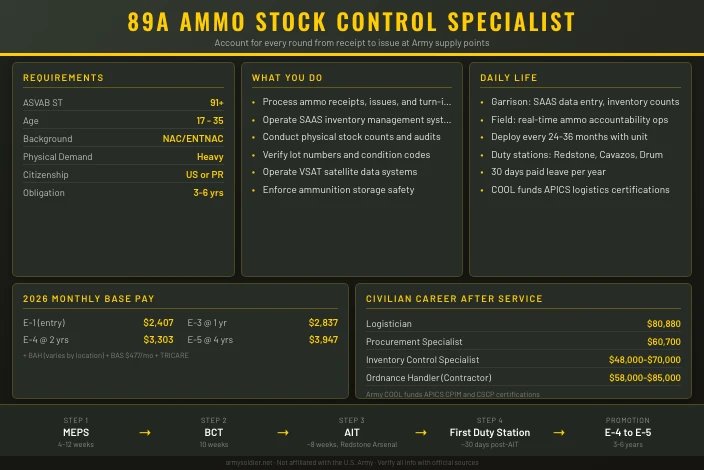
Ammunition Stock Control and Accounting Specialists perform inventory management and accounting for all classes of ammunition, explosives, and associated components at Army supply points and depot activities. They use the Standard Army Ammunition Modernized-System (SAAS) to process receipts, issues, turn-ins, and transfers, and they maintain the accuracy of ammunition records across every transaction.
Daily Tasks
In garrison, the work is database-driven. A 89A spends significant time at a computer terminal processing SAAS transactions, reconciling records, and preparing reports for the supply officer. Physical counts, lot number verification, and condition assessments are regular duties at any ammunition supply point (ASP) or combat training center.
During field operations and deployments, the pace accelerates. Units draw ammunition for training or operations, and the 89A is responsible for accurate issue, turn-in, and accountability throughout. Live fire exercises generate significant transaction volume.
Standard daily duties include:
- Processing ammunition receipts, issues, turn-ins, and transfers in SAAS
- Conducting physical inventories and reconciling system records against actual stock
- Preparing stock status reports and ammunition accountability documentation
- Verifying lot numbers, quantity counts, and condition codes for all items in storage
- Operating Very Small Aperture Terminal (VSAT) systems to transmit data between supply management systems
- Ensuring compliance with storage and safety regulations for explosive materials
Specific Roles
The 89A MOS has several duty assignment types depending on the echelon:
| Assignment Type | Setting | Focus |
|---|---|---|
| Unit Armorer / Ammo NCO | Brigade/Battalion | Issue and turn-in for organic unit ammunition accounts |
| Ammunition Supply Point (ASP) | Division/Corps | Large-volume receipt and issue operations |
| Ammunition Storage Area (ASA) / Depot | Theater/CONUS | Long-term storage and bulk inventory management |
| Retail Ammo Point | Training Center / Range | Range operations support, issue and turn-in |
Mission Contribution
No ammunition, no fire. The supply chain that puts ammunition in soldiers’ hands during training and combat depends on accurate accounting at every node. A single miscount at an ammunition supply point can delay a battalion’s training exercise or, worse, create a safety incident when live rounds are unaccounted for. The 89A’s work keeps the system honest and safe.
Technology and Equipment
- Standard Army Ammunition Modernized-System (SAAS) software
- Very Small Aperture Terminal (VSAT) satellite communication systems
- Materiel handling equipment (forklifts, pallet jacks)
- Measurement and counting equipment for ammunition inspection
- Standard Army automation systems for reporting and documentation
Salary and Benefits
Base Pay
Pay is set by the 2026 DFAS pay tables.
| Rank | Time in Service | Monthly Base Pay |
|---|---|---|
| E-1 (PV1) | Entry | $2,407 |
| E-2 (PV2) | 6 months | $2,698 |
| E-3 (PFC) | 1 year | $2,837 |
| E-4 (SPC) | 2 years | $3,303 |
| E-5 (SGT) | 4 years | $3,947 |
| E-6 (SSG) | 8 years | $4,613 |
Allowances and Additional Benefits
Soldiers living off-post receive Basic Allowance for Housing (BAH) based on duty location and dependent status. The Basic Allowance for Subsistence (BAS) is $476.95 per month for all enlisted soldiers in 2026.
Additional benefits:
- TRICARE: No-cost medical, dental, and vision coverage for the soldier while on active duty
- Post-9/11 GI Bill: Up to 36 months of education benefits after service, covering full in-state public university tuition plus a monthly housing allowance
- Tuition Assistance: Up to $4,500 per year for college courses taken while serving
- Army COOL: Funds civilian credentials including supply chain and logistics certifications
Retirement
Under the Blended Retirement System (BRS), soldiers who serve 20 years receive a pension worth 40% of their highest 36-month average basic pay. The TSP government match contributes up to 5% of basic pay, beginning in the third year of service.
Work-Life Balance
The Army provides 30 days of paid leave per year. Garrison assignments at ammunition supply points follow structured workday schedules. Field exercises and deployments add extended hours and weekend duty. The role is not operationally intense in the same way as combat arms, but mission-critical accountabilities create their own pressure during high-optempo periods.
Qualifications and Eligibility
Requirements Table
| Requirement | Details |
|---|---|
| ASVAB Line Score | ST: 91 |
| Age | 17-35 (waiver possible to 39) |
| Citizenship | U.S. citizen or permanent resident alien |
| Education | High school diploma or GED |
| Background Check | Favorable NAC or ENTNAC required |
| Physical Demand | Heavy |
| Security Clearance | Not required (background investigation required) |
| AFQT Minimum | 31 (HS diploma) or 50 (GED) |
The ST (Skilled Technical) composite is derived from GS + VE + MK + MC subtests. A score of 91 is a moderate requirement that reflects the technical nature of the inventory and accounting work.
Application Process
- Meet with a recruiter and take the ASVAB at MEPS
- Pass the physical exam and confirm Heavy physical demand capability
- Clear the NAC/ENTNAC background investigation
- Request MOS 89A in your enlistment contract
Selection and Competitiveness
The ST 91 minimum is accessible to well-prepared recruits. Prior experience with inventory systems, bookkeeping, or logistics work is useful background. The background check requirement eliminates applicants with certain criminal convictions, particularly those involving theft or fraud.
Service Obligation
Standard contracts run 3, 4, or 6 years. The 89A pipeline totals roughly 18 weeks (BCT plus AIT) before arriving at a first unit.
See our ASVAB study guide for strategies to hit these line scores, or take the PiCAT from home if you are a first-time tester.
Work Environment
Setting and Schedule
The working environment varies by assignment. Ammunition supply points and storage areas are typically warehouse-style facilities with outdoor storage areas. The work involves both computer-based accounting and physical warehouse operations including materiel handling equipment. Some assignments are predominantly indoor; others involve significant outdoor stock management.
The schedule at a garrison ASP follows standard duty hours. During field exercises, the tempo increases substantially, and 89A soldiers may run extended hours supporting unit ammunition draws.
Chain of Command
At the unit level, an 89A may serve as the unit Ammunition NCO, reporting to the property book officer or supply officer. At battalion and brigade ASPs, they work within an ammunition platoon structure under an Ordnance warrant officer or officer. The chain of command is typically clear and functional.
Team Dynamics
Ammunition accounting can be both team and individual work. Inventory counts require teams to work accurately under time pressure. System entries and report generation are often individual tasks. The stakes of errors mean peer oversight and double-checking are built into the work culture.
Job Satisfaction
Soldiers who like logistics, systematic work, and the satisfaction of maintaining accurate records tend to do well here. The early responsibility is real: a junior 89A may be managing accountability for hundreds of thousands of dollars of ammunition within the first year. That responsibility is a selling point for many and a stressor for others.
Training and Skill Development
Initial Training
| Phase | Location | Length | Focus |
|---|---|---|---|
| Basic Combat Training (BCT) | Various | 10 weeks | Soldier fundamentals, weapons, fitness |
| Advanced Individual Training (AIT) | Redstone Arsenal, AL | ~8 weeks | SAAS operations, ammunition accounting procedures, storage regulations, safety |
| First Duty Station | Varies | Ongoing | Live ammunition accountability missions |
AIT at Redstone Arsenal in Huntsville, Alabama is run by the Ordnance school. The course covers the full scope of SAAS operations, ammunition accounting doctrine, explosive storage safety regulations, and materiel handling. Graduates are fully qualified to operate an ammunition supply point or serve as a unit ammunition NCO.
Advanced Training
89A soldiers can pursue:
- Senior leader courses through the Ordnance School at Redstone Arsenal
- SAAS Master Operator qualification for advanced system management roles
- Army COOL certifications in supply chain, logistics, and inventory management
- APIC (Army Petroleum and Industrial College) logistics management programs at senior grades
The Army COOL program lists several civilian credentials aligned with 89A skills, including APICS Certified Supply Chain Professional (CSCP) and CPIM certifications, which are widely recognized by civilian employers.
Everything starts with qualifying ASVAB scores — our study guide covers what to study first.
Career Progression and Advancement
Rank Progression
| Grade | Title | Typical Time in Grade | Key Milestone |
|---|---|---|---|
| E-1 to E-3 | Private / PFC | 0-18 months | Complete AIT, first unit assignment |
| E-4 | Specialist (SPC) | 18-36 months | Unit ammo NCO duties, SAAS proficiency |
| E-5 | Sergeant (SGT) | 3-6 years | Supervise ammunition section operations |
| E-6 | Staff Sergeant (SSG) | 6-10 years | OIC accountability, ASP section leadership |
| E-7 | Sergeant First Class (SFC) | 10-15 years | Platoon-level ammunition operations |
| E-8 | Master Sergeant (MSG) | 15-20+ years | Senior technical advisor, 1SG track |
Transfers and Flexibility
89A experience provides a strong foundation for reclassification to related logistics and supply MOSs such as 92A (Automated Logistical Specialist) or 89B (Ammunition Specialist). The inventory management and accounting skills also transfer to warrant officer tracks in property accountability (920A).
Performance Evaluation
NCO evaluations through the NCOER system reward technical competence in SAAS operations, accountability accuracy rates, and the ability to run efficient ASP operations. Soldiers with zero accountability discrepancies and strong audit records build reputations that drive promotion board selection.
Physical Demands and Medical Evaluations
Fitness Standards
89A is rated Heavy physical demand. Every soldier must pass the Army Fitness Test (AFT) with a minimum of 60 points per event.
| AFT Event | Description | Min Score |
|---|---|---|
| MDL | 3-Rep Max Deadlift | 60 pts |
| HRP | Hand Release Push-Up | 60 pts |
| SDC | Sprint-Drag-Carry | 60 pts |
| PLK | Plank | 60 pts |
| 2MR | Two-Mile Run | 60 pts |
| Total | 300 pts minimum |
Scores are sex- and age-normed. The Heavy physical demand reflects the materiel handling requirements of the job: moving ammunition containers, pallets, and cases requires real physical capacity.
Medical Evaluations
Standard annual physicals apply. There are no MOS-specific medical restrictions beyond the initial MEPS screening, but candidates with back or joint conditions should discuss the physical demands of ammunition handling with the recruiter and MEPS examiner.
Deployment and Duty Stations
Deployment Details
Ammunition accountability is required wherever Army units deploy. 89A specialists deploy with their units or as individual augmentees to theater ammunition activities. Deployment cycles depend heavily on unit type: active component ordnance units may deploy every 24-36 months for 9-12 months. The job function changes in deployment from garrison accountability to real-time combat operations support.
During combat operations, keeping ammunition flowing accurately and safely to units in contact is a high-pressure, high-stakes mission. The 89A’s accountability work is directly connected to operational readiness.
Duty Stations
Ammunition-related assignments are spread across the Army. Common duty locations include:
- Redstone Arsenal, AL (Ordnance School, Materiel Retrieval/Test Activity)
- Fort Bragg / Fort Liberty, NC
- Fort Cavazos, TX (III Corps)
- Fort Campbell, KY (101st Airborne)
- Fort Drum, NY (10th Mountain Division)
- OCONUS: Korea (Camp Humphreys), Germany, and theater ammunition activity assignments
Risk, Safety, and Legal Considerations
Job Hazards
Working with ammunition and explosives carries inherent risk. Improper handling, storage violations, or ignition events are the primary hazards. Ammunition storage areas have strict safety protocols precisely because the consequences of negligence are severe.
Safety Protocols
Army ammunition operations are governed by AR 700-156 (Munitions Support), DA Pam 700-16, and Department of Defense Explosives Safety Board (DDESB) standards. Every 89A is trained in proper handling, storage configuration, lot compatibility, and emergency response procedures. Storage areas are inspected regularly.
Legal and Accountability Obligations
Ammunition accountability is a legal obligation under Army regulations. Discrepancies in ammunition records are subject to investigation and can result in administrative or judicial action if negligence or misconduct is found. This makes accuracy and integrity non-negotiable on the job.
The service contract is a binding obligation. Separation before contract completion triggers potential bonus recoupment if applicable.
Impact on Family and Personal Life
Family Considerations
89A garrison assignments at ordnance units or ASPs offer reasonably predictable schedules compared to combat arms. Field exercises and deployments interrupt this. Military housing or BAH, combined with TRICARE coverage, reduces the financial complexity of supporting a family on an entry-level enlisted salary.
Army family support resources include Military OneSource, chaplain support, and installation Family Readiness Groups. Installations with large ordnance presences like Redstone Arsenal have established community support networks.
Relocation
Standard PCS cycle is every 2-4 years. Redstone Arsenal is an unusually stable assignment for this MOS given the Ordnance School presence. Soldiers with families often appreciate this if they stay in the Huntsville, Alabama area, which has a strong defense contractor community and reasonable cost of living.
Reserve and National Guard
The 89A Ammunition Stock Control and Accounting Specialist is available in both the Army Reserve and Army National Guard. Ammunition supply points (ASPs) and ordnance companies in both components carry 89A positions. The Army Reserve maintains several ammunition-focused units, and Guard states with large training installations also have 89A billets. The total number of positions is smaller than general logistics MOS but consistent across both components.
Drill Schedule and Training Commitment
Standard commitment is one weekend per month (Battle Assembly) plus two weeks of Annual Training per year. Drill weekends for 89A soldiers include Standard Army Ammunition System (SAAS) refresher training, inventory procedures, lot number tracking exercises, and ammunition safety reviews. Annual Training typically involves operating an ammunition supply point during a larger exercise. Additional training days may be needed for ammunition safety officer recertification.
Part-Time Pay
An E-4 with over 3 years of service earns about $464 per drill weekend (4 drill periods), totaling roughly $5,572 per year from drill pay plus about $1,741 for 15 days of Annual Training. Active-duty E-4 base pay is $3,482 per month.
Benefits Differences
Tricare Reserve Select costs $57.88 per month for member-only or $286.66 per month for family coverage in 2026. Active-duty TRICARE Prime is free.
Education benefits include Federal Tuition Assistance ($250 per credit hour, up to $4,500 per year) and the Montgomery GI Bill-Selected Reserve at $493 per month for full-time students. Guard members may qualify for state tuition waivers. Mobilization of 90 or more days earns Post-9/11 GI Bill eligibility.
Reserve retirement is points-based, requiring 20 qualifying years. Collection starts at age 60, reduced by 3 months per 90-day mobilization after January 2008, minimum age 50.
Deployment and Mobilization
89A soldiers in Reserve/Guard units see moderate mobilization rates. Ammunition operations are needed for every deployment, and ordnance units have been activated for overseas rotations. Typical mobilizations run 9 to 12 months. Frequency is comparable to other combat service support MOS.
Civilian Career Integration
The 89A pairs with civilian careers in inventory management, hazardous materials logistics, and defense industry ammunition supply. Ammunition accountability skills transfer to civilian ordnance depots, defense contractors, and federal agencies that manage explosive materials. USERRA protects your civilian job during activations, and employers must reinstate you with the seniority you would have earned.
| Feature | Active Duty | Army Reserve | Army National Guard |
|---|---|---|---|
| Commitment | Full-time | 1 weekend/month + 2 weeks/year | 1 weekend/month + 2 weeks/year |
| Monthly Pay (E-4, 3+ yrs) | $3,482 | ~$464/drill weekend | ~$464/drill weekend |
| Healthcare | TRICARE Prime ($0) | Tricare Reserve Select ($57.88/mo) | Tricare Reserve Select ($57.88/mo) |
| Education | Federal TA, Post-9/11 GI Bill | Federal TA, MGIB-SR ($493/mo) | Federal TA, MGIB-SR, state tuition waivers |
| Deployment Tempo | Regular rotations | Moderate mobilization | Moderate mobilization |
| Retirement | 20-year pension at age 40+ | Points-based, collect at age 60 | Points-based, collect at age 60 |
Post-Service Opportunities
Ammunition accounting skills transfer to civilian supply chain, logistics, and inventory management careers. The government contracting sector also hires veterans with Army ammunition and ordnance experience for depot and logistics support roles.
| Civilian Job Title | Median Annual Salary | Job Outlook |
|---|---|---|
| Logistician | $80,880 | +17% (2024-2034) |
| Purchasing Agent / Procurement Specialist | $60,700 | +2% (2024-2034) |
| Inventory Control Specialist | $48,000-$70,000 | Steady demand |
| Explosives Worker / Ordnance Handler | $58,000-$85,000 | Specialized demand |
Salary data from BLS Occupational Outlook Handbook (May 2024 data).
Army COOL-funded certifications like the APICS CPIM (Certified in Planning and Inventory Management) or CSCP directly increase civilian hiring prospects and starting salaries in supply chain roles. Defense contractors with ammunition depot contracts actively recruit veterans with SAAS experience and NAC clearances.
Is This a Good Job for You? The Right (and Wrong) Fit
Ideal Candidate
This MOS fits well if you:
- Like systematic, detail-oriented work where accuracy matters
- Are comfortable with both computer-based database work and physical warehouse operations
- Want a logistics and supply chain skill set that transfers directly to civilian careers
- Can take accountability seriously and maintain zero-defect standards on records
- Are comfortable working around hazardous materials with strict safety protocols
Potential Challenges
The work lacks the tactical action and field intensity that some enlistees are seeking. Long stretches of SAAS data entry and physical inventory counts in warehouse environments are the reality, not an exception. Errors in this job have consequences beyond a simple correction, so the pressure to maintain perfect records is constant.
Soldiers who find they perform better in dynamic, unpredictable environments may find the structured, process-driven nature of ammunition accounting limiting. Reclassification to an adjacent logistics or combat MOS is possible after an initial contract.
Career and Lifestyle Alignment
If you want a technical logistics career, early real responsibility, and a direct path to APICS certifications and supply chain management roles in the civilian sector, 89A delivers on those goals. The ordnance and ammunition contracting market is significant, and veterans with this background compete well. If you want a more physically dynamic Army career, look at 89B (Ammunition Specialist) or other CMF 89 roles with more field and range operations.
More Information
Talk to an Army recruiter about current 89A availability, duty station options, and the background investigation process. Verify current AIT schedule and location with the recruiter, as these can change with Army training base realignments.
- Prepare for the ASVAB with our study guide to make sure your line scores qualify
This site is not affiliated with the U.S. Army or any government agency. Verify all information with official Army sources before making enlistment or career decisions.
Explore more Army ordnance and EOD careers such as 89B Ammunition Specialist and 89D Explosive Ordnance Disposal Specialist.