89B Ammunition Specialist
Every round fired in combat starts with someone who stored it, inspected it, and put it in the right hands at the right time. That’s the 89B Ammunition Specialist – the soldier keeping the Army’s weapons loaded and its explosives accounted for. It’s a job with real technical depth, significant physical demands, and a civilian career track that not many people know exists.
Qualifying requires specific ASVAB line scores — our ASVAB study guide covers what to target and how to prepare.
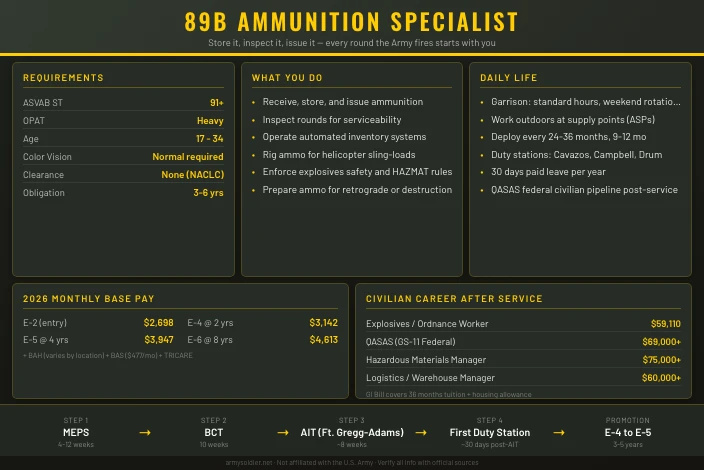
Job Role and Responsibilities
The 89B Ammunition Specialist manages the Army’s conventional ammunition, guided missiles, explosives, and their components from receipt through storage, issue, and disposal. Soldiers in this MOS handle inventory control, hazardous material compliance, weapons system inspections, and the controlled destruction of expired or unserviceable munitions. They work in ammunition supply points (ASPs), brigade support battalions, and theater-level logistics units across the full range of Army operations.
Daily Tasks
The day-to-day work is a mix of physical labor, documentation, and technical judgment. On any given shift, an 89B might be:
- Receiving, sorting, and storing incoming ammunition shipments by lot number and type
- Conducting visual and technical inspections to assess serviceability of rounds and components
- Processing ammunition requests from supported units and preparing loads for transport
- Maintaining detailed inventory records in Army automated ammunition systems
- Enforcing explosives safety regulations, storage standards, and fire protection measures
- Preparing ammunition for retrograde (returning it to a higher echelon) or for destruction
- Loading and rigging ammunition bundles for helicopter sling-load operations
Senior 89Bs supervise teams, conduct quality assurance inspections, and serve as technical advisors to commanders on all matters related to ammunition status and explosives safety.
Specific Roles
The primary classification within CMF 89 for ammunition work is MOS 89B. Soldiers can also earn Additional Skill Identifiers (ASIs) that expand their qualifications – for example, the V5 ASI for Ammunition Inspector or specialized demolitions training. The warrant officer pathway in this career field is MOS 890A, Ammunition Warrant Officer, which focuses on planning and managing ammunition distribution at the operational and theater level.
| Code | Type | Description |
|---|---|---|
| 89B | MOS (Primary) | Ammunition Specialist (enlisted) |
| 890A | Warrant Officer MOS | Ammunition Warrant Officer |
| V5 | ASI | Ammunition Inspector |
Mission Contribution
Ammunition is what turns military capability into combat power. Without a functioning supply chain from depot to trigger, every weapon system becomes inert. The 89B is the link between strategic stockpiles and the soldier pulling the trigger. They ensure rounds arrive in the right quantity, in serviceable condition, with the proper documentation – and that anything unserviceable gets removed from circulation before it fails at the wrong moment.
Technology and Equipment
89B Soldiers work with automated ammunition management systems, including the Integrated Logistics Analysis Program (ILAP) and Standard Army Ammunition System-Modernized (SAAS-MOD), which track inventory across the supply chain. They operate forklifts, all-terrain cranes, and material handling equipment to move large ammunition pallets and crates. For sling-load operations, they rig and certify loads for CH-47 Chinook helicopters. Soldiers also use portable electronic inspection equipment to check ammunition lot data and serviceability status in the field.
Salary and Benefits
Base pay is set by rank and years of service, published annually by the Defense Finance and Accounting Service. The 2026 rates reflect a 3.8% across-the-board increase effective January 1, 2026.
Base Pay Table (2026)
| Rank | Pay Grade | Entry Pay (under 2 yrs) | Pay at 4 yrs | Pay at 8 yrs |
|---|---|---|---|---|
| Private (PV2) | E-2 | $2,698 | $2,698 | – |
| Private First Class | E-3 | $2,837 | $3,198 | – |
| Specialist | E-4 | $3,142 | $3,659 | $3,816 |
| Sergeant | E-5 | $3,343 | $3,947 | $4,299 |
| Staff Sergeant | E-6 | $3,401 | $4,069 | $4,613 |
| Sergeant First Class | E-7 | $3,932 | $4,663 | $5,105 |
Most soldiers enter at E-1 or E-2. If you arrive with college credits or an Eagle Scout designation, you may qualify for an accelerated entry grade.
Additional Benefits
On top of base pay, soldiers receive a flat Basic Allowance for Subsistence (BAS) of $476.95 per month (2026 rate) to cover food costs. Soldiers living off-post also receive Basic Allowance for Housing (BAH), which varies by duty location and dependency status. At a mid-CONUS installation, a single E-4 typically receives around $1,350 to $1,700 per month in BAH – tax-free.
Healthcare through TRICARE Prime covers the soldier and all dependents with no enrollment fees, no deductibles, and no copays at military treatment facilities. Dental and vision are included. The Army also offers up to $4,500 per year in Tuition Assistance for college coursework taken while on active duty, plus access to the Post-9/11 GI Bill (up to $29,920.95 per year at private schools for the 2025-2026 academic year) upon separation.
Work-Life Balance
Active duty soldiers earn 30 days of paid leave per year, accruing at 2.5 days per month. Most garrison schedules follow a standard duty day with weekends off, though ASP operations can require weekend duty rotations when mission tempo is high. Deployment and field exercises disrupt the predictable schedule, but the work itself tends to be day-shift heavy compared to many combat arms jobs.
Qualifications and Eligibility
Qualification Table
| Requirement | Minimum Standard |
|---|---|
| ASVAB Line Score | ST: 91 |
| AFQT (minimum enlistment) | 31 (HS diploma); 50 (GED) |
| Age | 17-34 (waiver possible to 42) |
| Citizenship | U.S. citizen or permanent resident |
| Physical Demand Category (OPAT) | Heavy |
| Security Clearance | None required (NACLC background check) |
| Color Vision | Normal color vision required |
| Medical | No allergy to explosive materials; no claustrophobia |
| Service Obligation | 3-6 years (varies by contract) |
The OPAT Heavy category means you need to demonstrate the ability to perform tasks requiring frequent lifting of 50 pounds and occasional loads over 100 pounds. If you don’t meet the Heavy category threshold during OPAT testing at MEPS, you will not qualify for this MOS.
Application Process
Selection and Competitiveness
The 89B isn’t among the Army’s most competitive MOS slots, but seat availability fluctuates. If it isn’t available at your preferred contract length, consider requesting an alternate start date or discussing an 89A (Ammunition Stock Control Specialist) as a related option. Prior experience in warehouse operations, chemistry, or any licensed explosives handling is a legitimate talking point with a recruiter, though no civilian prerequisites are required.
Service Obligation
Most soldiers enter as Private (E-1) or Private (E-2) and serve an initial contract of three to six years. Soldiers who reclass into 89B from another MOS typically already hold E-4 or higher and attend a condensed qualification course rather than the full AIT pipeline.
See our ASVAB study guide for strategies to hit these line scores, or take the PiCAT from home if you are a first-time tester.
Work Environment
89Bs spend the majority of their time at ammunition supply points – dedicated storage areas on post that can range from small Forward Operating Base (FOB) bunkers to large, spread-out storage complexes with dozens of earth-covered bunkers called igloos. The work is predominantly outdoors regardless of weather, because you can’t let ammunition-handling schedules slip due to rain.
Setting and Schedule
Garrison work at a stateside ASP typically runs Monday through Friday, with scheduled weekend rotations for inventory accountability. The bunker environment requires following strict explosives safety regulations, which means deliberate, methodical work at all times. During deployment to a combat zone, 89Bs may operate around the clock to keep up with mission tempo.
Leadership and Communication
89Bs operate in small, tight-knit teams. At the E-5 level, you’re leading a team of two to four soldiers through daily ASP operations and inspections. By E-6, you’re the section sergeant running all inventory control and coordinating directly with brigade S4 staff on ammunition requirements and shortfalls. Performance feedback comes through the Non-Commissioned Officer Evaluation Report (NCOER) system, which is tied directly to promotion eligibility.
Team Dynamics and Autonomy
The work demands precision and accountability above all else. Ammunition accountability errors have serious legal and safety consequences, so the job culture is process-oriented and standards-driven. That said, experienced 89Bs have significant technical autonomy – junior soldiers generally don’t make decisions about serviceability or disposal. Those calls belong to qualified inspectors.
Job Satisfaction
Soldiers in this MOS frequently cite the sense of ownership over their supply point as a source of professional satisfaction. The job has clear metrics for success: inventory accuracy rates, serviceability percentages, and zero-defect explosives safety records. There’s less direct combat exposure than many Army jobs, which some soldiers find preferable – though 89Bs do deploy in support of combat operations.
Training and Skill Development
Training Pipeline Table
| Phase | Location | Length | Focus |
|---|---|---|---|
| Basic Combat Training (BCT) | Various installations | 10 weeks | Soldiering fundamentals, weapons qualification, fitness |
| Advanced Individual Training (AIT) | Fort Gregg-Adams, VA (Ordnance School) | ~8 weeks | Ammunition identification, storage, inspection, inventory systems |
| Additional certification (Reservists/Reclassees) | Fort McCoy, WI (RTS-M) | 4 weeks | Compressed qualification course for reclassifying soldiers |
Initial Training
BCT is the same for every enlisted soldier – 10 weeks of physical conditioning, weapons qualification, land navigation, and Army values. Your MOS specialty doesn’t matter during BCT. After BCT, you report to the Munitions and EOD Training Department at the U.S. Army Ordnance School, Fort Gregg-Adams, Virginia for AIT.
The 89B AIT course (645-89B10) runs approximately eight weeks. It covers ammunition identification and cataloging across the Army’s entire inventory – from small arms cartridges to guided missiles. You’ll learn the Army’s automated ammunition management systems, explosives safety regulations, and the handling procedures for each class of ammunition. Field exercises include sling-load rigging for air delivery and ammunition transfer point operations.
Advanced Training
Once you hit E-6 and attend the Advanced Leader Course (ALC) at Fort Gregg-Adams, there’s a hands-on practicum at Fort McCoy’s Ammunition Supply Point where you learn detailed inspection procedures for every major ammunition type in the inventory. The transition from E-5 to E-6 is a significant jump in technical responsibility – you’re now the person who signs off on serviceability decisions.
Beyond ALC, experienced 89Bs can pursue:
- Air Assault School (Fort Campbell) – qualifies you for sling-load operations planning
- Airborne School (Fort Moore) – opens airborne unit assignments
- Hazardous Materials (HAZMAT) certification – required for commercial transportation compliance
- Ammunition Inspector (ASI V5) – advanced qualification for depot-level inspection duties
- Warrant Officer Candidacy – the 890A pathway is a common career goal for technically strong 89Bs
The Army also supports civilian college coursework through Tuition Assistance. Many 89Bs pursue degrees in logistics, supply chain management, or chemical technology while on active duty.
Everything starts with qualifying ASVAB scores — our study guide covers what to study first.
Career Progression and Advancement
Rank Progression Table
| Rank | Pay Grade | Typical Time to Achieve | Key Milestone |
|---|---|---|---|
| Private (PV1/PV2) | E-1/E-2 | Entry | BCT graduation |
| Private First Class | E-3 | 6-12 months | AIT graduation |
| Specialist (SPC) | E-4 | 18-24 months | Basic proficiency established |
| Sergeant (SGT) | E-5 | 3-5 years | Team leader; SSD1 + PLDC/BLC required |
| Staff Sergeant (SSG) | E-6 | 6-10 years | Section sergeant; ALC completion |
| Sergeant First Class (SFC) | E-7 | 11-15 years | Platoon sergeant; SLC completion |
| Master Sergeant (MSG) | E-8 | 16-20 years | Senior advisor role |
| Sergeant Major (SGM) | E-9 | 20+ years | Nominative/CSM track |
Career Path
Most 89Bs spend their first four years as a team member learning the technical fundamentals of ASP operations. Promotion to E-5 typically comes at the three-to-five year mark and requires completion of the Basic Leader Course (BLC) and achieving Skill Level 2 proficiency. At E-6, you’re running an ammunition section – managing inventory records, coordinating with supported units, and supervising inspections.
One of the strongest career moves available to a motivated 89B is applying for the 890A Ammunition Warrant Officer program. Warrant officers in this field are the Army’s senior technical experts on ammunition distribution planning. Army Recruiting Command’s 890A program page details the requirements, which typically include at least two years as an E-5 or above in CMF 89.
Role Flexibility
Soldiers who want to broaden their logistics experience can apply to attend the Property Accountability Officer course and cross-train in supply chain functions. Lateral reassignment to 89A (Stock Control Specialist) is also possible and useful for soldiers who want more of the administrative inventory side and less of the physical handling work.
Performance Evaluation
NCOs are evaluated through the Non-Commissioned Officer Evaluation Report (NCOER), which rates performance in character, presence, intellect, leads, develops, and achieves. For 89Bs, the “achieves” domain is heavily weighted toward measurable outcomes: inventory accuracy, zero safety violations, and unit readiness metrics tied to ammunition availability.
Physical Demands and Medical Evaluations
Ammunition handling is physically demanding. A standard 105mm artillery round weighs approximately 100 pounds. A 155mm projectile weighs about 95 pounds before the propellant charge and fuse. Moving hundreds of these rounds through a supply point in a single shift is hard work that requires functional strength, not just the ability to pass a fitness test.
Army Fitness Test (AFT)
The Army Fitness Test replaced the ACFT on June 1, 2025. It has five events and is scored on a 0-100 scale per event, with 500 as the maximum. The minimum passing standard is 300 total points with at least 60 points per event, normed by sex and age. The 89B does not fall under the combat specialty standard (which requires 350 points).
| AFT Event | Abbreviation | What It Tests |
|---|---|---|
| 3 Rep Max Deadlift | MDL | Lower body and grip strength |
| Hand Release Push-Up | HRP | Upper body muscular endurance |
| Sprint-Drag-Carry | SDC | Functional fitness and speed |
| Plank | PLK | Core stability |
| Two-Mile Run | 2MR | Cardiovascular endurance |
Daily Physical Demands
The physical load on the job is real. Most duty days involve repeated lifting, lowering, and moving of heavy items using both manual handling and material handling equipment. Soldiers must be able to work safely in confined igloo storage spaces, wearing required personal protective equipment. Hearing protection is mandatory in certain storage areas due to equipment noise.
Medical Evaluations
Soldiers receive a full medical evaluation at MEPS before enlistment. Periodic Soldier Readiness Processing (SRP) ensures soldiers remain medically deployable throughout their career. Any condition that limits heavy lifting or creates a risk around explosive materials will be evaluated for profile or MOS change.
Deployment and Duty Stations
89Bs serve Army-wide – wherever there’s a supported unit, there’s a requirement for ammunition logistics. Common stateside installations include:
- Fort Cavazos (formerly Fort Hood), TX – large armored force, high ammunition demand
- Fort Campbell, KY – airborne and air assault units with specialized ammunition requirements
- Fort Drum, NY – light infantry with cold-weather operations
- Fort Wainwright, AK – arctic environment operations
- Fort Gregg-Adams, VA – Ordnance School and training base assignments
- Joint Base Lewis-McChord, WA – Stryker brigade and airborne support
Overseas assignments include Korea, Germany (Grafenwoehr), and rotational deployments to CENTCOM and AFRICOM areas of responsibility.
Deployment Details
89Bs deploy in support of combat operations and theater sustainment missions. Typical deployment length is nine to twelve months, with combat deployments to areas like the Middle East being the most common. 89Bs do not typically conduct direct combat missions, but they work in forward operating areas where indirect fire and force protection are real considerations. Deployment frequency depends heavily on your unit’s rotation cycle – some units deploy every two to three years.
Location Flexibility
Duty station assignments go through the Human Resources Command (HRC) assignment process. Soldiers can submit preference statements and are considered for assignments based on Army needs, their rank, and prior assignment history. Soldiers who speak a second language, hold additional qualifications like Airborne, or volunteer for specific programs have more say in the assignment process.
Risk, Safety, and Legal Considerations
Working with explosives carries inherent risk that cannot be fully engineered away. The Army manages this through rigorous training, strict regulation, and a safety culture that treats every procedure as non-negotiable.
Job Hazards
- Detonation risk from improper handling of unstable or damaged munitions
- Fire risk in ammunition storage areas
- Exposure to propellant gases and chemical compounds during inspection and demilitarization
- Physical injury from heavy material handling
- Risk from enemy indirect fire during deployed ASP operations
Safety Protocols
Army Regulation AR 385-10 and DA Pam 385-64 govern ammunition and explosives safety. Every soldier working in an ASP completes formal explosives safety training before touching any ammunition. Quantity-distance calculations determine how much ammunition can be stored in a given location relative to inhabited buildings and roads. There are minimum safe separation distances for every class of ammunition, and violations can result in suspension of operations.
Security and Legal Requirements
No security clearance is required to enlist as an 89B, but every soldier undergoes a National Agency Check with Local Agency Checks and Credit Check (NACLC). A criminal history involving controlled substances, explosives charges, or serious felonies will likely disqualify you. Given that this MOS handles weapons and explosives, the Army takes the background investigation seriously.
The initial service obligation is three to six years depending on your enlistment contract. Breaking your contract has legal consequences under the Uniform Code of Military Justice (UCMJ) and may result in recoupment of any bonus or training-related costs.
Impact on Family and Personal Life
Life in the 89B MOS is more predictable in garrison than many Army jobs, but deployment cycles and field exercises still create periods of extended separation. Most stateside ASP jobs run on a standard duty schedule, which allows for family life, school schedules, and community involvement during non-deployed periods.
Family Considerations
Families of active duty soldiers have access to a substantial support network. Army Community Service (ACS) provides counseling, financial planning assistance, employment referrals for spouses, and family readiness support during deployments. Military OneSource offers free counseling, financial coaching, and crisis referrals around the clock.
TRICARE Prime covers all family members at no cost at military treatment facilities. On-post schools, childcare centers, and housing are available at most major installations, though waitlists for on-post housing can run six to twelve months at high-demand installations.
Relocation and Flexibility
Permanent Change of Station (PCS) moves happen on average every two to three years. The Army pays for the physical household goods move, and soldiers receive a Dislocation Allowance (DLA) to offset transition costs. Frequent moves are one of the more disruptive aspects of Army life for families, particularly for spouses with portable careers and children in established school programs.
Reserve and National Guard
The 89B Ammunition Specialist is available in both the Army Reserve and Army National Guard. Ammunition companies and ordnance battalions in both components carry 89B positions. The Army Reserve has a strong ammunition support presence, and most Guard states with Ammunition Supply Points have 89B billets.
Drill Schedule and Training Commitment
Standard commitment is one weekend per month (Battle Assembly) plus two weeks of Annual Training per year. Drill weekends for 89B soldiers include ammunition handling procedures, storage inspections, HAZMAT refresher training, and supply point operations. Annual Training typically involves operating a field ammunition supply point or supporting live-fire exercises with ammunition issue. Additional training days may be needed for explosive safety recertification and HAZMAT credential renewal.
Part-Time Pay
An E-4 with over 3 years of service earns about $464 per drill weekend (4 drill periods), totaling roughly $5,572 per year from drill pay plus about $1,741 for 15 days of Annual Training. Active-duty E-4 base pay is $3,482 per month.
Benefits Differences
Tricare Reserve Select costs $57.88 per month for member-only or $286.66 per month for family coverage in 2026. Active-duty TRICARE Prime is free.
Education benefits include Federal Tuition Assistance ($250 per credit hour, up to $4,500 per year) and the Montgomery GI Bill-Selected Reserve at $493 per month for full-time students. Guard members may qualify for state tuition waivers. Mobilization of 90 or more days earns Post-9/11 GI Bill eligibility.
Reserve retirement is points-based, requiring 20 qualifying years. Collection starts at age 60, reduced by 3 months per 90-day mobilization after January 2008, minimum age 50.
Deployment and Mobilization
89B soldiers in Reserve/Guard units see moderate mobilization rates. Ammunition support is essential for any sustained operation, and ordnance units have been activated regularly. Typical mobilizations run 9 to 12 months. Frequency is comparable to other logistics MOS.
Civilian Career Integration
The 89B pairs with civilian careers in ammunition depot operations, HAZMAT handling, explosive safety, and defense logistics. Federal installations like Army ammunition plants and depots hire civilian ammunition handlers. HAZMAT and explosive safety certifications earned through military training are recognized by civilian employers. USERRA protects your civilian job during activations, and employers must reinstate you with the seniority you would have earned.
| Feature | Active Duty | Army Reserve | Army National Guard |
|---|---|---|---|
| Commitment | Full-time | 1 weekend/month + 2 weeks/year | 1 weekend/month + 2 weeks/year |
| Monthly Pay (E-4, 3+ yrs) | $3,482 | ~$464/drill weekend | ~$464/drill weekend |
| Healthcare | TRICARE Prime ($0) | Tricare Reserve Select ($57.88/mo) | Tricare Reserve Select ($57.88/mo) |
| Education | Federal TA, Post-9/11 GI Bill | Federal TA, MGIB-SR ($493/mo) | Federal TA, MGIB-SR, state tuition waivers |
| Deployment Tempo | Regular rotations | Moderate mobilization | Moderate mobilization |
| Retirement | 20-year pension at age 40+ | Points-based, collect at age 60 | Points-based, collect at age 60 |
Post-Service Opportunities
The skills an 89B builds – explosives handling, inventory management, hazardous materials compliance, and technical inspection – have direct civilian value in defense contracting, mining, demolition, and federal civilian employment.
Civilian Career Table
| Civilian Job Title | Median Annual Salary | Outlook |
|---|---|---|
| Explosives Worker / Ordnance Handling Expert | ~$59,110 | Declining (-1% or lower through 2034) |
| QASAS (GS-11 Federal Civilian) | ~$69,000-$90,000 (GS-11/12 scale) | Stable |
| Hazardous Materials Manager | ~$75,000-$95,000 | Stable |
| Warehouse/Logistics Manager | ~$60,000-$80,000 | Growing |
| Defense Contractor (Ammunition Technical) | $65,000-$105,000 | Stable |
Salary data for civilian explosives workers is sourced from O*NET Online, SOC 47-5032, with 2024 BLS OEWS data.
The most direct path for experienced 89Bs is the QASAS program – Quality Assurance Specialist, Ammunition Surveillance – a federal civilian GS-series position that specifically recruits from the 89B pipeline. QASAS specialists work for the Army, Navy, and Air Force inspecting ammunition throughout its lifecycle. It’s common for retiring 89Bs to step directly into a GS-09 or GS-11 QASAS position with minimal retraining.
The Post-9/11 GI Bill provides up to 36 months of education benefits, covering full in-state tuition at public schools or up to $29,920.95 per year at private institutions (AY 2025-2026). Combined with the Vocational Rehabilitation program (Chapter 31) for service-connected disabilities, most veterans have multiple paths to funded education after service.
Transition Assistance
The Army’s Transition Assistance Program (TAP) runs a mandatory three-to-five day workshop within 180 days of your separation date. It covers resume writing, interview preparation, benefit enrollment, and VA claims. The Army Career Skills Program (CSP) connects separating soldiers with apprenticeships, credentialing programs, and employer partnerships during the final 120 days of service.
Is This a Good Job for You? The Right (and Wrong) Fit
This MOS rewards people who like methodical, high-stakes technical work over direct action. If you find satisfaction in bringing order to complex inventory systems, enforcing standards without exception, and taking technical ownership of a supply point, the 89B will suit you well.
Ideal Candidate Profile
The strongest 89B candidates tend to share a few traits:
- Detail-oriented under pressure. Ammunition accountability errors can have serious operational and legal consequences. Soldiers who thrive here treat their inventory records with the same rigor as a financial audit.
- Physically capable. This isn’t a desk job. You need functional strength for daily heavy lifting, and you have to maintain it throughout your career.
- Comfortable with regulated environments. Everything in an ASP is governed by regulation. If rigid procedures frustrate you, this will be a daily grind.
- Interest in logistics and supply chain. The best 89Bs think like supply chain managers, not just warehouse workers.
Potential Challenges
Soldiers who want frequent direct contact with combat operations or high-adrenaline missions may find the 89B frustrating. The work is important but often invisible – you succeed when nothing goes wrong. Deployments exist, but they’re support roles, not assault roles.
The job also has a physical toll. Repetitive heavy lifting over a long career contributes to musculoskeletal wear, and soldiers need to be proactive about injury prevention and physical maintenance throughout their service.
Long garrison stretches can feel monotonous for soldiers who need variety and novelty. If you chose the Army specifically to see action, the 89B pipeline is probably not your best fit.
Is This the Right Fit?
If you want technical expertise, a clear federal civilian career path after service, consistent duty hours in garrison, and the satisfaction of knowing that every round in your supply point is exactly where it should be – the 89B is a strong choice. If you need constant variety, frontline missions, or a job that prioritizes combat skills over logistics skills, look elsewhere.
More Information
Talk to an Army recruiter to confirm current bonus availability, AIT seat timelines, and assignment options for the 89B MOS. Recruiters have access to real-time vacancy data that changes monthly. You can also contact the U.S. Army Ordnance School directly through goordnance.army.mil for training information.
- Prepare for the ASVAB with our study guide to make sure your line scores qualify
This site is not affiliated with the U.S. Army or any government agency. Verify all information with official Army sources before making enlistment or career decisions.
Explore more Army Ordnance & EOD careers such as 89D Explosive Ordnance Disposal Specialist.