89D Explosive Ordnance Disposal Specialist
Every IED, unexploded bomb, and abandoned chemical weapon the Army encounters eventually lands in the hands of one specialist. The 89D Explosive Ordnance Disposal Specialist is the person who walks up to it. EOD soldiers identify, render safe, and dispose of conventional explosives, improvised devices, and weapons of mass destruction – in combat zones, on domestic ranges, and everywhere in between. The training pipeline is one of the longest in the enlisted Army at 33 weeks of AIT alone, and the job carries a Secret security clearance requirement and an enlistment bonus of up to $20,000 for qualified candidates. If you’re looking for a role where your technical decisions matter more than almost any other in the Army, this is it.
Qualifying requires specific ASVAB line scores — our ASVAB study guide covers what to target and how to prepare.
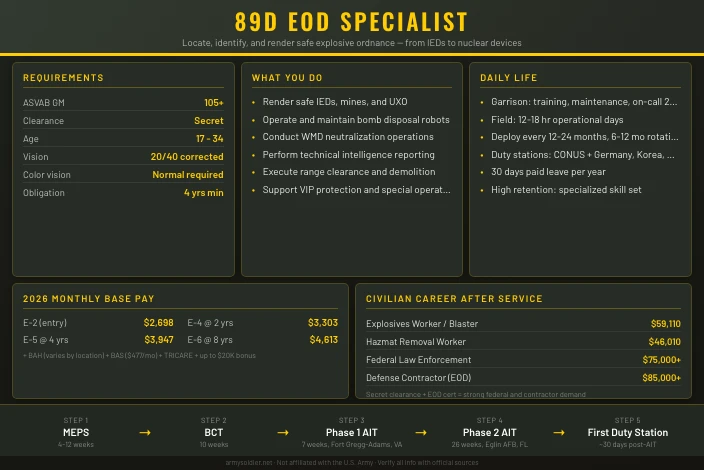
Job Role and Responsibilities
The 89D Explosive Ordnance Disposal Specialist is the Army’s primary technical expert for identifying, disabling, and destroying all categories of explosive hazards – from roadside IEDs to nuclear ordnance and chemical munitions. EOD soldiers operate across all environments and threat levels, routinely supporting conventional units, special operations forces, and civilian law enforcement. Their decisions in the field directly prevent casualties and shape tactical outcomes.
Daily Tasks
EOD work is not a single, predictable job. The mission changes based on the operating environment, but common responsibilities include:
- Locating, identifying, and rendering safe unexploded ordnance (UXO), mines, booby traps, and improvised explosive devices
- Operating bomb disposal robots and remote tools to approach suspected devices
- Conducting post-blast analysis and technical intelligence reporting after incidents
- Performing range clearance and demolition to eliminate hazardous munitions
- Supporting special operations and VIP protection details that require explosive threat mitigation
- Advising commanders on explosive hazard routes and threat patterns
In garrison, much of the day focuses on equipment maintenance, training exercises, and on-call response. In a deployed environment, a team can run multiple response calls per day.
Specialization Codes
The Army uses Additional Skill Identifiers (ASIs) to designate specialized capabilities within the 89D MOS. Senior EOD soldiers may qualify for ASIs covering nuclear EOD operations, technical intelligence, and joint EOD integration with sister services.
| Identifier | Type | Purpose |
|---|---|---|
| 89D | Primary MOS | Explosive Ordnance Disposal Specialist |
| P5 | ASI | Airborne qualification |
| V5 | ASI | Mountain warfare |
| Joint certifications | Interoperability | Air Force/Navy/Marine EOD coursework (earned at Phase 2) |
Mission Contribution
EOD teams operate at the tip of every forward mission that involves explosive threats. They protect convoys from IEDs, clear contested areas before infantry advances, and provide the only Army capability for handling chemical and nuclear munitions in the field. Every hour an EOD team spends on a range clearance or a render-safe procedure directly extends the operational reach of the units around them.
Technology and Equipment
89D specialists work with some of the most advanced equipment in the Army’s inventory. This includes the PackBot and TALON robotic systems for remote device investigation, specialized X-ray and disruptive tools, full 85-pound bomb suits, detection equipment for chemical and radiological signatures, and demolition materials for controlled destruction. Soldiers trained in nuclear EOD procedures operate under joint protocols with additional technical equipment not available in any other enlisted career field.
Salary and Benefits
Pay for a new 89D specialist follows the standard Army enlisted pay table – but EOD soldiers have access to an enlistment bonus, hazardous duty incentive pay, and a compensation package that most civilian equivalents can’t match.
Base Pay Table (2026)
All figures are monthly basic pay from DFAS 2026 military pay rates.
| Rank | Grade | Years of Service | Monthly Basic Pay |
|---|---|---|---|
| Private (PV2) | E-2 | Entry | $2,698 |
| Private First Class (PFC) | E-3 | 1 year | $2,837 |
| Specialist (SPC) | E-4 | 2 years | $3,303 |
| Sergeant (SGT) | E-5 | 4 years | $3,947 |
| Staff Sergeant (SSG) | E-6 | 8 years | $4,613 |
| Sergeant First Class (SFC) | E-7 | 12 years | $5,537 |
Allowances and Special Pay
Base pay is only part of total compensation. EOD soldiers also receive:
- Basic Allowance for Housing (BAH): Varies by duty location and dependency status. An E-4 at Fort Campbell, KY receives roughly $1,200-$1,600 per month without dependents depending on local housing markets.
- Basic Allowance for Subsistence (BAS): $476.95/month (flat enlisted rate, 2026)
- Hazardous Duty Incentive Pay (HDIP): EOD soldiers qualify for demolition duty pay. Rates vary by assignment; confirm current amounts with your recruiter or finance office.
- Enlistment bonus: Up to $20,000 for qualified new enlistees; bonus amounts are subject to change.
Additional Benefits
Healthcare is TRICARE Prime at no cost for active-duty soldiers. Coverage extends to family members with no enrollment fee and a $1,000 annual catastrophic cap for out-of-network care.
Education benefits include up to $4,500 per year in Tuition Assistance while serving, and the Post-9/11 GI Bill after separation covers full in-state tuition at public schools plus a monthly housing allowance and up to $1,000 in annual book stipends for up to 36 months.
Retirement under the Blended Retirement System (BRS) combines a 20-year pension at 40% of your high-36 average basic pay with a Thrift Savings Plan (TSP) that the Army matches up to 4% of basic pay starting in year three.
Work-Life Balance
EOD soldiers earn 30 days of paid leave per year. Garrison schedules generally follow normal duty hours except for on-call response rotations. Deployed or field environments are more demanding – 12 to 18 hour operational days are common during active missions. The specialized nature of EOD work means unit sizes are small (teams of 2-4 soldiers), which creates tight cohesion but also means fewer people share the duty burden.
Qualifications and Eligibility
EOD is a volunteer-only MOS with several non-waiverable requirements. The Army screens candidates carefully because the training investment is significant and the mission has no margin for error.
Qualification Table
| Requirement | Standard | Waiverable? |
|---|---|---|
| ASVAB GM Score | 105 minimum | Yes (waiverable) |
| Security Clearance | Secret | Yes (waiverable) |
| Citizenship | U.S. citizen | No |
| Volunteer status | Must volunteer | No |
| Color vision | Normal (no deficiency) | No |
| Hearing | Normal | No |
| Vision | Correctable to 20/40 | No |
| Prior EOD relief | Not previously relieved from EOD training | No |
| Driver’s license | Valid U.S. license | No |
| PULHES profile | 111121 | No |
The GM (General Maintenance) composite measures general science, auto and shop information, mathematics knowledge, and electronics information. A score of 105 is competitive but achievable with serious preparation. The GM score requirement is waiverable in some cases, but the physical and vision requirements are not.
Application Process
Selection Criteria and Competitiveness
EOD has a lower fill rate than most Army MOSs because the physical and vision requirements eliminate a meaningful portion of candidates before they reach training. The bomb suit assessment in Phase 1 – which tests cognitive and physical performance while wearing an 85-pound suit – filters additional candidates. Soldiers who arrive at Phase 1 physically prepared and with strong academic foundations in science and math have a significantly better completion rate.
Service Obligation
New enlistees selecting 89D commit to a minimum 4-year active-duty service obligation. Soldiers who receive an enlistment bonus carry a repayment obligation if they fail to complete their term. Those who do not complete EOD training are reclassified to another MOS rather than separated.
See our ASVAB study guide for strategies to hit these line scores, or take the PiCAT from home if you are a first-time tester.
Work Environment
Setting and Schedule
EOD soldiers work in every environment the Army operates in – motor pools, training ranges, forward operating bases, and improvised sites wherever an explosive threat is reported. In garrison, the day typically involves team training, equipment checks, and maintaining readiness for on-call response. No two days are identical, and unplanned response calls can occur at any hour.
Deployed schedules are more demanding. Teams may conduct multiple response missions per day, combined with after-action reporting, equipment inspection, and preparation for the next mission.
Leadership and Team Dynamics
EOD operates in small teams, typically two to four soldiers led by a sergeant or staff sergeant. This structure gives junior soldiers significant hands-on responsibility earlier than most other Army career fields. A Specialist (E-4) on an EOD team handles tasks that might be reserved for higher-ranking NCOs in a larger unit.
Performance evaluations follow the Army’s standard Non-Commissioned Officer Evaluation Report (NCOER) system for E-5 and above, and the Army Evaluation Entry System for lower grades. Given the technical nature of the MOS, demonstrated proficiency in render-safe procedures and mission planning carries significant weight in evaluations.
Autonomy and Decision-Making
The team leader makes tactical decisions on-scene during a response, but the EOD specialist executing the render-safe procedure often operates with direct physical autonomy in the final approach. This is not a MOS where you wait for orders at every step. The Army trains EOD soldiers to apply technical judgment in real time, which is part of why the training pipeline is so long.
Job Satisfaction and Retention
EOD soldiers consistently report high job satisfaction tied to mission clarity, team cohesion, and the visible impact of their work. The small unit structure means soldiers know their teammates well. Retention within the MOS is relatively strong compared to the broader Army enlisted population, partly because the transition to civilian contractor or federal law enforcement work is attractive enough that soldiers often extend or re-enlist to build more resume depth before separating.
Training and Skill Development
Initial Training Pipeline
The 89D training pipeline is one of the longest in the enlisted Army. From enlistment to first duty station, expect roughly 12 to 14 months of initial training.
| Phase | Location | Length | Focus |
|---|---|---|---|
| Basic Combat Training (BCT) | Various Army installations | 10 weeks | Foundational soldiering: physical fitness, weapons, Army customs |
| AIT Phase 1 | Fort Gregg-Adams, VA | 7 weeks | Bomb suit assessment, ordnance ID, explosive techniques (278 hours) |
| AIT Phase 2 | Eglin Air Force Base, FL | 26 weeks | Joint EOD: demolition, IED defeat, ground/air ordnance, nuclear/chemical hazards |
| First duty station report | Unit-dependent | ~30 days post-AIT | Unit integration and on-the-job qualification |
Phase 1 at Fort Gregg-Adams covers five instructional modules totaling 278 hours. The bomb suit assessment is a go/no-go event – failure means reassignment to a different MOS, not a second attempt.
Phase 2 at Eglin AFB is joint training shared with Air Force, Navy, and Marine Corps EOD students. This creates interoperability that matters in the field; Army EOD teams often work alongside personnel from other services on joint missions. Students work through demolition procedures, tool application, ground and air ordnance identification, IED defeat techniques, and nuclear/chemical hazard response.
Advanced Training
After reaching a duty station and completing unit qualification, EOD soldiers can pursue specialized advanced courses:
- Advanced Homemade Explosives (HME) Training: Analysis and defeat of improvised energetic materials
- Advanced IED Disposal (AIEDD): Complex device defeat scenarios, typically accessed at the E-6 level
- Joint Nuclear EOD Course: Nuclear weapon rendering safe procedures, restricted to qualified soldiers
- Airborne School (Fort Moore, GA): 3 weeks; qualifies soldiers for airborne-designated EOD units
- Mountain Warfare School: For soldiers assigned to mountain-capable units
These advanced qualifications are tied to ASI codes that appear on a soldier’s official record and directly affect assignment eligibility and promotion competitiveness.
Everything starts with qualifying ASVAB scores — our study guide covers what to study first.
Career Progression and Advancement
Rank Progression
| Rank | Grade | Typical Timeline | Primary Role |
|---|---|---|---|
| Private First Class (PFC) | E-3 | 0-1 year | Student, BCT/AIT |
| Specialist (SPC) | E-4 | 1-2 years | Junior EOD team member |
| Sergeant (SGT) | E-5 | 3-5 years | EOD team member, WMD NCO |
| Staff Sergeant (SSG) | E-6 | 6-10 years | Team leader, Coach/Trainer, Drill Sergeant |
| Sergeant First Class (SFC) | E-7 | 10-16 years | Platoon Sergeant, Operations Sergeant |
| Master Sergeant (MSG) | E-8 | 16-22 years | Senior Operations, Senior Instructor |
| Sergeant Major (SGM) | E-9 | 22+ years | Command SGM, Group-level leadership |
Timeline estimates reflect typical promotion points from the CMF 89 DA Pam 600-25 career development guide, not guarantees.
Role Flexibility and Transfers
Transferring out of 89D is uncommon but possible through the Army’s voluntary reclassification process. Most soldiers who leave the MOS do so to pursue warrant officer or officer programs, not to transfer to another enlisted MOS. The specialized nature of the training means the Army is reluctant to move qualified EOD soldiers unless there is a compelling reason or a force structure change.
Soldiers interested in warrant officer aviation (flight training) must meet SIFT test requirements and apply through the Warrant Officer Candidate School process, which is separate from the MOS system.
Performance Evaluation
NCOs (E-5 and above) are evaluated annually through the NCOER. Key rated attributes include technical competence in render-safe procedures, mission planning, physical readiness, and junior soldier development. In a small unit like an EOD team, individual contributions are visible and directly traceable. There is little room to coast on peer performance the way a soldier in a large unit might.
To succeed in this career, develop strong science and mathematics fundamentals before AIT, maintain AFT performance above the minimum threshold, pursue advanced ASI qualifications proactively, and build a reputation for sound tactical judgment in complex scenarios.
Physical Demands and Medical Evaluations
Physical Requirements
EOD soldiers carry an 85-pound bomb suit during render-safe procedures. Beyond that, they move through all terrain types, may need to carry heavy equipment to remote sites, and operate in hot, cold, and contaminated environments. Daily physical demands include equipment transport, obstacle navigation, and the sustained focus required for technically precise work under stress.
The Army Fitness Test (AFT) replaced the Army Combat Fitness Test on June 1, 2025. All soldiers must pass the AFT regardless of MOS.
Army Fitness Test (AFT) Standards
The AFT has five events scored 0-100 points each, with a maximum of 500 points. The general passing standard is 300 total points (at least 60 per event), sex- and age-normed.
| Event | Abbreviation | Description |
|---|---|---|
| 3-Rep Max Deadlift | MDL | Maximum weight lifted for 3 repetitions |
| Hand Release Push-Up | HRP | Full arm extension at bottom of each rep |
| Sprint-Drag-Carry | SDC | 250-meter course with five separate tasks |
| Plank | PLK | Timed hold in standard plank position |
| Two-Mile Run | 2MR | Standard 2-mile timed run |
Minimum passing: 60 points per event, 300 total (general standard, sex- and age-normed). EOD is not among the 21 designated combat MOSs that require the higher 350-point combat specialty standard, but soldiers who score well consistently demonstrate the physical readiness that EOD demands in the field.
OPAT Requirements
The Occupational Physical Assessment Test (OPAT) is administered at MEPS and determines which physical demand categories a candidate qualifies for. EOD is a physically demanding MOS. Confirm current OPAT category requirements for 89D with your recruiter, as these are subject to update.
Medical Evaluations
Beyond initial MEPS screening, EOD soldiers receive periodic medical evaluations throughout their career. The PULHES profile requirement of 111121 must be maintained – any degradation in vision, hearing, or physical capacity that falls below this standard can result in removal from the MOS. Soldiers exposed to blast events or chemical agents receive documented medical follow-up under Army occupational health protocols.
Deployment and Duty Stations
Deployment Patterns
EOD soldiers deploy regularly. The Army operates 2 EOD Groups, 6 Battalions, and 38 Companies worldwide, and most of those units cycle through deployment rotations. Typical deployment length runs 6 to 12 months, with dwell time between deployments varying by unit and operational demand. During peak demand periods (such as OIF/OEF), EOD teams deployed every 12 to 18 months. Current operational tempo is lower but deployments remain frequent.
Deployment environments range from established forward operating bases to austere forward positions where EOD teams operate as the only explosive hazard response asset in the area.
Duty Station Locations
EOD units are stationed across a wide range of installations, including both CONUS and overseas assignments.
| Installation | Location | Unit |
|---|---|---|
| Fort Campbell | Kentucky | Multiple EOD companies |
| Schofield Barracks | Hawaii | 303rd EOD Battalion, 74th EOD Company |
| Joint Base Elmendorf-Richardson | Alaska | 716th EOD Company |
| Fort Wainwright | Alaska | 65th EOD Company |
| Grafenwoehr | Germany | 702nd EOD Company |
| Camp Humphreys | Korea | 718th EOD Company |
| Various CONUS installations | Multiple states | 38 companies total |
Assignment preferences can be submitted but are not guaranteed. Soldiers with family considerations may request specific regions through the Army’s assignment preference system, but mission needs take priority.
Risk, Safety, and Legal Considerations
Job Hazards
EOD is one of the most hazardous MOS designations in the Army. The primary risks include:
- Accidental detonation during render-safe procedures despite correct technique
- Secondary device activation in IED environments designed to target responders
- Chemical and radiological exposure during WMD-related missions
- Cumulative blast exposure over a career, which military medical research links to traumatic brain injury risk even without a single identifiable incident
- Physical injury from the weight and heat stress of extended bomb suit wear
Safety Protocols
Every render-safe procedure follows a deliberate technical sequence documented in classified and unclassified technical manuals. Teams use standoff tools and robotics to reduce proximity to the device wherever possible. The 85-pound bomb suit provides protection against fragmentation and overpressure at defined standoff distances. No EOD soldier approaches a device without a technical assessment, and no assessment is bypassed under operational time pressure without explicit authorization.
Unit safety programs include mandatory after-action reviews following every incident, equipment certification cycles, and medical monitoring for soldiers with known blast exposure histories.
Security and Legal Requirements
The Secret security clearance required for 89D involves an extensive background investigation covering financial history, foreign contacts, criminal record, and personal conduct. Clearance eligibility is evaluated before enlistment and must be maintained throughout service. Conduct that jeopardizes clearance eligibility – including certain financial problems, foreign relationships, or legal issues – can result in MOS removal.
EOD soldiers deployed in conflict zones operate under the Law of Armed Conflict (LOAC) and applicable rules of engagement. Legal obligations are identical to those of any other Army soldier, with additional technical legal frameworks governing handling of certain categories of weapons (nuclear, chemical, biological).
Enlistment contracts for 89D carry standard military service obligations. Bonus repayment obligations apply if a soldier fails to complete their contracted term for non-service-connected reasons.
Impact on Family and Personal Life
Family Considerations
The combination of on-call garrison duty, regular deployments, and assignment to specialized units at specific installations makes 89D a demanding choice for families. Small unit size means that when a team deploys, every member goes – there’s no rotating out while the unit stays. Families need to be prepared for both the deployment cycle and for the possibility of on-call response at any hour even during garrison periods.
The Army provides family support through Army Community Service (ACS) at most installations, which offers financial counseling, deployment preparation programs, and community connection resources. TRICARE Prime covers family healthcare at no cost, which is a significant financial stabilizer for families on an enlisted salary.
Relocation and Time Away from Home
Permanent Change of Station (PCS) moves occur on average every 2-3 years. EOD unit locations are concentrated at specific installations, which limits where soldiers can expect to serve compared to a more widely distributed MOS. Overseas assignments in Germany and Korea add international relocation to the career timeline. Remote duty locations like Alaska can be isolating for families accustomed to larger metropolitan areas.
Soldiers can submit assignment preferences through the Army Career Tracker system, but EOD manning requirements at specific units often override individual preferences.
Reserve and National Guard
The 89D Explosive Ordnance Disposal Specialist is available in both the Army Reserve and Army National Guard. Both components maintain EOD companies, though the total number of units is small. The Army Reserve has several dedicated EOD companies, and some Guard states have EOD detachments. Because EOD is a low-density, high-demand specialty, Reserve component 89D soldiers are highly valued and actively recruited.
Drill Schedule and Training Commitment
Standard commitment is one weekend per month (Battle Assembly) plus two weeks of Annual Training per year. EOD drill weekends are more intensive than most MOS, involving render-safe procedure drills, robotics equipment training, explosive identification exercises, and IED defeat scenarios. Annual Training typically includes multi-day practical exercises with live or simulated explosive devices. You will need additional training days for EOD-specific recertifications, and proficiency maintenance requirements are strict. Letting technical skills atrophy is not an option in this MOS.
Part-Time Pay
An E-4 with over 3 years of service earns about $464 per drill weekend (4 drill periods), totaling roughly $5,572 per year from drill pay plus about $1,741 for 15 days of Annual Training. EOD-qualified soldiers may receive Hazardous Duty Incentive Pay (HDIP) of $150 per month during periods of active duty. Active-duty E-4 base pay is $3,482 per month.
Benefits Differences
Tricare Reserve Select costs $57.88 per month for member-only or $286.66 per month for family coverage in 2026. Active-duty TRICARE Prime is free.
Education benefits include Federal Tuition Assistance ($250 per credit hour, up to $4,500 per year) and the Montgomery GI Bill-Selected Reserve at $493 per month for full-time students. Guard members may qualify for state tuition waivers. Mobilization of 90 or more days earns Post-9/11 GI Bill eligibility.
Reserve retirement is points-based, requiring 20 qualifying years. Collection starts at age 60, reduced by 3 months per 90-day mobilization after January 2008, minimum age 50.
Deployment and Mobilization
89D soldiers in Reserve/Guard units see high mobilization rates. EOD is one of the most frequently deployed specialties in the entire military. Reserve component EOD teams have been activated repeatedly for combat rotations and continue to support missions worldwide. Typical mobilizations run 9 to 12 months. Some EOD soldiers have been mobilized multiple times over a career. The small size of the EOD community means individual soldiers shoulder a heavier deployment burden than most MOS.
Civilian Career Integration
The 89D has strong civilian career crossover. Federal agencies (FBI, ATF, Secret Service, DHS), state and local bomb squads, defense contractors, and commercial demolition companies all hire trained EOD technicians. Civilian bomb technicians are in high demand and command premium salaries. The Secret Service specifically recruits military EOD-qualified personnel. USERRA protects your civilian job during activations, and employers must reinstate you with the seniority you would have earned.
| Feature | Active Duty | Army Reserve | Army National Guard |
|---|---|---|---|
| Commitment | Full-time | 1 weekend/month + 2 weeks/year | 1 weekend/month + 2 weeks/year |
| Monthly Pay (E-4, 3+ yrs) | $3,482 + HDIP | ~$464/drill weekend | ~$464/drill weekend |
| Healthcare | TRICARE Prime ($0) | Tricare Reserve Select ($57.88/mo) | Tricare Reserve Select ($57.88/mo) |
| Education | Federal TA, Post-9/11 GI Bill | Federal TA, MGIB-SR ($493/mo) | Federal TA, MGIB-SR, state tuition waivers |
| Deployment Tempo | High (frequent rotations) | High (EOD is persistently deployed) | High (EOD is persistently deployed) |
| Retirement | 20-year pension at age 40+ | Points-based, collect at age 60 | Points-based, collect at age 60 |
Post-Service Opportunities
Transition to Civilian Life
The 89D MOS produces one of the most transferable skill sets in the Army. An EOD-qualified soldier leaving the service carries:
- A current Secret security clearance
- Joint EOD certification recognized by all military branches and many federal agencies
- Documented experience with hazardous material handling, technical intelligence, and specialized equipment operation
- Leadership experience in high-stakes, low-margin environments
These credentials open doors in federal law enforcement (FBI, ATF, Secret Service), Department of Defense civilian EOD positions, and defense contracting firms that need cleared technical personnel.
Civilian Career Outlook
| Civilian Job Title | Median Annual Salary | Job Outlook |
|---|---|---|
| Explosives Worker / Blaster | $59,110 | -1% (stable replacement demand) |
| Hazardous Materials Removal Worker | $46,010 | +8% (faster than average) |
| Federal Law Enforcement Officer | $75,000+ | Varies by agency |
| Defense Contractor (EOD/CIED) | $85,000+ | Strong demand, clearance-gated |
| Police / Bomb Squad Technician | $67,000-$90,000 | Varies by department |
The BLS Occupational Employment Statistics cover the explosives worker and hazmat categories. Federal law enforcement and contractor figures represent typical ranges based on GS pay scale and industry compensation surveys; individual salaries vary.
The defense contracting market is especially strong for EOD veterans. Firms supporting DoD and intelligence community contracts actively recruit cleared EOD technicians, and the combination of technical qualification plus active Secret clearance commands a significant salary premium over the general explosives worker category.
Transition Programs
The Army’s Transition Assistance Program (TAP) is mandatory for all separating soldiers and includes resume writing, interview preparation, and benefits counseling. EOD-specific transition resources include connection to the EOD Warrior Foundation, which provides financial assistance and networking support for veterans in the EOD community.
Education benefits through the Post-9/11 GI Bill cover 36 months of full in-state tuition at public universities, a monthly housing allowance tied to the local E-5 BAH rate, and up to $1,000 per year in book stipends – enough to complete a bachelor’s degree and then some.
Is This a Good Job for You?
Ideal Candidate Profile
The soldiers who thrive in 89D share a specific combination of traits:
- High stress tolerance: You need to perform precise technical tasks while managing the awareness that a mistake has lethal consequences.
- Strong analytical aptitude: Identifying unknown ordnance and selecting the correct render-safe technique requires pattern recognition and disciplined reasoning, not just physical courage.
- Detail orientation: Checklists and technical procedures exist for a reason. Soldiers who skip steps or improvise outside their training do not last in this MOS.
- Physical durability: Wearing 85 pounds of protection in summer heat for extended periods demands real physical conditioning, not just the ability to pass a fitness test.
- Comfort with small teams: You’ll work with the same 2-3 people constantly, in high-stress situations. Interpersonal friction has nowhere to hide.
Potential Challenges
EOD is not a good fit for everyone. Consider the following honestly:
- The cumulative blast exposure risk is real and documented. Multiple deployments in IED-heavy environments carry long-term neurological health implications that current medicine can mitigate but not eliminate.
- The job’s on-call nature extends into garrison life. A late-night response call is not unusual, and family plans get interrupted.
- Phase 1 training has a meaningful attrition rate. Soldiers who don’t pass the bomb suit assessment do not get a second attempt and are reclassified to a different MOS. Arriving unprepared is a real risk.
- Duty station options are more limited than in larger CMFs. If your family has deep roots in a specific region, the Army’s EOD basing structure may not accommodate that preference consistently.
For soldiers who can operate in those conditions, EOD offers something few Army jobs provide: a mission where your individual technical judgment determines the outcome, and a career foundation that transfers directly into some of the most sought-after civilian positions available to veterans.
More Information
Talk to an Army recruiter to get current bonus amounts, available training dates, and unit basing options for the 89D MOS. Recruiters can also verify current OPAT requirements and initiate the security clearance process. Call 1-888-550-ARMY (2769) or visit goarmy.com to find a recruiter near you.
- Prepare for the ASVAB with our study guide to make sure your line scores qualify
This site is not affiliated with the U.S. Army or any government agency. Verify all information with official Army sources before making enlistment or career decisions.
Explore more Army Ordnance & EOD careers to find other MOS options in the ordnance and explosive disposal career field.