46Q Public Affairs Mass Communication Specialist
Most Army jobs keep you out of the news. The 46Q puts you in charge of making it. Public Affairs Mass Communication Specialists write news stories, shoot and edit video, photograph operations, manage social media, and brief media in combat zones. If you want a military career that builds a real journalism or communications portfolio, this MOS is one of the few that delivers it on the job.
The Army redesignated 46Q as MOS 46S in October 2018 when it merged the print-focused 46Q and broadcast-focused 46R into a single multimedia specialty. Current recruits enlist under MOS 46S, but the career field is still widely referenced as 46Q in older publications and many recruiting conversations. This guide covers the full picture under the current 46S designation.
Qualifying requires specific ASVAB line scores — our ASVAB study guide covers what to target and how to prepare.
Job Role and Responsibilities
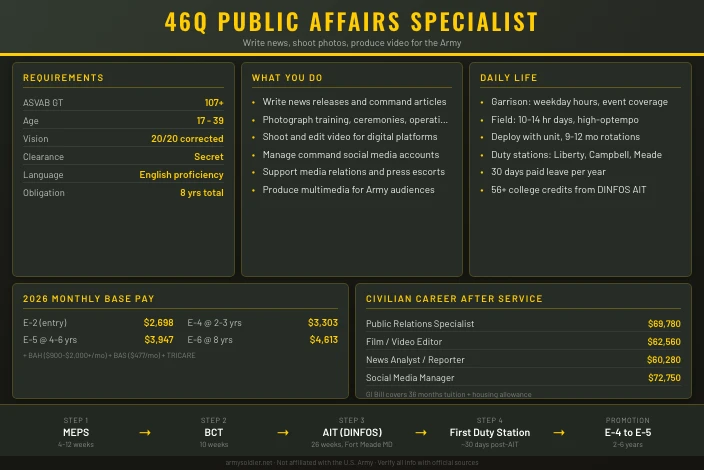
Public Affairs Mass Communication Specialists serve as the Army’s journalists, photographers, and broadcast producers. They write news releases and command information articles, shoot still and video coverage of training and operations, manage unit social media accounts, and support media relations by preparing commanders for press engagements. Every piece of content they produce shapes how the public and Army audiences understand military operations.
The daily workload depends on your assignment. At a brigade combat team, you might spend your morning photographing a change of command ceremony, then spend the afternoon writing a feature story about a soldier’s service. Before the end of the day you upload edited video to a command social media feed. At higher headquarters or a public affairs office, the pace shifts toward media relations: monitoring news coverage, preparing talking points, and coordinating interviews between commanders and reporters.
Daily Tasks
- Write news releases, feature articles, and command information products
- Photograph training events, ceremonies, and operations with military-grade camera equipment
- Shoot, edit, and produce video packages for TV broadcast and digital platforms
- Manage command social media accounts on approved platforms
- Set up and operate broadcast equipment for live and recorded productions
- Prepare media advisories, press releases, and background materials for commander interviews
- Support media escorts during field exercises and combat operations
- Maintain photography and video archives for unit records
Specialized Roles
The 46S MOS uses Army skill identifiers to designate specializations:
| Identifier | Type | Description |
|---|---|---|
| 46S10 | Skill Level 1 | E-1 to E-4, entry-level multimedia journalism |
| 46S20 | Skill Level 2 | E-5, team leader, supervises junior specialists |
| 46S30 | Skill Level 3 | E-6, NCOIC of public affairs section |
| 46S40 | Skill Level 4 | E-7, senior public affairs NCO, advises commanders |
| 46S50 | Skill Level 5 | E-8 to E-9, command-level public affairs leadership |
| 46Z | Senior MOS | Public Affairs Senior Sergeant (SFC and above) |
| ASI 2R | Specialization | Studio Broadcaster (broadcast-track soldiers) |
Soldiers who demonstrate strong broadcast skills can earn the 2R ASI (Studio Broadcaster) designation through additional DINFOS training. This opens doors to broadcast-specific billets at Army TV studios and network-connected platforms.
How This Role Supports the Mission
Every commander needs the public’s trust to operate effectively. Public affairs soldiers build that trust by producing factual, timely coverage of Army activities before adversaries can control the narrative. In deployed environments, they operate as the primary link between Army units and media organizations, managing journalist access while protecting operational security. At home stations, they support recruiting, community relations, and soldier morale through internal media products.
Technology and Equipment
The job is equipment-intensive. You work with professional-grade DSLR and mirrorless cameras, broadcast-quality video cameras, audio recording gear, lighting kits, and editing workstations running industry-standard software such as Adobe Premiere and Photoshop. In the field, you carry that gear through the same terrain as every other soldier, shooting under conditions most civilian photographers never encounter. Broadcast soldiers also operate studio and field transmission equipment for live and taped productions.
Salary and Benefits
Financial Benefits
Pay is based on rank and time in service. Most 46S soldiers enter at E-1 and reach E-4 within 2 to 3 years.
| Pay Grade | Rank | Typical Time in Service | 2026 Monthly Base Pay |
|---|---|---|---|
| E-2 | Private (PV2) | Entry (post-BCT) | $2,698 |
| E-4 | Specialist (SPC) | 2-3 years | $3,303 |
| E-5 | Sergeant (SGT) | 4-6 years | $3,947 |
| E-6 | Staff Sergeant (SSG) | 8 years | $4,613 |
| E-7 | Sergeant First Class (SFC) | 10-14 years | $5,268 |
Base pay is one piece of the compensation picture. BAH (Basic Allowance for Housing) adds $900 to $2,000 or more per month depending on your duty station and dependent status. BAS (Basic Allowance for Subsistence) adds $476.95 per month for food. Both allowances are tax-free.
The 46S MOS does not appear on current Army enlistment bonus charts. Bonus availability changes frequently based on Army manning needs, so check with your recruiter for the most current information.
Additional Benefits
TRICARE covers you and your family at no cost during active-duty service. Medical, dental, vision, mental health, and prescriptions all come with zero enrollment fees, no deductibles, and no copays. Family members are covered under the same plan.
Tuition Assistance (TA) pays up to $4,500 per year toward college classes while you’re serving. The Post-9/11 GI Bill covers up to 36 months of in-state tuition at public universities (full cost, no cap) or up to $29,920.95 per year at private schools, plus a monthly housing allowance and $1,000 annual book stipend after separation. The DINFOS AIT itself earns 56+ transferable college credit hours through ACE accreditation.
Work-Life Balance
You earn 30 days of paid leave per year. At a garrison public affairs office, you typically work weekdays during standard business hours with some evenings for special events. Field exercises and deployments change that pattern, but the hours are generally more predictable than combat arms MOSs.
The Blended Retirement System (BRS) provides a pension worth 40% of your highest 36 months of base pay at 20 years. The government also matches up to 5% of your Thrift Savings Plan (TSP) contributions starting in year three.
Qualifications and Eligibility
Basic Qualifications
The minimum ASVAB requirement is a GT (General Technical) score of 107. The GT composite combines Verbal Expression and Arithmetic Reasoning, which reflects the emphasis on writing, critical thinking, and communication that the job demands. This is one of the higher GT minimums among Army support MOSs.
| Requirement | Details |
|---|---|
| Age | 17-39 (up to 42 with waiver) |
| Citizenship | U.S. citizen or permanent resident |
| Education | High school diploma or GED |
| AFQT | Minimum 31 (diploma) or 50 (GED) |
| GT Score | Minimum 107 |
| Security Clearance | Secret (required) |
| Physical Demands | Light |
| Vision | Correctable to 20/20 |
| Language | English proficiency required |
The Secret clearance requirement means a background investigation into your criminal history, finances, foreign contacts, and personal conduct. This process takes 2 to 6 months and starts before you ship to basic training.
Application Process
Start at a recruiting station. The recruiter reviews your ASVAB scores and initiates the background check paperwork for your Secret clearance. MEPS follows: a full physical exam, final ASVAB if needed, and MOS selection. If your GT meets the 107 threshold and your background clears, your recruiter books a training seat at DINFOS.
From first recruiter visit to ship date, expect 4 to 12 weeks. Clearance investigations are the most common source of delays.
Selection Criteria and Competitiveness
The 46S fills relatively few billets compared to logistics or medical MOSs. That means competition for seats can tighten during high-enlistment periods. Recruits with prior journalism, photography, or broadcasting experience, or a college degree in communications, stand out. Two years of high school language arts coursework is the baseline the Army looks for; more is better.
Upon Accession into Service
Most recruits enter at E-1 (Private) and promote to E-2 after BCT. College credits, AP coursework, or JROTC leadership can qualify you for E-2 or E-3 entry. The standard service obligation is 8 years total, split between active duty and Reserve or Individual Ready Reserve time. Active duty contract lengths typically run 3 to 6 years.
See our ASVAB study guide for strategies to hit these line scores, or take the PiCAT from home if you are a first-time tester.
Work Environment
Setting and Schedule
Public affairs work happens wherever the Army operates. At a major installation, you work in a newsroom-style office, editing bays, and broadcast studios alongside civilian public affairs staff. In the field, you move with the unit, carrying camera bags in addition to your standard soldier kit.
Garrison schedules lean toward standard weekday hours. Evening and weekend work increases during exercises, ceremonies, and unit events. On deployment, you match the operational tempo of the unit you’re supporting, which can mean 10 to 14 hour days during high-optempo periods.
| Setting | Typical Schedule | Equipment |
|---|---|---|
| Garrison newsroom | Weekdays, 0800-1700, with event coverage on evenings/weekends | Desktop editing stations, studio cameras, broadcast gear |
| Field exercises | Matches unit schedule, often 12+ hour days | DSLR, laptop, portable audio kit, soldier kit |
| Deployed | 10-14 hour days during high-optempo operations | Ruggedized camera gear, satellite uplink, mobile editing |
Leadership and Communication
The chain of command in a public affairs section typically runs from the specialist up through the PA NCOIC (usually an E-6 or E-7), to the Public Affairs Officer (a commissioned officer, FA 46 functional area). At lower echelons, a single NCO may run the entire PA shop with 2 to 4 specialists. At corps or Army level, PA sections are larger and more structured.
Performance counseling happens quarterly at minimum, with formal NCOERs for E-5 and above annually. Public affairs quality is measurable: your stories either get picked up by civilian outlets or they don’t, your photos either meet editorial standards or they go back for retakes.
Team Dynamics and Autonomy
Junior specialists (E-1 through E-4) work under supervision but often operate independently in the field. A solo specialist covering a training exercise might be the only media presence at an event, which means making editorial judgments without a supervisor nearby. That autonomy comes early compared to many MOSs.
As you gain rank, you take on more production oversight, mentor junior specialists, and advise commanders on communication strategy. E-6 and above spend as much time managing their section’s output as creating it themselves.
Job Satisfaction and Retention
Public affairs soldiers report high job satisfaction when they get consistent media placements and creative latitude. The frustrations usually come from operational security constraints, which can limit what you can publish, and the tension between journalistic instincts and command messaging priorities. Soldiers who thrive treat both the soldier and journalist roles as complementary.
Training and Skill Development
Initial Training
Training follows two phases: Basic Combat Training (BCT) and Advanced Individual Training (AIT) at DINFOS.
| Training Phase | Location | Duration | Focus |
|---|---|---|---|
| BCT | Fort Jackson, SC; Fort Moore, GA; Fort Leonard Wood, MO | 10 weeks | Soldier fundamentals: drill, marksmanship, fitness, field craft |
| AIT | Defense Information School (DINFOS), Fort Meade, MD | 26 weeks | Multimedia journalism, photography, video production, writing, broadcast operations |
BCT makes you a soldier before anything else. You qualify with your assigned weapon, complete land navigation, and meet the Army’s fitness standards alongside every other MOS.
The Defense Information School at Fort Meade is where the real specialty training happens. The Mass Communications Foundation Course runs 26 weeks and covers the full range of media skills: journalistic writing for print and web, still photography, video production and editing, audio recording, graphic design, social media management, and broadcast operations. DINFOS is accredited by the Council on Occupational Education (COE) and the American Council on Education (ACE). Students earn 56 or more transferable college semester hours by the time they graduate.
Advanced Training
After your first assignment, several training paths open up. Soldiers assigned to broadcast billets attend additional DINFOS courses to earn the 2R ASI (Studio Broadcaster) designation, qualifying them for Army TV studio operations, field transmission systems, and live broadcasting.
NCO development schools (Warrior Leader Course, Advanced Leader Course, Senior Leader Course) include PA-specific modules alongside standard leadership instruction. Senior NCOs can attend the Joint Forces Public Affairs Course and various joint PA training events that bring together communicators from all services.
The Army Credentialing Assistance (CA) program covers testing fees for civilian credentials. Relevant certifications include the Adobe Certified Professional designation, Poynter journalism certificates, and various social media credentials that translate directly to civilian communications roles.
Everything starts with qualifying ASVAB scores — our study guide covers what to study first.
Career Progression and Advancement
Career Path
Promotion through the junior enlisted ranks moves on a predictable schedule. NCO ranks get competitive, and PA billets are fewer than in larger career fields, so your performance record matters more than it might in a higher-density MOS.
| Rank | Pay Grade | Typical Time in Service | Role |
|---|---|---|---|
| Private (PV2) | E-2 | 0-1 years | Junior multimedia specialist |
| Private First Class (PFC) | E-3 | 1-2 years | Specialist, building portfolio |
| Specialist (SPC) | E-4 | 2-3 years | Capable solo coverage specialist |
| Sergeant (SGT) | E-5 | 4-6 years | Team leader, manages junior specialists |
| Staff Sergeant (SSG) | E-6 | 6-10 years | PA section NCOIC, advises commanders |
| Sergeant First Class (SFC) | E-7 | 10-14 years | Senior PA NCO (46Z designation), brigade-level advisor |
| Master Sergeant (MSG) | E-8 | 14-18 years | Division/corps PA NCO |
| Sergeant Major (SGM) | E-9 | 18+ years | Army-level PA enlisted leader |
At E-7, soldiers transition from the 46S MOS code to 46Z (Public Affairs Senior Sergeant). This is a prerequisite for senior PA leadership positions and comes with a formal promotion board.
Role Flexibility and Transfers
Public affairs soldiers serve wherever the Army has a PA shop, which includes infantry brigades, special operations support units, joint commands, the Pentagon, and international assignments. Some soldiers move into recruiting, drill sergeant, or inspector general positions mid-career while maintaining their PA skill set.
Reclassifying out of 46S is possible but means completing new AIT and taking on a fresh service obligation. The more common path for soldiers who want a change is to accept a broadening assignment (recruiting, drill sergeant duty) rather than a full MOS change.
Performance Evaluation
E-5 and above receive an annual NCOER (Non-Commissioned Officer Evaluation Report). Your rater scores your leadership, readiness, and performance. For PA soldiers, evaluators pay attention to media placements, the quality of your production work, and how well you support commander communication goals.
What separates top performers: consistent placement of stories in civilian and military outlets, zero OPSEC violations, mastery of multiple production platforms, and a record of mentoring junior soldiers. PA is a small community where your reputation follows you from assignment to assignment.
Physical Demands and Medical Evaluations
Physical Requirements
The 46S carries a “Light” physical demands rating. You won’t pull heavy loads or march with combat equipment as a daily job requirement. But you still deploy with units into field environments, carry camera and production gear over rough terrain, and meet every soldier fitness standard.
The Army Fitness Test (AFT) replaced the ACFT on June 1, 2025. Every soldier takes it at least once per year. The test has five events, each scored 0 to 100 points. You need 60 points per event and 300 total to pass. The 46S applies the general (non-combat specialty) standard, which is sex- and age-normed.
| Event | Description | Minimum Passing Score |
|---|---|---|
| 3-Rep Max Deadlift (MDL) | Maximum weight for 3 reps | 60 points (age/sex normed) |
| Hand-Release Push-Up (HRP) | Push-ups with full arm extension at bottom | 60 points |
| Sprint-Drag-Carry (SDC) | Five 50-meter shuttles with varied loads | 60 points |
| Plank (PLK) | Front leaning rest on forearms, timed | 60 points |
| Two-Mile Run (2MR) | Timed run | 60 points |
Maximum total score is 500. Scores above 300 contribute to promotion points, which matters in a competitive MOS like 46S.
Medical Evaluations
An annual Periodic Health Assessment (PHA) covers blood pressure, weight, hearing, vision, and general health. Pre-deployment medical clearances are more thorough. The Secret clearance process also includes periodic reinvestigations every 10 years, which may involve a medical records review if flagged issues arise.
Vision correctable to 20/20 is required. Color vision deficiency does not disqualify you but may limit some photography assignments where color accuracy is critical.
Deployment and Duty Stations
Deployment Details
Public affairs soldiers deploy with the units they support. Active-duty units typically rotate on a 9 to 12 month deployment cycle followed by 24 to 36 months at home station, depending on the Army’s operational tempo.
Deployed PA teams support media relations, produce command information content, and manage press access during combat and stability operations. Most of the tour is spent inside the wire at established bases, but PA soldiers travel with units on operations to capture coverage. A typical deployed day starts with a morning stand-up briefing where the PA team reviews the day’s coverage opportunities, followed by content production, editorial review, and release coordination.
During stability operations, the focus shifts toward community engagement stories, humanitarian assistance coverage, and host-nation media relations. During active combat operations, the pace accelerates and the content shifts to operational updates, casualty documentation, and embedded media support. Both environments require the PA team to balance speed with accuracy and security review.
Location Flexibility
Public affairs billets exist at most major installations and several overseas commands. 46S soldiers serve at a wider range of locations than many support MOSs. The number of PA billets at any single installation is small, usually 2 to 6 enlisted positions, so your assignment depends heavily on where slots open up.
Common CONUS duty stations:
- Fort Liberty, NC (XVIII Airborne Corps)
- Fort Campbell, KY (101st Airborne Division)
- Fort Cavazos, TX (III Corps)
- Fort Carson, CO (4th Infantry Division)
- Fort Moore, GA (Maneuver Center of Excellence)
- Fort Meade, MD (Army Public Affairs Center / DINFOS)
- Pentagon, Washington, D.C. (Office of the Chief of Public Affairs)
- Fort Sam Houston, TX (Army South)
OCONUS assignments:
- Wiesbaden, Germany (U.S. Army Europe and Africa)
- Camp Humphreys, South Korea (Eighth Army)
- Schofield Barracks, Hawaii (25th Infantry Division)
- Fort Wainwright, Alaska (U.S. Army Alaska)
The Army fills positions based on mission requirements. You can submit a preference list, but the Army’s needs come first.
Risk, Safety, and Legal Considerations
Job Hazards
In garrison, the main risks are equipment-related. Deployed PA soldiers face the same indirect fire, convoy risks, and austere conditions as everyone else on the installation, though they typically operate inside established bases.
Key hazards specific to public affairs:
- Back and shoulder strain from carrying 30+ pounds of camera gear over rough terrain
- Eye strain and repetitive stress from long editing sessions
- OPSEC violations from publishing information that compromises operational security
- Privacy Act liability from improperly releasing photos or personal information
- Vehicle and aircraft hazards during embedded coverage with maneuver units
Safety Protocols
Every photo caption and story goes through an operational security review before publication. PA shops follow strict content release procedures, and soldiers learn during AIT that no product goes public without command approval. In the field, PA teams follow the same force protection measures as the units they embed with: bunker drills, movement protocols, and communication checks.
Security and Legal Requirements
MOS 46S requires a Secret security clearance. The clearance process is covered in the Qualifications section above.
All public affairs content is subject to legal review for copyright, privacy rights, and the Privacy Act. PA soldiers work directly with legal officers to clear photographs and stories before release, particularly in situations involving detainees, civilian casualties, or sensitive personnel matters. The Uniform Code of Military Justice applies to all soldier conduct, and public statements that embarrass the Army or reveal unauthorized information carry specific legal risks in this MOS.
Impact on Family and Personal Life
Family Considerations
The 46S generally follows a predictable garrison schedule compared to combat arms MOSs. PA office hours are weekday-heavy with periodic event coverage on evenings and weekends. Deployments happen, but the frequency is tied to your parent unit’s rotation schedule rather than MOS-specific demands.
That said, the small PA community means fewer soldiers share the same deployment schedule, which can make informal support networks harder to build. Spouses of PA soldiers often connect more with the broader unit FRG than with other PA families, simply because there may only be 2 or 3 PA families at a given installation.
The Army provides support through:
- Family Readiness Groups (FRGs) within your unit for peer support
- Military OneSource for free counseling, financial coaching, and family services
- Exceptional Family Member Program (EFMP) for families with special needs dependents
- Spousal employment assistance through installation family support centers
BAH at common PA duty stations ranges from roughly $1,500 to $2,400 per month depending on rank and location. Posts like Fort Meade and the Pentagon area sit in higher cost-of-living zones, so housing allowances are larger but local expenses eat into the difference.
Relocation and Flexibility
PCS moves happen every 2 to 4 years. The Army pays moving costs but each relocation means new schools for kids and a new job search for spouses. The spread of PA billets across most major installations gives you a better chance at a preferred location than soldiers in narrow specialties, though the absolute number of PA billets at any given post is small. Spouses with remote-work careers or portable certifications handle the moves better than those in location-dependent fields.
Reserve and National Guard
The 46Q/46S Public Affairs Mass Communication Specialist is available in both the Army Reserve and Army National Guard. Both components maintain public affairs detachments and mobile public affairs detachments (MPADs). The Army Reserve has several dedicated public affairs units, and most Guard states have at least one public affairs detachment. Total billets are limited compared to general support MOS, but the specialty is represented in both components.
Drill Schedule and Training Commitment
Standard commitment is one weekend per month (Battle Assembly) plus two weeks of Annual Training per year. Drill weekends for 46Q soldiers include writing stories, shooting and editing video content, managing unit social media, and producing communication products for the command. Annual Training often involves embedded coverage of a large exercise or producing a series of feature stories for the component. You may have additional training days for multimedia equipment certifications and public affairs qualification courses.
Part-Time Pay
An E-4 with over 3 years of service earns about $464 per drill weekend (4 drill periods), totaling roughly $5,572 per year from drill pay plus about $1,741 for 15 days of Annual Training. Active-duty E-4 base pay is $3,482 per month. Many Reserve/Guard PA specialists work civilian media, marketing, or communications jobs that pay competitively.
Benefits Differences
Tricare Reserve Select costs $57.88 per month for member-only or $286.66 per month for family coverage in 2026. Active-duty TRICARE Prime is free. TRS is a meaningful benefit for media professionals, who may work freelance or contract positions without employer health coverage.
Education benefits include Federal Tuition Assistance ($250 per credit hour, up to $4,500 per year) and the Montgomery GI Bill-Selected Reserve at $493 per month for full-time students. Guard members may qualify for state tuition waivers. Mobilization of 90 or more days earns Post-9/11 GI Bill eligibility.
Reserve retirement is points-based, requiring 20 qualifying years. Collection starts at age 60, reduced by 3 months per 90-day mobilization after January 2008, minimum age 50.
Deployment and Mobilization
46Q soldiers in Reserve/Guard units see low to moderate mobilization rates. Public affairs detachments deploy in support of combat operations, humanitarian missions, and large-scale exercises. When activated, tours typically run 9 to 12 months. National Guard PA specialists may also support state emergency activations, handling media relations and public communication during disasters or civil emergencies.
Civilian Career Integration
The 46Q/46S has strong civilian career crossover. Journalism, broadcast production, video editing, photography, social media management, and corporate communications are all direct matches. Your military portfolio of published stories, video packages, and photo essays demonstrates professional experience to civilian employers. USERRA protects your civilian media job during activations, and employers must reinstate you with the seniority you would have earned.
| Feature | Active Duty | Army Reserve | Army National Guard |
|---|---|---|---|
| Commitment | Full-time | 1 weekend/month + 2 weeks/year | 1 weekend/month + 2 weeks/year |
| Monthly Pay (E-4, 3+ yrs) | $3,482 | ~$464/drill weekend | ~$464/drill weekend |
| Healthcare | TRICARE Prime ($0) | Tricare Reserve Select ($57.88/mo) | Tricare Reserve Select ($57.88/mo) |
| Education | Federal TA, Post-9/11 GI Bill | Federal TA, MGIB-SR ($493/mo) | Federal TA, MGIB-SR, state tuition waivers |
| Deployment Tempo | Moderate | Low-moderate | Low-moderate + state missions |
| Retirement | 20-year pension at age 40+ | Points-based, collect at age 60 | Points-based, collect at age 60 |
Post-Service Opportunities
Transition to Civilian Life
The 46S portfolio translates well to civilian media and communications jobs. You leave with professional-quality work samples: published articles, broadcast segments, photography archives, and production credits. That’s a reel and resume that civilian communications grads often take years to build.
The Transition Assistance Program (TAP) provides resume help, interview prep, and education counseling during your last year. The GI Bill covers tuition for journalism, communications, or media production degrees that multiply your earning potential. Many veterans use the GI Bill to finish a bachelor’s degree while working entry-level media jobs post-separation.
Civilian Career Prospects
| Civilian Job | Median Annual Salary (May 2024) | 10-Year Outlook |
|---|---|---|
| Public Relations Specialist | $69,780 | +5% |
| News Analyst / Reporter / Journalist | $60,280 | -4% |
| Photographer | $43,830 | +4% |
| Film and Video Editor | $62,560 | +8% |
| Social Media Manager | $72,750 | +8% |
Public relations and social media management show the strongest outlook. The journalism track has contracted, but military journalists with broadcast production skills and federal-sector experience compete well for government communications roles at DoD, VA, and federal agencies that value security-cleared candidates. Defense contractors and think tanks also hire former PA soldiers for communications and media relations roles.
Post-Service Policies
An honorable discharge gives you access to VA healthcare, disability compensation if applicable, and Post-9/11 GI Bill benefits. Talk to your career counselor at least 18 months before your ETS date if you plan to transition. The smaller the MOS, the more important it is to start early.
Is This a Good Job for You?
Ideal Candidate Profile
The 46S suits people who can write a complete sentence under pressure and stay calm with a camera when everything around them is chaotic. You don’t need a journalism degree, but you do need genuine interest in the craft.
Traits that predict success:
- Strong writing and communication skills in English
- Visual eye for framing photographs and video
- Comfortable approaching strangers, including senior officers and civilians, for stories
- Detail-oriented enough to avoid OPSEC errors while working fast
- Self-directed in the field without constant supervision
- Interest in both storytelling and military service as parallel callings
Prior experience with school newspapers, yearbooks, social media content creation, or amateur photography helps. The Army teaches the technical production skills from scratch at DINFOS, but natural communicators accelerate through training faster.
Potential Challenges
The tension between journalistic instincts and command messaging does not go away. You work for commanders, not editors, and sometimes that means not publishing a story you think the public should see. Soldiers who struggle with that constraint find the job frustrating.
This MOS may not fit you if:
- You need constant physical activity or outdoor fieldwork
- You want a high-adrenaline combat-focused career
- You are uncomfortable working around senior leaders (colonels, generals, civilian executives) as part of daily duties
- Your writing skills are weak and you have no interest in improving them
The 46S community is small. Every soldier knows most of the others in the field, which means your professional reputation matters more than in larger MOSs. Mistakes, especially OPSEC violations or poor-quality work, follow you.
Who Builds a Real Portfolio Here
The 46S makes sense for people who want to serve but also want to build a real media career simultaneously. You graduate AIT with 56+ college credit hours, professional equipment experience, published work, and a Secret clearance. Few civilian media programs deliver that combination on entry.
If you plan to work in communications, journalism, or public relations after the Army, three to six years as a 46S gives you a head start that classroom training rarely matches. The trade-off is the loss of editorial independence and the constraints of military service. Whether that trade-off is worth it depends entirely on what you want out of both careers.
More Information
Talk to an Army recruiter about MOS 46S and ask to see current training seat availability at DINFOS. Bring your ASVAB scores or an estimate of your GT composite. If you have a journalism or photography portfolio, bring that too.
- Prepare for the ASVAB with our study guide to make sure your line scores qualify
This site is not affiliated with the U.S. Army or any government agency. Verify all information with official Army sources before making enlistment or career decisions.
Explore more Army public affairs careers.