18B Special Forces Weapons Sergeant
Most soldiers carry one weapon system and learn it well. A Special Forces Weapons Sergeant carries every weapon system and teaches it to foreign fighters under fire. The 18B is the Green Beret who can strip, repair, and employ a Soviet-era PKM machine gun, an American M240, a 120mm mortar, and a dozen weapons in between, then turn around and train a partner nation’s soldiers to do the same. The dropout rate across the full pipeline runs near 70%. The ones who finish earn the most technically demanding weapons role in the U.S. Army.
Qualifying requires specific ASVAB line scores — our ASVAB study guide covers what to target and how to prepare.
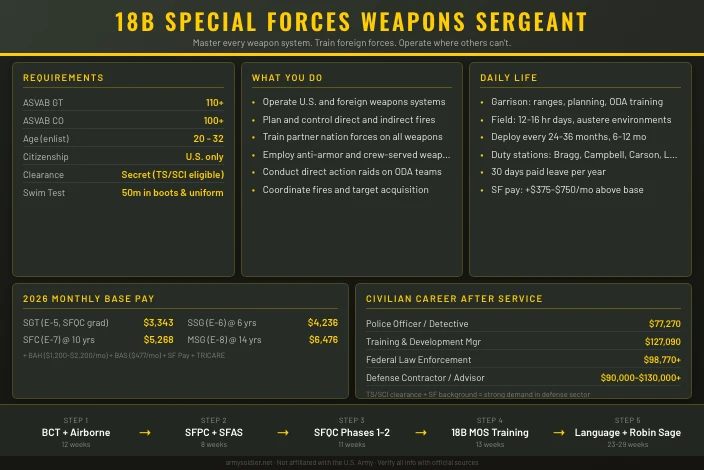
Job Role and Responsibilities
The 18B Special Forces Weapons Sergeant operates and maintains a wide range of U.S., allied, and foreign weapons systems while conducting conventional and unconventional warfare missions. As a core member of a 12-person Operational Detachment-Alpha (ODA), the 18B plans fire support, trains indigenous forces, and leads direct action raids in some of the most denied and dangerous environments on earth.
Daily Tasks
No two days look the same on an ODA. In garrison, an 18B might spend a morning at the range zeroing a new weapons system, an afternoon writing a training plan for an upcoming foreign internal defense mission, and an evening reviewing maps of a potential target area. In the field, the day compresses into movement, security, training, and mission execution.
Specific tasks include:
- Employing and maintaining light weapons up to .50-caliber systems
- Operating heavy crew-served weapons including 120mm mortars
- Employing anti-armor weapons like the Carl Gustaf and AT4
- Coordinating and controlling direct and indirect fires during operations
- Evaluating terrain and assigning target locations for crew-served weapon positions
- Training foreign military and paramilitary forces on U.S. and non-standard weapons
- Constructing and supervising fortifications during defensive operations
- Interpreting combat orders and translating them into weapons employment plans
Specialization
CMF 18 uses Army MOS codes at the primary level and Additional Skill Identifiers (ASI) for specialization.
| Code | Type | Description |
|---|---|---|
| 18B | MOS | Special Forces Weapons Sergeant (E-5 to E-6) |
| 18B3 | Senior Grade | Staff Sergeant Weapons Sergeant |
| 18Z | MOS | Special Forces Senior Sergeant (E-9 command-level) |
| P | ASI | Military Freefall (HALO/HAHO) qualified |
| S | ASI | Special Forces Scuba qualified |
Mission Contribution
An ODA cannot function without a competent weapons sergeant. Every Green Beret is cross-trained, but the 18B owns the team’s fires and lethality. On a foreign internal defense mission, the 18B designs and runs the weapons training program for partner forces, often translating doctrine across language and culture barriers. On a direct action mission, the 18B controls the support-by-fire element and ensures every weapon system in the assault is functioning and positioned correctly.
Technology and Equipment
The 18B works with a wider variety of weapons than virtually any other soldier in the Army. That list includes:
- U.S. standard infantry arms: M4, M249, M240B, M2 .50-cal, MK19 grenade launcher
- Crew-served indirect fire: M224 60mm mortar, M252 81mm mortar, M120 120mm mortar
- Anti-armor: AT4, Carl Gustaf recoilless rifle, Javelin missile system
- Foreign weapons: AK-pattern rifles, PKM, RPG-7, DShK, and dozens of others
- Laser range finders, thermal optics, and fire control systems
- UAS integration for target acquisition in support of fires
Salary and Benefits
Pay starts the moment you ship to Basic Combat Training. Enlistment bonuses for Special Forces can reach $40,000 for qualified candidates per goarmy.com, though exact amounts vary by contract year and Army recruiting priorities.
Base Pay (2026)
| Rank | Grade | Monthly Base Pay |
|---|---|---|
| Private First Class | E-3 | $2,837 |
| Specialist | E-4 | $3,142 - $3,816 |
| Sergeant | E-5 | $3,343 - $4,422 |
| Staff Sergeant | E-6 | $3,401 - $5,044 |
| Sergeant First Class | E-7 | $3,932 - $5,537 |
| Master Sergeant | E-8 | $5,867 - $7,042 |
Source: DFAS 2026 Military Pay Chart. Pay varies by years of service.
Most soldiers in the pipeline graduate SFQC as an E-5. At E-5 with four years of service, base pay sits at $3,947 per month. Add BAS of $476.95 (monthly food allowance) and BAH, which varies by duty station but ranges from roughly $1,200 to $2,200 per month for most CONUS locations. Total monthly compensation for an E-5 at Fort Bragg without dependents typically runs well above $5,500.
Special pay additions for qualified Green Berets include:
- Special Forces Pay: $375 to $750 per month depending on grade
- Hazardous Duty Pay: Up to $150 per month for parachute operations
- Dive Pay: Up to $240 per month if scuba-qualified
- Foreign Language Proficiency Pay: $100 to $500 per month based on tested proficiency
Additional Benefits
Healthcare: TRICARE Prime covers active-duty soldiers at no cost. No enrollment fee, no deductible, no copays at military treatment facilities. Family members are also covered under the sponsor’s TRICARE enrollment.
Retirement: The Blended Retirement System (BRS) combines a traditional pension with a Thrift Savings Plan. At 20 years, the pension pays 40% of your high-36 average basic pay. The government automatically contributes 1% of basic pay to your TSP starting at 60 days of service, and matches up to 4% after your second year.
Education: The Post-9/11 GI Bill covers full in-state tuition at public universities and up to $29,920.95 annually at private schools. You also receive a monthly housing allowance and up to $1,000 per year in book stipends for 36 months of schooling. Tuition Assistance is available while serving, covering up to $4,500 per year.
Work-Life Balance
Soldiers earn 30 days of paid leave per year, accruing at 2.5 days per month. Green Beret teams deploy more frequently than conventional units. Between deployments and training rotations, family separation is substantial. Garrison periods between deployments allow for more regular hours, but training requirements for an ODA rarely follow a standard 9-to-5 schedule.
Qualifications and Eligibility
The 18B MOS is not a direct enlistment option. Candidates enlist under the 18X contract, which assigns them to the Special Forces pipeline. Assignment to 18B happens after successfully completing SFAS, where candidates rank specialty preferences.
Qualification Table
| Requirement | Standard |
|---|---|
| Citizenship | U.S. citizen only |
| Age (enlisting) | 20-32 |
| Age (active-duty lateral) | 20-36 |
| ASVAB GT | 110 minimum |
| ASVAB CO | 100 minimum |
| Security Clearance | Secret (with TS/SCI eligibility) |
| Vision | Correctable to 20/20; red/green color discrimination required |
| Swim test | 50 meters in boots and uniform |
| Physical fitness | AFT minimum 300 total, 60 per event |
| Airborne | Must complete or be airborne-qualified |
| Criminal record | No felony convictions; minor traffic violations acceptable |
| Service remaining | 24 months TIS remaining upon SFQC completion |
Application Process
Selection Competitiveness
SFAS maintains roughly a 30-35% selection rate. Physical conditioning is the most common reason candidates fail early. Land navigation failures eliminate a significant number in the middle phases. No prior military experience guarantees selection. Civilians with strong athletic backgrounds, high ASVAB scores, and prior leadership experience tend to perform well, but nothing replaces the preparation you put in before day one.
Having a prior infantry, ranger, or combat arms background helps but is not required. The Army cares about your performance during the course, not your resume before it.
Service Obligation
Soldiers who successfully complete SFQC receive a minimum service obligation that extends their enlistment. Standard SF enlistments run 4-6 years, with most requiring re-enlistment extension to fulfill the 24-month post-SFQC TIS requirement.
See our ASVAB study guide for strategies to hit these line scores, or take the PiCAT from home if you are a first-time tester.
Work Environment
Special Forces operate globally under the U.S. Army Special Forces Command (Airborne), headquartered at Fort Bragg, North Carolina. An 18B’s work environment shifts constantly based on the mission cycle: garrison training, pre-deployment workups, overseas deployment, and recovery rotations.
Setting and Schedule
Garrison life at an SF unit is busier and less predictable than at a conventional unit. ODA teams run their own training calendars with a mix of weapons qualification ranges, medical training, communication exercises, and joint operations with other special operations forces. Early morning PT is standard. Days frequently run 10-12 hours, and night training is common in the months before deployment.
Deployed, the environment is austere. Teams often operate at small forward operating bases or in direct coordination with host-nation security forces at their own facilities. Creature comforts are limited. Connectivity back home is inconsistent.
Chain of Command and Performance Feedback
An ODA is led by a captain (ODA Commander) and a Warrant Officer (Team Sergeant in some formations), with the Team Sergeant (E-8) as the senior NCO. The 18B works directly under both. Performance feedback comes through the Army’s Officer Evaluation Report (OER) and Non-Commissioned Officer Evaluation Report (NCOER) system. In Special Forces, the small team size means your performance is highly visible and feedback is direct.
Team Dynamics and Autonomy
Green Berets operate with more individual autonomy than almost any other soldier in the Army. ODA members are expected to take initiative and make decisions without waiting for orders. At the same time, everything on the team depends on tight coordination. The 18B doesn’t operate as a lone expert. Weapons, communications, medical, and engineering functions integrate constantly on every mission.
Job Satisfaction and Retention
CMF 18 retention rates are high relative to the conventional Army. The mission variety, the autonomy, the quality of teammates, and the global deployment opportunities keep most Green Berets re-enlisting. The hardest part for many is not the physical or tactical demands but managing the family separation that comes with frequent deployments and training rotations.
Training and Skill Development
The path from civilian to qualified 18B takes between 18 months and two years, depending on attrition timelines and course scheduling.
Training Pipeline
| Phase | Course | Location | Duration | Focus |
|---|---|---|---|---|
| 1 | Basic Combat Training (BCT) | Fort Moore, GA | 9 weeks | Basic soldiering, marksmanship, discipline |
| 2 | Basic Airborne Course | Fort Moore, GA | 3 weeks | Static line parachuting, 5 jumps required |
| 3 | SF Preparation Course (SFPC) | Fort Bragg, NC | 4 weeks | Physical conditioning, land navigation, rucking |
| 4 | Special Forces Assessment and Selection (SFAS) | Camp Rowe, NC | 4 weeks | Selection screening, land navigation, psychological assessment |
| 5 | SFQC Phase 1: Small Unit Tactics | Fort Bragg, NC | 8 weeks | Patrolling, raids, ambushes, reconnaissance |
| 6 | SFQC Phase 2: SERE | Fort Bragg, NC | 3 weeks | Survival, Evasion, Resistance, Escape training |
| 7 | SFQC Phase 3: MOS Training (18B) | Fort Bragg, NC | 13 weeks | U.S. and foreign weapons systems, fires coordination, weapons employment planning |
| 8 | SF Language Training | Fort Bragg, NC | 18-24 weeks | Assigned regional language to functional level |
| 9 | Robin Sage CULEX | Central NC | 5 weeks | Culmination exercise with simulated indigenous forces |
The full pipeline from BCT to Green Beret runs approximately 65-95 weeks depending on course scheduling gaps and potential recycles.
Phase 3 Weapons Training in Depth
The 13-week 18B MOS course is one of the most weapons-intensive schools in the Army. You will qualify on more individual and crew-served weapons systems than any other MOS course. The curriculum covers:
- U.S. standard infantry weapons disassembly, assembly, function check, and employment
- Foreign and non-standard weapons common to each of the Army’s SF regional groups (e.g., AK-pattern weapons, Soviet-era crew-served systems, RPGs)
- Indirect fire planning and mortars employment at every caliber level
- Anti-armor systems, both tube-launched and missile
- Fire support coordination and integration with CAS (Close Air Support) planning
- Range operations management and instruction techniques for training foreign forces
You graduate not just as a shooter but as a teacher. The ability to train foreign forces on unfamiliar weapons is the operational product the Army needs.
Advanced Training
Qualified 18Bs can pursue advanced training through:
- Military Freefall School (HALO/HAHO): 4.5-week course at Fort Moore or Yuma Proving Ground. Awards the P ASI.
- Combat Diver Qualification Course (CDQC): 4-week course at Key West, FL. Awards the S ASI and dive pay.
- Ranger School: 62-day leadership course open to SF NCOs. Does not change MOS but adds the Ranger Tab.
- Sniper School: 7-week course. Adds precision engagement capability to the team.
- Combatives Master Trainer Course: Army Modern Army Combatives Program (MACP) instructor certification.
- Unit-level language immersion: Deployed language training with regional partner forces.
Everything starts with qualifying ASVAB scores — our study guide covers what to study first.
Career Progression and Advancement
Rank Progression
| Rank | Grade | Typical TIS | Milestone |
|---|---|---|---|
| Private First Class | E-3 | Entry | Ship to BCT |
| Sergeant | E-5 | 1-2 years | Award of 18B upon SFQC graduation |
| Staff Sergeant | E-6 | 4-6 years | 12 months on SFOD-A required for promotion |
| Sergeant First Class | E-7 | 10-12 years | Senior Weapons Sergeant, ODA leadership |
| Master Sergeant | E-8 | 15-18 years | Senior NCO positions, group staff |
| Sergeant Major | E-9 | 20+ years | CSM track or SF-level staff |
Graduating SFQC automatically promotes you to Sergeant (E-5). Promotion to Staff Sergeant (E-6) requires 12 months of time on an SFOD-A after qualification. That’s a hard requirement, not a soft guideline.
Specialization Paths
Senior 18Bs often move into:
- Weapons of Mass Destruction (WMD) response roles at the SF Group level
- Training Development positions at the John F. Kennedy Special Warfare Center and School (SWCS)
- Foreign Advisor assignments under Security Force Assistance Brigades (SFAB)
- Warrant Officer path as a Special Forces Warrant Officer (180A), which requires a separate selection process
The 180A Warrant Officer MOS is a common career goal for senior 18B NCOs who want to lead an ODA as the Team Sergeant equivalent officer role.
Role Transitions and Transfers
Transferring out of CMF 18 is possible but unusual. Most Green Berets stay in the community once qualified. The more common path is lateral movement within special operations: moving between Group assignments, taking assignments at USSOCOM, or applying for inter-agency positions with the CIA’s Ground Branch or State Department programs.
Performance Evaluation
NCO performance is evaluated annually through the NCOER system. In an SF unit, the small team environment and high operational tempo mean your performance is observed closely. NCO support channels are direct and expectations are explicit. A poor NCOER at this level can end a career quickly. Exceptional performance gets noticed at the Group Commander level.
Physical Demands and Medical Evaluations
The 18B is a combat specialty. The physical demands are real and daily.
Fitness Standards
The Army Fitness Test (AFT) replaced the ACFT on June 1, 2025. The AFT has five events scored 0-100 each, with a maximum of 500 points. All soldiers must score a minimum of 60 points per event.
The 18B MOS falls under the combat specialty standard, which requires a minimum of 350 total points (sex-neutral, age-normed scoring) to pass. This is stricter than the general Army standard of 300 points.
| Event | Abbreviation | Description |
|---|---|---|
| 3 Rep Max Deadlift | MDL | Weighted deadlift, 3 repetitions |
| Hand Release Push-Up | HRP | Arm extension push-up |
| Sprint-Drag-Carry | SDC | 50-meter shuttle with drag and carry |
| Plank | PLK | Timed isometric hold |
| Two-Mile Run | 2MR | Timed run |
Source: army.mil/aft
Beyond the AFT, ODA members conduct physical training daily. Rucking with heavy loads is a constant. SFAS alone includes ruck marches that progressively increase in distance and weight over the four-week course. Expect 45-65 pound rucksacks on marches exceeding 12 miles during selection.
Daily Physical Demands
An 18B physically carries more weight than most soldiers on most days. In the field, a weapons sergeant manages crew-served weapon components distributed across the team. Mortar base plates, tubes, and rounds require multiple soldiers to move, but the weapons sergeant plans and directs that movement under operational conditions. Strength, endurance, and pain tolerance are baseline requirements, not competitive advantages.
Medical Standards
The standard military MEPS physical applies at enlistment. SF-specific medical standards are more stringent. Color vision requirements (red/green discrimination) are firm. Prior knee, shoulder, and back injuries that might receive waivers in conventional Army pipelines are evaluated more strictly for SFAS candidates. The Army does not advertise specific waiver policies for SF medical disqualifiers. Contact a SORB recruiter for a current disqualifier list.
Ongoing medical evaluations happen through annual physical assessments. Combat injuries are treated at the unit level by the team’s 18D Medical Sergeant before transfer to higher-level care.
Deployment and Duty Stations
Primary Duty Stations
Special Forces Groups align to specific geographic regions, which drives where you’ll live and where you’ll deploy.
| SF Group | Location | Primary AOR |
|---|---|---|
| 1st SFG | Fort Lewis, WA | Pacific / INDOPACOM |
| 3rd SFG | Fort Bragg, NC | Africa / AFRICOM |
| 5th SFG | Fort Campbell, KY | Middle East / CENTCOM |
| 7th SFG | Fort Bragg, NC / Eglin AFB, FL | Latin America / SOUTHCOM |
| 10th SFG | Fort Carson, CO | Europe / EUCOM |
| 19th SFG (ARNG) | Multiple CONUS states | Various |
| 20th SFG (ARNG) | Multiple CONUS states | Various |
Assignment to a specific Group is determined by Army needs, recruiting availability, and language training. You can express preferences but cannot guarantee placement.
Deployment Details
Active SF Groups deploy frequently. A typical ODA rotation involves 6-12 month deployments, often multiple times within a 36-month window. Between deployments, teams spend significant time at Joint Combined Exchange Training (JCET) events, training partner forces in-country for shorter periods of 30-90 days. These shorter rotations count as deployments from a family-separation standpoint but are distinct from combat operations tours.
Deployments may be to Africa, the Middle East, Central Asia, Europe, or Latin America depending on Group assignment. Many missions are unclassified at the country level but classified at the operational level. Soldiers typically cannot discuss specific mission details with family.
Risk, Safety, and Legal Considerations
Job Hazards
The 18B operates in high-risk environments by design. Combat deployments carry obvious risks: enemy fire, IEDs, ambushes. Beyond direct combat, the weapons sergeant works daily with live ordnance and crew-served weapon systems. Range accidents, training injuries, and parachute mishaps are statistically rare but are occupational hazards of this specialty.
Unconventional warfare environments add complexity. Operating with foreign partners in unstable regions means navigating legal frameworks, rules of engagement, and political constraints that conventional soldiers never encounter.
Safety Protocols
All weapons handling follows Army Range Operations regulations. Live-fire training requires certified range safety officers and strict ammunition accountability. Parachute operations follow USASOC jump master standards. SERE training prepares soldiers for capture scenarios with established safety protocols and a medical team standing by.
Security Clearance and Legal Obligations
The 18B requires a Secret security clearance with access to Sensitive Compartmented Information (SCI) as missions demand. The background investigation is thorough. Financial instability, foreign contacts, drug use, and criminal history are common disqualifiers. The clearance investigation begins after SFAS selection.
Soldiers sign a service obligation that extends with each bonus and specialized school. AWOL, misconduct, or failure to maintain security clearance standards can result in administrative separation. Deployment to conflict zones is governed by the law of armed conflict and Theater Campaign plans. All SF soldiers receive training on legal use of force, detainee handling, and engagement authorities before deployment.
Impact on Family and Personal Life
The Green Beret lifestyle is demanding on families. Frequent deployments, irregular hours, and operational security requirements that limit communication create real strain. The Army recognizes this and has support infrastructure at every major SF installation.
Family Support
Family Readiness Groups (FRGs) operate at the battalion level for SF units. Military OneSource provides counseling, financial advising, and deployment support for family members. TRICARE covers family healthcare at no cost to the soldier. Schools on or near major installations like Fort Bragg and Fort Campbell are accustomed to serving military families.
Fort Bragg, home to the largest concentration of SF soldiers, has well-developed family support infrastructure. The 82nd Airborne community and USASOC organizations on post provide resources specifically for families managing frequent and sometimes classified deployments.
Relocation
PCS moves happen roughly every 3-5 years or when a soldier changes Group assignment, attends a school, or receives a staff assignment. Overseas duty stations in Germany (Stuttgart, Grafenwoehr) or Japan (Okinawa) are possible for certain assignments. Soldiers receive BAH and moving allowances for each PCS move.
Operational security requirements can limit what soldiers can tell their families about upcoming deployments, mission locations, and return dates. Families who do best in the SF community are those who build independent support networks and communicate openly about the stress of uncertainty.
Reserve and National Guard
Component Availability
The 18B MOS exists in the Army National Guard through the 19th Special Forces Group (Airborne) and the 20th Special Forces Group (Airborne) – the only Guard units that carry full Special Forces designations. There are no Army Reserve Special Forces units. Guard 18Bs are fully qualified Green Berets who maintain the same skill standards as their active-duty counterparts, including weapons qualifications, foreign language proficiency, and MOS certification.
The 19th SFG operates out of Utah (headquarters), West Virginia, Washington, California, Ohio, Rhode Island, and Colorado. The 20th SFG is based in Alabama with battalions in Florida, Illinois, Kentucky, Massachusetts, Maryland, Mississippi, North Carolina, West Virginia, and Texas.
Drill Schedule and Training Commitment
Guard 18Bs do not follow the standard one-weekend-per-month schedule. Expect three to five training days per month – most months include additional training days beyond the standard Battle Assembly weekend. Annual Training runs three to four weeks rather than the standard two. Add language training, weapons qualifications, and periodic exercises with active-duty SF units or partner nation forces and the total commitment is closer to 60-90 days per year for an active Guard SF soldier.
Part-Time Pay
An E-4 Guard 18B earns roughly $422 per drill weekend (four drill periods). Annual drill pay across 12 weekends runs about $5,064. Add two to four weeks of Annual Training and you pick up another $1,583 to $3,166. The actual time commitment and pay varies – Guard 18Bs in high-operational-tempo states often receive additional training pay for extra duty days.
Benefits Differences
Guard 18Bs are not on active-duty TRICARE. Between deployments and activations, you pay for Tricare Reserve Select – $57.88 per month for member-only coverage, $286.66 per month for member plus family (2026 rates). During a federal mobilization of 30 or more consecutive days, you switch to full active-duty TRICARE at no cost.
- Education: Federal Tuition Assistance covers $4,500 per year for drilling Guard soldiers. The Montgomery GI Bill Selected Reserve (MGIB-SR) pays roughly $416 per month for approved programs. Post-9/11 GI Bill benefits scale with cumulative active-duty time – a full mobilization year earns you significant benefit percentage toward the full 36-month entitlement. Many states also offer tuition waivers at state schools for Guard members.
- Retirement: Guard soldiers earn retirement points. You need 20 qualifying years (50 points per year minimum) to earn a pension, but it does not pay out until age 60. Each qualifying 90-day federal mobilization can reduce that minimum age by 90 days, down to age 50. TSP matching up to 5% is available under BRS.
Deployment and Mobilization
Guard SF units have deployed to Afghanistan, Iraq, Africa, the Philippines, and other theaters. Mobilizations are less frequent than active duty but longer when they happen – typically four to nine months. Some Guard 18Bs deploy every few years; others go longer stretches between activations. The tempo depends heavily on your Group’s current mission set and theater assignments.
Civilian Career Integration
Guard 18B service pairs naturally with civilian careers in law enforcement, private security, defense contracting, and firearms instruction. Your TS/SCI clearance transfers directly to contractor and government positions. USERRA protects your civilian job during any federal activation – employers must restore your position, pay, and seniority when you return.
| Feature | Active Duty | Army Reserve | Army National Guard |
|---|---|---|---|
| Commitment | Full-time | Not available | 3-5 days/month + 3-4 week AT |
| Monthly Pay (E-4, ~3 yrs) | $3,166/month | N/A | ~$422/drill weekend |
| Healthcare | TRICARE, $0 premiums | N/A | TRS, $57.88/month (member) |
| Education | TA + Post-9/11 GI Bill | N/A | TA + MGIB-SR + state waivers |
| Deployment | 6-12 months, frequent | N/A | 4-9 months, less frequent |
| Retirement | BRS pension at 20 years | N/A | Points-based, age 60 |
Post-Service Opportunities
The 18B exits service with a skills package that is genuinely rare in the civilian market. Weapons handling expertise, foreign language proficiency, cross-cultural leadership experience, and a Top Secret clearance create immediate value in defense, law enforcement, and security sectors.
Civilian Career Table
| Civilian Career | Median Annual Salary | Job Outlook (10-yr) |
|---|---|---|
| Police Officer / Detective | $77,270 | +4% (average) |
| Private Security Manager | $79,050+ | +4% |
| Training and Development Manager | $127,090 | +6% |
| Defense Contractor / Advisor | $90,000 - $130,000+ | Strong demand |
| Federal Law Enforcement (FBI, DEA, DHS) | $98,770+ | Steady |
BLS data from May 2024. Defense contractor salaries vary widely by agency, clearance level, and role.
Cleared veterans with SF backgrounds are in consistent demand from defense contractors, intelligence community contractors, and federal law enforcement agencies. Many transition to work that is operationally similar to their military service, advising foreign security forces or providing training to law enforcement units.
The Post-9/11 GI Bill, available after qualifying service, covers 36 months of undergraduate or graduate education. Many 18B veterans pursue degrees in criminal justice, political science, international relations, or business before or during federal agency careers.
Transition Programs
The Army’s Transition Assistance Program (TAP) begins 12 months before separation. The Department of Veterans Affairs Vocational Rehabilitation program assists veterans with service-connected disabilities in career transition. The SkillBridge program allows soldiers in their final 180 days of service to intern with civilian companies on government time.
Is This a Good Job for You? The Right (and Wrong) Fit
Ideal Candidate Profile
The 18B attracts a specific type of person. The best candidates are:
- Self-directed: You don’t wait to be told what to do next.
- Technically curious: You genuinely want to understand how every weapon system works, not just fire it.
- Physically durable: Not just strong, but able to sustain performance over weeks of degraded sleep, food, and comfort.
- Comfortable with ambiguity: Missions change, intelligence is imperfect, plans fall apart. You adapt without losing composure.
- Motivated to teach: The 18B’s primary value on deployment is often instruction. If you resent sharing knowledge, this role will frustrate you.
Prior experience with competitive shooting, hunting, or military service in a combat MOS provides a foundation, but the SFQC starts from scratch.
Potential Challenges
The selection failure rate alone should be a clear signal about difficulty. Most 18X candidates who begin the pipeline do not earn a Green Beret. SFAS is deliberately stressful, opaque, and unforgiving. Land navigation in the dark with a heavy ruck is the most commonly cited reason for failure in the early phases.
Long-term, the deployment tempo and family separation are the reasons most Green Berets eventually leave the service. The job is exceptional. The lifestyle is relentless. Those are not the same thing, and it takes clarity to separate them before signing a contract.
Career and Lifestyle Alignment
This role suits someone who values mission variety over predictability, peer quality over rank structure, and operational freedom over administrative comfort. It does not suit someone who prioritizes geographic stability, regular family schedules, or a clearly defined daily routine.
For the right person, the 18B is one of the most demanding and rewarding enlisted careers in the U.S. military. For someone who underestimated the selection process or the deployment demands, it can be a source of genuine regret. Go in with accurate expectations.
More Information
Talk to a Special Operations Recruiting Battalion recruiter before signing any contract. SORB recruiters specialize in SF pipelines and can give you current bonus information, selection dates, and honest assessment of your fitness and ASVAB scores relative to recent classes. Reach them at goarmy.com or call 1-888-550-ARMY.
- Prepare for the ASVAB with our study guide to make sure your line scores qualify
This site is not affiliated with the U.S. Army or any government agency. Verify all information with official Army sources before making enlistment or career decisions.
Explore more Army special operations careers such as the 18X Special Forces Candidate and 37F Psychological Operations Specialist.