18C Special Forces Engineer Sergeant
Every 12-person Green Beret team carries an engineer sergeant. He’s the one who rigs the bridge for demolition at 0300, clears a minefield so the team can extract, and then spends the next week teaching a partner-nation platoon how to build defensive fighting positions. The 18C is not a combat engineer in the conventional sense. He’s a Special Forces-qualified demolitions expert, construction specialist, and unconventional warfare advisor who brings engineering capability to the world’s most austere operating environments.
Qualifying requires specific ASVAB line scores — our ASVAB study guide covers what to target and how to prepare.
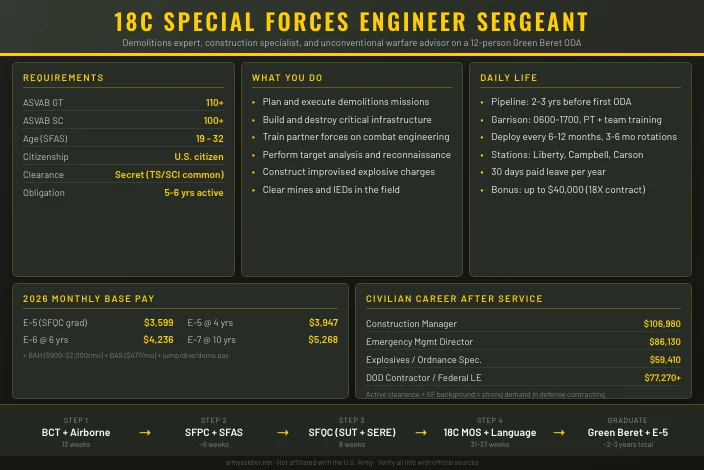
Job Role and Responsibilities
The 18C Special Forces Engineer Sergeant plans and executes demolitions, builds and destroys critical infrastructure, conducts field fortification, performs target analysis, and advises foreign military forces on combat engineering tactics. As one of five core specialties on an Operational Detachment-Alpha (ODA), the 18C provides the team with the ability to breach obstacles, destroy enemy assets, construct hasty defenses, and support unconventional warfare through sabotage operations.
In garrison, your time splits between maintaining certifications, planning training events, and supporting the team’s mission preparation cycle. Green Beret teams train constantly between deployments, and the engineer sergeant is responsible for keeping the team’s demolitions knowledge current. That means range days with different explosive systems, refresher courses on improvised munitions, and rehearsals for specific mission types.
Deployed, the work gets more varied. A typical rotation might involve training a partner-nation engineer unit on breaching techniques in one month, conducting route reconnaissance and documenting IED emplacement patterns the next, and executing a direct-action mission requiring a precision breach in the third. You adapt to whatever the operational environment demands.
Specific Roles
The 18C MOS sits within Career Management Field 18 (Special Forces). Related codes in the same field include:
| Code | Title | Type |
|---|---|---|
| 18C | Special Forces Engineer Sergeant | Enlisted MOS |
| 18B | Special Forces Weapons Sergeant | Enlisted MOS |
| 18D | Special Forces Medical Sergeant | Enlisted MOS |
| 18E | Special Forces Communications Sergeant | Enlisted MOS |
| 18F | Special Forces Intelligence Sergeant | Enlisted MOS |
| 18X | Special Forces Candidate (enlistment contract) | Pipeline designator |
| 180A | Special Forces Warrant Officer | Warrant Officer MOS |
| 18A | Special Forces Officer | Officer AOC |
Engineers who excel can earn Additional Skill Identifiers (ASIs) through advanced courses. The V5 ASI (Special Forces Demolitions Master) is a specialized qualification for 18Cs who complete the advanced demolitions course. The 5V ASI applies to combat diver-qualified Special Forces soldiers. Special Qualification Identifier P (Parachutist) is required for all Green Berets.
Technology and Equipment
The 18C works with a wide range of explosive systems: TNT, C-4, PETN, detonating cord, time fuse, M18A1 Claymore mines, anti-tank mines, and a variety of U.S. and foreign demolition kits. You learn to construct improvised explosive devices from locally available materials and to defeat them in the field. On the construction side, you operate power tools, survey equipment, and operate light engineering equipment for field fortification.
As part of an ODA, you carry standard Special Forces communications gear, individual weapons, and specialty items tied to your mission profile. If you complete the Combat Diver Qualification Course, you add underwater demolition capability to your skill set.
Salary and Benefits
Financial Benefits
Special Forces soldiers earn standard Army base pay plus several additional pays that stack on top. Most 18X candidates who complete the full pipeline enter as Sergeant (E-5) upon SFQC graduation. Those who attend as existing soldiers may enter the pipeline at a higher grade.
| Rank | Monthly Base Pay (2026) | Notes |
|---|---|---|
| E-5 (SGT) at 2 yrs | $3,599 | Typical SFQC graduation rank |
| E-5 (SGT) at 4 yrs | $3,947 | Senior team member |
| E-6 (SSG) at 6 yrs | $4,236 | Assistant team sergeant |
| E-7 (SFC) at 10 yrs | $5,268 | Team sergeant (18-series senior NCO) |
| E-8 (MSG) at 14 yrs | $6,476 | Company sergeant major track |
Base pay figures are from DFAS 2026 pay tables. These are pre-tax figures and do not include allowances or special pays.
Green Berets draw additional pays that can significantly increase total compensation:
- Jump pay (Parachute Duty Pay): $150/month for airborne-qualified soldiers
- Combat Diver pay: $110 to $340/month depending on diver rating
- Special Duty Assignment Pay (SDAP): Up to $750/month for designated SF positions
- Hazardous duty pay: For demolitions work and specific high-risk assignments
- Language pay: Up to $1,000/month for proficiency in a designated critical language
The Army advertises signing bonuses of up to $40,000 for Special Forces contracts. Confirm the current amount with a recruiter, as bonus levels change based on Army needs.
Additional Benefits
TRICARE covers active-duty soldiers and their families at no enrollment fee and no copay for in-network care. That includes medical, dental, vision, mental health, and prescriptions. Family members enrolled under TRICARE Prime pay nothing out-of-pocket for in-network visits.
Army Tuition Assistance covers up to $4,500 per year (capped at $250 per semester hour) for college courses taken while on active duty. After separation, the Post-9/11 GI Bill provides up to 36 months of tuition coverage at a public university (full in-state rate, no dollar cap), plus a monthly housing allowance based on the E-5 with-dependents BAH rate at the school ZIP code and $1,000 per year in book stipends.
Retirement runs through the Blended Retirement System (BRS):
- 40% pension after 20 years of service, calculated on your highest 36 months of basic pay
- Government matches up to 5% of your Thrift Savings Plan contributions (1% automatic + up to 4% matching)
- Continuation pay at the 8 to 12-year mark (Army active component typically 2.5x monthly basic pay for a 3-year commitment)
Work-Life Balance
Soldiers earn 30 days of paid leave per year, accruing at 2.5 days per month with a maximum 60-day carryover. Federal holidays (11 per year) are typically observed in garrison. Special Forces soldiers spend more time away from home than most Army jobs, including field exercises, pre-deployment training rotations, and overseas deployments. Teams typically deploy every 6 to 12 months on rotations lasting 3 to 6 months, though that cycle varies by group and mission.
Qualifications and Eligibility
The 18C pipeline has more screening steps than nearly any other enlisted MOS. You must meet Army general enlistment standards plus a set of Special Forces-specific requirements before you ever attend the Qualification Course.
| Requirement | Minimum Standard |
|---|---|
| ASVAB GT | 110 or higher |
| ASVAB SC | 100 or higher |
| Age (enlisted, 18X contract) | 19 to 32 at time of SFAS |
| Citizenship | U.S. citizen |
| Physical profile | PULHES 111221 or better |
| Vision | Correctable to 20/20 |
| Security clearance | Secret (Top Secret/SCI required for some ODA positions) |
| Swim qualification | Pass the SF swim test |
| Medical | Must meet airborne physical standards |
| Service obligation | 5 to 6 years active duty (18X contract) |
All Special Forces candidates must score GT: 110 and SC: 100 on the ASVAB. The GT composite (Verbal Expression + Arithmetic Reasoning) measures analytical and communication ability. The SC composite (Verbal Expression + Arithmetic Reasoning + Auto & Shop + Mechanical Comprehension) reflects the technical breadth the job demands. These are among the highest ASVAB minimums in the Army.
The OPAT (Occupational Physical Assessment Test) category for CMF 18 is Heavy, the most demanding physical demand category. This reflects the regular load-bearing, rucking, and physically intensive work Green Berets perform in the field.
Application Process
Selection Criteria and Competitiveness
SFAS is the defining filter. Roughly 60 to 70 percent of candidates do not pass. The cadre evaluate you continuously over 24 days using a combination of physical performance, decision-making under stress, and peer assessments. There is no published minimum score. Candidates are assessed as a whole, and the selection board makes the final call.
Prior experience as a combat engineer (MOS 12B) or sapper-qualified soldier gives you relevant demolitions and construction knowledge. Airborne-qualified soldiers and those with Ranger School experience tend to fare better at SFAS. Strong land navigation skills are non-negotiable.
Service Obligation
18X enlistees commit to 5 to 6 years of active duty. Soldiers who do not complete the pipeline are reassigned to another MOS and serve out the remaining contract time. Soldiers already on active duty who volunteer for SF sign an additional service obligation upon starting the SFQC.
See our ASVAB study guide for strategies to hit these line scores, or take the PiCAT from home if you are a first-time tester.
Work Environment
Setting and Schedule
Green Beret life moves between two very different tempos. In garrison at one of the Special Forces Group installations, the workday typically runs 0600 to 1700 with physical training anchoring the morning. Teams spend garrison time planning, maintaining equipment, attending schools, and running team-level training events. The 18C spends a significant portion of garrison time on certification maintenance, explosives accountability, and mentoring junior team members.
Deployed, the schedule is mission-driven and rarely follows a pattern. ODA missions can range from advisory work with a partner-nation unit in a remote base to direct-action raids that put you in a hostile environment with no conventional backup. Field time is physically demanding and mentally intense.
Leadership and Communication
Special Forces teams operate with a flat, peer-based leadership dynamic unusual in the conventional Army. Each 18C has a counterpart (two engineers per ODA), and the team functions as a unit of highly skilled adults who plan and execute together. Your direct chain of command runs through the Team Sergeant (SFC/E-7) to the Detachment Commander (captain).
Performance feedback happens continuously in the SF environment. Quarterly counselings, Non-Commissioned Officer Evaluation Reports (NCOERs), and peer evaluations all contribute to your record. SF NCOs are expected to perform independently and lead their functional domain without constant supervision.
Team Dynamics and Autonomy
The ODA is built for independent operations. Green Berets regularly operate in small teams, far from conventional support, making decisions without real-time guidance from higher headquarters. As the team’s engineer sergeant, you own your domain. You brief the team on demolitions options, make technical calls on explosive charges, and are the authority on what can and can’t be done with the materials available. That level of ownership is rare in the Army and is one of the primary draws of the career.
Job Satisfaction and Retention
Special Forces soldiers reenlist at rates significantly above the Army average. The combination of meaningful missions, high-performing teammates, and the unique autonomy of ODA life creates strong retention. Soldiers who struggle with the SF lifestyle typically cite the constant time away from home and the physical demands of sustained operations. Those who thrive tend to be the ones who find the work genuinely interesting and who invest in their teammates.
Training and Skill Development
The 18C training pipeline is one of the longest in the Army. From BCT to wearing the Green Beret takes most candidates 2 to 3 years.
| Phase | Location | Duration | Focus |
|---|---|---|---|
| Basic Combat Training (BCT) | Fort Moore, GA | 10 weeks | Basic soldiering, land navigation, weapons |
| Basic Airborne Course | Fort Moore, GA | 3 weeks | Static-line parachuting (5 qualifying jumps) |
| Special Forces Prep Course (SFPC) | Fort Liberty, NC | 2 weeks | Physical conditioning, land navigation, small-unit tactics |
| Special Forces Assessment and Selection (SFAS) | Camp Mackall, NC | ~24 days | Candidate evaluation and selection |
| SFQC Phase 1 (SUT) | Fort Liberty, NC | 5 weeks | Small-unit tactics, patrolling, weapons |
| SFQC Phase 2 (SERE) | Camp Mackall, NC | 3 weeks | Survival, Evasion, Resistance, Escape |
| SFQC Phase 3 (MOS - 18C) | Fort Liberty, NC | 13 weeks | Demolitions, construction, explosives, mines |
| SFQC Phase 4 (Language & Culture) | Fort Liberty, NC | 18-24 weeks | Critical language, regional culture |
| SFQC Phase 5 (Robin Sage) | Camp Mackall / NC | 5 weeks | Full-mission-profile capstone exercise |
Phase 3: 18C MOS Training in Detail
The 13-week engineer phase at Fort Liberty is where candidates learn the technical skills that define the MOS. The curriculum covers:
- Demolitions fundamentals: charge calculations, types of explosives, firing systems, timing, and safety
- Improvised munitions: constructing effective charges from locally available or expedient materials
- Land mines and IEDs: identification, classification, neutralization, and emplacement
- Sabotage and target analysis: planning demolitions missions against infrastructure and military targets
- Field construction: fighting positions, obstacles, bridge construction and destruction, field expedient structures
- Civil engineer basics: welding, electrical wiring, plumbing, masonry, and framing for humanitarian and stability operations
Graduation from this phase earns the 18C MOS designation and moves the candidate to language training.
Advanced Training
After earning the Green Beret, 18Cs continue developing throughout their career:
- Sapper Leader Course: An Army-wide advanced demolitions and combat engineering course available to 18Cs seeking deeper expertise
- Combat Diver Qualification Course (CDQC): 4 weeks at Key West, Florida; qualifies soldiers for underwater infiltration and demolitions
- Military Free Fall (HALO/HAHO): Static-line to free-fall transition for high-altitude infiltration
- Combatives: Soldiers advance through Army Modern Army Combatives Program levels
- Warrant Officer path: Experienced 18-series NCOs can apply to become 180A Special Forces Warrant Officers
Language proficiency training is ongoing. SOCOM-assigned soldiers with demonstrated language skill earn Foreign Language Proficiency Pay (FLPP), which can add up to $1,000/month.
Everything starts with qualifying ASVAB scores — our study guide covers what to study first.
Career Progression and Advancement
| Rank | Typical Milestone | Time |
|---|---|---|
| E-5 (SGT) | SFQC graduation | Years 1-2 |
| E-6 (SSG) | Assistant team sergeant on ODA | Years 4-6 |
| E-7 (SFC) | Team sergeant, leading an ODA | Years 8-12 |
| E-8 (MSG) | Company/battalion sergeant major track | Years 12-16 |
| E-9 (SGM) | Battalion or Group SGM | Years 18+ |
| 180A (WO1-CW5) | SF Warrant Officer path | After E-6/E-7 |
The career path for a Green Beret runs through the ODA. You start as a junior team member, learn the team’s mission, and take on more responsibility as you grow. Most E-6s take an assignment as an assistant team sergeant before competing for team sergeant positions at E-7. Senior NCOs move into company-level staff roles or take the Warrant Officer path for those who want to stay close to ODA operations.
Role Flexibility and Transfers
Special Forces soldiers serve within USASOC (U.S. Army Special Operations Command). Reassignment within CMF 18 is common, but leaving the career field requires separating from SF, which carries its own process and timeline. Soldiers who want to change direction can volunteer for other assignments, but doing so typically means leaving the SF Groups and returning to conventional Army units. The 18C qualification and demolitions skills remain part of your record and are recognized throughout the Army.
Performance Evaluation
Green Berets are rated using the standard Army NCOER (Non-Commissioned Officer Evaluation Report) system, but evaluated against a higher standard. Special Forces leaders expect NCOs to own their lanes, make expert-level recommendations, and perform without supervision. The NCOER rates soldiers on Army Values, Character, Presence, Intellect, Leads, Develops, and Achieves. In the SF community, the bar for “Excellence” ratings is significantly higher than in conventional units.
Soldiers who want to succeed focus on:
- Staying current on all technical certifications (demolitions, airborne, language)
- Volunteering for additional schools and courses
- Building genuine expertise in one or two regional areas
- Leading peer development and mentoring junior 18Cs
- Performing at the highest level on every deployment
Physical Demands and Medical Evaluations
The 18C is one of the most physically demanding enlisted jobs in the Army. Day-to-day physical demands include heavy rucking (50+ pounds), obstacle negotiation, combatives, swimming, and extended operations with limited sleep. During training rotations and deployments, 16-hour days are routine.
The Army Fitness Test (AFT) replaced the old ACFT on June 1, 2025. All soldiers test on the same five events, scored 0-100 per event with a maximum of 500 points. CMF 18 soldiers must meet the combat specialty standard of 350 total points (sex-neutral, age-normed), not the general 300-point standard.
| Event | Abbreviation | Minimum Score |
|---|---|---|
| 3 Rep Max Deadlift | MDL | 60 |
| Hand Release Push-Up | HRP | 60 |
| Sprint-Drag-Carry | SDC | 60 |
| Plank | PLK | 60 |
| Two-Mile Run | 2MR | 60 |
| Combat Specialty Total | 350 minimum |
Beyond the AFT, Special Forces candidates must pass the SFAS physical screening (swim test, physical fitness test, land navigation), and periodic medical evaluations throughout their careers. Combat diver qualification adds an underwater swim requirement and a full dive physical. Parachutist status requires an annual jump physical.
Medical Evaluations
Green Berets undergo a thorough MEPS physical before enlistment and an SF-specific medical screening before SFAS. Annual physicals, dental exams, vision checks, and hearing tests are standard. Soldiers who develop medical conditions that prevent them from meeting airborne standards or passing the AFT face medical review boards and potential reclassification.
Deployment and Duty Stations
Deployment Details
Special Forces soldiers deploy frequently. The typical rotation cycle for a Green Beret team is one deployment every 6 to 12 months, with each deployment lasting 3 to 6 months. Some operational environments involve longer persistent rotations. CMF 18 soldiers should expect to spend a significant portion of their careers overseas.
18C engineers have deployed to every major theater where U.S. Special Operations Forces have operated: Afghanistan, Iraq, Syria, Africa, the Philippines, and Europe. The specific mission set varies by group and by the operational environment, ranging from training partner forces to direct-action operations.
Location Flexibility
Special Forces Groups are stationed at a handful of installations:
- 1st SFG: Joint Base Lewis-McChord, Washington (Pacific theater focus)
- 3rd SFG: Fort Liberty, North Carolina (Africa focus)
- 5th SFG: Fort Campbell, Kentucky (Middle East focus)
- 7th SFG: Fort Liberty, North Carolina (Latin America and SOUTHCOM focus)
- 10th SFG: Fort Carson, Colorado (European theater focus)
- 19th SFG: National Guard (various state locations)
- 20th SFG: National Guard (various state locations)
Group assignment is determined by the Army based on needs and your performance in the pipeline. You can request a preference, but assignment decisions go through USASOC. Most Green Berets serve at more than one Group over a career.
Risk, Safety, and Legal Considerations
Job Hazards
The 18C carries a higher operational risk profile than nearly any other enlisted MOS. Daily hazards in training and in the field include:
- Explosives handling: live demolitions with high-order explosives, including misfires and unplanned detonations
- High-altitude operations: military free fall creates parachuting risks
- Combat operations: ODA missions take teams into direct contact with enemy forces
- Underwater operations: combat diving carries drowning and pressure-related risks
- Operational isolation: teams often operate far from conventional medical support
Safety Protocols
Demolitions ranges operate under strict Army safety regulations. Every live-fire and demolitions event follows a published range safety plan with trained range safety officers. Explosive Ordnance Disposal protocols govern how 18Cs handle captured or improvised devices. Military free-fall operations include rigorous equipment checks and jumpmaster inspections. Combat diving follows Navy dive medicine standards.
No amount of protocol eliminates the inherent risk. Training accidents and combat casualties occur in the Special Forces community. Soldiers and their families should understand this before committing to the career.
Security and Legal Requirements
All Special Forces soldiers require a Secret security clearance at minimum. Many ODA assignments require a Top Secret/SCI clearance, especially in intelligence-heavy roles. The clearance process involves a full background investigation, interviews, polygraph examinations for TS/SCI, and periodic reinvestigation every 5 years. Any history of drug use, financial problems, or foreign contacts can affect eligibility.
18C soldiers working with foreign partner forces operate under strict legal frameworks governing the use of explosives and the conduct of train-advise-assist missions. The Law of Armed Conflict (LOAC) and Rules of Engagement (ROE) govern all operations. Violations carry legal consequences under the Uniform Code of Military Justice.
Impact on Family and Personal Life
Family Considerations
The SF lifestyle is hard on families. Deployments, field training rotations, language school, and professional military education create long stretches where soldiers are away from home. A typical active 18C might be away from the family installation 150 to 200 days per year during a high-tempo period. Family Readiness Groups (FRGs) at each SF Group provide peer support networks for spouses and family members during deployments.
TRICARE covers family medical care at no out-of-pocket cost. On-post schools, childcare, and commissary access are available at all SF Group installations. Military OneSource provides free counseling, financial advice, and deployment support resources.
Relocation and Flexibility
Green Berets receive Permanent Change of Station (PCS) orders every 2 to 4 years on average. Frequent moves are part of the career. Soldiers can submit preference requests through the assignment system, but USASOC needs drive most decisions. Housing allowance (BAH) covers the cost of off-post housing at the duty station ZIP code for soldiers who choose to live off-post. On-post housing is available at most SF Group installations through privatized housing.
Reserve and National Guard
Component Availability
The 18C MOS is available on active duty and in the Army National Guard. There are no Army Reserve Special Forces units. The Guard maintains two Special Forces Groups: the 19th SFG (Airborne), headquartered in Utah with battalions in Washington, West Virginia, California, Ohio, Rhode Island, and Colorado, and the 20th SFG (Airborne), headquartered in Alabama with battalions across the Southeast, Midwest, and Northeast. Guard Green Berets are fully qualified and maintain the same standards as their active-duty counterparts.
Drill Schedule and Training Commitment
Guard SF soldiers carry a much heavier training load than standard Guard MOSs. Expect 3 to 5 training days per month, not just one weekend. Annual Training runs 3 to 4 weeks instead of the standard 2. On top of that, you will attend schools, language training, and team training exercises throughout the year. The 18C engineer role adds demolition and construction certifications that need periodic renewal. This is a serious time commitment that goes well beyond the typical “one weekend a month” recruiting pitch.
Part-Time Pay
An E-4 with about three years of service earns roughly $422 per drill weekend in 2026. But Guard SF soldiers drill far more than 12 weekends. With extra training days, annual military pay can reach $10,000 to $15,000 or more depending on your unit’s schedule and any additional duty assignments. Special Duty Assignment Pay may also apply. Active-duty E-4 base pay is $3,166 per month.
Benefits Differences
Guard 18C soldiers get Tricare Reserve Select instead of free active-duty TRICARE. TRS costs $57.88 per month for member-only or $286.66 for member plus family in 2026.
Education benefits include:
- Federal Tuition Assistance: $4,500 per year for drilling members
- MGIB-SR: roughly $416 per month while enrolled
- Post-9/11 GI Bill: requires 90 or more days of federal activation; many Guard SF soldiers accumulate enough active time through deployments to earn full benefits
- State tuition waivers (Guard only): vary by state, some cover 100% at state schools
Retirement uses the points-based system. The heavy training schedule means Guard SF soldiers accumulate retirement points faster than standard Guard MOSs. Pension draws at age 60, reducible by mobilizations.
Deployment and Mobilization
Guard SF units deploy. The 19th and 20th SFGs have sent teams to Afghanistan, Iraq, Africa, and other theaters. Mobilizations typically last 4 to 9 months. Frequency varies by team, but most Guard 18C soldiers deploy at least once during a career. The tempo is lower than active-duty SF Groups, but you should expect real-world missions.
Civilian Career Integration
The 18C skill set pairs with construction management, demolition work, civil engineering (with a degree), and defense contracting. The engineering expertise, leadership ability, and problem-solving skills built in SF are valued across industries. Many Guard 18C soldiers work in construction, engineering, or government service during the week. USERRA protects your civilian job during mobilization.
| Feature | Active Duty | Army Reserve | Army National Guard |
|---|---|---|---|
| Commitment | Full-time | Not available | 3-5 days/month + 3-4 weeks AT |
| Monthly Pay (E-4, ~3 yrs) | $3,166/month | N/A | ~$422/drill weekend + extra training days |
| Healthcare | TRICARE, $0 premiums | N/A | TRS, $57.88/month (member) |
| Education | TA + Post-9/11 GI Bill | N/A | Federal TA, MGIB-SR, state tuition waivers |
| Deployment | Regular rotation every 1-2 years | N/A | Mobilization every 3-5 years |
| Retirement | BRS pension at 20 years | N/A | Points-based, age 60 |
Post-Service Opportunities
The 18C brings a combination of skills that translate well to civilian careers: explosives expertise, construction and project management, technical problem-solving, small-team leadership, and in many cases, a foreign language and regional expertise. The security clearance that comes with the career opens additional doors in government contracting and federal employment.
| Civilian Career | Median Annual Salary | Job Outlook |
|---|---|---|
| Construction Manager | $106,980 | +9% (2024-2034) |
| Explosives Worker / Ordnance Specialist | ~$59,410 | Stable |
| Emergency Management Director | $86,130 | +4% (2024-2034) |
| Federal Law Enforcement / DOD Contractor | $77,270+ | Steady demand |
| Civil Engineer (with degree via GI Bill) | $100,640 | +6% (2024-2034) |
Figures above are from the Bureau of Labor Statistics Occupational Outlook Handbook using 2024 wage data. Job outlook percentages reflect 2024-2034 projections.
Veterans who use the GI Bill to earn a bachelor’s degree in civil or mechanical engineering add formal credentials to their hands-on experience. Construction management firms, defense contractors (SAIC, Booz Allen, CACI, Leidos), and federal agencies actively recruit SF veterans with technical backgrounds and active clearances. The Department of Defense civilian workforce and agencies like SOCOM, DIA, and NSA also hire former Special Forces NCOs for advisory and training roles.
The Army’s Transition Assistance Program (TAP) provides job search training, resume workshops, and employer connection events starting 18 months before your ETS date. SkillBridge allows active-duty soldiers to work with a civilian employer for up to 180 days before separation while still receiving military pay and benefits.
Is This a Good Job for You? The Right (and Wrong) Fit
Ideal Candidate Profile
The best 18C candidates bring a specific mix of traits. Physical toughness is the floor, not the ceiling. Every person at SFAS is fit. What separates those who earn the beret is mental resilience, the ability to problem-solve under extreme fatigue, and a genuine interest in the technical work.
Strong candidates typically:
- Have a background in construction, engineering, or technical trades
- Enjoy hands-on technical problem-solving
- Thrive in small, high-performing team environments
- Are comfortable with frequent uncertainty and changing conditions
- Want to take ownership of a functional domain rather than follow a script
Prior service as a combat engineer (12B), sapper, or Ranger-qualified infantry soldier tends to correlate with success in the pipeline and performance in the 18C role.
Potential Challenges
This job is not for everyone. If any of the following describe you, it’s worth thinking carefully before pursuing the 18C path:
- You need a predictable schedule and regular time at home
- The idea of handling live explosives daily makes you uncomfortable
- You prefer a defined work environment over constant operational uncertainty
- You’re not prepared for a 2 to 3-year training pipeline with a real chance of washout
- You have family or financial circumstances that make frequent long deployments very difficult
The washout rate at SFAS is high by design. The Army uses it to ensure only soldiers who can operate effectively under extreme conditions reach the ODA.
Career and Lifestyle Alignment
The 18C is a career, not just a job. Soldiers who thrive in CMF 18 tend to stay for 20 years. The combination of technical mastery, team culture, and operational mission creates a level of professional satisfaction that’s hard to find elsewhere. If you’re drawn to the idea of being genuinely expert at something difficult, operating with a high-caliber team, and doing meaningful work in demanding environments, this career aligns well with that.
If your primary goal is a stable garrison life, fast civilian transition, or a conventional promotion path, there are Army careers better suited to those priorities.
More Information
The best way to learn about the 18C pipeline is to talk to a recruiter who specializes in Special Forces recruiting. The U.S. Army Special Forces Command website at goarmysof.army.mil publishes official information on CMF 18 requirements. You can also call the Army recruiting line at 1-888-550-ARMY to connect with a local Special Forces-knowledgeable recruiter.
- Prepare for the ASVAB with our study guide to make sure your line scores qualify
This site is not affiliated with the U.S. Army or any government agency. Verify all information with official Army sources before making enlistment or career decisions.
Explore more Army special operations careers such as the 18X Special Forces Candidate and the 37F Psychological Operations Specialist.