18D Special Forces Medical Sergeant
The 18D is the most medically trained enlisted soldier in the U.S. Army. Not the 68W combat medic. Not the Navy corpsman. The Special Forces Medical Sergeant goes further: trauma surgery, dental procedures, veterinary care, public health, obstetrics, and prolonged field care for patients who won’t see a hospital for days. You operate alone or in pairs, far from conventional support, with equipment that fits in a rucksack. The training pipeline runs close to two years. About half the students who start the Special Operations Combat Medic (SOCM) course don’t finish it. The ones who do become some of the most capable medical providers in any military on earth.
Qualifying requires specific ASVAB line scores — our ASVAB study guide covers what to target and how to prepare.
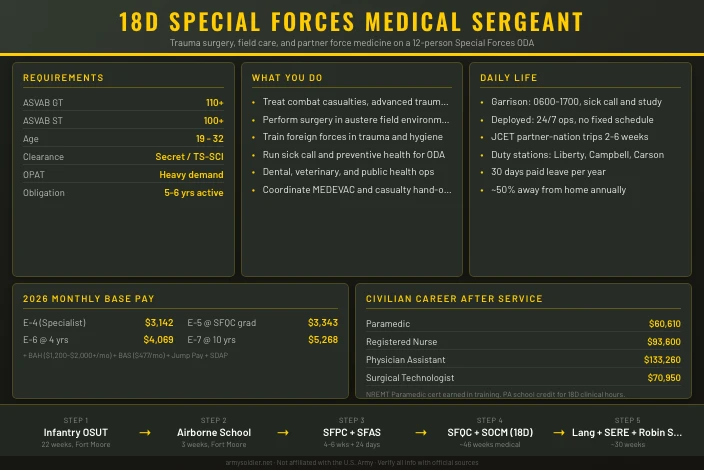
Job Role and Responsibilities
The 18D Special Forces Medical Sergeant provides emergency and primary medical care for Operational Detachment-Alpha (ODA) teams and the indigenous forces they train. Duties include trauma stabilization, surgical procedures, dental extractions, preventive medicine, and establishing field medical facilities in denied or austere environments. The 18D also teaches basic and advanced medical skills to partner-force soldiers and civilians.
Day-to-day work splits between garrison and operational phases. In garrison at your Special Forces Group, you run sick call for the team, maintain medical equipment, study, and train. A lot of the training is keeping perishable skills sharp: airway management, surgical procedures, IV placement under stress. You also attend continuing medical education to maintain your certifications.
On deployment, the mission expands. ODAs operate in remote areas where the nearest trauma center might be a 12-hour flight away. The 18D is responsible for keeping the team healthy, treating combat casualties, and providing care to partner forces and local civilians when the mission calls for it. You set up temporary clinics, run vaccination campaigns, and sometimes perform surgical procedures that would normally happen in an operating room.
Daily Tasks
- Assess and treat combat casualties using advanced trauma life support protocols
- Perform surgical procedures including wound debridement, chest tube insertion, and emergency airway management
- Conduct sick call, physical exams, and preventive health screenings for ODA members
- Train foreign military personnel in basic trauma care and hygiene
- Maintain and account for all medical equipment, pharmaceuticals, and controlled substances
- Coordinate medical evacuation (MEDEVAC) and casualty transfer to higher-level care
- Conduct public health assessments and disease surveillance in operational areas
- Provide dental care including extractions, fillings, and basic oral surgery
Mission Contribution
Special Forces ODAs deploy to places conventional Army units don’t go. They operate with minimal support, in small numbers, for extended periods. Without a trained 18D, a 12-person ODA has no trauma care capability beyond basic first aid. The medical sergeant keeps the team operational, treats casualties on the spot, and provides community healthcare that builds rapport with the local population. That rapport is often what makes the difference between a successful unconventional warfare mission and a failed one.
Technology and Equipment
Your medical kit goes far beyond a standard IFAK. The 18D carries equipment for surgical procedures, extended field care, and austere medical operations:
- Advanced airway management devices (King LT, surgical airway kits)
- Portable ultrasound units for field diagnosis
- Blood products and IV therapy supplies
- Surgical instrument sets for minor and emergent procedures
- Telemedicine capability for real-time consultation with trauma physicians
- Veterinary and dental instruments
- Broad-spectrum pharmaceuticals including controlled substances
Salary and Benefits
Financial Benefits
Base pay follows the standard enlisted pay table. Most soldiers enter the 18D pipeline as an E-1 through E-4 and graduate as an E-5. Qualified 18D soldiers also earn special pays on top of base pay.
| Rank | Pay Grade | Monthly Base Pay (2026) |
|---|---|---|
| Private (PV1) | E-1 | $2,407 |
| Specialist | E-4 | $3,142 |
| Sergeant (SFQC grad) | E-5 | $3,343 |
| Staff Sergeant (4 yrs) | E-6 | $4,069 |
| Sergeant First Class | E-7 | $5,268 |
Beyond base pay, 18D soldiers earn several additional pays:
- Special Duty Assignment Pay (SDAP) for assignment to Special Forces
- Jump Pay ($150/month) for maintaining airborne qualification
- Hazardous Duty Pay during combat deployments
- Language Proficiency Bonus based on Defense Language Proficiency Test scores
- Special Forces Proficiency Pay as applicable
Additional Benefits
TRICARE covers you and your family at zero out-of-pocket cost on active duty. That means no enrollment fees, no deductibles, and no copays for doctor visits, hospitalization, prescriptions, dental, vision, or mental health care.
Housing and food allowances add significantly to your total compensation:
- BAH (Basic Allowance for Housing) varies by duty station. A single E-5 at Fort Liberty, NC receives roughly $1,200-$1,600 monthly. Rates at other Group locations vary.
- BAS (Basic Allowance for Subsistence) adds $476.95 per month for food.
Education benefits include the Post-9/11 GI Bill, which pays full in-state tuition at public universities plus a monthly housing allowance and $1,000 annual book stipend for up to 36 months. Active-duty soldiers can use Tuition Assistance for up to $4,500 per year in college courses while serving.
Retirement follows the Blended Retirement System (BRS):
- 40% pension at 20 years (calculated on your highest 36 months of base pay)
- Government matches up to 5% of TSP contributions
- Continuation pay bonus available at 8-12 years of service
Work-Life Balance
You earn 30 days of paid leave per year. The reality of using it depends on your operational cycle. SF teams rotate through deployment, reset, training, and pre-deployment phases. During training cycles, taking leave is manageable. During pre-deployment and deployment phases, it’s not.
The schedule in garrison runs roughly 0600-1700 on normal duty days. Field exercises and schools break that pattern. Expect to be away from home roughly half the year when you account for deployments, training rotations, and language school.
Qualifications and Eligibility
Basic Qualifications
The 18D is not a direct-enlistment MOS. You enter through the 18X Special Forces Candidate contract and are assigned the 18D specialty during the Qualification Course based on performance, aptitude, and Army needs. Active-duty soldiers with other MOSs can also apply to reclassify into CMF 18.
| Requirement | Standard |
|---|---|
| Age | 19-32 (new recruits); up to 36 (active-duty reclassification) |
| Citizenship | U.S. citizen only |
| Education | High school diploma or GED |
| AFQT (ASVAB) | Minimum 31 (diploma); 50 (GED) |
| General Technical (GT) | Minimum 110 |
| Skilled Technical (ST) | Minimum 100 |
| Security Clearance | Secret (eligible); many positions require TS/SCI |
| Vision | Correctable to 20/20 |
| OPAT | Heavy physical demand category |
| Airborne | Must volunteer for Airborne School |
| Swim | 50-meter swim in uniform and boots |
The GT composite (Verbal Expression + Arithmetic Reasoning) is the harder score to reach. A 110 GT puts you above roughly 75% of test-takers. The ST composite (General Science + Verbal Expression + Mathematics Knowledge + Mechanical Comprehension) at 100 tests the scientific and technical aptitude you’ll need in the SOCM course, where you cover pharmacology, anatomy, and clinical medicine at a pace most nursing programs don’t match.
Application Process
The process from recruiter visit to ship date typically runs 4 to 12 weeks. Medical waivers or clearance delays extend that timeline.
Selection Criteria and Competitiveness
The entire SF pipeline is competitive, and the 18D specialty within it is the longest and most technically demanding phase. Candidates who score highest on GT and ST are most likely to be assigned to 18D. Performance during the Qualification Course also factors in.
SFAS evaluates candidates over 24 days using physical endurance events, solo land navigation, team events under stress, and peer evaluations. Only about 30% of candidates pass SFAS and continue to the Qualification Course. Of those who reach the SOCM phase, roughly half wash out before graduation.
Characteristics that correlate with success in the 18D specialty:
- Strong science background (biology, chemistry, anatomy)
- Ability to retain technical information under extreme physical stress
- Prior EMT or medical certification
- Comfort with blood, procedures, and clinical environments
- Self-discipline for sustained independent study
Upon Accession into Service
You enter as E-1 (Private) and promote through normal timelines during OSUT and Airborne School. Upon graduating the full SFQC pipeline, you are promoted to E-5 (Sergeant) and awarded the 18D MOS, the Green Beret, and the Special Forces Tab. The service obligation for an 18X contract is typically 5 to 6 years of active duty.
See our ASVAB study guide for strategies to hit these line scores, or take the PiCAT from home if you are a first-time tester.
Work Environment
Setting and Schedule
Where you work depends on your training phase and operational cycle:
- Training pipeline: Fort Moore and Fort Liberty, NC. Structured academic and field training. Days start before 0500 and end when the cadre determine. No weekends during high-intensity phases.
- Garrison at your Group: The team room and medical facility at your Group compound. Normal duty day runs 0600-1700, with PT at first light. You run sick call, study, and maintain gear. The schedule shifts based on upcoming exercises and deployments.
- Deployed: Forward operating bases, partner-force camps, local clinics, or austere field locations. There is no schedule. You treat casualties when they come in and run clinics when the mission allows.
Green Berets also spend significant time at specialized training locations. Medical sergeants rotate through civilian Level 1 trauma centers for clinical rotations during SOCM, and continue attending medical conferences and advanced courses throughout their careers.
Leadership and Communication
ODAs use a flatter structure than conventional Army units. The team captain and team sergeant (18Z) lead, but every team member contributes to planning and decision-making. As the 18D, you own the medical lane completely. No one outranks you on medical matters during a mission.
Performance feedback comes through the Noncommissioned Officer Evaluation Report (NCOER) system. In SF, your reputation within the community carries as much weight as any written evaluation.
Team Dynamics and Autonomy
The 18D works within a 12-person ODA, but medical decisions belong to you alone. On a mission in a remote location, you’re the closest thing to a doctor the team has. You make clinical calls that would normally require a physician’s signature at home. That authority comes with accountability: if you miss something or make a wrong call, there’s no one to catch it.
That autonomy is what attracts most people to the MOS. And it’s what drives some away during training, when the weight of that responsibility becomes clear.
Job Satisfaction and Retention
SF retention is among the highest in the Army. The 18D MOS has strong retention because the skills are unique, the work is meaningful, and the pay improves significantly with time in service and special pays. The most common complaints mirror the rest of the SF community: time away from family, physical wear over years of hard training, and bureaucratic friction.
Training and Skill Development
Initial Training
The 18D training pipeline is the longest in the Army. Plan on two to three years from enlistment to earning your Green Beret, with the SOCM phase alone lasting roughly 46 weeks.
| Phase | Location | Duration | Focus |
|---|---|---|---|
| Infantry OSUT | Fort Moore, GA | 22 weeks | Basic soldiering, marksmanship, squad tactics |
| Airborne School | Fort Moore, GA | 3 weeks | Static-line parachute operations, 5 qualifying jumps |
| SFPC | Fort Liberty, NC | 4-6 weeks | Physical conditioning, land navigation, SFAS prep |
| SFAS | Camp Mackall, NC | 24 days | Assessment and selection: endurance, land nav, peer eval |
| SFQC Phase 1: Orientation | Fort Liberty, NC | 7 weeks | SF history, doctrine, unconventional warfare theory |
| SFQC: Small Unit Tactics | Camp Mackall, NC | 13 weeks | Patrolling, ambushes, raids, reconnaissance |
| SOCM (18D MOS Training) | Fort Liberty, NC | ~46 weeks | Trauma surgery, pharmacology, clinical medicine, dental, public health |
| SFQC: Language & Culture | Fort Liberty, NC | 18-25 weeks | Assigned language to working proficiency |
| SERE | Camp Mackall, NC | 3 weeks | Survival, Evasion, Resistance, Escape |
| Robin Sage (CULEX) | NC Uwharrie region | 4 weeks | Culminating unconventional warfare field exercise |
The SOCM course is the defining experience for 18D candidates. The first phase hits anatomy and physiology at an intensity that rivals accelerated nursing programs, with tests every two to three days. Students who miss certain standards are dropped immediately. Clinical rotations at civilian Level 1 trauma centers give you hands-on experience before your first deployment. Graduates leave with an NREMT Paramedic certification and skills that qualify them to practice far beyond the paramedic scope in civilian medicine.
Advanced Training
After earning your tab, the medical training continues. Most 18D soldiers attend:
- Military Free-Fall Parachutist Course at Yuma Proving Ground, AZ
- Combat Diver Qualification Course at Key West, FL
- Special Operations Flight Medic Course
- Prolonged Field Care advanced courses
- Tactical Combat Casualty Care (TCCC) Instructor certification
- Foreign medical equivalency courses for the region your Group covers
Language training runs alongside everything else. You maintain and improve your assigned language through immersion programs and in-country deployment time. The Army pays language proficiency bonuses based on your DLPT scores.
Everything starts with qualifying ASVAB scores — our study guide covers what to study first.
Career Progression and Advancement
Career Path
You graduate the SFQC as an E-5 and begin your career as a team member. Advancement from there follows performance, time in grade, and military education.
| Rank | Pay Grade | Typical Timeline | Role |
|---|---|---|---|
| Sergeant | E-5 | SFQC graduation | ODA 18D team member |
| Staff Sergeant | E-6 | 2-4 years after tab | Senior medical NCO, ODA |
| Sergeant First Class | E-7 | 6-10 years after tab | Team Sergeant (18Z) candidate, medical training advisory roles |
| Master Sergeant | E-8 | 12-16 years total | Group or battalion medical planner |
| Sergeant Major | E-9 | 18+ years total | Senior medical NCO at Group or command level |
At E-7, strong performers compete for the 18Z designation, which makes you the senior enlisted leader of an ODA. Others move into medical planning billets at battalion and Group staff, or serve as instructors at the John F. Kennedy Special Warfare Center and School (SWCS).
Specialization Opportunities
Beyond the primary 18D MOS, you can earn Additional Skill Identifiers (ASIs) and Special Qualification Identifiers (SQIs) that open more advanced assignments:
- SQI “S” – Special Forces qualified
- SQI “P” – Parachutist
- ASI “K4” – Military Free-Fall qualified
- ASI “B4” – Combat Diver qualified
- Interagency Medical Advisor roles with CIA Special Activities Center and similar elements
- Warrant Officer track: 180A (Special Forces Warrant Officer)
Role Flexibility and Transfers
Transferring out of SF is uncommon once you’ve earned your tab. The investment is too large on both sides. Lateral moves to other SF specialties require retraining. Some 18D soldiers pursue a commission through OCS or the Warrant Officer program, which keeps them in the Special Operations community.
Active-duty 18D soldiers who separate early can reclassify into the 68W or 68C MOS to serve out remaining time, though this path is rare.
Performance Evaluation
NCOERs drive career advancement. Your rater is typically your team leader; your senior rater is a battalion-level officer. In SF, specific accomplishments matter more than generic superlatives. Strong evaluations document patient outcomes, foreign partner training results, language test scores, and leadership during deployments.
What sets top performers apart: DLPT scores at 2/2 or higher, a Ranger tab, advanced certifications (PHRP, EMT-Critical Care), and a reputation as someone who maintains skills without being told to.
Physical Demands and Medical Evaluations
Physical Requirements
The SF pipeline is one of the hardest physical programs in the military, and the 18D specialty adds intellectual demands on top of that. During SFAS, you ruck 12-18 miles daily with a 55-pound pack while sleep-deprived and disoriented. SOCM adds academic pressure on top of continued physical training standards.
After earning your tab, SF soldiers train 5-6 days per week. Most teams run, ruck, swim, and lift above the Army minimum because they know their lives and their teammates’ lives depend on their fitness. The 18D has to be able to treat casualties while already depleted from days in the field.
Every soldier must pass the Army Fitness Test (AFT) at least once per year. The AFT has 5 events scored 0-100 each, for a maximum of 500 points. All CMF 18 positions fall under the combat specialty standard, which requires a minimum total score of 350 using sex-neutral, age-normed standards.
| Event | Abbreviation | Scoring |
|---|---|---|
| 3-Repetition Maximum Deadlift | MDL | 60 pts minimum per event |
| Hand-Release Push-Up | HRP | 60 pts minimum per event |
| Sprint-Drag-Carry | SDC | 60 pts minimum per event |
| Plank | PLK | 60 pts minimum per event |
| Two-Mile Run | 2MR | 60 pts minimum per event |
Most Green Berets score well above 400. Soldiers who score below 350 face administrative action and cannot deploy.
Medical Evaluations
The initial MEPS screening is followed by SF-specific medical standards per AR 40-501. Before SFAS, you undergo additional screening for any disqualifying conditions. Annual physical exams, deployment readiness assessments, and post-deployment health evaluations continue throughout your career.
18D soldiers accumulate wear from years of rucking, jumping, diving, and operating in extreme environments. Knees, backs, and shoulders take consistent damage. The Army provides physical therapy and surgery, but chronic pain is a common reality for long-serving SF medics. Mental health resources are available and actively encouraged by SF leadership, particularly after combat deployments.
Deployment and Duty Stations
Deployment Details
Green Berets deploy more than most Army soldiers. Expect 3 to 6 months deployed, 6 to 12 months at home station, then back out again. Some teams deploy twice in a year for shorter rotations. Joint Combined Exchange Training (JCET) missions to partner nations happen regularly and last 2 to 6 weeks, separate from named operations.
The five active-duty Special Forces Groups each align to a specific region, which determines where you’ll operate:
| Group | Home Station | Regional Focus |
|---|---|---|
| 1st SFG (A) | Joint Base Lewis-McChord, WA | Indo-Pacific |
| 3rd SFG (A) | Fort Liberty, NC | Africa |
| 5th SFG (A) | Fort Campbell, KY | Middle East |
| 7th SFG (A) | Eglin AFB, FL | Latin America |
| 10th SFG (A) | Fort Carson, CO | Europe |
Two National Guard SF groups (19th and 20th SFG) also field 18D positions for reservists who complete the full pipeline.
Location Flexibility
Your Group assignment is the primary driver of where you live and where you deploy. You can express a preference, but the Army fills Group slots based on its needs and your language training. Expect to stay with one Group for 3 to 5 years before a potential reassignment.
Overseas rotations to Germany, Okinawa, and partner-nation locations come up regularly. Family accompaniment depends on the assignment type. Some rotational billets are unaccompanied; Group assignments are typically accompanied.
Risk, Safety, and Legal Considerations
Job Hazards
The 18D faces the same hazards as every Green Beret, plus a few unique to the medical role:
- Direct combat in small-team environments with limited quick reaction force support
- Parachute operations (static line and free-fall)
- Diving and underwater operations
- Handling controlled substances and maintaining pharmaceutical accountability in the field
- Exposure to disease in austere environments with poor sanitation
- Psychological burden of treating severe casualties with limited resources
Treating a teammate under fire while also managing the tactical situation is a scenario the 18D trains for repeatedly. It doesn’t get routine.
Safety Protocols
SF units enforce strict safety standards during parachute, dive, and demolitions training. Medical emergency protocols are in place at every training event. As the team’s medical expert, the 18D often serves as the safety officer for medical contingencies during training.
All medication storage, controlled substance handling, and medical procedures follow Army Regulation and applicable medical protocols. Field procedures that exceed normal paramedic scope require consultation with a remote physician via telemedicine when possible.
Security and Legal Requirements
All SF soldiers hold at minimum a Secret clearance. Many 18D positions and missions require Top Secret/SCI access. The investigation examines your financial history, foreign contacts, criminal record, and personal conduct. Foreign-born family members or significant overseas relationships trigger additional review but don’t automatically disqualify you.
You sign a non-disclosure agreement covering all classified operations. Violations carry federal charges and UCMJ consequences. Prescribing and dispensing controlled substances in the field follows a strict chain of accountability governed by DEA requirements and Army medical policy.
Impact on Family and Personal Life
Family Considerations
SF life is hard on families. You’ll be away from home 6 to 9 months per year on average when you count deployments, JCET trips, schools, and training exercises. Communication during some deployments goes dark for weeks. Medical emergencies at home become logistical problems when you’re eight time zones away.
Support resources at SF installations include:
- Family Readiness Groups (FRGs) at the company level
- Military OneSource for counseling, legal help, and family services
- Special Operations Care Coalition for wounded soldiers and their families
- Exceptional Family Member Program (EFMP) for special-needs dependents
- On-post childcare and spousal employment assistance at every Group
Relocation and Flexibility
Expect a permanent change of station (PCS) every 3 to 5 years. The Army covers moving costs, but each move disrupts your family’s life. SF duty stations tend to have established military communities with good schools, healthcare, and services. Fort Liberty, Fort Campbell, Fort Carson, Eglin, and Joint Base Lewis-McChord all have large SF family populations.
The harder adjustment is the unpredictability. Deployments extend. Training trips get added with a week’s notice. Leave gets cancelled. Planning around a SF schedule means building in a lot of flexibility.
Reserve and National Guard
Component Availability
The 18D MOS is available on active duty and in the Army National Guard. There are no Army Reserve Special Forces units. The Guard maintains the 19th SFG (Airborne) and the 20th SFG (Airborne), both with battalions spread across multiple states. Guard 18D medics are fully qualified Special Forces Medical Sergeants who maintain the same certifications and standards as active-duty 18Ds.
Drill Schedule and Training Commitment
Guard SF medics face the heaviest training load of any 18-series MOS in the Guard. Beyond the standard 3 to 5 training days per month and 3 to 4 week Annual Training that all Guard SF soldiers carry, 18Ds must maintain NREMT-Paramedic certification, advanced trauma skills, and other medical credentials. This means continuing medical education hours, clinical rotations, and recertification exams on top of SF team training. Some Guard 18Ds work part-time in emergency rooms or EMS agencies to keep their clinical skills sharp between drills.
Part-Time Pay
An E-4 with about three years of service earns roughly $422 per drill weekend in 2026. Guard SF soldiers drill far more than standard weekends, so annual military pay can reach $10,000 to $15,000 or more with extra training days. Special Duty Assignment Pay may also apply. Active-duty E-4 monthly base pay is $3,166.
Benefits Differences
Guard 18D soldiers receive Tricare Reserve Select rather than free active-duty TRICARE. TRS costs $57.88 per month for member-only or $286.66 for member plus family in 2026.
Education benefits include:
- Federal Tuition Assistance: $4,500 per year for drilling members
- MGIB-SR: roughly $416 per month while enrolled
- Post-9/11 GI Bill: requires 90 or more days of federal activation; Guard SF soldiers often accumulate enough deployments to earn full benefits
- State tuition waivers (Guard only): vary by state, some cover 100% at state schools, which is valuable for 18Ds pursuing PA or nursing degrees
Retirement uses the points-based system. The heavy training schedule means Guard SF soldiers accumulate points faster than standard Guard MOSs. Pension draws at age 60, reducible by qualifying mobilizations.
Deployment and Mobilization
Guard SF units deploy to real-world missions. The 19th and 20th SFGs have sent teams to multiple theaters. Mobilizations typically last 4 to 9 months. Guard 18D medics provide the same combat trauma care and village stability medical support as their active-duty counterparts. Most Guard 18Ds deploy at least once during a career, sometimes more.
Civilian Career Integration
The 18D skill set is one of the most transferable in the military. Guard 18D medics work as paramedics, emergency room technicians, physician assistants (with additional schooling), nurses, and EMS supervisors in their civilian careers. The SOCM training and advanced trauma experience make 18Ds highly sought after in emergency medicine. USERRA protects your civilian job during mobilization, and many EMS agencies actively recruit Guard SF medics.
| Feature | Active Duty | Army Reserve | Army National Guard |
|---|---|---|---|
| Commitment | Full-time | Not available | 3-5 days/month + 3-4 weeks AT + medical CEUs |
| Monthly Pay (E-4, ~3 yrs) | $3,166/month | N/A | ~$422/drill weekend + extra training days |
| Healthcare | TRICARE, $0 premiums | N/A | TRS, $57.88/month (member) |
| Education | TA + Post-9/11 GI Bill | N/A | Federal TA, MGIB-SR, state tuition waivers |
| Deployment | Regular rotation every 1-2 years | N/A | Mobilization every 3-5 years |
| Retirement | BRS pension at 20 years | N/A | Points-based, age 60 |
Post-Service Opportunities
Transition to Civilian Life
18D is one of the best military MOSs for civilian career transition. The combination of NREMT Paramedic certification, surgical skills, clinical rotations, and years of autonomous medical practice puts you ahead of most civilian healthcare applicants. Physician assistant programs actively recruit 18D veterans because of their documented clinical hours and hands-on experience.
The Transition Assistance Program (TAP) provides resume help, interview coaching, and benefits counseling in your final year on active duty. The Post-9/11 GI Bill covers 36 months of full in-state tuition at public universities, up to $29,920.95 per year at private institutions, plus a monthly housing allowance and $1,000 annual book stipend.
Some 18D veterans pursue civilian EMS or nursing roles immediately after separation. Others go straight to PA school. A significant number go into government contracting, supporting State Department medical programs, CIA medical operations, or DOD contractor roles in high-threat environments.
Civilian Career Prospects
| Civilian Job | Median Annual Salary (BLS, May 2024) | 10-Year Outlook |
|---|---|---|
| Paramedic | $60,610 | +6% (faster than average) |
| Registered Nurse | $93,600 | +5% (faster than average) |
| Physician Assistant | $133,260 | +20% (much faster than average) |
| Surgical Technologist | $70,950 | +7% (faster than average) |
The PA path is the most common long-term career for 18D veterans with college degrees. Many PA programs offer credit toward clinical hour requirements based on documented 18D experience. The Army COOL program helps match your training to civilian certifications and identify funding for credentialing exams.
Federal agencies that recruit 18D veterans include the CIA, DIA, State Department (Diplomatic Security), and USAID’s Office of U.S. Foreign Disaster Assistance.
Post-Service Policies
An honorable discharge gives you lifetime VA healthcare access, disability compensation for service-connected conditions, and full education benefits. SF veterans with combat deployments qualify for enhanced VA benefits. Soldiers with service-connected disabilities receive priority care and monthly tax-free compensation.
Start transition planning at least 12 months before your expected separation date. Career counselors at your installation can help map your 18D credentials to civilian licensing requirements in your target state.
Is This a Good Job for You? The Right (and Wrong) Fit
Ideal Candidate Profile
The 18D attracts people who want to be the most capable medic in the room, not just the team’s medic. If your goal is practicing high-level medicine with maximum autonomy in extreme environments, this is the job. If you want a stable schedule and a supervised clinical setting, it isn’t.
Traits that predict success:
- Strong academic aptitude, particularly in sciences
- Physical toughness that holds up over weeks of sustained stress
- Calm decision-making under chaos and time pressure
- Genuine interest in medicine beyond the tactical context
- Self-motivation to study independently without external structure
- Ability to work through ambiguous situations without clear guidance
Prior medical experience, including EMT certification, volunteer EMS work, or healthcare jobs, gives you a meaningful edge during the SOCM course. You won’t be memorizing material from scratch while also managing physical exhaustion.
Potential Challenges
The SOCM attrition rate is roughly 50%. Students drop for academic failures, physical injuries, and personal decisions. The course doesn’t ease you in. Week one hits you with anatomy and physiology content that accelerates every few days. There’s no academic probation period. Miss a test standard and you’re recycled or dropped.
Beyond training, the long-term challenges are real:
- Sustained time away from home wears on relationships
- Physical injuries accumulate over years of rucking, jumping, and diving
- The psychological weight of treating severe casualties without adequate resources follows some medics for years
- Career advancement requires continued academic investment on top of an already demanding job
Career and Lifestyle Alignment
This MOS fits people who want the most demanding medical training the military offers and are willing to spend two to three years earning access to it. The skills translate directly to six-figure civilian careers. The operational experience is genuinely rare. And the team environment inside an ODA is unlike anything in conventional medicine or conventional Army service.
But the cost is real: years of hard training, consistent time away from home, physical wear, and the psychological weight of practicing medicine in combat. If you can look at that list and see it as the point rather than the downside, talk to a Special Operations recruiter.
More Information
Contact a Special Operations recruiter rather than a general Army recruiter. Ask specifically about the 18X contract, current bonus amounts, and physical preparation programs available before your ship date. You can also review the 18D career path through the Army’s Special Forces career pages and the CMF 18 progression plan published at army.mil.
- Prepare for the ASVAB with our study guide to make sure your line scores qualify
This site is not affiliated with the U.S. Army or any government agency. Verify all information with official Army sources before making enlistment or career decisions.
Explore more Army special operations careers such as the 18X Special Forces Candidate and the 37F Psychological Operations Specialist.