18E Special Forces Communications Sergeant
Every 12-person Green Beret team has exactly one communications sergeant. When the ODA is operating in a denied area with no conventional forces nearby, you are the only link between the team and anyone who can extract them, resupply them, or bring fire support. That’s the job. And it requires a GT score of 110, roughly 60 weeks of training, and the willingness to pass one of the hardest selection programs in the U.S. military.
Qualifying requires specific ASVAB line scores — our ASVAB study guide covers what to target and how to prepare.
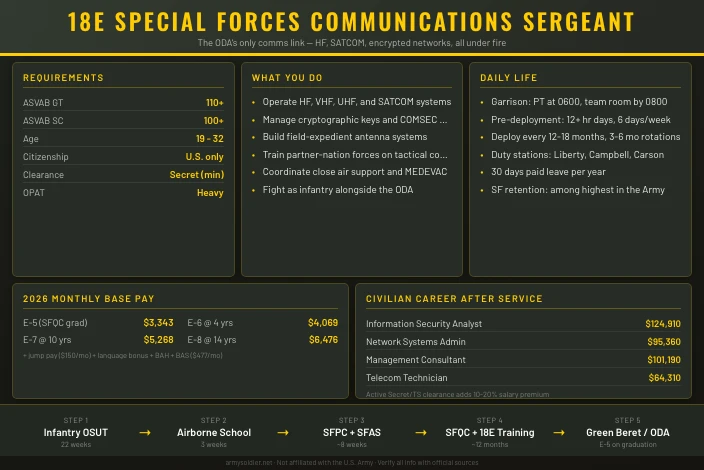
Job Role and Responsibilities
The 18E Special Forces Communications Sergeant plans, installs, and operates the full range of communications systems used by Special Forces Operational Detachment-Alpha (ODA) teams. This includes high-frequency radio, satellite communications (SATCOM), and encrypted digital networks across the entire electromagnetic spectrum. The 18E must be capable of establishing reliable communications in any environment, under fire, with improvised materials if necessary.
Day-to-day work in garrison means maintaining equipment, running communications exercises, and keeping every radio, antenna, and encryption device in the team room ready to deploy within 18 hours. During field training and deployments, it means building communications architectures from scratch in austere locations, often while simultaneously fighting as an infantry soldier.
Daily Tasks
A communications sergeant’s work divides into two broad categories: technical operations and combat support.
Technical operations:
- Configure and operate HF, VHF, UHF, and SHF radio systems
- Establish satellite uplinks using AN/PSC-5, PRC-117G, and similar systems
- Load and manage cryptographic keys and communications security (COMSEC) material
- Build antenna systems using field-expedient materials when issued equipment fails
- Maintain communications logs and frequency management plans
- Instruct partner-nation soldiers on tactical radio operations
Combat operations:
- Conduct direct action raids, ambushes, and reconnaissance alongside the rest of the ODA
- Establish communications under fire during casualty evacuation and close air support requests
- Move with the team on foot patrols with full combat load plus communications equipment
Specific Roles
Upon earning the 18E MOS, soldiers may be assigned additional identifiers as their careers develop:
| Identifier | Type | Description |
|---|---|---|
| SQI “S” | Special Qualification Identifier | Special Forces qualified |
| SQI “P” | Special Qualification Identifier | Military Parachutist |
| ASI “K4” | Additional Skill Identifier | Military Free-Fall (HALO/HAHO) qualified |
| ASI “B4” | Additional Skill Identifier | Combat Diver qualified |
| 18F | MOS | Assistant Operations and Intelligence Sergeant (E-7 option) |
| 18Z | MOS | Special Forces Operations Sergeant (Team Sergeant, E-7/E-8) |
Mission Contribution
Special Forces teams operate in small, isolated elements where no backup is minutes away. The 18E’s job keeps the team alive. When a team sergeant needs to coordinate with aircraft for close air support, the 18E makes that call happen. When a hostage rescue mission requires real-time coordination between ground teams, the 18E builds the network. No communications, no mission.
Beyond direct combat missions, 18Es also teach communications skills to foreign partner forces as part of Foreign Internal Defense (FID) missions. A well-trained partner nation’s signals corps extends U.S. operational reach without putting American soldiers at additional risk.
Technology and Equipment
The 18E trains on both classified and unclassified systems across the full electromagnetic spectrum:
- HF radios: Long-range communications across thousands of miles
- SATCOM terminals: AN/PSC-5 Spitfire, AN/PRC-117G, and Iridium satellite systems
- VHF/UHF tactical radios: PRC-152 and PRC-148 for short-range team and air communications
- Encryption systems: NSA-certified COMSEC devices for secure voice and data
- Digital communications: Tactical Local Area Networks (TACLAN), Blue Force Tracker, and joint tactical networks
- Improvised antenna systems: Wire antennas, directional arrays, and field-built solutions
Most of this equipment is not available to conventional Army units. 18Es work with systems that require specialized operator certifications and handling procedures.
Salary and Benefits
Financial Benefits
Pay follows the standard enlisted pay scale by grade and time in service. Every 18E graduates SFQC as an E-5 (Sergeant) at minimum, so the entry-level pay floor is the E-5 rate.
| Rank | Grade | Monthly Base Pay (2026) |
|---|---|---|
| Sergeant | E-5 | $3,343 |
| Staff Sergeant | E-6 | $3,401 to $5,044 (varies by time in service) |
| Sergeant First Class | E-7 | $3,932 to $5,537 |
| Master Sergeant | E-8 | $5,867 to $7,042 |
| Sergeant Major | E-9 | $7,182 to $8,248 |
Base pay is only the starting point. Special Forces soldiers earn significant additional pay:
- Special Duty Assignment Pay (SDAP): Varies by position and assignment
- Parachute pay (Hazardous Duty Incentive Pay): $150 per month for active jump status
- HALO pay: Additional incentive pay for Military Free-Fall qualified soldiers
- Language Proficiency Bonus: Paid based on DLPT scores; proficiency in a designated language pays $500 to $1,000+ per month
- Combat deployment pay: Hostile fire pay and imminent danger pay during overseas deployments
- Enlistment / Reenlistment bonuses: The 18E MOS is eligible for up to $40,000 signing bonus. Bonus amounts change frequently; confirm with your recruiter.
Housing and subsistence allowances add to your take-home. BAH varies by duty station and dependency status. A single E-6 at Fort Liberty, NC receives BAH based on local housing rates. BAS is a flat $476.95 per month for all enlisted soldiers, regardless of rank or location.
Additional Benefits
TRICARE Prime covers you and your dependents at no cost on active duty. That includes doctor visits, hospitalization, prescriptions, mental health care, dental, and vision. Your family pays nothing out-of-pocket for in-network care.
The Post-9/11 GI Bill covers 36 months of education benefits after separation: full in-state tuition at public universities, up to $29,920.95 per year at private schools, a monthly housing allowance tied to local E-5 BAH rates, and $1,000 annually for books. Active-duty Tuition Assistance covers $4,500 per year for college courses taken while serving.
Retirement follows the Blended Retirement System (BRS):
- 40% pension after 20 years (based on your highest 36 months of base pay)
- Government auto-contributes 1% of basic pay to your TSP from day one
- Government matches up to 4% of basic pay when you contribute 5%
- Continuation pay bonus between 8-12 years of service (Army active component typically 2.5x monthly base pay)
Work-Life Balance
You earn 30 days of paid leave per year. Using all of it is another matter. Between training rotations, language courses, JCET (Joint Combined Exchange Training) deployments, and combat deployments, SF soldiers are frequently away from home.
In garrison, a typical duty day runs from about 0600 to 1700. But training cycles, pre-deployment workups, and readiness requirements eat into that schedule regularly. Expect to spend six to nine months away from home station in a given year.
Qualifications and Eligibility
Basic Qualifications
The 18E MOS is not open to most recruits. Getting here requires meeting the requirements for the SF pipeline first, then passing every phase of it.
| Requirement | Standard |
|---|---|
| Citizenship | U.S. citizen only |
| Age | 19-32 (new recruits); up to 36 for active-duty reclassification |
| Education | High school diploma or GED |
| AFQT (overall ASVAB) | Minimum 31 (diploma); 50 (GED) |
| ASVAB GT composite | Minimum 110 |
| ASVAB SC composite | Minimum 100 |
| Security Clearance | Secret (minimum); many assignments require TS/SCI |
| Vision | Correctable to 20/20 |
| OPAT | Heavy physical demand category |
| Swim | 50-meter swim in uniform and boots |
| Airborne | Must volunteer for and complete Airborne School |
The GT composite (Verbal Expression + Arithmetic Reasoning) of 110 is the harder score to hit. It puts you in roughly the top 25% of ASVAB takers. The SC composite (Verbal Expression + Arithmetic Reasoning + Auto/Shop + Mechanical Comprehension) at 100 measures the communications and technical reasoning the job demands.
Active-duty soldiers seeking to reclassify to 18E must hold a minimum rank of E-3 (PFC) and no higher than E-6 (SSG), with no more than 12-14 years of total service prior to training and a minimum of 36 months remaining after graduation.
Application Process
The process from recruiter visit to shipping typically takes 4 to 12 weeks. Medical waivers or clearance delays can extend that significantly.
Selection Criteria and Competitiveness
The SF pipeline selects roughly 30% of candidates who start it. Most drop during SFAS or the early SFQC phases. SFAS evaluators are looking for:
- Physical endurance that holds up over days, not hours
- Solo land navigation ability, day and night
- Mental resilience under sustained sleep deprivation and physical stress
- Peer evaluations that show teammates trust you
- Demonstrated leadership under pressure
The 18E specialty within the SFQC requires above-average technical aptitude on top of those baseline requirements. Candidates who struggle with the communications training phase can be recycled to a different specialty or dropped.
Upon Accession into Service
New recruits enter as E-1 (Private) and promote normally through OSUT and Airborne School. Upon graduation from the full SFQC, soldiers are promoted to E-5 (Sergeant) regardless of time in service, awarded the Green Beret and Special Forces Tab, and assigned their 18E MOS. Total service obligation is typically 5-6 years from enlistment.
See our ASVAB study guide for strategies to hit these line scores, or take the PiCAT from home if you are a first-time tester.
Work Environment
Setting and Schedule
Your environment shifts dramatically depending on where you are in your career cycle.
In garrison: Team room at your Special Forces Group compound. PT starts at 0600. The rest of the day covers communications rehearsals, equipment maintenance, range days, and language training. Hours typically run 0600 to 1700, but this varies with training cycles. Pre-deployment workups are long, intense, and unpredictable.
In training: The Army’s Special Forces training centers push candidates and graduates through sustained physical and mental stress. Expect early mornings, late nights, and weeks with no defined end to the duty day.
Deployed: Forward operating bases, partner-nation camps, or austere field positions. No set schedule. You’re operational 24 hours a day. Communications windows may run at 0300 because that’s when propagation conditions are best for HF transmissions.
Leadership and Communication
ODAs run flatter than conventional Army units. Your ODA captain commands the team, and the team sergeant (18Z) runs daily operations. But every team member has a voice and a specialty that nobody else on the team can replicate. When it comes to communications architecture and frequency planning, the 18E is the expert, and the team trusts that.
Performance feedback comes through annual NCOERs and constant informal mentorship from senior team members. In a community this small, your reputation follows you between units.
Team Dynamics and Autonomy
An ODA operates with a level of autonomy unusual in any military. You might deploy with a two-person advance party, link up with partner forces, and run training missions for weeks before your next contact with battalion. Every decision about when to communicate, on what frequency, and with what encryption level falls on the 18E.
That autonomy comes with accountability. If communications fail during an emergency extraction, the consequences are real.
Job Satisfaction and Retention
SF retention is among the highest in the Army. The combination of meaningful missions, tight team cohesion, technical challenge, and competitive total compensation keeps most Green Berets in until they can retire. The primary complaints are time away from family, physical wear after years of demanding training, and bureaucratic friction that comes with any large organization.
Training and Skill Development
Initial Training
The 18X to 18E pipeline is the longest initial training commitment in the Army. Plan for roughly two years from ship date to earning your Green Beret and MOS.
| Phase | Location | Duration | Focus |
|---|---|---|---|
| Infantry OSUT | Fort Moore, GA | 22 weeks | Basic soldiering, marksmanship, land navigation, squad tactics |
| Airborne School | Fort Moore, GA | 3 weeks | 5 static-line jumps to qualify as a parachutist |
| SF Prep Course (SFPC) | Fort Liberty, NC | 4-6 weeks | Physical conditioning, ruck marches, land navigation |
| SFAS | Camp Mackall, NC | ~24 days | Physical and mental assessment, peer evaluation, solo land nav |
| SFQC Orientation | Fort Liberty, NC | 7 weeks | SF history, organization, unconventional warfare theory |
| Small Unit Tactics | Camp Mackall, NC | 13 weeks | Patrolling, ambushes, raids, reconnaissance |
| 18E MOS Training | Fort Liberty, NC | ~13 weeks | Communications systems, antenna theory, COMSEC, SATCOM operations |
| Language and Culture | Fort Liberty, NC | 18-25 weeks | Assigned foreign language to working proficiency |
| SERE | Camp Mackall, NC | 3 weeks | Survival, Evasion, Resistance, Escape |
| Robin Sage (CULEX) | NC Uwharrie region | 4 weeks | Culminating unconventional warfare exercise |
The 18E MOS training phase is roughly 13 weeks of dedicated communications instruction. You cover the theory and practice of HF propagation, antenna construction, SATCOM systems, frequency planning, COMSEC management, and communications-in-contact procedures. This phase is where the technical aptitude required by your GT and SC scores actually gets tested in practice.
Robin Sage is the culminating exercise. You infiltrate the fictional country of Pineland, link up with guerrilla forces played by civilian role players, and run a full unconventional warfare campaign. Communications support during Robin Sage is entirely the 18E’s responsibility.
Advanced Training
After earning the Green Beret, the schooling continues. SF soldiers attend additional courses throughout their careers:
- Military Free-Fall Parachutist Course (MFF): HALO and HAHO infiltration techniques at Yuma Proving Ground, AZ. Required for the ASI “K4” identifier
- Combat Diver Qualification Course (CDQC): Open-circuit scuba operations in Key West, FL. Required for the ASI “B4” identifier
- Advanced Special Operations Techniques (ASOT): Intelligence collection and reporting
- Ranger School: Strongly encouraged for all SF NCOs; teaches small-unit tactics leadership under sustained stress
- Defense Language Institute (DLI) immersion courses: Language proficiency must be maintained and improved throughout your career
- Civilian certifications: Through Army COOL, 18Es can earn CompTIA Network+, CompTIA Security+, CompTIA CySA+, CCNA, and other credentials that transfer directly to civilian careers
Language training doesn’t stop after SFQC. Your Group’s regional focus drives which language you study, and you return to full immersion courses between deployments to maintain your Defense Language Proficiency Test (DLPT) scores.
Everything starts with qualifying ASVAB scores — our study guide covers what to study first.
Career Progression and Advancement
Career Path
Every 18E graduates SFQC as an E-5. From there, promotion depends on performance evaluations, time in grade, and military education requirements.
| Rank | Grade | Typical Timeline | Role |
|---|---|---|---|
| Sergeant | E-5 | SFQC graduation | Junior communications sergeant on ODA |
| Staff Sergeant | E-6 | 2-4 years post-tab | Senior communications sergeant on ODA |
| Sergeant First Class | E-7 | 6-10 years post-tab | 18Z (Team Sergeant) or 18F (Intel Sergeant) candidate |
| Master Sergeant | E-8 | 12-16 years total | Company or battalion operations sergeant |
| Sergeant Major | E-9 | 18+ years total | Group-level or higher senior enlisted role |
At E-7, strong performers can either remain on ODAs as team sergeants (18Z) or move into the 18F role, which focuses on intelligence collection, analysis, and operational planning. The 18Z is the senior enlisted leader on an ODA and typically the most experienced Green Beret on the team. Some E-7 18Es also move into training assignments at the John F. Kennedy Special Warfare Center and School (SWCS), where they train the next generation of communications sergeants.
Specialization Opportunities
Beyond the 18E baseline, you can accumulate qualifications that open new assignments and increase pay:
- 18Z (Operations Sergeant): The team sergeant role, earned through promotion and selection at E-7/E-8
- 18F (Operations and Intelligence Sergeant): Intelligence-focused assignments at higher echelons
- 180A (Special Forces Warrant Officer): Officer-track career option for experienced 18-series NCOs
- MFF/HALO parachutist (ASI K4): Required for certain insertion-method missions
- Combat Diver (ASI B4): Maritime Special Operations capability
- SOTIC graduate: Special Operations Target Interdiction Course (sniper qualification)
Role Flexibility and Transfers
Transitioning out of Special Forces to a conventional Signal MOS (25 series) is possible but unusual. Most Green Berets who leave the SF community separate from the Army entirely or transition to civilian careers. Lateral moves to different SF specialties require retraining through SWCS.
The warrant officer path (180A) is a realistic option for experienced 18-series NCOs. It keeps you in Special Operations while moving into a technical advisory and planning role at the ODA, battalion, and Group level.
Performance Evaluation
NCOERs drive your career. Your rater is typically your company commander or team leader, and your senior rater is a battalion-level officer. Strong evaluations call out specific missions, communications architectures you built under pressure, language scores, and leadership during deployments.
What separates top performers in 18E: DLPT scores at 2/2 or above in your assigned language, current and active jump and dive status, Ranger tab, completion of advanced communications schools, and a reputation for keeping communications up when others can’t.
Physical Demands and Medical Evaluations
Physical Requirements
The SF pipeline is physically demanding in ways that most Army training programs aren’t. SFAS involves multi-day ruck marches carrying 55-plus pounds with minimal sleep and no clear finish line. After earning your tab, the physical standard stays high. Most ODAs train five to six days a week with a mix of rucking, running, swimming, and strength work.
Daily physical demands in an operational unit include:
- Prolonged foot movement with full combat load (70-120 pounds depending on mission)
- Swimming with equipment in open water
- Parachute operations (landing forces on the body)
- Obstacle crossing, climbing, and climbing egress during training
- Sustained physical effort over multi-day field exercises
All SF soldiers take the Army Fitness Test (AFT) at least once per year. The AFT replaced the ACFT on June 1, 2025. It has five events scored 0-100 points each, with a maximum score of 500.
| AFT Event | Abbreviation | Minimum Score (60 pts) |
|---|---|---|
| 3-Rep Max Deadlift | MDL | 60 pts |
| Hand-Release Push-Up | HRP | 60 pts |
| Sprint-Drag-Carry | SDC | 60 pts |
| Plank | PLK | 60 pts |
| Two-Mile Run | 2MR | 60 pts |
All CMF 18 positions are designated combat MOSs under AFT standards. That means 18Es must score a minimum of 350 out of 500 total, using sex-neutral, age-normed standards. Most operational SF soldiers score significantly above that floor.
The OPAT (Occupational Physical Assessment Test) is required at accession. CMF 18 positions require the Heavy physical demand category, the highest OPAT tier.
Medical Evaluations
MEPS is the first screen. Before SFAS, you complete an additional medical screening specific to SF standards under AR 40-501. Annual physicals, deployment readiness exams, and post-deployment health assessments continue throughout your career.
SF soldiers accumulate injuries at higher rates than conventional troops. Knees, backs, ankles, and shoulders absorb years of rucking, jumping, and diving. The Army provides physical therapy and surgical care, but chronic joint problems are common among long-serving Green Berets. Mental health services are available and actively encouraged, particularly after sustained combat deployments.
Deployment and Duty Stations
Deployment Details
18Es deploy more frequently than the Army average. A standard rotation is 3-6 months overseas followed by 6-12 months at home station. JCET training missions to partner nations happen between full deployments and last 2-6 weeks. In some years, a team conducts two or more overseas rotations.
The five active-duty Special Forces Groups each operate in a specific region of the world. Your Group assignment determines your deployment theater:
| Group | Home Station | Regional Focus |
|---|---|---|
| 1st SFG (A) | Joint Base Lewis-McChord, WA | Indo-Pacific |
| 3rd SFG (A) | Fort Liberty, NC | Africa |
| 5th SFG (A) | Fort Campbell, KY | Middle East / Central Asia |
| 7th SFG (A) | Eglin AFB, FL | Latin America |
| 10th SFG (A) | Fort Carson, CO | Europe |
The National Guard 19th and 20th SFG also field 18E positions.
Location Flexibility
You can request a preferred Group assignment, but the Army’s needs and your language training assignment largely determine where you end up. Expect to remain at one Group for 3-5 years before a potential reassignment. Overseas rotations to Germany, Okinawa, and partner-nation locations are common. Family accompanied tours depend on the assignment type and duration.
Risk, Safety, and Legal Considerations
Job Hazards
SF operations carry risks that conventional Army jobs don’t match:
- Direct combat in austere environments with limited quick-reaction force support
- Static-line and Military Free-Fall parachute operations
- Combat dive operations in open water
- Operation of complex electronic equipment under fire
- Working with explosive ordnance during demolition training and operations
- Extreme environment exposure: desert heat, arctic cold, high altitude, jungle
- Psychological stress from sustained high-tempo deployments
Green Berets have been killed and wounded in every major U.S. conflict and counter-terrorism operation since the Korean War. The small team structure means every casualty reduces the team’s operational capability.
Safety Protocols
SFQC and operational SF units enforce strict safety protocols for parachute operations, dive training, demolitions, and live-fire exercises. Jump masters, dive supervisors, and range safety officers enforce standards at every training event. Pre-mission planning includes formal risk assessments and rehearsals.
Body armor, helmets, and mission-specific protective equipment are standard. Every ODA includes an 18D medical sergeant trained in advanced trauma care.
Security and Legal Requirements
All SF soldiers must hold a Secret security clearance at minimum. Many assignments require Top Secret or Top Secret/SCI access depending on the unit, mission set, and communications systems operated. The investigation examines your financial history, foreign contacts, criminal record, and personal conduct. Plan for 3-12 months for the full investigation to clear.
18Es handle NSA-certified cryptographic equipment and classified communications systems, which imposes additional security obligations. You sign non-disclosure agreements covering classified operations. Violations carry consequences under both the UCMJ and federal law.
Impact on Family and Personal Life
Family Considerations
The SF operational tempo is harder on families than almost any other Army career track. Between deployments, pre-deployment workups, schools, and JCET trips, expect to be away from home 6-9 months in a typical year. Communication during some deployments drops to weekly or less depending on the operational security environment.
Support systems available at SF duty stations:
- Family Readiness Groups (FRGs): Unit-level family support networks
- Military OneSource: Free counseling, financial advising, and family services
- Special Operations Care Coalition: Support for wounded SF soldiers and their families
- Exceptional Family Member Program (EFMP): Support for dependents with special needs
- Installation employment assistance: Spousal career resources at each SF home station
Relocation and Flexibility
PCS moves happen every 3-5 years. The Army pays moving costs, but each move disrupts your family’s life. SF duty stations tend to be near established military communities. Fort Liberty, Fort Campbell, Fort Carson, JBLM, and Eglin all have mature SF family networks with schools, employment opportunities, and community support.
The harder part isn’t the moves. It’s the uncertainty. Deployments extend without warning. Training trips appear on the calendar 10 days out. Family plans built around a known schedule get cancelled regularly.
Reserve and National Guard
Component Availability
The 18E MOS is available on active duty and in the Army National Guard. There are no Army Reserve Special Forces units. The Guard fields the 19th SFG (Airborne) and the 20th SFG (Airborne), with battalions spread across roughly 20 states. Guard 18E communications sergeants are fully qualified Green Berets who maintain the same standards as active-duty SF soldiers.
Drill Schedule and Training Commitment
Guard SF soldiers train far more than the standard one weekend per month. Expect 3 to 5 training days per month, Annual Training running 3 to 4 weeks, plus additional schools and exercises throughout the year. 18E soldiers must maintain proficiency on HF/VHF/UHF radio systems, satellite communications, and encryption equipment. Communications equipment changes regularly, so staying current on new systems takes extra time. Guard SF communicators also attend language training and team-level field exercises.
Part-Time Pay
An E-4 with about three years of service earns roughly $422 per drill weekend in 2026. Guard SF soldiers drill well beyond 12 weekends per year, so annual military pay can reach $10,000 to $15,000 or more with extra training days. Special Duty Assignment Pay may also apply. Active-duty E-4 monthly base pay is $3,166.
Benefits Differences
Guard 18E soldiers receive Tricare Reserve Select instead of free active-duty TRICARE. TRS costs $57.88 per month for member-only or $286.66 for member plus family in 2026.
Education benefits include:
- Federal Tuition Assistance: $4,500 per year for drilling members
- MGIB-SR: roughly $416 per month while enrolled
- Post-9/11 GI Bill: requires 90 or more days of federal activation; Guard SF soldiers often accumulate enough deployment time to earn full benefits
- State tuition waivers (Guard only): vary by state, some cover 100% at state schools
Retirement uses the points-based system. Guard SF soldiers earn points faster than standard Guard MOSs because of the heavier training schedule. Pension draws at age 60, reducible by qualifying mobilizations.
Deployment and Mobilization
Guard SF units deploy to real-world missions. The 19th and 20th SFGs have sent Operational Detachment-Alphas to multiple theaters. Mobilizations typically last 4 to 9 months. Guard 18E communicators provide the same satellite links, radio nets, and encrypted communications as their active-duty peers. Most Guard SF soldiers deploy at least once during a career.
Civilian Career Integration
The 18E skill set transfers directly to civilian telecommunications, IT networking, cybersecurity, and satellite communications. Many Guard 18E soldiers work in IT, network administration, or defense contracting during the week. The combination of security clearance, communications expertise, and SF experience makes 18E soldiers competitive for high-paying technical positions. USERRA protects your civilian job during mobilization.
| Feature | Active Duty | Army Reserve | Army National Guard |
|---|---|---|---|
| Commitment | Full-time | Not available | 3-5 days/month + 3-4 weeks AT |
| Monthly Pay (E-4, ~3 yrs) | $3,166/month | N/A | ~$422/drill weekend + extra training days |
| Healthcare | TRICARE, $0 premiums | N/A | TRS, $57.88/month (member) |
| Education | TA + Post-9/11 GI Bill | N/A | Federal TA, MGIB-SR, state tuition waivers |
| Deployment | Regular rotation every 1-2 years | N/A | Mobilization every 3-5 years |
| Retirement | BRS pension at 20 years | N/A | Points-based, age 60 |
Post-Service Opportunities
Transition to Civilian Life
Former 18Es are among the most employable veterans in the job market. Your combination of technical communications skills, security clearance, foreign language proficiency, and operational experience opens doors in defense contracting, government agencies, and telecommunications that most veterans can’t access.
The Transition Assistance Program (TAP) provides resume help, interview coaching, and benefits orientation during your last year on active duty. The GI Bill covers 36 months of tuition at any public university (full in-state rate) plus a housing allowance and $1,000 annual book stipend.
Army COOL funds civilian certification exams that align with 18E skills, including CCNA, CompTIA Security+, CompTIA Network+, and CompTIA CySA+. Getting these certifications before separation substantially increases starting salary offers.
Private military contractors, defense consulting firms, and intelligence agencies actively recruit from the SF community. Many former 18Es transition directly into six-figure roles without a job search.
Civilian Career Prospects
| Civilian Career | Median Annual Salary (BLS, May 2024) | Outlook (2024-2034) |
|---|---|---|
| Information Security Analyst | $124,910 | +29% (much faster than average) |
| Telecommunications Technician | $64,310 | Stable, ~23,200 annual openings |
| Network and Computer Systems Administrator | $95,360 | +5% (faster than average) |
| Intelligence Analyst (federal) | $99,440 | Stable, high demand with clearance |
| Management Analyst / Consultant | $101,190 | +9% (faster than average) |
Federal agencies that actively recruit 18E veterans include the NSA, CIA, DIA, DHS Cybersecurity division, and the State Department’s Bureau of Diplomatic Security. Defense contractors like L3Harris, Leidos, Booz Allen Hamilton, and Northrop Grumman hire 18Es specifically for classified communications and SIGINT program support.
Post-Service Policies
An honorable discharge provides lifetime access to VA healthcare, disability compensation (for service-connected conditions), and education benefits. SF soldiers with combat deployments qualify for enhanced VA benefits. Veterans with service-connected disabilities receive priority care and monthly tax-free compensation.
Start transition planning at least 12 months before your separation date. Benefits elections, clearance portability, and civilian certification timelines all require lead time that most separating soldiers underestimate.
Is This a Good Job for You? The Right (and Wrong) Fit
Ideal Candidate Profile
The SF pipeline doesn’t select for the biggest soldiers or the fastest runners. It selects for people who keep moving when the rational choice is to stop. Beyond that baseline, 18E specifically attracts soldiers with technical curiosity.
Traits that correlate with success in this role:
- Technical aptitude: genuine interest in how radio waves propagate, how encryption works, how antenna geometry affects signal strength
- Mental endurance that holds over weeks, not hours
- Ability to operate systems under duress, with cold hands, at night, under fire
- Language learning ability (you’ll spend over four months studying a foreign language before you ever deploy)
- Comfort with ambiguity and operating without clear guidance
The best 18E candidates study communications before they enlist. Ham radio licensing, electronics coursework, and IT certifications all signal the kind of technical interest that translates to SFQC success.
Potential Challenges
This path carries real costs that aren’t always clear at the recruiter’s office:
- Washout risk: Roughly 70% of 18X candidates don’t earn a Green Beret. If you wash out of SFAS or the SFQC, the Army assigns you to an MOS based on its needs, not your preferences
- Pipeline length: You’ll be in training for two-plus years before your first operational assignment. Peers who enlisted in conventional MOSs will be mid-career by then
- Physical wear: Years of rucking, jumping, and diving accumulate. Chronic knee and back injuries are common
- Family strain: Divorce rates in SF run higher than the Army average for documented reasons
If predictability matters to you, this isn’t the right path. The 18X contract is a bet on yourself. You’re wagering years of your life on passing a program that most people fail.
Career and Lifestyle Alignment
This job fits a specific type of person: technically curious, physically disciplined, comfortable with discomfort, and motivated by small-team operational work with direct impact. The pay gets serious once you add special pays and allowances. The skills transfer to civilian careers that pay well above median. And the operational experiences are things that 99% of people will only read about.
But the cost is high. If you read the failure rates and want in anyway, talk to a Special Operations recruiter and start preparing now.
More Information
Reach out to your local Army recruiter and ask to be connected with a Special Operations recruiter. The standard recruiting process doesn’t always cover SF enlistment specifics, so requesting the right contact matters. You can also visit goarmy.com directly or contact the USASOC recruiting office for current bonus amounts, training schedules, and preparation resources.
Start your physical preparation 6-12 months before your intended ship date. Focus on rucking with weight, distance running, swimming, and land navigation practice. The GT 110 and SC 100 ASVAB requirements are non-negotiable, so take a practice test early.
- Prepare for the ASVAB with our study guide to make sure your line scores qualify
This site is not affiliated with the U.S. Army or any government agency. Verify all information with official Army sources before making enlistment or career decisions.
Explore more Army special operations careers such as the 18X Special Forces Candidate and the 37F Psychological Operations Specialist.