18F Special Forces Assistant Operations and Intelligence Sergeant
There is no direct path from the recruiting office to MOS 18F. This is one of the most selective jobs in the U.S. Army, reserved for experienced Special Forces operators who have already passed the Special Forces Qualification Course, served on an Operational Detachment Alpha (ODA), and demonstrated the judgment to manage intelligence operations under pressure. If you’re reading this as someone exploring Army enlistment options, 18F is a career destination, not an entry point.
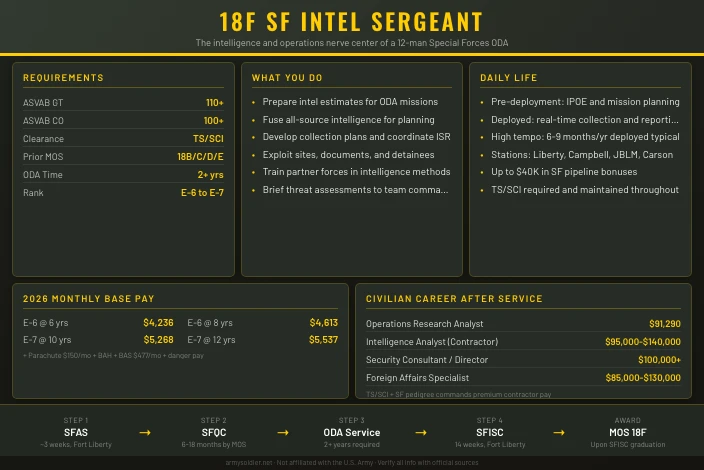
The 18F is the intelligence and operations nerve center of an ODA. Every 12-man Special Forces team has one, and that soldier is responsible for fusing all-source intelligence, planning missions with the team commander, and coordinating operations with higher headquarters. The current Army enlistment bonus of up to $40,000 applies to the Special Forces pipeline, reflecting how hard the Army works to grow these capabilities.
Qualifying requires specific ASVAB line scores — our ASVAB study guide covers what to target and how to prepare.
Job Role and Responsibilities
The Special Forces Assistant Operations and Intelligence Sergeant employs conventional and unconventional intelligence collection and processing techniques to support Special Forces operations. The 18F prepares intelligence estimates during mission planning, provides tactical and technical guidance to the Detachment Commander, and plans, organizes, trains, and advises on intelligence collection and processing with indigenous and allied personnel.
Daily Tasks
Daily work depends heavily on the operational cycle. During mission planning phases, the 18F is consumed by intelligence preparation of the operational environment (IPOE): analyzing threat networks, terrain, population dynamics, and adversary capabilities. During operations, the focus shifts to real-time collection, cueing, and reporting.
At the ODA level, the 18F is also the team’s link to higher-level intelligence resources: theater collection assets, national intelligence products, and partner nation intelligence services. Making those relationships work requires interpersonal skill as much as technical knowledge.
Typical responsibilities:
- Preparing and briefing intelligence estimates and threat assessments for the team
- Developing intelligence collection plans using all available assets
- Exploiting intelligence from detainee operations, document exploitation, and partner sources
- Coordinating with battalion and group S2 sections for higher-level intelligence support
- Planning and overseeing Special Forces intelligence operations
- Training indigenous personnel in basic intelligence collection and reporting methods
- Maintaining operational security on all team planning and mission activities
Specific Roles
The 18F operates across the full Special Forces mission spectrum:
| SF Mission Type | 18F Role |
|---|---|
| Unconventional Warfare (UW) | Resistance network intelligence, partner force development |
| Direct Action (DA) | Target development, pre-mission ISR coordination |
| Special Reconnaissance (SR) | Intelligence collection planning and execution |
| Foreign Internal Defense (FID) | Host nation intelligence capacity building |
| Counter-terrorism (CT) | Network analysis, target exploitation |
| Civil Affairs (CA) | HUMINT collection from civilian engagement |
Mission Contribution
An ODA without a capable 18F is essentially blind. Commanders make decisions with incomplete information in every Special Forces operation. The 18F’s job is to narrow that gap as much as possible and to ensure the team does not walk into a situation the intelligence preparation should have revealed. A well-executed 18F role has saved lives. Gaps in that role have cost them.
Technology and Equipment
- Intelligence analytical platforms (Palantir, Analyst’s Notebook, DCGS-A)
- Signals intelligence collection equipment at the detachment level
- Sensitive site exploitation kits
- Tactical communications systems (satellite, HF, VHF)
- All-source intelligence fusion tools on classified networks
- Biometric collection devices
Salary and Benefits
Base Pay
Pay is governed by the 2026 DFAS pay tables. Soldiers reach 18F as Staff Sergeants (E-6) or Sergeant First Class (E-7), meaning the relevant pay grades are:
| Rank | Time in Service | Monthly Base Pay |
|---|---|---|
| E-5 (SGT) | 4 years | $3,947 |
| E-6 (SSG) | 6 years | $4,236 |
| E-6 (SSG) | 8 years | $4,613 |
| E-7 (SFC) | 10 years | $5,268 |
| E-7 (SFC) | 12 years | $5,537 |
| E-8 (MSG) | 14 years | $6,476 |
Special Pays and Allowances
Special Forces soldiers receive additional compensation beyond base pay:
- Special Duty Assignment Pay (SDAP): Varies by assignment; many SF billets qualify
- Hazardous Duty Incentive Pay: Parachute pay ($150/month) for jump-qualified soldiers
- Hostile Fire / Imminent Danger Pay: $225/month when deployed to qualifying areas
- BAH: Varies by duty station; Fort Liberty area rates for an E-7 with dependents exceed $2,000/month
- BAS: $476.95/month flat for all enlisted soldiers in 2026
Enlistment and Re-enlistment Bonuses
The Army currently offers up to $40,000 in bonuses for the Special Forces pipeline. Specific bonus amounts depend on the contract length, prior service status, and current Army incentive programs. Verify current figures with a Special Forces recruiter.
Benefits
- TRICARE: Full coverage at no cost for the soldier; low-cost family coverage
- Post-9/11 GI Bill: 36 months of education benefits, including full in-state tuition and housing allowance
- Tuition Assistance: Up to $4,500 annually for courses taken while serving
Retirement
Under the Blended Retirement System (BRS), a 20-year pension pays 40% of the highest 36-month average basic pay. For an E-8 retiring at 20 years, that baseline is significant. TSP government matching up to 5% of basic pay adds substantial long-term value. Continuation pay, available between years 7-12, provides an additional lump sum for soldiers who extend.
Work-Life Balance
There is no pretending that Special Forces work-life balance resembles a normal schedule. Deployment cycles, language training, and constant operational preparation mean sustained high tempo. The Army provides 30 days of paid leave per year, but accessing it during high-optempo periods requires coordination. Many SF soldiers find the intensity is something they signed up for, not a sacrifice they reluctantly accept.
Qualifications and Eligibility
Requirements Table
| Requirement | Details |
|---|---|
| ASVAB Line Scores | GT: 110 minimum; CO: 100 minimum |
| Prior MOS Requirement | Must hold 18B, 18C, 18D, or 18E before attending SFISC |
| Time on ODA | Minimum 2 years on an Operational Detachment Alpha or Bravo |
| Rank | Staff Sergeant (E-6) to Sergeant First Class (E-7) |
| Security Clearance | TS/SCI required |
| Citizenship | U.S. citizen required |
| Physical Standards | PULHES 111221; must meet SF physical requirements |
| Swimming | 50 meters in uniform with boots |
| Age | No upper limit published for SFISC, but service time requirements effectively set the range |
The GT composite (VE + AR) of 110 and CO composite (AR + CS + AS + MC) of 100 are among the higher enlisted ASVAB requirements in the Army. Combined with the prior service requirements, they reflect the cognitive and analytical demands of the intelligence role on an ODA.
The TS/SCI clearance requires a Single Scope Background Investigation (SSBI), the most thorough standard federal background investigation. It covers the previous 10 years of financial history, all foreign contacts and travel, employment, education, and mental health treatment.
The Path to 18F
Service Obligation
Enlisting as 18X typically involves a 3-4 year active duty obligation at minimum. Special Forces service creates additional commitments through re-enlistment incentives and bonus agreements. The SFISC adds time to your overall training investment. Soldiers who take the SF bonuses commit to additional service years.
See our ASVAB study guide for strategies to hit these line scores, or take the PiCAT from home if you are a first-time tester.
Work Environment
Setting and Schedule
18F soldiers work in the Special Forces detachment environment. That means frequent foreign travel, extended training cycles, and deployments to austere and often high-threat locations. The garrison schedule at Fort Liberty or other SF Group home stations is training-heavy but has more structure than many expect. Pre-deployment training cycles compress that schedule significantly.
At the ODA level, the team operates with significant collective and individual autonomy. Mission planning cycles are intense; briefing and approval processes require precision. Senior NCOs like the 18F carry substantial weight in these processes.
Chain of Command
The 18F works directly for the ODA team sergeant and commander. Above the ODA: a Special Forces Company, Battalion (Special Forces Group), and Group commander. The intelligence chain runs through group and theater special operations commands to national-level intelligence agencies in many cases.
Team Dynamics
An ODA is a tight-knit, high-trust unit. Every member has survived the same selection and qualification process. The 18F is expected to be the team’s expert on intelligence, but also a capable operator who can pull his weight in any physical or tactical situation. The reputation and trust earned on the ODA comes from performance, not rank.
Job Satisfaction
Special Forces re-enlistment rates are among the highest in the Army. The combination of meaningful, complex work, peer quality, and professional autonomy drives retention. The 18F role specifically, which sits at the intersection of intelligence and operations, is one of the more intellectually demanding positions available to an enlisted soldier anywhere in the U.S. military.
Training and Skill Development
Initial and Entry Training
The path to 18F runs through several major training events:
| Phase | Location | Length | Focus |
|---|---|---|---|
| SFAS (Special Forces Assessment and Selection) | Fort Liberty, NC | ~3 weeks | Physical and cognitive selection |
| SFQC Phase 1 (Small Group) | Fort Liberty, NC | ~12 weeks | Special Forces core skills, tactics |
| SFQC MOS Phase (18B/C/D/E) | Various | 12-24+ weeks | MOS-specific qualification |
| SFQC Phase 3 (Robin Sage) | North Carolina | ~3 weeks | Full-mission unconventional warfare exercise |
| ODA Service | Various | 2+ years | Operational experience before SFISC eligibility |
| SFISC (Special Forces Intelligence Sergeant Course) | Fort Liberty, NC | 14 weeks | All-source intelligence for SF operations |
The SFISC, course number 011-18F40, runs three iterations per year with a class size of approximately 50 students. Curriculum covers intelligence preparation of the operational environment, human intelligence, signals intelligence, geospatial intelligence, and network analysis applied to the Special Forces mission set.
Advanced Training
After receiving the 18F MOS, soldiers continue developing through:
- Defense Language Institute training for regional language proficiency
- Advanced Special Operations Techniques (ASOT) certification for advanced intelligence operations
- Combat Applications Course (Rangers) or other cross-training opportunities
- Advanced analytical tools training on classified platforms
- Joint and interagency assignments with DIA, CIA, NSA, and theater intelligence organizations
Everything starts with qualifying ASVAB scores — our study guide covers what to study first.
Career Progression and Advancement
Rank Progression
| Grade | Title | Typical Time in Grade | Key 18F Milestone |
|---|---|---|---|
| E-5 | Sergeant (SGT) | 3-5 years | Completing SFQC, first ODA assignment |
| E-6 | Staff Sergeant (SSG) | 6-10 years | Primary SFISC eligibility window |
| E-7 | Sergeant First Class (SFC) | 10-14 years | Senior 18F, ODA Team Sergeant candidate |
| E-8 | Master Sergeant (MSG) | 14-18 years | Group/Battalion S2 NCOIC, Senior advisor |
| E-9 | Sergeant Major (SGM) | 18-25 years | Group Intelligence SGM |
Specialization and Transfers
Experienced 18Fs can pursue:
- Warrant Officer track: The 350F (Special Forces Warrant Officer) path is available for senior NCOs
- Joint billets: JSOC, DIA, CIA, NSA, and theater special operations commands regularly draw from experienced 18Fs
- Inter-agency assignments: Detailed to other government agencies in intelligence-related roles
- ROTC / Green to Gold: Officer commissioning for those who meet the academic requirements
Performance Evaluation
NCOERs in Special Forces reflect performance in a demanding peer environment. The qualitative benchmarks for an 18F are: quality and timeliness of intelligence products, effectiveness in shaping ODA mission planning, performance under operational pressure, and demonstrated mastery of analytical methods. Senior NCO ratings from ODA Team Sergeants and Group S2 officers carry significant weight.
Physical Demands and Medical Evaluations
Fitness Standards
Special Forces imposes standards above the Army general minimum. The Army Fitness Test (AFT) applies to all soldiers, but SF Group commanders may impose additional unit standards. The AFT combat standard applies to SF MOSs.
| AFT Event | Description | Min Score |
|---|---|---|
| MDL | 3-Rep Max Deadlift | 60 pts |
| HRP | Hand Release Push-Up | 60 pts |
| SDC | Sprint-Drag-Carry | 60 pts |
| PLK | Plank | 60 pts |
| 2MR | Two-Mile Run | 60 pts |
| Total | 350 pts minimum (combat standard) |
The AFT 350-point combat standard is sex-neutral and age-normed. This is a meaningfully harder standard than the general 300-point threshold. SFAS physical testing is separate from and additional to the AFT.
Medical Evaluations
SF soldiers undergo periodic physicals. The TS/SCI clearance requires a medical component in the SSBI. Mental health treatment history is reviewed during clearance reinvestigations. The operational demands of SF service place sustained stress on musculoskeletal systems; injury history and management are important throughout an SF career.
Deployment and Duty Stations
Deployment Details
Special Forces deployments differ from conventional units. Rotational deployments to partner nations, Joint Combined Exchange Training (JCET) events, and direct action/special reconnaissance operations can occur on cycles that keep soldiers deployed for 6-9 months out of every 12-18. The tempo is higher than most Army units and varies significantly by Group focus area.
Duty Stations
SF Group home stations align with geographic focus areas:
| SF Group | Home Station | Regional Focus |
|---|---|---|
| 1st SFG | Joint Base Lewis-McChord, WA | INDOPACOM |
| 3rd SFG | Fort Liberty, NC | AFRICOM |
| 5th SFG | Fort Campbell, KY | CENTCOM |
| 7th SFG | Eglin AFB, FL | SOUTHCOM |
| 10th SFG | Fort Carson, CO | EUCOM |
| 19th SFG (ARNG) | Multiple states | CENTCOM/EUCOM |
| 20th SFG (ARNG) | Multiple states | SOUTHCOM/AFRICOM |
Risk, Safety, and Legal Considerations
Job Hazards
This is one of the highest-risk career paths in the Army. Special Forces operations occur in denied areas, permissive and semi-permissive environments, and direct combat. The risk is inherent and understood by every soldier who volunteers for the pipeline.
Safety Protocols
SOF operations follow strict risk management processes. Mission briefs, rehearsals, and abort criteria are mandatory. The intelligence preparation the 18F provides is itself a safety measure for the team.
Security Requirements
A TS/SCI clearance is required and must be maintained throughout service in Special Forces. Loss of clearance results in removal from the SF unit and reclassification. Counterintelligence polygraph examinations are part of the TS/SCI process for many SF positions.
The UCMJ governs all Special Forces operations along with specific Title 10 authorities, Executive Orders governing covert operations, and theater-level rules of engagement. 18F soldiers are expected to understand these frameworks and operate within them precisely.
Impact on Family and Personal Life
Family Considerations
SF careers are demanding on families. The combination of frequent deployments, training cycles, and the classified nature of the work creates real strain. Fort Liberty and other SF Group home stations have established support infrastructure: Family Readiness Groups, special operations-specific family programs, and connections to the broader SOF community.
Many SF soldiers describe the SF community itself, including the families that grow up around Group home stations, as a support system unlike anything in conventional Army life. That community is real, but it takes time to build and requires the family to be in it.
Relocation
SF careers are relatively stable geographically compared to conventional units. Soldiers often spend 4-6 years at the same Group home station before a major PCS. Joint and interagency billets break that pattern for senior NCOs.
Reserve and National Guard
Component Availability
The 18F MOS is available on active duty and in the Army National Guard. There are no Army Reserve Special Forces units. The Guard maintains the 19th SFG (Airborne) and 20th SFG (Airborne). Because 18F is a senior MOS requiring the rank of E-7 or above, Guard positions are limited to team sergeant, operations sergeant, and intelligence sergeant slots within SF companies and battalions. You must already hold another 18-series MOS and meet the prerequisites before reclassifying to 18F.
Drill Schedule and Training Commitment
Guard SF soldiers train far beyond standard drill weekends. Expect 3 to 5 training days per month, 3 to 4 weeks of Annual Training, and additional exercises and schools throughout the year. 18F soldiers must maintain proficiency in intelligence analysis, operations planning, and working with joint and interagency partners. Language skills and cultural knowledge also require ongoing investment. The senior rank and planning responsibilities mean you may spend additional time on administrative and operational duties between drill periods.
Part-Time Pay
As a senior NCO, an 18F earns more than the E-4 baseline. An E-7 with 10 years of service earns roughly $680 per drill weekend in 2026. With the heavy Guard SF training schedule, annual military pay can range from $15,000 to $20,000 or more depending on extra training days and special pay. Active-duty E-7 monthly base pay at 10 years is approximately $5,097.
Benefits Differences
Guard 18F soldiers receive Tricare Reserve Select rather than free active-duty TRICARE. TRS costs $57.88 per month for member-only or $286.66 for member plus family in 2026.
Education benefits include:
- Federal Tuition Assistance: $4,500 per year for drilling members
- MGIB-SR: roughly $416 per month while enrolled
- Post-9/11 GI Bill: most Guard SF seniors have enough cumulative deployment time to earn 100% benefits
- State tuition waivers (Guard only): vary by state, some cover full tuition at state schools
Retirement uses the points-based system. The heavy training schedule and deployments help Guard SF soldiers accumulate points faster. Pension draws at age 60, reducible by qualifying mobilizations.
Deployment and Mobilization
Guard SF units deploy to real-world missions. 18F soldiers serve as the intelligence and operations backbone of Operational Detachment-Alphas and company-level staffs. Mobilizations typically last 4 to 9 months. Most senior Guard SF soldiers have deployed multiple times over their careers.
Civilian Career Integration
The 18F skill set maps to intelligence analysis, operations management, project planning, and defense contracting. Many Guard 18F soldiers work in government intelligence agencies, defense firms, or consulting in their civilian careers. The combination of SF experience, security clearance, and leadership at the senior NCO level makes 18F soldiers competitive for management positions. USERRA protects your civilian job during mobilization.
| Feature | Active Duty | Army Reserve | Army National Guard |
|---|---|---|---|
| Commitment | Full-time | Not available | 3-5 days/month + 3-4 weeks AT |
| Monthly Pay (E-7, ~10 yrs) | ~$5,097/month | N/A | ~$680/drill weekend + extra training days |
| Healthcare | TRICARE, $0 premiums | N/A | TRS, $57.88/month (member) |
| Education | TA + Post-9/11 GI Bill | N/A | Federal TA, MGIB-SR, state tuition waivers |
| Deployment | Regular rotation every 1-2 years | N/A | Mobilization every 3-5 years |
| Retirement | BRS pension at 20 years | N/A | Points-based, age 60 |
Post-Service Opportunities
18F veterans transition to some of the most competitive positions in the intelligence and security sectors. The combination of TS/SCI clearance, SF pedigree, and deep analytical experience is extremely rare in the civilian market.
| Civilian Job Title | Median Annual Salary | Job Outlook |
|---|---|---|
| Operations Research Analyst | $91,290 | +21% (2024-2034) |
| Intelligence Analyst (Contractor / DoD) | $95,000-$140,000 | High demand |
| Security Consultant / Director | $100,000-$160,000 | Strong demand |
| Foreign Affairs Specialist (Federal) | $85,000-$130,000 | Steady demand |
Salary data from BLS Occupational Outlook Handbook (May 2024 data). Defense contractor intelligence roles often exceed BLS median figures for veterans with active TS/SCI and SF experience.
Defense contractors, three-letter agencies, and private security firms actively recruit former SF soldiers. An 18F with a TS/SCI, regional language capability, and 10+ years of operational experience commands salaries at the high end or above the ranges listed. The GI Bill supports advanced degrees in intelligence studies, international relations, or national security policy at the master’s level.
Is This a Good Job for You? The Right (and Wrong) Fit
Ideal Candidate
18F suits a soldier who:
- Has already proven themselves in the Special Forces pipeline
- Thinks analytically and enjoys fusing complex, incomplete information into assessable judgments
- Can work independently and make sound decisions with limited oversight
- Has genuine interest in intelligence tradecraft, not just the operational action
- Is comfortable with sustained high tempo and the associated personal sacrifices
Potential Challenges
This MOS demands the same physical capability as any other 18-series but adds a level of cognitive workload that not every operator wants to carry. Writing intelligence products, managing collection, and briefing the team commander requires sustained analytical focus alongside the operational demands of SF service.
The path is long. Reaching 18F takes a minimum of 5-7 years from enlistment, most of which involves demanding physical and psychological selection events with real washout rates. Soldiers who start the pipeline expecting guaranteed success don’t survive it.
Career and Lifestyle Alignment
If you’re already in the Special Forces pipeline, or approaching the point where SFISC nomination becomes realistic, and intelligence and operations work appeals to you, 18F is as good as it gets for an enlisted career in the U.S. Army. The post-service options are exceptional and the work is genuinely consequential. If you want the SF experience without the intelligence focus, stay in your primary MOS and remain on the ODA in that capacity.
More Information
Special Forces recruiting is handled by Special Forces Command’s recruiting pipeline. Existing SF soldiers seeking SFISC nomination should work through their chain of command and Group S1/S2 sections. For prior-service soldiers considering the SF pipeline, a Special Forces-specific recruiter can advise on current SFAS class dates and eligibility.
- Prepare for the ASVAB with our study guide to make sure your line scores qualify
This site is not affiliated with the U.S. Army or any government agency. Verify all information with official Army sources before making enlistment or career decisions.
Explore more Army special operations careers such as 18B Special Forces Weapons Sergeant and 18E Special Forces Communications Sergeant.