18X Special Forces Candidate
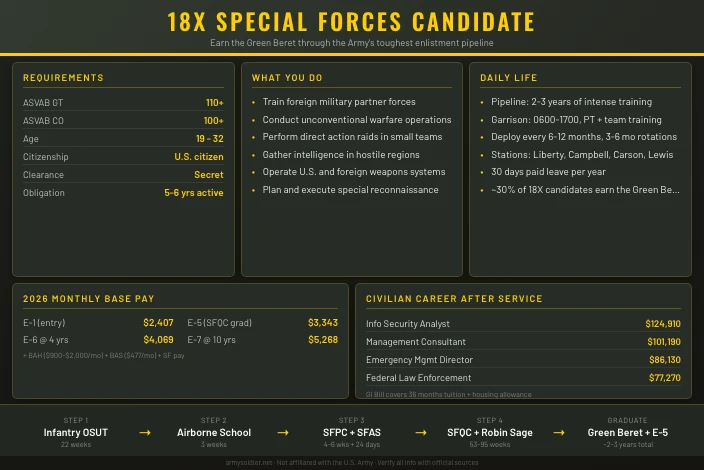
Most Army jobs hand you a guaranteed MOS on day one. The 18X contract doesn’t. You sign up to try out for Special Forces, and if you don’t make the cut, the Army picks your job for you. Roughly 70% of 18X candidates wash out before earning a Green Beret. The ones who survive get access to the most respected small-unit combat teams in the U.S. military.
Qualifying requires specific ASVAB line scores — our ASVAB study guide covers what to target and how to prepare.
Job Role and Responsibilities
The 18X is not an MOS itself. It’s an enlistment contract that puts you on a direct path to Special Forces Assessment and Selection (SFAS). If you pass every phase of the pipeline, you earn one of four Green Beret specialties: weapons sergeant (18B), engineer sergeant (18C), medical sergeant (18D), or communications sergeant (18E).
Your daily life changes drastically depending on where you are in the pipeline. During infantry One Station Unit Training (OSUT), you learn basic soldiering: marksmanship, land navigation, squad tactics. At Airborne School, you jump out of planes five times. During the Special Forces Preparation Course (SFPC), you ruck long distances, practice land navigation, and get physically crushed on purpose.
After selection, the Qualification Course (SFQC) trains you in one of the four specialties listed above. Each one is a different job:
| MOS | Title | Primary Focus |
|---|---|---|
| 18B | Weapons Sergeant | U.S. and foreign weapons systems, fire coordination, anti-armor |
| 18C | Engineer Sergeant | Demolitions, field construction, fortifications, land-mine warfare |
| 18D | Medical Sergeant | Trauma surgery, prolonged field care, veterinary support |
| 18E | Communications Sergeant | HF/VHF/UHF/SHF radio networks, cryptographic systems |
Qualified Green Berets operate on 12-person Operational Detachment-Alpha (ODA) teams. Each ODA deploys to train foreign military forces, conduct unconventional warfare, perform direct action raids, and gather intelligence in hostile regions. You operate in small teams, far from conventional support, often for months at a time.
Mission Contribution
Special Forces exist to do what conventional units can’t. ODAs embed with partner forces in denied areas, build guerrilla networks, and conduct raids behind enemy lines. Green Berets trained Kurdish Peshmerga fighters in Iraq, partnered with Afghan commandos in Helmand Province, and supported counter-narcotics operations across Latin America.
The work is low-profile and high-impact. A single ODA can shape a region’s security situation in ways that a full brigade couldn’t replicate.
Technology and Equipment
You train on both U.S. and foreign weapons systems. That includes AK-47 variants, RPGs, Soviet-era crew-served weapons, and NATO standard rifles and machine guns. Comms sergeants operate advanced satellite and encrypted radio systems. Engineers use commercial and military demolition charges, breaching tools, and construction equipment.
Every team member carries night vision, GPS, tactical radios, and mission-specific gear. SF units get priority access to newer equipment before it reaches conventional forces.
Salary and Benefits
Financial Benefits
Your pay is based on rank and time in service. Most 18X candidates enter as E-1 (Private) and promote through the pipeline. Upon graduation from SFQC, you’re promoted to E-5 (Sergeant) regardless of time in service.
| Rank | Pay Grade | Monthly Base Pay (2026) |
|---|---|---|
| Private (PV1) | E-1 | $2,407 |
| Private (PV2) | E-2 | $2,698 |
| Specialist | E-4 | $3,142 |
| Sergeant (SFQC grad) | E-5 | $3,343 |
| Staff Sergeant (4 yrs) | E-6 | $4,069 |
On top of base pay, you receive BAH (Basic Allowance for Housing), which varies by duty station and ranges from roughly $900 to $2,000+ monthly for a single E-5. BAS (Basic Allowance for Subsistence) adds $476.95 per month for food.
Qualified Green Berets also earn Special Duty Assignment Pay (SDAP) and may receive Special Forces proficiency pay, language proficiency pay, and hazardous duty incentive pay for parachute jumps and combat deployments.
Additional Benefits
TRICARE covers you and your family at zero cost while on active duty. Doctor visits, hospital stays, prescriptions, dental, vision, and mental health are all included.
The Post-9/11 GI Bill pays up to 36 months of tuition at any public university (full in-state rate) plus a monthly housing allowance and $1,000 annual book stipend. Active-duty soldiers also get $4,500 per year in Tuition Assistance for college courses while serving.
Retirement follows the Blended Retirement System (BRS):
- 40% pension after 20 years of service (based on your highest 36 months of base pay)
- Government matches up to 5% of your TSP contributions
- Continuation pay bonus at 8-12 years of service
Work-Life Balance
You earn 30 days of paid leave per year. But don’t expect a normal schedule. Training rotations, language school, and deployment cycles dominate your calendar. SF soldiers spend roughly half their time away from home station between training exercises, schools, and deployments.
During garrison time at your Group, days run from 0600 to 1700 with morning PT, team training, and mission planning. Field time and deployments follow no schedule at all.
Qualifications and Eligibility
Basic Qualifications
The 18X contract has stricter standards than most Army enlistment programs. You can’t waiver your way past most of these.
| Requirement | Details |
|---|---|
| Age | 19-32 (new recruits); up to 36 (active-duty reclassification) |
| Citizenship | U.S. citizen only (no permanent residents) |
| Education | High school diploma or GED |
| AFQT (ASVAB) | Minimum 31 (diploma) or 50 (GED) |
| General Technical (GT) | Minimum 110 |
| Combat (CO) | Minimum 100 |
| Security Clearance | Eligible for Secret clearance |
| Vision | Correctable to 20/20 |
| Swim Assessment | 50-meter swim in uniform and boots |
| OPAT | Heavy physical demand category |
| Airborne | Must volunteer for Airborne School |
The GT composite (Verbal Expression + Arithmetic Reasoning) is the harder score to hit. A 110 GT puts you above roughly 75% of ASVAB test-takers. The CO composite (Arithmetic Reasoning + Coding Speed + Auto/Shop + Mechanical Comprehension) at 100 is more accessible but still requires solid math and mechanical aptitude.
Application Process
The entire process from recruiter visit to shipping typically takes 4 to 12 weeks. Medical waivers or clearance delays can stretch that.
Selection Criteria and Competitiveness
The 18X program is extremely selective. Only about 30% of candidates who start the pipeline earn a Green Beret. Most drop during SFAS or the early SFQC phases.
What the cadre evaluate at SFAS:
- Physical endurance under sustained stress
- Land navigation ability (solo, day and night)
- Leadership under pressure
- Teamwork and peer evaluations
- Mental resilience when sleep-deprived and physically broken down
Prior athletic experience, wilderness skills, and leadership roles help but aren’t required. The strongest predictor of success is sustained effort when quitting would be easier. No prior military experience is needed for 18X, but candidates who prepare seriously for 6-12 months before shipping have significantly better pass rates.
Upon Accession into Service
You enter as E-1 (Private) and promote through normal enlisted timelines during OSUT and Airborne School. Upon graduating the full SFQC pipeline, you are promoted to E-5 (Sergeant) and awarded your SF MOS (18B, 18C, 18D, or 18E), the Green Beret, and the Special Forces Tab. Total service obligation is typically 5-6 years active duty.
See our ASVAB study guide for strategies to hit these line scores, or take the PiCAT from home if you are a first-time tester.
Work Environment
Setting and Schedule
Your work environment depends entirely on your training phase and operational status.
- Training pipeline (2-3 years): Structured military training at Fort Moore and Fort Liberty. Days start before dawn and end when the cadre say so. Physical training, classroom instruction, field exercises, and evaluations fill every week.
- Garrison at your Group: Team rooms at the Group compound. PT at 0600, team meetings, range days, language training, and mission planning fill the duty day. Hours are typically 0600-1700 but flex based on training cycles.
- Deployed: Forward operating bases, safe houses, partner force camps, or austere field locations. No set schedule. Missions run 24/7.
Green Berets spend considerable time at remote training sites, including Camp Mackall (NC), military free-fall facilities, and foreign partner-nation locations.
Leadership and Communication
SF units use a flat leadership structure compared to conventional Army. Your ODA captain commands the team, and the team sergeant (18Z) runs daily operations. But every team member has a voice. Briefs are collaborative. Junior soldiers speak up when they see problems.
Performance feedback comes through annual NCOERs and constant informal mentorship from senior team members. The SF community is small enough that your reputation follows you.
Team Dynamics and Autonomy
An ODA operates with extreme autonomy. You might deploy to a country with a two-person element, make contact with local forces, and run training missions for weeks before your next check-in with headquarters. Decision-making authority pushes down to the lowest level.
That freedom comes with accountability. Every team member carries specialized skills that the team depends on. If you’re the 18D, you’re the only trauma medic. If you’re the 18E, you’re the only comms link to extraction support.
Job Satisfaction and Retention
SF retention is among the highest in the Army. Green Berets who earned their tab tend to stay. The combination of meaningful missions, team cohesion, operational variety, and competitive pay keeps people in. Re-enlistment bonuses and continuation pay sweeten the deal.
The primary complaints: time away from family, physical wear on the body after years of hard training, and the bureaucratic friction that comes with any military organization.
Training and Skill Development
Initial Training
The 18X pipeline is the longest initial training commitment in the Army. Plan for 2 to 3 years from enlistment to earning your Green Beret.
| Phase | Location | Duration | Focus |
|---|---|---|---|
| Infantry OSUT | Fort Moore, GA | 22 weeks | Basic soldiering, rifle marksmanship, squad tactics, land navigation |
| Airborne School | Fort Moore, GA | 3 weeks | Parachute operations, 5 jumps to qualify |
| SFPC | Fort Liberty, NC | 4-6 weeks | Physical conditioning, land navigation, SFAS preparation |
| SFAS | Camp Mackall, NC | 24 days | Physical and mental assessment, peer evaluations, solo land nav |
| SFQC Phase 1: Orientation | Fort Liberty, NC | 7 weeks | SF history, organization, unconventional warfare theory |
| SFQC: Small Unit Tactics | Camp Mackall, NC | 13 weeks | Patrolling, ambushes, raids, reconnaissance |
| SFQC: MOS Training | Fort Liberty, NC | 14-58 weeks | Specialty skills (18B/C/D/E); 18D medical is longest |
| SFQC: Language & Culture | Fort Liberty, NC | 18-25 weeks | Assigned foreign language to working proficiency |
| SERE | Camp Mackall, NC | 3 weeks | Survival, Evasion, Resistance, Escape |
| Robin Sage (CULEX) | NC Uwharrie region | 4 weeks | Culminating unconventional warfare exercise in “Pineland” |
Robin Sage is the final test. You infiltrate the fictional country of Pineland, link up with guerrilla forces played by civilian role players, and conduct a full unconventional warfare campaign. It’s the closest thing to a real-world deployment you’ll experience in training.
Advanced Training
After earning your tab, the schools keep coming. SF soldiers regularly attend:
- Military Free-Fall Parachutist Course at Yuma Proving Ground, AZ
- Combat Diver Qualification Course at Key West, FL
- Advanced Special Operations Techniques (ASOT)
- Ranger School (strongly encouraged for all SF soldiers)
- Sniper School, breacher courses, and advanced demolitions
Language training continues throughout your career. You maintain and advance your assigned language through immersion courses and deployments to your Group’s regional focus area. The Army pays language proficiency bonuses based on your test scores.
Everything starts with qualifying ASVAB scores — our study guide covers what to study first.
Career Progression and Advancement
Career Path
The 18X pipeline guarantees E-5 upon graduation. After that, promotion depends on performance, time in grade, and military education.
| Rank | Pay Grade | Typical Timeline | Role |
|---|---|---|---|
| Sergeant | E-5 | SFQC graduation | ODA team member (18B/C/D/E) |
| Staff Sergeant | E-6 | 2-4 years after tab | Senior team member, may become assistant team sergeant |
| Sergeant First Class | E-7 | 6-10 years after tab | Team sergeant (18Z) candidate, ODA operations |
| Master Sergeant | E-8 | 12-16 years total | Company or battalion operations sergeant |
| Sergeant Major | E-9 | 18+ years total | Senior enlisted leader, Group or command level |
At E-7, strong performers compete for the 18Z (Operations Sergeant) position. The 18Z leads the enlisted side of an ODA and is typically the most experienced Green Beret on the team. Some NCOs transition to 18F (Assistant Operations and Intelligence Sergeant) at E-7, focusing on intelligence collection and target analysis.
Specialization Opportunities
Beyond your primary MOS, you can earn Additional Skill Identifiers (ASIs) and Special Qualification Identifiers (SQIs) that open new assignments:
- SQI “S” – Special Forces qualified
- SQI “P” – Parachutist
- ASI “K4” – Military Free-Fall qualified
- ASI “B4” – Combat Diver qualified
- Functional Area 18 assignments at battalion and group staff levels
Role Flexibility and Transfers
Transferring out of SF to a conventional MOS is possible but rare. Most Green Berets stay in the community. Lateral moves within SF (changing your MOS specialty) are uncommon and require retraining.
Officers and warrant officers in the SF community follow separate career tracks. Enlisted Green Berets can apply for the Warrant Officer program (180A) or pursue a commission through OCS. Both paths keep you in Special Operations.
Performance Evaluation
NCOERs drive your career. Your rater is usually your team leader or company commander. Your senior rater is typically a battalion-level officer. Strong evaluations mention specific missions, leadership during deployments, language proficiency, and advanced schooling.
What separates top performers: consistent physical fitness, language scores above 2/2 on the DLPT, Ranger tab, advanced schools, and a reputation as someone who makes the team better.
Physical Demands and Medical Evaluations
Physical Requirements
This is one of the most physically punishing career paths in the military. During SFAS, you ruck 12-18 miles daily with a 55-pound pack, navigate solo through dense woods at night, and perform team events designed to test your breaking point.
After earning your tab, the physical demands don’t stop. ODAs maintain fitness standards well above the Army minimum. Most SF soldiers train 5-6 days per week with a mix of rucking, running, swimming, and strength work.
Every soldier takes the Army Fitness Test (AFT) at least once per year. The AFT has 5 events, each scored 0-100:
| Event | Minimum (60 pts) | Max Score Standard |
|---|---|---|
| 3-Rep Max Deadlift (MDL) | 140 lbs | 340 lbs |
| Hand-Release Push-Up (HRP) | 10 reps | 60+ reps |
| Sprint-Drag-Carry (SDC) | 2:40 | 1:33 |
| Plank (PLK) | 2:00 | 4:00+ |
| Two-Mile Run (2MR) | 15:54 | 12:45 |
Combat MOSs (including all CMF 18 positions) require a minimum total score of 350 out of 500 using sex-neutral, age-normed standards. Most Green Berets score well above 400.
Medical Evaluations
The initial medical screening at MEPS is just the start. Before SFAS, you go through additional medical screening specific to SF standards per AR 40-501. Annual physicals, deployment readiness exams, and post-deployment health assessments continue throughout your career.
SF soldiers accumulate injuries. Knees, backs, shoulders, and ankles take the worst beating. The Army provides physical therapy and surgical care, but chronic pain is common among long-serving Green Berets. Mental health screening is available and encouraged, especially after combat deployments.
Deployment and Duty Stations
Deployment Details
Green Berets deploy more frequently than most conventional soldiers. A typical rotation is 3-6 months deployed, 6-12 months home, then back out. Some teams deploy twice in a single year for shorter rotations. Joint Combined Exchange Training (JCET) trips to partner nations happen regularly and last 2-6 weeks.
Current operational areas span every continent except Antarctica. The five active-duty Special Forces Groups each focus on a specific region:
| Group | Home Station | Regional Focus |
|---|---|---|
| 1st SFG (A) | Joint Base Lewis-McChord, WA | Indo-Pacific |
| 3rd SFG (A) | Fort Liberty, NC | Africa |
| 5th SFG (A) | Fort Campbell, KY | Middle East |
| 7th SFG (A) | Eglin AFB, FL | Latin America |
| 10th SFG (A) | Fort Carson, CO | Europe |
Two National Guard groups (19th and 20th SFG) also accept qualified soldiers.
Location Flexibility
Your Group assignment determines your home station and your deployment region. You can request a specific Group, but assignments depend on the Army’s needs and your language training. Expect to stay at one Group for 3-5 years before a potential reassignment.
Overseas rotations to Germany, Okinawa, and partner-nation locations are common. Family accompaniment depends on the assignment type.
Risk, Safety, and Legal Considerations
Job Hazards
SF operations carry inherent risk that conventional Army jobs don’t match:
- Direct combat in hostile environments with limited backup
- Parachute operations (static line and free-fall)
- Dive operations in open water
- Explosive handling during demolition and breaching training
- Extreme environments: deserts, jungles, arctic, high altitude
- Psychological stress from sustained combat deployments
Green Berets have been killed and wounded in every major conflict since Vietnam. The small team size means losing one member cripples the team’s capability.
Safety Protocols
SF units follow strict safety protocols for parachute operations, dive training, demolitions, and live-fire exercises. Range safety officers, jump masters, and dive supervisors enforce standards. Medical sergeants (18D) provide immediate trauma care during training.
Body armor, helmets, and mission-specific protective equipment are standard for all operations. Pre-mission planning includes detailed risk assessments and contingency plans.
Security and Legal Requirements
All SF soldiers must hold a Secret security clearance. Many positions and missions require Top Secret or Top Secret/SCI access. The investigation process takes 3-12 months and examines your financial history, foreign contacts, criminal record, and personal conduct.
You sign a non-disclosure agreement covering classified operations. Violations carry serious legal consequences under the UCMJ and federal law. Soldiers with foreign-born spouses or significant foreign contacts face additional screening but aren’t automatically disqualified.
Impact on Family and Personal Life
Family Considerations
The SF lifestyle is harder on families than almost any other Army career. You’ll be away from home 6-9 months per year between deployments, training rotations, and schools. Communication during deployments varies from daily phone calls to weeks of silence depending on the mission.
Support resources at every SF installation:
- Family Readiness Groups (FRGs) run by each company
- Military OneSource for free counseling and family services
- Special Operations Care Coalition for wounded/injured SF soldiers and families
- Exceptional Family Member Program (EFMP) for special needs dependents
- Spousal employment assistance at each duty station
Relocation and Flexibility
You’ll PCS (permanent change of station) every 3-5 years. The Army covers moving costs, but each move disrupts your spouse’s career, your kids’ schools, and your social network. SF duty stations tend to be near larger military communities with good schools and services. Eglin, Lewis-McChord, Campbell, Carson, and Liberty all have established SF family communities.
The hardest part isn’t the moves. It’s the uncertainty. Deployments get extended. Training trips pop up with a week’s notice. Plans change constantly.
Reserve and National Guard
Component Availability
The 18X enlistment option is active duty only. You cannot enlist as 18X through the Army Reserve or National Guard. The 18X program exists as a direct pipeline from a recruiting station to Special Forces Assessment and Selection (SFAS) and the SF Qualification Course, and that pipeline runs exclusively through active-duty channels.
That said, a path to Special Forces does exist in the National Guard. The Guard fields two Special Forces Groups: the 19th SFG (Airborne) and the 20th SFG (Airborne), with battalions across roughly 20 states. Guard soldiers reach SF through a different process. You enlist or transfer into a Guard SFG, then volunteer for SFAS through your unit. If selected, you attend the SF Qualification Course in Guard status and return to your SFG upon graduation. There is no Reserve pathway to SF.
Drill Schedule and Training Commitment
Since 18X is active duty only, the standard Reserve/Guard drill schedule does not apply to this enlistment option. Guard soldiers pursuing SF through a Guard SFG will attend drill with their unit before and during the SFAS/Q Course pipeline. Once qualified, Guard SF soldiers face a heavy training commitment of 3 to 5 days per month, 3 to 4 weeks of Annual Training, and additional schools and exercises.
Part-Time Pay
The 18X program pays active-duty rates only. An active-duty E-4 with about three years of service earns $3,166 per month in 2026. Guard soldiers in SF units who have completed the Q Course earn drill pay plus extra training day pay, which can total $10,000 to $15,000 or more per year depending on the unit’s training schedule.
Benefits Differences
Active-duty 18X candidates receive full TRICARE at no cost. Guard SF soldiers get Tricare Reserve Select at $57.88 per month for member-only or $286.66 for member plus family.
Key differences for the Guard SF route:
- Federal Tuition Assistance: $4,500 per year for Guard drilling members
- MGIB-SR: roughly $416 per month for Guard members while enrolled
- Post-9/11 GI Bill: Guard SF soldiers gain eligibility through federal activations
- State tuition waivers (Guard only): vary by state, some cover 100% at state schools
- Active-duty 18X candidates receive TA, Post-9/11 GI Bill eligibility, and full TRICARE from day one
Deployment and Mobilization
Active-duty SF soldiers deploy on regular rotations, typically every 1 to 2 years. Guard SF units mobilize less frequently but still deploy to real-world missions. The 19th and 20th SFGs have sent teams to multiple theaters. Guard SF mobilizations typically last 4 to 9 months.
Civilian Career Integration
The 18X program itself is a training pipeline, not a permanent MOS. Candidates who complete the Q Course are reclassified to 18B, 18C, 18D, or 18E. Civilian career integration depends on which SF MOS you receive after qualification. Guard SF soldiers balance their civilian careers with the heavy SF training schedule. USERRA protects your civilian employment during military training and mobilizations.
| Feature | Active Duty (18X) | Army Reserve | Army National Guard (SFG route) |
|---|---|---|---|
| Availability | Yes | Not available | Yes, through 19th/20th SFG |
| Commitment | Full-time | N/A | 3-5 days/month + 3-4 weeks AT (after Q Course) |
| Monthly Pay (E-4, ~3 yrs) | $3,166/month | N/A | ~$422/drill weekend + extra training days |
| Healthcare | TRICARE, $0 premiums | N/A | TRS, $57.88/month (member) |
| Education | TA + Post-9/11 GI Bill | N/A | Federal TA, MGIB-SR, state tuition waivers |
| Deployment | Regular rotation every 1-2 years | N/A | Mobilization every 3-5 years |
| Retirement | BRS pension at 20 years | N/A | Points-based, age 60 |
Post-Service Opportunities
Transition to Civilian Life
Former Green Berets are among the most sought-after military veterans in the civilian job market. Your combination of language skills, cultural expertise, leadership, and security clearance opens doors that most veterans can’t access.
The Transition Assistance Program (TAP) provides resume help, interview coaching, and benefits counseling during your last year on active duty. The GI Bill covers 36 months of tuition (full in-state rate at public schools, up to $29,920.95 per year at private institutions) plus a housing allowance and $1,000 annual book stipend.
Many SF veterans skip traditional job searches entirely. Private military contractors, intelligence agencies, and defense consulting firms recruit directly from the SF community.
Civilian Career Prospects
| Civilian Job | Median Annual Salary (BLS, May 2024) | 10-Year Outlook |
|---|---|---|
| Information Security Analyst | $124,910 | +29% (much faster than average) |
| Management Analyst / Consultant | $101,190 | +9% (faster than average) |
| Emergency Management Director | $86,130 | +3% (average) |
| Police / Federal Law Enforcement | $77,270 | +3% (average) |
| Private Investigator | $52,370 | +6% (faster than average) |
Federal agencies that actively recruit SF veterans: CIA, FBI, DEA, DIA, NSA, Department of State (Diplomatic Security), and U.S. Marshals Service. Defense contractors like Lockheed Martin, L3Harris, and Booz Allen Hamilton hire SF veterans for security consulting, intelligence analysis, and program management roles.
Post-Service Policies
An honorable discharge gives you lifetime access to VA healthcare, disability compensation, and education benefits. SF soldiers with combat deployments qualify for enhanced VA benefits. Veterans with service-connected disabilities get priority care and monthly tax-free compensation.
Talk to your career counselor about transition planning at least 12 months before your separation date.
Is This a Good Job for You? The Right (and Wrong) Fit
Ideal Candidate Profile
The Green Beret pipeline doesn’t select for the biggest or fastest soldiers. It selects for people who refuse to quit and can think clearly when everything has gone wrong.
Traits that predict success:
- Mental toughness that holds up over weeks, not just hours
- Ability to learn languages and work across cultures
- Self-motivated physical fitness maintained for months before shipping
- Leadership ability that shows up in peer evaluations, not just rank
- Comfort with ambiguity and operating without clear guidance
The best 18X candidates prepare for 6-12 months before enlisting. That means running, rucking, swimming, and land navigation practice. It also means studying the SF pipeline so nothing surprises you.
Potential Challenges
The 18X contract carries real risk that other enlistment programs don’t:
- If you wash out of SFAS or SFQC, the Army reassigns you to a “needs of the Army” MOS. You don’t get to pick.
- The training pipeline is 2-3 years long. Your civilian peers will be finishing college degrees while you’re still in school.
- Injuries during training are common. Stress fractures, torn ligaments, and chronic joint problems affect a significant number of candidates.
- Divorce rates in SF are higher than the Army average because of deployment tempo.
If you need job security and predictability, the 18X contract is a gamble. You’re betting 5-6 years of your life on passing one of the hardest selection programs in the world.
Career and Lifestyle Alignment
This program fits one type of person: someone who wants to operate at the highest level of ground combat and is willing to sacrifice years of comfort to get there. The pay eventually gets competitive (an E-7 with 10 years and special pay earns well over $6,000/month before allowances). The skills transfer to six-figure civilian careers. And the experience is something most people only read about.
But the cost is real. Your body will wear down. Your relationships will be tested. And 70% of the people who try this program don’t finish it.
If you’re the type who reads that last sentence and gets motivated rather than discouraged, talk to an SF recruiter.
More Information
Contact your local Army recruiter and ask specifically about the 18X Special Forces Candidate contract. Not every recruiter handles SF enlistments, so you may be referred to a Special Operations recruiter. Ask about current bonus amounts, training dates, and physical preparation programs.
Take the ASVAB at your nearest MEPS to see if you meet the GT 110 and CO 100 minimums
Start a 6-month physical preparation program focused on rucking, running, swimming, and bodyweight exercises
Read the SF career progression plan at army.mil for details on the full career path
Prepare for the ASVAB with our study guide to make sure your line scores qualify
This site is not affiliated with the U.S. Army or any government agency. Verify all information with official Army sources before making enlistment or career decisions.
Explore more Army special operations careers such as the 37F PSYOP Specialist.