37F Psychological Operations Specialist
Most soldiers fight with weapons. PSYOP specialists fight with information. As a 37F, you study a foreign population, figure out what makes them tick, and create messages that change how they think and act. It’s part intelligence analyst, part media producer, and part cultural anthropologist, all wrapped in an Army Special Operations beret.
Qualifying requires specific ASVAB line scores — our ASVAB study guide covers what to target and how to prepare.
Job Role and Responsibilities
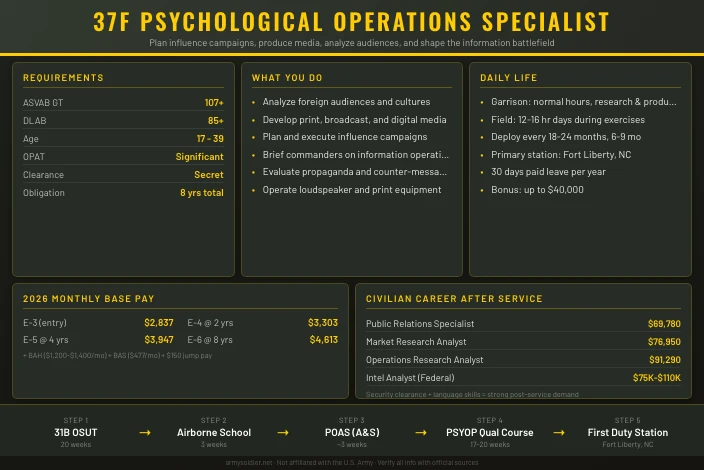
A 37F plans, develops, and distributes influence campaigns across print, broadcast, digital, and face-to-face channels. You analyze foreign audiences, craft targeted messages, produce media products, evaluate their impact, and brief commanders on how information operations shape the battlefield. This is one of the few Army jobs where your brain is the primary weapon system.
Your daily work depends on whether you’re in garrison or deployed. In garrison at Fort Liberty, most of your time goes to research and training. You study target audiences, review intelligence reports, and build media products like leaflets, radio scripts, social media content, and video packages. Equipment maintenance fills the gaps between missions.
Deployed, the pace changes. You embed with supported units and run influence operations in real time. That might mean broadcasting radio messages to a hostile village, distributing printed materials at a checkpoint, or advising a battalion commander on how local cultural dynamics affect his mission. You also analyze enemy propaganda and develop counter-messaging.
Specific Roles
The 37F is the entry-level enlisted MOS within CMF 37 (Psychological Operations). Related positions in the career field include:
| Code | Title | Type |
|---|---|---|
| 37F | Psychological Operations Specialist | Enlisted MOS |
| 37A | Psychological Operations Officer | Officer AOC |
| 37X | PSYOP Recruit (in-pipeline) | Trainee designation |
Additional Skill Identifiers (ASIs) and Special Qualification Identifiers (SQIs) become available as you gain experience. Airborne-qualified soldiers carry the SQI “P” (Parachutist). Language proficiency in a critical language opens doors to regional specialization.
Technology and Equipment
You work with tactical loudspeaker systems, portable printing equipment, video and audio production gear, and social media monitoring tools. The Tactical PSYOP Detachment carries its own broadcast and print capability into the field. You also operate military communications equipment and classified computer systems for intelligence analysis and product dissemination.
Salary and Benefits
Financial Benefits
Military pay follows rank and years of service. Most 37F graduates enter as E-3 or E-4 after completing the long training pipeline.
| Rank | Pay Grade | Years of Service: 2 | Years of Service: 4 | Years of Service: 6 | Years of Service: 8 |
|---|---|---|---|---|---|
| Private First Class (PFC) | E-3 | $3,015 | $3,198 | $3,198 | $3,198 |
| Specialist (SPC) | E-4 | $3,303 | $3,659 | $3,816 | $3,816 |
| Sergeant (SGT) | E-5 | $3,599 | $3,947 | $4,109 | $4,299 |
| Staff Sergeant (SSG) | E-6 | $3,743 | $4,069 | $4,236 | $4,613 |
Source: DFAS 2026 pay tables. Figures reflect the 2026 pay raise.
On top of base pay, you receive BAH (Basic Allowance for Housing) and BAS. BAH depends on your duty station and dependency status. A single E-4 at Fort Liberty gets roughly $1,200 to $1,400 per month. BAS adds about $477 monthly for food. Airborne-qualified soldiers get an additional $150/month in jump pay (Parachute Duty Pay).
The Army offers signing bonuses up to $40,000 for 37F, depending on your contract length and ship date. Bonus amounts change frequently, so confirm the current figure with your recruiter.
Additional Benefits
TRICARE covers you and your family at zero out-of-pocket cost on active duty. That includes medical, dental, vision, mental health, and prescriptions. Tuition Assistance pays up to $4,500 per year for college courses while you serve. After separation, the Post-9/11 GI Bill covers up to 36 months of tuition at a public university (full in-state rate) plus a monthly housing allowance and $1,000/year book stipend.
Retirement works through the Blended Retirement System (BRS):
- 40% pension after 20 years of service (based on your highest 36 months of basic pay)
- Government matches up to 5% of your Thrift Savings Plan (TSP) contributions
- Continuation pay at the 8 to 12 year mark (typically 2.5x monthly basic pay for a 3-year commitment)
Work-Life Balance
You earn 30 days of paid leave per year. Garrison work at Fort Liberty runs normal duty hours most weeks, but field exercises and pre-deployment workups extend that. Deployed PSYOP teams work 12+ hour days for months at a time. The pace is demanding, and time away from home adds up fast in this career field.
Qualifications and Eligibility
Basic Qualifications
You must be a U.S. citizen between 17 and 39. High school grads need a minimum AFQT of 31. GED holders need 50. The 37F requires one ASVAB line score:
- General Technical (GT): 107 minimum
The GT composite combines Verbal Expression (VE) and Arithmetic Reasoning (AR). A 107 is moderately competitive and reflects the analytical demands of the job.
You also need a Defense Language Aptitude Battery (DLAB) score of 85 or higher. The DLAB measures your ability to learn foreign languages. Not every applicant takes it at MEPS, so ask your recruiter to schedule it.
| Requirement | Details |
|---|---|
| Age | 17-39 years old |
| Citizenship | U.S. citizen only (no permanent residents) |
| Education | High school diploma or GED |
| AFQT (ASVAB) | Minimum 31 (diploma) or 50 (GED) |
| General Technical (GT) | Minimum 107 |
| DLAB | Minimum 85 |
| Security Clearance | Secret (must be eligible) |
| OPAT | Significant (Gray) |
| Vision | Correctable to 20/20 |
| Airborne | Must volunteer for Airborne training |
Application Process
Start at your local Army recruiting station. Tell the recruiter you want 37F specifically. You will enlist under a 37X (PSYOP Recruit) contract, which guarantees a slot in the training pipeline. At MEPS, you take the ASVAB, the DLAB, get a full medical exam, and begin your security clearance paperwork.
Selection Criteria and Competitiveness
This is one of the most selective enlisted MOSs in the Army. The pipeline has a significant washout rate. Strong candidates share a few traits: high GT scores (well above the 107 floor), a genuine interest in foreign cultures and languages, physical toughness, and the ability to think under pressure. Prior college coursework in political science, communications, psychology, or foreign languages strengthens your application.
Upon Accession into Service
You enlist as E-1 (Private) and promote through the pipeline based on time in service. Soldiers with college credits or prior service may enter at E-2, E-3, or E-4. The total service obligation is 8 years: typically a 4 to 6 year active-duty contract plus time in the Individual Ready Reserve.
See our ASVAB study guide for strategies to hit these line scores, or take the PiCAT from home if you are a first-time tester.
Work Environment
Setting and Schedule
PSYOP specialists split time between three settings:
- Garrison (Fort Liberty, NC) – office and production facility work during normal duty hours. Research, media production, equipment maintenance, and training fill most days.
- Field training – multi-week exercises at Fort Liberty, the Joint Readiness Training Center (JRTC) at Fort Johnson, LA, or the National Training Center (NTC) at Fort Irwin, CA. Hours stretch to 16+ during exercises.
- Deployment – forward operating bases, embassies, or embedded with supported units abroad. Twelve-hour days minimum, often longer.
Leadership and Communication
Your chain of command runs through your Tactical PSYOP Detachment (TPD) leader, typically a Captain, and a senior NCO (E-7 or above). Detachments are small teams of 4 to 8 soldiers, which means you work closely with your leadership every day.
During operations, you also brief and advise supported unit commanders. That means an E-5 PSYOP sergeant might brief a full Colonel on information operations. Communication skills matter more in this MOS than in almost any other enlisted job.
Team Dynamics and Autonomy
PSYOP detachments operate with significant independence. Your team deploys to support a larger unit, but you plan and execute your own operations within the commander’s guidance. Junior soldiers get more responsibility earlier than in most MOSs because the teams are small and the mission demands it.
You balance teamwork within your detachment against solo research and production tasks. An average day might include collaborative planning in the morning and hours of independent audience analysis or media production in the afternoon.
Job Satisfaction and Retention
PSYOP specialists tend to re-enlist at solid rates compared to other SOF-adjacent MOSs. The work is intellectually stimulating, the teams are tight, and the mission variety keeps things interesting. Common complaints center on the long training pipeline, frequent deployments, and the challenge of explaining what you actually do to friends and family.
Soldiers who thrive here are the ones who enjoy the research and creative side of military operations. If you need visible, kinetic results to feel satisfied, this might frustrate you.
Training and Skill Development
Initial Training
The 37F training pipeline is one of the longest in the Army. Plan for roughly a year from enlistment to earning your MOS.
| Phase | Location | Duration | Focus |
|---|---|---|---|
| 31B OSUT | Fort Leonard Wood, MO | 20 weeks | Military Police One Station Unit Training (soldier skills + MP tasks) |
| Airborne School | Fort Moore, GA | 3 weeks | Static-line parachute operations; 5 qualifying jumps |
| POAS | Fort Liberty, NC | ~3 weeks | Psychological Operations Assessment and Selection (physical, mental, problem-solving screening) |
| PSYOP Qualification Course | Fort Liberty, NC | ~17-20 weeks | Language/culture, PSYOP core skills, media production, culmination exercise |
The pipeline starts with 31B (Military Police) OSUT at Fort Leonard Wood. This 20-week course combines Basic Combat Training and MP-specific skills into a single block.
After OSUT, you attend Basic Airborne Course at Fort Moore, GA. Three weeks of ground training, tower training, and jump week. You make 5 static-line parachute jumps to earn your wings.
Then comes the real filter. Psychological Operations Assessment and Selection (POAS) at Fort Liberty tests your physical endurance, problem-solving, teamwork, and psychological resilience. The cadre are looking for soldiers who can think clearly under stress and work effectively in small teams. A significant percentage of candidates wash out here.
Survivors move into the PSYOP Qualification Course at the JFK Special Warfare Center and School. The course runs through five phases: In-Processing, Language and Culture, PSYOP Core, a Culmination Exercise, and Graduation. You learn audience analysis, propaganda analysis, media production, tactical planning, and how to integrate PSYOP into military operations.
Advanced Training
After earning your MOS, training continues throughout your career. Common follow-on schools include:
- Defense Language Institute (DLI) – 26 to 64 weeks depending on the language
- Military Information Support Operations (MISO) Planner Course
- Senior Leader Course and Master Leader Course for NCO development
- Joint PSYOP Support Element (JPSE) training
- Survival, Evasion, Resistance, and Escape (SERE) School
Language training is a major part of the PSYOP career. The Army invests heavily in making sure you can operate in your assigned region. Expect at least one language course during your first enlistment.
Everything starts with qualifying ASVAB scores — our study guide covers what to study first.
Career Progression and Advancement
Career Path
Promotion to E-4 (Specialist) comes relatively quickly given the length of the training pipeline. Many soldiers reach E-4 by the time they finish the Qualification Course. E-5 (Sergeant) requires passing a promotion board and demonstrating leadership ability.
| Rank | Pay Grade | Typical Years | Typical Role |
|---|---|---|---|
| Private First Class | E-3 | 0-1 | PSYOP trainee / pipeline |
| Specialist | E-4 | 1-3 | Detachment member, media producer |
| Sergeant | E-5 | 3-6 | Team leader, detachment NCOIC |
| Staff Sergeant | E-6 | 6-10 | Senior detachment NCOIC, company operations NCO |
| Sergeant First Class | E-7 | 10-15 | Platoon sergeant, staff PSYOP planner |
| Master Sergeant | E-8 | 15-20 | Company first sergeant, senior staff planner |
Most 37F soldiers spend their careers within the 4th Psychological Operations Group (Active) or the 8th Psychological Operations Group (Airborne) at Fort Liberty. Reserve Component soldiers serve in the 2nd and 7th PSYOP Groups.
Role Flexibility and Transfers
Lateral moves within CMF 37 are limited because the career field is small. Some 37F soldiers transition to Civil Affairs (38B), Intelligence (35 series), or other SOF-adjacent MOSs. Any transfer requires retraining and a new service obligation.
Officers in the PSYOP branch (37A) follow a separate track. Enlisted soldiers who want to commission can apply for Officer Candidate School (OCS) or Green to Gold programs.
Performance Evaluation
NCOs receive annual NCOERs rated by their chain of command. Strong evaluations emphasize language proficiency, operational deployments, leadership of detachment operations, and completion of military education milestones. Promotions above E-5 depend heavily on these reports.
What sets top performers apart: language skills, deployment experience, ability to brief senior officers confidently, and a track record of successful influence campaigns. Soldiers who earn the PSYOP senior badge and complete advanced courses stand out in promotion boards.
Physical Demands and Medical Evaluations
Physical Requirements
PSYOP is a Special Operations career field, and the physical demands reflect that. POAS tests your endurance through long rucks, limited sleep, and sustained problem-solving under physical stress. After earning the MOS, you maintain Airborne status, which means regular parachute jumps and sustained physical readiness.
The 37F carries an OPAT category of Significant (Gray), meaning you must meet the Gray-level minimums on the OPAT before shipping to training:
- Standing Long Jump: 4 ft 7 in
- Seated Power Throw: 13 ft 1 in
- Strength Deadlift: 140 lbs
- Interval Aerobic Run: 10:20 mile
Every soldier takes the Army Fitness Test (AFT) at least once per year. Minimum standards for ages 17 to 21:
| Event | Male Minimum | Female Minimum |
|---|---|---|
| 3-Rep Max Deadlift (MDL) | 140 lbs | 80 lbs |
| Hand-Release Push-Up (HRP) | 10 reps | 10 reps |
| Sprint-Drag-Carry (SDC) | 2:40 | 3:40 |
| Plank (PLK) | 2:00 | 2:00 |
| Two-Mile Run (2MR) | 15:54 | 18:54 |
Each event is scored 0 to 100. You need at least 60 per event and 300 total to pass. Field work involves carrying 50 to 80 pounds of equipment over uneven terrain, loading and unloading broadcast gear, and operating in extreme temperatures.
Medical Evaluations
Annual physicals cover weight, blood pressure, vision, hearing, and overall health. Pre-deployment screening adds dental readiness, mental health check, and any theater-specific medical requirements. Airborne status requires periodic flight physicals. Any condition that limits your ability to jump or deploy can pull you from operational status.
Deployment and Duty Stations
Deployment Details
Active-duty PSYOP soldiers deploy frequently. The 4th PSYOP Group maintains a constant rotation of teams supporting combatant commands worldwide. Expect to deploy every 18 to 24 months for 6 to 9 month rotations. Some assignments involve shorter TDY (temporary duty) trips of 2 to 4 months.
Deployment locations span every geographic combatant command:
- CENTCOM – Middle East and Central Asia
- EUCOM – Eastern Europe, particularly supporting NATO partners
- INDOPACOM – Pacific region, South Korea, Japan, Philippines
- AFRICOM – Sub-Saharan Africa
- SOUTHCOM – Central and South America
PSYOP teams deploy to both combat zones and peacetime environments. Not every deployment involves direct combat, but the operational tempo stays high regardless.
Location Flexibility
Most active-duty 37F soldiers are stationed at Fort Liberty, NC, home of the U.S. Army Special Operations Command and both active PSYOP Groups. Some billets exist at Theater Special Operations Commands (TSOCs) in Germany, Japan, and other overseas locations.
Reserve Component PSYOP units are scattered across the country. The 2nd and 7th PSYOP Groups have battalions in multiple states, which offers more geographic flexibility for part-time soldiers.
You can submit assignment preferences, but Fort Liberty is where the majority of active-duty PSYOP work happens. Expect to spend most of your career there between deployments.
Risk, Safety, and Legal Considerations
Job Hazards
PSYOP specialists face a different risk profile than most combat MOSs.
In garrison and training:
- Physical injury during Airborne operations (parachute malfunctions, landing injuries)
- Training accidents during field exercises
- Repetitive strain from equipment operation and media production
Deployed:
- Indirect fire at forward operating bases
- Ambush or IED exposure during mounted and dismounted patrols
- Threat from hostile populations during face-to-face engagements
- Psychological stress from sustained operations in hostile environments
Safety Protocols
Standard safety procedures apply for all Airborne operations: equipment inspections, jump master checks, and drop zone safety teams. In the field, PSYOP teams follow force protection measures set by the supported unit. Body armor, helmets, and crew-served weapons training are standard for all deployed personnel.
Mental health support includes embedded behavioral health providers and access to Military OneSource counseling. The small team environment means leaders stay close to their soldiers and can spot stress early.
Security and Legal Requirements
Every 37F requires a Secret security clearance. The investigation starts at MEPS and typically takes 2 to 4 months. Some assignments require Top Secret or TS/SCI access, which involves a more thorough background investigation.
You must maintain a clean record to keep your clearance. Drug use, financial problems, or foreign contacts can trigger a review or revocation. Losing your clearance effectively ends your PSYOP career.
All PSYOP operations fall under strict legal oversight. Every product you create goes through a review and approval process before distribution. You operate under the Laws of Armed Conflict and theater-specific rules of engagement. Misrepresenting PSYOP content as coming from a neutral source or violating targeting restrictions carries serious consequences.
Impact on Family and Personal Life
Family Considerations
The deployment tempo is the hardest part. PSYOP soldiers spend significant time away from home between deployments, training exercises, and TDY trips. Spouses and kids adjust to an unpredictable schedule.
Support resources at Fort Liberty:
- Family Readiness Groups (FRGs) – unit-level peer support
- Military OneSource – free counseling, financial guidance, and family services
- USASOC Family Programs – Special Operations-specific family support
- Exceptional Family Member Program (EFMP) – support for families with special medical or educational needs
Relocation and Flexibility
Because most active-duty billets are at Fort Liberty, you may not move as often as soldiers in other MOSs. That stability helps families settle into schools and communities. The trade-off is frequent short-notice travel and deployments that pull you away even when your family stays put.
Reserve Component soldiers in PSYOP units have more location options since units are spread across multiple states. Weekend drills and annual training still take time, and mobilizations happen.
Reserve and National Guard
Component Availability
The 37F MOS is available in both the Army Reserve and the Army National Guard. The Reserve holds the bulk of PSYOP forces through the U.S. Army Civil Affairs and Psychological Operations Command (USACAPOC) headquartered at Fort Liberty, North Carolina. Some Guard states also maintain PSYOP units. The Reserve PSYOP battalions are the primary home for part-time 37F soldiers, and positions exist at all enlisted grades.
Drill Schedule and Training Commitment
Standard commitment is one weekend per month plus two weeks of Annual Training. Reserve and Guard PSYOP units often schedule extra training days for language proficiency, regional expertise development, and PSYOP-specific exercises. Annual Training may involve joint exercises with active-duty units or overseas training deployments. Expect 2 to 4 additional training days per year beyond the baseline, and more if your unit is preparing for a mobilization.
Part-Time Pay
An E-4 with about three years of service earns roughly $422 per drill weekend in 2026. Over 12 weekends, that totals about $5,064. Annual Training adds approximately $1,583. Extra training days push the total higher. Active-duty E-4 monthly base pay is $3,166 for comparison. Foreign language proficiency pay may add up to $500 per month for qualified linguists.
Benefits Differences
Reserve and Guard 37F soldiers receive Tricare Reserve Select instead of free active-duty TRICARE. TRS costs $57.88 per month for member-only or $286.66 for member plus family in 2026.
Education benefits include:
- Federal Tuition Assistance: $4,500 per year for drilling members
- MGIB-SR: roughly $416 per month while enrolled
- Post-9/11 GI Bill: requires 90 or more days of federal activation; many PSYOP soldiers accumulate activation time through frequent deployments
- State tuition waivers (Guard only): vary by state; Reserve members (the majority of PSYOP forces) do not receive state waivers
Retirement follows the points-based system. Pension draws at age 60, reducible by qualifying mobilizations. The higher training tempo helps PSYOP soldiers accumulate retirement points faster than some other Reserve MOSs.
Deployment and Mobilization
Reserve PSYOP units have a high mobilization rate. PSYOP specialists deploy frequently in support of combatant commands worldwide, including the Middle East, Africa, Europe, and the Pacific. Mobilizations typically run 9 to 12 months. This is one of the most frequently deployed Reserve MOSs. Expect at least one mobilization during a six-year enlistment, and many 37F soldiers deploy more than once.
Civilian Career Integration
The 37F skill set transfers to marketing, public relations, advertising, media production, and strategic communications. The experience in audience analysis, message development, and media dissemination that PSYOP training provides is directly applicable to civilian marketing and communications roles. Many Reserve 37F soldiers work in marketing, advertising, or government public affairs during the week. USERRA protects your civilian job during mobilization, which matters given the high deployment tempo.
| Feature | Active Duty | Army Reserve | Army National Guard |
|---|---|---|---|
| Commitment | Full-time | One weekend/month + 2 weeks/year + extra days | One weekend/month + 2 weeks/year + extra days |
| Monthly Pay (E-4, ~3 yrs) | $3,166/month | ~$422/drill weekend | ~$422/drill weekend |
| Healthcare | TRICARE, $0 premiums | TRS, $57.88/month (member) | TRS, $57.88/month (member) |
| Education | TA + Post-9/11 GI Bill | Federal TA, MGIB-SR; Post-9/11 after activation | Federal TA, MGIB-SR, state tuition waivers |
| Deployment | Regular rotation | Mobilization every 2-3 years | Mobilization every 3-5 years |
| Retirement | BRS pension at 20 years | Points-based, age 60 | Points-based, age 60 |
Post-Service Opportunities
Transition to Civilian Life
PSYOP training builds a skill set that translates directly into several high-demand civilian fields. You leave with experience in audience analysis, media production, strategic communications, foreign language proficiency, and cross-cultural engagement. Few civilian programs teach this combination.
The Transition Assistance Program (TAP) provides resume writing, interview preparation, and benefits counseling during your last 12 months on active duty. The Post-9/11 GI Bill covers up to 36 months of tuition at a public university plus a housing allowance and book stipend. Many PSYOP veterans use it for graduate programs in international relations, communications, or intelligence studies.
Civilian Career Prospects
PSYOP experience maps well to several civilian careers:
| Civilian Job | Median Annual Salary (BLS, May 2024) | 10-Year Outlook |
|---|---|---|
| Public Relations Specialist | $69,780 | +6% (2024-2034) |
| Market Research Analyst | $76,950 | +7% (2024-2034) |
| Operations Research Analyst | $91,290 | +21% (2024-2034) |
| Intelligence Analyst (Federal) | $75,000-$110,000 (GS-11 to GS-13) | Stable |
Three-letter agencies (CIA, DIA, NSA) and defense contractors actively recruit former PSYOP soldiers. Your security clearance, language skills, and regional expertise make you a strong candidate for intelligence and influence positions. Private sector employers in advertising, public relations, and political consulting also value the analytical and communication skills you build in this career field.
Post-Service Policies
An honorable discharge gives you access to VA healthcare, disability compensation (if applicable), and education benefits. Soldiers who serve 20 years or more receive a BRS pension. You can separate after your service obligation ends, but talk to your career counselor about transition options well before your ETS date.
Is This a Good Job for You?
Ideal Candidate Profile
The best PSYOP soldiers combine intellectual curiosity with physical toughness.
Traits that predict success:
- Genuine interest in foreign cultures, languages, and geopolitics
- Strong writing and speaking skills
- Comfortable working in small teams with high autonomy
- Physical fitness well above Army minimums
- Patience for long, demanding training pipelines
- Ability to think creatively under pressure
This role fits people who want a military career that uses their brain as much as their body. If you’ve always been the person who reads about foreign conflicts, studies languages for fun, or wants to understand why people believe what they believe, this MOS was built for you.
Potential Challenges
This MOS is a poor fit if you:
- Want a predictable schedule with minimal travel
- Prefer hands-on mechanical or medical work over research and writing
- Struggle with ambiguity or situations without clear right answers
- Can’t handle a long training pipeline with a real chance of washout
- Need instant, visible results from your work (influence campaigns take months to show effects)
The washout rate during POAS is significant. Failing means reclassification to a different MOS, not a second chance. If you’re not prepared to commit fully to the pipeline, don’t sign the contract.
Career and Lifestyle Alignment
PSYOP offers one of the most intellectually rich enlisted careers in the Army. You get language training, regional expertise, and strategic communication skills that open doors in intelligence, diplomacy, and the private sector. The GI Bill and your clearance make post-service transitions smoother than average.
The cost is real. Frequent deployments strain relationships. The training pipeline consumes your first year. And the work itself can be psychologically heavy when you’re shaping perceptions in conflict zones. This career rewards people who find that challenge motivating rather than draining.
More Information
Talk to an Army recruiter about the 37F. Ask specifically about the 37X contract, current bonus amounts, and DLAB scheduling. If possible, request a referral to speak with someone who has completed the PSYOP pipeline.
Visit goarmy.com for the official 37F overview
Schedule your ASVAB and DLAB at your nearest MEPS
Research PSYOP history and doctrine at goarmysof.army.mil
Prepare for the ASVAB with our study guide to make sure your line scores qualify
This site is not affiliated with the U.S. Army or any government agency. Verify all information with official Army sources before making enlistment or career decisions.
Explore more Army special operations careers to find other SOF career paths.