38B Civil Affairs Specialist
Wars aren’t won by firepower alone. Civilian populations, local governments, and humanitarian conditions shape outcomes in ways that no amount of direct combat can fix. The Army’s 38B Civil Affairs Specialists are the soldiers who work that human terrain. They engage local leaders, assess civil infrastructure, and help commanders understand what’s happening in a community before, during, and after military operations.
Civil Affairs is not a glamorous MOS in the traditional Army sense. There’s no 11B door-kicking mystique. What it offers is complex, consequential work that combines military operations with cross-cultural communication, governance assessment, and humanitarian coordination. The GT 107 ASVAB requirement, the 13-week specialized AIT at Fort Liberty, and the Secret clearance requirement reflect what the job actually demands.
Qualifying requires specific ASVAB line scores — our ASVAB study guide covers what to target and how to prepare.
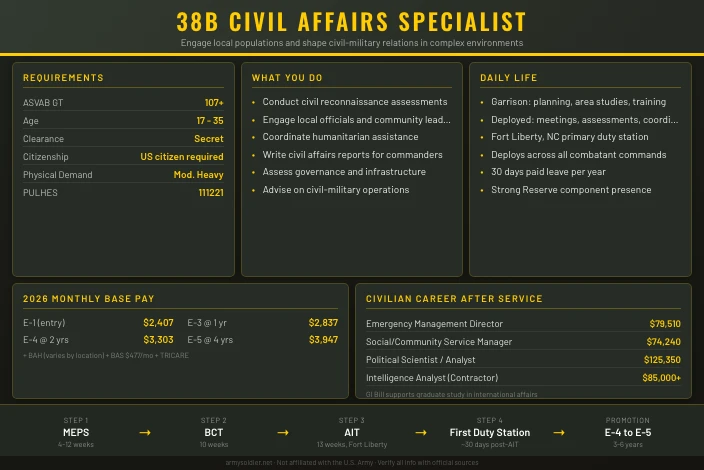
Job Role and Responsibilities
Civil Affairs Specialists support military operations by engaging civilian populations and local authorities to minimize conflict between military forces and local communities. They assess civil infrastructure, coordinate with government and non-government organizations, and help commanders manage civil-military relationships in complex environments.
Daily Tasks
The daily work depends heavily on the operating environment. In garrison, a 38B plans and rehearses for civil affairs operations, maintains area expertise on likely deployment regions, and builds cultural and linguistic knowledge. Deployed, the work is relationship-heavy and operationally fast: meeting with local officials, assessing infrastructure damage, writing reports that inform the commanding general’s decision cycle.
Common responsibilities:
- Conducting civil reconnaissance to assess local infrastructure, governance, and population conditions
- Meeting and building relationships with civilian government officials, tribal leaders, and NGO representatives
- Writing civil affairs reports and assessments that feed into the intelligence and operations planning process
- Coordinating humanitarian assistance and civil-military operations
- Advising commanders on civil considerations and their effect on military operations
- Supporting nation-building efforts by identifying critical civilian needs
Specific Roles
The 38B MOS is part of Civil Affairs (CMF 38). Specialization happens through assignment to specific functional specialty teams:
| Functional Specialty | Focus Area |
|---|---|
| Rule of Law | Legal systems, judiciary, law enforcement reform |
| Economic Stability | Commerce, agriculture, employment programs |
| Infrastructure | Civil engineering assessment, reconstruction |
| Governance | Local government capacity and structure |
| Public Health and Welfare | Medical, sanitation, humanitarian conditions |
| Public Education | Schools, information programs |
Senior soldiers and NCOs typically develop depth in one or two functional specialties based on their background and assignments.
Mission Contribution
Civil Affairs provides the Army with a capability no other branch replicates: trained soldiers who can operate in the civilian domain, speak to what matters to local populations, and translate those conditions into actionable military intelligence. A 38B who builds a strong relationship with a local council leader may produce intelligence that prevents an ambush. The mission impact is real, even when it’s not visible.
Technology and Equipment
The job is information-heavy rather than equipment-heavy:
- Classified and unclassified communication systems
- Database and reporting platforms for civil affairs assessments (e.g., CIDNE, DCGS-A)
- Language translation tools and interpreters
- Standard Army small arms for force protection
Salary and Benefits
Base Pay
All military pay follows the 2026 DFAS pay tables. Civil Affairs Specialists enter at E-1 unless prior education credit applies.
| Rank | Time in Service | Monthly Base Pay |
|---|---|---|
| E-1 (PV1) | Entry | $2,407 |
| E-2 (PV2) | 6 months | $2,698 |
| E-3 (PFC) | 1 year | $2,837 |
| E-4 (SPC) | 2 years | $3,303 |
| E-5 (SGT) | 4 years | $3,947 |
| E-6 (SSG) | 8 years | $4,613 |
Allowances and Additional Benefits
Soldiers living off-post receive Basic Allowance for Housing (BAH) that varies by location and dependent status. The flat Basic Allowance for Subsistence (BAS) is $476.95 per month for all enlisted soldiers in 2026.
Deployed soldiers may receive additional pays including Hazardous Duty Pay and, when conditions qualify, Hostile Fire/Imminent Danger Pay of $225 per month.
Other benefits:
- TRICARE: No-cost medical, dental, and vision coverage while on active duty
- Post-9/11 GI Bill: Full in-state tuition at public universities for up to 36 months, plus a monthly housing allowance
- Tuition Assistance: Up to $4,500 per year for college courses while serving
Retirement
Soldiers under the Blended Retirement System (BRS) are eligible for a 20-year pension worth 40% of high-36 average basic pay, plus TSP matching of up to 5% of basic pay. Continuation pay between years 8-12 is an additional cash incentive for soldiers who commit to extending their service.
Work-Life Balance
The Army provides 30 days of paid leave per year. Civil Affairs units have unpredictable deployment cycles driven by where the Army needs civil affairs capability. Soldiers at Fort Liberty with active USASOC commitments can expect higher operational tempo than those at Reserve component units.
Qualifications and Eligibility
Requirements Table
| Requirement | Details |
|---|---|
| ASVAB Line Score | GT: 107 |
| Age | 17-35 (waiver possible to 39) |
| Citizenship | U.S. citizen required |
| Education | High school diploma or GED |
| Security Clearance | Secret (must be eligible) |
| Physical Demand | Moderately Heavy |
| PULHES | 111221 |
| Criminal History | No court-martial; no significant civil convictions |
| AFQT Minimum | 31 (HS diploma) or 50 (GED) |
The GT (General Technical) composite is calculated from VE + AR subtest scores. A score of 107 requires strong verbal and reasoning ability, which aligns directly with the cross-cultural communication and writing demands of the job.
Application Process
- Score 107+ on the GT composite of the ASVAB at MEPS
- Pass the physical exam and confirm PULHES 111221 medical standards
- Confirm U.S. citizenship status and eligibility for a Secret clearance
- Request MOS 38B during enlistment contract negotiation
Selection and Competitiveness
The GT 107 requirement puts 38B in the upper range of enlisted ASVAB minimums. Recruits with prior language study, international experience, or coursework in political science, history, or sociology may find the work a natural fit. The Secret clearance requirement eliminates applicants with significant criminal history or financial problems.
Service Obligation
Standard enlistment contracts run 3, 4, or 6 years. The 38B training pipeline totals roughly 23 weeks (BCT plus AIT), so plan for approximately 5-6 months before reaching your first unit. Civil Affairs has a strong Reserve component presence, so reservists may be able to access this MOS through a Reserve contract.
See our ASVAB study guide for strategies to hit these line scores, or take the PiCAT from home if you are a first-time tester.
Work Environment
Setting and Schedule
Civil Affairs work happens at the intersection of military headquarters, local community environments, and multinational coordination spaces. In garrison, it’s planning, training, and area studies at the unit. Deployed, it’s meetings, assessments, and coordination in local settings that range from government buildings to remote villages.
The job is people-intensive rather than physically grueling day-to-day. That said, Civil Affairs teams often operate in the same high-threat environments as other Army units, so force protection awareness is constant.
Chain of Command
38B soldiers work in civil affairs companies and battalions under the U.S. Army Special Operations Command (USASOC) structure, though they also serve in conventional force S5 (civil affairs) staff sections at brigade and higher. The chain of command runs from team NCO leaders to a Civil Affairs Officer at the company or battalion level.
Team Dynamics
Civil Affairs teams are small. A Civil Affairs Team - Alpha (CAT-A) typically consists of a handful of soldiers, each expected to operate with significant individual initiative. Decisions about how to approach a community engagement or how to frame a civil affairs assessment often rest with the individual 38B on the ground. This is not a job where you wait for explicit orders on every action.
Job Satisfaction
Soldiers who value meaningful work at the intersection of military and civilian domains consistently report high job satisfaction in Civil Affairs. The complexity of the work, the travel to diverse operating environments, and the sense that your assessments shape real decisions drive retention for those who fit the MOS well.
Training and Skill Development
Initial Training
| Phase | Location | Length | Focus |
|---|---|---|---|
| Basic Combat Training (BCT) | Various | 10 weeks | Soldier fundamentals, weapons, fitness |
| Advanced Individual Training (AIT) | Fort Liberty, NC (USAJFKSWCS) | 13 weeks | Civil affairs operations, functional specialties, cultural engagement, report writing |
| First Duty Station | Varies | Ongoing | Team operations, area expertise development |
AIT at the U.S. Army John F. Kennedy Special Warfare Center and School runs 13 weeks. The course covers civil affairs doctrine, functional specialty training, cultural competency, civil reconnaissance techniques, and writing assessments that meet staff-level standards. You’ll also receive familiarization with the broader Special Operations Forces (SOF) environment.
Advanced Training
Over a career, Civil Affairs soldiers have access to:
- Language training through the Defense Language Institute (DLI) for assigned regional focus areas
- Cultural awareness programs at USAJFKSWCS
- Interagency cooperation courses alongside State Department, USAID, and other civilian agency personnel
- Master’s degree programs in civil affairs-related fields through Army Education Center funding
- Advanced Civil Affairs Operations Course for senior NCOs
Everything starts with qualifying ASVAB scores — our study guide covers what to study first.
Career Progression and Advancement
Rank Progression
| Grade | Title | Typical Time in Grade | Key Milestone |
|---|---|---|---|
| E-1 to E-3 | Private / PFC | 0-18 months | Complete AIT, first unit assignment |
| E-4 | Specialist (SPC) | 18-36 months | Team-level civil affairs missions |
| E-5 | Sergeant (SGT) | 3-6 years | Team leader, functional specialty development |
| E-6 | Staff Sergeant (SSG) | 6-10 years | Team Sergeant, section leadership |
| E-7 | Sergeant First Class (SFC) | 10-15 years | Platoon Sergeant, operational lead |
| E-8 | Master Sergeant (MSG) | 15-20+ years | Senior advisor, battalion staff |
Specialization and Transfers
Senior 38Bs often develop deep expertise in a regional area (MENA, SOUTHCOM, INDOPACOM) and a functional specialty. Soldiers with strong performance records can apply for the Special Forces pipeline (18 series) or Civil Affairs Officer programs (38A AOC). The Secret clearance and specialized skills also open doors to assignments at joint commands and interagency billets.
Performance Evaluation
The NCOER grades performance across competence, leadership, training, and fitness. For 38B, the qualities that drive strong ratings are: cultural and regional expertise, quality of civil affairs assessments and reports, effectiveness in community engagement, and the ability to operate with initiative in ambiguous environments.
Physical Demands and Medical Evaluations
Fitness Standards
38B is rated Moderately Heavy physical demand. The general AFT standard applies. Every soldier must pass the Army Fitness Test (AFT) with minimum 60 points per event.
| AFT Event | Description | Min Score |
|---|---|---|
| MDL | 3-Rep Max Deadlift | 60 pts |
| HRP | Hand Release Push-Up | 60 pts |
| SDC | Sprint-Drag-Carry | 60 pts |
| PLK | Plank | 60 pts |
| 2MR | Two-Mile Run | 60 pts |
| Total | 300 pts minimum |
Scores are sex- and age-normed. Maximum is 500 points. While 38B is not a designated combat MOS requiring the higher 350-point combat standard, Civil Affairs soldiers must maintain a high fitness level because they often operate in the same environments as combat units.
Medical Evaluations
Standard annual physicals are required. The PULHES 111221 standard at entry applies. Security clearance renewal includes a periodic reinvestigation that reviews medical and mental health history.
Deployment and Duty Stations
Deployment Details
Civil Affairs soldiers deploy frequently and to diverse locations. Because of the nature of civil-military operations, 38Bs often deploy to areas in the early stages of conflict escalation or post-conflict stabilization, not just active combat zones. Some deployments are long-duration embedded assignments. Others are short-term assessment teams.
Active component Civil Affairs units at Fort Liberty may see deployment cycles of every 12-24 months. Individual Augmentee (IA) assignments to joint and interagency organizations also occur for senior NCOs.
Duty Stations
Most active duty 38B assignments are at:
- Fort Liberty, NC (primary home of U.S. Army Civil Affairs and Psychological Operations Command)
- Various OCONUS locations through rotational assignments to EUCOM, CENTCOM, INDOPACOM, SOUTHCOM, and AFRICOM
- Reserve Civil Affairs brigades at installations across the U.S.
The Reserve component has a large Civil Affairs presence because the Army deliberately structured the force this way. Many 38Bs with relevant civilian backgrounds (international development, government, law) serve in the Reserve component.
Risk, Safety, and Legal Considerations
Job Hazards
Civil Affairs soldiers operate in environments where threat conditions can change rapidly. Working with civilian populations in conflict zones, meeting local officials in unsecured locations, and moving through urban and rural terrain all carry threat exposure. The risks are different from combat arms but are real.
Safety Protocols
Civil Affairs teams operate under force protection protocols set by the supported headquarters. Personal protective equipment, movement security, and communication procedures are drilled before and during every deployment.
Security Requirements
A Secret clearance is required. The investigation covers finances, criminal history, mental health treatment, foreign contacts, and foreign travel. U.S. citizenship is mandatory. Loss of clearance means reclassification.
The Civil Affairs mission sometimes requires soldiers to interact with non-U.S. personnel and partner nation organizations. This requires careful adherence to operational security and intelligence oversight guidelines.
Impact on Family and Personal Life
Family Considerations
Civil Affairs careers involve significant time away from home. Deployments and training exercises are frequent, and the nature of the work means less predictability than many garrison-focused MOSs. Fort Liberty has a large military community with extensive family support infrastructure, which helps.
The work itself can be challenging to explain to family members given the operational security requirements. Army Community Service, chaplain services, and Military OneSource provide support resources for families navigating these challenges.
Relocation
Most active 38B soldiers spend significant portions of their careers at Fort Liberty. PCS moves still occur, particularly for joint and interagency assignments. Reserve component 38Bs typically stay in their home region, which provides family stability.
Reserve and National Guard
Component Availability
The 38B MOS is available primarily in the Army Reserve, which holds about 84% of the Army’s Civil Affairs forces. The U.S. Army Civil Affairs and Psychological Operations Command (USACAPOC) at Fort Liberty, North Carolina is the home of Reserve CA units. A small number of Guard CA positions exist in select states, but they are rare. If you want to serve as a part-time Civil Affairs specialist, the Reserve is your best option. Positions exist at all enlisted grades.
Drill Schedule and Training Commitment
Standard commitment is one weekend per month plus two weeks of Annual Training. Reserve CA units often schedule extra training days for civil-military engagement exercises, foreign humanitarian assistance planning, and language training. Annual Training frequently involves overseas training deployments or joint exercises with partner nations. Expect 2 to 4 additional training days per year beyond baseline, and more during pre-mobilization periods.
Part-Time Pay
An E-4 with about three years of service earns roughly $422 per drill weekend in 2026. Over 12 weekends, that totals about $5,064. Annual Training adds approximately $1,583. Extra training days increase the annual total. Active-duty E-4 monthly base pay is $3,166. Foreign language proficiency pay may add up to $500 per month for qualified linguists.
Benefits Differences
Reserve 38B soldiers receive Tricare Reserve Select instead of free active-duty TRICARE. TRS costs $57.88 per month for member-only or $286.66 for member plus family in 2026.
Education benefits include:
- Federal Tuition Assistance: $4,500 per year for drilling members
- MGIB-SR: roughly $416 per month while enrolled
- Post-9/11 GI Bill: requires 90 or more days of federal activation; most CA soldiers accumulate enough deployment time due to the high mobilization rate
- State tuition waivers: not typically applicable since most 38B soldiers are Reserve (federal component), not Guard
Retirement follows the points-based system. The higher operational tempo helps CA soldiers accumulate points faster than many other Reserve MOSs. Pension draws at age 60, reducible by qualifying mobilizations down to age 50.
Deployment and Mobilization
Civil Affairs specialists have one of the highest mobilization rates in the Army Reserve. CA teams deploy regularly in support of combatant commands across the Middle East, Africa, Europe, and the Pacific. Mobilizations typically run 9 to 12 months. Some CA soldiers have deployed three or more times during their careers. This is not a “one weekend a month and you’re done” MOS. If you join a Reserve CA unit, expect to deploy.
Civilian Career Integration
The 38B skill set transfers directly to international development, government affairs, NGO work, humanitarian assistance, public administration, and project management. Many Reserve CA soldiers work in government agencies (USAID, State Department), international organizations, or nonprofit sectors during the week. The civil-military engagement, cultural awareness, and project coordination skills you build are hard to find outside the military. USERRA protects your civilian job during mobilization, and given how often CA soldiers deploy, you will use that protection.
| Feature | Active Duty | Army Reserve | Army National Guard |
|---|---|---|---|
| Commitment | Full-time | One weekend/month + 2 weeks/year + extra days | Limited positions |
| Monthly Pay (E-4, ~3 yrs) | $3,166/month | ~$422/drill weekend | ~$422/drill weekend |
| Healthcare | TRICARE, $0 premiums | TRS, $57.88/month (member) | TRS, $57.88/month (member) |
| Education | TA + Post-9/11 GI Bill | Federal TA, MGIB-SR; Post-9/11 after activation | Limited positions |
| Deployment | Regular rotation | Mobilization every 2-3 years | Varies, limited positions |
| Retirement | BRS pension at 20 years | Points-based, age 60 | Points-based, age 60 |
Post-Service Opportunities
Civil Affairs veterans transition into civilian careers that value cross-cultural communication, assessment and analysis skills, and experience working in complex human environments.
| Civilian Job Title | Median Annual Salary | Job Outlook |
|---|---|---|
| Emergency Management Director | $79,510 | +5% (2024-2034) |
| Social and Community Service Manager | $74,240 | +9% (2024-2034) |
| Political Scientist / Policy Analyst | $125,350 | +6% (2024-2034) |
| Intelligence Analyst (Government/Contractor) | $85,000-$110,000 | High demand |
Salary data from BLS Occupational Outlook Handbook (May 2024 data).
The Secret clearance is an asset. Government agencies (State Department, USAID, DIA, DHS) and defense contractors regularly hire Civil Affairs veterans for field-based positions, assessment roles, and program management. Veterans with language skills and regional expertise command premium salaries in international consulting and development work.
The Post-9/11 GI Bill supports graduate study in international relations, public administration, or national security policy, areas where 38B experience is directly relevant and valued.
Is This a Good Job for You? The Right (and Wrong) Fit
Ideal Candidate
This MOS is well suited for someone who:
- Communicates clearly and adapts quickly across cultural contexts
- Writes well and thinks analytically about complex situations
- Is comfortable operating with limited supervision in ambiguous environments
- Has genuine curiosity about other cultures, languages, and governance systems
- Wants a career path toward government, development, or international affairs
Potential Challenges
Civil Affairs is not for soldiers who want physical action as the daily routine, or those who need rigid structure and explicit instructions. The work requires patience, political sensitivity, and comfort with situations that don’t have clear tactical solutions. The GT 107 minimum exists for a reason: the writing, briefing, and analytical demands are real.
Deployment cycles are frequent, and some assignments put soldiers in high-threat environments without the direct combat power of a conventional maneuver unit. The Reserve-heavy nature of Civil Affairs also means active duty billets can be competitive.
Career and Lifestyle Alignment
If you want a military career that builds genuinely transferable skills for international and government work, with meaningful mission impact and a direct path to clearance-dependent careers, 38B is a strong choice. If you’re drawn to the physical and tactical intensity of combat arms, Civil Affairs will likely feel like a poor fit.
More Information
Contact your local Army recruiter to check current 38B availability, clearance processing timelines, and Reserve component opportunities. You can also visit the U.S. Army Special Operations Command for more information on Civil Affairs operations.
- Prepare for the ASVAB with our study guide to make sure your line scores qualify
This site is not affiliated with the U.S. Army or any government agency. Verify all information with official Army sources before making enlistment or career decisions.
Explore more Army special operations careers such as 18B Special Forces Weapons Sergeant and 37F Psychological Operations Specialist.