88H Cargo Specialist
Every piece of equipment the Army deploys – tanks, helicopters, ammunition pallets, vehicles, rations – has to move through a cargo specialist’s hands at some point. The 88H Cargo Specialist is the soldier who makes that happen. They load, secure, document, and transship cargo across every mode of transport: ships, aircraft, rail, and trucks. Without them, nothing gets to the fight on time or in one piece.
This MOS sits at the intersection of physical work and technical precision. You’ll operate heavy equipment worth millions of dollars, manage cargo documentation under strict accountability standards, and work directly at ports and aerial terminals where global logistics decisions get executed in real time.
Qualifying requires specific ASVAB line scores — our ASVAB study guide covers what to target and how to prepare.
Job Role and Responsibilities
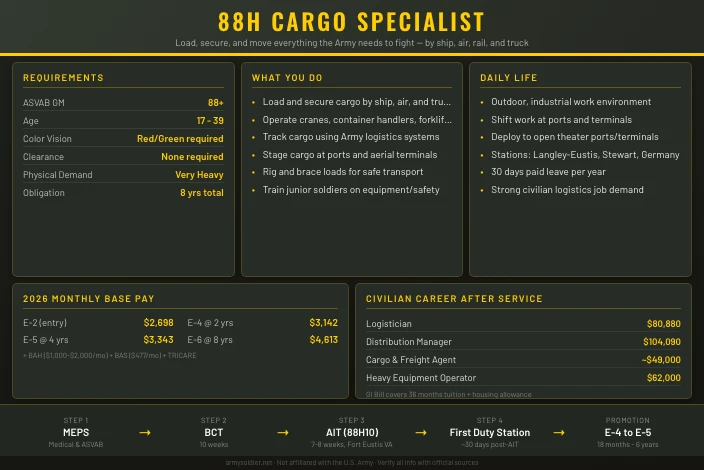
88H Cargo Specialists are disciplined technical experts who transship cargo between all modes of transportation and execute port operations including upload, download, staging, and marshalling tasks to support Army global operations. They operate and supervise the use of cargo handling equipment such as rough terrain container handlers, cranes, and forklifts to ensure the Army receives supplies, ammunition, and equipment wherever and whenever the mission demands.
Daily Tasks
The day-to-day depends heavily on your unit type and location. At a stateside installation, a typical duty day includes physical training, then cargo operations at a motor pool, warehouse, or intermodal facility. You’ll inspect and document incoming and outgoing shipments, operate forklifts and container handlers to stage loads, and verify that cargo is secured correctly before movement.
At a port or aerial terminal – which is where many 88H soldiers work – the tempo is faster. Ships and aircraft don’t wait. A cargo specialist at a port may spend a full shift directing cranes to load containers onto vessels, then shift to documentation and customs compliance work for the next aircraft manifest.
Common tasks across assignments:
- Inspect, count, and document cargo shipments using Army transportation information systems
- Operate the Kalmar RT240 Rough Terrain Container Handler (RTCH), ATLAS 10K forklift, and Hagglund ship/shore cranes
- Load and unload containers, breakbulk cargo, and vehicles from ships, railcars, aircraft, and trucks
- Apply rigging, blocking, and bracing to secure cargo for transit
- Manage cargo staging and marshalling areas at ports and aerial terminals
- Direct and train junior soldiers in equipment operation and safety protocols
- Coordinate with transportation units and customs personnel on documentation and accountability
Specialized Roles
The Army uses additional skill identifiers and progressive skill levels to recognize specialization within the MOS:
| Classification | Code | Description |
|---|---|---|
| MOS Primary | 88H | Cargo Specialist (all skill levels) |
| Additional Skill Identifier | R1 | Rough Terrain Container Handler (RTCH) operator |
| Skill Level 10 | 88H10 | Initial entry – cargo specialist tasks |
| Skill Level 20 | 88H20 | Team leader and NCO cargo operations |
| Skill Level 30 | 88H30 | Senior NCO and terminal operations leader |
| Skill Level 40 | 88H40 | Senior leader – strategic terminal management |
Mission Contribution
The Army runs on logistics. Every forward operating base, every combat patrol, every field hospital depends on a continuous supply chain that starts at an aerial terminal or seaport. The 88H is the soldier who executes that chain at the physical level – getting the right cargo onto the right conveyance at the right time. During major deployments, cargo specialists work alongside port opening elements and Theater Sustainment Commands to receive and push thousands of tons of equipment forward. Their accuracy and speed directly determine how fast a deployed force can achieve combat capability.
Technology and Equipment
88H soldiers work with a range of specialized equipment not found in most other MOS fields. The Kalmar RT240 Rough Terrain Container Handler is a 52,000-pound-capacity crane-forklift capable of stacking ISO containers four high. The All-Terrain Lifter Army System (ATLAS) handles 10,000-pound loads across rough terrain. The 5K Light Capability Rough Terrain Forklift (LCRTF) handles smaller pallet loads. The Hagglund ship/shore crane is used at deep-water ports to move cargo between vessels and the pier.
Beyond heavy equipment, soldiers use Army-specific cargo tracking and documentation systems including GATES (Global Air Transportation Execution System), TC-AIMS II (Transportation Coordinators’ Automated Information for Movements System), and ICODES-Sea/Air for intermodal container management.
Salary and Benefits
Pay
88H soldiers receive the same military base pay as all Army enlisted soldiers, determined by paygrade and years of service. The table below shows 2026 monthly base pay at grades typical for this MOS, sourced from DFAS.
| Rank | Paygrade | Years of Service | Monthly Base Pay |
|---|---|---|---|
| Private (PV2) | E-2 | Entry | $2,698 |
| Private First Class (PFC) | E-3 | 1-2 years | $2,837 |
| Specialist (SPC) | E-4 | 2-4 years | $3,142 - $3,659 |
| Sergeant (SGT) | E-5 | 4-8 years | $3,343 - $4,299 |
| Staff Sergeant (SSG) | E-6 | 8-12 years | $4,613 - $5,044 |
Base pay is only part of the picture. Most soldiers also receive:
- Basic Allowance for Housing (BAH): Varies by duty location and dependency status. A single E-4 at a typical installation receives roughly $1,000 to $2,000 monthly depending on the local housing market. BAH is tax-free.
- Basic Allowance for Subsistence (BAS): $476.95 per month (2026 rate), tax-free, for enlisted soldiers.
- TRICARE: Full medical, dental, and vision coverage at no cost to the soldier. Family members are covered under TRICARE Prime with no enrollment fee and a $1,000 annual catastrophic cap.
Enlistment Bonus
Qualified recruits enlisting for this MOS may be eligible for an enlistment bonus. Bonus amounts vary by contract length and Army manning priorities at the time of enlistment. Check with a recruiter for current figures – bonus availability changes frequently based on Army needs.
Education Benefits
Soldiers earn Post-9/11 GI Bill benefits with 36 months of full in-state tuition coverage at public universities, a monthly housing allowance tied to local BAH rates, and up to $1,000 annually for books and supplies. Private school tuition is covered up to $29,920 per academic year (AY 2025-2026 cap).
Army Tuition Assistance (TA) covers up to $4,500 per year while on active duty, at $250 per semester credit hour. That makes it practical to take college courses during your first enlistment without spending GI Bill entitlement.
The Blended Retirement System (BRS) provides a pension at 20 years equal to 40% of your high-36 average base pay, plus government-matched contributions to your Thrift Savings Plan account of up to 5% of base pay.
Work-Life Balance
Active duty soldiers earn 30 days of paid leave per year, accrued at 2.5 days per month. Work schedules vary by unit mission. Stateside cargo operations generally follow a regular weekday schedule with weekend duty rare unless a major exercise or shipment is pending. Port and aerial terminal assignments can involve shift work, including nights and weekends, to accommodate vessel and aircraft arrivals. Field exercises and deployments disrupt normal schedules for weeks at a time.
Qualifications and Eligibility
Basic Requirements
| Requirement | Standard |
|---|---|
| Age | 17 to 39 (waiver possible) |
| Citizenship | U.S. citizen or permanent resident alien |
| Education | High school diploma or GED |
| AFQT Minimum | 31 (HS diploma) / 50 (GED) |
| ASVAB Line Score | GM: 88 |
| Security Clearance | None required |
| Vision | Color discrimination of red/green required |
| Physical Demand Rating | Very Heavy |
The GM (General Maintenance) composite combines scores from four ASVAB subtests: General Science (GS), Auto and Shop Information (AS), Mathematics Knowledge (MK), and Electronics Information (EI). A score of 88 is achievable with solid fundamentals in math and mechanics – no advanced knowledge required, but you’ll need to study.
Color vision is a firm requirement. The Army tests for red/green discrimination during the MEPS medical evaluation. No waiver exists for this standard – it’s a disqualifier for 88H if you fail the color vision test.
The physical demand rating of Very Heavy means this role involves regularly lifting, carrying, and maneuvering loads above 100 pounds, often in adverse weather and on uneven terrain. Soldiers who prefer desk work or light physical activity will find the physical requirements of 88H a genuine challenge from day one.
Application Process
Selection and Competitiveness
The 88H MOS is not special operations or highly competitive by Army standards. The GM: 88 threshold is moderate, and the role does not require a security clearance or advanced aptitude test. That said, physical fitness matters for selection and daily performance. Soldiers who arrive at BCT already physically prepared tend to perform better through AIT as well.
U.S. citizenship is not required for 88H. Permanent resident aliens who meet all other qualifications can enlist.
Service Obligation
The standard enlistment for 88H is a three to six-year active duty contract. First-term soldiers enter at E-1 (Private, PV1) and typically promote to E-2 within six months of completing AIT. The Army’s total obligation (active plus reserve) is eight years.
See our ASVAB study guide for strategies to hit these line scores, or take the PiCAT from home if you are a first-time tester.
Work Environment
Setting and Schedule
The 88H work environment is primarily outdoor and industrial. Whether you’re working a pier at a seaport, staging cargo at an aerial terminal, or running warehouse operations at an installation, the work happens outside, around heavy equipment, and in all weather. There is classroom and office work involved – cargo documentation, system entry, inventory management – but the bulk of the job is physical and hands-on.
Schedules depend on assignment type. Soldiers assigned to transportation companies at installations generally work weekday hours. Those assigned to port opening units or aerial terminal companies may work rotating shifts to match cargo arrival windows that don’t follow normal business hours. Field exercises add irregular hours for weeks or months at a time.
Leadership and Communication
88H soldiers join the standard Army chain of command. Junior soldiers report to a team leader (typically an E-5 Sergeant) who reports up through the platoon sergeant and company leadership. Daily communication is a mix of formation briefings, radio contact during equipment operations, and documentation coordination with transportation planners and customs officials.
Performance feedback comes through two systems: informal counseling from your NCO supervisor, typically monthly, and the formal Army Evaluation Report (AER) system for NCOs at E-5 and above. Junior enlisted soldiers receive developmental counseling on a schedule set by their chain of command, typically monthly for the first year.
Team Dynamics
Cargo operations are inherently team-based. A container lift requires a crane operator, a signalman, and ground guides working in coordination. A port operation during a major deployment may involve dozens of soldiers working in coordinated shifts. The margin for independent decision-making grows as you gain rank. As a junior soldier, you execute tasks as directed. As an NCO, you lead small teams and have real authority over how operations are organized and executed within your section.
Job Satisfaction
Retention data for CMF 88 is not publicly reported at the MOS level, but soldiers in logistics fields often cite the practical utility of their skills and the tangible results of their work as key satisfaction factors. Seeing a ship loaded and underway, or watching a deployed unit receive the equipment they need, is a concrete measure of success. The physical demands and irregular hours can wear on soldiers over a long career, particularly those with families. Soldiers who thrive in 88H typically enjoy hands-on work, take pride in precision and safety, and are comfortable working in industrial environments.
Training and Skill Development
Initial Training
All Army enlistees complete Basic Combat Training (BCT) before MOS-specific schooling. BCT is ten weeks long and takes place at several installations across the country. After BCT, 88H soldiers attend Advanced Individual Training (AIT).
| Phase | Location | Length | Focus |
|---|---|---|---|
| Basic Combat Training (BCT) | Various (Fort Jackson, Fort Leonard Wood, Fort Moore, etc.) | 10 weeks | Soldier skills, weapons qualification, physical fitness, land navigation |
| Advanced Individual Training (AIT) – 88H10 | Fort Eustis, VA (Joint Base Langley-Eustis) | ~7-8 weeks | Cargo documentation, equipment operation, rigging, port and terminal operations |
AIT for 88H is conducted by the U.S. Army Transportation School’s Maritime and Intermodal Training Department at Joint Base Langley-Eustis in Virginia. Training combines classroom instruction with hands-on equipment operation. Students learn cargo documentation procedures, rigging techniques, and the safe operation of forklifts, container handlers, and cranes. Safety is a heavy emphasis – the equipment involved can kill or seriously injure someone who operates it incorrectly.
After completing both BCT and AIT, soldiers report to their first duty station, typically within 30 days of graduation.
Advanced Training
Training doesn’t stop after AIT. The Army invests in 88H soldiers at every career stage. Key advanced training opportunities include:
- Additional Skill Identifier R1 (RTCH Operator): A separate course that certifies soldiers to operate the Kalmar Rough Terrain Container Handler. This certification is a career advantage and is required for certain duty positions.
- 88H20-30 NCO Course: When soldiers reach E-5 and above, they return to the Transportation School for the more advanced MOS-specific course covering complex terminal operations, system management, and leadership tasks.
- Senior Leaders Course (SLC): Required for promotion to Sergeant First Class (E-7), covering strategic planning, resource management, and terminal operations oversight.
- Battle Staff Course: Available for senior NCOs preparing for staff positions at battalion level and above.
- Training with Industry: Competitive program placing soldiers with civilian freight and logistics companies (Virginia International Gateway, for example) to build practical skills with commercial cargo operations.
- Institute for Defense and Business: Seminars focused on Enterprise Resource Planning systems used in Army logistics – GATES, TC-AIMS II, and ICODES.
Soldiers who pursue Airborne School or Air Assault School gain cross-functional capabilities that open additional duty position options.
Everything starts with qualifying ASVAB scores — our study guide covers what to study first.
Career Progression and Advancement
Career Path
Promotion to E-4 (Specialist) typically happens within 12 to 18 months for soldiers meeting time-in-grade and performance requirements. NCO promotions from E-4 to E-5 depend on available slots in the Sergeant promotion list. The table below shows a typical progression for an 88H soldier.
| Rank | Paygrade | Typical Time | Key Duties |
|---|---|---|---|
| Private (PV1) | E-1 | Entry (BCT) | Student, basic soldier tasks |
| Private (PV2) | E-2 | 6 months post-AIT | Junior cargo handler |
| Private First Class (PFC) | E-3 | ~12-18 months | Cargo checker, equipment operator |
| Specialist (SPC) | E-4 | ~18-36 months | Container handler, documentation specialist |
| Sergeant (SGT) | E-5 | ~4-6 years | Team leader, senior crane operator, cargo section leader |
| Staff Sergeant (SSG) | E-6 | ~8-12 years | Section chief, terminal operations NCO, load planner |
| Sergeant First Class (SFC) | E-7 | ~12-18 years | Platoon sergeant, terminal operations sergeant, AIT instructor |
| Master Sergeant (MSG) | E-8 | ~18-22 years | Operations sergeant major, senior terminal advisor |
| Sergeant Major (SGM) | E-9 | 22+ years | Command sergeant major, senior NCO advisor |
Specialization Options
At the NCO level, 88H soldiers can pursue lateral positions that broaden their career and resume:
- AIT Instructor at the Transportation School
- Drill Sergeant
- Army Recruiter
- Observer Controller/Trainer at a Combat Training Center
- Training Management NCO
- Advanced Leader Course (ALC) Small Group Leader
Warrant Officer paths are not directly available from 88H, but high-performing NCOs can apply for warrant officer programs in related fields including logistics.
Performance Evaluation
Junior enlisted soldiers receive developmental counseling from their chain of command. NCOs at E-5 and above are rated annually through the Army Evaluation Report (AER) system. Your immediate supervisor rates your performance on a scale and writes a narrative that follows you through every promotion board. A senior rater above your direct supervisor provides a second evaluation. Performance on key duty positions – especially terminal operations during high-tempo exercises or deployments – carries significant weight on promotion boards.
Physical Demands and Medical Evaluations
Physical Requirements
The 88H MOS carries a Very Heavy physical demand rating, one of the highest in the Army. This reflects the daily reality of the job: operating equipment that requires climbing, bending, pulling, and occasionally manually lifting heavy loads. Pallets, containers, and rigging hardware don’t move themselves when equipment fails. Soldiers who are not physically strong and fit will struggle with both the daily demands and the Army Fitness Test (AFT) standards.
Daily physical demands include:
- Climbing in and out of large cargo equipment repeatedly during a shift
- Lifting and moving rigging hardware, chains, and blocking materials
- Standing on hard surfaces for extended periods during loading operations
- Working in extreme weather – ports and terminals operate year-round regardless of temperature or precipitation
Army Fitness Test (AFT)
The Army Fitness Test replaced the ACFT on June 1, 2025, per Army Directive 2025-06. It consists of five events scored 0-100 points each, for a maximum of 500 points. The minimum passing score is 60 points per event, with a total minimum of 300 points for general MOSs. The 88H is not a designated combat MOS, so the general standard applies: 300 total minimum, 60 minimum per event, sex- and age-normed scoring.
| AFT Event | Abbreviation | What It Measures |
|---|---|---|
| 3 Rep Maximum Deadlift | MDL | Lower body and grip strength |
| Hand Release Push-Up – Arm Extension | HRP | Upper body and core endurance |
| Sprint-Drag-Carry | SDC | Anaerobic capacity and agility |
| Plank | PLK | Core stability and endurance |
| Two-Mile Run | 2MR | Aerobic capacity |
The AFT is administered twice per year. Failing any single event means failing the entire test, regardless of total score. Soldiers who fail face adverse administrative action and potential separation.
Medical Evaluations
MEPS conducts the initial medical evaluation that determines fitness for service. The physical profile for 88H is 211222, which reflects the moderate-to-high physical demands of the role. After accession, soldiers receive annual medical readiness assessments and periodic dental exams through the Army’s health readiness system.
The specific requirement to discriminate red from green colors is a permanent standard enforced at MEPS. There is no waiver process for this requirement in 88H.
Deployment and Duty Stations
Deployment Patterns
88H soldiers deploy. The MOS supports theater opening and sustainment operations, which means they often deploy in the early stages of an operation to open ports and aerial terminals before the bulk of forces arrive. Deployments range from six to twelve months depending on the supporting command. Soldiers assigned to port opening elements or theater support commands see higher deployment rates than those assigned to installation transportation battalions.
Typical deployments in recent years have included rotations to Europe (USAREUR-AF), Southwest Asia (ARCENT), and Pacific Command (USARPAC) areas. The nature of the work – cargo operations at established ports – means most 88H deployments are to developed facilities rather than combat outposts, though the threat environment varies by theater.
Duty Stations
88H soldiers serve at installations and facilities across the Army. Common duty stations include:
- Joint Base Langley-Eustis, VA – Home of the Transportation School and major aerial terminal
- Fort Gregg-Adams, VA – Major logistics hub
- Savannah/Hinesville, GA (Fort Stewart) – Port of Savannah operations support
- Bayonne, NJ (Military Ocean Terminal Bayonne) – Key seaport facility
- Hawaii (Fort Shafter/Schofield Barracks) – Pacific logistics support
- Germany (Clay Kaserne, Wiesbaden) – European theater sustainment
Assignments are based on Army needs and available slots at the time of your enlistment or re-enlistment. You can submit preference requests, but the Army fills positions based on mission requirements first.
Risk, Safety, and Legal Considerations
Job Hazards
Heavy equipment operations carry real risk. Cranes, container handlers, and forklifts can cause fatal accidents when operated incorrectly, when load limits are exceeded, or when communication breaks down during lifts. The Army’s cargo handling environment also involves working around ships, aircraft, rail cars, and trucks simultaneously at busy terminals – which creates additional hazard exposure.
Secondary risks include:
- Crushing injuries from improperly secured cargo or equipment failure
- Falls from container tops and pier structures
- Noise-induced hearing loss from prolonged equipment operation
- Musculoskeletal injuries from repetitive lifting and awkward body positions
Safety Protocols
Every cargo operation follows documented safety procedures. The Army enforces required certification before soldiers operate any crane, container handler, or specialized lift equipment. A designated signalman is required for all crane and container handler operations. Load calculations must be verified before any lift. Soldiers who violate safety procedures face formal counseling, suspension from equipment operation, and potential UCMJ action.
Personal protective equipment – hard hats, steel-toed boots, high-visibility vests, hearing protection – is mandatory on working terminals and in warehouses.
Security and Legal Considerations
The 88H MOS does not require a security clearance. Some duty positions – particularly those involving classified cargo or specific theater assignments – may require a clearance at the Secret level, but this is position-specific rather than MOS-wide. Your unit will initiate any required investigation.
All soldiers serve under the Uniform Code of Military Justice (UCMJ). The service obligation for an active duty enlistment is three to six years, depending on contract length, with the total military obligation running eight years.
Impact on Family and Personal Life
Family Considerations
Cargo specialist assignments at stateside installations generally allow predictable family life during garrison periods. The challenge comes with deployments and extended field exercises. A six-month port opening deployment to Europe or the Middle East means sustained separation, though Army Family Readiness Groups (FRGs) and the Military OneSource program provide support resources.
Families of active duty soldiers qualify for TRICARE Prime health coverage at no enrollment cost, with no copays for in-network care. On-post family housing or BAH to cover off-post rent is available for soldiers with dependents.
Relocation
The Army moves 88H soldiers through Permanent Change of Station (PCS) assignments, typically every two to three years. PCS moves are fully funded by the Army. Frequent relocation is a reality of active duty service – families need to be prepared to move and reestablish in a new location every few years. Soldiers with spouses who have portable careers, or who are supportive of the lifestyle, adapt more successfully than those without a solid support structure.
Reserve and National Guard
The 88H Cargo Specialist is available in both the Army Reserve and Army National Guard. Transportation units are among the most common Reserve component organizations, so 88H slots exist in port operations companies, terminal battalions, and transportation groups across the country. Skill-level ceilings mirror active duty through SL4 in most units, though senior NCO billets (E-8/E-9) are limited by unit structure.
Drill Schedule and Training Commitment
Standard commitment is one weekend per month (Battle Assembly) plus two weeks of Annual Training per year. Cargo specialists in Reserve/Guard port units often run longer Annual Training periods (up to 21 days) when supporting joint logistics exercises at military ocean terminals. You may also need additional training days for equipment certifications on rough terrain container handlers, cranes, and forklifts, since proficiency on heavy cargo handling equipment requires more hands-on time than a single weekend provides.
Part-Time Pay
An E-4 with over 3 years of service earns about $464 per drill weekend (4 drill periods). That works out to roughly $5,572 per year from drill weekends alone, plus another $1,741 for 15 days of Annual Training. Compare that to an active-duty E-4’s monthly base pay of $3,482. The Reserve/Guard route pays significantly less, but it frees you to earn a full civilian salary during the week.
Benefits Differences
Tricare Reserve Select costs $57.88 per month for member-only coverage or $286.66 per month for family coverage in 2026. Active-duty soldiers pay nothing for TRICARE Prime. TRS is still a strong deal compared to most civilian health plans, which average $400 to $700 per month for family coverage.
Education benefits include Federal Tuition Assistance ($250 per credit hour, up to $4,500 per year) and the Montgomery GI Bill-Selected Reserve at $493 per month for full-time students. National Guard members may also qualify for state tuition waivers, which vary by state. If you get mobilized for 90 or more days on Title 10 orders, you start earning Post-9/11 GI Bill eligibility.
Reserve retirement uses a points-based system. You need 20 qualifying years (minimum 50 points per year) and can collect retired pay starting at age 60. Each 90-day mobilization after January 2008 reduces that age by 3 months, down to a minimum of age 50.
Deployment and Mobilization
Cargo specialists in Reserve/Guard transportation units see moderate to high mobilization rates. Port operations are a critical enabler for any large-scale deployment, and Reserve component terminal units have been activated regularly since 2001 for rotations to Kuwait, Europe, and the Pacific. Typical mobilizations run 9 to 12 months including pre-deployment training. Mobilization frequency is lower than active duty but higher than many non-combat MOS.
Civilian Career Integration
The 88H pairs well with civilian careers in port logistics, freight forwarding, warehouse management, and intermodal transportation. Skills with container handlers, cranes, and cargo documentation systems transfer directly. USERRA protects your civilian job during mobilizations. Your employer must reemploy you in the position you would have held if you had stayed, including any promotions or raises. Health insurance continues for up to 24 months during military leave.
| Feature | Active Duty | Army Reserve | Army National Guard |
|---|---|---|---|
| Commitment | Full-time | 1 weekend/month + 2 weeks/year | 1 weekend/month + 2 weeks/year |
| Monthly Pay (E-4, 3+ yrs) | $3,482 | ~$464/drill weekend | ~$464/drill weekend |
| Healthcare | TRICARE Prime ($0) | Tricare Reserve Select ($57.88/mo) | Tricare Reserve Select ($57.88/mo) |
| Education | Federal TA, Post-9/11 GI Bill | Federal TA, MGIB-SR ($493/mo) | Federal TA, MGIB-SR, state tuition waivers |
| Deployment Tempo | Regular rotations | Moderate-high mobilization cycles | Moderate-high mobilization cycles |
| Retirement | 20-year pension at age 40+ | Points-based, collect at age 60 | Points-based, collect at age 60 |
Post-Service Opportunities
Civilian Career Transition
The skills an 88H soldier builds translate directly into high-demand civilian logistics and operations roles. You’ll leave the Army familiar with cargo documentation systems, heavy equipment certification, port and terminal operations, and safety compliance – all of which civilian employers value in the freight and logistics sector.
Programs that support your transition include:
- Transition Assistance Program (TAP): Mandatory pre-separation counseling covering resume writing, job search, and VA benefits.
- Hiring Our Heroes: DoD-affiliated program connecting veterans with civilian employers in logistics, transportation, and operations.
- SkillBridge: Allows active duty soldiers within 180 days of separation to intern with civilian employers while still receiving military pay and benefits.
The Post-9/11 GI Bill covers 36 months of college tuition if you pursue a degree in supply chain management, logistics, or a related field. Many community colleges offer accelerated programs in these areas specifically designed for veterans.
Civilian Career Prospects
| Civilian Job Title | Median Annual Wage | Job Outlook (2024-2034) |
|---|---|---|
| Logistician | $80,880 | +17% (much faster than average) |
| Transportation, Storage & Distribution Manager | $104,090 | +8% |
| Cargo and Freight Agent | ~$49,000* | Stable |
| Heavy Equipment Operator (crane/forklift) | $62,000 | +4% |
*Cargo and Freight Agent wages vary significantly by employer and region. The BLS does not publish a full OOH page for this occupation; estimate based on OEWS data.
Logisticians and distribution managers typically require a bachelor’s degree for advancement, but military experience counts heavily toward hiring. Many companies specifically recruit veterans from logistics MOSs for entry-to-mid-level operations roles, with a degree as a concurrent or eventual requirement.
Is This a Good Job for You?
Ideal Candidate Profile
88H suits soldiers who enjoy physical, hands-on work and want to be directly involved in making operations happen rather than supporting them from a desk. You’re a good fit if you:
- Prefer outdoor and industrial work environments over an office
- Take satisfaction in precision and safety compliance, not just getting things done
- Are comfortable operating large equipment and learning technical certification courses
- Can handle physical demands day after day, including in bad weather
- Want transferable civilian skills in a sector with strong job demand
Potential Challenges
The job is physically demanding in ways that accumulate over a career. Soldiers who develop musculoskeletal problems from years of heavy equipment operation sometimes find career continuation difficult. Irregular hours at ports and terminals, combined with deployment cycles, can strain family relationships. If you want a predictable 9-to-5 schedule, this MOS will frustrate you.
The work also requires sustained attention to safety and documentation. A missed step in rigging or a documentation error in cargo tracking can have real consequences – operational delays, cargo loss, or injury. Soldiers who are careless or impatient with detailed procedures aren’t well-suited for this role.
Career and Lifestyle Alignment
If your goal is to build a civilian logistics career after military service, 88H gives you a strong foundation. The combination of equipment certifications, port operations experience, and Army documentation system proficiency opens doors at freight companies, shipping lines, distribution centers, and federal agencies. If your goal is combat operations or special operations, this isn’t the path – 88H is a support MOS, and while 88H soldiers deploy, they do so in a logistics role, not an infantry or combat arms capacity.
More Information
Talk to an Army recruiter to confirm current ASVAB score requirements, bonus availability, and open 88H duty station assignments. Recruiters can verify whether specific installations are currently accepting 88H accessions and what contract lengths are available. You can contact the Army at goarmy.com or call 1-888-550-ARMY (2769).
- Prepare for the ASVAB with our study guide to make sure your line scores qualify
This site is not affiliated with the U.S. Army or any government agency. Verify all information with official Army sources before making enlistment or career decisions.
Explore more Army transportation and logistics careers such as 88M Motor Transport Operator and 92A Automated Logistical Specialist.