88L Watercraft Engineer
The Army runs ships. Most people don’t know that, but the Transportation Corps operates a fleet of vessels ranging from harbor tugs to large seagoing craft – and every one of them needs a trained engineer to keep the engines running. The 88L Watercraft Engineer is the enlisted mechanic behind those operations: troubleshooting propulsion systems, managing engine rooms, and keeping Army watercraft combat-ready around the clock. If you have a mechanical aptitude and want a career that is genuinely rare in the military and civilian world, this MOS is worth a close look.
Qualifying requires specific ASVAB line scores — our ASVAB study guide covers what to target and how to prepare.
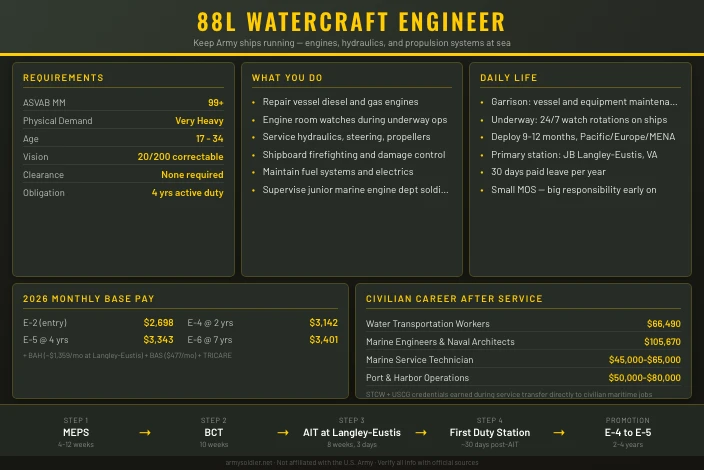
Job Role and Responsibilities
88L Watercraft Engineers supervise and perform field and sustainment-level maintenance on Army watercraft, amphibious vessels, and auxiliary equipment – including gasoline and diesel engines, propulsion machinery, lift systems, electrical components, and steering systems – to sustain maritime operational readiness.
Daily Tasks
The work is hands-on and technical from day one. In garrison, a typical day starts with physical training followed by daily systems checks on assigned vessels. You’ll pull scheduled services, document maintenance records, troubleshoot mechanical faults, and stand engine room watches during underway operations.
Core tasks across all assignments:
- Inspect, test, service, and repair vessel propulsion engines and associated systems
- Troubleshoot gasoline and diesel engine faults using technical manuals and diagnostic equipment
- Service and replace batteries, fuel system components, electrical wiring, propellers, and propeller shafts
- Maintain hydraulic systems, steering equipment, and lift machinery
- Stand engine room watches and monitor gauges during vessel operations
- Execute damage control and shipboard firefighting procedures
- Maintain maintenance logs, service records, and equipment accountability documents
- Supervise junior personnel in marine engine department operations
Specializations
The Army uses Additional Skill Identifiers (ASIs) to recognize advanced capabilities within an MOS.
| Classification | Type | Description |
|---|---|---|
| 88L | Primary MOS | Watercraft Engineer – all Army vessels |
| ASI H8 | Additional Skill Identifier | Instructor/Writer |
| ASI E6 | Additional Skill Identifier | Battle Staff Operations |
Senior 88Ls may pursue the Warrant Officer path to 880A (Marine Deck Officer) or 881A (Marine Engineering Warrant Officer), which opens command-level maritime roles. Selection requires a competitive packet and Warrant Officer Candidate School.
Mission Contribution
Army watercraft are used to move troops, vehicles, fuel, and supplies across rivers, harbors, and coastal waters where roads and bridges can’t do the job. That capability depends entirely on engines that run. An 88L with a vessel down in the middle of a logistics operation isn’t a minor inconvenience – it’s a mission stopper.
The U.S. Army Transportation Corps describes 88L Watercraft Engineers as technical specialists who “provide the Army with maritime field and sustainment level maintenance capabilities.” The MOS is small, which means individual soldiers carry significant responsibility early in their careers.
Technology and Equipment
The Army watercraft fleet includes a diverse mix of vessel types. As an 88L, you will work across this inventory:
- Landing Craft Utility (LCU): Large craft carrying troops, vehicles, and cargo over coastal and inland waterways
- Landing Craft Mechanized (LCM): Smaller mechanized landing craft for assault and resupply operations
- Logistics Support Vessel (LSV): Ocean-capable vessel for heavy equipment and bulk cargo transport
- Causeway Ferry and Improved Navy Lighterage System (INLS): Floating systems that bridge ship-to-shore operations
- Harbor tugs and utility boats: Day-to-day port and harbor operations
Engine systems range from marine diesel powerplants to complex hydraulic drive systems, and 88Ls must be proficient across all of them.
Salary and Benefits
Pay Table
Army pay is determined by rank and time in service. The table below shows 2026 monthly base pay at typical career milestones for an 88L.
| Rank | Pay Grade | Time in Service | Monthly Base Pay |
|---|---|---|---|
| Private (PV2) | E-2 | Entry level | $2,698 |
| Private First Class (PFC) | E-3 | ~1 year | $2,837 |
| Specialist (SPC) | E-4 | ~2 years | $3,142 |
| Sergeant (SGT) | E-5 | ~4 years | $3,343 |
| Staff Sergeant (SSG) | E-6 | ~7 years | $3,401 |
| Sergeant First Class (SFC) | E-7 | ~13 years | $3,932 |
Source: DFAS 2026 Military Pay Chart
Additional Benefits
Healthcare: Active duty soldiers and their dependents receive TRICARE Prime at no cost. There are no enrollment fees, deductibles, or copays for in-network care. Coverage includes medical, dental, vision, mental health, and prescriptions.
Education: The Army offers two primary education programs. Tuition Assistance covers up to $4,500 per year toward college courses taken while on active duty. The Post-9/11 GI Bill, usable after service, covers full in-state tuition at public universities plus a monthly housing allowance and up to $1,000 annually for books.
Retirement: Soldiers who joined after January 1, 2018 fall under the Blended Retirement System (BRS). It combines a 20-year pension worth 40% of your high-36 average basic pay with a government-matched Thrift Savings Plan (TSP) contribution of up to 5% of base pay. Soldiers who contribute 5% to their TSP receive the full government match.
Work-Life Balance
Soldiers earn 30 days of paid leave per year, accruing at 2.5 days per month. Garrison assignments at major watercraft installations typically run standard duty hours with on-call rotations. Field exercises and underway periods extend those hours significantly. Deployments vary by operational requirements; watercraft units have supported missions in the Pacific, Middle East, and Europe, with typical deployment lengths of nine to twelve months.
Qualifications and Eligibility
Requirements Table
| Requirement | Standard |
|---|---|
| ASVAB Line Score | MM: 99 |
| AFQT Minimum | 31 (high school diploma); 50 (GED) |
| Physical Demands Category | Very Heavy (PULHES: 222221) |
| Vision | Uncorrected no worse than 20/200; correctable to 20/20 in one eye, 20/40 in the other |
| Color Vision | Normal (no more than 4 errors on pseudoisochromatic plate test) |
| Citizenship | Not required for enlistment; permanent resident eligible |
| Security Clearance | None required |
| Minimum Age | 17 (with parental consent); Maximum 34 |
The ASVAB Mechanical Maintenance (MM) composite score is calculated from the Numerical Operations (NO), Auto and Shop Information (AS), Mechanical Comprehension (MC), and Electronics Information (EI) subtests. A score of 99 on MM reflects strong aptitude across all four areas. Focus your preparation on mechanical comprehension and auto and shop information – those subtests carry the most weight.
Application Process
Selection and Competitiveness
The 88L MOS is a niche technical specialty with a relatively small training seat allocation. Applicants with prior mechanical experience – boat engines, auto mechanics, HVAC, or diesel equipment – are well-positioned. The ACASP (Army Civilian Acquired Skills Program) allows applicants with two or more years of civilian experience in marine vessel systems to receive credit toward enlistment at a higher grade, provided they obtain certification from the Army Marine Qualification Division at Fort Eustis.
Service Obligation
Standard enlistment is four years of active duty service. Upon completion of AIT, soldiers report to their first duty station as a Private First Class (PFC, E-3) or Specialist (SPC, E-4) depending on prior credits and enlistment terms.
See our ASVAB study guide for strategies to hit these line scores, or take the PiCAT from home if you are a first-time tester.
Work Environment
Setting and Schedule
The day-to-day environment for an 88L is split between engine rooms, maintenance bays, and open water. In garrison, you’ll work in a motor pool-style setting for vessel maintenance alongside your watercraft crew. During underway operations, your workspace is the engine room of an operating vessel – loud, warm, and physically demanding.
Schedules are irregular by nature. Vessels deploy and return on operational timelines, not a standard nine-to-five rhythm. When a ship is underway, the work is continuous. Watches rotate, but there’s no leaving at close of business.
Leadership and Communication
88Ls work within the Transportation Corps unit structure, typically assigned to a Boat Company or Watercraft Unit. The chain of command runs from squad leader to platoon sergeant to unit commander. Junior engineers receive direction from NCOs and are evaluated by their platoon sergeant on both technical performance and soldiering skills.
Noncommissioned Officer Evaluation Reports (NCOERs) are completed annually for E-5 and above. Counseling sessions with supervisors are required quarterly at minimum, and many leaders do them monthly.
Team Dynamics
Vessel operations are team functions. An 88L doesn’t maintain a ship alone – you work alongside 88K Watercraft Operators, marine deck personnel, and vessel commanders. The technical work requires individual expertise, but the operational mission is always collective. Early in your career, you execute tasks directed by senior engineers. As you advance to E-5 and above, you direct junior soldiers and supervise maintenance operations.
Job Satisfaction
The 88L MOS is one of the smallest in the Army, which creates a tight-knit professional community. Soldiers who report high satisfaction in this field typically cite the technical depth of the work, the unique nature of watercraft operations within the Army, and the direct translation to well-paying civilian maritime jobs. The challenge is the operational pace: deployments, extended field exercises, and irregular schedules are real.
Training and Skill Development
Training Pipeline
| Phase | Location | Length | Focus |
|---|---|---|---|
| Basic Combat Training (BCT) | Various installations | 10 weeks | Soldiering fundamentals, weapons, land navigation |
| Advanced Individual Training (AIT) | Joint Base Langley-Eustis, VA | 8 weeks, 3 days | Marine engineering, propulsion systems, damage control |
| Unit Integration | First duty station | Ongoing | Vessel-specific qualification, watch-standing |
Basic Combat Training runs ten weeks and covers the fundamentals every Army soldier needs: physical fitness, weapons qualification, land navigation, first aid, and the Army values and culture. You’ll train alongside soldiers from across multiple MOS fields.
Advanced Individual Training for 88L runs approximately eight weeks and three days at the Maritime and Intermodal Training Department (MITD) at Joint Base Langley-Eustis, Virginia. The training is structured around technical competencies:
- Marine vessel engine systems (diesel and gasoline)
- Hydraulic and steering system maintenance
- Basic shipboard electronics
- Propeller inspection, removal, and installation
- Shipboard firefighting and emergency procedures
- Damage control techniques
- Engine room watches and operational logs
Upon arriving at your first unit, you’ll continue with vessel-specific qualification training under the supervision of senior 88Ls.
Advanced Training and Certifications
The Army supports professional maritime credentialing through the Credentialing Opportunities On-Line (COOL) program. These credentials are valuable both for Army promotion and civilian employment after service.
Key certifications relevant to 88L:
- National Able Seaman (USCG): Required for commercial vessel work; attainable with documented sea service hours
- STCW (Standards of Training, Certification and Watchkeeping): International certification required for commercial seafarers; Army service hours count toward qualification
- GMDSS Radio Operator License: Required for E-6 (Staff Sergeant) career progression
- ECDIS License (Electronic Chart Display and Information System): Also required at the E-6 level
- USCG Marine Mechanic Certification: Directly recognized by civilian employers
The Army pays for most of these credentials while you’re on active duty. Soldiers who pursue them proactively enter the civilian job market with qualifications that take civilian workers years and thousands of dollars to obtain independently.
Everything starts with qualifying ASVAB scores — our study guide covers what to study first.
Career Progression and Advancement
Rank Progression
| Rank | Pay Grade | Typical Time at Grade | Key Milestone |
|---|---|---|---|
| Private First Class (PFC) | E-3 | Entry to ~18 months | AIT graduation; first duty station |
| Specialist (SPC) | E-4 | 18 months to 4 years | MOS qualification complete |
| Sergeant (SGT) | E-5 | 4 to 7 years | Basic Leaders Course; supervises junior soldiers |
| Staff Sergeant (SSG) | E-6 | 7 to 12 years | Advanced Leaders Course; GMDSS and ECDIS credentials |
| Sergeant First Class (SFC) | E-7 | 12 to 18 years | Senior Leaders Course; platoon-level leadership |
| Master Sergeant (MSG) | E-8 | 18 to 22 years | Senior technical advisor or First Sergeant track |
| Sergeant Major (SGM) | E-9 | 22+ years | Battalion or higher level leadership |
Promotion from E-4 to E-5 is competitive based on a point system. Points come from physical fitness, weapons qualification, civilian education, military training courses, and awards. The 88L MOS has historically had promotion points below the Army average, meaning competitive soldiers advance at or ahead of the standard timeline.
Role Flexibility and Transfers
Soldiers seeking a lateral move out of 88L must apply through their unit and meet the ASVAB line score requirement for the gaining MOS. Transitions into related transportation fields (88K, 88H) are common and relatively straightforward. Moves into unrelated fields are possible but require command support and a training seat.
Performance Evaluation
Junior enlisted soldiers (E-1 through E-4) are evaluated via the Army Enlisted Record Brief and informal counseling. NCOs at E-5 and above receive formal annual NCOERs that assess performance in the rated period and potential for advancement. Strong NCOERs are the primary driver of career advancement beyond E-5.
Succeeding in this MOS requires three things: technical competence, physical readiness, and NCO mentorship. Soldiers who earn their STCW credentials early, score well on the AFT, and build relationships with senior engineers consistently outperform their peers at promotion boards.
Physical Demands and Medical Evaluations
Physical Requirements
The 88L MOS carries a “Very Heavy” physical demands rating with a PULHES of 222221. This reflects the real-world physical nature of the job. Working in engine rooms requires lifting heavy components, operating in confined spaces, and tolerating heat and noise for extended periods. Manual labor on marine equipment is not desk work.
Daily physical demands include:
- Lifting and moving engine components weighing over 50 pounds
- Working in confined engine room spaces requiring crawling and kneeling
- Standing for extended periods during watch rotations
- Operating in high-temperature environments during underway operations
- Performing physical labor outdoors in all weather conditions
Army Fitness Test (AFT) Standards
The Army Fitness Test (AFT) replaced the ACFT on June 1, 2025. It has five events scored 0-100 points each, for a maximum of 500 points total. All soldiers must score at least 60 points per event (300 total) to pass. The AFT is sex- and age-normed for general standard MOSs.
| Event | Abbreviation | Description |
|---|---|---|
| 3 Repetition Maximum Deadlift | MDL | Maximum weight deadlifted for 3 reps |
| Hand Release Push-Up | HRP | Push-ups with full arm extension at bottom |
| Sprint-Drag-Carry | SDC | Five 50-meter shuttle movements |
| Plank | PLK | Timed static plank hold |
| Two-Mile Run | 2MR | Timed 2-mile run |
Minimum passing standard: 60 points per event (300 total). Scores are normed by age and sex. Soldiers who fail any single event fail the entire test. Tests are administered semi-annually.
Medical Evaluations
Vision requirements are specific to this MOS: uncorrected vision no worse than 20/200 in each eye, correctable to 20/20 in one eye and 20/40 in the other. Normal color vision is required (no more than four errors on pseudoisochromatic plate testing), as color-coded systems and wiring are part of the job.
Annual physical evaluations are required throughout a soldier’s career. Medical waivers for some conditions are available through the recruiting command on a case-by-case basis.
Deployment and Duty Stations
Deployment Details
Army watercraft units support operations where sea, river, and coastal access is needed. The 88L has deployed to the Pacific theater in support of regional exercises, to the Middle East during surge operations, and to Europe for NATO maritime exercises. Typical deployment lengths run nine to twelve months.
The operational pattern for watercraft units differs from standard infantry or logistics units. Vessels may spend significant time at sea or in port at overseas locations, with the engineering detachment maintaining readiness throughout. Expect to be away from home station regularly, whether through deployment, field exercises, or extended underway periods.
Duty Stations
Watercraft units are concentrated at installations with access to navigable water. The primary locations are:
- Joint Base Langley-Eustis, Virginia – Home of the Army Transportation School and the primary watercraft training and operational hub
- Fort Shafter / Oahu, Hawaii – Supports Pacific theater watercraft operations
- Camp Carroll / Area III Support Activity, South Korea – Forward-positioned watercraft support for Korean Peninsula
- Fort Cavazos, Texas – Some watercraft detachments assigned here
- Army Reserve watercraft units – Located at various ports across the United States, including Charleston, SC; Jacksonville, FL; and Honolulu, HI
Duty station preferences can be listed, but assignments are driven by Army needs and available slots. Hawaii and Korea are competitive assignments that typically go to soldiers with solid performance records.
Risk, Safety, and Legal Considerations
Job Hazards
Marine engineering work carries real risks. Working around heavy machinery, high-voltage electrical systems, hot exhaust components, and flammable fuel in an enclosed space is inherently dangerous. Open-water operations add the risk of man-overboard situations, severe weather, and vessel flooding.
Engine rooms on military watercraft are high-noise environments. Long-term hearing protection compliance is essential. Fire and flooding are the two most serious acute hazards – both are addressed directly in 88L training.
Safety Protocols
The Army mandates strict personal protective equipment (PPE) standards in engine room environments. Hearing protection, safety footwear, and eye protection are required. All 88L soldiers train in shipboard firefighting and damage control at AIT, and units conduct periodic drills at the unit level.
Each vessel has a ship’s bill that assigns damage control responsibilities by watch station. Soldiers know their role before leaving port.
Security and Legal Requirements
The 88L MOS does not require a security clearance. U.S. citizenship is not required for enlistment, though non-citizens must hold lawful permanent resident status. Standard enlistment contracts carry a four-year active duty obligation, with remaining service potentially fulfilled in the Reserve or National Guard.
Soldiers operating military watercraft in international waters are subject to maritime law as well as the Uniform Code of Military Justice (UCMJ). Overseas deployments may require Status of Forces Agreement (SOFA) compliance at host-nation ports.
Impact on Family and Personal Life
Family Considerations
Army life involves relocation and time away from family, and the 88L MOS is no exception. Watercraft unit deployments and extended underway periods can separate soldiers from their families for months at a time. The Army’s Military OneSource program, Family Readiness Groups (FRGs), and on-post family support centers exist specifically to support families through these separations.
Soldiers with families benefit most from being stationed at established installations like Joint Base Langley-Eustis, where family support infrastructure is well-developed. TRICARE covers all family members at no cost, and on-post schools, housing, and recreational facilities reduce the financial pressure of military life.
Relocation and Flexibility
Permanent Change of Station (PCS) moves occur roughly every two to three years throughout a career. Most 88L assignments are concentrated at a small number of installations, which limits some of the geographic unpredictability that affects larger MOSs. Still, orders to Korea or Hawaii can arrive, and soldiers need to be prepared to relocate on relatively short notice.
Reserve and National Guard
The 88L Watercraft Engineer has limited availability in the Army Reserve and Army National Guard compared to most transportation MOS. The Army’s watercraft fleet is small and concentrated at a few locations, so Reserve/Guard billets exist primarily in watercraft companies attached to transportation battalions at coastal installations. The Army Reserve holds most of the Reserve component watercraft units. National Guard 88L positions are rare and state-dependent.
Drill Schedule and Training Commitment
Standard commitment is one weekend per month (Battle Assembly) plus two weeks of Annual Training per year. Watercraft engineers face extra training requirements because vessel maintenance demands hands-on time that a single drill weekend cannot cover. Annual Training often extends to 21 or more days for underway operations and engine room qualification exercises. You may also need additional training periods (ATPs) to maintain certifications on specific vessel types and propulsion systems.
Part-Time Pay
An E-4 with over 3 years of service earns about $464 per drill weekend (4 drill periods), totaling roughly $5,572 per year from drill weekends alone. Add approximately $1,741 for 15 days of Annual Training. Active-duty E-4 base pay runs $3,482 per month. Reserve/Guard watercraft engineers occasionally earn extra pay for additional training days and underway periods beyond the standard schedule.
Benefits Differences
Tricare Reserve Select runs $57.88 per month for member-only coverage or $286.66 per month for family coverage in 2026. Active-duty TRICARE Prime costs nothing. TRS is still a good value compared to civilian plans averaging $400 to $700 per month for families.
Education benefits include Federal Tuition Assistance ($250 per credit hour, up to $4,500 per year) and the Montgomery GI Bill-Selected Reserve at $493 per month for full-time students. Guard members may get state tuition waivers depending on the state. Mobilization of 90 or more days on Title 10 orders earns Post-9/11 GI Bill eligibility.
Reserve retirement is points-based. You need 20 qualifying years and can collect starting at age 60. Deployments of 90 or more days after January 2008 reduce that age by 3 months each, down to age 50 minimum.
Deployment and Mobilization
Mobilization for Reserve/Guard 88L soldiers is low to moderate. Watercraft units deploy for specific missions like theater opening operations, port support, and coastal logistics. Activation cycles have historically been tied to major deployments or exercises rather than routine rotations. When mobilized, tours typically run 9 to 12 months. The small number of watercraft units means fewer mobilizations overall, but when your unit gets called, the timeline can move fast.
Civilian Career Integration
The 88L has one of the strongest civilian career crossovers in the transportation field. Marine engineering skills translate directly to merchant marine careers, commercial vessel maintenance, and port facility engineering. The U.S. Merchant Marine faces chronic labor shortages, so trained watercraft engineers are in demand. USERRA protects your civilian job during activations, requiring your employer to reemploy you with the same seniority, status, and pay you would have earned if you had stayed. Your employer must continue health insurance for up to 24 months during military leave.
| Feature | Active Duty | Army Reserve | Army National Guard |
|---|---|---|---|
| Commitment | Full-time | 1 weekend/month + 2 weeks/year | 1 weekend/month + 2 weeks/year |
| Monthly Pay (E-4, 3+ yrs) | $3,482 | ~$464/drill weekend | ~$464/drill weekend |
| Healthcare | TRICARE Prime ($0) | Tricare Reserve Select ($57.88/mo) | Tricare Reserve Select ($57.88/mo) |
| Education | Federal TA, Post-9/11 GI Bill | Federal TA, MGIB-SR ($493/mo) | Federal TA, MGIB-SR, state tuition waivers |
| Deployment Tempo | Regular vessel operations | Low-moderate mobilization | Rare (few Guard watercraft units) |
| Retirement | 20-year pension at age 40+ | Points-based, collect at age 60 | Points-based, collect at age 60 |
Post-Service Opportunities
The maritime industry has a persistent demand for skilled engineers. Soldiers who leave the Army with STCW credentials, documented sea service hours, and experience maintaining marine diesel systems are highly competitive for civilian maritime jobs.
Civilian Career Prospects
| Job Title | Median Annual Wage | Job Outlook (2024-2034) |
|---|---|---|
| Water Transportation Workers (all) | $66,490 | +1% (as fast as average, ~9,500 openings/yr) |
| Marine Engineers and Naval Architects | $105,670 | Growing; specialized demand |
| Ship Engineers | Comparable to water transportation median | Steady demand, high replacement rate |
| Marine Service Technician | $45,000-$65,000 | Strong regional demand |
Source: Bureau of Labor Statistics, Occupational Outlook Handbook
The GI Bill covers 36 months of tuition and housing allowance, which can support licensing programs for maritime officers through credentialed institutions. The USCG-licensed Merchant Mariner path is a common route for 88Ls, with Army sea service hours directly counted toward USCG licensing requirements.
Beyond marine careers, 88Ls transition well into:
- Marine service technician roles at boat dealers and yacht yards
- Industrial maintenance technician positions in facilities with heavy equipment
- Port and harbor operations for federal agencies or private terminal operators
- Federal civil service positions – Army watercraft units employ civilian mariners (GS-7 and above) who work alongside military personnel
The Army Credentialing Assistance Program and Transition Assistance Program (TAP) both have resources specifically relevant to maritime career transitions. Start the process at least 12 months before your ETS date.
Is This a Good Job for You? The Right (and Wrong) Fit
Ideal Candidate Profile
The 88L MOS fits people who genuinely enjoy mechanical work and don’t need a predictable schedule to feel stable. If you’ve spent time working on boat engines, diesel equipment, HVAC systems, or any kind of machinery that requires troubleshooting by feel and sound as much as by the book, you’ll adapt well to this training.
Strong candidates tend to share these traits:
- Mechanical curiosity – comfortable taking things apart and figuring out how they work
- Comfort in physically demanding environments (heat, noise, confined spaces)
- Attention to detail in maintenance documentation and record-keeping
- Adaptability to irregular schedules and operational tempo changes
- Genuine interest in maritime operations, not just tolerating them
Potential Challenges
This MOS is not for someone who wants a predictable garrison routine. Watercraft operations run on vessel schedules, not office hours. Deployments are real and can be lengthy. The engine room environment is uncomfortable by design – hot, loud, and physically demanding.
The MOS is also small, which cuts both ways. You’ll have meaningful responsibility earlier than in larger fields, but your peer network within the Army will be limited. Professional development requires being proactive about seeking mentorship and training opportunities.
Career and Lifestyle Alignment
Soldiers who thrive in this MOS for a full career are typically those who find genuine satisfaction in keeping complex systems running and who adapt well to life near the water. The civilian payoff is real – maritime credentials earned in the Army transfer directly to well-paying commercial jobs. But the lifestyle during service is demanding, and the technical standards are high from day one.
If you want a military career that combines hands-on mechanical work, a unique operational mission, and strong post-service career value, 88L delivers on all three. If you need a predictable schedule or a large MOS community around you, look at a higher-volume transportation or maintenance MOS instead.
More Information
Contact a local Army recruiter to discuss current 88L seat availability, ship dates, and any enlistment incentives active during your contract window. Seat availability for this MOS changes by training cycle, and your recruiter has the current picture. You can also request to speak with a Transportation Corps career counselor who can walk you through the full pipeline from MEPS to your first duty station.
- Prepare for the ASVAB with our study guide to make sure your line scores qualify
This site is not affiliated with the U.S. Army or any government agency. Verify all information with official Army sources before making enlistment or career decisions.
Explore more Army transportation and logistics careers such as the 88M Motor Transport Operator and the 92A Automated Logistical Specialist.