92A Automated Logistical Specialist
The Army can only fight as long as its supply lines hold. Every bullet, fuel tank, ration, and spare part that reaches a soldier in the field passes through someone in MOS 92A. The Automated Logistical Specialist is the backbone of Army sustainment, the person who makes sure the right equipment is in the right place at the right time.
This is a desk-and-warehouse job with real operational stakes. You’ll manage millions of dollars in equipment using GCSS-Army, the Army’s enterprise logistics platform, track readiness data that commanders rely on to make decisions, and run the supply chain for an entire battalion. The systems you’ll master are the same ones used by major defense contractors and federal logistics agencies, which makes this MOS one of the most transferable in the Army.
Qualifying requires specific ASVAB line scores — our ASVAB study guide covers what to target and how to prepare.
Job Role and Responsibilities
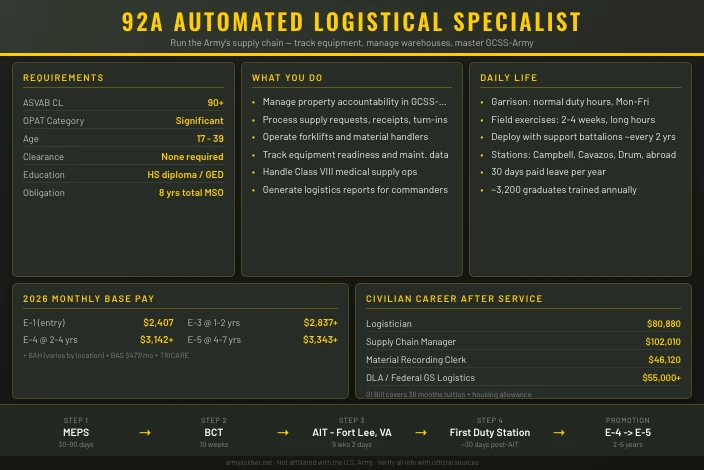
The 92A Automated Logistical Specialist performs maintenance management and warehouse operations to keep Army units supplied and combat-ready. Specialists maintain property records, track inventory, process supply requests, manage equipment accountability, and generate logistical reports that feed up the chain of command. This MOS is the primary enlisted logistics job in the Army’s Quartermaster branch (CMF 92) and exists at every echelon from company to corps.
Daily Tasks
The daily work mixes computer-based record management with hands-on warehouse operations. On a typical garrison day, a 92A might:
- Process equipment turn-ins, lateral transfers, and issue requests in GCSS-Army
- Conduct property accountability checks and reconcile discrepancies
- Manage subsistence (food) operations at ration break points
- Handle controlled substances (Class VIII medical supplies) with special documentation
- Receive and store incoming equipment, checking condition codes and documentation
- Prepare daily and weekly readiness reports for the S4 (logistics officer)
During field exercises or deployments, the pace accelerates. Supply operations don’t stop when units move. You’ll process requests in austere environments, coordinate with higher echelons for resupply, and manage property accountability for equipment that may be spread across multiple locations.
Specific Roles
The primary MOS identifier is 92A. Soldiers can add Additional Skill Identifiers (ASIs) over time that authorize specialized duties within the supply system. Common examples include hazardous materials handling and GCSS-Army super-user roles.
| Identifier | System | Purpose |
|---|---|---|
| MOS 92A | Primary | Automated logistical and supply operations |
| ASI | Additional Skill Identifier | Specialized tasks (hazmat, systems administration) |
Mission Contribution
Army readiness is measured by how much equipment is operational and available. The 92A directly owns that number. When a vehicle is deadlined awaiting parts, a 92A tracks the requisition. When ammunition needs to reach a firing range, a 92A moves it through the supply chain. When a unit deploys, a 92A accounts for every piece of equipment on the property book.
Supply specialists also manage the Army’s most expensive assets. A single combat vehicle can represent millions in government property. The 92A’s documentation work protects both the soldier and the Army from accountability failures that can end careers.
Technology and Equipment
The primary system is GCSS-Army, an SAP-based enterprise resource planning platform that manages the Army’s entire logistics enterprise. You’ll also work with:
- Standard Army property accountability software
- Automated storage and retrieval systems at larger installations
- Forklifts, pallet jacks, and material handling equipment (license required after AIT)
- Handheld scanners and barcode systems for inventory tracking
GCSS-Army experience is directly marketable. SAP is the dominant ERP platform in civilian supply chain management, and Army-trained users routinely move into consulting and systems analyst roles after service.
Salary and Benefits
Base Pay
92A is an enlisted MOS. Entry pay starts at E-1 (Private) and progresses with promotion. Most soldiers reach E-4 (Specialist) within two years. DFAS publishes the full 2026 military pay chart.
| Rank | Grade | Typical Time in Grade | Monthly Base Pay (2026) |
|---|---|---|---|
| Private | E-1 | 0-6 months | $2,407 |
| Private | E-2 | 6-12 months | $2,698 |
| Private First Class | E-3 | 1-2 years | $2,837 - $3,198 |
| Specialist | E-4 | 2-4 years | $3,142 - $3,816 |
| Sergeant | E-5 | 4-7 years | $3,343 - $4,422 |
| Staff Sergeant | E-6 | 7-12 years | $3,401 - $5,044 |
Allowances
Base pay is only part of total compensation. Active-duty soldiers also receive:
- BAS (Basic Allowance for Subsistence): $476.95/month for enlisted soldiers in 2026. This covers food costs and is paid regardless of rank.
- BAH (Basic Allowance for Housing): Varies by duty location, pay grade, and dependent status. A single E-4 at Fort Lee, Virginia receives approximately $1,200-$1,500/month. Use the DoD BAH calculator for exact figures at your duty station.
Both allowances are tax-free, which meaningfully increases take-home pay compared to an equivalent civilian salary.
Additional Benefits
Healthcare through TRICARE Prime costs active-duty soldiers nothing. No premiums, no deductibles, no copays at military treatment facilities. Coverage extends to eligible family members with a low annual out-of-pocket cap of $1,000.
Education benefits are substantial. Tuition Assistance covers up to $4,500 per year while on active duty, at $250 per semester hour. After service, the Post-9/11 GI Bill (Chapter 33) covers full in-state tuition at public universities with no dollar cap, plus a monthly housing allowance and up to $1,000 annually for books and supplies, for up to 36 months of enrollment.
Retirement under the Blended Retirement System (BRS) combines a traditional pension with Thrift Savings Plan (TSP) contributions. At 20 years of service, soldiers earn 40% of their high-36 average basic pay monthly for life. The government automatically contributes 1% of base pay to TSP starting after 60 days, and matches up to an additional 4% once you hit your third year of service.
Work-Life Balance
Soldiers earn 30 days of paid leave per year, accruing at 2.5 days per month, with up to 60 days allowed to carry over. Garrison schedules for 92A typically follow normal duty hours Monday through Friday, though field exercises and deployment rotations will extend those hours significantly. The job has lower operational tempo than combat arms, but it is still an Army job. Expect 24/7 availability during deployments.
Qualifications and Eligibility
Basic Requirements
To enlist as a 92A, you must meet standard Army enlistment criteria plus MOS-specific requirements:
| Requirement | Minimum Standard |
|---|---|
| Age | 17-39 (waiver possible to 42) |
| Citizenship | U.S. citizen or permanent resident |
| Education | High school diploma or GED |
| AFQT Score | 31 (diploma); 50 (GED) |
| ASVAB Line Score | CL: 90 (Clerical composite) |
| Security Clearance | None required (routine background check) |
| OPAT Category | Significant (Gray) |
| Vision | Correctable to 20/20 |
The CL (Clerical) composite is calculated from three ASVAB subtests: Verbal Expression (VE) + Arithmetic Reasoning (AR) + Mathematics Knowledge (MK). A score of 90 is moderately competitive but not extreme. Most candidates who score above average on the math and verbal sections of the ASVAB will qualify.
OPAT Physical Demand Category
The Occupational Physical Assessment Test (OPAT) categorizes 92A as Significant (Gray). This category requires frequent lifting of 41-99 pounds and occasional movement of loads up to 100 pounds. Warehouse operations drive this requirement: receiving and storing equipment regularly involves physically handling heavy items.
The OPAT is administered at MEPS or a recruiting station before you select your MOS. You must meet the Significant category score thresholds to be assigned 92A.
Application Process
The full process from first recruiter contact to shipping typically takes 30-90 days. Applicants with prior issues (medical, legal, or financial) may wait longer for waivers.
Service Obligation
Standard enlistment contracts run three to six years of active service. The Army’s total obligation model means you serve your active contract, then move to the Inactive Ready Reserve (IRR) to complete an eight-year military service obligation (MSO). Soldiers enter at E-1 (Private) and can earn accelerated promotion to E-2 or E-3 before shipping based on college credits, JROTC participation, or other criteria.
See our ASVAB study guide for strategies to hit these line scores, or take the PiCAT from home if you are a first-time tester.
Work Environment
Setting and Schedule
Most 92A duty time splits between two environments: the supply room and the warehouse. In garrison, you’ll work in a climate-controlled office using GCSS-Army for most of the day, with periodic trips to the warehouse or motor pool for physical inventory. The Army’s supply rooms typically operate Monday through Friday during normal duty hours, though battalion-level operations and deployments change that schedule significantly.
In the field, you’ll work wherever the unit operates: a motor pool in Germany, a forward support company in Kuwait, or a combat sustainment support battalion anywhere a major Army formation deploys. The physical environment varies from air-conditioned warehouses at large installations to bare-minimum field expedient sites with no shelter.
Chain of Command
The 92A works in a supply section led by a property book officer (Warrant Officer or Lieutenant) and a supply sergeant (E-7 or above). As an entry-level soldier, you’ll receive direct supervision and detailed task guidance. As you promote to E-5 and E-6, you’ll supervise junior soldiers and manage sections of the property book independently.
Performance feedback runs on the Army’s NCO Evaluation Report (NCOER) system for E-5 and above. Junior enlisted receive counseling through monthly written counseling statements from their immediate supervisor. Supply errors (missing equipment, incorrect documentation, or failed inventories) are highly visible and will appear in evaluations.
Team Dynamics
Supply operations are team-based. A battalion supply section might have four to eight 92As working together to manage the property book. Each soldier owns a portion of the inventory, but reconciliation is a collective effort. You’ll coordinate daily with the S4 shop, unit commanders, motor pool NCOs, and external supply support activities (SSAs).
Individual accountability is high. Every piece of equipment you sign for is your legal responsibility until it is properly transferred. This drives a culture where attention to detail is not optional. It is the job.
Retention and Satisfaction
The Army graduates roughly 3,200 92A soldiers annually, making it one of the larger MOS pipelines. Retention among supply soldiers tends to be moderate. The skills transfer well to civilian careers, which motivates some soldiers to separate after their first term, while others stay for the stability, benefits, and promotion potential into the NCO corps.
Training and Skill Development
Training Pipeline
| Phase | Location | Length | Focus |
|---|---|---|---|
| Basic Combat Training (BCT) | Various installations | 10 weeks | Soldier skills, physical fitness, weapons |
| Advanced Individual Training (AIT) | Fort Lee, Virginia | 9 weeks, 2 days | Supply operations, GCSS-Army, warehouse management |
| GTRAC Pre-training | Online (before AIT) | Self-paced | GCSS-Army fundamentals (required before arrival) |
BCT is the same for all Army enlisted soldiers. AIT begins immediately after BCT at the U.S. Army Quartermaster School at Fort Lee, Virginia.
AIT Curriculum
The 92A AIT course runs approximately 9 weeks and 2 days and covers five core areas:
Basic Supply Principles (24 hours) introduces the sustainment knowledge network, Army publications, military supply regulations, and delegation of authority documents. This phase establishes the regulatory foundation for everything else.
Plant Maintenance (109 hours) is the GCSS-Army-intensive phase. Students learn to process equipment maintenance work orders, manage readiness reporting, and work within the Army’s ERP platform for property tracking. This phase typically accounts for the largest share of AIT classroom hours.
Warehouse Operations (164.5 hours) covers the physical side of the job: receiving, issuing, storing, and turning in equipment. Students learn hazardous material handling standards, material handling equipment operation, and the Army’s storage procedures for different classes of supply.
Subsistence Operations (26.5 hours) introduces the Army Field Feeding System and ration break point operations, covering the logistics behind feeding soldiers in garrison and the field.
Class VIII Operations (20 hours) covers the identification, management, and special handling of medical supplies, including controlled substances. Compliance and documentation requirements for this supply class are stricter than other categories.
Advanced Training
Soldiers who demonstrate proficiency in GCSS-Army often serve as unit-level super users, providing informal training to fellow soldiers. Formal advanced courses through the Army Logistics University at Fort Lee include the Unit Supply Specialist Course and higher-level logistics management programs.
Promotion to Staff Sergeant (E-6) and above typically involves the Advanced Leaders Course (ALC), which covers supply management at the platoon and company level. Sergeant First Class (E-7) candidates complete the Senior Leaders Course (SLC), which prepares them for battalion-level supply operations.
Beyond internal Army training, soldiers can pursue civilian certifications while on active duty using Tuition Assistance. Credentials relevant to 92A include the Certified Supply Chain Professional (CSCP) from ASCM and related logistics certifications that map directly to GCSS-Army experience.
Everything starts with qualifying ASVAB scores — our study guide covers what to study first.
Career Progression and Advancement
Rank Progression
| Rank | Grade | Time in Service | Key Milestones |
|---|---|---|---|
| Private (PV1) | E-1 | Entry | Ship to BCT |
| Private (PV2) | E-2 | 6 months | Automatic promotion |
| Private First Class (PFC) | E-3 | 12-24 months | First performance evaluation |
| Specialist (SPC) | E-4 | 24-36 months | Qualify for Primary Leadership Development Course |
| Sergeant (SGT) | E-5 | 3-6 years | Become a team leader; NCO status |
| Staff Sergeant (SSG) | E-6 | 7-12 years | Section NCOIC; first-line supervisor |
| Sergeant First Class (SFC) | E-7 | 12-18 years | Platoon sergeant; battalion supply NCO |
| Master Sergeant (MSG) | E-8 | 18-24 years | Senior logistics NCO |
| Sergeant Major (SGM) | E-9 | 24+ years | Command Sergeant Major or logistics SGM positions |
Promotion from E-1 through E-4 is largely time-based with performance gates. From E-5 onward, promotion is competitive and requires a centralized selection board. Supply experience, NCOER ratings, and GCSS-Army proficiency all factor into promotion competitiveness.
Specialization
Beyond the base 92A MOS, experienced soldiers can pursue positions that build on supply expertise in specialized contexts:
- Training with Industry (TWI): Selected E-7 and above soldiers serve 10-12 months with civilian companies in supply chain and logistics roles, returning to the Army with private sector experience.
- Warrant Officer Path: Soldiers interested in property book operations can apply to become a 922A Property Accounting Technician (Warrant Officer), which requires a 92A background plus time in service and selection board approval.
- Officer Commissioning: Enlisted 92As can commission as officers through programs like Green to Gold, OCS, or ROTC. Logistics officers (90A) build directly on 92A experience.
Performance Evaluation
Specialists (E-4 and below) receive monthly written counseling and an annual Soldier Record Brief review. NCOs are rated annually on the NCOER, which covers character, presence, intellect, leads, develops, and achieves competencies. Supply-specific performance indicators include property accountability rates, document turn-around times, and GCSS-Army transaction accuracy.
Success in this MOS shows up in the numbers. Commanders track equipment readiness rates. A battalion with 95% equipment readiness has a good S4 shop. A unit with recurring accountability failures will reflect poorly on the supply NCO.
Physical Demands and Medical Evaluations
Army Fitness Test
All Army soldiers must pass the Army Fitness Test (AFT), which replaced the ACFT on June 1, 2025. The AFT has five events scored 0-100 each, with a maximum of 500 points. Scores are sex- and age-normed. The general standard (which applies to 92A) requires a minimum of 60 points per event and 300 total points.
| Event | Abbreviation | Description |
|---|---|---|
| 3-Rep Max Deadlift | MDL | Strength baseline |
| Hand Release Push-Up | HRP | Upper body endurance |
| Sprint-Drag-Carry | SDC | Functional fitness |
| Plank | PLK | Core stability |
| Two-Mile Run | 2MR | Aerobic capacity |
92A is not a combat specialty MOS, so the higher 350-point combat standard does not apply. Soldiers test at minimum twice per year.
Daily Physical Demands
The warehouse side of 92A involves regular lifting, carrying, and moving equipment. Expect to handle individual loads in the 40-75 pound range during receiving and storage operations. Pallet movement uses forklifts and pallet jacks, but manual handling is part of the job. The physical demand level reflects real work. This is not a purely sedentary office position.
Medical Standards
Candidates must meet Army enlistment medical standards at MEPS. Ongoing medical fitness is assessed annually as part of the Physical Health Assessment (PHA). Soldiers with profiles (medical limitations) may face restrictions on their ability to perform certain warehouse duties and could be subject to MOS reclassification if limitations are permanent.
Deployment and Duty Stations
Where 92As Serve
Supply units exist at every major Army installation. Entry-level 92As can expect assignment to:
- Combat Sustainment Support Battalions (CSSBs): The primary 92A unit type, found at installations across CONUS and overseas
- Brigade Support Battalions (BSBs): Embedded with combat brigades; higher operational tempo
- Division Sustainment Support Battalions (DSSBs): Division-level supply operations
- Combat Aviation Brigades (CABs): Aviation support units with unique supply requirements
Major installations with significant 92A populations include Fort Cavazos (TX), Fort Campbell (KY), Fort Drum (NY), Fort Stewart (GA), Fort Wainwright (AK), and overseas stations in Germany, Korea, and Japan.
Deployment Patterns
92A soldiers deploy. Supply support is needed wherever combat units operate, and every brigade-level deployment includes a support battalion. Deployment frequency depends heavily on your unit’s readiness cycle. Brigade Combat Teams often rotate on 12-month deployments every 24-36 months, though this varies significantly.
Overseas permanent change of station (PCS) assignments to Germany, Korea, Japan, or Italy are common and can last two to three years. These differ from combat deployments but still involve extended time away from home.
Assignment Preferences
Soldiers can submit a “dream sheet” listing preferred duty stations, but the Army fills positions based on needs. Performance record, time in service, and language skills (for overseas positions) all influence assignment outcomes. The Army’s assignment system generally becomes more responsive to soldier preferences as rank increases.
Risk, Safety, and Legal Considerations
Job Hazards
The primary hazards for 92A come from warehouse operations: forklift accidents, falling inventory, and handling of hazardous materials. Class IX (repair parts) and Class VIII (medical supplies) can include items requiring special handling and storage protocols. Subsistence operations involve temperature-controlled environments and food safety requirements.
Deployed 92As face the same base security risks as any soldier. Supply convoys in austere environments have historically been targeted, though 92As are not routinely assigned to convoy operations as their primary duty.
Safety Protocols
OSHA-equivalent Army safety standards apply to all warehouse operations. Forklift operator certification is required before operating material handling equipment. Hazardous materials training (HAZMAT) is a required element of AIT and must be refreshed periodically.
The Army’s physical security requirements for controlled items (weapons, controlled substances, and sensitive equipment) require strict documentation and dual-person integrity procedures that 92As learn in AIT.
Security and Legal Requirements
92A requires no security clearance at entry. The routine background check conducted at MEPS is sufficient. Soldiers working with sensitive items or systems may be required to obtain a Secret clearance over time depending on assignment.
The primary legal exposure for 92A soldiers is financial liability for missing or damaged property. The Army’s Financial Liability Investigation of Property Loss (FLIPL) process can hold soldiers personally responsible for property losses attributed to negligence. Documentation accuracy and proper hand receipts are your best protection.
Impact on Family and Personal Life
Family Considerations
The supply world offers more schedule predictability than combat arms but less than many civilians expect. Garrison schedules are fairly consistent, but field exercises run two to four weeks at a time, and deployments are a fact of Army life for any unit 92A serves in.
Military OneSource provides 24/7 support services for Army families, including counseling, childcare referrals, and financial counseling. Family Readiness Groups (FRGs) at the unit level provide peer support and communication during deployments.
Housing and Relocation
Soldiers are typically expected to PCS every two to three years. Junior enlisted soldiers without dependents often live in barracks on post, which is free. Soldiers with dependents live off-post and receive BAH. The Army’s relocation assistance programs (through ACAP and Soldier for Life) help with each move, including coordination for household goods shipment.
Frequent moves are the defining feature of Army family life. Partners who can work remotely or in portable careers adapt more easily than those tied to a single employer or location.
Reserve and National Guard
The 92A Automated Logistical Specialist is available in both the Army Reserve and Army National Guard. It is one of the most common support MOS across all Reserve components. Every brigade-level unit and most battalion-level units carry 92A positions, so billets exist in virtually every state and territory. Skill-level progression through SL4 is fully supported, and senior NCO positions are available at higher headquarters.
Drill Schedule and Training Commitment
Standard commitment is one weekend per month (Battle Assembly) plus two weeks of Annual Training per year. Drill weekends for 92A soldiers typically include GCSS-Army system training, property accountability reviews, and supply operations exercises. Annual Training often involves supporting a larger field exercise in the supply support role. Additional training days beyond the standard schedule are uncommon, though NCOs will need time for professional military education courses.
Part-Time Pay
An E-4 with over 3 years of service earns about $464 per drill weekend (4 drill periods), totaling roughly $5,572 per year from drill pay plus about $1,741 for 15 days of Annual Training. Active-duty E-4 base pay is $3,482 per month. The gap is real, but most Reserve/Guard 92A soldiers hold full-time civilian logistics or warehouse jobs that bring total income well above active-duty pay.
Benefits Differences
Tricare Reserve Select costs $57.88 per month for member-only or $286.66 per month for family coverage in 2026. Active-duty TRICARE Prime is free. TRS is still well below civilian marketplace averages for comparable coverage.
Education benefits include Federal Tuition Assistance ($250 per credit hour, up to $4,500 per year) and the Montgomery GI Bill-Selected Reserve at $493 per month for full-time students. National Guard soldiers may qualify for state tuition waivers. Mobilization of 90 or more days on Title 10 orders earns Post-9/11 GI Bill eligibility.
Reserve retirement is points-based, requiring 20 qualifying years. Collection starts at age 60, reduced by 3 months for each 90-day mobilization after January 2008, down to age 50.
Deployment and Mobilization
92A soldiers in Reserve/Guard units see moderate mobilization rates. Supply operations are needed in every deployment, and Reserve component logistics units have been activated regularly for rotations to Kuwait, Europe, and other theaters. Typical mobilizations last 9 to 12 months. Frequency is lower than combat arms or transportation MOS but consistent enough that most career 92A soldiers will experience at least one mobilization.
Civilian Career Integration
The 92A is one of the strongest Reserve/Guard MOS for civilian career overlap. GCSS-Army proficiency translates to civilian enterprise resource planning (ERP) systems like SAP and Oracle. Supply chain management, warehouse operations, inventory control, and logistics coordination are all direct career matches. Many employers actively seek candidates with military logistics experience. USERRA protects your civilian job during activations, requiring reemployment with the seniority and pay you would have earned. Health insurance continues for up to 24 months during military leave.
| Feature | Active Duty | Army Reserve | Army National Guard |
|---|---|---|---|
| Commitment | Full-time | 1 weekend/month + 2 weeks/year | 1 weekend/month + 2 weeks/year |
| Monthly Pay (E-4, 3+ yrs) | $3,482 | ~$464/drill weekend | ~$464/drill weekend |
| Healthcare | TRICARE Prime ($0) | Tricare Reserve Select ($57.88/mo) | Tricare Reserve Select ($57.88/mo) |
| Education | Federal TA, Post-9/11 GI Bill | Federal TA, MGIB-SR ($493/mo) | Federal TA, MGIB-SR, state tuition waivers |
| Deployment Tempo | Regular rotations | Moderate mobilization cycles | Moderate mobilization cycles |
| Retirement | 20-year pension at age 40+ | Points-based, collect at age 60 | Points-based, collect at age 60 |
Post-Service Opportunities
Civilian Career Translation
The skills built in 92A (GCSS-Army/SAP proficiency, property accountability, supply chain operations, warehouse management) translate directly into several high-demand civilian fields. Defense contractors, federal agencies, and large logistics companies actively recruit veterans with 92A backgrounds.
| Civilian Job Title | Median Annual Wage (May 2024) | 10-Year Outlook |
|---|---|---|
| Logistician | $80,880 | +17% (much faster than average) |
| Transportation/Storage/Distribution Manager | $102,010 | +6% (faster than average) |
| Material Recording Clerk | $46,120 | -6% (declining, but high openings) |
The Logistician role is the most direct translation of senior 92A experience. Entry-level soldiers coming out after one term often start as material recording clerks or supply chain coordinators and move up quickly with their GCSS-Army background.
The CSCP certification from ASCM and Six Sigma credentials add significant value on top of the Army experience. Many employers also recognize DD-214 service records as equivalent to several years of civilian logistics experience when evaluating supply chain candidates.
Transition Programs
The Army’s Soldier for Life Transition Assistance Program (SFL-TAP) begins preparing soldiers for transition up to two years before separation. It covers resume writing, interview preparation, federal employment applications (USAJOBS), and benefit entitlements.
The Post-9/11 GI Bill covers up to 36 months of tuition at the 100% benefit rate for eligible soldiers. At public universities, that means full in-state tuition with no dollar cap, plus a monthly housing allowance and $1,000/year for books. Private school attendance is capped at $29,920.95 per academic year (AY 2025-2026 rate).
Federal hiring preferences give veterans an advantage in government and DoD logistics positions. Many 92A veterans land GS-7 through GS-12 positions with the Defense Logistics Agency (DLA), Army Material Command (AMC), or similar agencies within months of separating.
Is This a Good Job for You?
Who Fits This MOS
The 92A attracts soldiers who are organized, detail-oriented, and comfortable working with data systems. You do not need to be a logistics expert coming in. The Army trains you. But you do need to be the kind of person who can manage competing priorities without losing track of details.
Strong candidates tend to:
- Score well on the math and verbal sections of the ASVAB
- Prefer structured work with clear accountability
- Have an interest in business systems, supply chain, or operations
- Want transferable civilian skills, not just a paycheck
- Adapt to bureaucratic processes without fighting them
The job rewards patience. Properly reconciling a property book takes methodical effort. Soldiers who need constant action or get frustrated by administrative work will find long garrison stretches difficult.
Potential Challenges
The administrative workload is real. When equipment goes missing or documentation has errors, a 92A can spend weeks untangling the problem. Financial liability investigations are stressful, and the paperwork burden in Army supply is heavy.
Deployments with support battalions can put you in relatively safe rear areas, but “relatively safe” is not “no risk.” Supply convoys and forward support operations have historically carried danger, and the Army does not offer supply-only safe deployments.
Promotion from E-5 upward becomes competitive, and soldiers who plateau at E-5 or E-6 may find their civilian skills value outpaces their military pay, creating pressure to separate before retirement eligibility.
Fit and Mismatch
This MOS is a strong match if you want skills that pay well in civilian life, a predictable garrison schedule, and a path to federal employment or defense contracting. It’s a poor fit if you want combat operations, physical outdoor work as your primary daily activity, or a job with minimal documentation responsibility.
More Information
Contact your local Army recruiter to get current enlistment bonus amounts, available contract lengths, and open 92A training seats. Bonus amounts for 92A change quarterly based on Army fill rates, so the figure your recruiter quotes is the authoritative current number. You can also visit goarmy.com to review the official MOS description before your first appointment.
- Prepare for the ASVAB with our study guide to make sure your line scores qualify
This site is not affiliated with the U.S. Army or any government agency. Verify all information with official Army sources before making enlistment or career decisions.
Explore more Army transportation and logistics careers such as 88M Motor Transport Operator and 92F Petroleum Supply Specialist.