92F Petroleum Supply Specialist
Every tank, helicopter, and generator in the Army runs on fuel. The 92F Petroleum Supply Specialist is the soldier who makes that happen – receiving, testing, storing, and pushing fuel forward to wherever the mission demands it. Without this MOS, every other Army job stops moving.
The role carries real responsibility from day one. You’ll operate million-dollar refueling systems, conduct quality tests on aviation fuel before it goes into aircraft, manage large inventories under strict accountability standards, and deploy alongside combat units to keep vehicles rolling during active operations. This isn’t a warehouse job – it’s a technical logistics role that puts you at the center of Army readiness.
Qualifying requires specific ASVAB line scores — our ASVAB study guide covers what to target and how to prepare.
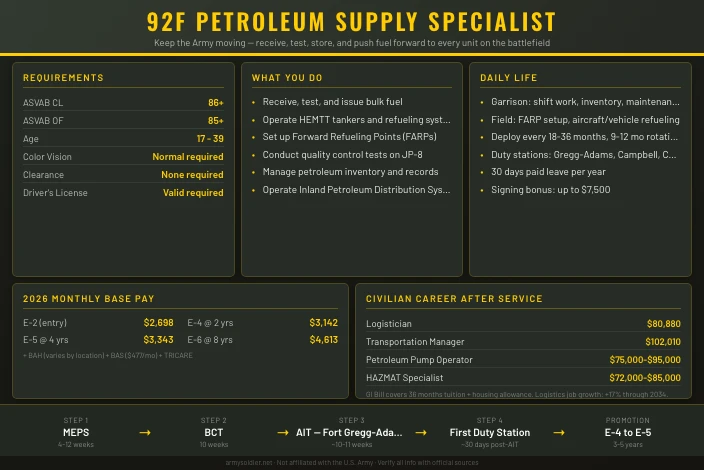
Job Role and Responsibilities
The 92F Petroleum Supply Specialist supervises and manages the reception, storage, and distribution of bulk and packaged petroleum, oils, and lubricants (POL) across the full operational spectrum. Soldiers in this MOS ensure fuel quality meets military specifications before issue, operate tactical refueling systems in support of ground and aviation units, and maintain strict accountability over all petroleum products from receipt through final disposition.
Daily Tasks
The daily rhythm depends heavily on your assignment – garrison duty looks different from a field exercise, and both look different from a deployment. In garrison, a typical day involves:
- Conducting inventories and reconciling fuel records
- Testing fuel samples for contamination, water, and specification compliance
- Performing preventive maintenance on tanker trucks, pumps, and storage equipment
- Receiving and offloading fuel deliveries from commercial or military suppliers
- Coordinating with unit motor pools on fuel requirements and scheduling
During field exercises and deployments, the pace accelerates. You’ll operate Forward Arming and Refueling Points (FARPs) and set up forward refueling points that can service helicopters and ground vehicles simultaneously. The HEMTT Tanker Aviation Refueling System (HTARS) and Advanced Aviation Forward Area Refueling System (AAFARS) are core platforms you’ll operate. You may also work with the Inland Petroleum Distribution System (IPDS), a large-scale tactical pipeline network that moves bulk fuel over long distances.
Specialized Roles Within 92F
Army MOS classification uses additional skill identifiers (ASIs) and special qualification identifiers (SQIs) to denote specialized capabilities within a primary MOS.
| Identifier | Type | Description |
|---|---|---|
| 92F | Primary MOS | Petroleum Supply Specialist (all skill levels) |
| P5 | ASI | Petroleum Laboratory Technician |
| H8 | ASI | Intermodal (Tank Container) Operations |
| F | SQI | Parachutist (Airborne qualified) |
Senior NCOs at skill level 3 (SL3) and above may serve as Quality Assurance Representatives, platoon sergeants, or petroleum supply NCOs for aviation units.
Mission Contribution
Fuel is a strategic resource. The Army classifies it as a Class III supply, and no operation runs without it. The 92F directly supports every echelon – from a rifle platoon’s vehicles to attack helicopters flying close air support. When supply chains are disrupted, the 92F soldier’s ability to improvise fuel distribution and maintain quality control under pressure becomes a decisive factor in mission success.
The role also carries environmental and safety responsibilities. Petroleum handlers manage HAZMAT under federal and Army regulations, which means a 92F mistake can have consequences beyond the battlefield.
Technology and Equipment
The equipment list for 92F is extensive and technical. You’ll work with:
- HEMTT Tanker (M978) – 2,500-gallon fuel tanker
- HTARS – aviation refueling system mounted on HEMTT chassis
- AAFARS – 600-gallon-per-minute aviation refueling system for forward operations
- IPDS – tactical pipeline system with pumps, hoses, and storage bladders
- FARE (Forward Area Refueling Equipment) – 600-gallon collapsible system
- Fuel Quality Testing Kits – for water detection, contamination, and spec verification
Salary and Benefits
Base Pay
Army base pay is set by pay grade and years of service. New 92F soldiers enter at E-1 and typically advance to E-4 within two years. All figures below are 2026 DFAS monthly rates.
| Rank | Pay Grade | Monthly Base Pay |
|---|---|---|
| Private (PV2) | E-2 | $2,698 |
| Private First Class | E-3 | $2,837 – $3,198 |
| Specialist | E-4 | $3,142 – $3,816 |
| Sergeant | E-5 | $3,343 – $4,422 |
| Staff Sergeant | E-6 | $3,401 – $5,044 |
| Sergeant First Class | E-7 | $3,932 – $5,537 |
Base pay is only part of the picture. Most soldiers also receive:
- BAH (Basic Allowance for Housing): varies by duty station and dependency status. At Fort Gregg-Adams (Petersburg, VA), an E-4 without dependents receives approximately $1,359/month based on the 2026 BAH lookup tool. Rates are higher at high-cost installations.
- BAS (Basic Allowance for Subsistence): $476.95/month flat rate for all enlisted soldiers in 2026.
- Enlistment bonus: goarmy.com lists 92F as eligible for up to a $7,500 signing bonus. Bonus amounts vary by contract length and market conditions – verify current amounts with your recruiter.
Additional Benefits
TRICARE Prime covers active-duty soldiers and their families at zero enrollment fee, zero deductible, and zero copay for in-network care. That includes medical, dental, vision, mental health, and prescriptions.
The Post-9/11 GI Bill covers full in-state tuition and mandatory fees at public universities after qualifying active service, plus a monthly housing allowance based on the E-5 BAH rate at the school’s ZIP code and up to $1,000 per year in book stipends. For private schools, the annual cap is $29,920.95 for the 2025-2026 academic year. While serving, the Army Tuition Assistance program covers up to $4,500 per year toward college credits.
Retirement under the Blended Retirement System (BRS) combines a pension at 40% of high-36 average basic pay after 20 years with a Thrift Savings Plan (TSP) that the Army matches up to 5% of basic pay. Soldiers who reach the 8-12 year mark can also receive Continuation Pay, worth up to 13x monthly basic pay in exchange for three additional years of service.
Work-Life Balance
Soldiers earn 30 days of paid leave per year, accruing at 2.5 days per month. Garrison assignments generally follow regular duty hours with on-call requirements for fuel deliveries and emergency situations. Field exercises and deployments break that routine for weeks or months at a time. The lifestyle is predictable in garrison and unpredictable on deployment – which is the Army’s general pattern across all MOS fields.
Qualifications and Eligibility
Requirements Table
| Requirement | Standard |
|---|---|
| ASVAB – Clerical (CL) | 86 minimum |
| ASVAB – Operators & Food (OF) | 85 minimum |
| AFQT (minimum enlistment) | 31 (HS diploma) / 50 (GED) |
| OPAT Category | Significant |
| Physical Profile (PULHES) | 211221 |
| Color Vision | Normal required (no deficiency) |
| Driver’s License | Valid state or territory license required |
| Security Clearance | None required |
| Citizenship | U.S. citizen or permanent resident alien |
| Age | 17-39 (waiver possible above 35) |
The CL composite is calculated from Verbal Expression + Arithmetic Reasoning + Mathematics Knowledge. The OF composite uses Verbal Expression + Numerical Operations + Auto and Shop Information + Mechanical Comprehension. Strong arithmetic and mechanical reasoning scores matter most.
The OPAT Significant category means you’ll be tested on jumping, throwing, and deadlifting ability before MOS assignment is confirmed. The Significant level requires moderately demanding physical performance – heavier than office-type work but less demanding than combat MOSs like 11B.
Application Process
Selection Criteria
92F is a moderately competitive MOS. The ASVAB thresholds are attainable for most applicants who study, and the MOS does not require a security clearance. Seat availability fluctuates based on Army manning levels – your recruiter will know current availability. A valid driver’s license is a hard requirement and must be in hand before shipping to basic training.
Waivers are available for some medical conditions and minor legal history. Age waivers above 35 are processed on a case-by-case basis. There are no waivers for color vision or the driver’s license requirement.
Service Obligation
Most enlistees commit to a 4-year active duty contract, with a 4-year inactive reserve obligation (8 years total service). Contract lengths of 3, 5, or 6 years are also available and affect bonus amounts. Officers and warrant officers in related logistics roles have separate obligations.
See our ASVAB study guide for strategies to hit these line scores, or take the PiCAT from home if you are a first-time tester.
Work Environment
Setting and Schedule
The 92F works in two distinct environments: garrison fuel points and tactical field operations. Garrison fuel operations at a motor pool involve a fixed facility with above-ground storage tanks, tanker staging areas, and a fuel point office. The work is hands-on and often dirty – expect fuel on your hands.
Field operations change everything. A FARP setup at a forward operating base might require positioning tankers, connecting pump units, establishing aircraft parking guides, and coordinating simultaneous refueling for multiple aircraft under time pressure. Weather doesn’t stop fuel operations – the Army needs fuel in rain, extreme heat, and cold.
Most fuel points operate on shift schedules to cover 24-hour readiness requirements. Shift work is common, especially at large installations with high fuel demand.
Team Dynamics
92F soldiers typically work in small teams within larger petroleum platoons. A standard fuel platoon might have 20-30 soldiers led by a lieutenant and a senior NCO. At the fuel point level, a team of 3-6 soldiers handles day-to-day operations under an E-5 or E-6 team leader. You’ll develop close working relationships with your section quickly because you depend on each other to catch errors – a contaminated fuel load that reaches an aircraft is catastrophic.
Individual accountability is a defining feature of the role. Every gallon you dispense is tracked. Discrepancies require explanation and reconciliation. The documentation burden is real, and soldiers who stay organized and detail-oriented advance faster.
Performance Evaluation
NCO Evaluation Reports (NCOERs) drive promotion decisions from E-5 upward. Evaluators assess performance against duty position standards in five areas: character, presence, intellect, leads, and develops. For 92F soldiers, technical proficiency – passing fuel quality tests, maintaining accurate records, and operating equipment without incidents – carries heavy weight in evaluations. Awards, physical fitness scores, and additional duties factor in as well.
Training and Skill Development
Training Pipeline
| Phase | Location | Length | Focus |
|---|---|---|---|
| Basic Combat Training (BCT) | Various (Fort Jackson, Fort Moore, etc.) | 10 weeks | Soldier fundamentals, rifle qualification, physical fitness |
| Advanced Individual Training (AIT) | Fort Gregg-Adams, VA | ~10-11 weeks | Petroleum fundamentals, fuel systems, quality testing, HAZMAT |
| First Duty Station | Varies | Ongoing | Unit integration, on-the-job qualification |
AIT Curriculum
The Quartermaster School’s PWED teaches 92F AIT across eight training modules:
- Basic Petroleum Fundamentals – fuel types, specifications, and chemical properties
- Quality Surveillance Procedures – lab testing, contamination identification, sampling protocols
- Petroleum Tactical Systems – AAFARS, HTARS, HEMTT tanker operations
- Survivability Training – field positioning, camouflage, force protection
- Petroleum Inventory Accounting – automated and manual accounting systems
- Mobile Petroleum Refueling Vehicles – M978 tanker operation and maintenance
- Bulk Petroleum Distribution Systems – IPDS setup, pipeline operations
- Inland Petroleum Distribution System – large-scale tactical distribution planning
The training facility at Fort Gregg-Adams includes more than 50 acres of operational equipment, storage tanks ranging from 500 to 420,000 gallons, and approximately 5.7 miles of pipeline infrastructure. Students work with live systems rather than simulators throughout most of the curriculum.
Advanced Training
After reaching E-5 (SGT), soldiers become eligible for advanced courses that expand their technical and leadership qualifications:
- Petroleum Laboratory Technician Course (ASI P5) – advanced fuel quality and testing certification
- Intermodal (Tank Container) Operations Course (ASI H8) – ISO tank container operations for strategic logistics
- Warrior Leader Course (WLC) – mandatory for promotion to E-5; covers small unit leadership
- Advanced Leader Course (ALC) – required for promotion to E-6; intensive leadership and staff skills
- Senior Leader Course (SLC) – required for promotion to E-7
Airborne-qualified 92F soldiers can attach to airborne logistics units, adding the SQI F to their record. Assignment to special operations support units, SFAB (Security Force Assistance Brigades), or Ranger battalions is possible for high-performing NCOs.
Everything starts with qualifying ASVAB scores — our study guide covers what to study first.
Career Progression and Advancement
Rank Progression
| Rank | Pay Grade | Typical Timeframe | Key Milestone |
|---|---|---|---|
| Private (PV2) | E-2 | Entry | Ship to BCT |
| Private First Class (PFC) | E-3 | 6-12 months | Complete AIT |
| Specialist (SPC) | E-4 | 18-24 months | First duty station |
| Sergeant (SGT) | E-5 | 3-5 years | WLC completion; team leader |
| Staff Sergeant (SSG) | E-6 | 6-10 years | ALC completion; section NCOIC |
| Sergeant First Class (SFC) | E-7 | 11-16 years | SLC completion; platoon sergeant |
| Master Sergeant (MSG) | E-8 | 17-22 years | Senior technical expert or First Sergeant path |
| Sergeant Major (SGM) | E-9 | 22+ years | Senior enlisted advisor |
Promotion to E-4 (SPC) is semi-automatic based on time in service. From E-5 onward, promotions are board-competitive. The CMF 92 field (Supply and Services) is moderately competitive at the mid-NCO levels – neither oversaturated nor critically undermanned, which means a consistent performer has a reasonable promotion timeline.
Role Flexibility and Transfers
92F soldiers can request lateral moves within CMF 92 to related MOS fields like 92A (Automated Logistical Specialist) or 92Y (Unit Supply Specialist) after completing re-class training. These transitions are possible between enlistment periods and sometimes during a current contract with command approval.
High-performing 92F soldiers can apply for Warrant Officer in the 920B (Property Accounting Technician) or 920A (Property Accounting Technician) warrant officer MOS fields after meeting time-in-service and experience requirements.
Succeeding in This Career
Three habits separate the soldiers who promote quickly from those who stagnate: accurate documentation, proactive maintenance, and consistent AFT performance.
Fuel accounting errors follow a soldier. One unexplained discrepancy on your record is a training moment; a pattern of discrepancies damages your NCOER and promotion potential. Learning the automated systems early – the Army’s Property Book Unit Supply Enhanced (PBUSE) and related fuel tracking software – gives you an edge.
Physical fitness matters beyond passing the AFT. The job requires lifting hoses, climbing tankers, and working in confined spaces. Soldiers who are physically capable are more useful in the field and draw better NCOER language.
Physical Demands and Medical Evaluations
Army Fitness Test Standards
The Army Fitness Test (AFT) replaced the ACFT on June 1, 2025. It has five events scored 0-100 each, with a maximum of 500 points. All soldiers must score at least 60 per event (300 total minimum). The 92F is not among the 21 designated combat MOSs that require 350 points – the standard 300-point minimum applies.
| Event | Abbreviation | What It Tests |
|---|---|---|
| 3 Repetition Maximum Deadlift | MDL | Lower body and core strength |
| Hand Release Push-Up | HRP | Upper body pushing strength |
| Sprint-Drag-Carry | SDC | Anaerobic power and muscular endurance |
| Plank | PLK | Core stability |
| Two-Mile Run | 2MR | Aerobic endurance |
Scores are sex- and age-normed. AFT administrative enforcement for active duty began January 1, 2026.
Daily Physical Demands
Beyond the AFT, 92F work is physically demanding on a daily basis. Connecting 4-inch hoses to pumps and tanks requires significant upper body strength. Fuel drums weigh 55 gallons (approximately 400 pounds full) and require mechanical assistance, but 5-gallon fuel cans are hand-carried. Tanker inspections require climbing ladders and working at height. In the field, soldiers may carry personal equipment plus specialized petroleum testing kits for miles.
The OPAT Significant category requires minimum performance in the standing long jump, seated power throw, and deadlift assessments at MEPS before MOS assignment is confirmed.
Medical Evaluations
Soldiers undergo a medical readiness assessment annually and a full periodic health assessment every 12-24 months. HAZMAT exposure – primarily petroleum vapors and benzene – is a documented occupational risk. The Army tracks petroleum handlers’ health through routine bloodwork as part of the periodic assessment. Soldiers working regularly with JP-8 aviation fuel should be aware of long-term respiratory and skin exposure risks and follow PPE protocols consistently.
Deployment and Duty Stations
Deployment Details
Fuel is a wartime requirement, which means 92F soldiers deploy. Most active-duty petroleum units follow a deployment cycle of 9-12 months deployed with 12-24 months dwell time at home station. Fuel support units have deployed to Kuwait, Iraq, Afghanistan, Poland, and Korea in recent decades. The specific deployment tempo depends on your unit – a sustainment brigade will deploy differently than a support battalion attached to an airborne division.
The Army Reserve and National Guard 92F positions typically deploy less frequently, but fuel units have been activated for extended support missions including natural disasters and overseas rotations.
Duty Stations
92F soldiers serve at installations with significant fuel infrastructure and operational units. Common duty stations include:
- Fort Gregg-Adams, VA (Quartermaster Corps home; training and sustainment units)
- Fort Campbell, KY (101st Airborne Division; aviation-heavy fuel mission)
- Fort Bragg (Fort Liberty), NC (XVIII Airborne Corps; airborne logistics)
- Fort Hood (Fort Cavazos), TX (1st Cavalry Division; large armor and aviation footprint)
- Schofield Barracks, HI (25th Infantry Division; Pacific deployment hub)
- Camp Humphreys, South Korea (USAG Humphreys; Korea rotation support)
OCONUS assignments in Germany, Italy, Japan, and Korea are available and frequently open to 92F soldiers with enough time in service.
Location Flexibility
Soldiers can submit a “dream sheet” listing preferred duty stations, and the Army fills assignments based on need and soldier preference when possible. Promotion board results sometimes come with assignment options. Soldiers with dependents have somewhat more pull when requesting assignment locations, but the Army’s needs ultimately determine where you go.
Risk, Safety, and Legal Considerations
Job Hazards
Petroleum operations carry consistent hazards. The primary risks are:
- Fire and explosion – fueling operations involve flammable vapors; static discharge and open flames are prohibited near fuel operations
- Benzene and chemical exposure – JP-8 and other military fuels contain known carcinogens requiring PPE
- Falls – tanker and storage tank inspections require climbing to heights of 10-15 feet
- Traffic – fuel points operate in high-traffic areas with large vehicles
In deployed environments, fuel storage facilities are priority targets. A fueler in a combat zone is operating in a high-consequence environment where a single mistake – a fuel fire, an aircraft fueling mishap – can have strategic consequences.
Safety Protocols
Every 92F soldier completes HAZMAT training before handling fuels. Standard operating procedures mandate grounding wires before fueling, PPE (gloves, goggles, appropriate clothing) during all fuel transfers, and fire extinguisher placement at fuel points. The Army’s petroleum safety regulations are contained in AR 750-43 and DA Pam 710-2 series. Commanders enforce fuel safety through pre-operational briefings and inspections.
Security and Legal Requirements
92F does not require a security clearance. The legal obligations are the standard Uniform Code of Military Justice (UCMJ) requirements that apply to all soldiers. Soldiers sign enlistment contracts specifying MOS, station, bonus terms, and service length – these are binding legal documents.
In deployed environments, Rules of Engagement (ROE) and theater-specific regulations govern soldier behavior. Fuelers in combat zones operate under the same legal authority as any other soldier and may be required to carry and use weapons in self-defense.
Impact on Family and Personal Life
Family Considerations
Army family life revolves around the installation and the deployment cycle. Garrison duty at major installations like Fort Campbell or Fort Cavazos puts families near military communities with on-post schools, medical facilities, family readiness groups, and recreational programs. The installation support structure is extensive.
Deployments are the biggest challenge for families. A 9-12 month absence is hard regardless of how strong the support systems are. Family Readiness Groups (FRGs) help spouses and dependents stay connected during deployments and work through administrative issues while the soldier is away.
Relocation and Flexibility
Army families relocate on average every 2-3 years through Permanent Change of Station (PCS) moves. The Army pays for the move through the Defense Personal Property Program (DP3). Frequent moves affect school continuity for children and employment stability for military spouses. The Army has programs like the Military Spouse Employment Partnership (MSEP) to help spouses find jobs in new locations, but the challenge is real and ongoing.
For single soldiers, PCS moves are more straightforward and often welcome – each new installation brings new opportunities, different units, and broader professional experience.
Reserve and National Guard
The 92F Petroleum Supply Specialist is available in both the Army Reserve and Army National Guard. Fuel support companies and quartermaster units in both components carry 92F positions. Slots are common because every large-scale unit needs fuel operations, though the total number of billets is smaller than general supply MOS like 92A or 92Y.
Drill Schedule and Training Commitment
Standard commitment is one weekend per month (Battle Assembly) plus two weeks of Annual Training per year. Drill weekends for 92F soldiers often include equipment inspections on fuel distribution systems, HAZMAT refresher training, and petroleum accountability exercises. Annual Training typically involves field operations at a Fuel System Supply Point (FSSP). You may need additional training days for HAZMAT recertification and petroleum quality surveillance refreshers, since these qualifications have annual renewal requirements.
Part-Time Pay
An E-4 with over 3 years of service earns about $464 per drill weekend (4 drill periods), totaling roughly $5,572 per year from drill pay plus about $1,741 for 15 days of Annual Training. Active-duty E-4 base pay is $3,482 per month. The part-time pay is modest, but 92F soldiers often earn more in civilian petroleum industry jobs than they would on active duty.
Benefits Differences
Tricare Reserve Select costs $57.88 per month for member-only or $286.66 per month for family coverage in 2026. Active-duty TRICARE Prime is free. TRS still compares favorably to most civilian health plans.
Education benefits include Federal Tuition Assistance ($250 per credit hour, up to $4,500 per year) and the Montgomery GI Bill-Selected Reserve at $493 per month for full-time students. Guard members may qualify for state tuition waivers. Mobilization of 90 or more days earns Post-9/11 GI Bill eligibility.
Reserve retirement is points-based, requiring 20 qualifying years. Collection starts at age 60, reduced by 3 months per 90-day mobilization after January 2008, minimum age 50.
Deployment and Mobilization
92F soldiers in Reserve/Guard units see moderate to high mobilization rates. Fuel support is a deployment essential, and petroleum units have been activated consistently for operations in the Middle East and Europe. Typical mobilizations run 9 to 12 months. Frequency is comparable to other high-demand logistics MOS.
Civilian Career Integration
The 92F pairs directly with civilian petroleum industry careers. Fuel distribution, pipeline operations, HAZMAT handling, and quality surveillance skills all transfer to jobs at refineries, fuel terminals, pipeline companies, and environmental safety firms. Civilian petroleum technicians earn competitive wages, and the HAZMAT certifications you maintain through military service are recognized by civilian employers. USERRA protects your civilian job during activations, and your employer must reinstate you with the seniority you would have earned.
| Feature | Active Duty | Army Reserve | Army National Guard |
|---|---|---|---|
| Commitment | Full-time | 1 weekend/month + 2 weeks/year | 1 weekend/month + 2 weeks/year |
| Monthly Pay (E-4, 3+ yrs) | $3,482 | ~$464/drill weekend | ~$464/drill weekend |
| Healthcare | TRICARE Prime ($0) | Tricare Reserve Select ($57.88/mo) | Tricare Reserve Select ($57.88/mo) |
| Education | Federal TA, Post-9/11 GI Bill | Federal TA, MGIB-SR ($493/mo) | Federal TA, MGIB-SR, state tuition waivers |
| Deployment Tempo | Regular rotations | Moderate-high mobilization | Moderate-high mobilization |
| Retirement | 20-year pension at age 40+ | Points-based, collect at age 60 | Points-based, collect at age 60 |
Post-Service Opportunities
Civilian Career Transition
The skills 92F soldiers develop transfer directly to civilian industries. Fuel distribution, pipeline operations, refinery work, and logistics management all value military petroleum experience. Veterans who separated as senior NCOs often move directly into supervisory or management roles.
The Army’s Transition Assistance Program (TAP) provides resume writing, interview preparation, and job placement support 180 days before separation. The Post-9/11 GI Bill covers 36 months of tuition and living expenses for veterans pursuing civilian credentials like CDL (Commercial Driver’s License) upgrades, HAZMAT endorsements, or college degrees in supply chain management.
Civilian Career Outlook
| Civilian Job Title | Median Annual Wage | Job Outlook (2024-2034) |
|---|---|---|
| Logistician | $80,880 | +17% (much faster than average) |
| Transportation, Storage & Distribution Manager | $102,010 | +6% (faster than average) |
| Petroleum Pump System Operator / Refinery Operator | $75,000-$95,000* | Stable |
| HAZMAT Specialist / Environmental Inspector | $72,000-$85,000* | Growing |
*Petroleum operator and HAZMAT specialist figures represent industry ranges; verify with BLS OES tables for current data.
Logistics is one of the stronger civilian job markets right now. The 17% projected growth for logisticians through 2034 reflects sustained demand from e-commerce, defense contracting, and supply chain restructuring. Veterans with 4-6 years of 92F experience typically enter civilian logistics roles at mid-level salaries and advance faster than civilians without military backgrounds, based on their operational experience and leadership history.
Is This a Good Job for You?
Who Fits This Role
The 92F is a good fit for someone who wants technical hands-on work within a structured logistics system, doesn’t mind getting dirty, and values the security of knowing their skills have direct civilian job value from day one.
Strong candidates typically share a few traits:
- Detail-oriented and comfortable with documentation requirements
- Mechanically inclined and comfortable operating large vehicles and industrial equipment
- Physically capable of sustained manual labor in weather extremes
- Comfortable working in environments where errors have real consequences
The job also suits soldiers who want flexibility after service. Fuel distribution, HAZMAT, and logistics management are hiring fields – the certifications and experience from 92F carry real value in the job market.
Potential Challenges
This MOS isn’t for everyone. The documentation burden is constant – every gallon is tracked, every discrepancy is investigated. Soldiers who struggle with record-keeping or who resist administrative tasks will find 92F frustrating.
Deployments to forward areas are part of the deal. A fuel specialist with a sustainment brigade or aviation support unit may spend significant time in high-tempo, austere environments. If that’s a dealbreaker, a different logistics MOS with less operational exposure might be a better fit.
Color vision deficiency is an automatic disqualifier with no waiver path. Anyone with known color blindness should not plan on 92F.
The shift schedule in garrison can affect quality of life. Fuel operations don’t stop at 5 PM, so late shifts and weekend rotations are common at high-tempo installations.
Long-Term Fit
Soldiers who stay in 92F long-term generally do so because the technical depth grows with experience. At the senior NCO level, you’re managing multi-million-dollar fuel operations, advising commanders on distribution planning, and mentoring junior soldiers. That’s a meaningful career arc. But it requires patience – the first two years are repetitive work that builds the foundation. Soldiers who want rapid variety in daily tasks may find the garrison routine slower than expected.
More Information
Talk to an Army recruiter to confirm current bonus amounts, available MOS seats, and contract options for 92F. Bonus figures and seat availability change frequently, and a recruiter can give you the most current picture. You can also explore goarmy.com for an overview or call 1-888-550-ARMY to connect with a local office.
- Prepare for the ASVAB with our study guide to make sure your line scores qualify
This site is not affiliated with the U.S. Army or any government agency. Verify all information with official Army sources before making enlistment or career decisions.
Explore more Army transportation and logistics careers such as 88M Motor Transport Operator and 92A Automated Logistical Specialist.