92G Culinary Specialist
The Army runs on food. Every forward operating base, garrison dining facility, and field kitchen depends on Soldiers who know how to cook at scale, keep supply chains running, and put hot meals on the table under pressure. The 92G Culinary Specialist makes that happen.
This isn’t a civilian kitchen job with a uniform. A 92G manages food operations for hundreds of Soldiers at a time, operates mobile kitchen equipment in the field, and may deploy anywhere the Army sends a unit. The work is physical, the hours are long, and the stakes are real. In return, you pick up culinary credentials recognized by the American Culinary Federation, a skillset with clear civilian demand, and pay that starts the day you arrive at Basic Combat Training.
If you want to cook professionally and build a career, the Army will pay you to learn.
Qualifying requires specific ASVAB line scores — our ASVAB study guide covers what to target and how to prepare.
Job Role and Responsibilities
The 92G Culinary Specialist is responsible for all food service operations at Army installations and in the field, including meal preparation, inventory management, kitchen equipment operation, and compliance with food safety standards. This MOS supports unit readiness by ensuring Soldiers receive nutritious meals in garrison and during deployments.
Daily Tasks
A typical garrison day includes running breakfast service, checking food storage temperatures, managing inventory against requisition orders, and coordinating with the dining facility manager on menu planning. Field days look different: pulling Mobile Kitchen Trailer (MKT) equipment out of storage, setting up a field kitchen, and feeding a company in conditions that range from comfortable to miserable.
Specific responsibilities include:
- Planning menus with attention to nutrition requirements and caloric standards
- Ordering, receiving, and inspecting food supplies and verifying quality
- Preparing food using a range of techniques including sauteing, roasting, baking, and grilling
- Operating the Army Field Feeding System (AFFS) and MKT during field exercises and deployments
- Training junior Soldiers on kitchen equipment, food safety procedures, and sanitation standards
- Maintaining kitchen equipment and performing preventive maintenance checks
- Ensuring compliance with DA food safety regulations and health standards
Specialized Roles and Identifiers
The Army uses a Military Occupational Specialty (MOS) code for enlisted primary classification. The 92G is the primary code. As Soldiers advance in rank, their MOSC (MOS Code) reflects their skill level:
| Code | Skill Level | Grade | Title |
|---|---|---|---|
| 92G1O | Skill Level 1 | E-1 to E-4 | Culinary Specialist |
| 92G2O | Skill Level 2 | E-5 | Food Service Sergeant |
| 92G3O | Skill Level 3 | E-6 | Culinary Operations Sergeant |
| 92G4O | Skill Level 4 | E-7 | Food Operations Manager |
| 92G5O | Skill Level 5 | E-8/E-9 | Senior Food Operations Sergeant |
Additional Skill Identifiers (ASIs) can be added over a career for qualifications in areas like Master Fitness Trainer or specific food service management courses. Consult DA Pam 611-21 for a current list of authorized ASIs for this MOS.
Mission Contribution
Food service is a combat multiplier. Research consistently links adequate nutrition to unit performance, cognitive function, and injury prevention. A well-run dining facility is not just a convenience – it directly affects training outcomes and mission readiness. In deployed environments, the 92G is often the Soldier ensuring that forces eating MREs get hot meals during resupply windows, and that food safety does not become a health crisis in austere conditions.
Technology and Equipment
The primary piece of field equipment is the Mobile Kitchen Trailer (MKT), a trailer-mounted kitchen capable of serving 250-800 Soldiers per day. 92Gs also operate the Assault Kitchen, the Kitchen Company Level Field Feeding (KCLFF) system, and standard commercial kitchen equipment in garrison facilities. Modern dining facilities use automated inventory software for supply tracking and ordering, so familiarity with basic software systems is part of the job.
Salary and Benefits
Base Pay
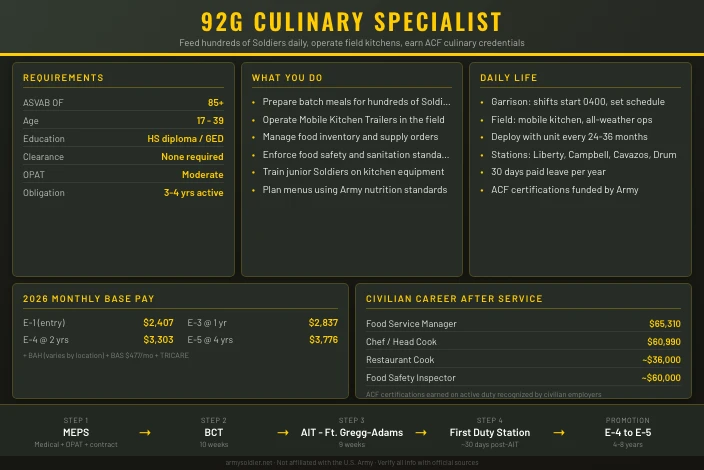
All Army pay scales are sourced from DFAS 2026 pay tables. The 92G enters service at E-1 and typically reaches E-4 within two years.
| Grade | Rank | Time in Service | Monthly Basic Pay |
|---|---|---|---|
| E-1 | Private (PV1) | Entry | $2,407 |
| E-2 | Private (PV2) | 6 months | $2,698 |
| E-3 | Private First Class (PFC) | 1 year | $2,837 |
| E-4 | Specialist (SPC) | 2 years | $3,303 |
| E-5 | Sergeant (SGT) | 4-6 years | $3,776 |
| E-6 | Staff Sergeant (SSG) | 8 years | $4,613 |
| E-7 | Sergeant First Class (SFC) | 12 years | $5,537 |
Basic pay is only part of total compensation. Most Soldiers living off-post receive Basic Allowance for Housing (BAH), which varies by location and dependency status. At Fort Gregg-Adams, an E-4 without dependents receives approximately $1,400/month in BAH; rates at high-cost locations exceed $2,000. The Basic Allowance for Subsistence (BAS) adds $476.95/month for all enlisted Soldiers, flat regardless of location.
Additional Benefits
Healthcare through TRICARE Prime covers the Soldier and eligible family members at no enrollment cost, no deductibles, and no copays for on-base care. The Army also covers dental and vision.
Education benefits include:
- Tuition Assistance (TA): Up to $4,500/year for on-duty college coursework, covering up to $250 per semester credit hour
- Post-9/11 GI Bill: After leaving service, covers full in-state tuition at public universities plus a monthly housing allowance and up to $1,000/year for books (36 months total)
- Credentialing Assistance: Funded professional certifications including American Culinary Federation credentials
Retirement and Work-Life Balance
The Blended Retirement System (BRS) combines a 20-year pension worth 40% of your high-36 average basic pay with a Thrift Savings Plan (TSP) that receives automatic 1% government contributions and matching up to 4% of basic pay after year two.
Soldiers earn 30 days of paid leave per year, accruing at 2.5 days per month. Dining facilities generally operate on set shift schedules in garrison, which gives 92Gs more schedule predictability than many combat support MOSs. Field exercises and deployments break that rhythm, but the baseline workweek in garrison is structured.
Qualifications and Eligibility
Basic Qualifications Table
| Requirement | Standard |
|---|---|
| ASVAB Line Score | OF: 85 minimum |
| Age | 17-39 |
| Citizenship | U.S. citizen or permanent resident alien |
| Education | High school diploma or GED |
| AFQT Minimum | 31 (HS diploma), 50 (GED) |
| Security Clearance | None required |
| OPAT Category | Moderate |
| Physical Profile | PULHES 111221 or better |
The OF (Operators and Food) composite is calculated from four ASVAB subtests: Verbal Expression + Numerical Operations + Auto and Shop Information + Mechanical Comprehension. An OF score of 85 puts this MOS within reach of most applicants who spend time studying. The math and mechanical sections are the ones that trip people up, so focus your prep there.
Application Process
Selection Criteria
The 92G is not a highly competitive MOS with a waiting list, but seats fill. Soldiers who arrive with Food Handler certifications or culinary coursework from high school or community college stand out during the process, though neither is required. A clean background and a qualifying ASVAB score are the primary gates.
Service Obligation
Most 92G contracts run three to four years for active duty. The total military service obligation (MSO) is eight years – active service plus reserve or inactive ready reserve time. Some contracts include an enlistment bonus or incentive that comes with a longer active commitment; discuss options with your recruiter.
Soldiers enter service as Private (E-1) or Private (E-2) depending on whether they completed college credits, JROTC, or Boy Scouts Eagle Scout rank before enlisting.
See our ASVAB study guide for strategies to hit these line scores, or take the PiCAT from home if you are a first-time tester.
Work Environment
Setting and Schedule
The 92G spends most garrison time in a commercial-grade kitchen environment: stainless steel, industrial equipment, high heat, and constant movement. Dining facilities at major installations serve thousands of Soldiers daily across multiple meal periods, so the work is team-oriented and physically demanding in the same way any professional kitchen is.
Shifts rotate across breakfast, lunch, and dinner service. Early mornings are standard – breakfast prep often starts around 0400. Field exercises push 92Gs outdoors with mobile kitchen setups, sometimes for weeks at a time. Deployments mean operating in austere environments with limited equipment and variable supply chains.
Leadership and Communication
92Gs work within the Quartermaster corps chain of command but coordinate daily with unit S4 (logistics) staff and dining facility managers. Performance feedback comes through the Army’s NCOER (NCO Evaluation Report) system for sergeants and above, and the AEVAL process for junior enlisted. Evaluations are annual and are the primary driver of promotion consideration.
Team Dynamics and Autonomy
At junior grades, a 92G works as part of a food service team under close NCO supervision. By E-5, you’re leading a section and making decisions on menu adaptation, supply ordering, and kitchen operations with minimal oversight. Senior NCOs at E-7 and above run entire dining facilities or food service operations for a battalion.
Job Satisfaction
The 92G community is tight-knit. Soldiers who thrive in this MOS tend to take genuine pride in the quality of food they put out, and the feedback loop is immediate – if the chow is good, Soldiers tell you. The grind of early shifts and field exercise kitchens can wear on people, but retention among 92Gs who reach E-5 is generally solid because the civilian career path is clear and the skills transfer directly.
Training and Skill Development
Training Pipeline Table
| Phase | Location | Length | Focus |
|---|---|---|---|
| Basic Combat Training (BCT) | Various installations | 10 weeks | Soldierization, weapons, tactics |
| Advanced Individual Training (AIT) | Fort Gregg-Adams, VA | 9 weeks | Culinary skills, field feeding, food service management |
| First Duty Station | Per assignment | Ongoing | On-the-job proficiency |
BCT is the same for every Army enlisted Soldier: physical conditioning, land navigation, weapons qualification, and Army values. After graduation, 92Gs travel to Fort Gregg-Adams, Virginia, home of the Joint Culinary Center of Excellence (JCOE). This is one of the most specialized initial training programs in the Army – no other branch runs a dedicated culinary training center at this scale.
AIT at Fort Gregg-Adams
The 9-week AIT covers:
- Army food service regulations and standards
- Large-scale cooking techniques: batch cooking, institutional preparation
- Nutrition planning and menu development for military populations
- Food safety, HACCP principles, and sanitation inspection procedures
- Mobile Kitchen Trailer (MKT) operation and preventive maintenance
- Field feeding operations and Army Field Feeding System procedures
- Inventory management, requisitioning, and food accountability
Advanced Training and Certifications
After AIT, 92Gs can pursue credentialing through the Army COOL (Credentialing Opportunities On-Line) program, which funds professional certifications at no cost to the Soldier. Available credentials include:
- Certified Culinarian (CC) – American Culinary Federation entry-level professional certification
- Certified Sous Chef (CSC) – mid-career ACF certification
- ServSafe Food Handler and Manager certifications
- Certified Food and Beverage Executive (CFBE)
The Quartermaster School also offers advanced courses in culinary arts, food service management, and field feeding operations as Soldiers progress through the NCO ranks. Credentialing Assistance funding covers exam fees and training costs for approved certifications.
Everything starts with qualifying ASVAB scores — our study guide covers what to study first.
Career Progression and Advancement
Rank Progression Table
| Grade | Rank | Typical Time in Grade | Role |
|---|---|---|---|
| E-1 | Private (PV1) | 0-6 months | Student/trainee |
| E-2 | Private (PV2) | 6-12 months | Junior cook |
| E-3 | Private First Class (PFC) | 1-2 years | Line cook |
| E-4 | Specialist (SPC) | 2-4 years | Senior cook, section lead |
| E-5 | Sergeant (SGT) | 4-8 years | Food service team leader |
| E-6 | Staff Sergeant (SSG) | 8-12 years | Dining facility section NCOIC |
| E-7 | Sergeant First Class (SFC) | 12-18 years | Dining facility NCOIC / Platoon Sergeant |
| E-8 | Master Sergeant (MSG) | 18-24 years | Food service operations manager |
| E-9 | Sergeant Major (SGM) | 22+ years | Senior food advisor, Army level |
Promotion to E-4 is semi-automatic based on time in service and completion of basic requirements. E-5 and above require a promotion board, demonstrated leadership, and a competitive promotion point score. Soldiers who pursue ACF certifications, complete military education courses, and take on additional duties build the strongest promotion packets.
Role Flexibility and Transfers
The 92G is classified under the Quartermaster branch. Soldiers interested in broader logistics can cross-train into related MOSs such as 92A (Automated Logistical Specialist) or 92F (Petroleum Supply Specialist) through a reclassification process, which requires approval from the gaining unit and Human Resources Command. Reclass is most accessible after completing your initial service obligation.
Warrant Officer opportunities exist in the Quartermaster branch via 920A (Property Accounting Technician) and 920B (Supply Systems Technician) paths, though these are not direct extensions of the 92G enlisted track. Competitive candidates with logistics experience and a college degree can apply.
Performance Evaluation
Enlisted Soldiers below E-5 are evaluated through the Army Enlisted Record Brief (ERB) and counseling sessions with their chain of command. Sergeants and above receive annual NCO Evaluation Reports (NCOERs), which assess mission accomplishment, individual values, and leadership. Senior NCOs (E-8/E-9) receive equivalent Evaluation Report assessments.
The keys to advancing in this MOS are the same as in any Quartermaster role: food quality and readiness metrics, inspection scores, professional military education (PME) completion, and demonstrated ability to train junior Soldiers.
Physical Demands and Medical Evaluations
Physical Requirements
The 92G is a Moderate OPAT category MOS, reflecting the physical demands of kitchen work – lifting containers and equipment up to 40 pounds, standing for extended periods, and working in hot environments. It is not classified as a combat specialty requiring the elevated 350-point AFT standard.
All Army Soldiers must pass the Army Fitness Test (AFT), which replaced the ACFT on June 1, 2025. The AFT has five events scored 0-100 points each, with a 300-point minimum (60 points per event) to pass. Scores are sex- and age-normed.
AFT Events
| Event | Abbreviation | Description |
|---|---|---|
| 3 Rep Max Deadlift | MDL | Measures lower body strength |
| Hand Release Push-Up | HRP | Measures upper body endurance |
| Sprint-Drag-Carry | SDC | Measures anaerobic capacity |
| Plank | PLK | Measures core endurance |
| Two-Mile Run | 2MR | Measures aerobic endurance |
The AFT is administered twice per year. Failure to pass can result in flagging (suspension of favorable personnel actions), which halts promotions, bonuses, and awards until the deficiency is corrected.
Daily Physical Demands
On a kitchen shift, a 92G typically:
- Stands for 4-8 hours on hard surfaces
- Lifts and carries cases of food product (typically 20-50 lbs)
- Works in hot, humid environments with commercial equipment
- Performs rapid movement between workstations during meal service
Field operations add physical demands: loading and unloading MKT equipment, setting up field kitchens in all weather conditions, and sometimes humping gear over distance to establish a field feeding site.
Medical Evaluations
Initial medical screening occurs at MEPS. Ongoing medical evaluations include annual Soldier Readiness Processing (SRP) checks and periodic physical examinations. The 92G does not require vision or hearing standards beyond the general Army PULHES profile. Food handlers must maintain current Food Handler certifications per installation policies.
Deployment and Duty Stations
Deployment Details
The 92G deploys with their unit, not as a standalone asset. Deployment frequency depends entirely on the unit assignment – a 92G assigned to a combat brigade will deploy more often than one assigned to a training base. Typical deployment cycles for Army active component units run every 24-36 months, with deployments lasting 9-12 months. Some units operate on steady-state rotations with shorter, more frequent deployments.
In deployed environments, 92Gs operate under contingency dining standards – field feeding systems, consolidated feeding, and MRE distribution when hot meals aren’t feasible. Food safety in a deployed environment is critical; a foodborne illness outbreak can non-combat incapacitate a unit.
Duty Stations
92Gs serve at installations wherever the Army has a presence. Common duty stations include:
- Fort Liberty, NC (82nd Airborne Division, XVIII Airborne Corps)
- Fort Campbell, KY (101st Airborne Division)
- Fort Moore, GA (Maneuver Center of Excellence)
- Fort Cavazos, TX (1st Cavalry Division)
- Fort Drum, NY (10th Mountain Division)
- Germany (USAREUR-AF) – Grafenwoehr, Wiesbaden, Vilseck
Duty station preferences can be listed at MEPS, but assignment is based on Army needs. First-term Soldiers have limited influence over their initial assignment; follow-on assignments allow more input through the assignment preference system.
Risk, Safety, and Legal Considerations
Job Hazards
Kitchen environments carry specific risks: burns from hot equipment and liquids, cuts from knives and slicers, slips and falls on wet surfaces, and heat exhaustion during sustained operations. Field feeding adds weather exposure and the physical risks of moving equipment in operational environments.
The Army Food Safety Program governs all food handling. Violations of food safety standards can result in health hazards at scale – a contamination incident in a dining facility serving 1,000 Soldiers a day is a serious event.
Safety Protocols
Installation dining facilities operate under Army Regulation 30-22 (Army Food Program) and comply with FDA Food Code standards adapted for military operations. 92Gs receive formal food safety training in AIT and are required to maintain ServSafe certification throughout their careers. Personal protective equipment – cut-resistant gloves, slip-resistant footwear, and heat protection – is standard issue in Army kitchens.
Security and Legal Requirements
The 92G MOS does not require a security clearance. The standard Army enlistment contract binds Soldiers to the Uniform Code of Military Justice (UCMJ) for the duration of active service. Deployments to combat zones are determined by operational requirements, not MOS; a 92G can and does deploy to austere and hazardous locations.
Impact on Family and Personal Life
Family Considerations
Kitchen shift work creates a predictable schedule in garrison, which many families prefer over unpredictable operational schedules. Early morning start times (0400-0600) can be a strain, but the schedule resets daily rather than running on extended operations tempo. Family Readiness Groups (FRGs) and Military OneSource provide support services during deployments and transitions.
Families have access to the same TRICARE Prime healthcare coverage as the Soldier at no additional cost. On-post housing is available at most major installations, though wait lists vary. BAH at the with-dependents rate covers competitive off-post rentals at most duty stations.
Relocation and Flexibility
Army Soldiers receive Permanent Change of Station (PCS) moves approximately every 2-3 years. The Army covers most moving costs through the Personally Procured Move (PPM) program or direct Transportation Management Office shipment. Frequent moves are a reality of Army service regardless of MOS, and families should plan for school transitions and spouse career disruption as part of the lifestyle.
Reserve and National Guard
The 92G Culinary Specialist is available in both the Army Reserve and Army National Guard. Dining facility operations exist at virtually every installation, and field feeding teams deploy with every major unit, so 92G positions are common across both components. Most Reserve/Guard battalions have at least one 92G slot in their headquarters company.
Drill Schedule and Training Commitment
Standard commitment is one weekend per month (Battle Assembly) plus two weeks of Annual Training per year. Drill weekends for 92G soldiers may include food preparation for unit meals, field kitchen setup, and food safety recertification. Annual Training usually involves running a field feeding operation during a larger exercise. The training commitment is fairly standard, though you will need to maintain food handler certifications and may have additional sanitation training days.
Part-Time Pay
An E-4 with over 3 years of service earns about $464 per drill weekend (4 drill periods), totaling roughly $5,572 per year from drill pay plus about $1,741 for 15 days of Annual Training. Active-duty E-4 base pay is $3,482 per month. Many Reserve/Guard 92G soldiers work in civilian food service during the week, where experienced cooks and food service managers can earn more than active-duty base pay.
Benefits Differences
Tricare Reserve Select costs $57.88 per month for member-only or $286.66 per month for family coverage in 2026. Active-duty TRICARE Prime is free. TRS is a significant benefit for food service workers, who often lack employer-sponsored health insurance in the civilian sector.
Education benefits include Federal Tuition Assistance ($250 per credit hour, up to $4,500 per year) and the Montgomery GI Bill-Selected Reserve at $493 per month for full-time students. Guard members may qualify for state tuition waivers. Mobilization of 90 or more days on Title 10 orders earns Post-9/11 GI Bill eligibility.
Reserve retirement is points-based, requiring 20 qualifying years. Collection starts at age 60, reduced by 3 months per 90-day mobilization after January 2008, minimum age 50.
Deployment and Mobilization
92G soldiers in Reserve/Guard units see moderate mobilization rates. Every deployed unit needs food service, and culinary specialists have been activated for rotations to Kuwait, Europe, and domestic disaster relief operations. Typical mobilizations last 9 to 12 months. National Guard 92G soldiers also get activated for state emergencies like hurricanes and floods, where field feeding is a critical capability.
Civilian Career Integration
The 92G transfers directly to civilian food service careers. Restaurant management, institutional food service, catering, hotel kitchens, and school food programs are all matches. Military food safety certifications (ServSafe and equivalent) are recognized by civilian employers. The food service industry has consistently high demand for experienced cooks and managers. USERRA protects your civilian food service job during mobilizations, requiring reemployment with the same pay and seniority you would have earned.
| Feature | Active Duty | Army Reserve | Army National Guard |
|---|---|---|---|
| Commitment | Full-time | 1 weekend/month + 2 weeks/year | 1 weekend/month + 2 weeks/year |
| Monthly Pay (E-4, 3+ yrs) | $3,482 | ~$464/drill weekend | ~$464/drill weekend |
| Healthcare | TRICARE Prime ($0) | Tricare Reserve Select ($57.88/mo) | Tricare Reserve Select ($57.88/mo) |
| Education | Federal TA, Post-9/11 GI Bill | Federal TA, MGIB-SR ($493/mo) | Federal TA, MGIB-SR, state tuition waivers |
| Deployment Tempo | Regular rotations | Moderate + state missions | Moderate + state missions |
| Retirement | 20-year pension at age 40+ | Points-based, collect at age 60 | Points-based, collect at age 60 |
Post-Service Opportunities
Transition to Civilian Life
The 92G builds a direct, verifiable skillset with strong civilian demand. A Soldier leaving after four years has large-scale cooking experience, food safety certifications, inventory management experience, and potentially ACF professional credentials. These translate into immediate employment in commercial food service, hospital food service, hotel operations, and food manufacturing quality control.
The Army’s Transition Assistance Program (TAP) provides employment counseling, resume writing support, and job placement resources. The SkillBridge program allows Soldiers to do internships with civilian employers in the final 180 days of service, including food service companies.
Civilian Career Table
| Civilian Job Title | Median Annual Salary | Job Outlook (2024-2034) |
|---|---|---|
| Food Service Manager | $65,310 | +6% (faster than average) |
| Chef / Head Cook | $60,990 | +7% (much faster than average) |
| Restaurant Cook | ~$36,000 | +5% (faster than average) |
| Food Safety Inspector | ~$55,000-$70,000 | Varies by agency |
Salary data from the Bureau of Labor Statistics Occupational Outlook Handbook (May 2024). Food Safety Inspector figures vary by employer and jurisdiction.
Education After Service
The Post-9/11 GI Bill covers 36 months of college tuition at no cost for qualifying veterans. Culinary arts programs, hospitality management degrees, and food science degrees all align with the 92G skillset. Veterans with ACF certifications can often receive college credit for prior learning, shortening the time and cost to a degree.
Is This a Good Job for You? The Right (and Wrong) Fit
Ideal Candidate Profile
This MOS fits people who genuinely enjoy cooking and food, can work well on a team under time pressure, and don’t mind early mornings. The job rewards attention to detail – food safety is not something you can cut corners on – and people who take pride in their craft tend to thrive.
Strong candidates also have:
- Comfort with physical work in hot environments
- Organizational skills for inventory and supply tracking
- Patience for repetitive tasks done to a consistent standard
- Interest in professional culinary development
Potential Challenges
Early shift times are non-negotiable. Breakfast prep means arriving before most of the installation is awake, and this schedule does not change regardless of what happened the night before. Field exercises pull 92Gs away from comfortable kitchens and put them in conditions where producing a quality meal takes real problem-solving.
People who want varied, unpredictable work will find garrison dining facility operations repetitive. The daily rhythm of prep, service, cleanup, and repeat can feel monotonous after years. Those who find meaning in feeding people well and building a craft tend to stay engaged; those who want daily variety often reclassify by mid-career.
Deployment is also a real factor. A 92G assigned to a deployable unit will spend time away from home in austere conditions. The food service mission does not stop because the environment is difficult.
Who This Role Fits
If you want culinary training that civilian cooking schools charge tens of thousands of dollars for – paid for entirely by the Army – and you can handle shift work and military structure, the 92G path makes sense. It’s a direct pipeline from Army kitchen to civilian food service management, backed by ACF credentials that employers recognize.
People who struggle with early mornings, structured environments, or repetitive routines should look at other MOSs before committing.
More Information
Talk to an Army recruiter to get current bonus offers, available contract lengths, and confirmed MOS seat availability for 92G. Recruiters can also walk you through the ASVAB testing process and what to expect at MEPS. Find your nearest recruiter at goarmy.com.
- Prepare for the ASVAB with our study guide to make sure your line scores qualify
This site is not affiliated with the U.S. Army or any government agency. Verify all information with official Army sources before making enlistment or career decisions.
Explore more Army transportation and logistics careers such as 88M Motor Transport Operator and 92A Automated Logistical Specialist.