92M Mortuary Affairs Specialist
The 92M Mortuary Affairs Specialist does work that most people never want to think about and that the Army cannot operate without. When Soldiers die in service, the Army’s commitment to returning them to their families with full military honors depends entirely on this MOS. It requires composure under the worst circumstances, methodical precision, and genuine respect for those in your care. The people who do this job well describe it as the most meaningful work they’ve done.
Qualifying requires specific ASVAB line scores — our ASVAB study guide covers what to target and how to prepare.
Job Role and Responsibilities
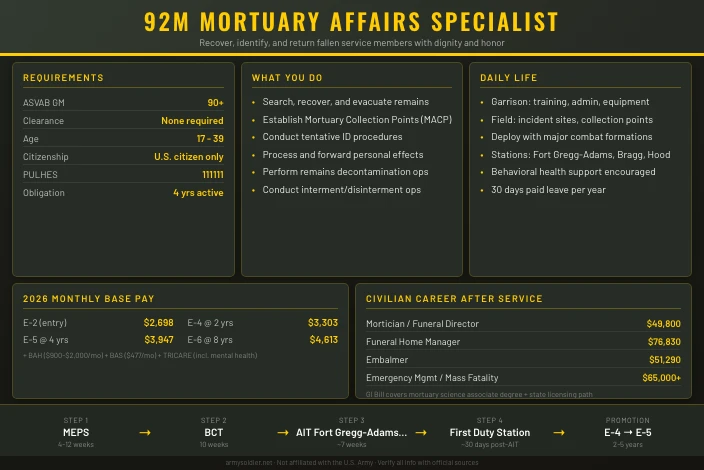
The 92M Mortuary Affairs Specialist searches for, recovers, evacuates, tentatively identifies, and processes the remains and personal effects of deceased military personnel. These Soldiers establish and operate mortuary affairs collection points, theater mortuary evacuation points, and personal effects depots, ensuring that every fallen service member is treated with dignity and returned to their family.
Daily Tasks
In garrison, the job is mostly administrative and training-focused. You maintain procedures, conduct training exercises on collection and identification techniques, manage equipment, and stay current on Army mortuary affairs regulations and policies.
During operations or exercises, the work becomes operational. You conduct searches of incident sites, recover and properly package remains, complete identification worksheets, and coordinate evacuation to theater mortuary facilities. Tentative identification uses fingerprints, dental records, and personal effects alongside military documentation. The 92M does not make final identifications, but the quality of their documentation directly supports the forensic process.
Personal effects management is a parallel responsibility. The belongings of fallen Soldiers are inventoried, secured, and forwarded to the appropriate depot for eventual return to families.
Specific Roles
| Identifier | Type | Description |
|---|---|---|
| 92M | Primary MOS | Mortuary Affairs Specialist |
| ASIs | Additional Skill Identifiers | Awarded for specialized capabilities |
Mission Contribution
The Geneva Conventions require proper recovery and treatment of battlefield casualties. Beyond legal obligation, the Army’s commitment to its Soldiers and their families requires that no one be left behind. The 92M carries that commitment into practice. Their work also supports the legal and administrative processes that allow families to receive benefits and burial honors.
Technology and Equipment
The Army is modernizing mortuary affairs capabilities for large-scale combat operations. Training now incorporates digital fingerprinting equipment and dental X-ray systems to improve the identification process. You use military mapping tools for incident site navigation, standardized remains pouches and transfer cases, personal effects bags, and the documentation systems that feed the Army’s human remains tracking process.
Salary and Benefits
All pay figures are 2026 rates from DFAS.
| Rank | Grade | Monthly Base Pay (entry) |
|---|---|---|
| Private (PV2) | E-2 | $2,698 |
| Private First Class | E-3 | $2,837 |
| Specialist | E-4 | $3,142 |
| Sergeant | E-5 | $3,343 |
| Staff Sergeant | E-6 | $3,401 |
BAS is $476.95 monthly for all enlisted Soldiers. BAH varies by duty station. At Fort Gregg-Adams, Virginia, a single E-4 can expect roughly $1,200 to $1,500 per month in BAH.
No enlistment bonus is currently associated with 92M. Verify with your recruiter, as incentives change with Army recruiting needs.
Additional Benefits
TRICARE Prime covers medical, dental, vision, and mental health services for you and your family at no cost. Mental health support is particularly relevant in this MOS given the emotional weight of the work. The Army provides access to behavioral health professionals through military treatment facilities and Military OneSource.
Tuition Assistance funds up to $4,500 per year for college courses while you serve. The Post-9/11 GI Bill provides 36 months of in-state tuition plus a housing allowance after separation, directly supporting mortuary science degree completion.
The Blended Retirement System (BRS) pays 40% of your high-36 average basic pay at 20 years, with TSP matching contributions beginning in year three of service.
Work-Life Balance
Soldiers receive 30 days of paid leave per year. Garrison schedules for mortuary affairs units follow standard Army duty hours. Operational tempo increases significantly during training exercises and deployments.
Qualifications and Eligibility
| Requirement | Standard |
|---|---|
| ASVAB Line Score | GM: 90 |
| Citizenship | U.S. citizen |
| Age | 17-39 |
| Education | High school diploma or GED |
| Security Clearance | None required |
| Physical Profile | PULHES 111111 or better |
The GM (General Maintenance) composite is General Science + Auto and Shop Information + Mathematics Knowledge + Electronics Information. A score of 90 reflects a general technical aptitude requirement rather than a specific science or mechanical focus.
Application Process
You enlist through MEPS, complete the ASVAB, and select the MOS based on your GM score and available training seats. No clearance investigation is required. The recruiter will discuss the nature of the work with you during the selection process; understanding what you’re signing up for is important.
Selection Criteria
Beyond the ASVAB score, recruiters and Army trainers look for emotional maturity and stability. This is not an MOS for Soldiers who haven’t considered the psychological dimensions of the work. Applicants should be honest with themselves and their recruiters about their ability to handle regular exposure to human remains in operational conditions.
Service Obligation
Standard four-year active duty enlistment. Entry grade is E-1 or E-2 based on education credits or JROTC participation.
See our ASVAB study guide for strategies to hit these line scores, or take the PiCAT from home if you are a first-time tester.
Work Environment
Setting and Schedule
In garrison, your work environment is largely administrative: offices, equipment storage, and training areas. In operational environments, you work at incident sites, collection points, and mortuary facilities. The work happens in whatever conditions the operational environment presents, including combat zones.
The emotional environment is the defining characteristic of this job. You develop professional distance through training and experience, but the work involves regular contact with human remains and personal effects. The Army recognizes this and provides behavioral health resources specifically for mortuary affairs personnel.
Leadership and Communication
Mortuary affairs units are small and tight-knit by necessity. You work in a Joint Mortuary Affairs Department (JMAD) or similar unit under Quartermaster command. Senior NCOs in this MOS lead through example and provide strong mentorship to junior Soldiers managing the emotional demands of the job.
Team Dynamics and Autonomy
This is a team-driven MOS. Incident site operations, collection point management, and evacuation coordination all require coordinated team action. Individual Soldiers have clear responsibilities, but the work is done together. Junior Soldiers work closely with senior NCOs throughout their careers in this field.
Job Satisfaction
Soldiers who stay in this MOS consistently describe it as meaningful. They understand that their precision and professionalism directly affects grieving families. That sense of purpose sustains many 92M Soldiers through difficult operational experiences. Those who leave typically do so because the emotional weight accumulates over multiple deployments, not because the work itself isn’t valued.
Training and Skill Development
Initial Training
| Phase | Location | Length | Focus |
|---|---|---|---|
| Basic Combat Training (BCT) | Various | 10 weeks | Army fundamentals, physical fitness, weapons |
| Advanced Individual Training (AIT) | Fort Gregg-Adams, VA | ~7 weeks | Mortuary affairs procedures, identification, collection operations |
BCT is standard for all Army enlisted Soldiers. AIT for 92M at Fort Gregg-Adams is approximately seven weeks at the Joint Mortuary Affairs Department (JMAD). The course qualifies Soldiers to perform skill-level 10 tasks across the full mortuary affairs mission.
AIT curriculum includes:
- Introduction to Army Mortuary Affairs program, elements, and activities
- Military map reading and land navigation for incident site operations
- Procedures to establish and operate Mortuary Affairs Collection Points (MACP)
- Theater Mortuary Evacuation Point (TMEP) and Theater Personal Effects Depot (TPED) operations
- Decontamination of remains operations
- Interment and disinterment procedures
- Tentative identification procedures including digital fingerprinting and dental X-ray techniques (recently added)
The course includes both classroom instruction and practical exercises. Recent curriculum updates emphasize large-scale combat operations capabilities, reflecting Army readiness priorities.
Advanced Training
After initial assignment:
- Advanced mortuary affairs courses at Fort Gregg-Adams for higher skill levels
- Mass fatality response courses for senior NCOs
- Behavioral health resilience training specific to the mortuary affairs community
- College coursework in mortuary science, funeral service, or forensic science through Tuition Assistance
Senior 92M NCOs develop into subject matter experts who support Army commanders in planning and executing mortuary affairs operations across a theater.
Everything starts with qualifying ASVAB scores — our study guide covers what to study first.
Career Progression and Advancement
Career Path
| Rank | Grade | Typical Time in Grade | Key Milestone |
|---|---|---|---|
| Private First Class | E-3 | 0-1 year | Complete AIT |
| Specialist | E-4 | 1-3 years | First duty assignment |
| Sergeant | E-5 | 3-5 years | Team leader |
| Staff Sergeant | E-6 | 5-9 years | Section NCOIC |
| Sergeant First Class | E-7 | 9-15 years | Platoon Sergeant |
| Master Sergeant / First Sergeant | E-8 | 15-22 years | Company-level advisor |
| Sergeant Major | E-9 | 22+ years | Theater/Division mortuary affairs advisor |
The 92M is a small MOS with limited positions at each echelon. Promotion competition is real, and performance matters. Senior NCO positions in this MOS carry significant responsibility for managing theater mortuary affairs operations during large-scale contingencies.
Specialization Opportunities
Experienced 92M NCOs develop expertise in specific aspects of the mission: identification procedures, mass fatality management, or personal effects operations. Some serve in joint assignments with the Armed Forces Medical Examiner System (AFMES), where the identification work interfaces directly with forensic science.
Role Flexibility
The 92M skillset does not map widely within the Army. Movement to other CMF 92 MOSs is possible but not common, as the training investment is specific. Soldiers committed to the mortuary affairs mission tend to stay in it.
Performance Evaluation
NCOs are evaluated through the NCOER system. Junior enlisted Soldiers receive developmental counseling. In this MOS, professionalism, technical accuracy, and the ability to operate under emotional stress are the distinguishing factors in strong evaluations.
Physical Demands and Medical Evaluations
The physical demands of 92M are moderate to significant during operational periods. Recovering and moving remains in field conditions requires physical effort. Incident site work may involve working in difficult terrain, heat, or contaminated environments. The PULHES 111111 standard reflects these demands.
Army Fitness Test Standards
The Army Fitness Test (AFT), replacing the ACFT on June 1, 2025, evaluates all Soldiers on five events with a maximum of 500 points total. Each event is scored 0-100, and Soldiers must earn at least 60 per event and 300 total (sex- and age-normed).
| Event | Abbreviation |
|---|---|
| 3 Repetition Maximum Deadlift | MDL |
| Hand Release Push-Up | HRP |
| Sprint-Drag-Carry | SDC |
| Plank | PLK |
| Two-Mile Run | 2MR |
The general 300-point standard applies. Physical fitness supports operational effectiveness in field conditions.
Medical Evaluations
Standard Army periodic physicals apply. The Army also provides behavioral health screening and support resources for Soldiers in this MOS, recognizing the occupational stress involved. Accessing behavioral health support is encouraged and does not carry the stigma it once did in the Army.
Deployment and Duty Stations
Deployment Details
Mortuary affairs assets deploy with every major combat formation. During contingency operations, 92M Soldiers establish and operate forward collection points and manage the evacuation of remains back through the theater chain. Deployments typically run 9 to 12 months. Operational tempo for this MOS is directly tied to the level of combat operations in the theater.
Location Flexibility
Mortuary affairs units are attached to quartermaster organizations. Assignments include:
- Fort Gregg-Adams, VA (JMAD and supporting units)
- Fort Bragg (Fort Liberty), NC (XVIII Airborne Corps)
- Fort Campbell, KY (101st Airborne)
- Fort Hood (Fort Cavazos), TX (III Corps)
- Reserve and National Guard components at various locations
OCONUS assignments in Germany, South Korea, and Kuwait are possible. This is a small MOS, so assignment options are more limited than in larger career fields.
Risk, Safety, and Legal Considerations
Job Hazards
Handling human remains in operational environments carries biological hazard risks. Exposure to bodily fluids, decomposition, and decontaminated remains requires proper personal protective equipment and adherence to safety protocols. Deployed environments add combat-zone ambient risks.
The psychological hazard is real and recognized. Cumulative exposure to battlefield casualties creates occupational stress that requires active management.
Safety Protocols
Personal protective equipment standards, biological hazard handling procedures, and decontamination protocols are taught in AIT and enforced at every assignment. The Army’s behavioral health system provides resources specifically calibrated to the mortuary affairs community.
Security and Legal Requirements
No security clearance is required. Legal obligations include proper documentation of human remains in accordance with Geneva Convention requirements and Army Regulation 638-2, which governs Army mortuary affairs operations.
Impact on Family and Personal Life
Family Considerations
Deployments are a real part of this career. The emotional demands of the job can affect personal relationships and family life, particularly after high-tempo deployments with significant casualty loads. The Army’s Military OneSource program, behavioral health services, and chaplain support are all available to help Soldiers and their families manage these challenges.
Spouses of 92M Soldiers often describe needing to understand the professional distance their partner maintains as a coping mechanism. Open communication and access to counseling support both help.
Relocation and Flexibility
PCS moves happen every two to three years. The limited number of installations with mortuary affairs units means assignment variety is constrained. Families should research the quality of life at likely duty stations before the Soldier signs a contract.
Reserve and National Guard
The 92M Mortuary Affairs Specialist is available in both the Army Reserve and Army National Guard, though billets are limited. Mortuary affairs is a low-density MOS with most positions concentrated in a small number of specialized units. The Army Reserve holds the majority of Reserve component mortuary affairs capability through quartermaster companies dedicated to this mission. National Guard 92M slots exist in some states but are not common.
Drill Schedule and Training Commitment
Standard commitment is one weekend per month (Battle Assembly) plus two weeks of Annual Training per year. Drill weekends include search-and-recovery training, remains processing procedures, and casualty documentation exercises. Annual Training typically involves multi-day practical exercises at a mortuary affairs collection point. The emotional weight of this training is heavier than most MOS, and units take deliberate steps to prepare soldiers psychologically. Additional training days may be required for HAZMAT certification and forensic recovery techniques.
Part-Time Pay
An E-4 with over 3 years of service earns about $464 per drill weekend (4 drill periods), totaling roughly $5,572 per year from drill pay plus about $1,741 for 15 days of Annual Training. Active-duty E-4 base pay is $3,482 per month.
Benefits Differences
Tricare Reserve Select costs $57.88 per month for member-only or $286.66 per month for family coverage in 2026. Active-duty TRICARE Prime is free. TRS is still a strong value compared to most civilian plans.
Education benefits include Federal Tuition Assistance ($250 per credit hour, up to $4,500 per year) and the Montgomery GI Bill-Selected Reserve at $493 per month for full-time students. Guard members may qualify for state tuition waivers. Mobilization of 90 or more days earns Post-9/11 GI Bill eligibility.
Reserve retirement is points-based, requiring 20 qualifying years. Collection starts at age 60, reduced by 3 months per 90-day mobilization after January 2008, minimum age 50.
Deployment and Mobilization
Mobilization for Reserve/Guard 92M soldiers is low to moderate in peacetime but spikes during combat operations. Mortuary affairs units were heavily activated during Iraq and Afghanistan. When mobilized, tours typically run 9 to 12 months. In peacetime, activations are less frequent, though units may be called for mass casualty incidents or disaster recovery support.
Civilian Career Integration
The 92M pairs with civilian funeral service careers, including funeral directing, embalming, and cemetery operations. Some states allow military mortuary affairs experience to count toward funeral director licensing requirements. USERRA protects your civilian job during activations, and employers must reinstate you with the seniority you would have earned.
| Feature | Active Duty | Army Reserve | Army National Guard |
|---|---|---|---|
| Commitment | Full-time | 1 weekend/month + 2 weeks/year | 1 weekend/month + 2 weeks/year |
| Monthly Pay (E-4, 3+ yrs) | $3,482 | ~$464/drill weekend | ~$464/drill weekend |
| Healthcare | TRICARE Prime ($0) | Tricare Reserve Select ($57.88/mo) | Tricare Reserve Select ($57.88/mo) |
| Education | Federal TA, Post-9/11 GI Bill | Federal TA, MGIB-SR ($493/mo) | Federal TA, MGIB-SR, state tuition waivers |
| Deployment Tempo | As needed | Low-moderate (spikes in wartime) | Low-moderate (spikes in wartime) |
| Retirement | 20-year pension at age 40+ | Points-based, collect at age 60 | Points-based, collect at age 60 |
Post-Service Opportunities
The 92M MOS creates a direct pathway into civilian funeral service and mortuary science careers. The skills, experience, and discipline translate immediately. Civilian funeral directors typically require an associate’s degree in mortuary science plus state licensure, and the GI Bill makes that degree accessible after service.
| Civilian Job Title | Median Annual Salary (May 2024, BLS) | Job Outlook |
|---|---|---|
| Mortician / Funeral Director | $49,800 | +4% (2024-34) |
| Funeral Home Manager | $76,830 | Stable |
| Embalmer | $51,290 | Stable |
Beyond civilian funeral service, some 92M veterans pursue careers in forensic investigation, emergency management, or mass fatality response planning, where their operational experience is directly applicable.
Is This a Good Job for You? The Right (and Wrong) Fit
Ideal Candidate Profile
The 92M MOS is suited to Soldiers with emotional maturity, strong composure under pressure, and a genuine sense of duty to fallen service members and their families. It’s not for everyone, and there’s no shame in recognizing that. The Soldiers who thrive here often describe themselves as practical, task-focused people who find meaning in doing a difficult job with professionalism.
Attention to detail is non-negotiable. Every piece of documentation, every identification worksheet, and every personal effects inventory has consequences for a grieving family. Errors have human costs.
Potential Challenges
Cumulative psychological exposure to battlefield casualties is the defining challenge of this MOS. Soldiers who do not actively manage their mental health, use available support resources, and maintain outside relationships can develop significant stress and trauma symptoms over a career. The Army has improved its support for this community, but the work itself does not get easier.
Career path limitations are also real. This is a small, specialized MOS with fewer advancement slots than larger career fields.
Career and Lifestyle Alignment
If you want a clear civilian career path in mortuary science or forensic services, and if you have the temperament for this work, the 92M MOS provides a direct bridge. The combination of Army training, operational experience, and GI Bill-funded mortuary science education positions you well for licensed funeral director roles at above-entry pay grades.
More Information
Talk to an Army recruiter about 92M in detail. The work itself is unlike any other Army job, and an honest conversation about what it involves is important before you commit. More information on mortuary affairs training is available through the Quartermaster School’s Joint Mortuary Affairs Department.
- Prepare for the ASVAB with our study guide to make sure your line scores qualify
This site is not affiliated with the U.S. Army or any government agency. Verify all information with official Army sources before making enlistment or career decisions.
Explore more Army transportation and logistics careers such as 92A Automated Logistical Specialist and 92F Petroleum Supply Specialist.