92R Parachute Rigger
A paratrooper’s life depends on the person who packed their chute. That’s not a figure of speech. The 92R Parachute Rigger is the Soldier responsible for the inspection, packing, and certification of every parachute system used by Army airborne units. Before you become a rigger, you have to earn your jump wings. You need to be willing to put your own life on the line to test the systems you build.
Qualifying requires specific ASVAB line scores — our ASVAB study guide covers what to target and how to prepare.
Job Role and Responsibilities
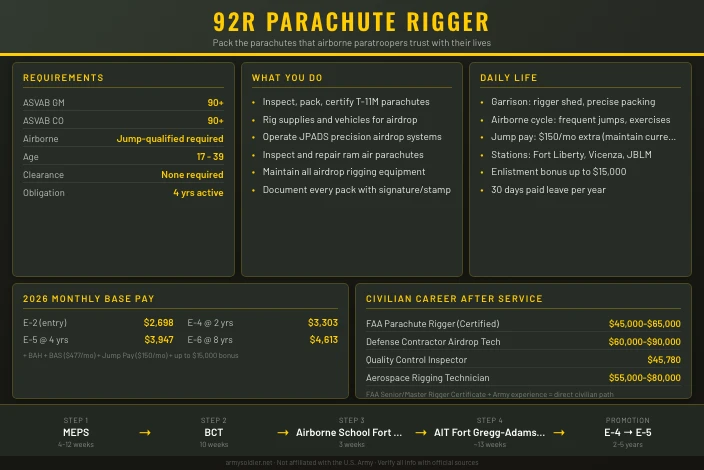
The 92R Parachute Rigger inspects, repairs, packs, and rigs parachute systems for both personnel and airdrop operations. They rig supplies, equipment, and vehicles for delivery by air, operate the Joint Precision Airdrop System (JPADS), and maintain all components of Army parachute systems to exacting standards.
Daily Tasks
In garrison, riggers spend most of their time in the rigger shed: a large, clean facility where parachutes are inspected, laid out, packed, and sealed according to Army technical manuals. Every pack job is documented with the rigger’s stamp and signature. Each Soldier who jumps or airdrops cargo trusts that documentation completely.
Cargo rigging is the other major daily function. You rig standard loads for airdrop, from small equipment bundles to vehicles and howitzers. You calculate platform weights, attach parachute clusters, connect extraction systems, and verify that the entire assembly will perform correctly at altitude.
For riggers assigned to special operations support, the work includes low-altitude and high-altitude parachute systems, ram air parachutes, and free-fall delivery systems.
Specific Roles
| Identifier | Type | Description |
|---|---|---|
| 92R | Primary MOS | Parachute Rigger |
| ASIs | Additional Skill Identifiers | Specialized rigging capabilities (HALO, JPADS, etc.) |
Mission Contribution
Airborne operations are a core Army capability. Inserting troops and equipment behind enemy lines, delivering supplies to isolated units, and projecting combat power by air all depend on reliable parachute systems. Without trained riggers, none of those missions happen. The 92R sits at the foundation of Army airborne logistics.
Technology and Equipment
The T-11M personnel parachute is the standard Army airborne system. You also work with MC-series cargo parachutes, the G-12 cargo parachute, and the 2K and 10K JPADS precision airdrop systems that use GPS to guide loads to a target. Ram air parachute systems (used in HALO and HAHO operations) add another technical dimension for riggers in special operations support roles. Packing equipment includes sewing machines, inspection lights, and specialized tools for each system.
Salary and Benefits
All pay figures are 2026 rates from DFAS.
| Rank | Grade | Monthly Base Pay (entry) |
|---|---|---|
| Private (PV2) | E-2 | $2,698 |
| Private First Class | E-3 | $2,837 |
| Specialist | E-4 | $3,142 |
| Sergeant | E-5 | $3,343 |
| Staff Sergeant | E-6 | $3,401 |
BAS adds $476.95 monthly. BAH depends on duty station. At Fort Bragg (Fort Liberty), one of the primary 92R duty stations, a single E-4 receives approximately $1,400 to $1,700 monthly in BAH.
Jump pay (Hazardous Duty Incentive Pay) is an additional $150 per month for enlisted Soldiers who maintain jump currency. You earn it while assigned to an airborne position and completing monthly jump requirements.
The 92R MOS qualifies for up to a $15,000 enlistment bonus per GoArmy.com data. Confirm the current amount with your recruiter.
Additional Benefits
TRICARE Prime covers full medical, dental, and prescription care for you and your family at no cost at military treatment facilities. Tuition Assistance provides up to $4,500 per year for college coursework. The Post-9/11 GI Bill supports 36 months of in-state tuition plus a housing allowance after separation.
Blended Retirement System (BRS) delivers 40% of your high-36 average basic pay as a pension at 20 years, plus TSP matching starting in year three of service.
Work-Life Balance
Soldiers earn 30 days of paid leave per year. Airborne units have demanding training schedules with frequent exercises and jump operations. The pace is higher than in non-airborne units, but the community is tight and the work is physically engaging.
Qualifications and Eligibility
| Requirement | Standard |
|---|---|
| ASVAB Line Score | GM: 90 & CO: 90 |
| Airborne Qualification | Must be airborne-qualified prior to or concurrent with AIT |
| Citizenship | U.S. citizen or permanent resident |
| Age | 17-39 |
| Education | High school diploma or GED |
| Security Clearance | None required |
| Physical Profile | PULHES 111111 or better |
Two ASVAB composites are required: GM (General Maintenance) at 90 and CO (Combat) at 90. GM is General Science + Auto and Shop Information + Mathematics Knowledge + Electronics Information. CO is Arithmetic Reasoning + Coding Speed + Auto and Shop Information + Mechanical Comprehension. Both must be met.
Application Process
You enlist through MEPS and select 92R based on your ASVAB scores. Your recruiter will coordinate the airborne qualification and AIT sequence. You must be medically cleared for jump school, which has additional physical requirements including a five-mile run and pull-ups during the week before jump week.
Selection Criteria
The dual ASVAB requirement filters for general technical ability across both maintenance and combat-related aptitudes. Physical readiness for airborne qualification is the second filter. The combination means 92R has a smaller applicant pool than many support MOSs.
Service Obligation
Standard four-year active duty contract. Entry grade is E-1 or E-2 based on education credits or prior JROTC.
See our ASVAB study guide for strategies to hit these line scores, or take the PiCAT from home if you are a first-time tester.
Work Environment
Setting and Schedule
The rigger shed is your primary workspace. It’s large, organized, and climate-controlled because parachute fabric and components must be kept in specific conditions. Packing a T-11M takes methodical care; rushing is how mistakes happen, and mistakes are fatal.
Airborne units operate on a demanding exercise cycle. Jump weeks, field exercises, and rapid deployment training make for busy training calendars. Garrison schedules are more regular between major exercises.
Leadership and Communication
Riggers work in Aerial Delivery Companies or Rigger Detachments attached to airborne units. Your immediate chain of command is within the rigger element, but you interface directly with the airborne units whose equipment you support. Jump masters, air movement officers, and the units themselves rely on your work.
Team Dynamics and Autonomy
Every pack job is an individual responsibility, but the work environment is collaborative. Senior riggers verify junior rigger work before a load goes into service. Quality control is built into the process: dual-signature pack jobs, regular inspections, and periodic test packs ensure systemic reliability.
As you advance to SGT and SSG, you take on supervisory roles, review junior riggers’ work, and serve as NCOIC of sections or specialty operations.
Job Satisfaction
Riggers describe the job with consistent pride. Jumping in the aircraft behind the airborne unit you supported, knowing those paratroopers’ lives depend on your work, creates a sense of accountability that most support jobs don’t match. The airborne community is close-knit, and 92R Soldiers are respected members of it.
Training and Skill Development
Initial Training
| Phase | Location | Length | Focus |
|---|---|---|---|
| Basic Combat Training (BCT) | Various | 10 weeks | Army fundamentals, physical fitness, weapons |
| Basic Airborne Course | Fort Moore, GA | 3 weeks | Parachutist qualification |
| Advanced Individual Training (AIT) | Fort Gregg-Adams, VA | ~13 weeks | Parachute packing, cargo rigging, airdrop systems |
BCT is standard for all Army enlisted Soldiers. The Basic Airborne Course at Fort Moore is three weeks and qualifies you as a military parachutist. Week one is ground week (tower training and exit procedures), week two is tower week, and week three is jump week, requiring five static-line jumps from an aircraft to earn your wings.
AIT at Fort Gregg-Adams runs approximately 13 weeks at the Aerial Delivery and Field Services Department (ADFSD). The course has four sequential phases:
- Phase 1 (~4.5 weeks): Cargo parachute packing and airdrop rigging (inter-service qualification)
- Phase 2 (~3 weeks): Personnel parachute inspection and packing (inter-service qualification)
- Phase 3 (~3 weeks): Ram air parachute systems (inter-service qualification)
- Phase 4 (~1 week): T-11M personnel parachute instruction (Army-specific procedures)
Students from multiple services attend portions of this course. Completing all four phases qualifies you for the full range of Army parachute rigging tasks.
Advanced Training
After initial assignment:
- JPADS operator training for precision airdrop systems
- HALO/HAHO rigging qualifications for special operations support roles
- Rigger Inspector certification for senior NCOs responsible for overseeing pack lines
- Master Parachutist Badge requirements: 65 jumps, a combat jump or HALO qualification, and four years in airborne assignments
Some 92R Soldiers support or train with Special Forces and Ranger units, which provides exposure to advanced airdrop methods and ram air systems beyond what the standard course covers.
Everything starts with qualifying ASVAB scores — our study guide covers what to study first.
Career Progression and Advancement
Career Path
| Rank | Grade | Typical Time in Grade | Key Milestone |
|---|---|---|---|
| Private First Class | E-3 | 0-1 year | Complete AIT and airborne qualification |
| Specialist | E-4 | 1-3 years | First airborne unit assignment |
| Sergeant | E-5 | 3-5 years | Section team leader, Junior Rigger Inspector |
| Staff Sergeant | E-6 | 5-9 years | Section NCOIC |
| Sergeant First Class | E-7 | 9-15 years | Platoon Sergeant |
| Master Sergeant / First Sergeant | E-8 | 15-22 years | Rigger Company advisor |
| Sergeant Major | E-9 | 22+ years | Division/Corps airdrop advisor |
Promotion to SGT requires board appearance and promotion points. Senior NCO promotion is centralized. Jump experience, Master Parachutist Badge, and additional airdrop qualifications all contribute to competitive profiles at promotion boards.
Specialization Opportunities
Experienced riggers pursue JPADS operator qualifications, free-fall rigging credentials, and Rigger Inspector certification. Some serve in special operations support roles that involve working with 160th SOAR, SF units, or Ranger battalions on advanced airdrop missions.
Role Flexibility
The 92R skillset is specific to the airborne community. Reclassification into other logistics or supply MOSs within CMF 92 is possible but wastes the investment in airborne qualification. Soldiers who lose their airborne physical profile may need to reclassify.
Performance Evaluation
NCOs are evaluated through the NCOER system. Technical accuracy in packing and rigging, leadership, and jump currency are all dimensions that appear in evaluations within this community. A rigger who can’t maintain jump currency loses access to jump pay and may face assignment limitations.
Physical Demands and Medical Evaluations
This MOS is physically demanding. Airborne qualification requires the physical fitness to complete week-long ground training, sustained runs, and jump week. Jump operations themselves are physically taxing. Cargo rigging involves lifting and handling heavy loads. The PULHES 111111 standard reflects the full physical requirements.
Army Fitness Test Standards
The Army Fitness Test (AFT), replacing the ACFT on June 1, 2025, tests Soldiers on five events scored 0-100 each with a 500-point maximum. All Soldiers must earn at least 60 per event and 300 total (sex- and age-normed).
| Event | Abbreviation |
|---|---|
| 3 Repetition Maximum Deadlift | MDL |
| Hand Release Push-Up | HRP |
| Sprint-Drag-Carry | SDC |
| Plank | PLK |
| Two-Mile Run | 2MR |
The general 300-point standard applies to 92R, but airborne units typically hold their Soldiers to higher physical standards in practice. A rigger who struggles on the AFT stands out in the airborne community in the wrong way.
Medical Evaluations
Maintaining jump physical qualification requires periodic medical evaluations beyond standard Army physicals. Hearing loss from aircraft noise is a known occupational risk for airborne personnel. Eye and ear protection are required during jump operations.
Deployment and Duty Stations
Deployment Details
Airborne units deploy frequently. The 82nd Airborne Division’s Global Response Force mission means some elements are on 18-hour alert cycles. Deployments for 92R Soldiers attached to airborne units run 9 to 12 months and can include combat deployments where airdrop capability is required for sustainment operations.
Location Flexibility
92R Soldiers are stationed wherever airborne units are located:
- Fort Bragg (Fort Liberty), NC (82nd Airborne Division, Special Operations Command)
- Joint Base Lewis-McChord (JBLM), WA (17th Fires Brigade, some airborne elements)
- Fort Campbell, KY (101st Airborne elements)
- Fort Carson, CO (some 4th Infantry Division airborne elements)
- OCONUS: Vicenza, Italy (173rd Airborne Brigade); Okinawa; Germany
Riggers follow airborne units. If you want to be at Fort Liberty, you’re in the right MOS. If you want wide assignment variety, there are better options.
Risk, Safety, and Legal Considerations
Job Hazards
The stakes are clear: an improperly packed parachute can kill the person who jumps it. The risk from jump operations themselves includes malfunction, aircraft accidents, and landing injuries. Cargo airdrop mishaps can damage equipment or injure personnel on the drop zone.
Safety Protocols
Technical manuals govern every packing and rigging procedure in exact detail. Quality control procedures, dual-signature verification, and periodic test packs are required safeguards. Jump operations follow strict air movement plans with qualified jump masters overseeing personnel operations.
Security and Legal Requirements
No security clearance is required. Legal obligations include proper documentation of every pack job, which creates a chain of accountability for each parachute in service.
Impact on Family and Personal Life
Family Considerations
Airborne unit life means frequent training exercises, jump days, and deployments that disrupt family routines. The 82nd Airborne’s Global Response Force requirement means some Soldiers are essentially always on call. Families at Fort Liberty need to be ready for short-notice separations.
Army family support programs, FRGs, and installation services are available. The airborne community culture tends to be strong, and unit families often support each other through deployments.
Relocation and Flexibility
92R Soldiers mostly serve at airborne installations, and Fort Liberty is the dominant assignment. PCS moves happen every two to three years, but many riggers return to Fort Liberty multiple times in a career. Families who can build roots in Fayetteville tend to find this manageable. Families that need geographic flexibility may find this MOS limiting.
Reserve and National Guard
The 92R Parachute Rigger is available in both the Army Reserve and Army National Guard, though positions are limited to units with an airborne mission. Guard airborne units exist in a handful of states, and Reserve rigger billets are concentrated in airborne-capable sustainment units. If you want to serve as a 92R in the Reserve/Guard, location matters. You will likely need to live near a unit that has rigger slots.
Drill Schedule and Training Commitment
Standard commitment is one weekend per month (Battle Assembly) plus two weeks of Annual Training per year. 92R drill weekends are more hands-on than many support MOS, with soldiers packing and inspecting parachutes, rigging airdrop loads, and conducting certification jumps. Annual Training often involves joint airborne exercises with multiple drops over several days. Riggers in airborne units may have additional jump days and packing requirements beyond the standard drill schedule to maintain proficiency and airborne qualification.
Part-Time Pay
An E-4 with over 3 years of service earns about $464 per drill weekend (4 drill periods), totaling roughly $5,572 per year from drill pay plus about $1,741 for 15 days of Annual Training. Airborne-qualified soldiers also receive jump pay ($150 per month) during periods of active duty or when performing jumps during training. Active-duty E-4 base pay is $3,482 per month.
Benefits Differences
Tricare Reserve Select costs $57.88 per month for member-only or $286.66 per month for family coverage in 2026. Active-duty TRICARE Prime is free.
Education benefits include Federal Tuition Assistance ($250 per credit hour, up to $4,500 per year) and the Montgomery GI Bill-Selected Reserve at $493 per month for full-time students. Guard members may qualify for state tuition waivers. Mobilization of 90 or more days earns Post-9/11 GI Bill eligibility.
Reserve retirement is points-based, requiring 20 qualifying years. Collection starts at age 60, reduced by 3 months per 90-day mobilization after January 2008, minimum age 50.
Deployment and Mobilization
92R soldiers in Reserve/Guard units see low to moderate mobilization rates. Rigger units deploy primarily in support of airborne operations or aerial delivery missions. Mobilization frequency depends heavily on the global operational tempo for airborne forces. Typical tours run 9 to 12 months when activated.
Civilian Career Integration
The 92R pairs with civilian careers in skydiving operations, aviation equipment inspection, aerial delivery services, and textile manufacturing (for parachute fabrication and repair). FAA-certified parachute rigger certification is available to 92R soldiers and is directly recognized in the civilian skydiving industry. USERRA protects your civilian job during activations, and employers must reinstate you with the seniority you would have earned.
| Feature | Active Duty | Army Reserve | Army National Guard |
|---|---|---|---|
| Commitment | Full-time | 1 weekend/month + 2 weeks/year | 1 weekend/month + 2 weeks/year |
| Monthly Pay (E-4, 3+ yrs) | $3,482 | ~$464/drill weekend | ~$464/drill weekend |
| Healthcare | TRICARE Prime ($0) | Tricare Reserve Select ($57.88/mo) | Tricare Reserve Select ($57.88/mo) |
| Education | Federal TA, Post-9/11 GI Bill | Federal TA, MGIB-SR ($493/mo) | Federal TA, MGIB-SR, state tuition waivers |
| Deployment Tempo | Regular with airborne units | Low-moderate | Low-moderate |
| Retirement | 20-year pension at age 40+ | Points-based, collect at age 60 | Points-based, collect at age 60 |
Post-Service Opportunities
The FAA issues civilian parachute rigger certificates, and Army experience provides the foundation for that credential. Civilian riggers service sport parachuting, skydiving operations, drone recovery systems, aerospace applications, and military contractor positions.
| Civilian Job Title | Median Annual Salary (May 2024, BLS) | Job Outlook |
|---|---|---|
| Quality Control Inspector | $45,780 | Stable |
| Textile/Fabric Worker (Parachute) | $39,000-$55,000 (varies) | Specialized demand |
| Defense Contractor Airdrop Technician | $60,000-$90,000 (varies) | Solid demand |
Defense contractors supporting Army and special operations airdrop programs actively recruit former 92R Soldiers. Companies supporting JPADS systems, parachute manufacturing, and airdrop testing hire veterans with hands-on military rigging experience at premium pay levels.
The FAA Senior or Master Parachute Rigger Certificate is achievable with Army experience and has direct civilian market value in the sport and commercial parachute industry.
Is This a Good Job for You? The Right (and Wrong) Fit
Ideal Candidate Profile
Strong 92R candidates are physically fit, detail-oriented, and genuinely comfortable with the airborne community’s culture and tempo. The job requires patience for precise, methodical work combined with the physical and mental readiness for airborne operations. You also need to be comfortable with the responsibility that comes with packing equipment someone else’s life depends on.
An interest in aviation, airdrop, or special operations environments makes this MOS more than just a job. Most riggers are proud of their wings and their work.
Potential Challenges
Jump-qualified positions are physically demanding to maintain. Injuries from jump operations are not uncommon. If your physical profile degrades to the point where you can’t maintain jump currency, your career in this MOS is effectively over.
The concentration of assignments at Fort Liberty means limited geographic flexibility. If your family cannot put down roots at one location, or if you need to stay near a specific region, this MOS creates friction.
Career and Lifestyle Alignment
The 92R MOS is a strong fit if you want to be in the airborne community, earn your jump wings, and do technical work that directly supports combat operations. The enlistment bonus, jump pay, and the civilian credential pathway add financial incentives on top of the mission significance.
If you want to be close to special operations culture without going through Special Forces selection, a rigger assignment supporting SOF units at Fort Liberty or Vicenza gets you in that orbit.
More Information
Contact an Army recruiter to confirm current bonus amounts, training seat availability, and airborne qualification sequencing for 92R. The Aerial Delivery and Field Services Department at Fort Gregg-Adams publishes training information worth reviewing before you enlist.
- Prepare for the ASVAB with our study guide to make sure your line scores qualify
This site is not affiliated with the U.S. Army or any government agency. Verify all information with official Army sources before making enlistment or career decisions.
Explore more Army transportation and logistics careers such as 88H Cargo Specialist and 92A Automated Logistical Specialist.