92S Shower/Laundry and Clothing Repair Specialist
Every Army unit in the field depends on clean uniforms and functioning equipment. The 92S Shower/Laundry and Clothing Repair Specialist makes that happen. When a brigade spends weeks in austere conditions, the 92S team arrives with mobile laundry and shower units, fighting disease outbreaks before they start. It’s a support role with a direct line to combat readiness.
Qualifying requires specific ASVAB line scores — our ASVAB study guide covers what to target and how to prepare.
Job Role and Responsibilities
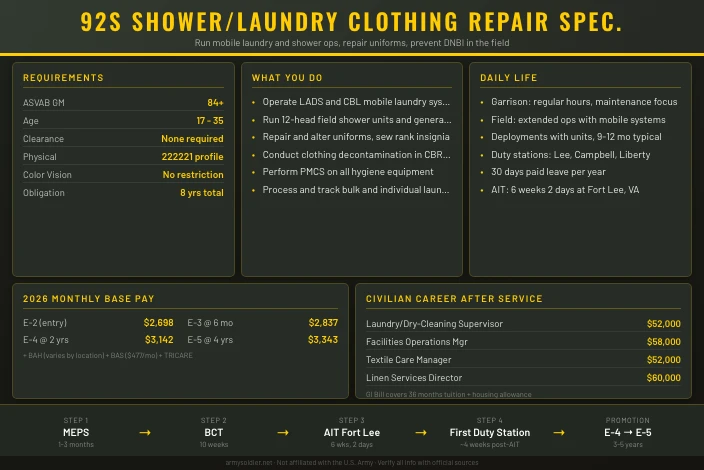
The 92S Shower/Laundry and Clothing Repair Specialist operates mobile laundry, shower, and clothing repair systems to support Army units in garrison and field environments. Specialists prevent disease and non-battle injuries (DNBI) by maintaining personal hygiene standards across the force, altering and repairing uniforms, and decontaminating clothing in CBRN environments.
Daily Tasks
Day-to-day work changes depending on whether you’re in garrison or deployed. In garrison, most of your time goes toward equipment maintenance, inventory management, and unit laundry processing. Field operations shift the focus entirely.
Common daily duties include:
- Setting up and operating the Laundry Advanced System (LADS) and Containerized Batch Laundry (CBL) systems
- Operating 12-head field shower units and associated generators
- Receiving, sorting, and processing bulk and individual laundry loads
- Altering and repairing uniforms – sewing patches, rank insignia, and torn seams
- Conducting clothing decontamination operations in CBRN scenarios
- Performing preventive maintenance checks and services (PMCS) on all equipment
Specific Roles
The Army classifies 92S under CMF 92 (Quartermaster). Soldiers may earn Additional Skill Identifiers (ASI) through advanced training.
| System | Code | Notes |
|---|---|---|
| Primary MOS | 92S | Shower/Laundry and Clothing Repair Specialist |
| Career Management Field | CMF 92 | Quartermaster |
Mission Contribution
The link between personal hygiene and combat effectiveness is well-documented. Units that can’t maintain basic hygiene in the field face reduced readiness from skin infections, trench foot, and other preventable conditions. The 92S directly supports the commander’s ability to sustain forces for extended periods. In CBRN environments, the decontamination mission becomes critical to survival.
Technology and Equipment
You’ll work with several pieces of specialized equipment:
- Laundry Advanced System (LADS) – a containerized mobile laundry platform
- Containerized Batch Laundry (CBL) – handles large-volume bulk laundry
- 12-Head Shower Unit – a trailer-mounted field shower
- Industrial sewing machines for uniform repair and alteration
- Generators and water distribution systems supporting hygiene operations
Salary and Benefits
Base Pay
Pay is determined by rank and time in service. All figures are 2026 DFAS rates.
| Rank | Grade | Monthly Base Pay (entry) |
|---|---|---|
| Private (PV2) | E-2 | $2,698 |
| Private First Class | E-3 | $2,837 |
| Specialist | E-4 | $3,142 |
| Sergeant | E-5 | $3,343 |
| Staff Sergeant | E-6 | $3,401 |
Beyond base pay, soldiers receive Basic Allowance for Subsistence (BAS) of $476.95/month and Basic Allowance for Housing (BAH), which varies by duty location. At Fort Lee, Virginia, an E-4 without dependents receives approximately $1,359/month in BAH.
Additional Benefits
Active-duty soldiers receive full TRICARE Prime health coverage at no cost. Coverage extends to eligible family members.
Education benefits include:
- Tuition Assistance (TA): Up to $4,500 per year for on-duty college courses
- Post-9/11 GI Bill: 36 months of full in-state tuition at public schools, plus a monthly housing allowance and up to $1,000 per year in book stipends
Retirement under the Blended Retirement System (BRS) combines a 20-year pension at 40% of high-36 average pay with a Thrift Savings Plan (TSP) that includes up to 5% government matching starting in the third year of service.
Work-Life Balance
Soldiers earn 30 days of paid leave per year, accruing at 2.5 days per month. Garrison work in a support unit generally follows a structured schedule, though field exercises and deployment change that. The 92S role is not typically subject to the high operational tempo of combat arms, but deployments occur regularly.
Qualifications and Eligibility
Requirements Table
| Requirement | Standard |
|---|---|
| ASVAB Line Score | GM: 84 |
| Minimum AFQT | 31 (diploma); 50 (GED) |
| Age | 17-35 |
| Citizenship | U.S. citizen or permanent resident |
| Physical Profile | 222221 |
| Security Clearance | None required |
| Gender | Open to all |
The GM (General Maintenance) composite is calculated as: GS + AS + MK + EI. Focus on general science, auto and shop information, math knowledge, and electronics basics to improve this score.
Application Process
- Meet with an Army recruiter and take the ASVAB at a Military Entrance Processing Station (MEPS)
- Pass the physical examination at MEPS
- Select 92S during job selection (availability depends on current Army needs)
- Sign an enlistment contract specifying your MOS, duty station preferences, and enlistment length
- Ship to Basic Combat Training (BCT)
The full process from recruiter contact to BCT ship date typically takes 1-3 months, though it can be faster for quick-ship candidates.
Selection and Competitiveness
The 92S MOS is moderately competitive. It requires no security clearance and no special physical screening beyond standard MEPS requirements. Soldiers who express strong interest in logistics, textiles, or field support will find this a good fit.
Service Obligation
Soldiers entering this MOS serve a minimum 3-year active-duty obligation with an 8-year total military service obligation (active + reserve component). Enlistment-grade entry is at E-1 (Private), though soldiers with qualifying college credits may enter at higher grades.
See our ASVAB study guide for strategies to hit these line scores, or take the PiCAT from home if you are a first-time tester.
Work Environment
Setting and Schedule
The 92S role splits time between garrison and field environments. In garrison, you’ll work in laundry facilities or supply rooms with regular duty hours. Field environments are more demanding – setting up and breaking down mobile systems on short notice, operating for extended hours, and working in all weather conditions.
During deployments, 12-16 hour operational days are common when supporting large units. The work is physically repetitive but requires attention to detail on equipment maintenance and clothing accountability.
Leadership and Communication
The chain of command in a quartermaster unit follows standard Army structure. Team leaders (E-5/E-6) directly supervise 2-5 soldiers. Section leaders report to a platoon sergeant and platoon leader. Performance feedback comes through the Army Evaluation Report system annually, with informal counseling required at least quarterly.
Team Dynamics
Most 92S sections are small (4-10 soldiers). You’ll work closely with the same crew for extended periods, especially during deployment. Individual tasks like sewing and equipment maintenance require focus, but mission success depends on coordinated effort across the whole section.
Job Satisfaction
Soldiers in this MOS report decent work-life balance in garrison and a clear sense of contribution during field operations. The challenge is that the role can feel isolated from the broader unit mission. Soldiers who thrive tend to be self-motivated, detail-oriented, and comfortable with repetitive technical work.
Training and Skill Development
Training Pipeline
| Phase | Location | Length | Focus |
|---|---|---|---|
| Basic Combat Training (BCT) | Various | 10 weeks | Soldiering fundamentals, physical fitness, weapons qualification |
| Advanced Individual Training (AIT) | Fort Lee, VA | 6 weeks, 2 days | Field laundry systems, shower operations, clothing repair, CBRN decontamination |
AIT at Fort Lee, Virginia runs through the U.S. Army Quartermaster School. Training covers the LADS, CBL, and field shower systems, along with basic uniform repair using industrial sewing machines. Students also learn DNBI prevention and CBRN decontamination procedures.
The total pipeline from BCT ship date to first duty station is approximately 20 weeks.
Advanced Training
After reaching Sergeant (E-5), soldiers can pursue the 92S Advanced Leader Course (ALC) through the Noncommissioned Officer Education System (NCOES). The Army COOL program can fund civilian certifications in textile care and laundry management directly related to this MOS.
Everything starts with qualifying ASVAB scores — our study guide covers what to study first.
Career Progression and Advancement
Career Path
| Rank | Grade | Typical Time | Milestone |
|---|---|---|---|
| Private (PV1/PV2) | E-1/E-2 | Entry | Enlist, ship to BCT |
| Private First Class | E-3 | 6-12 months | Complete AIT, arrive at first unit |
| Specialist | E-4 | 1-2 years | Sustain individual skills |
| Sergeant | E-5 | 3-5 years | First leadership role, attend ALC |
| Staff Sergeant | E-6 | 6-10 years | Section leader, mentor junior soldiers |
| Sergeant First Class | E-7 | 12-17 years | Platoon sergeant |
| Master Sergeant / 1SG | E-8 | 18-22 years | Senior NCO, company-level leadership |
Promotion to E-5 requires meeting Army centralized promotion board criteria: time in service, physical fitness, education points, and a competitive promotion file.
Role Flexibility
Soldiers can apply for reclassification to other MOS after completing their first enlistment. Related options within CMF 92 include 92Y (Unit Supply Specialist) and 92A (Automated Logistical Specialist). Transfers require approval from HRC and the gaining unit.
Performance Evaluation
NCOs are evaluated through the NCO Evaluation Report (NCOER). Key areas include technical proficiency, leadership, subordinate training, and adherence to Army standards. Strong evaluations accelerate promotion timelines.
The path to success in this career starts with mastering the technical systems early, taking ownership of equipment readiness, and pursuing voluntary education.
Physical Demands and Medical Evaluations
Physical Requirements
The 92S role is classified as moderately heavy physical demand. Day-to-day tasks include lifting laundry loads (25-50 lbs regularly), moving equipment in field conditions, and standing for extended periods during operations.
The Army Fitness Test (AFT) replaced the ACFT on June 1, 2025. All soldiers must pass 5 events with a minimum of 60 points each.
| AFT Event | Description | Minimum Score |
|---|---|---|
| 3-Rep Max Deadlift (MDL) | Strength | 60 pts |
| Hand Release Push-Up (HRP) | Upper body endurance | 60 pts |
| Sprint-Drag-Carry (SDC) | Anaerobic capacity | 60 pts |
| Plank (PLK) | Core stability | 60 pts |
| Two-Mile Run (2MR) | Aerobic endurance | 60 pts |
Soldiers must score a minimum of 300 total points (60 per event). The AFT is sex- and age-normed. Administrative enforcement for active duty began January 1, 2026.
Medical Evaluations
Soldiers undergo a full physical at MEPS before enlistment. No special vision requirements apply beyond correctable acuity. Periodic Soldier Readiness Processing (SRP) events maintain medical readiness throughout the career.
Deployment and Duty Stations
Deployment
The 92S deploys with the units it supports. Deployment frequency depends on unit operational tempo. Typical combat theater deployments run 9-12 months. Quartermaster companies have deployed in support of operations in the Middle East, Europe, and Africa.
Duty Station Options
Common duty stations with 92S positions:
- Fort Lee, VA (Quartermaster School and sustainment units)
- Fort Campbell, KY (101st Airborne Division sustainment)
- Fort Cavazos, TX (III Corps sustainment brigade)
- Fort Liberty, NC (82nd Airborne Division sustainment)
- OCONUS locations (Germany, South Korea, Japan)
Duty station preferences can be submitted during enlistment but are not guaranteed.
Risk, Safety, and Legal Considerations
Job Hazards
Chemical exposure and equipment-related injuries are the primary hazards. CBRN decontamination operations involve protective gear and strict safety protocols. Industrial laundry equipment can cause burns, entanglement injuries, and repetitive stress injuries without proper safety practices.
Safety Protocols
Soldiers receive safety training during AIT and at the unit level. Personal Protective Equipment (PPE) is required for chemical decontamination tasks. Equipment operators must complete operator licenses before running LADS or CBL systems unsupervised.
Security and Legal Requirements
No security clearance is required. Standard enlistment contracts apply, including the 8-year total military service obligation and UCMJ applicability throughout service.
Impact on Family and Personal Life
Family Considerations
The 92S role generally supports stable family life compared to combat MOS. Garrison duty follows a predictable schedule, and Army Family Readiness Groups (FRGs), the Military OneSource program, and on-post childcare services provide support during deployments and field exercises.
Relocation
PCS moves happen every 2-3 years on average. The Army covers authorized moving costs, but relocation disrupts schooling, employment, and social networks. Military OneSource offers relocation support resources for families.
Reserve and National Guard
The 92S Shower/Laundry and Clothing Repair Specialist is available in both the Army Reserve and Army National Guard. Billets are attached to quartermaster companies and field services units. The Army Reserve holds a significant share of field services capability, and several Guard states also maintain 92S positions. Total billets are smaller than general supply MOS, but the MOS is represented in both components.
Drill Schedule and Training Commitment
Standard commitment is one weekend per month (Battle Assembly) plus two weeks of Annual Training per year. Drill weekends for 92S soldiers include equipment maintenance on mobile laundry and shower systems, clothing repair exercises, and field sanitation training. Annual Training typically involves setting up and operating field laundry and shower units during a larger exercise. The training schedule is standard with no unusual additional requirements beyond normal PME courses.
Part-Time Pay
An E-4 with over 3 years of service earns about $464 per drill weekend (4 drill periods), totaling roughly $5,572 per year from drill pay plus about $1,741 for 15 days of Annual Training. Active-duty E-4 base pay is $3,482 per month.
Benefits Differences
Tricare Reserve Select costs $57.88 per month for member-only or $286.66 per month for family coverage in 2026. Active-duty TRICARE Prime is free.
Education benefits include Federal Tuition Assistance ($250 per credit hour, up to $4,500 per year) and the Montgomery GI Bill-Selected Reserve at $493 per month for full-time students. Guard members may qualify for state tuition waivers. Mobilization of 90 or more days earns Post-9/11 GI Bill eligibility.
Reserve retirement is points-based, requiring 20 qualifying years. Collection starts at age 60, reduced by 3 months per 90-day mobilization after January 2008, minimum age 50.
Deployment and Mobilization
Mobilization for Reserve/Guard 92S soldiers is low to moderate. Field services units deploy when large troop concentrations need sustained support, which is common during major operations but infrequent during peacetime. National Guard 92S soldiers may also be activated for domestic disaster response, where mobile shower and laundry capabilities support evacuees and first responders.
Civilian Career Integration
The 92S has limited direct civilian career equivalents, but the equipment maintenance, logistics, and textile repair skills transfer to commercial laundry operations, dry cleaning businesses, and facilities management roles. Some soldiers use the experience to move into HVAC or industrial equipment maintenance careers. USERRA protects your civilian job during activations, and employers must reinstate you with the seniority you would have earned.
| Feature | Active Duty | Army Reserve | Army National Guard |
|---|---|---|---|
| Commitment | Full-time | 1 weekend/month + 2 weeks/year | 1 weekend/month + 2 weeks/year |
| Monthly Pay (E-4, 3+ yrs) | $3,482 | ~$464/drill weekend | ~$464/drill weekend |
| Healthcare | TRICARE Prime ($0) | Tricare Reserve Select ($57.88/mo) | Tricare Reserve Select ($57.88/mo) |
| Education | Federal TA, Post-9/11 GI Bill | Federal TA, MGIB-SR ($493/mo) | Federal TA, MGIB-SR, state tuition waivers |
| Deployment Tempo | As needed | Low-moderate | Low-moderate + state missions |
| Retirement | 20-year pension at age 40+ | Points-based, collect at age 60 | Points-based, collect at age 60 |
Post-Service Opportunities
Transition to Civilian Life
Skills from the 92S MOS translate directly to civilian laundry and textile management industries. The discipline, equipment operation, and supervision skills developed here also apply broadly to facilities management, environmental services, and hospitality.
The Army Career Skills Program (CSP) and SkillBridge program let soldiers complete civilian apprenticeships during the final 180 days of service. The Transition Assistance Program (TAP) provides resume writing, job search support, and benefits counseling.
Civilian Career Prospects
| Civilian Job | Median Salary (BLS, May 2024) | Outlook (2024-2034) |
|---|---|---|
| Laundry/Dry-Cleaning Worker | ~$30,000/year | Declining (automation) |
| Tailor / Clothing Repair Specialist | ~$37,000/year | Slow growth |
| Textile Care / Linen Services Manager | ~$52,000/year | Stable |
| Facilities Operations Supervisor | ~$58,000/year | Stable |
The Post-9/11 GI Bill covers 36 months of college tuition, which opens doors to business management, industrial operations, or healthcare environmental services careers where veterans with hands-on logistics experience have an edge.
Is This a Good Job for You? The Right (and Wrong) Fit
Ideal Candidate Profile
This role suits someone who:
- Takes pride in keeping equipment clean and functional
- Doesn’t mind repetitive work with clear outcomes
- Can stay organized under pressure
- Wants a support role with real field experience
- Is interested in the logistics and sustainment side of the Army
Basic sewing ability or mechanical aptitude is a plus. No prior experience is required.
Potential Challenges
The work can feel monotonous, especially in garrison. The MOS doesn’t carry the prestige of combat arms, and some soldiers find the repetitive nature of laundry and clothing repair less engaging over a long career. If you need constant variety or want a role with direct tactical impact, this probably isn’t the right fit.
Lifestyle Alignment
The 92S MOS fits soldiers who want a steady pace in garrison with a clear contribution during field operations. It’s a solid foundation for a career in Army logistics, and the skills transfer well to civilian industries that offer stable post-service employment.
More Information
Talk to an Army recruiter to find out whether 92S slots are available at your preferred duty stations and whether any enlistment incentives apply to your contract.
- Prepare for the ASVAB with our study guide to make sure your line scores qualify
This site is not affiliated with the U.S. Army or any government agency. Verify all information with official Army sources before making enlistment or career decisions.
Explore more Army transportation and logistics careers such as 92W Water Treatment Specialist and 92Y Unit Supply Specialist.