92W Water Treatment Specialist
An Army unit without safe water stops operating within days. The 92W Water Treatment Specialist is the soldier who prevents that. When conventional supply lines fail or units push into areas with no infrastructure, the 92W sets up purification equipment and turns contaminated water into potable water for hundreds of soldiers. It’s a technical job with immediate life-safety consequences.
Qualifying requires specific ASVAB line scores — our ASVAB study guide covers what to target and how to prepare.
Job Role and Responsibilities
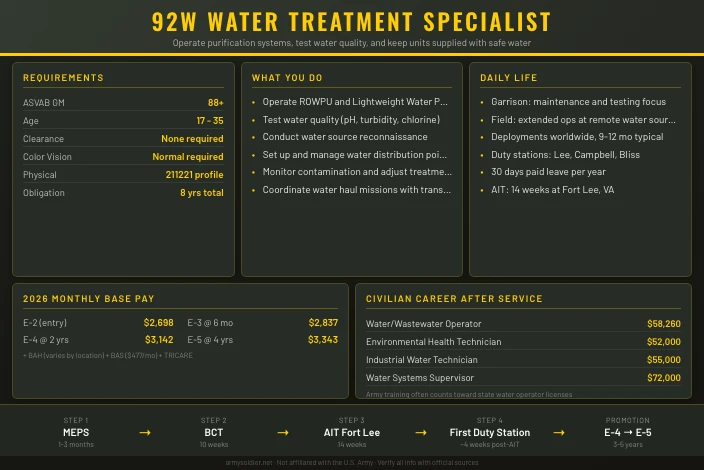
The 92W Water Treatment Specialist supervises and operates water purification and distribution equipment to provide safe drinking water to Army units in the field. Specialists perform water quality analysis, maintain purification systems, conduct water reconnaissance, and ensure clean water reaches units regardless of the operational environment.
Daily Tasks
In garrison, the work focuses on equipment maintenance, testing protocols, and training. In the field, the pace accelerates significantly.
Typical duties include:
- Operating Reverse Osmosis Water Purification Units (ROWPU) and lightweight water purifiers
- Performing water quality tests – turbidity, pH, chlorine residual, and bacteriological analysis
- Conducting water source reconnaissance and site preparation
- Setting up and managing water distribution points
- Monitoring for contamination and adjusting treatment parameters
- Performing PMCS on all water systems
- Coordinating water haul missions with transportation units
Specific Roles
The 92W serves under CMF 92 (Quartermaster).
| System | Code | Notes |
|---|---|---|
| Primary MOS | 92W | Water Treatment Specialist |
| Career Management Field | CMF 92 | Quartermaster |
Mission Contribution
A single ROWPU can produce thousands of gallons of potable water per day. Without this capability, commanders face impossible tradeoffs between staying in place and risking illness or pulling back to established supply. Waterborne illness has historically caused more combat-ineffective days than enemy action in several campaigns. The 92W is a direct countermeasure.
Technology and Equipment
Key systems you’ll operate and maintain:
- Reverse Osmosis Water Purification Unit (ROWPU) – the Army’s primary large-scale purification system
- Lightweight Water Purifier (LWP) – tactical-scale system for smaller units
- 5,000-gallon collapsible fabric tanks for water storage
- Water distribution systems including pumps, hoses, and distribution points
- Laboratory test kits and NBC water testing equipment
Salary and Benefits
Base Pay
All figures reflect 2026 DFAS pay rates.
| Rank | Grade | Monthly Base Pay (entry) |
|---|---|---|
| Private (PV2) | E-2 | $2,698 |
| Private First Class | E-3 | $2,837 |
| Specialist | E-4 | $3,142 |
| Sergeant | E-5 | $3,343 |
| Staff Sergeant | E-6 | $3,401 |
Soldiers also receive BAS of $476.95/month and BAH based on duty location. At Fort Lee, Virginia, an E-4 without dependents receives approximately $1,359/month in BAH.
Additional Benefits
Active-duty soldiers and eligible family members receive TRICARE Prime health coverage at no cost. Education benefits include Tuition Assistance (TA) up to $4,500 per year and the Post-9/11 GI Bill covering full in-state tuition at public schools for up to 36 months, plus a monthly housing allowance.
Under the Blended Retirement System (BRS), soldiers who reach 20 years receive a pension of 40% of their high-36 average basic pay. The Army contributes up to 5% of basic pay to the TSP with matching starting in the third year of service.
Work-Life Balance
Soldiers earn 30 days paid leave per year. Garrison assignments in water treatment typically follow regular duty hours. Field exercises and deployment shift the pace significantly, with extended operational hours and limited personal time.
Qualifications and Eligibility
Requirements Table
| Requirement | Standard |
|---|---|
| ASVAB Line Score | GM: 88 |
| Minimum AFQT | 31 (diploma); 50 (GED) |
| Age | 17-35 |
| Citizenship | U.S. citizen or permanent resident |
| Color Vision | Normal color vision required |
| Physical Profile | 211221 |
| Security Clearance | None required |
| Gender | Open to all |
The GM (General Maintenance) composite = GS + AS + MK + EI. The 92W minimum of 88 is slightly higher than similar quartermaster MOS, reflecting the greater emphasis on science and equipment maintenance.
Application Process
- Contact an Army recruiter and schedule ASVAB and MEPS appointments
- Complete the ASVAB and physical examination
- Request 92W during MOS selection (availability varies by Army needs)
- Sign an enlistment contract specifying MOS, duty station preferences, and term length
- Ship to Basic Combat Training (BCT)
The full process typically takes 1-3 months, depending on MEPS scheduling and contract processing.
Selection and Competitiveness
The 92W MOS has a consistent demand signal from the Army. Soldiers with a science or chemistry background, or those who score well on the GS subtest, have an advantage. No prior water treatment experience is required.
Service Obligation
The standard enlistment is 3 or 4 years active duty, with a total military service obligation of 8 years. Entry grade is E-1 (Private), with possible entry at E-2 or higher based on qualifying factors.
See our ASVAB study guide for strategies to hit these line scores, or take the PiCAT from home if you are a first-time tester.
Work Environment
Setting and Schedule
Water treatment sections operate across diverse environments – from fixed installations to forward operating bases to austere field sites with no existing infrastructure. In garrison, work is conducted at water storage and treatment facilities. In the field, you work outdoors in all weather conditions, often at remote locations.
The work combines physically demanding setup and teardown with methodical technical monitoring. Both require precision.
Leadership and Communication
Teams are typically small (4-8 soldiers) under an E-5 or E-6 team leader. Communication with transportation units is essential for coordinating water haul missions. Section leaders coordinate directly with supported units on water needs and distribution schedules.
Team Dynamics
A ROWPU crew of 3-4 soldiers works interdependently – one mistake in the treatment process affects everyone downstream. Soldiers who communicate clearly, follow technical procedures precisely, and troubleshoot under pressure succeed in this role.
Job Satisfaction
Water treatment soldiers consistently report a strong sense of mission value. The work is technical, the stakes are real, and the skill set is genuinely transferable. The downside is relative isolation and the fact that the contribution often goes unrecognized by the broader unit.
Training and Skill Development
Training Pipeline
| Phase | Location | Length | Focus |
|---|---|---|---|
| Basic Combat Training (BCT) | Various | 10 weeks | Soldiering fundamentals, physical fitness, weapons qualification |
| Advanced Individual Training (AIT) | Fort Lee, VA | 14 weeks | Water purification theory, ROWPU operations, water quality testing, distribution systems, field operations |
AIT at Fort Lee, Virginia runs through the U.S. Army Quartermaster School. The 14-week course mixes classroom instruction with hands-on equipment training. Students learn to operate the ROWPU and Lightweight Water Purifier, conduct water quality tests, perform maintenance under field conditions, and manage distribution points.
The total pipeline from BCT ship date to first duty station is approximately 26 weeks.
Advanced Training
NCOs pursue the 92W Advanced Leader Course (ALC) and Senior Leader Course (SLC) through NCOES. The Army COOL program supports civilian water treatment certifications, including those recognized by the American Water Works Association (AWWA).
Everything starts with qualifying ASVAB scores — our study guide covers what to study first.
Career Progression and Advancement
Career Path
| Rank | Grade | Typical Time | Milestone |
|---|---|---|---|
| Private (PV1/PV2) | E-1/E-2 | Entry | Enlist, ship to BCT |
| Private First Class | E-3 | 6-12 months | Arrive at first unit |
| Specialist | E-4 | 1-2 years | Sustain skills, prepare for promotion board |
| Sergeant | E-5 | 3-5 years | First leadership role, attend ALC |
| Staff Sergeant | E-6 | 6-10 years | Section leadership, train junior soldiers |
| Sergeant First Class | E-7 | 12-17 years | Platoon sergeant |
| Master Sergeant / 1SG | E-8 | 18-22 years | Senior NCO, company operations |
Role Flexibility
After the first enlistment, soldiers can reclassify to related MOS within CMF 92, such as 92F (Petroleum Supply Specialist) or 92Y (Unit Supply Specialist). Transfers require HRC approval and meeting the gaining MOS’s qualifications.
Performance Evaluation
NCOs are evaluated through the NCOER system. Technical proficiency, equipment readiness rates, and the quality of training provided to subordinates are key indicators. Soldiers who pursue civilian certifications and voluntary education typically show stronger promotion potential.
Physical Demands and Medical Evaluations
Physical Requirements
Setting up ROWPU systems requires lifting heavy components (50-100 lbs), digging, and working in cramped or exposed positions. Sustained field operations can be physically exhausting.
The Army Fitness Test (AFT) has been in effect since June 1, 2025.
| AFT Event | Description | Minimum Score |
|---|---|---|
| 3-Rep Max Deadlift (MDL) | Strength | 60 pts |
| Hand Release Push-Up (HRP) | Upper body endurance | 60 pts |
| Sprint-Drag-Carry (SDC) | Anaerobic capacity | 60 pts |
| Plank (PLK) | Core stability | 60 pts |
| Two-Mile Run (2MR) | Aerobic endurance | 60 pts |
The general standard requires 300 total points (60 per event), sex- and age-normed. Administrative enforcement for active duty began January 1, 2026.
Medical Evaluations
Normal color vision is tested and confirmed at MEPS. No security clearance is needed. Soldiers complete periodic Soldier Readiness Processing (SRP) events throughout their career to maintain medical and dental readiness.
Deployment and Duty Stations
Deployment
Water treatment units deploy wherever the Army goes. Quartermaster companies have supported combat and humanitarian operations across the Middle East, Africa, Europe, and Southeast Asia. Deployment lengths typically run 9-12 months for combat theater rotations. Humanitarian and training deployments may be shorter.
Duty Station Options
Common duty stations with 92W positions:
- Fort Lee, VA (Quartermaster School, sustainment units)
- Fort Campbell, KY (101st Airborne Division sustainment)
- Fort Cavazos, TX (III Corps logistics)
- Fort Bliss, TX (1st Armored Division)
- OCONUS locations (Germany, South Korea, Kuwait)
Duty station preferences are noted during enlistment but subject to Army needs.
Risk, Safety, and Legal Considerations
Job Hazards
Chemical handling is the primary hazard. Chlorine compounds and coagulants require PPE and careful handling. Equipment failures in austere environments can be dangerous. Working near water sources also presents drowning and contamination risks.
Safety Protocols
Army water treatment operations follow strict technical manuals and field manuals. Soldiers receive HAZMAT handling training during AIT. Units conduct safety briefings before every field water treatment operation.
Security and Legal Requirements
No security clearance is required. Standard enlistment contracts apply with a total military service obligation of 8 years. UCMJ applies throughout service.
Impact on Family and Personal Life
Family Considerations
The sustainment focus of this role typically offers more predictable garrison hours than combat MOS. Deployments occur but are generally well-planned. Army Family Readiness Groups (FRGs), Military OneSource, and on-post family services provide support.
Relocation
PCS moves occur every 2-3 years. The Army covers authorized moving expenses. Spouses can access Military Spouse Employment Partnership (MSEP) resources and the Army SECO program for career support during moves.
Reserve and National Guard
The 92W Water Treatment Specialist is available in both the Army Reserve and Army National Guard. Quartermaster water purification units exist in both components, with the Army Reserve holding a significant share of this capability. National Guard water treatment billets are found in several states, particularly those with engineer or quartermaster companies that include water purification as part of their mission.
Drill Schedule and Training Commitment
Standard commitment is one weekend per month (Battle Assembly) plus two weeks of Annual Training per year. Drill weekends for 92W soldiers include equipment maintenance on Reverse Osmosis Water Purification Units (ROWPUs), water quality testing refreshers, and field setup drills. Annual Training typically involves deploying and operating purification equipment in a field environment. Additional training days may be needed for water quality testing certifications and equipment operator recertification.
Part-Time Pay
An E-4 with over 3 years of service earns about $464 per drill weekend (4 drill periods), totaling roughly $5,572 per year from drill pay plus about $1,741 for 15 days of Annual Training. Active-duty E-4 base pay is $3,482 per month. Many Reserve/Guard 92W soldiers work in civilian water treatment plants during the week, often earning more than active-duty base pay.
Benefits Differences
Tricare Reserve Select costs $57.88 per month for member-only or $286.66 per month for family coverage in 2026. Active-duty TRICARE Prime is free.
Education benefits include Federal Tuition Assistance ($250 per credit hour, up to $4,500 per year) and the Montgomery GI Bill-Selected Reserve at $493 per month for full-time students. Guard members may qualify for state tuition waivers. Mobilization of 90 or more days earns Post-9/11 GI Bill eligibility.
Reserve retirement is points-based, requiring 20 qualifying years. Collection starts at age 60, reduced by 3 months per 90-day mobilization after January 2008, minimum age 50.
Deployment and Mobilization
92W soldiers in Reserve/Guard units see moderate mobilization rates. Water purification is a critical capability for any sustained deployment, and water treatment units have been activated for both overseas operations and domestic disaster response. Typical mobilizations run 9 to 12 months. National Guard 92W soldiers are frequently activated for state emergencies involving contaminated water supplies, hurricanes, and flooding.
Civilian Career Integration
The 92W is one of the best Reserve/Guard MOS for direct civilian career overlap. Water treatment plant operators are in demand nationwide, and military experience with reverse osmosis, chemical treatment, and water quality testing translates directly to state licensing requirements. Many states accept military training toward Water Treatment Operator certification. The average civilian water treatment operator earns $50,000 to $65,000 per year, and the field has consistent job growth. USERRA protects your civilian job during activations, and employers must reinstate you with the seniority you would have earned.
| Feature | Active Duty | Army Reserve | Army National Guard |
|---|---|---|---|
| Commitment | Full-time | 1 weekend/month + 2 weeks/year | 1 weekend/month + 2 weeks/year |
| Monthly Pay (E-4, 3+ yrs) | $3,482 | ~$464/drill weekend | ~$464/drill weekend |
| Healthcare | TRICARE Prime ($0) | Tricare Reserve Select ($57.88/mo) | Tricare Reserve Select ($57.88/mo) |
| Education | Federal TA, Post-9/11 GI Bill | Federal TA, MGIB-SR ($493/mo) | Federal TA, MGIB-SR, state tuition waivers |
| Deployment Tempo | Regular rotations | Moderate + state missions | Moderate + state missions |
| Retirement | 20-year pension at age 40+ | Points-based, collect at age 60 | Points-based, collect at age 60 |
Post-Service Opportunities
Transition to Civilian Life
The 92W skill set is directly applicable to civilian water and wastewater treatment careers. Municipal water systems, industrial facilities, and environmental services firms hire veterans with operational water treatment experience. Many states partially recognize military training toward licensing requirements.
The SkillBridge program allows soldiers to intern with civilian employers in the final 180 days of service. The Transition Assistance Program (TAP) provides resume, interview, and benefits counseling.
Civilian Career Prospects
| Civilian Job | Median Salary (BLS, May 2024) | Outlook (2024-2034) |
|---|---|---|
| Water/Wastewater Treatment Operator | $58,260/year | ~10,700 openings/year |
| Environmental Health & Safety Technician | ~$52,000/year | Moderate growth |
| Industrial Water Treatment Technician | ~$55,000/year | Growing demand |
| Water Systems Supervisor | ~$72,000/year | Stable |
Despite automation reducing total employment, water treatment sees roughly 10,700 job openings per year from retirements and transfers alone. Veterans with hands-on operational experience have a real competitive edge.
Is This a Good Job for You? The Right (and Wrong) Fit
Ideal Candidate Profile
A strong 92W candidate:
- Has an interest in science, chemistry, or environmental systems
- Pays close attention to detail and follows procedures carefully
- Is comfortable with technical work outdoors in any conditions
- Wants a meaningful support role with direct health consequences
- Is open to pursuing civilian certifications that extend career options
The color vision requirement is non-negotiable. If you have a color deficiency, this MOS is not available to you.
Potential Challenges
The role can be physically demanding and somewhat isolated from the main unit. Water sections often operate at a distance from base camp activities. The methodical nature of the work doesn’t appeal to everyone, and garrison duties can feel administrative compared to the field mission.
Lifestyle Alignment
The 92W MOS suits someone who wants a technical Army career with clear civilian application. If you’re considering environmental science, public health, or engineering as a post-service path, this MOS gives you hands-on experience that classroom training can’t replicate.
More Information
A local Army recruiter can confirm current availability, applicable enlistment bonuses, and preferred duty station options for the 92W MOS. Bonus eligibility and slot availability change periodically based on Army needs.
- Prepare for the ASVAB with our study guide to make sure your line scores qualify
This site is not affiliated with the U.S. Army or any government agency. Verify all information with official Army sources before making enlistment or career decisions.
Explore more Army transportation and logistics careers such as 92S Shower/Laundry and Clothing Repair Specialist and 92A Automated Logistical Specialist.