92Y Unit Supply Specialist
Every Army unit runs on supplies. Uniforms, weapons, spare parts, night-vision devices, ammunition, and tools – every item a soldier relies on flows through the unit supply room. The 92Y Unit Supply Specialist is the soldier who controls that room.
This MOS puts you in charge of millions of dollars in government property from the first month of your first duty assignment. You’ll run hand receipts, manage equipment accountability using GCSS-Army, and push supplies out to soldiers who need them now. Units depend on the 92Y to track what they have, identify what they’re missing, and prevent accountability failures that can derail careers. It’s detail-oriented work with real consequences, and the skills transfer directly to civilian logistics and supply chain roles that are in high demand.
Qualifying requires specific ASVAB line scores — our ASVAB study guide covers what to target and how to prepare.
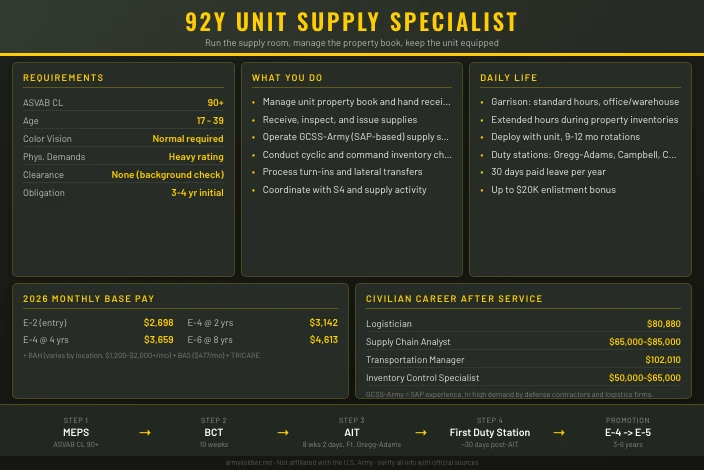
Job Role and Responsibilities
The 92Y Unit Supply Specialist supervises and maintains all Army supplies and equipment at the unit level. Specialists receive, inspect, inventory, store, issue, and deliver individual and organizational supplies and equipment. They maintain property accountability records, manage hand receipts, and operate the GCSS-Army automated supply system to track equipment across the unit property book.
Daily Tasks
A typical garrison day for a 92Y starts with accountability. Every item on the property book must be accounted for, documented, and physically verified on a regular cycle. From there, the day usually involves:
- Processing issue requests from soldiers in the unit, from gloves to night-vision goggles
- Preparing hand receipts and sub-hand receipts for equipment going to individuals
- Receiving incoming supplies, inspecting condition and quantities against manifests
- Entering transactions into GCSS-Army and reconciling any discrepancies
- Managing the supply room’s controlled items, expendables, and durable equipment
- Coordinating equipment turn-ins and lateral transfers with the supporting supply support activity
In the field or during deployment, the pace changes but the accountability doesn’t. Supply operations run continuously, and the 92Y manages property that may be spread across multiple locations or loan arrangements while the unit is in the field.
Specific Roles
The 92Y MOS uses the Army’s standard identifier system. The primary identifier is 92Y, with opportunities to earn Additional Skill Identifiers (ASIs) that authorize specialized duties.
| Identifier | Type | Purpose |
|---|---|---|
| 92Y | Primary MOS | Unit supply and equipment accountability operations |
| ASI | Additional Skill Identifier | Specialized duties such as hazardous materials handling |
| SQI | Special Qualification Identifier | Additional qualifications earned through service |
At the senior NCO level (E-7 and above), 92Y soldiers typically serve as Supply Sergeants or move into battalion-level S4 positions where they supervise multiple supply rooms and advise commanders on logistics readiness.
Mission Contribution
The Army measures combat readiness partly by equipment availability. A battalion commander needs to know exactly how many vehicles, radios, and weapons systems are operational and available right now. The 92Y supplies that answer. When a commander signs a property book hand receipt, the 92Y manages what comes next – every issue, turn-in, and transfer that keeps that equipment accounted for.
Equipment accountability failures have serious consequences. Lost or unaccounted government property can result in financial liability investigations, adverse personnel actions, and readiness shortfalls. The 92Y prevents those failures by maintaining meticulous records and catching discrepancies before they become problems.
Technology and Equipment
The primary platform is GCSS-Army, the Army’s enterprise resource planning system built on SAP. Every supply transaction – from a single pair of boots to a multi-million-dollar vehicle – runs through GCSS-Army. You’ll also work with:
- Standard property accountability software and forms (DA Form 2062, DA Form 3161)
- Material handling equipment including forklifts and pallet jacks at larger installations
- Handheld scanners and barcode systems for inventory tracking
- Army Materiel Status System (AMSS) for readiness reporting
SAP experience from GCSS-Army translates directly to civilian ERP roles. Companies across logistics, manufacturing, and government contracting specifically recruit veterans with hands-on SAP background.
Salary and Benefits
Base pay follows the standard Army enlisted pay table based on grade and years of service. A new 92Y enters as a Private (PV2, E-2) after completing Basic Combat Training. By the time most soldiers hit their first reenlistment window around four years, they’re typically at the Specialist (E-4) or Sergeant (E-5) grade.
Base Pay Table (2026)
| Rank | Grade | Years of Service | Monthly Basic Pay |
|---|---|---|---|
| Private (PV2) | E-2 | Entry | $2,698 |
| Private First Class (PFC) | E-3 | ~1 year | $2,837 |
| Specialist (SPC) | E-4 | ~2 years | $3,142 |
| Specialist (SPC) | E-4 | ~4 years | $3,659 |
| Sergeant (SGT) | E-5 | ~4-6 years | $3,599 |
| Staff Sergeant (SSG) | E-6 | ~8 years | $4,613 |
| Sergeant First Class (SFC) | E-7 | ~12 years | $5,537 |
Source: DFAS 2026 military pay chart. Rates reflect the 3.8% across-the-board increase effective January 1, 2026.
Additional Pay and Allowances
Base pay is only part of total compensation. Soldiers also receive:
- Basic Allowance for Housing (BAH): Varies by duty location, rank, and dependency status. A single E-4 at a major CONUS installation typically receives $1,200 to $2,000+ per month. Use the BAH Rate Lookup tool on the Defense Travel Management Office site for exact figures at your specific duty station.
- Basic Allowance for Subsistence (BAS): $476.95/month flat rate for all enlisted soldiers, regardless of rank or location.
- Enlistment Bonus: The 92Y MOS currently qualifies for an enlistment bonus of up to $20,000, depending on contract length and options selected. Verify current amounts with a recruiter, as bonus availability changes.
Additional Benefits
Healthcare: Active-duty soldiers and their eligible family members receive TRICARE Prime coverage at no cost. There are no enrollment fees, deductibles, or copayments for in-network care. Coverage includes medical, dental, vision, mental health, prescriptions, and hospitalization.
Education: The Army’s Tuition Assistance (TA) program covers up to $4,500 per year and $250 per semester credit hour for college courses taken while on active duty. After six or more years of qualifying active service, the Post-9/11 GI Bill covers full in-state tuition at public universities, a monthly housing allowance based on the school’s ZIP code, and up to $1,000 annually for books.
Retirement: Soldiers who joined after January 1, 2018 fall under the Blended Retirement System (BRS). BRS combines a traditional pension – 2% of high-36 average basic pay per year of service, paying 40% of that average at 20 years – with a government-matched Thrift Savings Plan (TSP). The TSP match begins in the third year of service: 100% match on the first 3% you contribute, 50% match on the next 2%.
Work-Life Balance
Soldiers earn 30 days of paid leave per year, accruing 2.5 days per month. Federal holidays add 11 additional non-duty days. In garrison, supply operations generally run on a normal duty day schedule, though the 92Y may have additional obligations around equipment draws, inventories, and cyclic property books that require extended hours.
Qualifications and Eligibility
The 92Y requires solid math and reading comprehension skills. The work involves constant documentation, numerical verification, and system entry – mistakes create accountability gaps that are difficult to unwind.
Qualification Requirements
| Requirement | Minimum Standard |
|---|---|
| ASVAB Line Score | CL 90 |
| Citizenship | U.S. citizen or permanent resident alien |
| Age | 17-39 (active duty) |
| Education | High school diploma or GED |
| Physical Profile | P-1, H-1, E-1, E-1, S-1 (PULHES) |
| Color Vision | Normal color vision required |
| Physical Demands Rating | Heavy |
| Security Clearance | None required (favorable background check) |
| Conduct | No documented conduct issues reflecting on character, honesty, or integrity in the past five years |
Source: DA Pam 611-21; U.S. Army Quartermaster School.
The CL (Clerical) composite combines Verbal Expression, Arithmetic Reasoning, and Mathematics Knowledge. A CL score of 90 puts you in the upper-middle range – strong enough to verify without being one of the most restrictive scores in the Army.
Application Process
The path to 92Y starts at a Military Entrance Processing Station (MEPS), where you’ll complete:
Selection Criteria and Competitiveness
The 92Y is a moderately competitive MOS. It’s among the Army’s most common support occupations, which means slots are generally available year-round. The enlistment bonus availability signals the Army’s ongoing need for qualified supply specialists. Recruiters can advise on current seat availability and contract options.
Service Obligation
Active-duty enlistment contracts typically run three to four years for initial enlistees. Soldiers enter service as a Private (E-1) and are promoted to Private (PV2, E-2) upon completing Basic Combat Training.
See our ASVAB study guide for strategies to hit these line scores, or take the PiCAT from home if you are a first-time tester.
Work Environment
Supply operations happen primarily indoors – in supply rooms, warehouses, and offices. The setting is climate-controlled more often than not, but you’ll regularly move between the supply room, the motor pool, and the unit arms room depending on the day’s tasks.
Setting and Schedule
In garrison, the 92Y works standard Army duty hours, typically starting with physical training in the early morning and transitioning to supply operations by mid-morning. Extended hours occur around semi-annual property inventories, change-of-command inventories, and cyclic inventory schedules – these periods can require long days and weekend work to complete documentation in time.
In the field or deployed, supply rooms operate as austere versions of their garrison counterparts. You may be working from a tent or vehicle, managing the same accountability requirements with fewer resources and more time pressure.
Leadership and Communication
The 92Y works directly for the unit’s property book officer or the S4, and reports to a Supply Sergeant (SSG or above) in most company-level environments. As a junior specialist, you’ll receive detailed task guidance. As you progress to SGT and SSG, you’ll take ownership of sections of the property book and eventually supervise junior supply specialists.
Performance evaluations come through the Non-Commissioned Officer Evaluation Report (NCOER) at E-5 and above. At E-4 and below, the Army Talent Alignment Process (ATAP) and counseling sessions with your immediate supervisor form the feedback loop.
Team Dynamics and Autonomy
Supply rooms are typically small teams – often two to five soldiers at the company level. You’ll know your teammates well and work closely with them on shared property book responsibilities. At the same time, the 92Y carries individual accountability for specific hand receipts and sub-hand receipts, meaning there’s a personal ownership dimension to the job that most support MOSs don’t have.
Job Satisfaction and Retention
The 92Y has solid retention rates within the CMF 92 career field. Soldiers who enjoy detailed, process-driven work with measurable accountability outcomes tend to find the MOS rewarding. The skills are directly transferable to civilian careers, which motivates many soldiers to complete their initial contract and then evaluate civilian options – or reenlist with a bonus.
Training and Skill Development
Initial Training
Training for 92Y is divided into two phases: Basic Combat Training (BCT) and Advanced Individual Training (AIT).
| Phase | Location | Length | Focus |
|---|---|---|---|
| Basic Combat Training (BCT) | Various Army installations | 10 weeks | Soldier fundamentals, physical conditioning, weapons qualification, Army values |
| Advanced Individual Training (AIT) | Fort Gregg-Adams, VA | 8 weeks, 2 days | Supply operations, GCSS-Army, property accountability, physical security |
BCT takes place at one of several Army installations. You’ll learn basic soldiering skills, Army customs and traditions, weapons qualification, and the physical and mental foundation every soldier needs before moving to specialty training.
AIT for 92Y is conducted at the Logistics Training Department, Fort Gregg-Adams, Virginia. The course runs eight weeks and two days and covers four modules:
- Module A (32 hours): MOS duties overview, Quartermaster heritage, safety, and introduction to supply principles and GCSS-Army
- Module B (53 hours): Manual supply operations – file preparation, hand receipts, and property documentation
- Module C (164.5 hours): Automated supply procedures using GCSS-Army for requesting, receiving, storing, inventorying, and issuing supplies
- Module D (32 hours): Storage requirements, physical security, and preventive maintenance coordination
The heaviest block is Module C, which makes sense – GCSS-Army proficiency is the core job skill for a 92Y, and you’ll spend the majority of AIT learning to work it fluently.
Advanced Training
After AIT, the 92Y’s professional development continues through structured Army schools and on-the-job experience. Key development opportunities include:
- Warrior Leader Course (WLC): Required for promotion to Sergeant (E-5). Focuses on small-unit leadership and tactical skills.
- Advanced Leaders Course (ALC): Required for Staff Sergeant (E-6). Covers NCO leadership, counseling, and branch-specific sustainment operations.
- Senior Leaders Course (SLC): Required for Sergeant First Class (E-7) and focuses on senior NCO roles in logistics management.
- GCSS-Army Super User Training: Authorizes soldiers to perform advanced system administration functions, valuable at battalion and brigade levels.
- Hazardous Materials Handling (HAZMAT): An ASI that expands duties to cover the storage and accountability of hazardous materials on the property book.
- Training With Industry (TWI): The Quartermaster School runs a competitive TWI program for 92Y soldiers that places selected NCOs with civilian logistics companies for a year, then returns them to Army service with direct industry experience.
Everything starts with qualifying ASVAB scores — our study guide covers what to study first.
Career Progression and Advancement
Career Path
CMF 92 supply careers follow a clear progression from individual contributor to senior advisor. The table below shows typical milestones.
| Grade | Rank | Typical TIG | Duty Position |
|---|---|---|---|
| E-1/E-2 | Private (PV1/PV2) | 0-6 months | Supply room clerk, property accountability assistant |
| E-3 | Private First Class (PFC) | 6-12 months | Supply specialist, hand receipt holder |
| E-4 | Specialist (SPC) | 1-3 years | Senior supply specialist, GCSS-Army operator |
| E-5 | Sergeant (SGT) | 4-6 years | Supply team leader, section NCOIC |
| E-6 | Staff Sergeant (SSG) | 6-10 years | Supply Sergeant, property book NCO |
| E-7 | Sergeant First Class (SFC) | 10-15 years | Senior Supply Sergeant, S4 NCOIC |
| E-8 | Master Sergeant (MSG) | 15-20 years | Property Book NCO, G4/J4 logistics staff |
| E-9 | Sergeant Major (SGM) | 20+ years | Senior logistics advisor, CSM track |
TIG = typical time in grade before promotion eligibility. Actual promotion timelines depend on Army-wide promotion cutoff scores, which fluctuate annually.
Specialization Opportunities
Senior 92Y soldiers can pursue positions with Special Operations units, including the 75th Ranger Regiment, the 160th Special Operations Aviation Regiment (SOAR), and USASOC elements. These assignments carry additional requirements – physical fitness standards, background checks, and selection events – but come with higher-visibility work and often additional special pays.
The Warrant Officer track is another option. 91P Warrant Officers serve as Property Accounting Technical Officers and supervise property book operations at battalion and brigade level. A strong 92Y performance record is a competitive foundation for the 91P warrant officer packet.
Role Flexibility and Transfers
The 92Y MOS is useful across every Army branch and unit type, from infantry battalions to medical units to aviation brigades. Every unit has a supply room. That ubiquity means 92Y soldiers have wide latitude in requesting duty stations and unit types through the assignment preference system (ATAP). Cross-training into 92A (Automated Logistical Specialist) or a warrant officer program are the most common lateral moves within CMF 92.
Performance Evaluation
Junior enlisted soldiers (E-1 through E-4) receive developmental counseling from their NCO supervisor. The Army Talent Alignment Process helps match soldiers to assignments based on skills and preferences. At E-5 and above, the NCOER is the primary evaluation instrument. 92Y NCOs are rated on technical proficiency – specifically property accountability outcomes, inventory accuracy, and GCSS-Army management – alongside leadership and character.
Success in this MOS shows up in the numbers: low loss rates, clean cyclic inventories, and zero significant hand receipt discrepancies during command inspections.
Physical Demands and Medical Evaluations
Physical Requirements
The 92Y carries a heavy physical demands rating. Day-to-day supply work involves lifting, carrying, and moving equipment that can weigh up to 100 pounds, including ammunition cases, equipment containers, and vehicle parts. Regular movement between storage areas, motor pools, and supply points is part of the job.
All soldiers must pass the Army Fitness Test (AFT), which replaced the ACFT on June 1, 2025. The AFT has five events scored 0-100 each, with a maximum of 500 points total. The general standard requires a minimum of 60 points per event (300 points total), age- and sex-normed. The 92Y follows the general standard – it is not one of the 21 designated combat MOSs requiring the higher combat specialty standard of 350 points.
AFT Events and Scoring (General Standard)
| Event | Abbreviation | Description | Minimum Score |
|---|---|---|---|
| 3 Rep Max Deadlift | MDL | Maximum weight lifted for 3 repetitions | 60 pts |
| Hand Release Push-Up | HRP | Push-ups with full arm extension at bottom | 60 pts |
| Sprint-Drag-Carry | SDC | 250-meter combined sprint, drag, and carry course | 60 pts |
| Plank | PLK | Timed plank hold | 60 pts |
| Two-Mile Run | 2MR | Timed two-mile run | 60 pts |
Source: army.mil/aft – AFT effective June 1, 2025.
Medical Evaluations
Soldiers receive annual medical readiness screenings and periodic physical examinations throughout their service. The 92Y must maintain the physical profile standards set at accession – particularly the color vision requirement, which is reassessed if a vision-related concern arises. Soldiers with medical conditions that develop during service may be subject to physical evaluation board proceedings if the condition affects duty performance.
Deployment and Duty Stations
Deployment Details
The 92Y deploys with the units it supports. Deployment frequency mirrors the operational tempo of the assigned unit – infantry battalions and aviation units typically deploy more often than garrison-based sustainment commands. A standard deployment cycle runs 9 to 12 months, with 12 to 24 months at home station between rotations, though this varies by unit and Army-wide operational requirements.
Supply operations during deployment are demanding. The 92Y manages accountability for equipment that may be spread across multiple forward operating bases, handles combat losses and found-on-installation property, and processes emergency requisitions under time pressure.
Location Flexibility
The 92Y exists at virtually every Army installation in the United States and overseas. Common duty stations include:
- Fort Gregg-Adams, VA – home of the Quartermaster Corps and sustainment-focused units
- Fort Campbell, KY – 101st Airborne Division and aviation-heavy assignments
- Fort Moore, GA – Maneuver Center of Excellence, infantry and armor units
- Fort Cavazos, TX – III Corps and large combined arms units
- Joint Base Lewis-McChord, WA – I Corps and Pacific-focused assignments
- Overseas: Korea (Camp Humphreys), Germany (Grafenwoehr, Wiesbaden), and other OCONUS locations
Soldiers submit assignment preferences through the Army Talent Alignment Process (ATAP). Availability depends on Army-wide fill requirements, but 92Y soldiers generally have solid options given how broadly the MOS is distributed across unit types.
Risk, Safety, and Legal Considerations
Job Hazards
The 92Y’s primary physical risk is material handling. Moving heavy equipment without proper technique causes musculoskeletal injuries – back strain, shoulder injuries, and knee problems are the most common. Working around vehicles in motor pools, operating forklifts, and handling ammunition crates all carry injury risk if safety procedures are skipped. The work environment is not high-risk compared to combat-focused MOSs, but the physical demands rating of heavy means physical injury is a realistic concern over a full career.
Deployed environments add hazards that don’t exist in garrison. Supply operations in forward areas may place 92Y soldiers near the wire, in convoy environments, or at locations that receive indirect fire. All soldiers receive weapons qualification and basic combat skills training in BCT precisely because support MOSs do get shot at.
Safety Protocols
Army supply operations follow strict safety procedures for material handling equipment, forklift operation, and hazardous materials handling. Soldiers must complete forklift operator certification before operating a lift independently. AIT covers these safety requirements as part of Module D, and unit-level refresher training reinforces them annually.
Required personal protective equipment – steel-toed boots, gloves, and hearing protection in certain work areas – is issued and enforced through standard unit safety programs. Supply rooms that handle hazardous materials have additional protocols under Army Regulation 700-141 for HAZMAT management.
Security and Legal Requirements
The 92Y does not require a formal security clearance for the baseline MOS. A background check is part of the accession process, and conduct issues within the past five years can disqualify an applicant. Soldiers who want to pursue higher-echelon logistics roles or special operations support assignments may later need to apply for a Secret clearance through standard Army channels.
Soldiers are bound by the Uniform Code of Military Justice (UCMJ) and standard Army enlistment contract obligations. Contract lengths vary by enlistment option – typically three or four years for an initial active-duty contract.
Impact on Family and Personal Life
Family Considerations
The 92Y’s garrison work schedule is more predictable than many other Army MOSs. Standard duty hours, lower field exercise frequency compared to combat arms, and a generally stable home station tempo make this one of the more family-friendly enlisted jobs. Extended hours during property book events and command inspections are the main exception, and those periods are predictable on the calendar rather than sudden.
Military OneSource provides free counseling, financial consultations, and resource referrals to active-duty families. The Family Readiness Group (FRG) at the unit level connects spouses and family members during deployments and field exercises. Army Community Service (ACS) offices on post offer employment assistance for military spouses, financial readiness workshops, and relocation support. Health coverage through TRICARE extends to all eligible dependents at no cost.
Childcare is one of the bigger practical concerns for military families. On-post child development centers (CDCs) provide subsidized care, but waitlists at high-demand installations can stretch months. Many families supplement with off-post options. The Army’s Child Care in Your Neighborhood (CCYN) program subsidizes off-post childcare costs for families who can’t get on-post slots.
Relocation and Flexibility
Army families relocate every two to three years through the Permanent Change of Station (PCS) process. Each move comes with relocation pay (moving allowances) and access to on-post housing or a BAH rate calculated for the new duty location. Fort Gregg-Adams is a mid-sized installation in the Petersburg, Virginia area with access to the Hampton Roads metro region – a reasonable first-duty-station environment for families, with access to Virginia Beach, Richmond, and the broader Tidewater region.
The 92Y’s distribution across nearly every Army installation means your preference list for ATAP can be realistic rather than aspirational. Soldiers who want a specific region – the Pacific Northwest, Hawaii, or Europe – have a better shot with a support MOS than with a specialty that’s concentrated at a handful of posts. Soldiers with strong records and competitive ATAP profiles have meaningful input into where they’re assigned, though the Army’s needs always take priority over individual preferences.
Reserve and National Guard
The 92Y Unit Supply Specialist is available in both the Army Reserve and Army National Guard. It is one of the most common MOS across all Reserve components because every company-level unit needs a supply room. If there is a Guard or Reserve unit within driving distance, there is likely a 92Y slot. Skill-level progression through SL4 is fully supported, and senior NCO positions are available at battalion and brigade levels.
Drill Schedule and Training Commitment
Standard commitment is one weekend per month (Battle Assembly) plus two weeks of Annual Training per year. Drill weekends for 92Y soldiers typically include property accountability checks, GCSS-Army data entry, supply room inventories, and hand receipt updates. Annual Training involves running the supply chain for a larger field exercise. The training commitment is standard with no unusual additional requirements beyond normal PME courses.
Part-Time Pay
An E-4 with over 3 years of service earns about $464 per drill weekend (4 drill periods), totaling roughly $5,572 per year from drill pay plus about $1,741 for 15 days of Annual Training. Active-duty E-4 base pay is $3,482 per month. Most Reserve/Guard 92Y soldiers hold civilian supply chain or warehouse jobs that often pay more than active-duty enlisted rates.
Benefits Differences
Tricare Reserve Select costs $57.88 per month for member-only or $286.66 per month for family coverage in 2026. Active-duty TRICARE Prime is free. TRS is well below civilian marketplace averages.
Education benefits include Federal Tuition Assistance ($250 per credit hour, up to $4,500 per year) and the Montgomery GI Bill-Selected Reserve at $493 per month for full-time students. Guard members may qualify for state tuition waivers. Mobilization of 90 or more days earns Post-9/11 GI Bill eligibility.
Reserve retirement is points-based, requiring 20 qualifying years. Collection starts at age 60, reduced by 3 months per 90-day mobilization after January 2008, minimum age 50.
Deployment and Mobilization
92Y soldiers in Reserve/Guard units see moderate mobilization rates. Every deploying unit needs supply support, and Reserve component 92Y soldiers have been activated regularly for rotations to Kuwait, Europe, and other theaters. Typical mobilizations last 9 to 12 months. The high number of 92Y positions across the force means individual mobilization frequency is spread out, but most career 92Y soldiers will experience at least one activation.
Civilian Career Integration
The 92Y is one of the most transferable Reserve/Guard MOS. Property accountability, inventory management, and GCSS-Army experience translate directly to warehouse management, supply chain coordination, and logistics roles in the civilian sector. Employers in distribution, retail, manufacturing, and government agencies actively recruit candidates with military supply experience. USERRA protects your civilian job during activations, requiring reemployment with the seniority and pay you would have earned. Health insurance continues for up to 24 months during military leave.
| Feature | Active Duty | Army Reserve | Army National Guard |
|---|---|---|---|
| Commitment | Full-time | 1 weekend/month + 2 weeks/year | 1 weekend/month + 2 weeks/year |
| Monthly Pay (E-4, 3+ yrs) | $3,482 | ~$464/drill weekend | ~$464/drill weekend |
| Healthcare | TRICARE Prime ($0) | Tricare Reserve Select ($57.88/mo) | Tricare Reserve Select ($57.88/mo) |
| Education | Federal TA, Post-9/11 GI Bill | Federal TA, MGIB-SR ($493/mo) | Federal TA, MGIB-SR, state tuition waivers |
| Deployment Tempo | Regular rotations | Moderate mobilization cycles | Moderate mobilization cycles |
| Retirement | 20-year pension at age 40+ | Points-based, collect at age 60 | Points-based, collect at age 60 |
Post-Service Opportunities
Transition to Civilian Life
The supply and logistics skills a 92Y builds are in demand across every sector that moves, stores, or tracks physical goods – retail, defense contracting, government, healthcare, manufacturing, and e-commerce. The specific advantage is GCSS-Army, which is built on SAP. SAP is one of the most widely deployed enterprise systems in the world, and Army-trained operators often qualify for supply chain analyst, ERP consultant, and warehouse manager roles that pay significantly more than similar positions without systems experience.
The Transition Assistance Program (TAP) provides mandatory pre-separation counseling, job search support, and connections to education resources. SkillBridge, a DOD program, lets soldiers work with civilian employers for up to 180 days before their separation date – with several logistics and supply chain companies actively participating.
Civilian Career Prospects
| Civilian Job Title | Median Annual Salary (2024) | Job Outlook (2024-2034) |
|---|---|---|
| Logistician | $80,880 | +17% (much faster than average) |
| Transportation, Storage & Distribution Manager | $102,010 | +6% (faster than average) |
| Inventory Control Specialist | $50,000-$65,000 | Steady demand across sectors |
| Supply Chain Analyst | $65,000-$85,000 | Growing with e-commerce expansion |
Source: BLS Occupational Outlook Handbook, May 2024 data.
Certifications that complement 92Y experience include the APICS Certified in Logistics, Transportation and Distribution (CLTD), the APICS Certified Supply Chain Professional (CSCP), and the Certified Professional in Supply Management (CPSM). Many of these certifications give credit for military experience in their eligibility requirements.
Discharge and Separation Options
Soldiers who complete their initial contract can separate honorably and access GI Bill benefits, veteran hiring preferences, and transition support programs. Those who wish to leave before their contract ends must apply through administrative separation channels – early separation is not guaranteed and depends on Army-wide needs and the nature of the request.
Is This a Good Job for You? The Right (and Wrong) Fit
Ideal Candidate Profile
The 92Y is a strong match if you:
- Are organized and detail-oriented – property book errors follow you
- Enjoy working with systems and data rather than purely physical tasks
- Want a transferable civilian skill set in a field with strong job growth
- Prefer a more predictable schedule than combat arms MOSs
- Can work independently on multi-step accountability tasks without constant supervision
- Have solid math skills and can catch numerical discrepancies under pressure
Soldiers who do well in this MOS tend to be methodical, consistent, and good at documentation. The job rewards people who take pride in keeping things in order.
Potential Challenges
The 92Y is not a good fit if you:
- Prefer fast-paced, field-heavy, or physical work over office and warehouse operations
- Struggle with repetitive administrative tasks
- Have difficulty maintaining focus on detailed documentation
- Are uncomfortable with personal financial liability for government property
The flip side of a predictable schedule is that supply work can feel repetitive in garrison. Property accountability has a procedural rhythm that doesn’t change much week to week. Some soldiers find that rewarding; others find it monotonous.
Career and Lifestyle Alignment
For soldiers who want a structured support role, a direct path to civilian supply chain careers, and a duty schedule that’s compatible with family life, the 92Y offers a strong combination. The enlistment bonus, GI Bill benefits, and SAP system experience make this MOS financially attractive beyond the base pay figures alone.
Soldiers who want more field time, combat arms proximity, or technical depth should look at other CMF 92 options like 92F (Petroleum Supply Specialist) or consider cross-training into 92A (Automated Logistical Specialist), which works at a higher echelon of supply operations.
More Information
Talk to an Army recruiter to confirm current bonus amounts, AIT seat availability, and contract options for 92Y. Bonus figures change regularly and the recruiter has access to real-time incentive information that this guide cannot provide. You can reach a recruiter at goarmy.com or by calling 1-888-550-ARMY (2769).
- Prepare for the ASVAB with our study guide to make sure your line scores qualify
This site is not affiliated with the U.S. Army or any government agency. Verify all information with official Army sources before making enlistment or career decisions.
Explore more Army transportation and logistics careers such as the 92A Automated Logistical Specialist and the 92F Petroleum Supply Specialist.