42B Adjutant General Officer
Every Army unit has a commander. Every commander has an S1. The Adjutant General officer is that officer, and the job is a lot harder than it looks on paper. Personnel accountability, casualty operations, strength management, postal services, and talent programs all run through the AG Corps. When a unit deploys without the right number of soldiers, when a casualty report reaches a family before it should, when a promotion packet sits unprocessed for months – those failures trace back to this branch.
The AG Corps is the second-oldest branch in the U.S. Army, established in 1775. Today’s 42B Human Resources Officer manages a personnel system that covers 1.1 million soldiers across all components, now integrated through the Army’s Integrated Personnel and Pay System (IPPS-A). If you want a commission that puts you at the center of how the Army manages its most important resource – people – the AG branch is worth a close look.
OCS candidates need a GT score of 110 on the ASVAB — our ASVAB for OCS guide covers exactly how to hit that number.
Job Role and Responsibilities
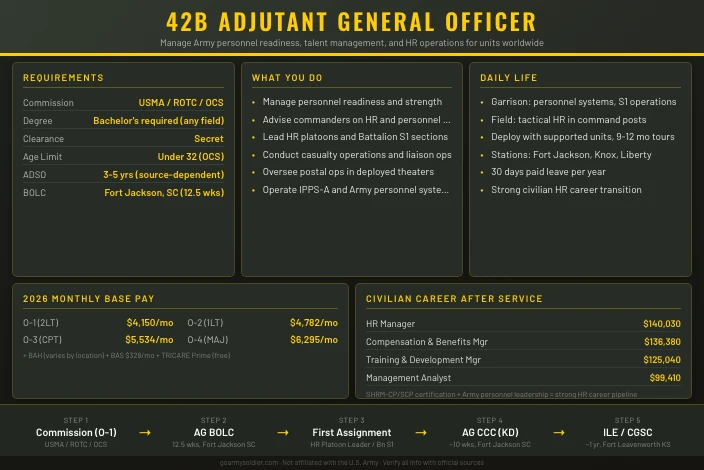
The 42B Adjutant General Officer is the Army’s human resources expert, responsible for managing personnel readiness, strength reporting, talent management, casualty operations, and postal services across a unit or organization. As the primary HR advisor to commanders, the AG officer ensures every soldier in the formation is tracked, qualified, assigned, and supported. The branch spans from platoon-level HR units to theater-level personnel operations, making the AG officer one of the most widely distributed officer specialties in the Army.
Command and Leadership Scope
At the lieutenant level, a 42B officer typically leads either an HR Platoon or serves as a Battalion S1. An HR Platoon may include 20 to 40 soldiers providing direct personnel support to a brigade. As a Battalion S1, the officer is the sole HR staff officer for a battalion of 500 to 800 soldiers, advising the battalion commander on all personnel matters.
Captains serve primarily as Battalion S1s in key developmental assignments, managing personnel readiness, awards processing, reassignment actions, and casualty reporting for their entire formation. At this level, the AG officer owns the personnel accountability mission during field exercises and deployments.
Field grade officers take on progressively larger HR organizations. Majors serve as Brigade S1s or Division HROC Chiefs, managing personnel operations for formations of several thousand soldiers. Lieutenant Colonels and Colonels command HR battalions or serve as G1s at division, corps, and Army command headquarters.
Specific Roles and Designations
| Designation | Code | Level | Description |
|---|---|---|---|
| Entry AOC | 42A | O-1 to O-3 | Awarded upon BOLC completion; not used to code positions |
| HR Officer AOC | 42B | O-3+ | Primary AOC for career AG officers post-CCC |
| Senior HR Officer | 42H | O-4+ | Awarded to officers completing non-AG CCC with HRMQC |
| Branch Detail | Varies | O-1 to O-3 | Some AG officers are detailed to another branch (IN, AR, EN) as lieutenants before redesignating AG |
Mission Contribution
The AG Corps exists to maximize operational effectiveness by ensuring the right soldiers are in the right places at the right times. Personnel readiness is a direct combat multiplier – units that go into the field under-strength or with untrained soldiers have reduced combat power before the first shot is fired.
In deployed environments, AG officers run the Human Resources Operations Center (HROC), manage theater-level strength reporting, coordinate casualty liaison operations, and oversee postal operations that sustain morale across the force. These functions are not administrative backwater tasks; they are operational requirements that commanders depend on every day.
Technology, Equipment, and Systems
AG officers work extensively with IPPS-A, the Army’s integrated personnel and pay system that replaced more than 30 legacy systems. They also use the Defense Casualty Information Processing System (DCIPS) for casualty reporting, the Electronic Military Personnel Office (eMILPO) for personnel transactions, and the Total Officer Personnel Management Information System (TOPMIS) for officer assignment management.
At the field level, AG officers manage HR systems through the Standard Army Management Information Systems (STAMIS) suite and employ tactical communications systems to sustain personnel operations in austere environments.
Salary and Benefits
Officer Base Pay
AG officers earn standard military base pay set by Congress each year. The figures below reflect 2026 rates from DFAS.
| Rank | Grade | Typical YOS | Monthly Base Pay |
|---|---|---|---|
| Second Lieutenant | O-1 | Less than 2 | $4,150 |
| First Lieutenant | O-2 | 2-3 | $5,446 |
| Captain | O-3 | 4-6 | $7,383 – $7,737 |
| Major | O-4 | 10-12 | $9,420 – $9,888 |
| Lieutenant Colonel | O-5 | 16-18 | $11,391 – $11,714 |
| Colonel | O-6 | 22-24 | $14,113 – $14,479 |
Special Pays and Bonuses
AG officers do not earn hazardous duty pay or flight pay in standard assignments. Officers assigned to airborne-coded billets earn jump pay of $150/month while maintaining currency. Special Duty Assignment Pay (SDAP) applies to specific assignments like ROTC cadre and recruiting duty.
No accession bonus currently applies to AG branch. The Army periodically offers selective continuation pay and retention incentives at the 8-12 year mark under the Blended Retirement System (BRS) continuation pay window.
Additional Benefits
All officers receive a package of non-taxable allowances and benefits that substantially increase total compensation:
- BAS (Basic Allowance for Subsistence): $328.48/month for officers (2026 rate)
- BAH: Varies by duty station and dependency status. At Fort Sam Houston, an O-3 without dependents receives $2,007/month; with dependents, $2,127/month. Officers at higher-cost installations receive proportionally higher rates.
- TRICARE Prime: Zero-cost healthcare coverage for the officer and family members, with no premiums, deductibles, or copays for in-network care
- Dental and vision coverage included
- 30 days paid leave per year
The Blended Retirement System (BRS) combines a 20-year pension at 40% of high-36 average base pay with TSP matching. The government contributes 1% automatically and matches up to 4% more when the officer contributes 5% of basic pay. The TSP matching begins in the third year of service.
Work-Life Balance
Garrison life generally runs a structured duty day. Officers typically work 0630 to 1700, with additional time required during training cycles, exercises, and personnel action surges around Army-wide personnel management boards. Deployment changes that calculus significantly. In theater, AG officers often operate long hours supporting continuous personnel operations, casualty reporting, and strength management across time zones.
Leave policies allow 30 days per year with a maximum carryover of 60 days. Most officers take at least two weeks annually, though operational tempo at some assignments makes leave difficult to schedule during peak periods.
Qualifications and Eligibility
Commissioning Sources
AG officers commission through three primary paths: USMA, ROTC, and OCS. A direct commission program also exists for civilian HR professionals who meet specific criteria.
| Commissioning Source | Degree Requirement | GPA Minimum | Age Limit | Service Obligation |
|---|---|---|---|---|
| USMA (West Point) | BS awarded at graduation | Academic standing per USMA standards | Under 23 at entry | 5 years active duty |
| Army ROTC | Bachelor’s degree | 2.0 minimum; competitive applicants typically higher | Under 31 at commissioning | 4 years active duty (8 years total service) |
| OCS | Bachelor’s degree (any field) | 2.0 minimum; board competitive | Under 32 at commissioning | 3 years active duty |
| Direct Commission | Bachelor’s degree; relevant HR experience | Board-assessed | Under 42 at commissioning | 3 years active duty |
Branch Selection and Assignment
ROTC cadets compete for AG through the Order of Merit List (OML) process. AG is generally considered a mid-tier competitive branch, meaning cadets with strong OML scores can typically secure it but it’s not guaranteed without deliberate effort. AG participates in branch detailing, so some newly commissioned officers serve two to three years in a combat arms or combat support branch before redesignating AG.
USMA graduates compete through a similar OML-based system. OCS candidates indicate branch preferences and are assigned by a board after commissioning. All officers enter at O-1 (Second Lieutenant).
Test Requirements
Officers are not required to take the ASVAB. Commissioning through OCS requires a college degree and competitive scores on officer assessment tools evaluated during the OCS selection process. The SIFT is not required for AG branch.
Security Clearance
AG officers must be eligible for and maintain a Secret security clearance. This requires a background investigation covering financial history, foreign contacts, and personal conduct. Most commissioning-age candidates clear this threshold without difficulty, but certain financial problems, drug use history, or foreign national family ties can complicate the process.
Upon Commissioning
New AG officers commission at O-1 (2LT) and are assigned to AG BOLC at Fort Jackson, SC, within months of commissioning. The standard ADSO for ROTC-commissioned officers is 4 years of active duty (with an 8-year total military service commitment). OCS officers owe a minimum of 3 years. USMA graduates owe 5 years.
OCS candidates can find a focused GT study plan in our ASVAB for OCS guide.
Work Environment
Setting and Schedule
Most AG officers work in standard office or staff environments – either a battalion or brigade S1 shop, an HR company headquarters, or a G1 section at a higher echelon. The work involves computer-based personnel management, coordination with HRC and higher-level G1 shops, direct counseling of soldiers on personnel matters, and briefing commanders on strength and readiness data.
Field exercises do pull AG officers into the field. HR platoons and S1 sections train alongside the units they support, operating HR systems from tactical operations centers and field command posts. In deployed environments, the work environment shifts to forward operating bases, and the pace accelerates sharply.
Leadership and Chain of Command
As a lieutenant serving as a Battalion S1, the AG officer is a staff officer with direct access to the battalion commander and XO. The relationship with the battalion S1 NCOIC – typically a Sergeant First Class (SFC) – is critical. The senior NCO manages the day-to-day operations of the S1 shop and is the most experienced HR practitioner in the section. New lieutenants who listen to that NCO perform better and make fewer process errors.
At the captain level in command or senior staff positions, the officer-NCO dynamic shifts. The AG captain is accountable for the output of the entire S1 section and must lead the team while also advising the commander.
Staff vs. Command Roles
AG officers spend the majority of their careers in staff positions rather than command. At the company grade level, the Battalion S1 role is a staff position, though HR Platoon Leader roles do exist. Company command opportunities exist but are less common than in combat arms branches.
At field grade, AG officers typically cycle between staff positions (Brigade S1, Division G1, Corps G1), command opportunities at the battalion level, and broadening assignments. Officers who invest in both command and staff performance tend to build more competitive files.
Job Satisfaction and Retention
AG officers who thrive in this branch tend to value people-focused work and find meaning in solving the personnel problems that affect soldiers’ careers and families. The branch offers predictable garrison schedules relative to combat arms, which matters for officers with families. The work is meaningful and tangible – a promotion packet processed correctly changes a soldier’s life; a casualty report handled properly preserves a family’s dignity during the worst moment of their lives.
Retention through the captain zone is generally solid. Officers who find the administrative workload frustrating or who prefer direct tactical command tend to leave after their initial obligation.
Training and Skill Development
Pre-Commissioning Training
ROTC cadets complete a four-year program that includes the Leadership Assessment Course (formerly LDAC) at Fort Knox, tactical training at camps and field exercises, and coursework in military science. OCS candidates complete a 12-week program at Fort Moore, GA, covering basic officer skills before branching. USMA graduates receive four years of military and academic training.
Basic Officer Leader Course (BOLC)
AG BOLC is conducted at the Soldier Support Institute at Fort Jackson, SC. The course runs 12 weeks and 5 days.
| Phase | Duration | Focus |
|---|---|---|
| Army Common Core | Weeks 1-2 | Shared officer skills, Army values, basic tactics |
| HR Core Competencies | Weeks 3-7 | Personnel Information Management, Personnel Readiness Management, Talent Management, casualty operations, postal operations |
| Leadership Fundamentals | Weeks 8-9 | Weapons qualification, land navigation, platoon training management, property accountability |
| Practicum / Integration | Weeks 10-12 | Applied HR operations, IPPS-A systems training, capstone exercises |
Officers leave BOLC prepared to serve as a Brigade Strength Manager, Battalion S1, or HR Platoon Leader. The course covers both the doctrinal HR competencies and the technical systems AG officers will use throughout their careers.
Professional Military Education (PME)
Additional Schools and Training
AG officers may attend Airborne School at Fort Moore, GA (3 weeks) to qualify for airborne-coded HR billets. Ranger School is not typically required for AG officers but is respected on any officer’s record. Officers selected for joint assignments may attend joint courses at the Defense Language Institute or the Joint Enabling Capabilities Command.
The Army offers fully funded graduate education through the Advanced Civil Schooling (ACS) program, available to officers after completing their KD assignment. HR management, public administration, and organizational development are common degree tracks for AG officers.
Before OCS, you need a qualifying GT score — see our ASVAB for OCS guide.
Career Progression and Advancement
Career Timeline
| Rank | Typical YOS | Key Developmental Positions |
|---|---|---|
| 2LT (O-1) | 0-2 | AG BOLC, initial unit assignment, HR Platoon Leader |
| 1LT (O-2) | 2-3 | Battalion S1, HR Platoon Leader |
| CPT (O-3) | 3-7 | Battalion S1 (primary KD), HR Company Commander |
| MAJ (O-4) | 7-12 | Brigade/Group S1, Division HROC Chief, Corps Strength Manager, Bn XO or S3 |
| LTC (O-5) | 12-18 | HR Battalion Commander, Division G1, Corps G1 |
| COL (O-6) | 18-24 | Senior G1, ASCC G1, HRC Director, AG Regimental Headquarters |
O-1 through O-3 promotions occur essentially automatically with time in grade, provided officers meet basic standards. O-4 and above are board-selected. Army-wide promotion rates to major have historically run in the 80-85% range, while lieutenant colonel rates run closer to 70% and colonel rates closer to 50%.
Building a Competitive Record
For an AG officer competing for field grade and beyond, the key levers are:
- Rated months in KD: Captains need a minimum of 18 rated months in a Battalion S1 role. More is better.
- Senior rater blocks: Consistent “Most Qualified” senior rater assessments drive board selection more than almost anything else.
- PME completion: Being ahead of zone on ILE attendance matters to O-5 boards.
- Joint service: A joint assignment at the O-4 or O-5 level signals breadth and builds relationships outside the AG community.
- Advanced degree: An ACS-funded graduate degree or a civilian master’s completed on personal time is expected at the O-5 and O-6 level.
Functional Areas and Branching Out
After completing KD assignments, AG officers may apply for Functional Area designation. Common transitions for AG officers include:
- FA 51 (Acquisition): AG officers with contracting or resource management experience sometimes transition here.
- FA 49 (ORSA): Officers with quantitative skills and data analysis backgrounds compete for operations research roles.
- FA 57 (Simulations): Less common for AG, but available to officers with the right technical background.
Voluntary Transfer Incentive Program (VTIP) allows officers to request transfer to another branch or functional area, typically between the 5th and 14th year of service.
Physical Demands and Medical Evaluations
AG officers must pass the Army Fitness Test (AFT) on the same standards as all Army officers. The AFT replaced the ACFT on June 1, 2025. It has five events scored from 0 to 100 each, with a maximum of 500 points total.
| Event | Abbreviation | Minimum Score |
|---|---|---|
| 3 Rep Max Deadlift | MDL | 60 |
| Hand Release Push-Up | HRP | 60 |
| Sprint-Drag-Carry | SDC | 60 |
| Plank | PLK | 60 |
| Two-Mile Run | 2MR | 60 |
General passing standard: 300 total points (60 per event), sex- and age-normed. AG is not a designated combat specialty, so the 350-point combat specialty standard does not apply to this branch.
No flight physical or branch-specific medical evaluation is required for AG officers beyond the standard officer commissioning physical. Officers must meet standard commissioning medical standards, which include vision correctable to 20/20 and general physical fitness.
Deployment and Duty Stations
Deployment Details
AG officers deploy with their supported units across the full range of military operations. Deployment tempo depends heavily on the unit – AG officers assigned to combat brigades deploying on 9-month or 12-month rotations will deploy at the same rate as those units. Officers assigned to AG-specific units like HR companies may deploy on theater-level support missions.
Typical deployments involve managing personnel readiness reporting, coordinating replacement operations, running casualty liaison functions, and sustaining postal operations in theater. AG officers at deployed headquarters manage the full personnel accountability mission for forces across a theater.
The AG branch is present in every type of deployment: combat rotations, peacekeeping operations, security cooperation missions, and rotational training deployments to Europe, Korea, and the Indo-Pacific.
Duty Station Options
AG officers serve at virtually every Army installation because every unit has an S1. Primary installations with significant AG-specific units or schoolhouses include:
- Fort Jackson, SC – Home of the Soldier Support Institute and AG School; many officers return for training and instructor assignments
- Fort Knox, KY – HRC headquarters; significant concentration of AG officers in career management roles
- Fort Liberty, NC – XVIII Airborne Corps and 82nd Airborne Division; high operational tempo
- Fort Campbell, KY – 101st Airborne Division
- Fort Cavazos, TX – III Corps; large installation with multiple brigade-level AG billets
- Joint Base Lewis-McChord, WA – I Corps; Pacific-oriented assignments
- OCONUS: Germany (V Corps, USAREUR-AF), Korea (8th Army), and Hawaii (25th Infantry Division) all carry AG officer billets
Assignment preferences are submitted through HRC. Officers can request preferred locations, but the Army fills needs first. Officers in high-demand positions at specific echelons have less flexibility than those in more widely distributed roles.
Risk, Safety, and Legal Considerations
Job Hazards
AG is a combat support branch. Officers deploy to forward operating bases and work in the same environments as the units they support. The direct physical risks are lower than for combat arms officers, but AG officers in deployed settings face indirect fire threats, convoy exposure, and the hazards common to all deployed soldiers.
The more significant risks for AG officers are administrative and legal. Personnel errors – a wrong assignment, a mishandled promotion, an incorrect casualty notification – have real consequences for soldiers and families. Errors in strength reporting can affect how commanders allocate resources and make decisions.
Legal and Command Responsibility
AG officers carry standard officer UCMJ authority and command responsibility within their formations. Officers commanding HR companies are subject to the full weight of command responsibility, including accountability for the conduct of their soldiers, the accuracy of their unit’s personnel records, and compliance with Army regulations.
Command climate surveys and Equal Opportunity requirements apply equally to AG officers in command. Officers who receive relief for cause face the same career consequences as in any other branch – a relief typically ends the likelihood of further promotion.
Safety Protocols
AG officers apply standard risk management principles (CRM – Composite Risk Management) to their operations. In HR companies and HR platoons conducting convoy or field operations, officers are responsible for conducting risk assessments and mitigating hazards. The office environment carries different but real risks: data security, privacy act compliance, and information security are persistent concerns given the sensitive nature of personnel data.
Impact on Family and Personal Life
Family Considerations
The AG Corps offers a somewhat more predictable schedule than combat arms branches, particularly during garrison periods. Regular duty hours, fewer extended field exercises, and staff-oriented assignments mean AG officers often have more consistent family time than their Infantry or Armor counterparts.
PCS moves occur approximately every two to three years, which is standard across all officer branches. Families can expect four to seven moves over a 20-year career. Army Community Service (ACS), the Family Readiness Group (FRG) network, and installation support programs exist at every major post to help families navigate moves and deployments.
The Army’s Military OneSource program provides free counseling, financial planning assistance, and transition support to all active-duty families.
Dual-Military and Family Planning
Dual-military AG couples can request join spouse assignments through HRC. The Army accommodates these requests when possible, but assignment needs can override preferences. AG officers at widely distributed installations have more geographic flexibility than branch-detail-constrained officers.
Family care plans are required for single parents and dual-military couples with children. Soldiers who cannot meet deployment requirements due to family care plan failures face potential separation. Officers considering this branch while managing complex family situations should consult their unit’s Family Support services early.
Reserve and National Guard
Component Availability
The AG branch is available in both the Army Reserve and the Army National Guard. HR battalions, HR companies, and AG staff positions exist across all components. The Reserve and Guard components provide a significant portion of the Army’s theater-level HR capacity during mobilizations.
Commissioning Paths
Reserve component AG officers commission through the same sources as active duty – ROTC with a Reserve component contract, state Guard OCS programs, or direct commission. ROTC cadets who select a Reserve obligation can request AG branch through the same OML process. Guard OCS programs, run by individual states, commission officers who then affiliate with their state’s National Guard units.
Active-duty AG officers who complete their ADSO can transfer to the Army Reserve or a state Guard unit. This allows them to continue serving while pursuing civilian careers.
Drill and Training Commitment
The standard Reserve and Guard commitment is one weekend per month (four drill periods) plus two weeks of Annual Training. AG positions may require additional training days for IPPS-A system certifications, unit readiness exercises, and personnel management board preparation. Some AG units conduct multi-day exercises beyond the standard schedule in years when major training events are scheduled.
Part-Time Pay
A Reserve or Guard AG officer at the O-3 grade earns approximately $738/weekend (4 drill periods) at less than 2 years of service, rising to approximately $903/weekend at 3 years of service. These figures reflect 2026 drill pay rates.
Benefits Comparison
| Category | Active Duty | Army Reserve | Army National Guard |
|---|---|---|---|
| Commitment | Full-time | 1 weekend/month + 2 weeks/year | 1 weekend/month + 2 weeks/year |
| Monthly Pay (O-3) | $5,534 – $9,004 (base) | ~$738 – $903/weekend | ~$738 – $903/weekend |
| Healthcare | TRICARE Prime ($0 premium) | TRICARE Reserve Select ($57.88/month individual) | TRICARE Reserve Select ($57.88/month individual) + state benefits vary |
| Education | Full TA + GI Bill at 100% | Federal TA + MGIB-SR ($493/month) | Federal TA + MGIB-SR + state tuition waivers (varies by state) |
| Deployment Tempo | Continuous based on unit | Periodic; mobilizations 9-12 months | Periodic; federal and state activations |
| Command Billets | Company through Army command | HR company and battalion commands | HR company and battalion commands |
| Retirement | 20-year pension at 40% high-36 | Points-based, collect at age 60 | Points-based, collect at age 60; earlier collection possible with qualifying service |
Deployment and Mobilization
Reserve and Guard AG officers have been mobilized regularly since 9/11. Theater-level HR organizations – the HROCs and HR companies that run large-scale personnel operations in deployed theaters – draw heavily from Reserve component units. Mobilizations typically run 9 to 12 months. Officers in operational AG units should expect deployment over a 20-year Reserve career.
Civilian Career Integration
AG branch pairs well with civilian HR careers. A Guard or Reserve AG officer working as a civilian HR manager, compensation analyst, or talent acquisition director gains directly transferable skills in both directions. The military HR framework – managing large workforces, navigating complex policy environments, and advising senior leaders – translates directly to corporate HR leadership.
USERRA protects Reserve and Guard officers’ civilian employment rights. Employers must reemploy returning service members in the same or comparable position after deployments of up to five cumulative years.
Post-Service Opportunities
Transition to Civilian Life
AG officers leave the Army with a strong foundation for civilian HR leadership roles. The Army’s Soldier for Life Transition Assistance Program (SFL-TAP) provides career counseling, resume assistance, and networking support beginning up to two years before separation. The Hiring Our Heroes program connects transitioning officers with corporate sponsors, and the Army Career Alumni Program (ACAP) offers additional transition resources.
Industries that actively recruit former AG officers include defense contracting, federal government civilian service, healthcare systems, financial services, and large corporations with complex HR compliance environments.
Civilian Career Prospects
| Civilian Role | Median Annual Salary (BLS, 2024) | Job Outlook |
|---|---|---|
| Human Resources Manager | $140,030 | +5% (2024-2034) |
| HR Specialist | $67,650 | +8% (2024-2034) |
| Compensation and Benefits Manager | $136,380 | +4% (2024-2034) |
| Training and Development Manager | $125,040 | +6% (2024-2034) |
| Management Analyst (Consultant) | $99,410 | +11% (2024-2034) |
Salary data from the Bureau of Labor Statistics Occupational Outlook Handbook.
An AG officer with 8-12 years of active service is competitive for senior HR specialist and early management roles at major corporations and federal agencies. Officers with 20 years of service often enter at the HR director or VP level.
Civilian Credentials and Education
AG officers gain experience managing personnel systems that align with the Society for Human Resource Management (SHRM) body of competencies. The SHRM-CP and SHRM-SCP certifications are the industry standard for civilian HR professionals, and former AG officers enter certification programs with a significant knowledge base already in place.
The Post-9/11 GI Bill covers full in-state tuition at public universities or up to $29,920.95 per academic year at private institutions, plus a monthly housing allowance. Officers who serve 36 or more months on active duty qualify at the 100% benefit level. The benefit can also be transferred to dependents after 6 years of service with an additional 4-year obligation.
Federal civilian employment is another strong pipeline. HR management positions at GS-12 through GS-14 are realistic targets for transitioning AG officers, and veterans’ preference provides a competitive advantage in federal hiring.
Is This a Good Job for You? The Right (and Wrong) Fit
Ideal Candidate Profile
The AG branch works well for officers who are genuinely interested in people – not in managing paperwork about people, but in the real problems that affect soldiers’ careers and families. An AG officer who views the S1 shop as a service function and approaches personnel problems the same way a good doctor approaches a patient tends to build a strong reputation fast.
Strong candidates are organized, detail-oriented, and comfortable working with data systems. They can brief a commander on personnel readiness with the same ease they counsel a soldier on a pay problem. They understand that accuracy matters – a casualty notification with a wrong name destroys a family’s trust in the Army.
Potential Challenges
Officers who chose this branch expecting a path to battalion command in the traditional combat arms sense will be disappointed. Command opportunities exist but are limited compared to Infantry, Armor, or even Field Artillery. Officers who define their military identity around combat arms tactical work will find the AG mission professionally unsatisfying.
The administrative load can be relentless. During Army-wide evaluation report or promotion board seasons, S1 shops process enormous volumes of personnel actions under hard deadlines. Officers who struggle with sustained administrative work or with managing large volumes of error-prone transactions will find this exhausting.
Career and Lifestyle Alignment
For an officer who wants a 20-year career with predictable garrison schedules, meaningful work supporting soldiers, strong civilian career translation, and a lower physical risk profile than combat arms, the AG branch is a good fit. The work has genuine impact at every level of the Army.
For an officer prioritizing combat command, tactical operations, or physical intensity, another branch will be a better match. The AG Corps is not a path to infantry tactics or armored warfare – it is a path to running the personnel system that makes the entire Army work.
More Information
Talk to an Army officer recruiter or your ROTC battalion cadre to get current branch selection data, bonus availability, and any changes to BOLC scheduling. The Army’s official career page for 42B is a starting point, but a direct conversation with someone who has worked in the AG branch will tell you more than any website. If you’re on the OCS path, check the OCS website at Fort Moore for current application requirements and class schedules.
- OCS candidates: prepare for GT 110 with our ASVAB for OCS study guide
This site is not affiliated with the U.S. Army or any government agency. Verify all information with official Army sources before making enlistment or career decisions.
Explore more Army officer careers such as the 36A Finance Officer and 25A Signal Officer.