14A Air Defense Artillery Officer
Nearly 59 percent of all Air Defenders serve overseas at any given time. As a 14A Air Defense Artillery (ADA) Officer, you will lead soldiers who protect forces, installations, and critical assets from aircraft, ballistic missiles, cruise missiles, drones, and rockets. The branch is growing faster than it has in decades, with new M-SHORAD and IFPC battalions standing up across the Army to meet threats from peer adversaries.
You commission as a Second Lieutenant and immediately take charge of 15 to 30 soldiers operating platforms worth up to $500 million. This is a technical combat arms branch that requires tactical leadership, systems expertise, and the judgment to engage or hold fire in seconds. If you want to shape the battle from above the ground level up, ADA is worth a close look.
OCS candidates need a GT score of 110 on the ASVAB — our ASVAB for OCS guide covers exactly how to hit that number.
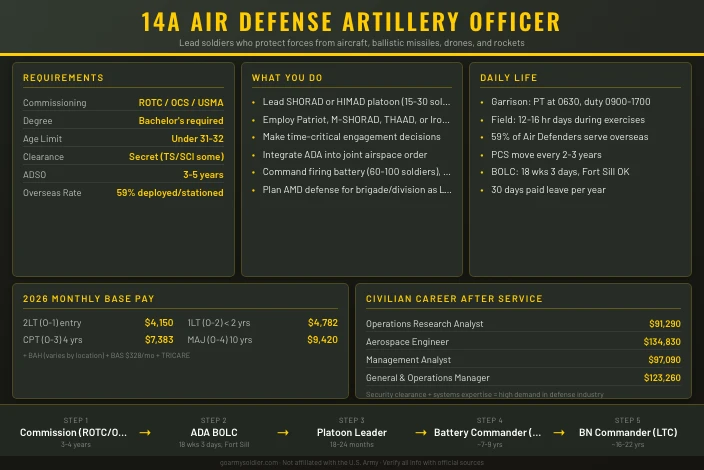
Job Role and Responsibilities
Air Defense Artillery Officers plan, deploy, and employ air and missile defense systems to protect Army forces, joint forces, and critical assets from aerial and missile threats. As a 14A officer, you lead soldiers at the platoon through battalion level, making engagement decisions on time-critical targets and integrating your fires into the joint airspace control order. The branch spans two distinct mission sets: Short Range Air Defense (SHORAD) protecting maneuver forces in the close fight, and High-to-Medium Altitude Air Defense (HIMAD) defending strategic assets at the corps and theater level.
Command and Leadership Scope
A new ADA officer enters the branch as a platoon leader, the first and most important leadership assignment of an officer’s career. At this level, you own 15 to 30 soldiers and a weapons system that can cost hundreds of millions of dollars. Platoon leader tours typically run 18 to 24 months, after which officers often serve as battery executive officers or tactical directors before attending the Captain’s Career Course.
At Captain, the key developmental assignment is battery command. A firing battery includes a headquarters section, one or more firing platoons, and a maintenance element, totaling roughly 60 to 100 soldiers. Battery commanders own every aspect of unit readiness: training, discipline, maintenance, and the employment of their weapons systems.
Lieutenant Colonels command ADA battalions of 400 to 600 soldiers. At this level, you plan air and missile defense for an entire brigade or division area, coordinate with the joint fire support element, and integrate your systems into the Army Air and Missile Defense Command (AAMDC) architecture.
Specific Roles and Designations
| Designation | Code | Description |
|---|---|---|
| Air Defense Artillery Officer | 14A | The single ADA officer AOC; all ADA officers commission with this code |
| Airborne | SI 5Q | Parachutist qualification; required for airborne unit assignments |
| Ranger | SI 5P | Ranger-qualified; competitive for senior ADA leadership |
| ADA Top Gun | Informal | Award for the most tactically proficient officers; competitive |
| Functional Area 40 | FA 40 | Space Operations (post-KD broadening) |
| Functional Area 50 | FA 50 | Force Management (post-KD broadening) |
| Functional Area 59 | FA 59 | Strategic Plans and Policy (post-KD broadening) |
The 14A code is the single commissioned officer designation for the Air Defense Artillery branch. All ADA officers carry the same AOC throughout their career. Skill identifiers and functional area codes are added later as officers earn qualifications and move into broadening assignments.
Mission Contribution
Air Defense Artillery is the Army’s first and last line of defense against airborne threats. In large-scale combat operations against peer adversaries, enemy long-range fires, cruise missiles, and drone swarms can degrade a force before ground contact. ADA units protect the maneuver force’s ability to fight by denying the enemy the use of the airspace and the surface-to-surface indirect fire corridor.
The branch contributes to combined arms operations at every echelon. SHORAD units move with infantry and armor formations, protecting them from low-altitude threats. HIMAD batteries defend corps and theater assets, including airfields, logistics hubs, and command nodes. Theater-level systems like PATRIOT and THAAD extend protection to theater ballistic missiles. No other branch is responsible for this full vertical spectrum of protection.
Technology, Equipment, and Systems
ADA officers manage some of the Army’s most technically complex and expensive platforms. The branch currently fields seven primary systems:
- Stinger: Man-portable, shoulder-fired infrared missile. The foundation of SHORAD operations for decades; now integrated into larger platforms.
- Avenger: Humvee-mounted system carrying two Stinger pods and a .50-caliber machine gun. Short-range defense for fixed sites and forward areas.
- M-SHORAD: Stryker-based next-generation SHORAD. Fires Stinger and Hellfire missiles; also carries a 30mm cannon. Designed to fight with maneuver formations. Four M-SHORAD battalions are standing up across the active Army through the mid-2020s.
- C-RAM: Counter-Rocket, Artillery, and Mortar system. Uses a Navy Phalanx gun firing 20mm rounds at very high rate to destroy indirect fire threats. Primarily defends fixed installations.
- Iron Dome: Acquired from Israel. Intercepts rockets, artillery shells, and mortars using guided missiles. Used in deployed force protection roles.
- PATRIOT: The Army’s primary HIMAD system. Defeats aircraft, helicopters, UAVs, ballistic missiles, and cruise missiles at medium-to-high altitude. Highly mobile, combat-proven in multiple conflicts.
- THAAD: Terminal High Altitude Area Defense. Engages ballistic missiles inside and outside the atmosphere at ranges beyond PATRIOT. Operated by THAAD batteries at echelons above division.
Command and control runs through the Air and Missile Defense Workstation (AMDWS), the Advanced Field Artillery Tactical Data System (AFATDS), and the Joint Air-Ground Integration Center (JAGIC) at brigade level. ADA officers learn these systems at BOLC and continue building proficiency through their first assignment.
Salary and Benefits
Base Pay (2026)
ADA Officers enter at O-1 (Second Lieutenant). The figures below reflect the 2026 pay tables from DFAS, which include a 3.8% across-the-board increase effective January 1, 2026.
| Rank | Grade | Years of Service | Monthly Base Pay |
|---|---|---|---|
| Second Lieutenant | O-1 | Less than 2 | $4,150 |
| Second Lieutenant | O-1 | 2-3 years | $4,320 |
| First Lieutenant | O-2 | Less than 2 | $4,782 |
| First Lieutenant | O-2 | 2-3 years | $5,446 |
| Captain | O-3 | Less than 2 | $5,534 |
| Captain | O-3 | 4 years | $7,383 |
| Captain | O-3 | 8 years | $8,126 |
| Major | O-4 | 10 years | $9,420 |
| Major | O-4 | 14 years | $10,214 |
Special Pay and Allowances
ADA Officers do not currently receive aviation flight pay or the hazardous duty incentive pay associated with aviation branches. Officers stationed at high cost-of-living installations receive Basic Allowance for Housing (BAH), which varies by location, pay grade, and dependency status. A single O-3 at Fort Sill, Oklahoma receives approximately $2,007 per month in BAH; rates at installations like Fort Shafter, Hawaii or Fort Wainwright, Alaska are significantly higher. All officers receive Basic Allowance for Subsistence (BAS) of $328.48 per month in 2026.
There is no current publicly advertised branch-specific accession or retention bonus for 14A officers. Continuation Pay is available at 7 to 12 years of service under BRS at a multiplier of 2.5x monthly base pay, in exchange for a 3-year service commitment.
Additional Benefits
Officers receive TRICARE Prime at no cost, covering medical, dental, vision, mental health, and prescriptions for the member and dependents. The Army’s Blended Retirement System (BRS) pairs a 20-year pension at 40% of high-36 average base pay with Thrift Savings Plan matching: 100% on the first 3% of contributions and 50% on the next 2%, up to a total government contribution of 5% of base pay.
Annual leave is 30 days per year, accruing at 2.5 days per month. Officers also have access to Army Tuition Assistance, covering up to $4,500 per year toward graduate coursework while on active duty. The Post-9/11 GI Bill transfers to dependents after 6 years of service if the officer commits to 4 additional years.
Work-Life Balance
In garrison, ADA officers typically work a Monday through Friday schedule with physical training in the early morning and duty hours running through the afternoon. Field exercises and system certifications add extended periods away from home, often 2 to 4 weeks at a time. Deployment tempo is higher for ADA than most officers expect: with 59% of Air Defenders serving overseas, rotational and extended deployments are a regular part of the career.
Qualifications and Eligibility
Commissioning Sources
Three primary paths lead to a commission in the Air Defense Artillery branch.
Reserve Officers’ Training Corps (ROTC) is the most common path. Cadets attend a four-year program at a host or partner university while earning a degree, then commission as a 2LT upon graduation. Branch assignment through ROTC follows the Order of Merit List (OML), a ranking based on GPA, physical fitness, leadership evaluations, and ROTC performance. Highly competitive branches go to cadets at the top of the OML. ADA has historically been accessible to cadets in the middle to upper-middle OML range, though demand shifts year to year.
Officer Candidate School (OCS) is for enlisted soldiers, prior service members, and civilians with a completed bachelor’s degree. The 12-week course at Fort Moore, Georgia assesses leadership under stress. Graduates commission at O-1. The Army assigns ADA as a branch option through OCS.
United States Military Academy (West Point) graduates commission directly into their preferred branch through a branching process similar to ROTC’s OML system.
| Commissioning Source | Degree Required | GPA Minimum | Age Limit | ADSO |
|---|---|---|---|---|
| ROTC | Bachelor’s (any field) | 2.0 (competitive is higher) | Under 31 at commissioning | 4 years |
| OCS | Bachelor’s (any field) | No minimum | Under 32 at commissioning | 3 years |
| USMA (West Point) | Bachelor’s (awarded upon graduation) | N/A | N/A | 5 years |
| ROTC with BRADSO | Bachelor’s (any field) | 2.0 | Under 31 | 7 years total |
Test Requirements
ROTC and OCS candidates do not take the ASVAB. The ASVAB is an enlisted enlistment test; officer candidates take no comparable entrance exam. OCS applicants must pass a background investigation and receive a National Agency Check with Local Agency Check and Credit Check (NACLC), which is the basis for a Secret clearance. Most ADA positions require at minimum a Secret security clearance; some HIMAD roles and joint assignments may require Top Secret/SCI access. Clearance eligibility is assessed before commissioning, not after.
Branch Selection and Assignment
ADA is a combat arms branch and is competitive, though not as highly contested as Infantry or Special Forces. ROTC cadets who want ADA should aim for the top half of their OML, express the branch as a first or second choice on their preference sheet, and consider accepting a Branch Detail if offered, which places officers in one branch (typically Infantry) for the first three years before transitioning to their parent branch.
Upon Commissioning
All commissioning sources enter active duty at O-1 (Second Lieutenant). ROTC graduates serve a minimum 4-year ADSO. OCS graduates serve a minimum 3-year ADSO. USMA graduates serve 5 years. Cadets who accept a Branch of Choice Service Obligation (BRADSO) through ROTC extend to 7 years in exchange for improved odds of receiving their preferred branch.
OCS candidates can find a focused GT study plan in our ASVAB for OCS guide.
Work Environment
Setting and Schedule
A lieutenant spends most of the working day at the battery level: motor pool checks, training events, maintenance management, and small-unit leader tasks. ADA lieutenants also spend significant time inside the Fire Direction Center and on the system itself, learning the technical aspects of their weapons platform before assuming leadership responsibility for it in the field.
Senior officers move between staff and command environments. At the battalion level and above, officers spend more time in operations centers, coordinating with higher headquarters and adjacent units. The office exists, but the most consequential work happens in the field, during system certifications and major exercises.
Leadership and Chain of Command
ADA officers work closely with senior NCOs from day one. The platoon sergeant is the lieutenant’s most important advisor and mentor in the first assignment. NCOs own the technical proficiency of the system and the day-to-day welfare of the soldiers. Officers own the tactical employment decisions, the unit’s training plan, and the administrative requirements that flow from battalion headquarters.
As officers advance, the relationship with the battalion Command Sergeant Major (CSM) becomes similarly important. Strong officer-NCO partnerships are what separate functional ADA units from dysfunctional ones.
Staff vs. Command Roles
Between command assignments, officers fill staff positions at brigade, division, and corps headquarters. Common staff jobs include S2 (intelligence officer), S3 (operations officer), and air and missile defense planner roles within the Army Air and Missile Defense Command. These staff tours build joint and operational planning skills that are essential for promotion to Major and above.
The ratio of command to staff time shifts as officers advance. Lieutenants and Captains spend most of their time in command-oriented positions. Majors and Lieutenant Colonels spend more time on staff, with battalion command as the capstone assignment.
Job Satisfaction and Retention
ADA officers who thrive in the branch tend to cite the combination of technical challenge, operational relevance, and global assignments as the primary drivers of retention. The branch is growing, with new unit activations providing additional command billets. Officers who want early command and high OCONUS exposure are well-positioned in ADA. Those who prefer a slower pace, routine garrison schedules, or primarily domestic assignments may find the tempo difficult to sustain long term.
Training and Skill Development
Pre-Commissioning Training
ROTC cadets complete four years of military science coursework, leadership labs, and a summer Cadet Summer Training (CST) assessment at Fort Knox, Kentucky. OCS candidates complete 12 weeks at Fort Moore, Georgia. West Point cadets complete a four-year academic and military program followed by a summer branch orientation. All commissioning sources attend Basic Combat Training or equivalent before entering their commissioning program.
Basic Officer Leader Course (BOLC)
After commissioning, all 14A officers attend the ADA Basic Officer Leader Course (BOLC) at Fort Sill, Oklahoma, the Fires Center of Excellence.
| Phase | Location | Length | Focus |
|---|---|---|---|
| BOLC Phase I | Fort Moore, GA (if OCS) or embedded in commissioning source | Varies | Common officer skills: land navigation, weapons, first aid |
| BOLC Phase II (ADA-specific) | Fort Sill, OK | 18 weeks, 3 days | ADA tactics, systems employment, troop leading procedures |
ADA BOLC covers troop leading procedures, training management, Army writing, air and missile defense tactics, and hands-on employment of ADA weapons systems. Graduates leave Fort Sill prepared to assume platoon leader duties in a SHORAD or HIMAD unit. The course runs continuously throughout the year and assigns officers to cohort classes based on commissioning date.
ADA BOLC is more technically demanding than the equivalent course for many branches. Officers will study radar theory, engagement operations, and the rules of engagement for airspace control in ways that have no close parallel in maneuver branches.
Professional Military Education (PME)
- Captain’s Career Course (CCC): Conducted at Fort Sill. Typically attended 6 to 8 years into service, before or concurrent with company command. Covers branch-level tactics at the battery and battalion level, fire support integration, and staff planning.
- Intermediate Level Education (ILE) / Command and General Staff College (CGSC): Attended at the Major level, typically 10 to 12 years of service. Fort Leavenworth, Kansas. Required for consideration to battalion command and promotion to LTC.
- Senior Service College (War College): Fort War College, Army War College, or joint equivalents. Selected O-5s and O-6s attend as preparation for brigade and general officer roles.
Additional Schools and Training
ADA officers are encouraged to pursue additional qualifications to build a competitive record.
- Airborne School (Fort Moore, GA): 3 weeks. Required for assignments to airborne units; also competitive for promotion files.
- Air Assault School (Fort Campbell, KY): 10 days. Valuable for officers seeking light force assignments.
- Ranger School (Fort Moore, GA): 61 days. Not required for ADA but competitive for battalion command consideration. Demonstrates physical and tactical leadership under extreme stress.
- ADA Top Gun: An internal ADA qualification awarded to the most tactically proficient officers through competitive performance during training events and certifications.
- Fully Funded Graduate School: Selected officers receive Army funding for a master’s degree at a civilian university. Available mid-career, typically around the 10-year mark. Degrees in engineering, operations research, and systems management are common choices for ADA officers.
Before OCS, you need a qualifying GT score — see our ASVAB for OCS guide.
Career Progression and Advancement
Career Path
| Rank | Grade | Typical Time | Key Developmental Position |
|---|---|---|---|
| Second Lieutenant | O-1 | 0-18 months | Platoon Leader (ADA) |
| First Lieutenant | O-2 | 18-42 months | Platoon Leader, Battery XO, or Tactical Director |
| Captain | O-3 | 3.5-10 years | Battery Commander (KD) |
| Major | O-4 | 10-16 years | BN S3, BDE AMD Planner, or Joint Staff |
| Lieutenant Colonel | O-5 | 16-22 years | Battalion Commander (KD) |
| Colonel | O-6 | 22-26 years | Brigade Commander or Senior Staff |
The most important KD positions are platoon leader at the lieutenant level and battery command at Captain. Officers who miss battery command without a documented exceptional reason are unlikely to be selected for major command. At O-5, battalion command is the corresponding KD position.
Promotion System
Promotions from O-1 to O-3 are essentially automatic with time in grade and satisfactory performance. O-4 (Major) is the first board-selected promotion and selects approximately 80% of eligible officers Army-wide. O-5 (Lieutenant Colonel) selects around 70%, and O-6 (Colonel) around 50%. Board files are built over an entire career; strong officer evaluation reports (OERs), KD completion, advanced education, and joint assignments all factor in.
Branching Out and Functional Areas
Officers typically declare a Functional Area (FA) around their 10-year mark, after completing their KD company command. ADA officers commonly move into FA 40 (Space Operations), FA 50 (Force Management), or FA 59 (Strategic Plans and Policy). Officers with strong technical backgrounds and interest in missile defense research have also pursued assignments with Missile Defense Agency programs.
Broadening assignments include recruiting command, ROTC instructor duty, joint staff billets, and congressional fellowships. These assignments are not required but improve board competitiveness and develop skills the Army values in senior leaders.
Building a Competitive Record
The officers who make it to battalion command typically share a few common characteristics: they completed all KD positions, earned at least one advanced degree, attended CGSC, sought at least one joint or broadening assignment, and accumulated OERs that place them above center of mass in their peer group. The Ranger tab is not required for ADA but has historically been a differentiator in competitive promotion files.
Physical Demands and Medical Evaluations
Physical Requirements
All Army officers, regardless of branch, take the Army Fitness Test (AFT). The AFT replaced the Army Combat Fitness Test (ACFT) on June 1, 2025, and consists of five events scored 0 to 100 each, with a maximum of 500 points. ADA is classified under the general standard, requiring a minimum of 300 total points with at least 60 points per event. Standards are sex- and age-normed.
| Event | Abbreviation | What It Measures |
|---|---|---|
| 3 Repetition Maximum Deadlift | MDL | Lower body and core strength |
| Hand Release Push-Up | HRP | Upper body muscular endurance |
| Sprint-Drag-Carry | SDC | Anaerobic power and endurance |
| Plank | PLK | Core stability |
| Two-Mile Run | 2MR | Aerobic endurance |
ADA does not carry a combat specialty AFT standard (350 points). The general 300-point standard applies. That said, officers who score higher are more competitive within their peer group and tend to perform better during physically demanding field exercises and evaluations.
Branch-Specific Physical Demands
ADA does not require a flight physical or a dive physical. Officers do not need corrected vision beyond standard commissioning requirements. There are no branch-specific color vision waiver disqualifications unique to ADA, though system operators working with certain sensor displays may have practical advantages with normal color vision.
Officers seeking HIMAD assignments or clearance-sensitive joint billets will undergo standard medical screenings as part of the personnel security process.
Deployment and Duty Stations
Deployment Details
ADA has one of the highest overseas exposure rates in the Army. Roughly 59% of Air Defenders are stationed or deployed overseas at any given time. Deployment types include:
- Rotational deployments to Korea, Germany, Japan, Guam, Italy, Spain, Belgium, and the Middle East
- Operational deployments supporting theater ballistic missile defense and force protection missions
- Persistent presence missions at sites like Camp Humphreys, South Korea and Grafenwoehr, Germany, which are permanent OCONUS duty stations
Deployment lengths range from 9 months for combat-zone deployments to 12 to 18 months for Korea accompanied tours (with family). Unaccompanied Korea tours run 12 months.
Duty Station Options
ADA officers serve at a smaller set of installations than maneuver branches. Primary CONUS duty stations include:
- Fort Sill, Oklahoma: Home of the Fires Center of Excellence and the 3rd Air Defense Artillery Brigade. Many officers return to Fort Sill for schooling and follow-on assignments.
- Fort Bliss, Texas / White Sands Missile Range, NM: THAAD operations and AMD system testing.
- Joint Base Lewis-McChord (JBLM), Washington: ADA elements supporting I Corps.
- Fort Campbell, Kentucky and Fort Bragg / Fort Liberty, North Carolina: SHORAD elements supporting airborne and air assault divisions.
OCONUS assignments are common and frequent. Officers can expect at least one OCONUS tour within their first 10 years.
Risk, Safety, and Legal Considerations
Job Hazards
ADA officers face the same general risks of military service as any combat arms officer: potential deployment to combat zones, physical training injuries, and the mental load of command. The weapons systems themselves carry high-voltage electrical hazards, and some platforms carry propellant and warhead components that require strict safety compliance. Radar emissions on certain systems require personnel to maintain safe standoff distances during operations.
The branch’s unique risk is the engagement decision itself. ADA officers in operational environments must make fratricide-prevention decisions in seconds, balancing the threat of incoming missiles or aircraft against the risk of engaging friendly forces or civilian aircraft. This decision burden is different from any other combat arms branch and requires strict adherence to rules of engagement and weapons control status orders.
Safety Protocols
ADA units follow the Army’s Composite Risk Management (CRM) process for all training and operational events. High-voltage systems have specific lockout/tagout procedures. Radar safety standoff distances are published in technical manuals and enforced as a command responsibility. Range safety procedures for live-fire events are governed by Army Regulation 385-63 and branch-specific publications from the ADA School.
Legal and Command Responsibility
Like all commissioned officers, 14A officers hold full UCMJ authority over soldiers in their command. This includes the authority to issue orders, conduct preliminary investigations, and initiate adverse action. Officers can be held criminally liable under the UCMJ for their own actions and, in certain circumstances, for the actions of soldiers under their command if they knew or should have known about misconduct and failed to act.
Command climate surveys (now conducted through the Defense Organizational Climate Survey, DEOCS) are a formal mechanism for evaluating a commander’s leadership environment. Poor results can factor into promotion and assignment decisions. Relief for cause in an OER is a career-ending event in most cases and is difficult to overcome at the board level.
Impact on Family and Personal Life
Family Considerations
ADA has one of the higher PCS tempo profiles in the Army. Officers can expect to move every 2 to 3 years, with a significant likelihood of OCONUS assignments. Spouses and families who can manage relocation, employment disruption, and extended separation are better positioned to sustain an ADA officer career over the long term.
Army Community Service (ACS), Family Readiness Groups (FRGs), and Military OneSource provide support during deployments and PCS moves. Spouse employment programs through the Army’s Spouse Education and Career Opportunities (SECO) program address the career disruption that frequent moves create.
The Army’s Joint Spouse Program attempts to co-locate dual-military couples at the same installation when possible. In practice, co-location is not guaranteed and becomes harder to achieve at the O-4 level and above when assignments grow less flexible.
Dual-Military and Family Planning
Dual-military ADA households should plan for the possibility of simultaneous deployments or uncoordinated PCS moves. The Army will attempt joint spouse assignments but operational requirements take priority. Soldiers with exceptional family member programs (EFMP) enrollments can request assignment coordination, though options are more limited for a branch with relatively few CONUS duty stations.
Childcare at installations like Fort Sill and OCONUS posts ranges from on-post Child Development Centers (CDCs) to installation support for off-post options. Demand for CDC slots typically exceeds availability during high-deployment periods.
Reserve and National Guard
Component Availability
The Air Defense Artillery branch is available in both the Army Reserve and the Army National Guard. Reserve ADA units are organized under U.S. Army Reserve Command (USARC) and focus primarily on HIMAD (PATRIOT) operations. National Guard ADA units vary by state and include both SHORAD and HIMAD mission sets. Several states field full-sized ADA brigades with command billets available to Guard officers.
Commissioning Paths
Guard and Reserve ADA officers typically commission through one of three routes:
- ROTC with a Reserve Component contract: Cadets request a Guard or Reserve obligation during their senior year. They complete the same BOLC training as active component officers.
- State OCS programs: Each state National Guard operates its own OCS pipeline, which commissions candidates directly into the Guard. These programs vary in length and structure by state.
- Inter-component transfer: Active duty ADA officers who complete their ADSO can request transfer to the Guard or Reserve to continue service part-time.
Drill and Training Commitment
Standard Reserve and Guard commitment is one weekend per month (four Unit Training Assemblies) plus two weeks of Annual Training per year. ADA Guard and Reserve units often require additional training days for system certifications, live-fire qualifications, and mission-readiness evaluations beyond the minimum schedule. Officers should expect more than the standard commitment in operationally active ADA units.
Part-Time Pay
An O-3 (Captain) with less than two years of service earns approximately $738 per drill weekend (four drill periods at daily drill pay). An O-3 with three or more years of service earns approximately $903 per weekend. Drill pay uses the same DFAS pay tables as active duty but is calculated per drill period rather than monthly.
Benefits Differences
| Category | Active Duty | Army Reserve | Army National Guard |
|---|---|---|---|
| Monthly base pay | Full O-grade pay | Drill pay per weekend | Drill pay per weekend |
| Healthcare | TRICARE Prime (free) | TRICARE Reserve Select ($57.88/mo member-only) | TRICARE Reserve Select ($57.88/mo member-only) |
| Education | Full TA ($4,500/yr) + GI Bill | TA ($4,500/yr) + MGIB-SR ($493/mo, 36 months) | TA ($4,500/yr) + MGIB-SR + possible state tuition waiver |
| Deployment tempo | High; 59% overseas | Varies by unit; mobilization possible | Varies by state mission; mobilization possible |
| Command opportunities | Multiple billets per career stage | Battery and battalion commands available | Battery and battalion commands available |
| Retirement | 20-year pension (BRS) at any age | Points-based; collection begins at age 60 | Points-based; collection begins at age 60 |
Deployment and Mobilization
ADA Guard and Reserve units have been mobilized for OCONUS force protection missions, particularly supporting PATRIOT deployments in the Middle East and Korea. Mobilization lengths typically run 9 to 12 months under Title 10 orders. Operational Support (ADOS) tours also allow Guard and Reserve officers to serve on active duty in staff or training roles for periods of 30 days to several years. Each qualifying mobilization day accelerates the Reserve retirement collection age by one day per 90 qualifying consecutive days of service, with a floor of age 50.
Civilian Career Integration
ADA Guard and Reserve service pairs well with civilian careers in aerospace and defense contracting, systems engineering, federal government program management, and intelligence community positions. PATRIOT and SHORAD operator and leader experience is directly relevant to roles at Raytheon Technologies, Lockheed Martin, L3Harris, and Northrop Grumman, all of which hold major AMD contracts. Employers covered by USERRA cannot deny promotion, seniority, or benefits because of military service, and Guard or Reserve officers in sensitive-sector civilian roles often find that their security clearance maintained through military service accelerates hiring.
Post-Service Opportunities
Transition to Civilian Life
ADA officers develop a skill set that defense industry employers actively seek: systems employment expertise, project leadership at scale, security clearance, and familiarity with major weapons systems still in production and modernization. Transition programs including the Army’s Soldier for Life Transition Assistance Program (SFL-TAP) and Hiring Our Heroes provide structured job search support. The American Corporate Partners (ACP) program connects veterans with corporate mentors.
Officers who serve at least 6 years and transfer GI Bill benefits before separating can use those benefits for graduate education. Those separating at the company-grade level can use the full 36 months of Post-9/11 GI Bill for their own graduate degree.
Civilian Career Prospects
| Job Title | Median Annual Salary | Job Outlook |
|---|---|---|
| General and Operations Manager | $123,260 | +7% (faster than average) |
| Operations Research Analyst | $91,290 | +23% (much faster than average) |
| Aerospace Engineer | $134,830 | +6% (faster than average) |
| Management Analyst | $97,090 | +11% (faster than average) |
| Defense Program Manager (GS-13/14) | $111,000-$147,000 (est.) | Steady federal hiring |
Median salary figures for management analysts, operations research analysts, and aerospace engineers are from Bureau of Labor Statistics Occupational Outlook Handbook based on May 2024 data. Federal GS salary figures are estimates based on OPM pay tables.
Graduate Education and Credentials
Project Management Professional (PMP) certification translates directly from Army staff planning experience and is widely recognized in defense contracting. Systems Engineering credentials align with PATRIOT and SHORAD systems employment backgrounds. Some ADA officers pursue professional engineering licensure, particularly those with technical undergraduate degrees. The GI Bill covers tuition at participating schools with a housing stipend equal to the E-5 with-dependents BAH rate at the school’s ZIP code, plus $1,000 per year in book stipends.
Is This a Good Job for You? The Right (and Wrong) Fit
Ideal Candidate Profile
ADA is a strong match for officers who want a technical combat arms career without the light infantry physical grind of Infantry or Special Operations. You should be comfortable learning complex weapons systems, thinking through engagement decisions under time pressure, and leading soldiers in a rapidly changing operational environment. The branch rewards officers who combine tactical instincts with technical discipline.
An interest in aerospace and missile defense technology is a genuine advantage. Officers who thrive here tend to be curious about how systems work, not just how to employ them. A background in engineering, physics, or computer science is not required, but it helps in BOLC and in PATRIOT system operations.
The OCONUS orientation of the branch suits candidates who want to live abroad, experience operational deployments early in their career, and build a resume with genuine overseas leadership experience.
Potential Challenges
The overseas tempo is the most common reason officers leave ADA early. Assignments in Korea, Germany, and the Middle East come with real family disruption. Officers who want to stay close to home, build civilian career equity simultaneously, or minimize PCS moves will find ADA difficult to reconcile with those priorities.
Staff grind is also real at the Major level. Officers who love the fast-paced battery commander job often find the subsequent battalion staff assignment slower and less satisfying. Enduring through staff tours is a requirement for battalion command selection, and not everyone sustains the motivation.
The branch is also smaller than the major combat arms branches, which means fewer officers per promotion cohort and tighter competition for KD assignments. A missed battery command opportunity can significantly alter a career trajectory.
Career and Lifestyle Alignment
An officer who wants a 20-year active career to O-6, a technical systems background on their resume, global assignments, and a path into defense contracting will find ADA well-aligned with those goals. An officer who wants to do a 4-year obligation, use the GI Bill for school, and return to civilian life will still benefit from the clearance, leadership experience, and systems expertise that ADA provides. Guard and Reserve service after initial active duty is a practical option for officers who want to maintain military credentials while building a civilian career in a related field.
More Information
Talk to a Fires Center of Excellence recruiter at Fort Sill or contact your university’s ROTC program to discuss branching into ADA. If you are on the OCS path, the Army’s recruiting center has branch option information for candidates.
- OCS candidates: prepare for GT 110 with our ASVAB for OCS study guide
This site is not affiliated with the U.S. Army or any government agency. Verify all information with official Army sources before making enlistment or career decisions.
Explore more Army Air Defense Artillery officer careers to find other roles in the AMD mission.