15A Aviation Officer
You want to fly Army aircraft. You want to lead soldiers. The 15A Aviation Officer branch puts you in the left seat of a helicopter and in charge of the people who depend on it. But the path from ROTC or OCS to flight school is longer and more selective than most branches, and the commitment on the back end (a 10-year Active Duty Service Obligation) is the longest in the Army officer corps. Before you sign, you need to understand exactly what you’re getting into.
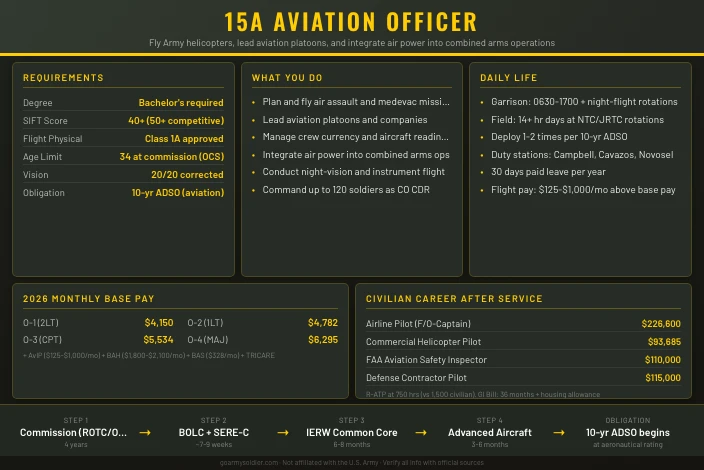
Job Role and Responsibilities
Army Aviation Officers plan and execute air assault, attack, reconnaissance, medical evacuation, and utility missions. They fly Army rotary-wing aircraft, lead aviation platoons and companies, and integrate air power into ground maneuver operations. At higher grades, they command aviation battalions and brigades that project combat power across the full spectrum of conflict. This is one of the few officer branches where tactical flying remains a core duty well into a captain’s career.
Command and Leadership Scope
As a 2LT or 1LT, you lead an aviation section or platoon: typically four to six aircraft and the crew chiefs, maintenance personnel, and supporting staff who keep them flying. You are responsible for crew currency, mission planning, aircraft readiness, and the safety of your soldiers on and off the flight line.
At the captain level, you move between flight duties and staff work. You may serve as a company executive officer or, later, as a company commander with 60 to 120 soldiers under your authority. Company command in aviation is smaller in headcount than infantry but carries the same legal and operational weight. You own the readiness of your aircraft and the welfare of your people.
As a major, you shift into battalion staff roles (S3, S4, XO) or transition to a Functional Area. Lieutenant colonels command aviation battalions of 400 to 600 personnel. Colonels command aviation brigades with multiple battalions.
Specific Roles and Designations
The 15A AOC is a transition code for junior officers. When a captain completes the Captain’s Career Course, HRC re-designates them into a terminal AOC based on aircraft qualification and Army needs.
| AOC | Designation | Primary Aircraft |
|---|---|---|
| 15A | Aviation (pre-CCC) | All rotary-wing (initial training) |
| 15B | Aviation Combined Arms Operations | UH-60 Black Hawk, CH-47 Chinook |
| 15C | Aviation Combined Arms Operations | AH-64 Apache |
| 15D | Aviation Combined Arms Operations | AH-64 Apache (additional track) |
Officers also compete for Functional Area designations after company command, including FA 40 (Space Operations) and FA 49 (Operations Research/Systems Analysis). Aviation-specific Additional Skill Identifiers include instrument flight examiner, instructor pilot, and safety officer qualifications.
Mission Contribution
Army aviation gives ground commanders a third dimension. Attack helicopter crews suppress enemy air defense and destroy armor. Black Hawks move infantry into terrain that takes trucks hours to cross. Medevac crews recover casualties from the point of injury. Reconnaissance aircraft give commanders real-time situational awareness.
Aviation officers integrate those capabilities into combined arms plans. A ground force commander who understands aviation planning cycles and aircraft limitations makes better decisions. Aviation officers who understand ground maneuver make the same.
Technology, Equipment, and Systems
Army aviation officers fly and supervise operations on the UH-60 Black Hawk, CH-47 Chinook, AH-64 Apache, and OH-58 Kiowa family aircraft, along with fixed-wing platforms including the C-12 and RC-12. Aviation units use the Army Battle Command System and mission planning software to coordinate airspace, NOTAMs, and multi-ship mission execution. Night-vision systems, forward-looking infrared, and digital datalinks are standard on most platforms.
Salary and Benefits
Financial Benefits
Base pay for aviation officers follows the standard officer pay scale. The figures below are monthly basic pay from DFAS 2026 pay tables.
| Grade | Title | Under 2 Years | 4 Years | 8 Years | 12 Years |
|---|---|---|---|---|---|
| O-1 | 2LT | $4,150 | $5,222 | N/A | N/A |
| O-2 | 1LT | $4,782 | $6,485 | N/A | N/A |
| O-3 | CPT | $5,534 | $7,383 | $8,126 | $8,788 |
| O-4 | MAJ | $6,295 | $7,881 | $8,816 | $9,888 |
Aviation officers also receive Aviation Career Incentive Pay (AvIP), commonly called flight pay. This is separate from basic pay and scales with years of aviation service:
| Years of Aviation Service | Monthly AvIP |
|---|---|
| 2 or fewer | $125 |
| Over 2 | $200 |
| Over 6 | $700 |
| Over 10 | $1,000 |
| Over 22 | $700 |
| Over 24 | $400 |
A CPT at 10 years of aviation service earns $8,126 in base pay plus $1,000 in flight pay, totaling $9,126 per month in taxable pays before allowances. General officers are capped at $200-$206 per month regardless of years of aviation service.
There is no current general accession bonus for aviation officers, though retention bonuses are offered periodically through Continuation Pay under the Blended Retirement System between years 7 and 12.
Additional Benefits
Housing allowance (BAH) varies by duty station and dependent status. At Fort Campbell, Kentucky (home of the 101st Airborne Division and one of the Army’s largest aviation installations), an O-3 without dependents receives roughly $1,800 to $2,100 per month in BAH depending on the year and local market. The officer Basic Allowance for Subsistence (BAS) is $328.48 per month in 2026.
All active-duty officers receive TRICARE Prime at no cost: no premiums, no deductibles, no copays. Family members are covered under the same plan with a $1,000 annual catastrophic cap.
Retirement under the Blended Retirement System pays 40% of high-36 average basic pay at 20 years, plus TSP matching of up to 5% of basic pay beginning in year three. Aviation officers with 10 years of service are prime targets for Continuation Pay, which the Army has paid at 2.5x monthly basic pay in exchange for a three-year additional obligation.
The Post-9/11 GI Bill transfers to dependents after six years of service, with a four-year additional obligation. Officers who serve 20 or more years rarely need it for themselves, but transferability makes it a significant family benefit.
Work-Life Balance
Garrison life runs roughly 0630 to 1700 Monday through Friday, with physical training, flight operations, maintenance, and staff work filling the day. Aviation units add night-flight rotations, which compress the schedule. Flight currency requirements mean you spend time in the aircraft beyond normal duty hours.
Field rotations and combat training center rotations (typically 30 days at the National Training Center or Joint Readiness Training Center) push days to 14 or more hours for the duration. Deployment tempo has moderated since the height of operations in Iraq and Afghanistan, but aviation units remain among the most frequently deployed in the Army.
Qualifications and Eligibility
Commissioning Sources
Aviation branch requires a commission first. Four paths lead to a commission:
| Source | GPA Minimum | Degree Requirement | Age Limit | Key Prerequisite |
|---|---|---|---|---|
| ROTC | Competitive (no hard floor) | Any bachelor’s degree | 31 at commissioning | SIFT, Class 1A flight physical |
| OCS | Competitive | Bachelor’s degree required | 34 at commission | SIFT, Class 1A flight physical |
| USMA (West Point) | N/A (admission-based) | 4-year program (West Point degree) | 23 at entry | Appointment process, SIFT after admission |
| Direct Commission | N/A | Varies (technical specialty) | Varies | Rare for aviation; branch-specific |
ROTC is the most common path into the aviation branch. USMA produces a steady pipeline. OCS candidates must complete all aviation prerequisites before branching.
No specific degree major is required. The Army Aviation Center of Excellence states that diverse academic backgrounds are encouraged and no prior flight experience is necessary or preferred.
Test Requirements
Aviation is the only Army officer branch that requires a separate aptitude test beyond the standard commission process. The Selection Instrument for Flight Training (SIFT) is mandatory for all aviation branch candidates.
- Minimum passing score: 40 (scale of 20-80)
- Average score: 50
- Competitive score: 50 or above
- Retake policy: one retake allowed after 180 days if you score below 40; a passing score cannot be retaken to improve it; two failures permanently disqualify you from Army aviation
The SIFT has seven subtests covering simple drawings, hidden figures, Army aviation knowledge, spatial orientation, reading comprehension, math skills, and mechanical comprehension. Total testing time is approximately 2.5 to 3 hours. The math and mechanical sections are computer-adaptive.
ROTC cadets should take the SIFT during the summer after their junior year at the latest. OCS candidates must pass the SIFT and hold a current Class 1A flight physical before the branching board.
OCS candidates who did not serve as enlisted soldiers also need an ASVAB GT score of 110 or higher to qualify for OCS, though this is an OCS prerequisite rather than an aviation-specific requirement.
Branch Selection and Assignment
For ROTC cadets, aviation is branched through the Order of Merit List (OML) process. Aviation is a competitive branch. It draws from the upper-middle of each commissioning class. Exact OML cutoffs vary by year and Army needs, but candidates below the top 60% of their class face a harder road.
For OCS candidates, a separate aviation branch board reviews the application package, SIFT score, flight physical, and overall record. Physical fitness, academic performance, and leadership evaluations all factor in.
Branch-detailing exists but is rare for aviation. The training pipeline is too long and the ADSO too substantial for the Army to divert aviation candidates into another branch first.
Upon Commissioning
New aviation officers commission at O-1 (2LT). The standard commissioning ADSO is four years for ROTC scholarship recipients and two years for non-scholarship. Aviation branch adds a separate 10-year ADSO upon earning an aeronautical rating. Under the current policy, the 10-year clock starts when you complete the Common Core phase of Initial Entry Rotary Wing (IERW) training, not at the end of flight school. This means the total commitment from commissioning to ADSO expiration runs roughly 12 to 13 years for most aviation officers.
Work Environment
Setting and Schedule
Aviation officers split their time between the flight line, the operations center, and the maintenance bay. As a lieutenant, most of your day touches aircraft directly: flight planning, preflight inspections, crew briefs, flying, and after-action reviews. As a captain moving toward company command, you spend more time on personnel issues, readiness reporting, and training management.
Aviation units typically operate two distinct environments: garrison and deployed. In garrison, fixed flight schedules, maintenance windows, and staff hours structure the week. On deployment or at combat training centers, operations run around the clock and schedules compress dramatically.
Leadership and Chain of Command
As a platoon leader, your direct superior is your company commander, and your key partner is your platoon sergeant, a senior NCO who owns the crew chief and maintenance team. The officer-NCO dynamic in aviation is particularly important because enlisted crew chiefs accumulate aircraft-specific expertise that junior officers lack. Smart lieutenants listen before they talk.
As a company commander, you report to your battalion commander and work alongside your First Sergeant. The battalion commander is typically a lieutenant colonel who flew earlier in their career and understands your operational constraints. The command relationship in aviation is more technically grounded than in some other branches because everyone in the chain of command speaks the same language: aircraft systems, weather windows, and maintenance cycles.
Staff vs. Command Roles
Aviation officers at the O-4 and O-5 level typically alternate between staff and command. Major-level staff roles include battalion S3 (operations officer), S4 (logistics), and XO. The battalion XO role is a primary developmental step for officers on track for battalion command.
Aviation officers who do not pick up battalion command by O-5 often move into joint staff positions, ROTC instructor duty, or Functional Area work. Not every aviation officer makes it to the flight line as a battalion commander. Staff work and broadening assignments fill significant portions of a mid-grade career.
Job Satisfaction and Retention
Aviation has among the highest retention rates of any combat branch through the 10-year mark, largely because the ADSO keeps officers in place. After the ADSO expires, the calculus changes fast. Airlines actively recruit experienced Army aviators, and the civilian compensation gap is substantial. Officers who leave after the ADSO typically cite the combination of compensation, operational tempo, and family stability as the driving factors.
Officers who stay beyond 12 years tend to do so because they want command or because they find the mission genuinely compelling. Aviation is unique in offering continued hands-on flying well into a senior officer’s career, which sets it apart from most other branches where senior officers spend the majority of their time in staff and command functions.
Training and Skill Development
Pre-Commissioning Training
ROTC cadets complete four years of leadership labs, field training exercises, and the Leader’s Training Course (or Advanced Camp). USMA cadets complete the full West Point curriculum with summer training requirements. OCS candidates complete 12 weeks of training at Fort Moore, Georgia.
All aviation candidates must complete the SIFT and hold a current Class 1A flight physical before competing for aviation branch through any commissioning source.
Basic Officer Leader Course (BOLC) and Flight School
Aviation BOLC is conducted at Fort Novosel, Alabama (formerly Fort Rucker). Unlike other branches where BOLC lasts 10 to 20 weeks, aviation combines officer leadership training with an extensive initial entry flight school pipeline. The full training sequence runs roughly two years from BOLC arrival to aircraft qualification.
| Phase | Location | Length | Focus |
|---|---|---|---|
| BOLC Phase I | Fort Novosel, AL | ~4-6 weeks | Officer leadership, land navigation, small-unit tactics |
| SERE-C | Camp Mackall, NC | ~3 weeks | Survival, Evasion, Resistance, Escape |
| IERW Common Core | Fort Novosel, AL | ~6-8 months | Basic rotary-wing flight, instruments, night flying, solo |
| Advanced Aircraft | Fort Novosel, AL | 3-6 months (varies by airframe) | Specific aircraft qualification (Apache, Black Hawk, Chinook) |
The 10-year ADSO begins upon completion of the IERW Common Core phase, when students earn their aeronautical rating and are designated Army Aviators. Advanced aircraft training adds additional time before officers reach their first operational unit.
Professional Military Education (PME)
Additional Schools and Training
Aviation officers have access to a range of additional qualifications depending on assignment and career goals:
- Instrument Flight Examiner – qualification earned through additional training at Fort Novosel; valuable for senior flight positions
- Airborne School – 3 weeks at Fort Moore; useful for air assault units
- Pathfinder School – 3 weeks at Fort Moore; strongly valued in air assault formations
- Ranger School – not required but respected, especially for officers in air assault divisions
- Advanced Civil Schooling (ACS) – fully funded master’s degree at a civilian university; available on a competitive basis, typically at the O-3/O-4 level
Career Progression and Advancement
Career Path
Aviation officers follow a well-defined developmental timeline. Key developmental (KD) positions drive promotion board selection.
| Grade | Title | Typical Years | Key Positions |
|---|---|---|---|
| O-1 (2LT) | Second Lieutenant | 0-1.5 | Section/platoon leader |
| O-2 (1LT) | First Lieutenant | 1.5-4 | Platoon leader, company XO |
| O-3 (CPT) | Captain | 4-10 | Company XO, company commander (KD) |
| O-4 (MAJ) | Major | 10-16 | Battalion S3/XO (KD) |
| O-5 (LTC) | Lieutenant Colonel | 16-22 | Battalion commander (KD) |
| O-6 (COL) | Colonel | 22-26+ | Brigade commander |
Company command at O-3 is the first KD gate. Officers who miss or delay company command face a steeper path to promotion to O-5. Battalion S3 and XO at the O-4 level are the second critical gate. Battalion command at O-5 is the gateway to senior positions.
Promotion System
O-1 through O-3 promotions are essentially automatic with time in service, assuming no adverse actions. The competitive threshold begins at O-4. Below-zone, in-zone, and above-zone selection rates fluctuate by year and branch. Aviation has historically had strong O-4 selection rates, but O-5 and O-6 boards are more competitive. Officers without a completed KD command tour face significantly lower selection odds.
Evaluation Reports (OERs) are the primary file factor. Senior rater assessments, awards, education, and joint experience all contribute. Aviation officers who accumulate instructor pilot qualifications, advanced schools, and combat deployments build stronger promotion files.
Branching Out and Functional Areas
After completing company command, aviation officers compete for Functional Area designations. Common transitions include:
- FA 40 (Space Operations) – for officers interested in satellite and space-enabled capabilities
- FA 49 (Operations Research/Systems Analysis) – quantitative analysis at the Army and joint level
- FA 50 (Force Management) – Army-wide force design and capability development
Broadening assignments include ROTC instructor duty, recruiting, congressional fellowship, Joint Staff positions, and Advanced Civil Schooling. These assignments are important for building a complete officer record but come at the cost of operational time.
Physical Demands and Medical Evaluations
Physical Requirements
Aviation officers take the same Army Fitness Test (AFT) as all other soldiers. The AFT replaced the ACFT on June 1, 2025, and has five events scored 0-100 each for a maximum of 500 points.
| Event | Full Name | Minimum Score (All Ages/Genders) |
|---|---|---|
| MDL | 3 Repetition Maximum Deadlift | 60 |
| HRP | Hand Release Push-Up – Arm Extension | 60 |
| SDC | Sprint-Drag-Carry | 60 |
| PLK | Plank | 60 |
| 2MR | Two-Mile Run | 60 |
The general standard is 300 points total (60 per event), scored by sex and age norms. Aviation is not currently on the list of 21 combat AOCs requiring the higher 350-point standard, but operational assignments may carry additional unit-level fitness standards.
Beyond the AFT, aviation officers are subject to regular physical fitness expectations at the unit level. Extended flight operations, particularly at night in degraded conditions, demand a high baseline of endurance and stamina even when formal test standards do not.
Flight Physicals and Branch-Specific Medical
Aviation officers require a Class 1A Flight Physical approved by the Army Aviation Center of Excellence at Fort Novosel. This is a more rigorous examination than the standard officer physical and covers:
- Visual acuity: distant vision must be correctable to 20/20 in each eye (glasses and contacts are permitted)
- Color vision, depth perception, and night vision testing
- Hearing: audiometric testing against aviation-specific standards
- Cardiovascular evaluation including EKG
- Neurological screening
- No history of certain conditions including seizure disorders, uncontrolled hypertension, or significant psychiatric diagnoses
The flight physical must be completed and approved before competing for aviation branch. Candidates should schedule it during the second semester of their junior year in ROTC (earlier if possible) to allow time for waivers if needed. Many conditions that would disqualify a candidate without a waiver can be waivered by the Army. Contact the Aviation Medicine physician at Fort Novosel early if you have any concerns.
Deployment and Duty Stations
Deployment Details
Aviation units deploy regularly. The 101st Airborne Division (Air Assault) at Fort Campbell, the 1st Cavalry Division at Fort Cavazos, and 160th Special Operations Aviation Regiment (SOAR) at Fort Campbell have all sustained high deployment tempos over the past two decades. Current operational commitments vary by year, but aviation officers should expect one to two combat or rotational deployments per ADSO.
Deployment types include:
- Combat deployments – active theater rotations to CENTCOM, AFRICOM, or INDOPACOM
- Rotational deployments – 9-12 month rotations to Europe (Germany, Romania), Korea, and CENTCOM
- Combat Training Center rotations – 30-day exercises at NTC (Fort Irwin, CA) or JRTC (Fort Polk, LA) that replicate deployment conditions
Aviation officers deploy alongside their units. Unlike some staff-heavy branches, aviation officers in operational units fly on deployments.
Duty Station Options
The Army’s aviation force is concentrated at a small number of installations. Most aviation officers serve at one of these locations during their career:
- Fort Novosel, Alabama – training base; many officers return as instructors
- Fort Campbell, Kentucky – 101st Airborne Division and 160th SOAR
- Fort Cavazos, Texas – 1st Cavalry Division
- Joint Base Lewis-McChord, Washington – 16th Combat Aviation Brigade
- Fort Wainwright, Alaska – 1st Brigade, 25th Infantry Division (hardship tour, typically 2 years)
- Camp Humphreys, South Korea – rotational and permanent party assignments
- Grafenwoehr/Ansbach, Germany – 12th Combat Aviation Brigade, USAREUR
Assignment preferences are submitted through HRC. Aviation officers have fewer installation options than some larger branches, which means PCS move frequency is moderate, roughly every two to three years.
Risk, Safety, and Legal Considerations
Job Hazards
Army aviation has a measurable accident rate. Aircraft operations at night, in degraded visual environments, at low altitude, and under operational stress are inherently dangerous. Aviation officers accept that risk as part of the job. Mishap data from the Army Combat Readiness Center shows that most aviation accidents involve human factors (spatial disorientation, controlled flight into terrain, and task saturation) rather than equipment failure.
Officers share the same physical exposure as their crew. A company commander on a Black Hawk or a lieutenant on an Apache is in the same seat as a warrant officer. The officer role adds command responsibility on top of crew risk.
Safety Protocols
Army aviation uses Crew Resource Management (CRM) and Terrain Avoidance Warning Systems to manage known risk factors. Before every mission, crews conduct formal risk assessments using the Army’s Composite Risk Management (CRM) process, which officers own at the mission commander level. Go/no-go authority rests with the pilot-in-command, and Army doctrine supports aviators refusing a mission that exceeds acceptable risk. In practice, mission pressure tests that doctrine regularly.
The Army Combat Readiness Center publishes aviation accident data and lessons learned. Aviation officers who want to understand the actual risk environment should read those reports before branching.
Legal and Command Responsibility
Company commanders in aviation carry the same UCMJ authority and accountability as ground force commanders. They own aircraft readiness, crew flight hour management, crew rest compliance, and safety culture. A crew that exceeds crew rest limits on a commander’s orders, or a unit that falsifies maintenance records, creates command climate and criminal liability.
Aviation officers hold significant command authority over expensive government property. An Apache costs roughly $50 million. Negligence that results in aircraft damage or loss can trigger investigation, relief for cause, or Article 32 proceedings. Aviation commanders who build and sustain a genuine safety culture (not just safety paperwork) protect both their soldiers and themselves.
Impact on Family and Personal Life
Family Considerations
The 10-year ADSO creates a long period of commitment that shapes family decisions around it. PCS moves every two to three years, field time, night-flight rotations, and deployments all affect family life. Spouses of aviation officers often carry significant household and childcare responsibility during extended field operations.
The Army provides substantial family support infrastructure. Army Community Service (ACS) offers counseling, financial planning, and employment assistance. Family Readiness Groups (FRGs) function at company and battalion level to connect families during deployments. Larger installations like Fort Campbell have mature support ecosystems – schools, childcare, medical facilities, and employment opportunities that smaller posts lack.
BAH rates for officers mean most families can afford housing near post without financial stress. Officer pay at the O-3 and O-4 levels, combined with tax-free deployment income, often allows for solid family financial footing.
Dual-Military and Family Planning
Dual-military couples in aviation face the same co-location challenge as other branches, with the added complication that aviation assignments are geographically concentrated. HRC will attempt to co-locate dual-military couples, but Army operational needs take priority. Aviation officers with non-Army spouses have more assignment flexibility since only one partner is assignment-constrained.
Family planning during the ADSO is common. Maternity and paternity leave have improved substantially under recent policy changes. Pregnancy and postpartum periods do not reset flight currency requirements retroactively, though flight duties pause during pregnancy per Army medical policy.
Reserve and National Guard
Component Availability
Army aviation is available in both the Army Reserve and Army National Guard. The National Guard operates Combat Aviation Brigades in multiple states, flying the same platforms as active-duty units. The Army Reserve has a smaller aviation footprint with select utility and medevac units.
Guard aviation officers can reach command billets. State CABs (Combat Aviation Brigades) provide company and battalion command opportunities for Guard officers, though the timeline is slower than active duty.
Commissioning Paths
Reserve and Guard commissioning follows the same paths as active duty: ROTC with a Reserve component contract, state OCS programs, or direct commissioning in rare technical specialties. ROTC cadets who branch aviation through a Reserve component contract enter the same flight school pipeline at Fort Novosel on Title 10 orders and incur the same 10-year ADSO from aeronautical rating.
Active-duty aviation officers can transfer to the Reserve or Guard after their ADSO expires. Many do so to continue flying while pursuing civilian airline careers.
Drill and Training Commitment
Reserve and Guard aviation officers commit to one weekend per month (Battle Assembly) plus two weeks of Annual Training per year. Aviation units often require additional training days for flight currency, aircraft qualification maintenance, and unit exercises. Maintaining flight currency as a part-time aviator is a genuine challenge. Guard and Reserve aviators typically need to be more proactive about scheduling flying time than their active-duty peers.
Part-Time Pay
An O-3 with fewer than 2 years of service earns $737.88 per drill weekend (4 drills). An O-3 at 3 years earns $902.72 per drill weekend. Annual Training pays at daily active-duty rates for the duration.
Benefits Differences
| Category | Active Duty | Army Reserve | Army National Guard |
|---|---|---|---|
| Commitment | Full-time | 1 wknd/mo + 2 wks AT | 1 wknd/mo + 2 wks AT |
| Monthly Pay (O-3, under 2 yrs) | $5,534 base | $737.88/drill weekend | $737.88/drill weekend |
| Healthcare | TRICARE Prime ($0) | TRICARE Reserve Select ($57.88/mo individual) | TRICARE Reserve Select ($57.88/mo individual) |
| Education | Tuition Assistance ($4,500/yr) + GI Bill transferable | Federal TA + MGIB-SR ($493/mo) | Federal TA + state tuition waivers (varies by state) |
| Deployment Tempo | High | Moderate (mobilization-based) | Moderate (state + federal) |
| Command Opportunities | PL, CO CDR, BN CDR | CO CDR (limited), BN CDR (rare) | CO CDR, BN CDR (state CAB) |
| Retirement | 20-yr pension at separation | Points-based, collection at 60 | Points-based, collection at 60 (earlier if mobilized) |
Deployment and Mobilization
Guard and Reserve aviation units have deployed repeatedly to Iraq, Afghanistan, and CENTCOM rotations over the past 20 years. Mobilizations typically run 12 months with 90 days of pre-deployment training. Guard aviators who accumulate enough Title 10 active-duty time can qualify for Post-9/11 GI Bill benefits at higher percentage tiers.
Civilian Career Integration
Guard and Reserve aviation is among the best combinations of military and civilian careers available. An officer flying UH-60s one weekend a month can pursue an airline career simultaneously. Military flight time, instrument ratings, and night-vision systems experience translate directly into a competitive civilian aviation resume. USERRA protections ensure civilian employers cannot penalize employees for Guard or Reserve service up to five cumulative years of absence.
Many Guard and Reserve aviation officers work as regional or major airline pilots during the week and fly Army aircraft on weekends. Airlines generally accommodate Guard and Reserve schedules, and some carriers have formal military leave programs beyond USERRA minimums.
Post-Service Opportunities
Transition to Civilian Life
Aviation officers leave the Army with one of the most marketable skill sets in the military. A pilot with 1,500 to 3,000+ flight hours, night-vision qualified, multi-engine experienced, and with demonstrated crew resource management and leadership skills has options that most career fields don’t offer.
Programs that support transition include:
- SFL-TAP (Soldier for Life Transition Assistance Program): mandatory for separating officers; covers resume writing, VA benefits, and job placement
- DOD SkillBridge: allows officers to spend their last 180 days of active duty with a civilian employer, including airlines, defense contractors, or aviation companies
- Hiring Our Heroes: nonprofit fellowship program connecting veterans with corporate employers
Post-Service Career Prospects
| Civilian Job Title | Median Annual Salary | Job Outlook |
|---|---|---|
| Airline Pilot (First Officer/Captain) | $226,600 (BLS median) | +4% through 2033 |
| Commercial Helicopter Pilot | $93,685 | Steady demand (EMS, offshore, tours) |
| Aviation Safety Inspector (FAA) | $88,000-$130,000 | Federal hiring dependent |
| Defense Contractor Pilot | $90,000-$130,000 | Strong (UAS, test, special ops support) |
| Aviation Operations Manager | $80,000-$110,000 | +6% through 2033 |
The path to the airlines is straightforward for Army aviators. Under FAA Rule 14 CFR 61.160, military helicopter pilots need only 750 total flight hours for a Restricted Airline Transport Pilot (R-ATP) certificate, compared to 1,500 hours for civilians. Most Army aviation officers have well above 750 hours by the end of their ADSO.
First-year regional airline First Officers currently earn $95,000 to $130,000 in total compensation, with major carrier captains earning substantially more. Southwest, Delta, United, and American all have active military hiring programs.
Graduate Education and Credentials
The Post-9/11 GI Bill covers 36 months of education benefits after separation. At 100% eligibility, that means full in-state tuition at public universities, up to $29,920.95 per year at private schools (AY 2025-2026 cap), and a monthly housing allowance tied to the E-5 BAH rate at the school’s ZIP code.
Military flight time counts toward FAA civilian certification requirements. Officers must still complete FAA written exams and check rides for civilian ratings, but the military training hours transfer. A commercial helicopter rating, instrument rating, and flight instructor certificate are all achievable with limited additional cost post-separation.
Is This a Good Job for You? The Right (and Wrong) Fit
Ideal Candidate Profile
Aviation branch fits officers who want to fly, but that alone is not enough. The strongest candidates combine genuine interest in aviation with the leadership instincts and people skills to manage a platoon or company. You need to be technically sharp (aircraft systems, weather, airspace, and navigation demand precision) but also calm under pressure and able to make fast decisions with incomplete information.
ROTC cadets who do well in aviation tend to be those who sought out additional challenges during their college years: student pilot licenses, physics or engineering coursework, Ranger Challenge teams, competitive athletics. Branch selection for aviation rewards a complete record, not just a single strong trait.
Potential Challenges
The 10-year ADSO is the most common reason officers choose not to branch aviation. Committing your late 20s and most of your 30s to a single employer is a significant decision. Officers who want out after 4 or 6 years have limited options.
The operational tempo in aviation units, particularly air assault and attack battalions, runs high. Field time, night operations, combat training center rotations, and deployments stack on top of regular garrison duties. Officers who prefer predictable schedules or significant time at home will find aviation demanding in ways that some other branches are not.
Flight school and the initial training pipeline are long. Officers who commission and then spend 18 to 24 months in training before reaching an operational unit sometimes find the delay frustrating, particularly if peers in other branches are already in command track positions.
Career and Lifestyle Alignment
Aviation is a strong fit if you plan to serve 10 or more years. The ADSO effectively requires it unless you accept a separation penalty. Officers who do serve the full obligation leave with exceptional credentials, strong retirement contributions, and a skill set that translates directly to a high-compensation civilian career.
For someone looking to serve 4 to 6 years and transition to the private sector, aviation is a harder calculus. The ADSO constrains your exit point. That said, separating after the ADSO at roughly year 12 to 14 still leaves plenty of working life ahead, and the airline market for military pilots is as strong as it has been in decades.
This site is not affiliated with the U.S. Army or any government agency. Verify all information with official Army sources before making enlistment or career decisions.
More Information
Talk to an Army Aviation recruiter or your ROTC battalion’s aviation branch advisor to get current branching rates and open flight school seats. ROTC cadets preparing for aviation branch should begin their SIFT study well before junior year. The SIFT study resources on this site cover all seven subtests with practice questions.
Explore more Army Aviation officer careers to find other roles in the Army’s aviation branch. If you are weighing commissioning against the Warrant Officer Flight Training path, the Army Aviation Officer vs Warrant Officer Pilot comparison covers flight hours, service obligations, pay, and post-service career paths side by side.