Army Chaplain Officer (56A)
No other Army officer operates under the Geneva Convention as a protected non-combatant. No other officer can counsel a soldier, conduct a worship service in a combat outpost, and then advise a battalion commander on the unit’s moral climate – all before noon. The Chaplain branch (CH) puts you at the center of soldiers’ lives at their most difficult moments, from homesickness at a first duty station to grief after a firefight. Getting there requires a graduate theological degree, the endorsement of your faith community, and a direct commission into the Army. The job itself requires something harder to measure.
OCS candidates need a GT score of 110 on the ASVAB — our ASVAB for OCS guide covers exactly how to hit that number.
Job Role and Responsibilities
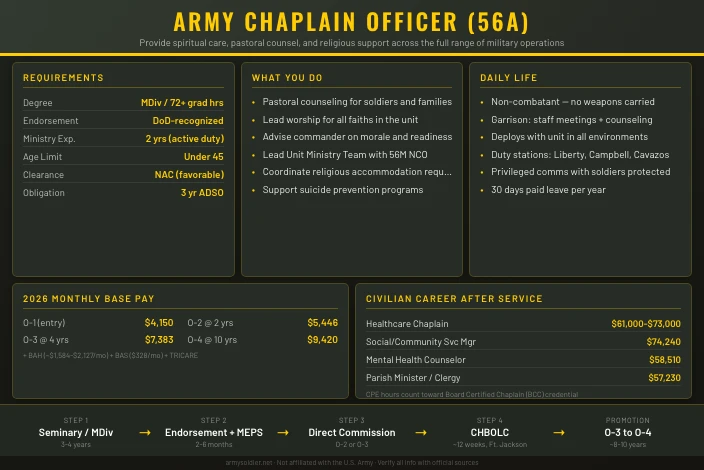
Army Chaplain officers (MOS 56A) provide religious support, pastoral care, and spiritual counsel to soldiers and their families across the full range of military operations. Chaplains serve as the commanding officer’s advisor on all matters affecting morale, religion, and the free exercise of religion within the command. They lead Unit Ministry Teams (UMTs) paired with an enlisted Religious Affairs Specialist (56M) and operate at every echelon from battalion through theater army. As non-combatants under the Geneva Convention, chaplains do not carry weapons and do not engage in combat – their 56M assistants provide force protection for the team.
Command and Leadership Scope
Chaplains do not command in the traditional sense. Instead, they serve as special staff officers advising commanders at every level. At battalion, a single chaplain covers roughly 400 to 800 soldiers and their families. At brigade and division, the role shifts toward coordinating a team of chaplains, managing religious support programs across multiple subordinate units, and providing direct counsel to senior leaders.
The span of influence is wider than the span of command. A battalion chaplain is often the first person a soldier talks to before a mental health referral, the officer who runs the unit’s suicide prevention program, and the pastor or rabbi or imam conducting services in a forward operating base chapel tent.
Specific Roles and Designations
| Designation | Description |
|---|---|
| 56A | Unit Ministry Officer (core branch identifier) |
| ASI 5G | Clinical Pastoral Education Supervisor |
| ASI 5H | Family Life Chaplain |
| ASI 5J | Hospital Chaplain |
| FA 56 | Chaplain Functional Area (broadening/staff assignments) |
Mission Contribution
The chaplain mission sits at the intersection of military readiness and constitutional rights. Every soldier has the right to free exercise of religion. The Army cannot hire clergy for every faith tradition, so chaplains from recognized denominations serve all soldiers while performing only the rites of their own faith tradition. A Catholic chaplain conducts Mass for Catholic soldiers; for soldiers of other faiths, the chaplain facilitates access to an appropriate religious leader.
This structure matters operationally. Research consistently shows that spiritual and moral resilience affect unit cohesion and performance under stress. Commanders rely on chaplains to identify warning signs of moral injury, domestic stress, and substance abuse before those problems degrade readiness.
Technology, Equipment, and Systems
Chaplains use Army command and control systems (ATAK, CPOF) to coordinate religious support planning in the operations process. The Unit Ministry Team maintains portable chapel kits, audio equipment for field services, and secure communication equipment. At installation level, chaplains manage religious support programs through the Army Family Readiness system and coordinate with military hospitals, Army Community Service (ACS), and behavioral health teams.
Salary and Benefits
Base Pay
All officer pay comes from DFAS and applies uniformly across branches. A new chaplain enters as a Second Lieutenant (O-1) and, given the advanced degree requirement, typically arrives with credit that accelerates time-in-grade.
| Rank | Grade | Typical Years of Service | Monthly Base Pay (2026) |
|---|---|---|---|
| Second Lieutenant | O-1 | Under 2 years | $4,150 |
| First Lieutenant | O-2 | 2-4 years | $5,446 |
| Captain | O-3 | 4-8 years | $7,383 |
| Major | O-4 | 10-14 years | $9,420 |
| Lieutenant Colonel | O-5 | 16-20 years | $11,391 |
| Colonel | O-6 | 22-26 years | $14,113 |
Source: DFAS 2026 Military Pay Tables
Allowances and Special Pays
Beyond base pay, officers receive a Basic Allowance for Subsistence (BAS) of $328.48 per month (2026 rate) plus Basic Allowance for Housing (BAH), which varies by installation and dependency status. At a mid-tier installation like Fort Sam Houston, an O-3 with dependents receives approximately $2,127 per month in BAH – tax free.
Chaplains do not receive flight pay or hazardous duty incentive pay. Continuation Pay under the Blended Retirement System is available between 7 and 12 years of service, with the Army active component typically offering 2.5 times monthly basic pay in exchange for a 3-year additional service commitment.
The Army Reserve offers a $10,000 accession bonus for chaplains committing to a 6-year contract, payable after completing CHBOLC within 36 months of commissioning.
Retirement and Long-Term Benefits
Officers commissioned after 2018 fall under the Blended Retirement System (BRS). BRS combines a 20-year pension (40% of high-36 average basic pay at 20 years) with automatic TSP contributions. The government contributes 1% automatically beginning at 60 days of service and matches up to 4% of basic pay starting in the third year of service – for a maximum government contribution of 5%.
TRICARE Prime covers medical, dental, vision, and behavioral health at zero cost to active duty officers and their enrolled family members (annual out-of-pocket catastrophic cap of $1,000 for family members).
Officers earn 30 days of paid leave per year, accruing at 2.5 days per month. Up to 60 days can carry over between fiscal years.
Work-Life Balance
Work schedules during garrison follow a structured Monday through Friday pattern, with physical fitness in the morning and duty hours running roughly 0900 to 1700. Field exercises and deployments change that entirely. A chaplain supports the unit’s battle rhythm, which means being available when soldiers need pastoral care – not just during office hours.
Qualifications and Eligibility
The chaplain branch has stricter academic and ecclesiastical entry requirements than any other Army officer branch. Meeting all three pillars – education, endorsement, and military standards – is mandatory before an application advances.
Commissioning Sources
Chaplains enter the Army almost exclusively through direct commission. Unlike infantry or aviation, there is no ROTC chaplain track that produces newly commissioned lieutenants. The standard path is:
- Complete theological education and ministry experience
- Secure ecclesiastical endorsement from a DoD-recognized religious endorsing organization
- Apply through the Army Chaplain Recruiting Branch
- Receive a direct commission as a First Lieutenant (O-2) or Captain (O-3), depending on experience and age
- Attend CHBOLC at Fort Jackson, SC
ROTC and West Point graduates cannot branch chaplain upon commissioning because the educational requirements cannot be met before a typical commissioning age. Some officers with prior service commission as chaplains mid-career after completing seminary.
| Commissioning Source | Academic Requirement | Age Limit | Branch-Specific Prereq |
|---|---|---|---|
| Direct Commission (standard) | BA/BS (120+ sem. hrs) + Graduate theology (72+ sem. hrs) | Under 45 at appointment | 2 years full-time professional ministry (active duty); ecclesiastical endorsement required |
| Direct Commission (prior service) | Same as above | Under 47 at appointment | 3+ years prior active or Reserve service; ecclesiastical endorsement required |
| ROTC | Not applicable | N/A | Chaplain branch not available at commissioning through ROTC |
| OCS | Not an applicable path | N/A | Chaplain branch not available through OCS |
Degree Requirements
The Army requires a baccalaureate degree of at least 120 semester hours and a graduate theological degree of at least 72 semester hours in theology, religious studies, or a related field. The Master of Divinity (MDiv) is the standard qualifying degree at most seminaries (typically 90+ semester hours). Equivalent degrees are accepted if they meet the minimum graduate credit threshold.
Ecclesiastical Endorsement
This requirement is unlike anything else in Army officership. Your faith community must certify that you are:
- Ordained or otherwise authorized to perform ministry in your tradition
- Qualified spiritually, morally, intellectually, and emotionally for military chaplaincy
- Willing and able to support religious pluralism and the free exercise of religion for all soldiers
The endorsement comes from a DoD-recognized endorsing body. Your denomination’s endorsing agent submits the endorsement directly to the Army. Without it, no application moves forward – and the Army cannot waive the requirement.
Additional Requirements
- U.S. citizenship (permanent residents may apply for Reserve component only)
- Favorable National Agency Check (security clearance eligibility)
- Pass Army physical examination at MEPS
- GT score meeting Army officer accession standards (verify current minimums with the Chaplain Recruiting Branch at recruiting.army.mil)
Upon Commissioning
New chaplains typically enter at O-2 (First Lieutenant) or O-3 (Captain) based on age and prior service credit. The standard Active Duty Service Obligation (ADSO) is 3 years for direct commission with concurrent call to active duty, per AR 135-210. The total military service obligation (active plus Reserve) is 8 years from commissioning.
OCS candidates can find a focused GT study plan in our ASVAB for OCS guide.
Work Environment
Setting and Schedule
Garrison chaplains split their time between an office, the unit motor pool area, and wherever soldiers gather. That sounds vague because the job is deliberately unstructured – soldiers do not make appointments to discuss their faith crisis or marital problems. Being visible and available matters more than any formal schedule.
A typical garrison day might include a morning command and staff meeting as the battalion commander’s special staff advisor, followed by counseling sessions, a memorial service preparation, coordination with behavioral health, and a unit Bible study or Friday Jumu’ah prayer service in the late afternoon. No two days are the same.
Field exercises and deployments compress the scope. The chaplain is always with the unit, always accessible, and always conducting services in whatever cleared space exists – a vehicle hood, a helicopter pad, a hardened bunker.
Chain of Command and NCO Relationships
Chaplains sit outside the normal staff hierarchy in a unique way. They report directly to the commander as a special staff officer, but they maintain a relationship of trust with every soldier regardless of rank. Privileged communication – the military equivalent of clergy-penitent privilege – means soldiers know what they tell a chaplain stays with the chaplain. That trust is the chaplain’s primary tool.
The 56M Religious Affairs Specialist is the chaplain’s operational partner. The NCO handles logistics, force protection, administrative coordination, and program support. A strong chaplain-56M relationship determines how effective the Unit Ministry Team is in the field.
Staff vs. Command Roles
Chaplains do not hold command billets. Career progression moves through advisory and staff positions at increasing echelons: battalion UMT, brigade chaplain staff, division chaplain staff, corps chaplain. Senior chaplains (O-5 and O-6) serve at HQDA, ACOM, and major Army commands as theater-level religious support advisors.
Between unit ministry assignments, chaplains serve as family life chaplains, hospital chaplains, installation chaplain staff, and at the Chaplain school as instructors. Broadening assignments include joint staff positions and chaplain candidate program oversight roles.
Job Satisfaction and Retention
Chaplain retention tends to be higher than many combat arms branches, driven by the meaningful nature of the work and the relatively stable family life compared to infantry or armor. Officers who leave most often cite frustration with the bureaucratic aspects of staff work at higher echelons, or they return to civilian ministry full time. Officers who stay typically describe the connection with soldiers as something civilian ministry rarely replicates.
Training and Skill Development
Pre-Commissioning
Unlike combat arms officers, chaplain candidates do not go through ROTC or OCS. Pre-commissioning preparation happens through seminary education, supervised ministry, and the Chaplain Candidate Program, which allows seminary students to serve in Reserve units and attend annual training while completing their degree. This provides direct exposure to military ministry before full commissioning.
Chaplain Basic Officer Leader Course (CHBOLC)
CHBOLC runs at the US Army Institute for Religious Leadership (USAIRL), Fort Jackson, South Carolina. It is the branch’s equivalent of BOLC and replaces standard officer basic training for chaplains.
| Phase | Focus | Notes |
|---|---|---|
| Direct Commissioning Course (DCC) | Army fundamentals: warrior tasks, BOLC common core, Chaplain Corps orientation | “Basic training” phase for officer skills |
| Phase 1 | Staff officer competencies: operations process, Army writing, briefing skills | Prepares chaplain for battalion staff role |
| Phase 2 | Chaplain ministry skills: pastoral care, worship facilitation, religious support planning | Battalion-level chaplaincy tasks |
| Phase 3 | 108-hour field training exercise | Integrates all phases in a realistic operational environment |
Total course length is approximately 12 weeks. The USAIRL runs approximately three CHBOLC cohorts per year.
Professional Military Education (PME)
- Chaplain Career Course (CCC): Attended around the O-3/O-4 transition. Prepares chaplains for brigade and division staff assignments, covering religious support planning at higher echelons.
- Intermediate Level Education (ILE) / Command and General Staff College (CGSC): Required for O-4 promotion. Chaplain majors attend ILE concurrently with the Chaplain Brigade Course.
- Senior Service College (SSC): Selective program for O-5s and O-6s preparing for strategic leadership roles.
Additional Schools and Civilian Education
The Army funds advanced civilian training for chaplains preparing for specialized ministry roles:
- Clinical Pastoral Education (CPE) supervisor programs (ASI 5G)
- Family life counseling certification tracks (ASI 5H)
- Graduate-level courses in trauma-informed care and crisis counseling
- The Army’s Graduate School program provides fully funded master’s-level coursework for competitive selectees
Before OCS, you need a qualifying GT score — see our ASVAB for OCS guide.
Career Progression and Advancement
Career Timeline
| Rank | Grade | Typical Time in Grade | Key Positions |
|---|---|---|---|
| Second Lieutenant / First Lieutenant | O-1 / O-2 | 1-3 years | Assigned to battalion UMT as assistant chaplain or junior chaplain |
| Captain | O-3 | 4-7 years | Battalion Chaplain (primary KD position); unit ministry team leader |
| Major | O-4 | 8-12 years | Brigade/Group Chaplain; division assistant chaplain; family life chaplain; installation chaplain |
| Lieutenant Colonel | O-5 | 13-17 years | Division Staff Chaplain; HQDA/ACOM staff chaplain; installation chaplain |
| Colonel | O-6 | 18-22 years | Corps Chaplain; Theater Army Chaplain; HQDA senior positions |
The battalion chaplain assignment at Captain is the primary career-defining position, equivalent to company command in combat arms. Officers who do not serve as a battalion chaplain before O-4 selection have significantly weaker promotion files.
Promotion System
O-1 through O-3 promotions are essentially automatic with time in service and satisfactory performance. O-4 (Major) is the first fully board-selected rank, where promotion rates typically run 70 to 80 percent Army-wide. O-5 and O-6 become progressively more competitive.
Chaplain officers compete within their own branch competitive category, not against combat arms or other branches. Officer Evaluation Reports (OERs), AFT scores, and senior rater assessments drive selection. A strong battalion chaplain record, ILE completion, and demonstrated impact on unit readiness are the markers boards look for.
Building a Competitive Record
Strong chaplain officer files typically show:
- Documented counseling caseload numbers and program outcomes (without violating privileged communication)
- Commander endorsements citing specific contributions to unit morale and readiness
- Voluntary additional duty roles (suicide prevention program officer, violence prevention coordinator)
- Timely completion of all PME schools
- Advanced civilian training credentials (CPE, family life certification)
- Joint assignments or broadening tours at ROTC, recruiting, or joint staff
Physical Demands and Medical Evaluations
Chaplains meet the same physical fitness standards as all Army officers. There are no branch-specific physical demands analogous to Ranger or airborne schools for infantry officers, but physical fitness is expected and inspected.
Army Fitness Test (AFT) Standards
The Army Fitness Test (AFT) replaced the ACFT on June 1, 2025. It has five events scored 0-100 points each, for a maximum of 500 points. A minimum score of 60 points per event is required. Chaplains meet the general standard (300 total, sex- and age-normed), not the 350-point combat specialty standard.
| Event | Abbreviation | Description |
|---|---|---|
| 3-Rep Max Deadlift | MDL | Loaded barbell deadlift, 3 repetitions |
| Hand Release Push-Up | HRP | Full extension at bottom, arm release each rep |
| Sprint-Drag-Carry | SDC | 5 lanes of 25 meters each with varied tasks |
| Plank | PLK | Timed prone plank hold |
| Two-Mile Run | 2MR | Timed 2-mile run |
Minimum passing score: 300 total (60 per event). Scores are sex- and age-normed. Officers scoring below 60 on any single event fail regardless of total score.
Medical Standards
Chaplains require a standard commissioning physical with no branch-specific disqualifiers beyond the general officer medical fitness standards. No flight physical, dive physical, or special duty physical is required. Officers must meet Army height and weight standards throughout their career.
Deployment and Duty Stations
Deployment Tempo
Chaplains deploy with their units. The tempo depends on the unit type. A chaplain assigned to an airborne brigade at Fort Liberty deploys more frequently than one assigned to a training installation. Typical active duty deployment cycles run 9 to 12 months deployed followed by 12 to 18 months at home station, though this varies significantly by Army operational demand.
Chaplains have served in every major combat theater since the Army’s founding. In current operations, they deploy to the Middle East, Europe (rotational), the Pacific, and Africa on a regular basis.
Duty Station Options
Chaplains serve at essentially every Army installation worldwide because every unit requires religious support coverage. Key installations with large chaplain populations include:
- Fort Liberty, NC (XVIII Airborne Corps)
- Fort Campbell, KY (101st Airborne Division)
- Fort Cavazos, TX (III Armored Corps)
- Fort Stewart, GA (3rd Infantry Division)
- OCONUS posts in Germany, South Korea, Hawaii, and Japan
The Chief of Chaplains manages all chaplain officer personnel assignments through HRC. Officers submit preference sheets, and the Army attempts to match preferences with needs. The Chaplain Buddy Program offers guaranteed co-location at the same installation for chaplain officers and their families during the initial ADSO period.
Risk, Safety, and Legal Considerations
Non-Combatant Status and Its Implications
Chaplains hold a unique legal status under the Geneva Convention. They are protected persons who may not be made prisoners of war but instead must be returned. This protection comes with a strict prohibition: chaplains do not bear arms, do not engage in combat, and do not participate in offensive or defensive military actions.
This creates a command responsibility challenge. The chaplain’s safety depends entirely on their 56M assistant and the unit they are assigned to. Commanders and chaplains must plan carefully for how UMTs operate in high-threat environments.
Command Responsibility and UCMJ
Chaplains are commissioned officers subject to the Uniform Code of Military Justice (UCMJ). They hold the same officer accountability standards as any staff officer – for actions, administrative decisions, and the welfare of subordinates – with one critical carve-out: privileged communication between a chaplain and a soldier is protected and cannot be compelled in legal proceedings.
This protection is absolute and distinguishes the chaplain role from every other officer on the staff. It is also the source of the chaplain’s authority as a counselor. Officers who violate this trust – by disclosing confidential communications – face severe career consequences and potential criminal liability.
Equal Opportunity and Religious Accommodation
Chaplains advise commanders on religious accommodation requests under AR 600-20. They also serve as a resource for soldiers seeking accommodation for religious practices that conflict with duty requirements. Getting this right matters: improper denial of religious accommodation requests is a legal liability for commands.
Impact on Family and Personal Life
Deployment and Garrison Balance
Chaplain officers deploy with their units, which means families experience the same separation cycles as any other branch. The difference is that chaplains are often the officers most aware of the strain that military life places on families – because they spend significant time counseling families of deployed soldiers and managing family readiness programs.
Garrison life is generally more predictable than combat arms. The work does not end at 1700, but it rarely involves the pre-dawn PT formations and all-night field exercises that define life in infantry or armor at certain career stages.
Family Support Infrastructure
Chaplains are often the officers who run the family support programs rather than just using them:
- Family Readiness Groups (FRG): Chaplains provide pastoral support and often speak at FRG events
- Army Community Service (ACS): Chaplains coordinate referrals and sometimes run programs alongside ACS staff
- Military OneSource: Chaplains refer families to counseling and crisis resources
- Soldier and Family Life Counselors (SFLC): Chaplains work alongside licensed counselors at the installation level
PCS (permanent change of station) moves happen approximately every 2 to 3 years. Officers and spouses should research spouse employment resources through Military OneSource and installation ACS offices before each move.
Dual-Military Families
The Army attempts to co-locate dual-military couples at the same installation, but it is not guaranteed. Chaplains may request join-spouse assignments through HRC, and the Chaplain Buddy Program for initial assignees provides some protection during the early career years.
Reserve and National Guard
Component Availability
The Chaplain branch is available in both the Army Reserve and the Army National Guard. Reserve and Guard chaplains serve the same UMT function as active duty chaplains and fulfill the same non-combatant role.
Commissioning Paths
Reserve and Guard chaplains enter through the same direct commission process as active duty. Key differences:
- Permanent residents may apply for the Army Reserve (but not active duty or National Guard)
- The Army National Guard in some states (New York, for example) offers state-specific chaplain officer accession programs
- The Reserve Chaplain Candidate Program allows seminary students to drill with Reserve units while completing their degree, then transition to full commission upon graduation
Active duty officers who complete their ADSO can transfer to the Reserve or Guard in the CH branch, maintaining their rank and continuing toward Reserve retirement.
Drill and Training Commitment
The standard Reserve/Guard schedule is one weekend per month (4 drill periods) plus 14 days of Annual Training per year. Chaplain officers in the Reserve frequently commit additional days for unit ministry needs, counseling support, and pre-deployment preparation beyond the minimum schedule.
Reserve chaplains may also complete Clinical Pastoral Education and Family Life certification programs on federal tuition assistance, which counts toward both military and civilian credentials.
Part-Time Pay
Reserve and Guard officers earn drill pay based on one-thirtieth of their monthly basic pay per drill period. A standard drill weekend counts as 4 drill periods.
| Grade | Monthly Active Duty Base Pay | Drill Weekend Pay (4 drills) |
|---|---|---|
| O-1 (under 2 years) | $4,150 | $553 |
| O-3 (under 2 years) | $5,534 | $738 |
| O-3 (3 years) | $6,770 | $903 |
Component Comparison
| Category | Active Duty | Army Reserve | Army National Guard |
|---|---|---|---|
| Commitment | Full time | 1 weekend/month + 2 weeks/year | 1 weekend/month + 2 weeks/year |
| Monthly Pay (O-3) | $6,770+ (base only) | ~$738-$903/drill weekend | ~$738-$903/drill weekend |
| Healthcare | TRICARE Prime ($0 premium) | TRICARE Reserve Select ($57.88/mo individual) | TRICARE Reserve Select ($57.88/mo individual) |
| Education Benefits | Full Tuition Assistance ($4,500/yr) | Federal TA + MGIB-SR ($493/mo) | Federal TA + state tuition benefits (varies) |
| Deployment Tempo | High (with unit cycle) | Moderate (mobilization-driven) | Moderate (state + federal activation) |
| Command Opportunities | Battalion-level UMT, theater chaplain | UMT and installation chapel positions | UMT positions, state chaplain roles |
| Retirement | 20-year active pension (40% at 20 yrs) | Points-based, collect at 60 | Points-based, collect at 60; state bonuses vary |
Reserve chaplains who have accumulated 90+ days of active duty (Title 10 orders) may qualify for Post-9/11 GI Bill benefits scaled to their total active service time.
USERRA protections apply to all Reserve and Guard service. Civilian employers cannot deny promotion, seniority, or benefits because of military service, and must allow reemployment after service periods of up to 5 cumulative years.
Post-Service Opportunities
Civilian Transition
An Army chaplain’s transition to civilian life is unusually direct. The skills – pastoral counseling, crisis intervention, grief support, leadership under pressure, and interfaith communication – map cleanly onto fields that actively recruit former military chaplains.
Transition programs like SFL-TAP (Soldier for Life – Transition Assistance Program) and Hiring Our Heroes help officers build civilian networks. For chaplains, the professional network built through Clinical Pastoral Education, family life certification, and advanced military ministry training often opens doors without formal recruiting programs.
Civilian Career Options
| Civilian Role | Median Annual Salary | Outlook |
|---|---|---|
| Clergy / Parish Minister | ~$57,230 | Stable, steady demand in faith communities |
| Hospital / Healthcare Chaplain | ~$61,000-$73,000 | Growing with healthcare expansion |
| Corporate / Workplace Chaplain | ~$55,000-$70,000 | Growing sector, especially defense contractors |
| Social and Community Service Manager | ~$74,240 | 9% growth projected (BLS) |
| Substance Abuse / Behavioral Health Counselor | ~$53,710 | 18% growth projected (BLS) |
| Mental Health Counselor | ~$58,510 | 22% growth projected (BLS) |
Salary data: Bureau of Labor Statistics Occupational Outlook Handbook
Healthcare and government chaplain roles tend to pay significantly more than parish ministry, and military service provides a direct credential with hospital chaplaincy programs that recognize CPE completed during military service.
Credentials and Education Benefits
Chaplains often leave active duty with:
- CPE hours that count toward board-certified chaplain (BCC) certification through the Association of Professional Chaplains (APC) or similar bodies
- Family life counselor credentials for those who completed the ASI 5H track
- An MDiv or equivalent graduate degree already in hand
The Post-9/11 GI Bill provides up to 36 months of education benefits covering full in-state public school tuition or up to $29,920.95 per year at private institutions (AY 2025-2026 cap), plus a monthly housing allowance. Officers who meet the minimum service threshold can also transfer unused benefits to dependents while still on active duty.
Is This a Good Job for You?
The Right Fit
Chaplain officership suits people who chose ministry not as a backup plan but as a vocation – and who want to practice that vocation in an environment that is raw, intense, and without easy answers. Soldiers deal with death, injury, family breakdown, moral injury from combat decisions, and the psychological weight of sustained deployments. They need a chaplain who can sit with those realities without flinching.
The ideal chaplain officer candidate is already active in pastoral ministry and curious about military culture. They are comfortable as an outsider on the staff (non-combatant in a combat organization) and confident enough in their own faith tradition to serve soldiers of every background without proselytizing.
Strong candidates typically show:
- Active ordained ministry with documented counseling experience
- Graduate theological education completed or nearly complete
- Comfort operating in ambiguous, high-pressure environments
- Physical fitness that meets Army standards without struggle
- A genuine interest in military history, culture, and the soldier’s experience
Where It Doesn’t Fit
This branch is a poor match for officers who want command authority, tactical leadership, or the kinetic side of military service. Chaplains advise; they do not command. The influence is real but always indirect. Someone who became an officer to lead soldiers in the field will find the non-combatant restriction suffocating rather than freeing.
The advanced degree requirement also means most chaplains enter service later than other officers – typically in their late 20s or early 30s – which affects retirement math for those planning a 20-year career.
The endorsement requirement is the most significant long-term constraint. Your denomination controls a condition of continued service. If you leave your faith community, ordination changes, or your endorsing body withdraws support, your military career ends – regardless of your performance record.
Long-Term Alignment
For officers who want a 20-year career, the chaplain branch offers genuine depth and variety: battalion ministry, family life specialty, hospital chaplaincy, joint assignments, and senior advisory roles at theater level. The work at every stage is meaningful rather than administrative.
For one-and-done officers, the 3-year ADSO minimum and the time investment in the degree and endorsement process make chaplaincy a poor fit for anyone not genuinely committed to ministry as a profession.
The Guard and Reserve option is the strongest path for civilian ministers who want military chaplaincy experience alongside a civilian congregation or hospital position, without the full-time commitment or permanent change of station cycles.
More Information
Contact the Army Chaplain Recruiting Branch to learn about current requirements, the direct commission process, and the Chaplain Candidate Program for seminary students. The office can be reached through recruiting.army.mil/MRB_ReligiousServices/. Your seminary or theological school may also have an alumni network of military chaplains who can speak to the career from direct experience.
- OCS candidates: prepare for GT 110 with our ASVAB for OCS study guide
This site is not affiliated with the U.S. Army or any government agency. Verify all information with official Army sources before making enlistment or career decisions.
Explore more Army Chaplain careers to find other ministry and religious support opportunities within the branch.