74A Chemical Officer
When a brigade combat team moves through an area contaminated with a chemical agent, one officer is responsible for knowing what it is, how far it has spread, and how to get soldiers through it alive. That is the Chemical officer. The 74A branch sits at the intersection of science and tactical leadership, advising commanders on threats that most officers will never fully understand. It draws people who want to be the expert in the room and who are comfortable operating in environments where the hazard is invisible and the consequences of a wrong call are permanent.
OCS candidates need a GT score of 110 on the ASVAB — our ASVAB for OCS guide covers exactly how to hit that number.
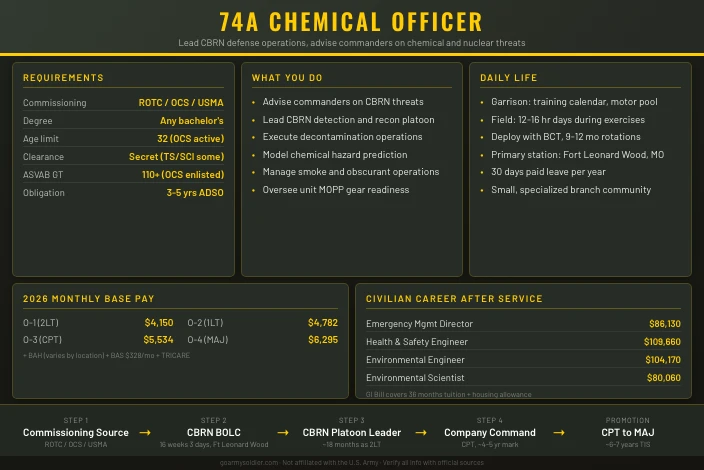
Job Role and Responsibilities
Chemical officers (AOC 74A) plan and execute Chemical, Biological, Radiological, and Nuclear (CBRN) defense operations across the full spectrum of Army missions. They advise commanders on CBRN threats, manage decontamination and hazard prediction operations, oversee smoke and obscurant employment, and lead CBRN units from platoon through battalion level. Their technical expertise covers WMD defense, hazardous materials management, and the full range of detection, protection, and decontamination capabilities organic to the force.
Command and Leadership Scope
A new Chemical officer takes command of a CBRN platoon with 25 to 40 soldiers. That platoon trains and executes across four mission areas: detection and reconnaissance, decontamination, CBRN defense support to the maneuver force, and smoke/obscurant operations. At company command as a Captain, the officer owns the full CBRN company: personnel readiness, training management, and operational employment for the brigade or division they support.
Field grade Chemical officers shift into staff roles as CBRN officers at brigade, division, or corps level, and eventually compete for battalion command as Lieutenant Colonels. Senior Chemical officers serve in key joint and interagency positions tied to WMD defense, consequence management, and homeland security policy.
Specific Roles and Designations
| Designation | Title | When Assigned |
|---|---|---|
| 74A | Chemical, Biological, Radiological and Nuclear (CBRN) Officer | All commissioned Chemical officers |
| SI 9A | Airborne Qualified | After completing Airborne School |
| SI 5Q | Ranger Tab Qualified | After completing Ranger School |
| FA 52 | Nuclear and Countering WMD | Post-KD broadening assignment |
Mission Contribution
The Chemical branch exists because no other officer in a brigade headquarters has the training to answer CBRN threat questions in real time. When a commander needs to know whether ground forces can move through an area, how long decontamination will take, or what protective equipment soldiers need for a specific threat, the Chemical officer answers. In combined arms operations, CBRN capability enables freedom of movement through contaminated terrain and denies the enemy the ability to use chemical or radiological weapons as a tactical multiplier.
Technology, Equipment, and Systems
Chemical officers work with a range of detection, modeling, and protection systems. Detection platforms include the M8A1 Automatic Chemical Agent Alarm, the JCAD (Joint Chemical Agent Detector), and the CBRN Reconnaissance Vehicle (Stryker-mounted in CBRN units). Hazard prediction and modeling relies on the Joint Effects Model (JEM) and CHEMPACK data systems. Officers also manage the Individual Protective Equipment (IPE) program for their supported unit, overseeing accountability and readiness of MOPP gear for hundreds or thousands of soldiers.
Command and control runs through the standard Army C2 architecture (CPOF, ATAK), with CBRN-specific overlays integrated into the common operating picture for commanders.
Salary and Benefits
Financial Benefits
Chemical officers earn standard commissioned officer base pay with no branch-specific automatic special pays. Officers assigned to positions involving nuclear or radiological hazard work may qualify for hazardous duty incentive pay; verify current eligibility with your personnel officer for the specific position.
| Grade | Title | Less than 2 yrs | 4 yrs | 8 yrs | 12 yrs |
|---|---|---|---|---|---|
| O-1 | Second Lieutenant (2LT) | $4,150 | $5,222 | – | – |
| O-2 | First Lieutenant (1LT) | $4,782 | $6,485 | – | – |
| O-3 | Captain (CPT) | $5,534 | $7,383 | $8,126 | $8,788 |
| O-4 | Major (MAJ) | $6,295 | $7,881 | $8,816 | $9,888 |
Source: DFAS 2026 pay tables. Rates effective January 1, 2026, reflecting a 3.8% raise per the FY2026 NDAA.
There is no branch-specific accession bonus for 74A as of early 2026. Officer bonuses change throughout the fiscal year; confirm current incentive status with your recruiter.
Additional Benefits
Officers receive TRICARE Prime at no premium, covering medical, dental, vision, mental health, and prescriptions for the entire family. Basic Allowance for Housing (BAH) is location-dependent; an O-3 at Fort Sam Houston, TX earns approximately $2,007/month without dependents and $2,127/month with dependents. Basic Allowance for Subsistence (BAS) for officers is $328.48/month regardless of location.
The Blended Retirement System (BRS) pays 40% of your high-36 average basic pay at 20 years, plus TSP matching up to 5% of basic pay. Continuation Pay between 7 and 12 years of service adds a lump sum of 2.5 to 13 times monthly basic pay in exchange for a three-year extension. Officers also receive 30 days paid leave per year and up to $4,500 annually in Tuition Assistance.
Work-Life Balance
Garrison work for a CBRN platoon leader runs on a standard training calendar: PT in the morning, training events through the day, administrative work in the afternoon. The schedule sharpens around collective training exercises and rotation cycles, when 12-to-16-hour days become the norm for weeks at a time. Staff positions at division or corps level carry a heavier administrative load but more predictable hours outside of exercise windows. Deployment tempo mirrors the supported unit, so Chemical officers assigned to BCTs cycle with the brigade’s deployment schedule.
Qualifications and Eligibility
Commissioning Sources
Chemical officers commission through ROTC, Officer Candidate School (OCS), or the United States Military Academy (West Point). Direct Commission into 74A is not a standard accession path. All three sources lead to the same starting point: 2LT branched Chemical, followed by CBRN BOLC at Fort Leonard Wood, Missouri.
ROTC produces the largest share of Chemical officers. Cadets compete for branch during their senior year through a talent-based branching process that weights academic performance, physical fitness, and leadership ratings. The Chemical branch consistently fills without requiring top-tier Order of Merit List ranking, making it accessible to well-rounded cadets who are not in the top quarter of their class.
OCS accepts active-duty enlisted soldiers, National Guard and Reserve candidates, and civilians holding a four-year degree. Enlisted soldiers attending OCS need a GT score of 110 or higher on the ASVAB. Civilian OCS candidates do not take the ASVAB. A science or engineering background is not required for commissioning, but it helps in BOLC and throughout the branch.
West Point graduates branch by OML with input from the Branching Assignment Team. Chemical is available to all cadets, and USMA’s science curriculum produces strong candidates for the branch.
| Commissioning Source | GPA Minimum | Degree Requirement | Age Limit | Physical Standard |
|---|---|---|---|---|
| ROTC | 2.0 cumulative | Any bachelor’s degree | 31 at commissioning | Pass AFT; DODMERB physical |
| OCS (Active) | 2.0 cumulative | Any bachelor’s degree | 32 at commissioning | Pass AFT; MEPS physical |
| OCS (Reserve/Guard) | 2.0 cumulative | Any bachelor’s degree | 35 at commissioning | Pass AFT; MEPS physical |
| West Point | Competitive | N/A (degree conferred) | 23 at entry | Pass AFT; DoDMERB physical |
Age limits reflect standard Army policy; waivers are available case-by-case.
Test Requirements
Enlisted soldiers attending OCS must achieve an ASVAB GT score of 110 or higher. This is a standard officer threshold, not a Chemical-specific requirement. No additional aptitude test is required for the 74A branch. The SIFT is not required unless the officer later pursues aviation qualification.
Branch Selection and Assignment
ROTC and West Point cadets select branches through the Army’s talent-based branching process. The Chemical branch is not among the most competitive branches by OML, which means cadets who request it early and perform solidly across academic, fitness, and leadership metrics typically receive it. The Army publishes branch fill data after each accession cycle; your ROTC battalion’s PMS can give you current guidance on how Chemical has been filling.
Officers may request a branch detail, beginning their career in a combat arms branch before reverting to Chemical later. Some Chemical officers detail into Infantry or Armor, gaining combined arms experience before returning to CBRN units. Branch detail officers incur an additional service obligation equal to their detail length.
Upon Commissioning
All new Chemical officers commission as Second Lieutenants (O-1). The standard Active Duty Service Obligation (ADSO) is 3 years for ROTC scholarship recipients and OCS graduates. West Point graduates owe 5 years. Officers who complete CBRN BOLC incur an additional one-year service obligation for the course. Accepting a branch-of-choice incentive or advanced civil schooling extends the obligation further.
OCS candidates can find a focused GT study plan in our ASVAB for OCS guide.
Work Environment
Setting and Schedule
A CBRN platoon leader’s day is built around training. Detection equipment requires constant maintenance and operator proficiency; decontamination operations are equipment-intensive and physically demanding. In garrison, the schedule involves motor pool accountability, rehearsals, and integration with supported maneuver units. Field training pulls the platoon out of garrison for days to weeks at a time to execute CBRN reconnaissance, decontamination line setup, or smoke operations.
Staff Chemical officers at brigade or division work in a planning environment. They integrate CBRN threat assessments into the intelligence preparation of the battlefield (IPB), brief commanders on hazard prediction models, and coordinate with higher CBRN elements on threat updates. That work involves more computer time and fewer motor pool hours, but it requires stronger communication skills because the audience is senior commanders who want the bottom line, not the chemistry.
Leadership and Chain of Command
As a platoon leader, the most important professional relationship is with the platoon sergeant (SFC). CBRN platoon sergeants carry years of hands-on equipment and operational experience. A new 2LT who listens, asks questions, and builds a working relationship with that NCO will lead a more effective platoon than one who tries to outrun their experience. You bring planning authority and officer accountability; the PSG brings institutional knowledge and soldier relationships.
At company command, you own the climate and the mission. The first sergeant manages the enlisted force day-to-day; you set the standards and sign for everything. The 74A branch’s technical nature means that soldiers expect their officer to understand the equipment and the science, at least at a working level. Officers who invest in that technical knowledge early build credibility that carries through the rest of their career.
Staff vs. Command Roles
The standard Army pattern puts officers in command roughly 30 to 40 percent of a career. Between platoon leader time and company command, Chemical officers typically fill battalion staff jobs (S2, S3, S4 positions). Post-command Majors fill brigade or division G3/G9 CBRN staff billets or joint positions tied to combatant command WMD policy. The staff time is where most of the analytical and advisory work happens, and it is where Chemical officers build the briefing skills and threat expertise that define the branch’s reputation.
Job Satisfaction and Retention
Chemical officers who stay beyond their initial obligation frequently cite two factors: the technical depth of the mission and the unique advisory role at senior levels. The branch has never commanded large formations, but it has consistent access to senior commanders who need expert advice. Officers who want to be the expert in the room, rather than the commander of a large tactical unit, often find that fits. Officers who leave early most often cite limited command opportunities relative to combat arms branches and the challenge of building a tactical identity in a small, specialized community.
Training and Skill Development
Pre-Commissioning Training
ROTC cadets complete four years of leadership labs, field training exercises, and an Advanced Camp between junior and senior year. OCS compresses commissioning training into 12 weeks at Fort Moore, GA. West Point is a four-year program that combines an accredited bachelor’s degree with officer preparation. None of these programs includes CBRN branch-specific training; that begins at BOLC.
Basic Officer Leader Course (BOLC)
All new Chemical officers attend CBRN BOLC at Fort Leonard Wood, Missouri, run by the U.S. Army Chemical, Biological, Radiological and Nuclear School (USACBRNS). The course is 16 weeks and 3 days in length, based on the FY2026 course schedule published by the U.S. Army CBRN School.
| Phase | Location | Approximate Length | Focus |
|---|---|---|---|
| Phase I (BOLC-A equivalent) | Fort Leonard Wood, MO | ~4 weeks | Army officer fundamentals, land navigation, tactics |
| Phase II (Branch technical) | Fort Leonard Wood, MO | ~8 weeks | CBRN detection, decontamination, hazard prediction, WMD defense, smoke operations |
| Phase III (Integration) | Fort Leonard Wood, MO | ~4 weeks | Tactical exercises, leader integration, culminating events |
BOLC covers detection and reconnaissance techniques, decontamination line operations, chemical agent identification, hazard prediction modeling, and smoke/obscurant employment. Officers complete field exercises integrating all four CBRN core tasks. Active Army officers incur a one-year service obligation upon completing CBRN BOLC.
Professional Military Education (PME)
Captain’s Career Course (CCC) for Chemical officers runs at Fort Leonard Wood through the USACBRNS. Timing is typically at the 4-to-6-year mark, before or after company command. The course deepens CBRN technical knowledge and prepares officers for battalion and brigade staff responsibilities.
Intermediate Level Education (ILE) at the Command and General Staff College (CGSC), Fort Leavenworth, KS, is a career-defining milestone at roughly the 10-to-12-year mark. Selection for resident ILE is competitive; it signals the Army’s intent to advance an officer to Lieutenant Colonel. Non-resident options are available for officers not selected for resident attendance.
Senior Service College (SSC) at the Army War College, Carlisle Barracks, PA, or equivalent programs, is available to Colonel-select and General Officer candidates. Selection is highly competitive.
Additional Schools and Training
Chemical officers have access to a range of additional schools that build tactical credibility and expand the advisory role:
- Airborne School (3 weeks, Fort Moore, GA): valuable for officers assigned to airborne or light infantry units
- Ranger School (61 days, Fort Moore, GA): competitive and respected at promotion boards, though not branch-required
- Air Assault School (10 days, Fort Campbell, KY): available at air assault installations
- HAZMAT Operations and Technician courses: civilian-recognized credentials that align with the CBRN mission
- WMD-specific courses: the USACBRNS offers advanced courses in nuclear, biological, and chemical defense that Chemical officers attend throughout their career
The Army’s Advanced Civil Schooling (ACS) program offers fully funded graduate education to select officers, typically at the 8-to-12-year mark. Chemistry, environmental science, and biosecurity graduate programs are natural fits for Chemical officers.
Before OCS, you need a qualifying GT score — see our ASVAB for OCS guide.
Career Progression and Advancement
Career Path
The Chemical officer career follows the standard Army progression from platoon leader through battalion command, with CBRN-specific KD positions defining each level.
| Rank | Typical Time-in-Grade | Key Developmental Position |
|---|---|---|
| 2LT (O-1) | 18 months | CBRN Platoon Leader |
| 1LT (O-2) | 18 months | Battalion staff (S2/S3/S4), assistant operations officer |
| CPT (O-3) | 4-5 years | CBRN Company Commander (KD), then battalion or brigade staff |
| MAJ (O-4) | 4-5 years | Battalion S3 or XO (KD), Division/Corps CBRN staff officer |
| LTC (O-5) | 4-5 years | CBRN Battalion Commander (KD), Brigade XO |
| COL (O-6) | Varies | CBRN Brigade Commander, Senior CBRN Advisor (HQDA, joint commands) |
O-1 through O-3 promotion is time-based with satisfactory performance. O-4 and above requires board selection.
Promotion System
Promotion to Captain happens at roughly the 3-to-4-year mark for officers who meet standards. Major is the first competitive board; Army-wide selection rates historically run around 80 percent for officers with complete files. Lieutenant Colonel selection tightens to roughly 70 percent, and Colonel selection runs closer to 50 percent. Officers competing above Major need completed KD positions, strong Officer Evaluation Reports, a graduate degree, and additional military schooling on their record.
Branching Out and Functional Areas
After company command, Chemical officers can apply for Functional Areas (FA) that take the career outside the tactical CBRN mission. Relevant options include:
- FA 52 (Nuclear and Countering WMD): senior advisory roles in WMD defense policy, combatant command staff, and interagency coordination
- FA 49 (Operational Research/Systems Analysis): data analysis and modeling work at Army headquarters
- FA 51 (Acquisition): managing CBRN defense equipment programs and procurement
Branch transfers are possible through the Voluntary Transfer Incentive Program (VTIP). Chemical officers with strong records sometimes transfer to Military Intelligence or Cyber branches. Broadening assignments include ROTC instructor duty, joint staff positions at combatant commands, National Security Council staff, and Congressional Fellowship programs.
Building a competitive file means completing Ranger or Airborne before the Major board, finishing a graduate degree before ILE, getting into command on time, and establishing a reputation as a credible CBRN advisor with operational experience.
Physical Demands and Medical Evaluations
Physical Requirements
All Army officers take the Army Fitness Test (AFT), which replaced the ACFT on June 1, 2025. The AFT has five events scored 0-100 each, with a maximum total of 500 points.
| Event | Abbreviation | Minimum (60 pts) |
|---|---|---|
| 3 Rep Max Deadlift | MDL | 60 points |
| Hand Release Push-Up | HRP | 60 points |
| Sprint-Drag-Carry | SDC | 60 points |
| Plank | PLK | 60 points |
| Two-Mile Run | 2MR | 60 points |
General standard: 300 total points (60 per event), sex- and age-normed. The AFT is administered at least twice per year.
The 74A branch does not carry a combat specialty designation requiring the higher 350-point standard. Officers assigned to airborne or Ranger-qualified units are expected to maintain higher personal standards as a matter of professional expectation.
CBRN field operations carry physical demands beyond the standard test. Working in full Mission Oriented Protective Posture (MOPP) gear (protective mask, overgarment, gloves, and boots) raises core body temperature and limits dexterity and visibility. Decontamination operations are physically intensive and time-pressured. Officers who arrive in good shape make better decisions in that environment.
Medical Standards and Security Clearance
Chemical officers require at minimum a Secret security clearance upon commissioning. Assignments involving WMD-specific operations, senior advisory roles, or access to classified threat data typically require a Top Secret/SCI clearance. The investigation begins at the commissioning source; a clean financial and criminal history are the primary qualifying factors.
No branch-specific medical standard applies beyond the standard commissioned officer physical. Officers with corrected vision or controlled medical conditions may still commission with appropriate waivers if otherwise qualified.
Deployment and Duty Stations
Deployment Details
Chemical officers deploy with their supported unit. Officers assigned to brigade combat teams cycle on the BCT’s deployment rotation, typically 9 to 12 months deployed followed by a reset and dwell period. CBRN battalion officers deploy with the battalion on deliberate CBRN support missions. Staff Chemical officers at division and corps may deploy to headquarters positions supporting theater operations.
The deployment mission includes combat support in a CBRN-contested environment, WMD consequence management operations, and training of partner-nation forces in CBRN defense. As adversary use of chemical weapons has increased in recent conflicts globally, Chemical officers have gained renewed operational relevance. The branch is not a rear-area specialty.
Duty Station Options
Chemical officers serve primarily at installations with organic CBRN units or major headquarters that require CBRN staff expertise. Key duty stations include:
- Fort Leonard Wood, MO: home of the USACBRNS, the 3rd Chemical Brigade, and the primary training base for the Chemical Corps
- Fort Cavazos, TX: CBRN units supporting III Corps
- Fort Campbell, KY: CBRN support to 101st Airborne Division
- Fort Stewart, GA: CBRN support to 3rd Infantry Division
- Fort Wainwright, AK and Schofield Barracks, HI: OCONUS-adjacent options
- OCONUS: Germany (USAREUR-AF), Korea (USFK), and Japan (USARPAC) all require CBRN expertise at echelon
HRC manages officer assignments through a preference sheet process. Early career officers have limited influence over their assignment; officers post-command with strong records get more consideration. The Chemical branch is small enough that the branch manager knows most officers by record.
Risk, Safety, and Legal Considerations
Job Hazards
Chemical officers face the physical risks of any Army officer: training accidents, vehicle incidents during field operations, and combat exposure during deployments. The CBRN mission adds a layer specific to the branch: officers and their soldiers work with actual chemical defense equipment, conduct live-agent training at Dugway Proving Ground, UT and similar installations, and operate in contaminated environments during exercises. Exposure risk is managed through strict safety protocols, but it exists.
Command responsibility risk for Chemical officers centers on technical judgments made under time pressure. An incorrect hazard prediction that sends soldiers into a contaminated area, or a decontamination clearance issued prematurely, has immediate safety consequences. Officers carry that responsibility regardless of who ran the model.
Safety Protocols
Chemical officers apply Composite Risk Management (CRM) to all training and operational planning. CBRN safety follows Army Regulation 385-10 and specific USACBRNS training safety requirements. Live-agent and simulation training follows strict safety protocols with medical personnel present. Officers coordinate with installation safety officers and unit safety NCOs on all high-risk training events. Decontamination operations and MOPP work in high heat environments require detailed heat category monitoring and water consumption plans.
Legal and Command Responsibility
Officers hold authority under the Uniform Code of Military Justice (UCMJ) and are accountable for their unit’s actions. For Chemical officers, that accountability includes the technical advice they provide to commanders. An officer who provides inaccurate or poorly researched CBRN threat analysis that results in a command decision causing harm to soldiers faces serious professional and potentially legal consequences.
Relief for cause effectively ends promotion prospects. Maintaining clear counseling records, sound technical standards, and a healthy command climate protects officers from both operational mistakes and institutional exposure.
Impact on Family and Personal Life
Family Considerations
Chemical officers move roughly every 2 to 3 years through platoon leader, staff, and command assignments. The PCS tempo is consistent with most Army branches. Army Community Service (ACS) and Family Readiness Groups (FRGs) operate at most Chemical unit installations and provide relocation support, spouse employment assistance, and family programming.
Fort Leonard Wood is the primary Chemical Corps installation; it is relatively isolated in south-central Missouri compared to large metropolitan Army posts. Families who value proximity to major cities should plan assignments around follow-on duty stations rather than expecting multiple Fort Leonard Wood tours. The long stretches at Leonard Wood during BOLC and CCC give officers who are single or without families time to focus on training.
Dual-Military and Family Planning
Dual-military couples can request join spouse assignments, which HRC processes alongside both officers’ normal assignment requests. Chemical units exist at fewer installations than combat arms or support branches, which can limit join spouse flexibility early in a career. The Army’s Child Development Center (CDC) network and the Child Care in Your Neighborhood program cover childcare needs across most major posts.
Reserve and National Guard
Component Availability
The Chemical branch is available in both the Army Reserve and the Army National Guard. CBRN units at battalion and company level exist in both components. Guard CBRN units carry a domestic mission that is genuinely relevant: chemical and industrial accident response, radiological emergency support, and consequence management for natural disasters. That state-level mission gives Guard Chemical officers real operational experience outside of federal deployments.
Commissioning Paths
Reserve component officers commission through ROTC with a Reserve-component contract, state OCS programs for National Guard, or by transferring from active duty after their ADSO. Active-duty Chemical officers who separate can apply for a Reserve or Guard commission, typically retaining their grade if applying within a reasonable window of separation.
Drill and Training Commitment
The standard Reserve/Guard commitment is one weekend per month (four Unit Training Assemblies) plus two weeks of Annual Training. CBRN units frequently add proficiency training tied to equipment certification: detection systems require operator recertification, decontamination operations require hands-on rehearsal, and HAZMAT certifications have renewal requirements. Expect 10 to 15 additional training days per year beyond the standard drill schedule for active CBRN units.
Part-Time Pay
A Reserve or Guard Chemical officer at O-3 earns approximately $738/weekend (4 drill periods) at less than 2 years of service, or approximately $903/weekend at the 3-year mark. Annual Training pays at the full active-duty daily rate for 14 days. Active-duty O-3 base pay by comparison runs $5,534 to $9,004/month depending on years of service.
Benefits Differences
| Category | Active Duty | Army Reserve | Army National Guard |
|---|---|---|---|
| Commitment | Full-time | 1 weekend/month + 2 weeks AT | 1 weekend/month + 2 weeks AT |
| Monthly pay (O-3, <2 yrs) | $5,534 | ~$738/weekend | ~$738/weekend |
| Healthcare | TRICARE Prime ($0 premium) | TRICARE Reserve Select ($57.88/mo individual) | TRICARE Reserve Select ($57.88/mo individual) |
| Education | TA ($4,500/yr) + Post-9/11 GI Bill | Federal TA + MGIB-SR ($493/mo) | Federal TA + MGIB-SR + state tuition waivers |
| Deployment tempo | Regular BCT cycle | Periodic mobilization | State missions + federal mobilization |
| Command billets | Full ladder (PL to BDE CDR) | Company, battalion, brigade | Company, battalion, brigade, state |
| Retirement | 20-yr pension at 40% high-36 | Points-based, collect at 60 | Points-based, collect at 60 |
Deployment and Mobilization
Reserve and Guard CBRN units mobilize for both federal and domestic missions. Federal mobilization tempo has historically averaged one 9-to-12-month deployment per 3-to-5 years for active CBRN units. Guard Chemical officers also deploy on state orders for consequence management operations, which are not counted in federal deployment statistics but are real operational events. ADOS (Active Duty for Operational Support) tours are available for Reserve Chemical officers who want to fill active-duty positions.
Civilian Career Integration
Chemical Reserve and Guard officers in environmental, safety, or emergency management careers have strong civilian-military career alignment. An environmental health and safety manager or hazmat specialist who serves as a Reserve CBRN officer brings directly relevant skills to both roles. USERRA protections guarantee reemployment rights after mobilization for all employers. Many federal emergency management and environmental agencies actively credit military CBRN experience toward hiring and advancement.
Post-Service Opportunities
Transition to Civilian Life
The Chemical officer career builds credentials that translate directly to high-demand civilian sectors: emergency management, hazardous materials management, environmental health and safety, homeland security, and defense consulting. The branch’s combination of technical knowledge and senior-level advisory experience is difficult to replicate without military service.
Transition programs include Skillbridge (DoD internship program available during the last 180 days of service), Hiring Our Heroes corporate fellowships, and the Army’s Soldier for Life Transition Assistance Program (SFL-TAP). Federal agencies with direct application from the Chemical officer background include FEMA, the Environmental Protection Agency (EPA), the Defense Threat Reduction Agency (DTRA), and the Department of Homeland Security.
Civilian Career Prospects
| Civilian Career | Median Annual Salary (BLS, May 2024) | Job Outlook (2024-2034) |
|---|---|---|
| Emergency Management Directors | $86,130 | 3% growth |
| Health and Safety Engineers | $109,660 | 4% growth |
| Environmental Engineers | $104,170 | 4% growth |
| Environmental Scientists and Specialists | $80,060 | 4% growth |
| Hazardous Materials Removal Workers (supervisor) | Above median for field | 1% growth |
Source: Bureau of Labor Statistics Occupational Outlook Handbook, May 2024 data.
Defense consulting firms and government contractors seeking personnel with CBRN expertise and security clearances actively recruit former Chemical officers. Senior-level positions at defense contractors in the WMD defense space often start well above the BLS medians for comparable civilian titles.
Graduate Education and Credentials
The Post-9/11 GI Bill covers full in-state tuition at public universities for up to 36 months, plus a monthly housing allowance at the E-5 BAH rate for the school’s ZIP code and a $1,000/year book stipend. Private school costs are covered up to $29,920.95 per academic year. Officers can transfer unused GI Bill benefits to dependents after 6 years of service with a 4-year commitment extension.
Civilian credentials that carry over from Chemical officer service include HAZMAT Operations and Technician certifications (OSHA-aligned), emergency response and incident command experience (ICS-compatible), and technical expertise recognized by the EPA and DHS. Many Chemical officers complete graduate degrees in chemistry, environmental science, biosecurity, or public administration using Tuition Assistance during service, reducing post-service GI Bill usage.
Is This a Good Job for You? The Right (and Wrong) Fit
Ideal Candidate Profile
The Chemical branch rewards officers who are intellectually curious about science and comfortable being the technical authority in the room. Strong candidates tend to have analytical minds, an interest in chemistry or biology, and the communication skills to translate technical information into plain language for commanders who do not share that background. ROTC cadets who majored in science fields and want tactical leadership will find the branch a natural fit.
The post-service transition story also matters. If you plan to leave after 4 to 8 years, the combination of CBRN expertise, a security clearance, and a science background opens doors in federal emergency management, environmental consulting, and defense contracting that are genuinely hard to access without this specific background. If you plan to serve 20 years, the FA 52 WMD advisory track and senior CBRN staff positions give the career continued relevance at the highest levels of the Army and joint force.
Potential Challenges
The Chemical branch is small. There are fewer CBRN units than infantry or armor units, which means fewer command billets per officer and a narrower path to battalion command. Officers who measure career success by the size of their formation will find the branch constrained. Field grade officers in staff positions may spend years advising rather than commanding, which does not suit everyone.
The branch’s technical nature requires ongoing investment in knowledge. Threat environments change, equipment updates, and doctrine evolves. Officers who coast on BOLC knowledge without continuing to develop technically lose credibility as advisors over time. The branch rewards officers who keep learning; it exposes those who stop.
Career and Lifestyle Alignment
Officers who want full 20-year careers will find consistent command opportunities at each grade level, genuine advisory relevance to senior commanders, and a post-service market that values their specific combination of technical and leadership credentials. Officers planning to serve 4 to 8 years get a clearer civilian transition path than most combat arms branches offer, particularly into federal service and high-demand environmental and safety sectors.
The branch is a poor fit for officers who want a large tactical formation, those who are uninterested in the science and technical advisory side of the mission, or those who prefer physical operations to analytical work. If the idea of briefing a general officer on hazard prediction models sounds less appealing than leading a rifle platoon, look at Infantry or Armor instead.
- OCS candidates: prepare for GT 110 with our ASVAB for OCS study guide
This site is not affiliated with the U.S. Army or any government agency. Verify all information with official Army sources before making enlistment or career decisions.
More Information
Contact an Army officer recruiter or your campus ROTC program for the most current information on branching into the Chemical Corps. If you’re on the OCS track as an enlisted soldier, confirm your GT score before applying. The U.S. Army CBRN School at Fort Leonard Wood and GoArmy.com’s 74A page are the authoritative starting points for current course schedules and requirements.
Explore more Army Chemical officer careers to find other CBRN roles and related officer options in the Chemical Corps.